MCQ 512 Marks
Line $y=x+a \sqrt{2}$ is a tangent to the circle $x^2+y^2= a ^2$ at
- A
$\left(\frac{ a }{\sqrt{2}}, \frac{ a }{\sqrt{2}}\right)$
- B
$\left(-\frac{ a }{\sqrt{2}},-\frac{ a }{\sqrt{2}}\right)$
- C
$\left(\frac{ a }{\sqrt{2}},-\frac{ a }{\sqrt{2}}\right)$
- ✓
$\left(-\frac{ a }{\sqrt{2}}, \frac{ a }{\sqrt{2}}\right)$
AnswerCorrect option: D. $\left(-\frac{ a }{\sqrt{2}}, \frac{ a }{\sqrt{2}}\right)$
(D)
Suppose that the point be $( h , k )$.
Tangent at ( $h , k$ ) is
$\begin{array}{l}h x+k y=a^2 \text { and } x-y=-\sqrt{2} a \\\text { or } \frac{h}{l}=\frac{k}{-l}=\frac{a^2}{-\sqrt{2 a}} \text { or } h=-\frac{a}{\sqrt{2}}, k=\frac{a}{\sqrt{2}}\end{array}$
Therefore, point of contact is $\left(-\frac{ a }{\sqrt{2}}, \frac{ a }{\sqrt{2}}\right)$.
View full question & answer→MCQ 522 Marks
If the straight line y = mx + c touches the circle $x^2+y^2-4 y=0$, then the value of c will be
AnswerCorrect option: C. $2\left(1+\sqrt{1+m^2}\right)$
(C)
Apply for tangency of line, $m x-y+ c =0$, centre being $(0,2)$ and radius $=2$$\left|\frac{-2+c}{\sqrt{1+m^2}}\right|=2$
$\begin{array}{l}\Rightarrow c ^2-4 c +4=4+4 m^2 \\ \Rightarrow c ^2-4 c -4 m^2=0 \\ \Rightarrow c =\frac{4 \pm \sqrt{16+16 m^2}}{2} \text { or } c =2\left(1+\sqrt{1+ m ^2}\right)\end{array}$
View full question & answer→MCQ 532 Marks
If the line ycos $\alpha=x \sin \alpha+a \cos \alpha$ be a tangent to the circle $x^2+y^2= a ^2$, then
- A
$\sin ^2 \alpha=1$
- ✓
$\cos ^2 \alpha=1$
- C
$\sin ^2 \alpha=a^2$
- D
$\cos ^2 \alpha=a^2$
AnswerCorrect option: B. $\cos ^2 \alpha=1$
(B)
The tangent is $y \cos \alpha=x \sin \alpha+\operatorname{acos} \alpha$
$\therefore y=x \tan \alpha+a$
Comparing with $y=m x+c$, we get
$m = x \tan \alpha, c = a$
It is a tangent to the circle $x^2+y^2= a ^2$,
If $c ^2= a ^2\left(1+ m ^2\right)$
i.e. $a^2=a^2\left(1+\tan ^2 \alpha\right)$
$\Rightarrow \sec ^2 \alpha=1$
$\Rightarrow \cos ^2 \alpha=1$
View full question & answer→MCQ 542 Marks
Which following lines is a tangent to the circle $x^2+y^2=25$ for all values of m?
- A
$y=m x+25 \sqrt{1+m^2}$
- ✓
$y=m x+5 \sqrt{1+m^2}$
- C
$y=m x+25 \sqrt{1-m^2}$
- D
$y=m x+5 \sqrt{1-m^2}$
AnswerCorrect option: B. $y=m x+5 \sqrt{1+m^2}$
(B)
Line $y= m x+ c$ is a tangent if
$c= \pm a \sqrt{1+m^2}$
$\therefore y=m x+5 \sqrt{1+m^2}$
View full question & answer→MCQ 552 Marks
The equations of the tangents to the circle $x^2+y^2=36$, which are inclined at an angle of $45^{\circ}$ to the X-axis are
- A
$x+y= \pm \sqrt{6}$
- B
$x=y \pm 3 \sqrt{2}$
- ✓
$y=x \pm 6 \sqrt{2}$
- D
$y=x \pm 2 \sqrt{6}$
AnswerCorrect option: C. $y=x \pm 6 \sqrt{2}$
(C)
$y= mx + c$ is a tangent, if
$c = \pm a \sqrt{1+ m ^2}$, where $m =\tan 45^{\circ}=1$
$\therefore$ The equation is $y=x \pm 6 \sqrt{2}$
View full question & answer→MCQ 562 Marks
The line 3x - 2y = k meets the circle $x^2+y^2=4 r^2$ at only point, if $k ^2$ is
- A
$20 r^2$
- ✓
$52 r^2$
- C
$\frac{52}{9} r^2$
- D
$\frac{20}{9} r^2$
AnswerCorrect option: B. $52 r^2$
(B)
$2 y=3 x- k$
$\therefore y=\frac{3}{2} x-\frac{ k }{2}$
Now $c ^2= a ^2\left(1+ m ^2\right)$
$\therefore \quad \frac{ k ^2}{4}=4 r ^2\left(1+\frac{9}{4}\right)$
$\therefore \quad k ^2=52 r ^2$
View full question & answer→MCQ 572 Marks
The line $\frac{x}{a}+\frac{y}{b}=1$ will touch the circle $x^2+y^2= c ^2$ if
AnswerCorrect option: B. $\frac{1}{ c ^2}=\frac{1}{ a ^2}+\frac{1}{b^2}$
View full question & answer→MCQ 582 Marks
If 5x - 12y + 10 = 0 and 12y - 5x + 16 = 0 are tangents of a circle, then radius of that circle is
Answer(C)
The equation of the tangents are
$5 x-12 y+10=0$ and $5 x-12 y-16=0$
Hence, they are parallel to each other. The perpendicular distance between these two lines is the diameter of the circle
$2 r=\left|\frac{c_1-c_2}{\sqrt{a^2+b^2}}\right|$
$c_1=10 ; c_2=-16 ; a=5 ; b=-12$
$\therefore \quad 2 r=\left|\frac{10-(-16)}{\sqrt{5^2+12^2}}\right|=\left|\frac{26}{13}\right|=2$
$\Rightarrow r=1$
View full question & answer→MCQ 592 Marks
The equation of the tangent to the circle $x^2+y^2+4 x-4 y+4=0$ which make equal intercepts on the positive co-ordinate axes is given by
- A
$x+y+2 \sqrt{2}=0$
- ✓
$x+y=2 \sqrt{2}$
- C
$x+y=2$
- D
$x+y=\sqrt{2}$
AnswerCorrect option: B. $x+y=2 \sqrt{2}$
(B)
Centre and radius of the circle $x^2+y^2+4 x-4 y+4=0$ are $(-2,2)$ and 2 respectively.
Let the equation of tangent be
$x+y+ c =0$.Then,
$\begin{array}{l}\left|\frac{-2+2+c}{\sqrt{2}}\right|=2 \\ \Rightarrow c= \pm 2 \sqrt{2}\end{array}$
But for positive intercepts, $c =-2 \sqrt{2}$
$\therefore$ The tangent is $x+y-2 \sqrt{2}=0$
View full question & answer→MCQ 602 Marks
If y + c = 0 is a tangent to the circle $x^2+y^2-6 x-2 y+1=0$ at (a, 4) then
Answer(B)
Here, $g =-3, f =-1$
Equation of tangent at $(a, 4)$ is
$\begin{array}{l}a x+4 y-3(x+a)-(y+4)+1=0 \\\Rightarrow(a-3) x+3 y-3 a-4+1=0 \\\Rightarrow(a-3) x+3 y-3(a+1)=0 \\\Rightarrow \frac{(a-3)}{3} x+y-(a+1)=0\end{array}$
Comparing with $y+ c =0$, we get
$\frac{ a -3}{3}=0 \Rightarrow a =3$
$-(a+1)=c \Rightarrow c=-4$
$\therefore a c=-12$
View full question & answer→MCQ 612 Marks
If x + y = 2 is a tangent to $x^2+y^2=2$ then the equation of the tanget at the same point of contact to the circle $x^2+y^2+3 x+3 y-8=0$ is
Answer(C)
Equation of the tangent to $x^2+y^2=2$ at $( h , k )$ is $h x+ k y=2$
By comparing $h x+ k y=2$ with $x+y=2$,
point of contact is $(1,1)$.
Equation of the tangent to $x^2+y^2+3 x+3 y-8=0$ at $(1,1)$ is
$\begin{array}{l}x(1)+y(1)+\frac{3}{2}(x+1)+\frac{3}{2}(y+1)-8=0 \\\Rightarrow 5 x+5 y-10=0 \\\Rightarrow x+y=2\end{array}$
View full question & answer→MCQ 622 Marks
The X-axis touches the circle whose centre is (0, 1) The equation of the tangent to the circle at (1, 1) is
Answer(B)
The equation of the circle with centre $(0,1)$ is
$x^2+(y-1)^2=a^2$
It passes through the point $(1,1)$.
$\therefore$ $1^2+(1-1)^2=a^2$
$\Rightarrow$ radius is 1 .
The equation of the circle is $x^2+y^2-2 y=0$.
$\therefore$ The equation of the tangent at $(1,1)$ is
$\begin{array}{l}x+y-y-1=0 \\\Rightarrow x-1=0\end{array}$
View full question & answer→MCQ 632 Marks
If the centre of a circle is (-6, 8) and it passes through the origin, then equation to its tangent at origin, is
Answer(B)
Centre $(-6,8)$, radius $=\sqrt{6^2+8^2}=10$
$\therefore$ Equation of circle is $x^2+y^2+12 x-16 y=0$
$\therefore$ Equation of tangent at $(0,0)$ is
$6 x-8 y=0 \Rightarrow 3 x=4 y$
View full question & answer→MCQ 642 Marks
The area of triangle formed by the tangent normal drawn at $(1, \sqrt{3})$ to the circle $x^2+y^2=4$ and positive X-axis, is
- ✓
$2 \sqrt{3}$
- B
$\sqrt{3}$
- C
$4 \sqrt{3}$
- D
$3 \sqrt{3}$
AnswerCorrect option: A. $2 \sqrt{3}$
(A)
Equation of the tangent at $(1, \sqrt{3})$ is
$x+\sqrt{3} y-4=0$
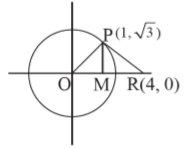
$PM=\sqrt{3} \text { and } OR=4$
Hence, the required area $=\frac{1}{2} \times 4 \times \sqrt{3}=2 \sqrt{3}$ View full question & answer→MCQ 652 Marks
Equation of tangent to the circle $x^2+y^2=10$ at the point with abscissa 1 is
- ✓
$x \pm 3 y=10$
- B
$3 x \pm y=10$
- C
$3 x \pm 3 y=10$
- D
$x-y=3$
AnswerCorrect option: A. $x \pm 3 y=10$
(A)
Abscissa $=1$
Hence, given equation of circle reduces to
$y^2=9$
$\Rightarrow y= \pm 3$
$\therefore$ Equation of tangent at
$(1, \pm 3)$ to $x^2+y^2=10$ is $x(1)+y( \pm 3)=10$
View full question & answer→MCQ 662 Marks
The equation of the tangent to the circle $x^2+y^2=50$ at the point, where the line x - 7 = 0 meets the circle, is
- A
- B
- C
$x \pm 7 y=50$
- ✓
$7 x \pm y=50$
AnswerCorrect option: D. $7 x \pm y=50$
(D)
The equation of the tangent to the circle $x^2+y^2=50$ is $x x_1+y y_1=50$
The circle meets the line $x-7$.
$\therefore (7)^2+y_1^2=50$
$\Rightarrow y_1^2=50-49=1$
$\Rightarrow y_1= \pm 1$
$\therefore$ Equation of the tangent is $7 x \pm y=50$
View full question & answer→MCQ 672 Marks
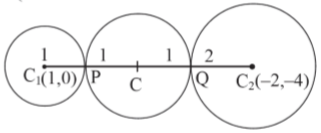
Let the line segment joining the centres of the circles $x^2-2 x+y^2=0$ and $x^2+y^2+4 x+8 y+16=0$ intersect the another circle at P and Q respectively. Then the equation of the circle with PQ as its diameter is
- A
$5 x^2+5 y^2-2 x-16 y+8=0$
- B
$5 x^2+5 y^2-8 x-24 y+27=0$
- C
$5 x^2+5 y^2+8 x+24 y+27=0$
- ✓
$5 x^2+5 y^2+2 x+16 y+8=0$
AnswerCorrect option: D. $5 x^2+5 y^2+2 x+16 y+8=0$
(D)
The centres of two circles are $C_1(1,0)$ and $C_2(-2,-4)$ and their radii are 1 and 2 units respectively.
Let C be the centre of the required circle.
Then, $C P=C Q=1$.
$\therefore$ $C C_1=2$ and $C C_2=3$.
Clearly, C divides $C _1 C _2$ in the ratio $2: 3$.
Therefore, coordinates of C are
$\left(\frac{-4+3}{2+3}, \frac{-8+0}{2+3}\right)=\left(-\frac{1}{5},-\frac{8}{5}\right) .$
Hence, equation of the required circle is
$\begin{array}{l}\left(x+\frac{1}{5}\right)^2+\left(y+\frac{8}{5}\right)^2=1^2 \\\Rightarrow 5 x^{2}+5 y^{2}+2 x+16 y+8=0\end{array}$ View full question & answer→MCQ 682 Marks
The equation of the circle which passes through the points of intersection of the circles $x^2+y^2-6 x=0$ and $x^2+y^2-6 y=0$ and has its centre at $\left(\frac{3}{2}, \frac{3}{2}\right)$ is
- A
$x^2+y^2+3 x+3 y+9=0$
- B
$x^2+y^2+3 x+3 y=0$
- ✓
$x^2+y^2-3 x-3 y=0$
- D
$x^2+y^2-3 x-3 y+9=0$
AnswerCorrect option: C. $x^2+y^2-3 x-3 y=0$
(C)
$C_1: x^2+y^2-6 x=0$ ....(i)
$C _2: x^2+y^2-6 y=0$ ....(ii)
Solving (i) and (ii), we get
$x=y$ ....(iii)
Substituting (iii) in (i), we get
$y=3$
$\therefore x=3$
Point on circle is $P (3,3)$ and
$\begin{aligned} & \text { centre }=\left(\frac{3}{2}, \frac{3}{2}\right) \\ \therefore & \text { Radius }=\sqrt{\left(3-\frac{3}{2}\right)^2+\left(3-\frac{3}{2}\right)^2}=\frac{3}{\sqrt{2}}\end{aligned}$
$\therefore$ equation of the circle is
$\begin{array}{l}\left(x-\frac{3}{2}\right)^2+\left(y-\frac{3}{2}\right)^2=\frac{9}{2} \\\Rightarrow x^2+y^2-3 x-3 y=0\end{array}$
View full question & answer→MCQ 692 Marks
If one diameters of the circle $x^2+y^2-2 x-6 y+6=0$ is a chord to the circle with centre (2, 1), then the radius of the bigger circle is
Answer(D)
The centre of the given circle is $C_1(1,3)$ and
radius $=\sqrt{(-1)^2+(-3)^2-6}$
$=\sqrt{1+9-6}$
$=2$
$C _1 C _2=\sqrt{(2-1)^2+(1-3)^2}$
$=\sqrt{1+4}=\sqrt{5}$
$\therefore$ Radius of bigger circle $=\sqrt{(\sqrt{5})^2+2^2}$
$=\sqrt{5+4}$
$=3$
View full question & answer→MCQ 702 Marks
If one of given diameters of the circle, given by the equation, $x^2+y^2-4 x+6 y-12=0$, is a chord of a circle S, whose centre is at (-3, 2), then the radius of S is
- ✓
$5 \sqrt{3}$
- B
$5$
- C
$10$
- D
$5 \sqrt{2}$
AnswerCorrect option: A. $5 \sqrt{3}$
(A)
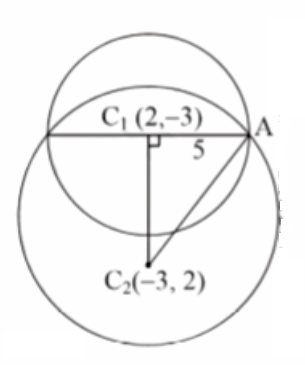
The centre of the given circle is $C _1(2,-3)$ and radius
$\begin{array}{l}=\sqrt{(-2)^2+3^2-(-12)} \\=5 \\C_1 C_2=\sqrt{(-3-2)^2+(2+3)^2} \\\quad=\sqrt{25+25} \\\quad=\sqrt{50}\end{array}$
$\therefore$ Radius of S is $C _2 A=\sqrt{(\sqrt{50})^2+5^2}$
$\begin{array}{l}=\sqrt{75} \\=5 \sqrt{3}\end{array}$ View full question & answer→MCQ 712 Marks
If one of the diameters of the curve $x^2+y^2-4 x-6 y+9=0$ is a chord of a circle with centre (1, 1), then the radius of this circle is
Answer(A)
Given equation of circle is
$x^2+y^2-4 x-6 y+9=0$
$\Rightarrow x^2-4 x+4+y^2-6 y+9-4=0$
$\Rightarrow(x-2)^2+(y-3)^2=4$
$\therefore$ centre $=(2,3)$, radius $=2$
The diameter of this circle is a chord of circle with centre $O (1,1)$.
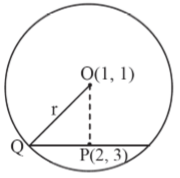
$OP =\sqrt{(3-1)^2+(2-1)^2}=\sqrt{5}$
$QP =2$
$\therefore r^2=(\sqrt{5})^2+2^2 \Rightarrow r=3$ View full question & answer→MCQ 722 Marks
For all values of $\theta$, the locus of the point of intersection of the lines $x \cos \theta+y \sin \theta= a$ and $x \sin \theta-y \cos \theta=b$ is
Answer(B)
The point of intersection is
$x= a \cos \theta+ b \sin \theta$
$y= a \sin \theta- b \cos \theta$
$\therefore \quad x^2+y^2= a ^2+ b ^2$
Hence, it is equation of a circle.
View full question & answer→MCQ 732 Marks
Radius parametric equation represented by $x=2 a\left(\frac{1-t^2}{1+t^2}\right), y=\frac{4 a t}{1+t^2}$ is
Answer(D)
$x=2 a\left(\frac{1-t^2}{1+t^2}\right)$ ...(i)
$y=\frac{4 at }{1+ t ^2}$ ...(ii)
Squaring and adding (i) and (ii), we get
$x^2+y^2=4 a ^2 \cdot \frac{\left(1- t ^2\right)^2}{\left(1+ t ^2\right)^2}+\frac{16 a ^2 t ^2}{\left(1+ t ^2\right)^2}$
$=\frac{4 a^2}{\left(1+t^2\right)^2}\left[1-2 t^2+t^4+4 t^2\right]$
$=\frac{4 a^2}{\left(1+t^2\right)^2}\left(1+t^2\right)^2$
$\therefore \quad x^2+y^2=(2 a)^2$
$\therefore \quad$ Radius $=2 a$
View full question & answer→MCQ 742 Marks
For what value of k, the points (0, 0), (1, 3), (2, 4) and (k, 3) are con-cyclic?
Answer(B)
The equation of circle through points $(0,0)$, $(1,3)$ and $(2,4)$ is
$x^2+y^2-10 x=0$
Point ( $k, 3$ ) will be on the circle, if
$\begin{array}{l}k^2+9-10 k=0 \\\Rightarrow k^2-10 k+9=0 \\\Rightarrow k^2-9 k-k+9=0 \\\Rightarrow(k-1)(k-9)=0 \\\Rightarrow k=1 \text { or } k=9\end{array}$
View full question & answer→MCQ 752 Marks
If a circle passes through the points (0, 0), (a, 0), (0, b), then its centre is
- A
- B
- ✓
$\left(\frac{a}{2}, \frac{b}{2}\right)$
- D
$\left(\frac{b}{2},-\frac{a}{2}\right)$
AnswerCorrect option: C. $\left(\frac{a}{2}, \frac{b}{2}\right)$
(C)
Let the equation of circle be
$x^2+y^2+2 g x+2 f y+c=0$
Now on passing through the given points, we get three equations
$c=0$ ...(i)
$a^2+2 g a+c=0$....(ii)
$b^2+2 f b+c=0$ ....(iii)
Solving equations (i), (ii) and (iii), we get
$g=-\frac{a}{2}, f=-\frac{b}{2}$
Hence, the centre is $\left(\frac{ a }{2}, \frac{b}{2}\right)$.
View full question & answer→MCQ 762 Marks
The locus of the centre of the circle which cuts off intercepts of length 2a and 2b from X-axis and Y-axis respectively, is
- A
$x+y= a + b$
- B
$x^2+y^2=a^2+b^2$
- ✓
$x^2-y^2=a^2-b^2$
- D
$x^2+y^2=a^2-b^2$
AnswerCorrect option: C. $x^2-y^2=a^2-b^2$
(C)
Since X -intercept $=2 a$
$\therefore 2 \sqrt{g^2-c}=2 a$$\quad\ldots(i)$
Also, Y -intercept $=2 b$
$\therefore 2 \sqrt{f^2-c}=2 b$$\quad\ldots(ii)$
On squaring (i) and (ii) and then subtracting (ii) from (i), we get
$g^2-f^2=a^2-b^2$
Hence, the locus is
$x^2-y^2=a^2-b^2$
View full question & answer→MCQ 772 Marks
The equation of the circle passing through the point (2, 1) and touching Y-axis at the origin is
- A
$x^2+y^2-5 x=0$
- ✓
$2 x^2+2 y^2-5 x=0$
- C
$x^2+y^2+5 x=0$
- D
AnswerCorrect option: B. $2 x^2+2 y^2-5 x=0$
(B)
We have the equation of circle
$x^2+y^2+2 g x+2 f y+c=0$
But it passes through $(0,0)$ and $(2,1)$.
$\therefore \quad c=0$
$5+4 g+2 f=0$ ....(i)
Also $\sqrt{ g ^2+ f ^2- c }=| g |$
$\Rightarrow f =0$ $\ldots [\because c=0]$
$\therefore g=-\frac{5}{4}$ ....[From (i)]
Hence, the equation will be $2 x^2+2 y^2-5 x=0$.
View full question & answer→MCQ 782 Marks
A circle is concentric with the circle $x^2+y^2-6 x+12 y+15=0$ and has area double of its area. The equation of the circle is
- ✓
$x^2+y^2-6 x+12 y-15=0$
- B
$x^2+y^2-6 x+12 y+15=0$
- C
$x^2+y^2-6 x+12 y+45=0$
- D
$x^2+y^2-6 x+12 y-45=0$
AnswerCorrect option: A. $x^2+y^2-6 x+12 y-15=0$
(A)
Equation of circle concentric to given circle is
$x^2+y^2-6 x+12 y+k=0$
Since area of required circle $=2$ (area of given circle)$\begin{array}{l}\Rightarrow \sqrt{9+36-k}=\sqrt{2} \sqrt{9+36-15} \\\Rightarrow 45-k=60 \\\Rightarrow k=-15\end{array}$
Hence, the required equation of circle is
$x^2+y^2-6 x+12 y-15=0$
View full question & answer→MCQ 792 Marks
The equation of the circle whose radius is 5 and which touches the circle $x^2+y^2-2 x-4 y-20=0$ externally at the point (5, 5), is
- A
$x^2+y^2-18 x-16 y-120=0$
- ✓
$x^2+y^2-18 x-16 y+120=0$
- C
$x^2+y^2+18 x+16 y-120=0$
- D
$x^2+y^2+18 x-16 y+120=0$
AnswerCorrect option: B. $x^2+y^2-18 x-16 y+120=0$
(B)
Let the centre of the required circle be $\left(x_1, y_1\right)$. Centre of given circle is $(1,2)$ and
$r =\sqrt{1+4+20}=5$
$\therefore$ radii of both circles are same.
$\therefore$ Point of contact $(5,5)$ is the mid point of the line joining the centres of both circles.
$\begin{array}{l} \therefore \frac{x_1+1}{2}=5 \text { and } \frac{y_1+2}{2}=5 \\\Rightarrow x_1=9, y_1=8\end{array}$
Hence, the required equation is
$(x-9)^2+(y-8)^2=25$
$\Rightarrow x^2+y^2-18 x-16 y+120=0$
View full question & answer→MCQ 802 Marks
If the circles $x^2+y^2+2 \lambda x+2=0$ and $x^2+y^2+4 y+2=0$ touch each other, then $\lambda=$
- A
$\pm 1$
- ✓
- C
$\pm 3$
- D
$\pm 4$
Answer(B)
The centres of two circles are $C_1(-\lambda, 0)$ and $C _2(0,-2)$ and their radii are $\sqrt{\lambda^2-2}$ and $\sqrt{2}$.
The given circles touches each other, if
$\sqrt{\lambda^2+4}=\sqrt{\lambda^2-2}+\sqrt{2}$
$\Rightarrow \lambda^2+4=\lambda^2-2+2+2 \sqrt{2} \sqrt{\lambda^2-2}$
$\Rightarrow \sqrt{2}=\sqrt{\lambda^2-2}$
$\Rightarrow \lambda^2=4$
$\Rightarrow \lambda= \pm 2$
View full question & answer→MCQ 812 Marks
The equation of a circle of radius 5 which lies within the circle $x^2+y^2+14 x+10 y-26=0$ and touches it at the point (-1, 3) is
- ✓
$x^2+y^2+8 x+2 y-8=0$
- B
$x^2+y^2+10 x+2 y+1=0$
- C
$x^2+y^2+8 x+4 y-4=0$
- D
$x^2+y^2+8 x+6 y=0$
AnswerCorrect option: A. $x^2+y^2+8 x+2 y-8=0$
(A) Consider option (A),
$x^2+y^2+8 x+2 y-8=0$
Point $(-1,3)$ is common to both circle and lies on above circle also.
Since point $(-1,3)$ satisfies the equation of circle in option (A).
$\therefore$ correct answer is option (A).
View full question & answer→MCQ 822 Marks
A circle $x^2+y^2+2 g x+2 f y+ c =0$ passing through (4, -2) is concentric to the circle $x^2+y^2-2 x+4 y+20=0$ then the value of c will be
Answer(A)
Circle $x^2+y^2+2 gr +2 fy + c =0$
is concentric with $x^2+y^2-2 x+4 y+20=0$.
$\therefore$ centre is $(1,-2)$ and
radius $=\sqrt{(4-1)^2+(-2+2)^2}=\sqrt{3^2+0^2}=3$
Also, $r=\sqrt{g^2+f^2-c}$
$\therefore 3=\sqrt{(-1)^2+(2)^2-c}$
$\therefore 9=1+4-c$
$\therefore c=-4$
View full question & answer→MCQ 832 Marks
The equation of the circle concentric with the circle $x^2+y^2+8 x+10 y-7=0$ and passing through the centre of the circle $x^2+y^2-4 x-6 y=0$ is
- A
$x^2+y^2+8 x+10 y+59=0$
- ✓
$x^2+y^2+8 x+10 y-59=0$
- C
$x^2+y^2-4 x-6 y+87=0$
- D
$x^2+y^2-4 x-6 y-87=0$
AnswerCorrect option: B. $x^2+y^2+8 x+10 y-59=0$
(B)
Centre of the required circle is $(-4,-5)$ and it passes through $(2,3)$.
$\therefore$ $\text { Radius }=\sqrt{(-4-2)^2+(-5-3)^2}=10$
$\therefore$ Equation of the required circle is
$(x+4)^2+(y+5)^2=(10)^2$
$\Rightarrow x^2+y^2+8 x+10 y-59=0$
View full question & answer→MCQ 842 Marks
The equation of the circle with centre at (1, -2) and passing through the centre of the given circle $x^2+y^2+2 y-3=0$, is
- ✓
$x^2+y^2-2 x+4 y+3=0$
- B
$x^2+y^2-2 x+4 y-3=0$
- C
$x^2+y^2+2 x-4 y-3=0$
- D
$x^2+y^2+2 x-4 y+3=0$
AnswerCorrect option: A. $x^2+y^2-2 x+4 y+3=0$
(A)
Centre of the given circle is $(0,-1)$.
$\therefore$ the required circle passes through $(0,-1)$.
$\therefore$ $r=\sqrt{(0-1)^2+(-1+2)^2}=\sqrt{ } 2$
Hence, the required equation is
$(x-1)^2+(y+2)^2=(\sqrt{2})^2$
$\Rightarrow x^2+y^2-2 x+4 y+3=0$
View full question & answer→MCQ 852 Marks
The equation of the circle concentric with the circle $x^2+y^2-4 x-6 y-3=0$ and touching Y-axis is
- A
$x^2+y^2-4 x-6 y-9=0$
- ✓
$x^2+y^2-4 x-6 y+9=0$
- C
$x^2+y^2-4 x-6 y+3=0$
- D
$x^2+y^2-4 x-6 y-3=0$
AnswerCorrect option: B. $x^2+y^2-4 x-6 y+9=0$
(B)
Centre of the circle
$x^2+y^2-4 x-6 y-3=0 \text { is } C(2,3)$
Since, it touches the Y -axis
$\therefore$ $r-2$
Hence required equation of the circle is
$(x-2)^2+(y-3)^2=2^2$
$\Rightarrow x^2+y^2-4 x-6 y+9=0$
View full question & answer→MCQ 862 Marks
A variable circle passes through the fixed point A(p, q) and touches X-axis. The locus of the other end of diameter through A is
- ✓
$(x-p)^2=4 q y$
- B
$(x-q)^2=4 p y$
- C
$(y-p)^2=4 q x$
- D
$(y-q)^2=4 p x$
AnswerCorrect option: A. $(x-p)^2=4 q y$
(A)
Let another end of the diameter be ( $h , k$ ).
Since centre is the midpoint of the diameter.
$\therefore \quad$ Centre $=\left(\frac{ p + h }{2}, \frac{ q + k }{2}\right)$
Since the circle touches X -axis,
radius $=\left|\frac{q+k}{2}\right|$
$\Rightarrow \sqrt{( h - p )^2+( k - q )^2}=2\left|\frac{ q + k }{2}\right|$
$\Rightarrow( h - p )^2+( k - q )^2=( q + k )^2$
$\Rightarrow( h - p )^2=( k + q )^2-( k - q )^2$
$\Rightarrow( h - p )^2=4 k y$
$\therefore $ Locus of $( h , k )$ is $(x- p )^2=4 q y$
View full question & answer→MCQ 872 Marks
The point diametrically opposite to the point P(1, 0) on the circle $x^2+y^2+2 x+4 y-3=0$ is
Answer(B)
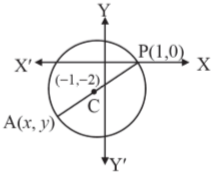
Let $A (x, y)$ be the required point.
Given equation of circle is
$x^2+y^2+2 x+4 y-3=0$
$\therefore$ Centre $=(-1,-2)$
Since C is the midpoint of AP.
$\therefore$ $A=(-3,-4)$ View full question & answer→MCQ 882 Marks
If one end of a diameter of the circle $x^2+y^2-4 x-6 y+11=0$ be (3, 4), then the other end is
Answer(C)
Let another end of the diameter be $(x, y)$.
Centre of the given circle is $(2,3)$.
Since centre is the midpoint of the diameter.
$\therefore 2=\frac{3+x}{2}, 3=\frac{4+y}{2}$
$\Rightarrow x=1, y=2$
$\Rightarrow(x, y)=(1,2)$
Alternate Method:
Here, $\left(x_1, y_1\right)=(3,4)$
$\therefore$ $(x, y)-(-(3-4),-(4-6))$...[Using Shortcut 6]$=(1,2)$
View full question & answer→MCQ 892 Marks
If the equation $\frac{K(x+1)^2}{3}+\frac{(y+2)^2}{4}=1$ represents a circle, then K =
- ✓
$\frac{3}{4}$
- B
$1$
- C
$\frac{4}{3}$
- D
AnswerCorrect option: A. $\frac{3}{4}$
(A)
The given equation represents a circle, if coeff. of $x^2=\operatorname{coeff}$, of $y^2$
After solving the given equation , we get
$\frac{K}{3}=\frac{1}{4} \Rightarrow K=\frac{3}{4}$
View full question & answer→MCQ 902 Marks
The equation of the circle passing through the point (1, 0) and (0, 1) and having the smallest radius is
- A
$x^2+y^2-2 x-2 y+1=0$
- ✓
$x^2+y^2-x-y=0$
- C
$x^2+y^2+2 x+2 y-7=0$
- D
$x^2+y^2+x+y-2=0$
AnswerCorrect option: B. $x^2+y^2-x-y=0$
(B)
Circle whose diametric end points are $(1,0)$ and $(0,1)$ will be of smallest radius.
$\therefore$ By using diameter form, equation of circle is
$(x-1)(x-0)+(y-0)(y-1)=0$
$\Rightarrow x^2+y^2-x-y=0$
View full question & answer→MCQ 912 Marks
The equation of the circle whose centre is $(1,-3)$ and which touches the line $2 x-y-4=0$ is
- ✓
$5 x^2+5 y^2-10 x+30 y+49=0$
- B
$5 x^2+5 y^2+10 x-30 y+49=0$
- C
$5 x^2+5 y^2-10 x+30 y-49=0$
- D
$5 x^2+5 y^2-10 x-30 y+49=0$
AnswerCorrect option: A. $5 x^2+5 y^2-10 x+30 y+49=0$
(A)
$\text { Radius of circle }=\left|\frac{2(1)-1(-3)-4}{\sqrt{4+1}}\right|=\frac{1}{\sqrt{5}}$
$\therefore$ Equation is $(x-1)^2+(y+3)^2=\left(\frac{1}{\sqrt{5}}\right)^2$
$\Rightarrow x^2+y^2-2 x+6 y+10=\frac{1}{5}$
$\Rightarrow 5 x^2+5 y^2-10 x+30 y+49=0$
View full question & answer→MCQ 922 Marks
The equation of a circle which touches both axes and the line 3x -4y + 8 = 0 and whos centre lies in the third quadrant is
- A
$x^2+y^2-4 x+4 y-4=0$
- B
$x^2+y^2-4 x+4 y+4=0$
- ✓
$x^2+y^2+4 x+4 y+4=0$
- D
$x^2+y^2-4 x-4 y-4=0$
AnswerCorrect option: C. $x^2+y^2+4 x+4 y+4=0$
(C)
The equation of circle in third quadrant touching the coordinate axes with centre $(- a ,- a )$ and radius ' a ' is
$x^2+y^2+2 a x+2 a y+a^2=0$ ...(i)
Since, line $3 x-4 y+8=0$ touches the circle
$\therefore$ perpendiular distance from centre of the circle to the line $=$ radius
$\therefore$ $\left|\frac{3(-a)-4(-a)+8}{\sqrt{9+16}}\right|=a$
$\Rightarrow a=2$
Substituting $a =2$ in equation (i), we get
$x^2+y^2+4 x+4 y+4=0$
This is the required equation of the circle
View full question & answer→MCQ 932 Marks
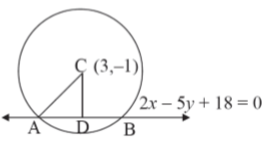
The equation of the circle whose centre is (3, -1) and which cuts off a chord of length 6 on the line 2x - 5y + 18 = 0 is
MCQ 942 Marks
Equation of the circle which touches the lines x = 0, y = 0 and 3x + 4y = 4 is
- A
$x^2-4 x+y^2+4 y+4=0$
- ✓
$x^2-4 x+y^2-4 y+4=0$
- C
$x^2+4 x+y^2+4 y+4=0$
- D
$x^2+4 x+y^2-4 y+4=0$
AnswerCorrect option: B. $x^2-4 x+y^2-4 y+4=0$
(B)
Let centre of circle be ( $h , k$ ).
Since it touches both axes, therefore $h = k = a$
Hence, equation can be $(x-a)^2+(y-a)^2=a^2$
But it also touches the line $3 x+4 y=4$
$\therefore\left|\frac{3 a+4 a-4}{\sqrt{9+16}}\right|=a$
$\Rightarrow a =2$
Hence, the required equation of circle is
$(x-2)^2+(y-2)^2=2^2$
$\Rightarrow x^2+y^2-4 x-4 y+4=0$
View full question & answer→MCQ 952 Marks
The equation of the circle which passes throug the points (2, 3) and (4, 5) and the centre lies on the straight line y - 4x + 3 = 0, is
- A
$x^2+y^2+4 x-10 y+25=0$
- ✓
$x^2+y^2-4 x-10 y+25=0$
- C
$x^2+y^2-4 x-10 y+16=0$
- D
$x^2+y^2-14 y+8=0$
AnswerCorrect option: B. $x^2+y^2-4 x-10 y+25=0$
(B)
Let centre be ( $h , k$ ). Then,
$\sqrt{( h -2)^2+( k -3)^2}=\sqrt{( h -4)^2+( k -5)^2}$
$\Rightarrow-4 h+4-6 k+9=-8 h+16-10 k+25$
$\Rightarrow 4 h+4 k-28=0$
$\Rightarrow h + k -7=0$ ...(i)
Since, centre lies on the given line.
$\therefore$ $k-4 h+3=0$....(ii)
Solving (i) and (ii), we get $( h , k )=(2,5)$
$\therefore$ centre is $(2,5)$ and
$\text { radius }=\sqrt{(2-2)^2+(5-3)^2}=2$
$\therefore$ the required equation of the circle is$\begin{array}{l}(x-2)^2+(y-5)^2=(2)^2 \\\Rightarrow x^2+y^2-4 x-10 y+25=0\end{array}$
View full question & answer→MCQ 962 Marks
A circle has radius 3 units and its centre lies of the line y = x - 1. Then the equation of the circle if it passes through point (7, 3), is
- ✓
$x^2+y^2-8 x-6 y+16=0$
- B
$x^2+y^2+8 x+6 y+16=0$
- C
$x^2+y^2-8 x-6 y-16=0$
- D
$x^2+y^2+8 x-6 y-16=0$
AnswerCorrect option: A. $x^2+y^2-8 x-6 y+16=0$
(A)
Let its centre be ( $h , k$ ), then
$h-k=1$....(i)
Also, radius $a =3$
$\therefore$ Equation of the circle is$(x-h)^2+(y-k)^2=9$
Also, it passes through $(7,3)$
$\text { i.e., }(7-h)^2+(3-k)^2=9$.....(ii)
From (i) and (ii), we get
$h=4, k=3$
$\therefore$ Equation is $x^2+y^2-8 x-6 y+16=0$
View full question & answer→MCQ 972 Marks
The lines 2x - 3y = 5 and 3x - 4y = 7 are the diameters of a circle of area 154 square units The equation of the circle is
- A
$x^2+y^2+2 x-2 y=62$
- ✓
$x^2+y^2-2 x+2 y=47$
- C
$x^2+y^2+2 x-2 y=47$
- D
$x^2+y^2-2 x+2 y=62$
AnswerCorrect option: B. $x^2+y^2-2 x+2 y=47$
(B)
Centre of circle $=$ Point of intersection of diameters $=(1,-1)$
Now, area $=154$
$\Rightarrow \pi r^2=154\Rightarrow r=7$
Hence, the equation of required circle is
$(x-1)^2+(y+1)^2=7^2$
$\Rightarrow x^2+y^2-2 x+2 y=47$
View full question & answer→MCQ 982 Marks
If the lines 2x + 3y + 1 = 0 and 3x -y - 4 = 0 lie along diameters of a circle of circumferenc $10 \pi$ , then the equation of the circle is
- A
$x^2+y^2+2 x-2 y-23=0$
- B
$x^2+y^2-2 x-2 y-23=0$
- C
$x^2+y^2+2 x-2 y+23=0$
- ✓
$x^2+y^2-2 x+2 y-23=0$
AnswerCorrect option: D. $x^2+y^2-2 x+2 y-23=0$
(D)
Since the centre always lies on the diameter.
Solving $2 x+3 y+1=0$ and $3 x-y-4=0$, the co-ordinates of the centre are $(1,-1)$.
Given, circumference $=10 \pi$
$\therefore \quad 2 \pi r=10 \pi \Rightarrow r=5$
∴ the equation of the circle is
$(x-1)^2+(y+1)^2=5^2$
$\Rightarrow x^2+y^2-2 x+2 y-23=0$
View full question & answer→MCQ 992 Marks
The equation of the circle whose diameter lies on 2x+3y=3 and 16x-y=4 which passes through (4, 6) is
AnswerCorrect option: A. $5\left(x^2+y^2\right)-3 x-8 y=200$
(A)
Since the centre always lies on the diameter.
Solving $2 x+3 y=3$ and $16 x-y=4$,
we get co-ordinates of the centre $=\left(\frac{3}{10}, \frac{4}{5}\right)$.
The circle passes through $(4,6)$.
$\therefore \quad r^2=\left(4-\frac{3}{10}\right)^2+\left(6-\frac{4}{5}\right)^2$
$=\left(\frac{37}{10}\right)^2+\left(\frac{26}{5}\right)^2=\frac{4073}{100}$
∴ the equation of the circle is
$\left(x-\frac{3}{10}\right)^2+\left(y-\frac{4}{5}\right)^2=\frac{4073}{100}$
$\Rightarrow 100 x^2+100 y^2-60 x-160 y=4000$
$\Rightarrow 5\left(x^2+y^2\right)-3 x-8 y=200$
View full question & answer→MCQ 1002 Marks
If the lines x + y = 6 and x + 2y = 4 be diameters of the circle whose diameter is 20, then the equation of the circle is
- ✓
$x^2+y^2-16 x+4 y-32=0$
- B
$x^2+y^2+16 x+4 y-32=0$
- C
$x^2+y^2+16 x+4 y+32=0$
- D
$x^2+y^2+16 x-4 y+32=0$
AnswerCorrect option: A. $x^2+y^2-16 x+4 y-32=0$
(A)
Here, $r =10$ (radius)
Centre will be the point of intersection of the diameters, i.e., $(8,-2)$.
Hence, required equation is
$\begin{array}{l}(x-8)^2+(y+2)^2=10^2 \\\Rightarrow x^2+y^2-16 x+4 y-32=0\end{array}$
View full question & answer→