MCQ 1012 Marks
The equation of the circle having centre (1, -2) and passing through the point of intersection of
lines 3x + y = 14, 2x + 5y = 18 is
- ✓
$x^2+y^2-2 x+4 y-20=0$
- B
$x^2+y^2-2 x-4 y-20=0$
- C
$x^2+y^2+2 x-4 y-20=0$
- D
$x^2+y^2+2 x+4 y-20=0$
AnswerCorrect option: A. $x^2+y^2-2 x+4 y-20=0$
(A)
The point of intersection of $3 x+y-14=0$ and $2 x+5 y-18=0$ is $(4,2)$.
Centre of the circle is $(1,2)$.
$\therefore$ radius $=\sqrt{(4-1)^2+(2+2)^2}=5$
∴ the equation of the circle is
$(x-1)^2+(y+2)^2=5^2$
$\therefore x^2+y^2-2 x+4 y-20=0$
View full question & answer→MCQ 1022 Marks
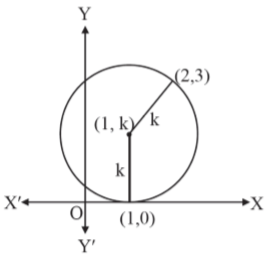
The length of the diameter of the circle which touches the X-axis at the point (1, 0) and passes through the point (2, 3) is
- A
$\frac{10}{3}$
- B
$\frac{3}{5}$
- C
$\frac{6}{5}$
- D
$\frac{5}{3}$
View full question & answer→MCQ 1032 Marks
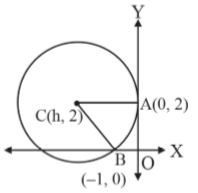
The circle passing through the point (-1, 0) and touching the Y-axis at (0, 2) also passes through the point
- A
$\left(-\frac{3}{2}, 0\right)$
- B
$\left(-\frac{5}{2}, 2\right)$
- C
$\left(-\frac{3}{2}, \frac{5}{2}\right)$
- D
$(-4,0)$
View full question & answer→MCQ 1042 Marks
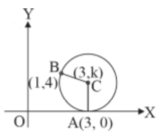
The equation of the circle which touches X-axis at (3, 0) and passes through (1, 4) is given by
- A
$x^2+y^2-6 x-5 y+9=0$
- B
$x^2+y^2+6 x+5 y-9=0$
- C
$x^2+y^2-6 x+5 y-9=0$
- D
$x^2+y^2+6 x-5 y+9=0$
View full question & answer→MCQ 1052 Marks
ABCD is a square, the length of whose side is a. Taking AB and AD as the coordinate axes, the equation of the circle passing through the vertices of the square is
- A
$x^2+y^2+a x+a y=0$
- ✓
$x^2+y^2- a x- a y=0$
- C
$x^2+y^2+2 a x+2 a y=0$
- D
$x^2+y^2-2 a x-2 a y=0$
AnswerCorrect option: B. $x^2+y^2- a x- a y=0$
(B)
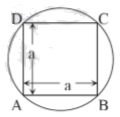
According to the figure, $A (0,0), B ( a , 0)$, $C ( a , a )$ and $D (0, a )$.
and centre is $\left(\frac{ a }{2}, \frac{ a }{2}\right)$.
∴ the equation of the circle is
$\begin{array}{l}\left(x-\frac{a}{2}\right)^2+\left(y-\frac{a}{2}\right)^2=\frac{a^2}{2} \\\Rightarrow x^2+y^2-a x-a y=0\end{array}$ View full question & answer→MCQ 1062 Marks
The equation of the circle passing through the origin and cutting intercepts of length 3 and 4 units from the positive axes, is
- A
$x^2+y^2+6 x+8 y+1=0$
- B
$x^2+y^2-6 x-8 y=0$
- C
$x^2+y^2+3 x+4 y=0$
- ✓
$x^2+y^2-3 x-4 y=0$
AnswerCorrect option: D. $x^2+y^2-3 x-4 y=0$
(D)
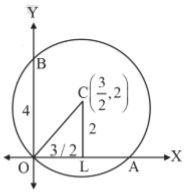
Given, $OA =3$ and
OB = 4
$\therefore OL =\frac{3}{2}$ and $CL =2$
By pythagoras theorem,
$OC ^2= OL ^2+ LC ^2$
$OC ^2=\left(\frac{3}{2}\right)^2+2^2$
$=\frac{25}{4}$
$\therefore OC =\frac{5}{2}$
The centre of the circle is $\left(\frac{3}{2}, 2\right)$ and radius $=\frac{5}{2}$.
∴ the equation of the circle is
$\begin{aligned}\left(x-\frac{3}{2}\right)^2+(y-2)^2 & =\left(\frac{5}{2}\right)^2 \\ \therefore \quad x^2+y^2-3 x-4 y & =0\end{aligned}$
View full question & answer→MCQ 1072 Marks
The equation of the circle with centre (2, 2) which passes through (4, 5) is
- A
$x^2+y^2-4 x+4 y-77=0$
- ✓
$x^2+y^2-4 x-4 y-5=0$
- C
$x^2+y^2+2 x+2 y-59=0$
- D
$x^2+y^2-2 x-2 y-23=0$
AnswerCorrect option: B. $x^2+y^2-4 x-4 y-5=0$
(B)
Centre $(2,2)$ and
$\begin{aligned} r & =\sqrt{(4-2)^2+(5-2)^2} \\ & =\sqrt{13}\end{aligned}$
Hence, required equation is $\begin{array}{l}(x-2)^2+(y-2)^2=(\sqrt{13})^2 \\\Rightarrow x^2+y^2-4 x-4 y-5=0\end{array}$
View full question & answer→MCQ 1082 Marks
The equation of the circle of radius 5 and touching the coordinate axes in third quadrant is
- A
$(x-5)^2+(y+5)^2=25$
- B
$(x+4)^2+(y+4)^2=25$
- C
$(x+6)^2+(y+6)^2=25$
- ✓
$(x+5)^2+(y+5)^2=25$
AnswerCorrect option: D. $(x+5)^2+(y+5)^2=25$
(D)
Since circle touches the co-ordinate axes in III quadrant.
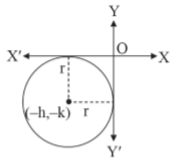
$\therefore $ Radius $=- h =- k$
Hence, $h = k =-5$
∴ Equation of circle is $(x+5)^2+(y+5)^2=25$ View full question & answer→MCQ 1092 Marks
The equation of the circle in the first quadrant which touches each axis at a distance 5 from the origin, is
- A
$x^2+y^2+5 x+5 y+25=0$
- ✓
$x^2+y^2-10 x-10 y+25=0$
- C
$x^2+y^2-5 x-5 y+25=0$
- D
$x^2+y^2+10 x+10 y+25=0$
AnswerCorrect option: B. $x^2+y^2-10 x-10 y+25=0$
(B)
The centre of the circle which touches each axis in first quadrant at a distance 5 , will be $(5,5)$ and radius will be 5 .
∴ equation of the circle is
$\begin{array}{l}(x-5)^2+(y-5)^2=(5)^2 \\\Rightarrow x^2+y^2-10 x-10 y+25=0\end{array}$
View full question & answer→MCQ 1102 Marks
The equation of director circle of the circle $x^2+y^2= a ^2$ is
- A
$x^2+y^2=4 a^2$
- ✓
$x^2+y^2=\sqrt{2} a ^2$
- C
$x^2+y^2-2 a ^2=0$
- D
AnswerCorrect option: B. $x^2+y^2=\sqrt{2} a ^2$
(B)
Director circle has its radius $\sqrt{2}$ times that of radius of the given circle.
$\therefore$ The required equation is $x^2+y^2=2 a ^2$.
View full question & answer→MCQ 1112 Marks
The square of the length of the tangent from (3, -4) on the circle $x^2+y^2-4 x-6 y+3=0$ is
Answer(C)
Length of tangent
$=\sqrt{3^2+(-4)^2-4(3)-6(-4)+3}=\sqrt{40}$
∴ Square of length of tangent $=40$
View full question & answer→MCQ 1122 Marks
Square of the length of the tangent drawn from the point $(\alpha, \beta)$ to the circle $a x^2+a y^2=r^2$ is
- A
$a \alpha^2+a \beta^2-r^2$
- ✓
$\alpha^2+\beta^2-\frac{r^2}{a}$
- C
$\alpha^2+\beta^2+\frac{ r ^2}{ a }$
- D
$\alpha^2+\beta^2-r^2$
AnswerCorrect option: B. $\alpha^2+\beta^2-\frac{r^2}{a}$
View full question & answer→MCQ 1132 Marks
If the length of the tangent segment from the point (5, 3) to the circle
$x^2+y^2+10 x+ k y-17=0$ is 7, then k equals
Answer(A)
Length of tangent segment
$\begin{array}{l}=\sqrt{5^2+3^2+10(5)+k(3)-17}=7 \\\Rightarrow 67+3 k=49 \\\Rightarrow k=-6\end{array}$
View full question & answer→MCQ 1142 Marks
The length of the tangent from the origin to the circle $3 x^2+3 y^2-4 x-6 y+2=0$ is
AnswerCorrect option: B. $\frac{\sqrt{2}}{\sqrt{3}}$
(B)
Equation of the circle is
$3 x^2+3 y^2-4 x-6 y+2=0$
$\Rightarrow x^2+y^2-\frac{4 x}{3}-\frac{6 y}{3}+\frac{2}{3}=0$
∴ Length of the tangent from the origin is
$\sqrt{0^2+0^2-\left(\frac{4}{3}\right)(0)-\left(\frac{6}{3}\right)(0)+\frac{2}{3}}=\sqrt{\frac{2}{3}}$
View full question & answer→MCQ 1152 Marks
The length of the tangent from the point (-3, 8) to the circle $x^2+y^2-8 x+2 y+1=0$ is
- A
$\sqrt{91}$
- ✓
$\sqrt{114}$
- C
$\sqrt{79}$
- D
$\sqrt{131}$
AnswerCorrect option: B. $\sqrt{114}$
(B)
Length of the tangent from the point $(-3,8)$ is
$\sqrt{(-3)^2+8^2-8(-3)+2(8)+1}$
$=\sqrt{9+64+24+16+1}=\sqrt{114}$
View full question & answer→MCQ 1162 Marks
The length of tangent from the point (2, -3) to the circle $2 x^2+2 y^2=1$ is
- A
- B
$10 \sqrt{2}$
- ✓
$\frac{5}{\sqrt{2}}$
- D
$5 \sqrt{2}$
AnswerCorrect option: C. $\frac{5}{\sqrt{2}}$
(C)
Equation of the circle is $2 x^2+2 y^2-1=0$
$\Rightarrow x^2+y^2-\frac{1}{2}=0$
Length of the tangent from the point $(2,-3)$ is
$\sqrt{2^2+(-3)^2-\frac{1}{2}}=\sqrt{13-\frac{1}{2}}=\frac{5}{\sqrt{2}}$
View full question & answer→MCQ 1172 Marks
The circles $x^2+y^2=9$ and $x^2+y^2-12 y+27= 0$ touch each other. The equation of their common tangent is
Answer(B)
Let $S_1=x^2+y^2-12 y+27=0$
and $S _2=x^2+y^2-9=0$
Then equation of common tangent is
$\begin{array}{l}S_1-S_2=0 \\\Rightarrow-12 y+36=0 \\\Rightarrow y=3\end{array}$
View full question & answer→MCQ 1182 Marks
The two circles $x^2+y^2-2 x+6 y+6=0$ and $x^2+y^2-5 x+6 y+15=0$ touch each other. The equation of their common tangent is
Answer(A)
Let $S _1=x^2+y^2-2 x+6 y+6=0$
and $S _2 \equiv x^2+y^2-5 x+6 y+15=0$
Then equation of common tangent is
$\begin{array}{l}S_1-S_2=0 \\\Rightarrow 3 x=9 \\\Rightarrow x=3\end{array}$
View full question & answer→MCQ 1192 Marks
The value of c, for which the line y = 2x + c is a tangent to the circle $x^2+y^2=16$, is
- A
$-16 \sqrt{5}$
- B
- ✓
$4 \sqrt{5}$
- D
$16 \sqrt{5}$
AnswerCorrect option: C. $4 \sqrt{5}$
(C)
$c= \pm a \sqrt{1+m^2}$
Here, $a=4, m=2$
$\therefore c= \pm 4 \sqrt{1+4}= \pm 4 \sqrt{5}$
View full question & answer→MCQ 1202 Marks
The line $\sqrt{3} x+y- c = 0$ is a tangent to the circle $x^2+y^2=4$, if c is equal to
- A
$\pm 16$
- ✓
$\pm 4$
- C
$\pm 1$
- D
$\pm 2$
AnswerCorrect option: B. $\pm 4$
(B)
The line $y=m x+c$ is a tangent to the circle
$x^2+y^2=a^2$, if $c^2=a^2 m^2+a^2$
Here, $a =2, m=-\sqrt{3}$
$\therefore c^2=4(3)+4=16$
$\Rightarrow c= \pm 4$
View full question & answer→MCQ 1212 Marks
If the line x = 7 touches the circle $x^2+y^2-4 x-6 y-12=0$ then the co-ordinates of the point of contact are
Answer(A)
Putting $x=7$, we get $y^2-6 y+9=0$
$\Rightarrow y=3,3$
Hence, the point of contact is $(7,3)$.
View full question & answer→MCQ 1222 Marks
If the line y= mx + c be a tangent to the circle $x^2+y^2=a^2$, then the point of contact is
- A
$\left(\frac{- a ^2}{ c }, a ^2\right)$
- B
$\left(\frac{ a ^2}{ c }, \frac{- a ^2 m}{ c }\right)$
- ✓
$\left(\frac{-a^2 m}{c}, \frac{a^2}{c}\right)$
- D
$\left(\frac{-a^2 c}{m}, \frac{a^2}{m}\right)$
AnswerCorrect option: C. $\left(\frac{-a^2 m}{c}, \frac{a^2}{c}\right)$
(C)
Find points of intersection by simultaneously solving for $x$ and $y$ from $y= m x+ c$ and $x^2+y^2=a^2$ which comes out as $\left(-\frac{a^2 m}{c}, \frac{a^2}{c}\right)$
View full question & answer→MCQ 1232 Marks
The equation of tangent to the circle at $x=5 \cos \theta, y=5 \sin \theta, \theta=\frac{\pi}{3}$ is
AnswerCorrect option: A. $x+y \sqrt{3}=10$
(A)The equation of the tangent to the circle
$x^2+y^2= a ^2$ at $P (\theta)$ is $x \cos \theta+y \sin \theta= a$
Here, $a=5, \theta=\frac{\pi}{3}$
The equation of the tangent is
$x \cos \frac{\pi}{3}+y \sin \frac{\pi}{3}=5$
$\Rightarrow x\left(\frac{1}{2}\right)+y\left(\frac{\sqrt{3}}{2}\right)=5$
$\Rightarrow x+y \sqrt{3}=10$
View full question & answer→MCQ 1242 Marks
The equation of the tangent to the circle $x^2+y^2-x+3 y=10$ at $(- 2, 1)$ is
Answer(A)
Equation of tangent is given by
$x x_1+y y_1+ g \left(x+x_1\right)+ f \left(y+y_1\right)+ c =0$
$\therefore-2 x+y-\frac{1}{2}(x-2)+\frac{3}{2}(y+1)-10=0$
$\Rightarrow-4 x+2 y-x+2+3 y+3-20=0$
$\Rightarrow-5 x+5 y-15=0$
$\Rightarrow x-y+3=0$
View full question & answer→MCQ 1252 Marks
The equation of the tangent to the circle $x^2+y^2+2 x-1=0$ at $(-1, \sqrt{2})$ is
- ✓
$y-\sqrt{2}=0$
- B
$y+x-\sqrt{2}=$
- C
$x+\sqrt{2}=0$
- D
$x-\sqrt{2}=0$
AnswerCorrect option: A. $y-\sqrt{2}=0$
(A)
The equation of the tangent to the circle
$x^2+y^2+2 g x+2 f y+c=0$ at $\left(x_1, y_1\right)$ is
$xx_1+y y_1+ g \left(x+x_1\right)+ f \left(y+y_1\right)+ c =0$
Here, $g =1, f =0, c =-1$
∴ The equation of the tangent at $(-1, \sqrt{2})$ is $-x+\sqrt{2} y+x-1-1=0$
$\Rightarrow \sqrt{2} y=2 \quad \Rightarrow y=\sqrt{2}$
$\Rightarrow y-\sqrt{2}=0$
View full question & answer→MCQ 1262 Marks
The equation of the tangent to the circle $x^2+y^2= r ^2$ at (a, b) is $a x+b y-\lambda=0$, where $\lambda$ is
Answer(C)
Equation of tangent at $( a , b )$ is
$a x+b y-r^2=0$
Comparing with $ax + b y-\lambda=0$, we get $\lambda=r^2$
View full question & answer→MCQ 1272 Marks
The gradient of the tangent at (6, 8) on the circle $x^2+y^2=100$ is
- A
$\frac{3}{4}$
- ✓
$\frac{-3}{4}$
- C
$\frac{4}{3}$
- D
$\frac{-3}{2}$
AnswerCorrect option: B. $\frac{-3}{4}$
(B)
Equation of tangent at $(6,8)$ to
$x^2+y^2=100$ is $6 x+8 y=100$
$\therefore y=\frac{-6}{8} x+\frac{100}{8}$
$\Rightarrow m=\frac{-6}{8}=\frac{-3}{4}$
View full question & answer→MCQ 1282 Marks
A circle with centre (a, b) passes through origin. The equation of the tangent to the cit at the origin is
Answer(B)The slope of the tangent will be
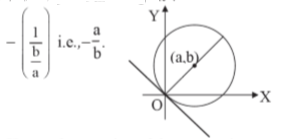
Hence, the equation of the tangent is $y=-\frac{ a }{ b } x$
i.e., $b y+ a x=0$ View full question & answer→MCQ 1292 Marks
The equation of the tangent to the circle $x^2+y^2=17$ at the point (1, -4) is
Answer(B)
The equation of the tangent to the circle $x^2+y^2= a ^2$ at $\left(x_1, y_1\right)$ is $x x_1+y y_1= a ^2$
Here, $x_1=1, y_1=-4$
$\therefore$ The equation of the tangent at $(1,-4)$ is
$x-4 y=17$
View full question & answer→MCQ 1302 Marks
The centre of the circle x = 1 + 2 cos $\theta$, $y=3+2 \sin \theta$, is
Answer(B)
$\frac{x+1}{2}=\cos \theta$ ...(i)
and $\frac{y-3}{2}=\sin \theta$ (ii)
Squaring (i) and (ii) and adding, we get
$\left(\frac{x+1}{2}\right)^2+\left(\frac{y-3}{2}\right)^2=1$
$\Rightarrow(x+1)^2+(y-3)^2=4$,
$\therefore$ Centre is $(-1,3)$.
View full question & answer→MCQ 1312 Marks
The parametric representation of the circle $(x-3)^2+(y+4)^2=25$ is
- A
$x=5+3 \cos \theta, y=5-3 \sin \theta$
- B
$x=5+3 \cos \theta, y=5+3 \sin \theta$
- ✓
$x=3+5 \cos \theta, y=-4+5 \sin \theta$
- D
$x=3+5 \cos \theta, y=-3+5 \sin \theta$
AnswerCorrect option: C. $x=3+5 \cos \theta, y=-4+5 \sin \theta$
(C)
$(x-3)^2+(y+4)^2=5^2$
Comparing with $(x- h )^2+(y- k )^2= r ^2$, we get
$h=3, k=-4, r=5$
$\therefore $ Parametric equations are $x=3+5 \cos \theta, y=-4+5 \sin \theta$
View full question & answer→MCQ 1322 Marks
The parametric form of the equation of circle $4 x^2+4 y^2=9$ is
- ✓
$x=\frac{3}{2} \cos \theta, y=\frac{3}{2} \sin \theta$
- B
$x=\frac{2}{5} \sin \theta, y=\frac{2}{5} \cos \theta$
- C
$x=\frac{3}{4} \sin \theta, y=\frac{3}{4} \cos \theta$
- D
$x=3 \sin \theta, y=\sqrt{2} \cos \theta$
AnswerCorrect option: A. $x=\frac{3}{2} \cos \theta, y=\frac{3}{2} \sin \theta$
(A)
$4 x^2+4 y^2=9$
$\Rightarrow x^2+y^2=\frac{9}{4} \Rightarrow x^2+y^2=\left(\frac{3}{2}\right)^2$
$\therefore x=\frac{3}{2} \cos \theta, y=\frac{3}{2} \sin \theta$
View full question & answer→MCQ 1332 Marks
If the line x + 2by + 7 = 0 is a diameter of the circle $x^2+y^2-6 x+2 y=0$ then b =
Answer(D)
Here, the centre of circle $(3,-1)$ must lie on the line $x+2 by+7=0$.
$\therefore \ 3-2 b+7=0$
$\Rightarrow b=5$
View full question & answer→MCQ 1342 Marks
Which of the following line is a diameter of the circle $x^2+y^2-6 x-8 y-9=0 ?$
Answer(C)
Centre $(3,4)$ of the given circle is satisfying only $x+y=7$
∴ Option $( C )$ is the correct answer.
View full question & answer→MCQ 1352 Marks
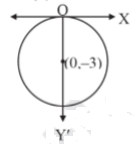
Circle $x^2+y^2+6 y=0$ touches
- A
- B
- C
X-axis at the point (3, 0)
- D
Y-axis at the point (0, 2)
View full question & answer→MCQ 1362 Marks
The circle $x^2+y^2+4 x-4 y+4=0$ touches
Answer(C)
Both axis, as centre is $(-2,2)$ and radius is 2 .
View full question & answer→MCQ 1372 Marks
If the radius of the circle $x^2+y^2+2 g x+2 f y+c=0$ is r, then it will touch both the axes, if
- A
- B
- ✓
$g=f=\sqrt{c}=r$
- D
$g = f$ and $c ^2= r$
AnswerCorrect option: C. $g=f=\sqrt{c}=r$
(C)
Given conditions are $g=f=r$
and $\sqrt{g^2+f^2-c}=r$
$\Rightarrow g=\sqrt{c}=f=r$
View full question & answer→MCQ 1382 Marks
If the circle $x^2+y^2+2 g x+2 f y+c=0$ touches X-axis, then
- A
$g=f$
- ✓
$g ^2= c$
- C
$f ^2= c$
- D
$g ^2+ f ^2= c$
AnswerCorrect option: B. $g ^2= c$
(B)
Circle $x^2+y^2+2 g x+2 f y+c=0$ touches X-axis
$\therefore $ radius $=$ ordinate of centre
$\Rightarrow \sqrt{g^2+f^2-c}=(-f)$
$\Rightarrow g ^2= c$
View full question & answer→MCQ 1392 Marks
For the circle $x^2+y^2+6 x-8 y+9=0$, which of the following statements is true?
- A
Circle passes through the point (-3, 4)
- ✓
- C
- D
Answer(B)
Intercept made by the circle on the X -axis
$=2 \sqrt{9-9}=0$... [Using Shortcut 2]
$\therefore$ Intercept cut on X -axis is zero.
Hence, circle touches $X$-axis.
View full question & answer→MCQ 1402 Marks
For the circle $x^2+y^2+3 x+3 y=0$, which of the following relation is true?
- A
- B
- C
- ✓
Circle passes through origin
AnswerCorrect option: D. Circle passes through origin
(D)
If $c=0$, circle passes through origin.
View full question & answer→MCQ 1412 Marks
$ax ^2+2 y^2+2 b x y+2 x-y+ c =0$ represents a circle through the origin, if
Answer(D)
The given equation represents a circle.
if coeff, of $x^2=\operatorname{coeff}$. of $y^2$ and coeff. of $x y=0 $
$\therefore a=2$ and $b=0$
Also, it passes through origin.
$\therefore c=0$
View full question & answer→MCQ 1422 Marks
The equation $a x^2+b y^2+2 h x y+2 g x+2 f y+c=0$ will represent a circle, if
- A
- B
- ✓
$a=b \neq 0$ and $h=0$
- D
AnswerCorrect option: C. $a=b \neq 0$ and $h=0$
View full question & answer→MCQ 1432 Marks
Radius of the circle $x^2+y^2+2 x \cos \theta+2 y \sin \theta-8=0$ is
- A
- ✓
- C
$2 \sqrt{3}$
- D
$\sqrt{10}$
Answer(B)
Radius $=\sqrt{\cos ^2 \theta+\sin ^2 \theta+8}=3$
View full question & answer→MCQ 1442 Marks
The centre and radius of the circle $2 x^2+2 y^2-x=0$ are
- ✓
$\left(\frac{1}{4}, 0\right)$ and $\frac{1}{4}$
- B
$\left(-\frac{1}{2}, 0\right)$ and $\frac{1}{2}$
- C
$\left(\frac{1}{2}, 0\right)$ and $\frac{1}{2}$
- D
$\left(0,-\frac{1}{4}\right)$ and $\frac{1}{4}$
AnswerCorrect option: A. $\left(\frac{1}{4}, 0\right)$ and $\frac{1}{4}$
(A)
Here, $g =\frac{-1}{4}, f =0$ and $c =0$
$\therefore$ centre $=(-g,-f)=\left(\frac{1}{4}, 0\right)$
and $r=\sqrt{\frac{1}{16}+0-0}=\frac{1}{4}$
View full question & answer→MCQ 1452 Marks
If the radius of the circle $x^2+y^2-18 x+12 y+ k =0$ is 11, then k =
Answer(C)
$\begin{array}{l}(\text { Radius })^2=g^2+f^2-c \\ \Rightarrow 121=81+36-k \Rightarrow k=-4\end{array}$
View full question & answer→MCQ 1462 Marks
The equation $x^2+y^2+4 x+6 y+13=0$ represents a
- A
- B
pair of coincident straight lines
- C
pair of concurrent straight lines
- ✓
Answer(D)
Here, $g =2, f =3$ and $c =13$
$\therefore \quad r=\sqrt{g^2+f^2-c}$
$\therefore \quad r=\sqrt{4+9-13}=0$
option (D) is the correct answer.
View full question & answer→MCQ 1472 Marks
The circle represented by the equation $x^2+y^2+2 g x+2 f y+c=0$ will be a point circle, if
- ✓
$g^2+f^2=c$
- B
$g ^2+ f ^2> c$
- C
$g ^2+ f ^2+ c =0$
- D
$g ^2+ f ^2< c$
AnswerCorrect option: A. $g^2+f^2=c$
(A)
Using condition of point circle,
$\begin{array}{l}\text { Radius }=\sqrt{g^2+f^2-c}=0 \\\Rightarrow g^2+f^2-c\end{array}$
View full question & answer→MCQ 1482 Marks
Radius of circle (x - 5)(x - 1) + (y - 7)(y - 4) = 0 is
- A
- B
- ✓
$\frac{5}{2}$
- D
$\frac{7}{2}$
AnswerCorrect option: C. $\frac{5}{2}$
(C)
Extremities of diameter are $(5,7)$ and $(1,4)$.
Radius is half of the distance between them.
$\therefore $ Radius $=\frac{1}{2} \sqrt{(4)^2+(3)^2}$
$=\frac{5}{2}$
View full question & answer→MCQ 1492 Marks
The equation of a circle whose diameter is the line joining the points (-4, 3) and (12, -1) is
- A
$x^2+y^2+8 x+2 y+51=0$
- B
$x^2+y^2+8 x-2 y-51=0$
- C
$x^2+y^2+8 x+2 y-51=0$
- ✓
$x^2+y^2-8 x-2 y-51=0$
AnswerCorrect option: D. $x^2+y^2-8 x-2 y-51=0$
(D)
By diameter form, the required equation is
$\left(x-x_1\right)\left(x-x_2\right)+\left(y-y_1\right)\left(y-y_2\right)=0$
$\therefore \quad(x+4)(x-12)+(y-3)(y+1)=0$
$\therefore \quad x^2+y^2-8 x-2 y-51=0$
View full question & answer→MCQ 1502 Marks
The equation $\left(x-x_1\right)\left(x-x_2\right)+\left(y-y_1\right)\left(y-y_2\right)=0$ represents a circle whose centre is
- A
$\left(\frac{x_1-x_2}{2}, \frac{y_1-y_2}{2}\right)$
- ✓
$\left(\frac{x_1+x_2}{2}, \frac{y_1+y_2}{2}\right)$
- C
$\left(x_1, y_2\right)$
- D
$\left(x_2, y_2\right)$
AnswerCorrect option: B. $\left(\frac{x_1+x_2}{2}, \frac{y_1+y_2}{2}\right)$
(B)
The given equation represents a circle having line segment joining $\left(x_1, y_1\right)$ and $\left(x_2, y_2\right)$ as a diameter.
∴ the coordinates of its centre are
$\left(\frac{x_1+x_2}{2}, \frac{y_1+y_2}{2}\right)$.
View full question & answer→