Questions · Page 1 of 2

Solve the Following Question.(2 Marks)

🎯

Test yourself on this topic

50 questions · timed · auto-graded

Question 12 Marks
Prove the Theorem : Non-vertical lines having slopes $m_1$ and $m_2$ are perpendicular to each other if and only if $m_1 \times m_2=-1$.
Answer
Let $\alpha$ and $\beta$ be inclinations of lines having slopes $m_1$ and $m_2$. As lines are non vertical $\alpha \neq \frac{\pi}{2}$ and $\beta \neq \frac{\pi}{2}$
$
\therefore \tan \alpha=m_1 \text { and } \tan \beta=m_2
$
From Fig. 5.5 and 5.6 we have,
$\begin{aligned} & \alpha-\beta=90^{\circ} \text { or } \alpha-\beta=-90^{\circ} \\ & \alpha-\beta= \pm 90^{\circ} \\ & \therefore \cos (\alpha-\beta)=0 \\ & \therefore \cos \alpha \cos \beta+\sin \alpha \sin \beta=0 \\ & \therefore \sin \alpha \sin \beta=-\cos \alpha \cos \beta \\ & \therefore \tan \alpha \tan \beta=-1 \\ & \therefore m_1 m_2=-1\end{aligned}$
View full question & answer
Question 22 Marks
Show that there is only one line which passes through $B(5,5)$ and the sum of whose intercepts is zero.
Answer
When line is passing through origin, the sum of intercepts made by the line is zero.
Slope of line passing through origin and $B(5,5)$ is
$
m=\frac{5-0}{5-0}=1
$
Equation of the line having slope $m$ and passing through origin $(0,0)$ is $y=m x$.
The equation of the required line is $y = x$
$
\therefore x-y=0
$
$\therefore$ There is only one line which passes through $B (5,5)$ and the sum of whose intercepts is zero.
View full question & answer
Question 32 Marks
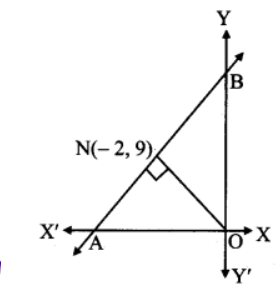
The perpendicular from the origin to a line meets it at $(-2, 9).$ Find the equation of the line.
Answer
Image
Slope of $O N=\frac{9-0}{-2-0}=\frac{-9}{2}$
Since line $A B \perp O N$,
slope of the line $A B$ perpendicular to $O N$ is $\frac{2}{9}$ and it passes through point $N(-2,9)$.
Equation of the line in slope point form is $y-y_1=m\left(x-x_1\right)$
Equation of line $A B$ is
$ y-9=\frac{2}{9}(x+2)$
$\Rightarrow 9(y-9)=2(x+2)$
$\Rightarrow 9 y-81=2 x+4$
$\Rightarrow 2 x-9 y+85=0 $
View full question & answer
Question 42 Marks
Find points on the X-axis whose distance from the line $\frac{x}{3}+\frac{y}{4}=1$ is $4$ units.
Answer
The equation of line is $\frac{x}{3}+\frac{y}{4}=1$
i.e. $4 x+3 y-12=0$
Let $(h, 0)$ be a point on the $X$-axis.
The distance of this point from line (i) is $4.$
$ \Rightarrow \frac{|4 h+3(0)-12|}{\sqrt{4^2+3^2}}=4$
$\Rightarrow \frac{|4 h -12|}{5}=4$
$\Rightarrow|4 h -12|=20$
$\Rightarrow 4 h -12=20 \text { or } 4 h -12=-20$
$\Rightarrow 4 h =32 \text { or } 4 h =-8$
$\Rightarrow h =8 \text { or } h =-2 $
$\therefore$ The required points are $(8,0)$ and $(-2,0)$.
View full question & answer
Question 52 Marks
Find the y-intercept of the line whose slope is $4$ and which has x-intercept $5.$
Answer
Given, slope $=4, x$-intercept $=5$
Since the $x$-intercept of the line is $5, $ it passes through $(5,0)$.
Equation of the line in slope point form is $y-y_1=m\left(x-x_1\right)$
Equation of the required line is
$ y-0=4(x-5)$
$y=4 x-20$
$4 x-y=20$
$\frac{4 x}{20}-\frac{y}{20}=1$
$\frac{x}{5}+\frac{y}{(-20)}=1 $
This equation is of the form $\frac{x}{a}+\frac{y}{b}=1$, where $x$-intercept $=b, y$-intercept $=-20$
View full question & answer
Question 62 Marks
Line through $A(h, 3)$ and $B(4,1)$ intersect the line $lx – 9y -19 = 0$ at right angle. Find the value of $h.$
Answer
Given, $A(h, 3)$ and $B(4,1)$
Slope of $A B\left(m_1\right)=\frac{1-3}{4-h}$
$m _1=\frac{2}{h-4}$
Slope of line $7 x-9 y-19=0$ is $m_2=\frac{7}{9}$
Since line $A B$ and line $7 x-9 y-19=0$ are perpendicular to each other,
$m_1 \times m_2=-1$
$\frac{2}{h-4} \times \frac{7}{9}=-1$
$14=9(4-h)$
$14=36-9 h$
$9 h=22$
$h=\frac{22}{9} $
View full question & answer
Question 72 Marks
Find the distance of $P(-1, 1)$ from the line $12(x + 6) = 5(y – 2).$
Answer
Given equation of the line is
$ 12(x+6)=5(y-2)$
$12 x+72=5 y-10$
$12 x-5 y+82=0 $
Let $p$ be the perpendicular distance of the point $(-1,1)$ from the line $12 x-5 y+82=0$.
$p =\left|\frac{12(-1)-5(1)+82}{\sqrt{12^2+(-5)^2}}\right|$
$=\left|\frac{-12-5+82}{\sqrt{144+25}}\right|=\left|\frac{65}{13}\right|=5 \text { units. } $
View full question & answer
Question 82 Marks
Find the x-intercept of the line whose slope is 3 and which makes intercept 4 on the Y-axis.
Answer
Equation of a line having slope ‘m’ and y-intercept ‘c’ is y = mx + c

Given, m = 3, c = 4

The equation of the line is y = 3x + 4

3x – y = -4

$\begin{aligned} & \frac{3 x}{(-4)}-\frac{y}{(-4)}=1 \\ & \frac{x}{\left(\frac{-4}{3}\right)}+\frac{y}{4}=1\end{aligned}$

This equation is of the form $\frac{x}{a}+\frac{g}{b}=1$, where

x-intercept = a

$\mathrm{x}$-intercept $=\frac{-4}{3}$

Alternate Method:

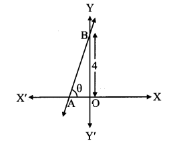
Image

Let θ be the inclination of the line. Then tan θ = 3 …..[∵ slope = 3 (given)]

$\begin{aligned} & \frac{\mathrm{OB}}{\mathrm{OA}}=3 \\ & \frac{4}{\mathrm{OA}}=3 \\ & \mathrm{OA}=\frac{4}{3}\end{aligned}$

$x$-intercept $=-\frac{4}{3}$ as point $A$ is to the left side of $Y$-axis.

View full question & answer
Question 92 Marks
Find the equation of the line through A(-2, 3) and perpendicular to the line through S(1, 2) and T(2, 5).
Answer
Slope of ST $=\frac{5-2}{2-1}=3$

Since the required line is perpendicular to ST,

slope of required line $=\frac{-1}{3}$ and line passes through $A(-2,3)$

Equation of the line in slope point form is $y-y_1=m\left(x-x_1\right)$

The equation of the required line is

$\begin{aligned} & y-3=\frac{-1}{3}(x+2) \\ & \Rightarrow 3(y-3)=-(x+2) \\ & \Rightarrow 3 y-9=-x-2 \\ & \Rightarrow x+3 y=7\end{aligned}$

View full question & answer
Question 102 Marks
Find the distance between the parallel lines 3x + 4y + 3 = 0 and 3x + 4y + 15 = 0.
Answer
Equations of the given parallel lines are 3x + 4y + 3 = 0 and 3x + 4y + 15 = 0 Here, $a=3, b=4, c_1=3$ and $c_2=15$

∴ Distance between the parallel lines

$\begin{aligned} & =\left|\frac{c_1-c_2}{\sqrt{a^2+b^2}}\right| \\ & =\left|\frac{3-15}{\sqrt{3^2+4^2}}\right|=\left|\frac{-12}{\sqrt{9+16}}\right|\end{aligned}$

$=\frac{12}{5}$ units

View full question & answer
Question 112 Marks
Find the distance of the origin from the line 12x + 5y + 78 = 0.
Answer
Let p be the perpendicular distance of origin from the line 12x + 5y + 78 = 0. Here, a = 12, b = 5, c = 78

$\begin{aligned} & \mathbf{p}=\left|\frac{\mathrm{c}}{\sqrt{\mathrm{a}^2+\mathrm{b}^2}}\right| \\ & \mathbf{p}=\left|\frac{78}{\sqrt{12^2+5^2}}\right|=\left|\frac{78}{\sqrt{144+25}}\right|\end{aligned}$

$\begin{aligned} & =\frac{78}{13} \text { } \\ & =6 \text { units }\end{aligned}$

View full question & answer
Question 122 Marks
Find the equation of the line: through the origin which bisects the portion of the line 3x + 2y = 2 intercepted between the co-ordinate axes.
Answer
Given equation of the line is 3x + 2y = 2.

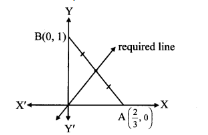
Image

$\begin{aligned} & \frac{3 x}{2}+\frac{2 y}{2}=1 \\ & \frac{x}{\frac{2}{3}}+\frac{y}{1}=1\end{aligned}$

This equation is of the form $\frac{x}{a}+\frac{y}{b}=1$, with $a=\frac{2}{3}, b=1$.

The line $3 x+2 y=2$ intersects the $X$-axis at $A\left(\frac{2}{3}, 0\right)$ and $Y$-axis at $B(0,1)$.

Required line is passing through the midpoint of AB

Midpoint of $A B=\left(\frac{\frac{2}{3}+0}{2}, \frac{0+1}{2}\right)=\left(\frac{1}{3}, \frac{1}{2}\right)$

$\therefore$ Required line passes through $(0,0)$ and $\left(\frac{1}{3}, \frac{1}{2}\right)$.

Equation of the line in two point form is

$\frac{y-y_1}{y_2-y_1}=\frac{x-x_1}{x_2-x_1}$

∴ The equation of the required line is

$\begin{aligned} & \frac{y-0}{\frac{1}{2}-0}=\frac{x-0}{\frac{1}{3}-0} \\ & 2 y=3 x \\ & \therefore 3 x-2 y=0\end{aligned}$

View full question & answer
Question 132 Marks
Find the distance between the parallel lines $6 x+8 y+21=0$ and $3 x+4 y+7=0$.
Answer
We write equation $3 x+4 y+7=0$ as $6 x+8 y+14=0$ in order to make the coefficients of $x$ and coefficients of $y$ in both equations to be same.
Now by using formula $p=\left|\frac{c_1-c_2}{\sqrt{a^2+b^2}}\right|$
We get the distance between the given parallel lines as
$
p=\left|\frac{21-14}{\sqrt{6^2+8^2}}\right|=\frac{7}{10}
$
View full question & answer
Question 142 Marks
Find the distance of the point $P(2,5)$ from the line $3 x+4 y+14=0$
Answer
The distance of the point $\mathrm{P}\left(x_1, y_1\right)$ from the line $a x+b y+c=0$ is given by
$
p=\left|\frac{a x_1+b y_1+c}{\sqrt{a^2+b^2}}\right|
$
$\therefore$ The distance of the point $\mathrm{P}(2,5)$ from the line $3 x+4 y+14=0$ is given by
$
p=\left|\frac{3(2)+4(5)+14}{\sqrt{3^2+4^2}}\right|=\frac{40}{5}=8
$
View full question & answer
Question 152 Marks
A line is perpendicular to the line $3 x+2 y-1=0$ and passes through the point $A(1,1)$. Find its equation.
Answer
Slope of the line $3 x+2 y-1$ is $-\frac{3}{2}$.
Required line is perpendicular it.
The slope of the required line is $\frac{2}{3}$.
Required line passes through the point $\mathrm{A}(1,1)$.
$\therefore$ It's equation is given by the formula
$
\begin{aligned}
& \quad\left(y-y_1\right)=m\left(x-x_1\right) \\
& \therefore \quad(y-1)=\frac{2}{3}(x-1) \\
& \therefore \quad 3 y-3=2 x-2 \\
& \therefore \quad 2 x-3 y+1=0 .
\end{aligned}
$
View full question & answer
Question 162 Marks
A line is parallel to the line $x+3 y=9$ and passes through the point $A(2,7)$. Find its equation.
Answer
Slope of the line $x+3 y=9$ is $-\frac{1}{3}$
Required line passes through the point $A(2,7)$.

$\therefore$ It's equation is given by the formula
$
\begin{aligned}
& \left(y-y_1\right)=m\left(x-x_1\right) \\
& \therefore \quad(y-7)=-\frac{1}{3}(x-2) \\
& \therefore \quad 3 y-21=x+2 \\
& \therefore \quad x+3 y=23 .
\end{aligned}
$

View full question & answer
Question 172 Marks
Find the acute angle between the lines $y-\sqrt{3} x+1=0$ and $\sqrt{3} y-x+7=0$.
Answer
Slopes of the given lines are $m_1=\sqrt{3}$ and $m_2=\frac{1}{\sqrt{3}}$.
The acute angle $\theta$ between lines having slopes $m_1$ and $m_2$ is given by
$
\begin{aligned}
& \tan \theta=\left|\frac{m_1-m_2}{1+m_1 m_2}\right| \\
& \tan \theta=\frac{1}{\sqrt{3}}=\left|\frac{\sqrt{3}-\frac{1}{\sqrt{3}}}{1+\sqrt{3} \times \frac{1}{\sqrt{3}}}\right|=\left|\frac{\sqrt{3}-\frac{1}{\sqrt{3}}}{1+1}\right|=\left|\frac{\sqrt{3}-\frac{1}{\sqrt{3}}}{2}\right| \\
& =\left|\frac{1-3}{2 \sqrt{3}}\right|=\left|\frac{-1}{\sqrt{3}}\right|=\frac{1}{\sqrt{3}} \\
& \therefore \tan \theta=\frac{1}{\sqrt{3}} \quad \therefore \quad \theta=30^{\circ} \\
&
\end{aligned}
$
View full question & answer
Question 182 Marks
Find the acute angle between the following pairs of lines: $y=2 x+3$ and $y=3 x+7$
Answer
Slopes of lines $y=2 x+3$ and $y=3 x+7$
are $m_1=2$ and $m_2=3$
The acute angle $\theta$ between lines having slopes $\mathrm{m}_1$ and $\mathrm{m}_2$ is given by
$
\begin{aligned}
& \tan \theta=\left|\frac{m_1-m_2}{1+m_1 m_2}\right| \\
& \therefore \tan \theta=\left|\frac{2-3}{1+(2)(3)}\right|=\left|\frac{-1}{7}\right|=\frac{1}{7} \\
& \therefore \theta=\tan ^{-1}\left(\frac{1}{7}\right) .
\end{aligned}
$
View full question & answer
Question 192 Marks
Find the acute angle between the following pairs of lines: $12 x-4 y=5$ and $4 x+2 y=7$
Answer
Slopes of lines $12 x-4 y=5$ and $4 x+2 y=7$ are $m_1=3$ and $m_2=2$.
If $\theta$ is the acute angle between lines having slope $\mathrm{m}_1$ and $\mathrm{m}_2$ then
$\tan \theta=\left|\frac{\mathrm{m}_1-\mathrm{m}_2}{1+\mathrm{m}_1 \mathrm{~m}_2}\right|$
$\therefore \tan \theta=\left|\frac{3-(-2)}{1+(3)(-2)}\right|=\left|\frac{5}{-5}\right|=1$
$\therefore \tan \theta=1 \quad \therefore \theta=45^{\circ}$
View full question & answer
Question 202 Marks
Find the slope and intercepts made by the following lines : $x+3 y-15=0$
Answer
Comparing equation $x+3 y-15=0$ with $a x+b y+c=0$.
we get $a=1, b=3, c=-15$
$\therefore$ Slope of this line $=-\frac{a}{b}=-\frac{1}{3}$

The $x$ - intercept is $-\frac{\mathrm{c}}{\mathrm{a}}=-\frac{-15}{1}=15$
The $y-$ intercept is $-\frac{c}{b}=-\frac{-15}{3}=5$

View full question & answer
Question 212 Marks
Find the slope and intercepts made by the following lines : $2 x+y+30=0$
Answer
Comparing equation $2 x+y+30=0$
with $a x+b y+c=0$.
we get $a=2, b=1, c=30$
$\therefore$ Slope of this line $=-\frac{a}{b}=-2$
The $\mathrm{X}$-intercept is $-\frac{\mathrm{c}}{\mathrm{a}}=-\frac{30}{2}=-15$
The Y-intercept is $-\frac{\mathrm{c}}{\mathrm{b}}=-\frac{30}{1}=-30$
View full question & answer
Question 222 Marks
Find the slope and intercepts made by the following lines : $x+y+10=0$
Answer
Comparing equation $x+y+10=0$ with $a x+b y+c=0$, we get $a=1, b=1, c=10$
$\therefore$ Slope of this line $=-\frac{a}{b}=-1$
The $\mathrm{X}$-intercept is $-\frac{\mathrm{c}}{\mathrm{a}}=-\frac{10}{1}=-10$
The Y-intercept is $=-\frac{\mathrm{c}}{\mathrm{b}}=-\frac{10}{1}=-10$
View full question & answer
Question 232 Marks
Reduce the equation $\sqrt{3} x-y-2=0$ into normal form. Find the values of $p$ and $\alpha$.
Answer
Comparing $\sqrt{3} x-y-2=0$ with $a x+b y+c=0$ we get $a=\sqrt{3}, b=-1$ and $c=-2$
$
\sqrt{\mathrm{a}^2+\mathrm{b}^2}=\sqrt{3+1}=2
$
Divide the given equation by 2 .
$
\frac{\sqrt{3}}{2} x-\frac{1}{2} y=1
$
$\therefore \cos 330^{\circ} x=\sin 330^{\circ} y=1$ is the required normal form of the given equation. $\mathrm{p}=1$ and $\theta=330^{\circ}$.
View full question & answer
Question 242 Marks
Obtain the equation of the line passing through points $\mathrm{A}(2,1)$ and $\mathrm{B}(1,2)$.
Answer
The equation of the line which passes through points $\mathrm{A}\left(x_1, y_1\right)$ and $\mathrm{B}\left(x_2, y_2\right)$ is
$
\frac{x-x_1}{x_2-x_1}=\frac{y-y_1}{y_2-y_1} \text {. }
$
$\therefore$ The equation of the line passing through points $\mathrm{A}(2,1)$ and $\mathrm{B}(1,2)$ is $\frac{x-2}{1-2}=\frac{y-1}{2-1}$
$
\begin{aligned}
& \therefore \frac{x-2}{-1}=\frac{y-1}{1} \\
& \therefore x-2=-y+1 \\
& \therefore x+y-3-0
\end{aligned}
$
View full question & answer
Question 252 Marks
If the angle between two lines is $45^{\circ}$ and the slope of one of the lines is $\frac{1}{2}$, find the slope of the other line.
Answer
If $\theta$ is the acute angle between lines having slopes $m_1$ and $m_2$ then
$
\begin{aligned}
& \tan \theta=\left|\frac{m_1-m_2}{1+m_1 m_2}\right| \\
& \text { Given } \theta=45^{\circ} .
\end{aligned}
$
Let $m_1=\frac{1}{2}$. Let $m_2$ be the slope of the other line.
$
\begin{aligned}
& \tan 45^{\circ}=\left|\frac{\frac{1}{2}-m_2}{1+\left(\frac{1}{2}\right) m_2}\right| \quad \therefore 1=\left|\frac{1-2 m_2}{2+m_2}\right| \\
& \therefore \frac{1-2 m_2}{2+m_2}=1 \text { or } \frac{1-2 m_2}{2+m_2}=-1 \\
& \therefore m_2=3 \text { or }-\frac{1}{3}
\end{aligned}
$
There are two lines which satisfy the given conditions.
View full question & answer
Question 262 Marks
Obtain the new equation of the locus $x^2-x y-2 y^2-x+4 y+2=0$ when the origin is shified to $(2,3)$, the directions of the axes remaining the same.
Answer
Here $(h, k)=(2,3)$ and if new co-ordinates are $(\mathrm{X}, \mathrm{Y})$.
$
\begin{aligned}
& \therefore x=\mathrm{X}+h, \quad y=\mathrm{Y}+k \text { gives } \\
& \therefore \mathrm{x}=\mathrm{X}+2, \quad y=\mathrm{Y}+3
\end{aligned}
$
The given equation
$
\begin{gathered}
x^2-x y-2 y^2-x+4 y+2=0 \text { becomes } \\
(\mathrm{X}+2)^2-(\mathrm{X}+2)(\mathrm{Y}+3)-2(\mathrm{Y}+3)^2- \\
(\mathrm{X}+2)+4(\mathrm{Y}+3)+2=0 \\
\therefore \mathrm{X}^2-\mathrm{XY}-2 \mathrm{Y}^2-10 \mathrm{Y}-8=0
\end{gathered}
$
This is the new equation of the given locus.
View full question & answer
Question 272 Marks
The origin is shifted to the point $(-2,1)$, the axes being parallel to the original axes. If the new co-ordinates of point $\mathrm{A}$ are $(7,-4)$, find the old co-ordinates of point $\mathrm{A}$.
Answer
We have $(h, k)=(-2,1)$ and if new co-ordinates are $(\mathrm{X}, \mathrm{Y})$.
$
\begin{aligned}
& x=\mathrm{X}+h, y=\mathrm{Y}+k \\
& \therefore x=\mathrm{X}-2, y=\mathrm{Y}+1 \\
& (\mathrm{X}, \mathrm{Y})=(7,-4)
\end{aligned}
$
we get $x=7-2=5, \quad y=-4+1=-3$.
$\therefore$ Old co-ordinates A are $(5,-3)$
View full question & answer
Question 282 Marks
Find the eqation of the locus of points which are equidistant from A(- 3, 0) and B(3, 0) Identify the locus.
Answer
Let P(x, y) be any point on the required locus. P is equidistant from A and B.
$\begin{aligned} & \therefore \mathrm{PA}=\mathrm{PB} \\ & \therefore \mathrm{PA}^2=\mathrm{PB}^2 \\ & \therefore(x+3)^2+(y-0)^2=(x-3)^2+ \\ & (y-0)^2 \\ & \therefore x^2+6 x+9+y^2=x^2-6 x+9+y^2 \\ & \therefore 12 x=0 \\ & \therefore x=0 . \text { The locus is the Y-axis. }\end{aligned}$
View full question & answer
Question 292 Marks
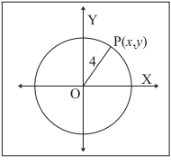
Let L (P OP= 4). Find the equation of L.
Image
Answer
L is the locus of points in the plane which are at 4 unit distance from the origin.
Let $\mathrm{P}(x, y)$ be any point on the locus $\mathrm{L}$.
As $\mathrm{OP}=4, \mathrm{OP}^2=16$
$
\begin{aligned}
& \therefore(x-0)^2+(y-0)^2=16 \\
& \therefore x^2+y^2=16
\end{aligned}
$
This is the equation of locus L.
The locus is seen to be a circle
View full question & answer
Question 302 Marks
Find the distance between the parallel lines 9x + 6y – 7 = 0 and 3x + 2y + 6 = 0.
Answer
Equations of the given parallel lines are 3x + 2y + 6 = 0 and

$9 x+6 y-1=0$ i,e, $3 x+2 y-\frac{7}{3}=0$

Here, $a=3, b=2, c_1=6$ and $c_2=\frac{-7}{3}$

∴ Distance between the parallel lines

$=\left|\frac{c_1-c_2}{\sqrt{a^2+b^2}}\right|=\left|\frac{6-\left(-\frac{7}{3}\right)}{\sqrt{3^2+2^2}}\right|$

$=\left|\frac{6+\frac{7}{3}}{\sqrt{9+4}}\right|=\frac{25}{3 \sqrt{13}}$ units

View full question & answer
Question 312 Marks
Find the distance between parallel lines 4x – 3y + 5 = 0 and 4xr – 3y + 7 = 0.
Answer
Equations of the given parallel lines are 4x – 3y + 5 = 0 and 4x – 3y + 1 = 0

Here, a = 4, b = – 3, c1 = 5 and c2 = 7

∴ Distance between the parallel lines

$\begin{aligned} & =\left|\frac{c_1-c_2}{\sqrt{a^2+b^2}}\right|=\left|\frac{5-7}{\sqrt{4^2+(-3)^2}}\right| \\ & =\left|\frac{-2}{\sqrt{16+9}}\right|=\left|\frac{-2}{5}\right|=\frac{2}{5} \text { units }\end{aligned}$

View full question & answer
Question 322 Marks
Find the distance of the point A(- 2, 3) from the line 12x – 5y – 13 = 0.
Answer
Let p be the perpendicular distance of the point A(- 2, 3) from the line 12x – 5y – 13 = 0 Here, a = 12, b = – 5, c = – 13, x1 = -2, y1 = 3

$\therefore \quad \mathrm{p}=\left|\frac{\mathrm{ar}+\mathrm{b} y_1+\mathrm{c}}{\sqrt{\mathrm{a}^2+\mathrm{b}^2}}\right|=\left|\frac{12(-2)-5(3)-13}{\sqrt{12^2+(-5)^2}}\right|$

$=\left|\frac{-24-15-13}{\sqrt{144+25}}\right|=\left|\frac{-52}{13}\right|=4$ units

View full question & answer
Question 332 Marks
Find the distance of the origin from the line 7x + 24y – 50 = 0.
Answer
Let p be the perpendicular distance of origin fromtheline

7x + 24y – 50 = 0

Here, a = 7, b = 24, c = -50

$\begin{aligned} & \therefore \quad p=\left|\frac{c}{\sqrt{a^2+b^2}}\right| \\ & \therefore \quad p=\left|\frac{-50}{\sqrt{7^2+24^2}}\right|=\left|\frac{-50}{\sqrt{49+576}}\right|=\left|\frac{-50}{25}\right|=2 \text { units }\end{aligned}$

View full question & answer
Question 342 Marks
Find the equation of the line whose x-intercept is 3 and which ¡s perpendicular to the line 3x – y + 23 = 0.
Answer
Slope of the line 3x – y + 23 = 0 is 3. ∴ Slope of the required line perpendicular to

$3 x-y+23=0$ is $\frac{-1}{3}$

Since the x-intercept of the required line is 3, it passes through (3, 0).

∴ The equation of the required line is ‘

$y-0=\frac{-1}{3}(x-3)$

∴ 3y = x + 3

∴ x + 3y = 3

View full question & answer
Question 352 Marks
Show that the lines x – 2y – 7 = 0 and 2x – 4y + 15 = 0 are parallel to each other.
Answer
Let m1 be the slope of the line x – 2y – 7 = 0.

$\therefore m_1=\frac{- \text { coefficient of } x}{\text { coefficient of } y}=\frac{-1}{-2}=\frac{1}{2}$

Let $m_2$ be the slope of the line $2 x-4 y+15=0$.

$\therefore m_2=\frac{- \text { coefficient of } x}{\text { coefficient of } y}=\frac{-2}{-4}=\frac{1}{2}$

Since m1 = m2 the given lines are parallel to each other.

View full question & answer
Question 362 Marks
Find the slope, x-intercept, y-intercept of each of the following lines : x + 2y = 0
Answer
Given equation of the line is x + 2y = 0.

Comparing this equation with ax + by + c = 0,

we get

a = 1, b = 2, c = 0

$\begin{array}{r}\therefore \quad \text { Slope of the line }=\frac{-a}{b}=\frac{-1}{2} \\ x \text {-intercept }=\frac{-c}{a}=\frac{-0}{1}=0 \\ y \text {-intercept }=\frac{-c}{b}=\frac{-0}{2}=0\end{array}$

View full question & answer
Question 372 Marks
Find the slope, x-intercept, y-intercept of each of the following lines : 3x-y-9 = 0
Answer
Given equation of the line is 3x – y – 9 = 0.

Comparing this equation with ax + by + c = 0,

we get

a = 3, b = – 1, c = – 9

$\begin{aligned} & \therefore \quad \text { Slope of the line }=\frac{-a}{b}=\frac{-3}{-1}=3 \\ & x \text {-intercept }=\frac{-c}{a}=\frac{-(-9)}{3}=3 \\ & y \text {-intercept }=\frac{-c}{b}=\frac{-(-9)}{-1}=-9\end{aligned}$

View full question & answer
Question 382 Marks
Find the slope, x-intercept, y-intercept of each of the following lines : i. 2x + 3y-6 = 0
Answer
Given equation of the line is 2x + 3y – 6 = 0.

Comparing this equation with ax + by + c = 0,

we get

a = 2, b = 3, c = -6

$\therefore \quad$ Slope of the line $=\frac{-\mathrm{a}}{\mathrm{b}}=\frac{-2}{3}$

$x$-intercept $=\frac{-c}{a}=\frac{-(-6)}{2}=3$

$y$-intercept $=\frac{-\mathrm{c}}{\mathrm{b}}=\frac{-(-6)}{3}=2$

View full question & answer
Question 392 Marks
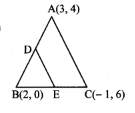
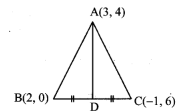
The vertices of a triangle are A(3, 4), B(2, 0) and C(- 1, 6). Find the equations of the lines containing. : the midpoints of sides AB and BC.
Answer
Let D and E be the midpoints of side AB and side BC respectively. The equation of the line DE is

$\begin{aligned} \therefore \quad \mathrm{D} & =\left(\frac{3+2}{2}, \frac{4+0}{2}\right)=\left(\frac{5}{2}, 2\right) \text { and } \\ \mathrm{E} & =\left(\frac{2-1}{2}, \frac{0+6}{2}\right)=\left(\frac{1}{2}, 3\right)\end{aligned}$

$\therefore \quad$ The equation of the line $\mathrm{DE}$ is

$\begin{aligned} \frac{y-2}{3-2} & =\frac{x-\frac{5}{2}}{\frac{1}{2}-\frac{5}{2}} \\ \therefore \quad \frac{y-2}{1} & =\frac{2 x-5}{-4}\end{aligned}$

Image

∴ -4(y-2) = 2x-5

∴ 2x + 4y – 13 = 0

View full question & answer
Question 402 Marks
The vertices of a triangle are A(3, 4), B(2, 0) and C(- 1, 6). Find the equations of the lines containing. : the median AD
Answer
Let D be the midpoint of side BC. Then, AD is the median through A.

$\therefore D=\left(\frac{2-1}{2}, \frac{0+6}{2}\right)=\left(\frac{1}{2}, 3\right)$

The median AD passes through the points

$A(3,4)$ and $D\left(\frac{1}{2}, 3\right)$

Image

∴ The equation of the median AD is

$\begin{aligned} & \frac{y-4}{3-4}=\frac{x-3}{\frac{1}{2}-3} \\ & \frac{y-4}{-1}=\frac{x-3}{-\frac{5}{2}}\end{aligned}$

$\frac{5}{2}(y-4)=x-3$

∴ 5y – 20 = 2x – 6

∴ 2x – 5y + 14 = 0

View full question & answer
Question 412 Marks
The vertices of a triangle are A(3, 4), B(2, 0) and C(- 1, 6). Find the equations of the lines containing. : 1.side BC
Answer
Vertices of AABC are A(3, 4), B(2, 0) and C(- 1, 6).

Equation of the line in two point form is

$\frac{y-y_1}{y_2-y_1}=\frac{x-x_1}{x_2-x_1}$

∴ The equation of the side BC is

$\begin{aligned} & \frac{y-0}{6-0}=\frac{x-2}{-1-2} \\ & \frac{y}{6}=\frac{x-2}{-3}\end{aligned}$

∴ – 3y = 6x – 12

∴ 6x + 3y – 12 = 0

∴ 2x + y – 4 = 0

View full question & answer
Question 422 Marks
Find the equation of the line having inclination 135° and making x-intercept 7.
Answer
Given, Inclination of line = 0 = 135°

∴ Slope of the line (m) = tan 0 = tan 135°

= tan (90° + 45°)

= – cot 45° = – 1 x-intercept of the required line is 7.

∴ The line passes through (7, 0).

Equation of the line in slope point form is $y-y_1=m\left(x-x_1\right)$

$\therefore$ The equation of the required line is $y-0=-1(x-7)$

∴ y = -x + 7

∴ x + y – 7 = 0

View full question & answer
Question 432 Marks
Line y = mx + c passes through the points A(2,1) and B(3,2). Determine m and c.
Answer
Given, A(2, 1) and B(3,2)

Equation of the line in two point form is $\frac{y-y_1}{y_2-y_1}=\frac{x-x_1}{x_2-x_1}$

∴ The equation of the required line is

$\begin{aligned} & \frac{y-1}{2-1}=\frac{x-2}{3-2} \\ & \therefore \frac{y-1}{1}=\frac{x-2}{1} \\ & \therefore y-1=x-2 \\ & \therefore y=x-1\end{aligned}$

Comparing this equation with y = mx + c,

we get m = 1 and c = – 1

Alternate Method:

Points A(2, 1) and B(3, 2) lie on the line y = mx + c.

∴ They must satisfy the equation.

∴ 2m + c = 1 …(i) and 3m + c = 2 …(ii) equation (ii) – equation (i) gives m = 1

Substituting m = 1 in (i), we get 2(1) + c = 1

∴ c = 1 – 2 = – 1

View full question & answer
Question 442 Marks
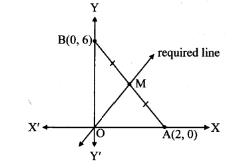
Find the equation of the line: passing through the origin and which bisects the portion of the line 3JC + y = 6 intercepted between the co-ordinate axes.
Answer

Image

Given equation of the line is 3x +y = 6.

$\therefore \frac{x}{2}+\frac{y}{6}=1$

This equation is of the form $\frac{x}{a}+\frac{y}{b}=1$,

where a = 2, b = 6 ∴ The line 3x + y = 6 intersects the X-axis and Y-axis at A(2, 0) and B(0, 6) respectively. Required line is passing through the midpoint of AB.

$\therefore$ Midpoint of $A B=\left(\frac{2+0}{2}, \frac{0+6}{2}\right)=(1,3)$

∴ Required line passes through (0, 0) and (1,3).

Equation of the line in two point form is

$\frac{y-y_1}{y_2-y_1}=\frac{x-x_1}{x_2-x_1}$

∴ The equation of the required line is

$\begin{aligned} & \frac{y-0}{3-0}=\frac{x-0}{1-0} \\ & \frac{y}{3}=\frac{x}{1} \\ & \therefore y=3 x \\ & \therefore 3 x-y=0\end{aligned}$

Alternate Method:

Given equation of the line is 3x + y = 6 …

(i) Substitute y = 0 in (i) to get a point on X-axis.

∴ 3x + 0 = 6

∴ x = 2 Substitute x = 0 in

(i) to get a point on Y-axis.

∴ 3(0) + 7 = 6 ∴ y = 6

∴ The line 3x + y = 6 intersects the X-axis and Y-axis at A(2,0) and B(0,6) respectively.

Let M be the midpoint of AB.

$M=\left(\frac{2+0}{2}, \frac{0+6}{2}\right)=(1,3)$

Slope of $O M(m)=\frac{3-0}{1-0}=3$

Equation of OM is of the formy = mx.

∴ The equation of the required line is y = 3x

∴ 3x – y = 0

View full question & answer
Question 452 Marks
Find the equation of the line: containing the point A(4, 3) and having inclination 120°.
Answer
Given, Inclination of line = θ = 120° Slope of the line (m) = tan θ = tan 120° = tan (90° + 30°) = – cot 30°

$=-\sqrt{3}$

and the line passes through A(4, 3).

Equation of the line in slope point form is $y-y_1=m\left(x-x_1\right)$

∴ The equation of the required line is

$\begin{aligned} & y-3=-\sqrt{3}(x-4) \\ & \therefore y-3=-\sqrt{3} x+4 \sqrt{3} \\ & \therefore \sqrt{3} x+y-3-4 \sqrt{3}=0\end{aligned}$

View full question & answer
Question 462 Marks
Find the equation of the line: containing the point A(3, 5) and having slope 2/3
Answer
Given, slope $(\mathrm{m})=\frac{2}{3}$ and the line passes through $(3,5)$.

Equation of the line in slope point form is $y-y_1=m\left(x-x_1\right)$

$\therefore$ The equation of the required line is $y-5=\frac{2}{3}(x-3)$

∴ 3 (y – 5) = 2 (x – 3)

∴ 3y – 15 = 2x – 6

∴ 2x – 3y + 9 = 0

View full question & answer
Question 472 Marks
Find the equation of the line: having slope 1/2 and containing the point (3, -2)
Answer
Given, slope $(m)=\frac{1}{2}$ and the line passes through $\left(3_t-2\right)$.

Equation of the line in slope point form is

$y-y_1=m\left(x-x_1\right)$

∴ The equation of the required line is

$\begin{aligned} & {[y-(-2)]=\frac{1}{2}(x-3)} \\ & \therefore 2(y+2)=x-3 \\ & \therefore 2 y+4=x-3 \\ & \therefore x-2 y-7=0\end{aligned}$

View full question & answer
Question 482 Marks
Find the equation of the line: passing through the origin and parallel to AB, where A is (2,4) and B is (1,7).
Answer
Given, A (2, 4) and B (1, 7)

Slope of $A B=\frac{7-4}{1-2}=-31-2$

Since the required line is parallel to line AB, slope of required line (m) = slope of AB

∴ m = – 3 and the required line passes through the origin.

Equation of the line having slope m and passing through origin (0, 0) is y = mx.

∴ The equation of the required line is y = – 3x

View full question & answer
Question 492 Marks
Find the equation of the line: Find the equation of the line: containing the origin and having inclination 60°.
Answer
Given, Inclination of line = θ = 60°

Slope of the line (m) = tan θ = tan 60°

$=\sqrt{3}$

Equation of the line having slope m and passing through origin (0, 0) is y = mx.

$\therefore$ The equation of the required line is $y=\sqrt{3} \mathrm{x}$

View full question & answer
Question 502 Marks
Find the equation of the line: passing through the points P(2, 1) and Q(2,-1)
Answer
The required line passes through the points P(2, 1) and Q(2,-1).

Since both the given points have same x co-ordinates

i.e. 2, the given points lie on the line x = 2.

∴ The equation of the required line is x = 2.

View full question & answer
Solve the Following Question.(2 Marks) - Maths STD 11 Questions - Vidyadip