Questions

Write short note

🎯

Test yourself on this topic

6 questions · timed · auto-graded

Question 14 Marks

Image
Answer
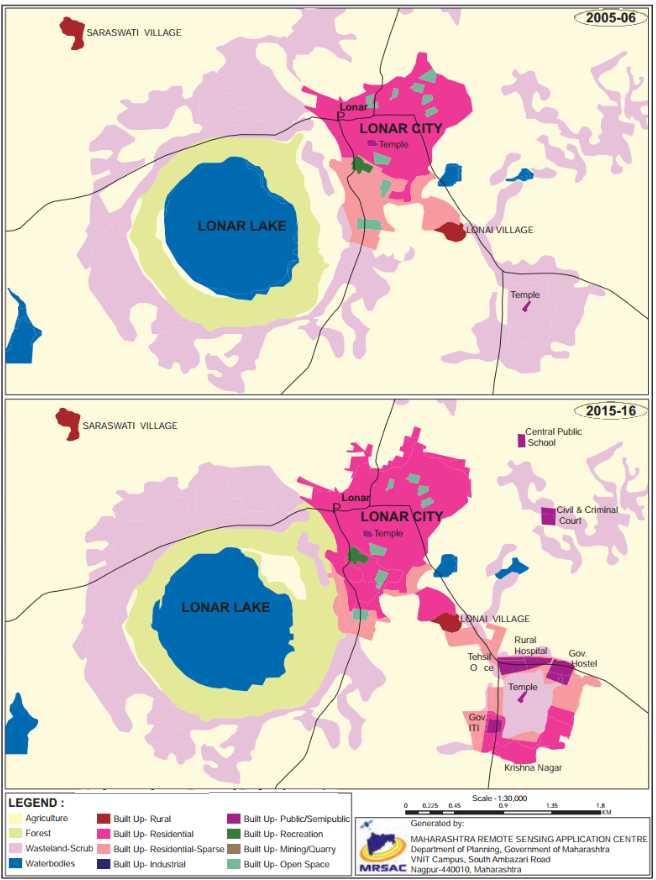
  • Two maps of Lonar city are given. One map is of the year 2005-06 and another is of 2015-16.
  • These two maps show the changes in land use that have taken place in the span of 10 years.
  • The following changes have been registered.
  • There is no change in the size of Lonar lake.
  • The area occupied by Lonar city has increased substantially.
  • Forest area around the lake has increased.
  • An area under waste land/ scrubs have increased.
  • Around the temple in the southeast, on the waste scrub land a new rural hospital, government hostel, government ITI, Tahsil office etc., has been developed. This newly developed area has been named as Krishna Nagar, which is not in 2005-06 map.
  • To the north-east of the Lonar city two more building have been constructed. One is central public school and another is civil and criminal court.
  • To the south of the temple in the heart of Lonar city built up residential area is spreading over built up residential sparse.
  • Overall built up residential sparse is increasing in all directions around Lonar lake and south-eat of the Lonar city and thus there is encroachment over agricultural land.
View full question & answer
Question 24 Marks
Mixed land use.
Answer
  • Mixed land use is observed in some of the urban areas.
  • It is an area where different types of land use exist together.
  • In some cities residential, industrial, commercial, administrative functions are found in an integrated manner.
  • In many cities in developing countries one can find schools, clinics, houses, business shops at one place itself.
  • Generally mixed land use is found in cities which are growing very fast, because land in the city is not sufficient to reserve certain areas for certain land use, therefore there is mixed land use.
View full question & answer
Question 34 Marks
Suburbs
Answer
  • In the outer part of the urban areas there are small towns or small cities, they are known as suburbs.
  • When big cities become overcrowded and overpopulated, the further development starts outside city area and thus suburbs develop.
  • For example, Dombivali, Kalyan, Ambarnath etc., are the suburbs of Mumbai.
  • Suburbs generally consists of residential housing and shops of low order, which act as central place for the local community.
  • Often, suburbs are the most recent growth of an urban area and their end marks the urban fringe.
  • With increase in population there is growth of suburb, the growth of suburbs may result in urban sprawl.
View full question & answer
Question 44 Marks
Problems of urban settlements.
Answer
  • Most of the urban areas have very large size of population and density of population is also very high.
  • When cities increase in size, many changes occur. These changes are related to land use and structure of the city.
  • The large size of population and high density create number of socio-economic, cultural, infrastructural, administrative and environmental problems.
  • The air, water and noise pollution, development of slums, traffic jam, overcrowding in trains and buses, waste disposal etc., are some of the serious problems in most of the urban settlements.
View full question & answer
Question 54 Marks
Interrelationship between urban and rural settlement.
Answer
  • Settlements can be divided into urban and rural on the basis of their functions.
  • Rural settlements are smaller than urban settlements.
  • In rural areas agriculture and allied agricultural activities like livestock rearing, fishing, lumbering etc., are developed.
  • In urban areas, industries, construction and economic activities like trade, transport and communication, banking and insurance are the important activities.
  • The development industries need various raw material and services which are supplied by rural areas.
  • For example, cotton grown in rural areas is supplied to cotton textile industries in urban areas. Everyday many rural people commute to urban areas to work in different activities.
  • Thus, there is good interrelationship between urban and rural areas since they depend on each other.
View full question & answer
Question 64 Marks
Size and types of settlements.
Answer
  • Settlements vary in size and type. The size of settlement varies from hamlet to metropolitan town.
  • A small settlement could be sparsely spaced and large size settlement could be closely spaced.
  • On the basis of spacing between the houses, settlements can be divided into four types such as compact/clustered/nucleated /dispersed settlements, semi clustered or fragmented settlements and isolated settlements etc.
  • Economic character and social structure of settlement varies with the size of settlement.
  • Settlements can also be divided into two types on the basis of their function namely rural settlements and urban settlements.
  • Due to large population in urban areas, urban settlements are compact and larger in size.
  • Rural settlements are semi-clustered or fragmented and smaller in size.
  • In urban settlements there are various functions such as industrial, commercial, administrative, educational, religious, cantonment, tourism etc., therefore urban settlements are multifunctional.
  • Some cities are known by their functional importance. For example, Allahabad is known as a religious centre, Jaipur is known as a tourist centre.
  • Secondary and tertiary activities are more developed in urban settlements. ,
  • In rural settlements primary activities are more developed compared to secondary and tertiary activities.
  • In rural settlements agriculture is the main function and other activities related to agriculture such as livestock rearing, tree crops growing, lumbering, fishing are developed.
View full question & answer