Growth of urban areas is linked to land use.
Question types
Human Settlements and Land Use question types
44 questions across 8 question groups — pick any mix to generate a Geography paper with step-by-step answer keys.
44
Questions
8
Question groups
5
Question types
01
Give geographical reason
4 Q→02Mark and name the following on the outline map of the world with suitable index.
1 Q→03Write short note
6 Q→04Answer the following question in detail
5 Q→05Identify the correct and incorrect factor:
17 Q→06Distinguish between
6 Q→07Observe the following graph , chart or map and answer the question given below.
2 Q→08Read the given passage and answer the following questions:
3 Q→Sample Questions
Human Settlements and Land Use questions
One sample from each question group in this chapter. Select any group above to see the full set with answer keys.
View full solution →
Rural-urban fringe have the characteristics of both urban and rural settlements.
In rural settlements, land use is related to agriculture.
Not all rural settlements change into urban settlements.
Explain the land use in rural areas.
Mixed land use.
Suburbs
Problems of urban settlements.
Interrelationship between urban and rural settlement.
Can you differentiate between urban and rural settlements?
You know what is urban and what is rural. What will you call the area that lies between them?
Draw a neat and labelled diagram
(1) Linear settlement
(2) Radial settlement
(3) Compact settlement
(4) Dispersed settlement
What factors are responsible for development of various patterns in settlement? Give examples.
Explain the characteristics of rural settlement.
A – When cities grow, their functions also grow.
R – Cities can have only one function.
R – Cities can have only one function.
- ✓Only A is correct.
- BOnly R is correct.
- CBoth A and R are correct and R is the correct explanation of A.
- DBoth A and R are correct but R is not the correct explanation of A.
Answer: A.
View full solution →A – Settlements can be of various types.
R – Various physical factors affect the growth of settlements.
R – Various physical factors affect the growth of settlements.
- AOnly A is correct.
- BOnly R is correct.
- CBoth A and R are correct and R is the correct explanation of A.
- ✓Both A and R are correct but R is not the correct explanation of A.
Answer: D.
View full solution →A – Land cover can be determined by analysing the satellite imagery.
R – Land use cannot be determined from satellite imagery alone.
R – Land use cannot be determined from satellite imagery alone.
- AOnly A is correct.
- BOnly R is correct.
- CBoth A and R are correct and R is the correct explanation of A.
- ✓Both A and R are correct but R is not the correct explanation of A.
Answer: D.
View full solution →A – Houses are built along the source of water.
R – In dry regions water is a crucial factor.
R – In dry regions water is a crucial factor.
- AOnly A is correct.
- BOnly R is correct.
- CBoth A and R are correct and R is the correct explanation of A.
- ✓Both A and R are correct but R is not the correct explanation of A.
Answer: D.
View full solution →On the basis of spacing between the house’s settlement are divided.
- ACompact
- Bfragmented
- Cdispersal
- ✓linear
Answer: D.
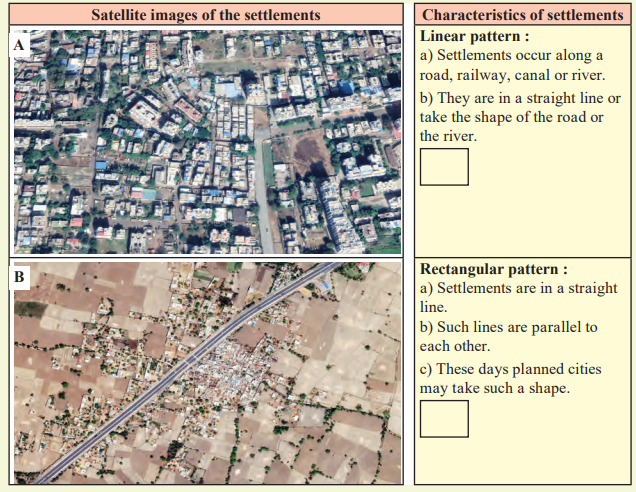
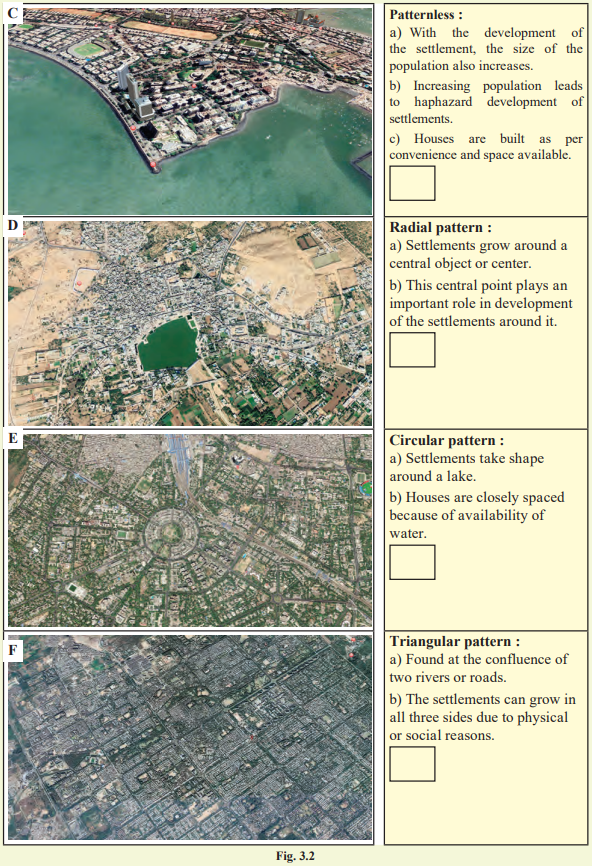
View full solution →Observe Fig A to F. They show various patterns of settlements. Try to understand the difference between them. Carefully read their characteristics in the second column. According to the applicable characteristics, write alphabet of the image settlement in the place provided below characteristics.
Nucleated and Dispersed Settlement
Radial pattern and Circular Pattern
Barren and Non-agricultural Land
Land Use and Land Cover
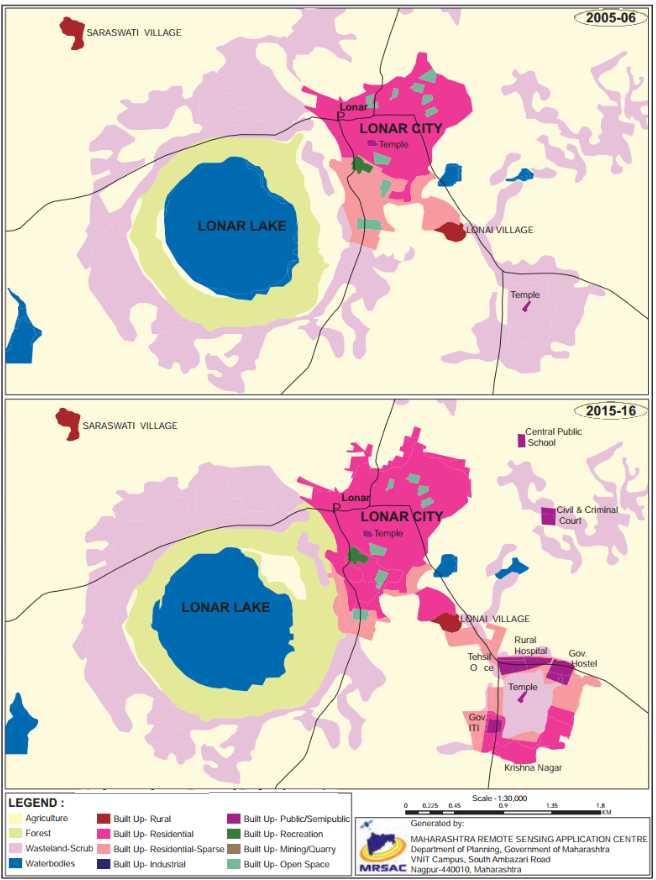
See map of Ichalkaranji city and observe how changes have occurred in the city over the years. Answer the questions that follow.
(i) Enlist the colours used for showing land uses in the index.
(ii) What do the blue and black lines show?
(iii) What is the name of the river in the map?
(iv) Name any two villages shown on the map.
(v) Which city is shown on the map?
See map of Ichalkaranji city and observe how changes have occurred in the city over the years. Answer the questions that follow.
(i) Which periods do the map belongs to?
(ii) Which land covers have reduced? What are their colours?
(iii)Which landcovers seen to have increased? what are their colours?
(iv) Which land cover has been replaced by increased landcovers?
(vi) Write a conclusive note comparing both the maps.
Different types of human settlements include hamlets, villages, small towns, large towns, isolated places, cities and conurbations. In some systems, types of human settlements are broken up into urban, suburban and rural; for example, the U.S. Census Bureau divides settlements into urban or rural categories based on precise definitions. Small settlements, such as hamlets and villages, have low populations and restricted access to services, larger types of settlements, such as cities, have higher populations, higher densities and greater access to services.
For example, a village may have only one or two general stores, while a large metropolis may have many specialized stores and chain stores. These differences are known as low-order service settlements and high-order service settlements. Larger settlements also have a sphere of influence affecting surrounding settlements. Settlements may also be divided by the site chosen, such as sites selected based on resources, trading points, defensive sites, shelter and relationship to water resources. The functions of human settlements also differ, as settlements may be established as ports, market towns and resorts. Types of rural settlements may also be classified by function, such as proximity to farming, fishing and mining. Settlements that focus on one economic activity are called single functional settlements. Human settlements may be permanent or temporary. For example, a refugee camp is a temporary settlement, while a city is a permanent settlement.
(1)Which human settlements are mentioned in the passage above?
(2)On what basis are urban and rural areas classified?
(3)What are the functions carried out in rural settlement?
(4)Explain the difference between low-order services and higher order service settlements.
| A | B | C |
| (1) Permanent pasture | (1) Land left fallow for more than 5 years | (1) Privately owned |
| (2) Area under miscellaneous tree crops | (2) Owned by village Panchayat | (2) It can be brought under cultivation |
| (3) Current fallow | (3) Orchards and fruit trees | (3) Common property resource |
| (4) Culturable waste-land | (4) Land left without cultivation for one or less than one agricultural year | (4) Cultural practice adopted for giving the land rest |
| A | B | C |
| (1) Linear pattern | (1) Around central object | (1) Houses are closely spaced |
| (2) Triangular pattern | (2) Along the road | (2) Straight line |
| (3) Circular pattern | (3) Around lake | (3) Three sides growth |
| (4) Radial pattern | (4) Confluence of river | (4) Around centre |
Generate a Human Settlements and Land Use paper free
Pick question groups from the list above, set marks and difficulty, and export a branded PDF with step-by-step answer keys. First 3 chapters free — no signup.