Questions

Answer the following in one or two sentence.

Take a timed test

60 questions · self-marked practice — reveal the answer and mark yourself.
Question 12 Marks
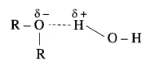
Arrange O – H, C – H and N – H bonds in increasing order of their bond polarity.
Answer
Increasing order of polarity :C – H, N – H, O – H
View full question & answer
Question 22 Marks
Give the reagents and conditions necessary to prepare phenol from
a. Chlorobenzene
b. Benzene sulfonic acid.
Answer
(1) From chlorobenzene : Reagents required : NaOH and dil. HC1 Temperature : 623 K, Pressure : 150 atm
(2) From Benzene sulphonic acid : Reagents required : aq NaOH, caustic soda, dil. HC1 Temperature : 573 K
View full question & answer
Question 42 Marks
Draw structures of following compounds:
(i) 2,5-DiethIphenoI
(ii) Prop-2-en-I-oI
(iii) 2-methoxypropane
(iv) Phenylmethanol
View full question & answer
Question 62 Marks
Write name of the electrophile used in Kolbe’s Reaction.
Answer
Electrophile : Carbon dioxide (O = C = O)
View full question & answer
Question 82 Marks
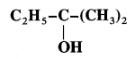
Write the IUPAC name of alcohol having molecular formula $C_4H_{10}O$ which is resistant towards oxidation.
View full question & answer
Question 102 Marks
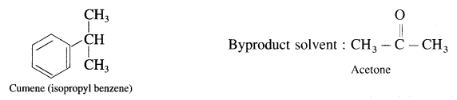
Write the name of reactant used for preparation of phenol, which gives byproduct used as solvent.
Answer
Reactant used in the preparation of phenol :

Image
View full question & answer
Question 112 Marks
How will you affect the following two-step conversions? Diethyl ether into n-butane :
Answer
$C _2 H _5- O - C _2 H _5+\underset{\text { conc (excess) }}{2 HI } \xrightarrow{\Delta} \underset{\text { Ethyl iodide }}{2 C _2 H _5 I + H _2 O }$
$\underset{\text { Ethyl iodide }}{ C _2 H _5 I + Na + C _2 H _5 I } \xrightarrow[\text { (Wurtz reaction) }]{\text { dry ether }} \underset{n \text {-Butane }}{ C _4 H _{10}}+ NaI$
View full question & answer
Question 122 Marks
An organic compound with the formula $C _4 H _{10} O _3$ shows properties of ether and alcohol. When treated with an excess of $HBr$ yields only one compound 1,2 dibromomethane. Write structural formula of ether and that of alcohol.
Answer
 When $C _4 H _{10} O _3$ is treated with excess of $HBr$, a single compound 1,2-dibromoethane is formed.
$HO - CH _2- CH _2- O - CH _2- CH _2- OH +\underset{\text { excess }}{4 HBr } \longrightarrow \underset{\text { 1, 2-dibromoethane }}{2 Br - CH _2- CH _2- Br +3 H _2 O }$
$\therefore$ The structural formula of $C _4 H _{10} O _3$ is $HO - H _2 C - CH _2- O - CH _2- CH _2- OH$
View full question & answer
Question 132 Marks
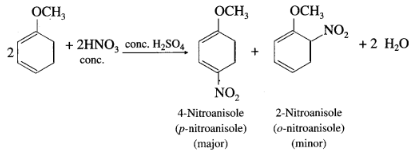
Describe the action of cone. $HNO_3$ on anisole.Write the equation of nitration of anisole.
Answer
When anisole is reacted with nitrating mixture $($cone. $HNO _3+$ cone. $Fl _2 SO _4 ),$ a mixture of $p$ nitroanisole and $o-$nitroanisole is obtained.
Image
View full question & answer
Question 142 Marks
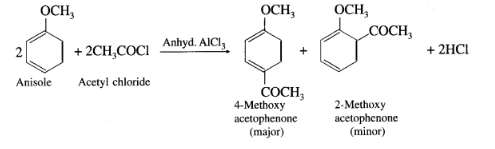
Describe the action of Acetyl chloride on anisole (Friedel-Crafts acylation).###Write the equation of the reaction Friedel-Crafts acylation of anisole.###Write a note on Friedel-Crafts acylation.
Answer
When anisole is treated with acetyl chloride in the presence of anhydrous aluminium chloride (a Lewis acid), 4-Methoxy acetophenone (major product) is obtained. The acetyl groups are introduced at -ortho and -para positions in anisole, the reaction is known as Friedel Craft’s acylation reaction.
Image
View full question & answer
Question 152 Marks
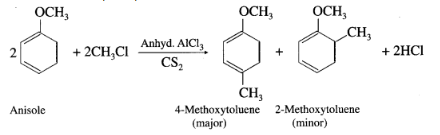
Describe the action of methyl chloride on anisole (Friedel-Crafts reaction).###Write the equation of Friedel-Crafts reaction-alkylation of anisole.
Answer
When anisole is treated with alkyl halide in the presence of anhydrous aluminium chloride (a Lewis acid) as catalyst, 4-Methoxy toluene is formed as major product. The alkyl groups are introduced at -ortho and -para positions in anisole, the reaction is known as Friedel-Crafts alkylation reaction.
Image
View full question & answer
Question 162 Marks
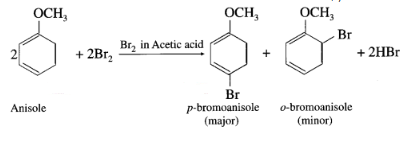
Describe the action of bromine in acetic acid on anisole.###Write the equation of the reaction of bromination of anisole in ethanoic acid medium.
Answer
When anisole is treated with bromine in acetic acid, /i-bromoanisole (major product) is obtained.

Image
View full question & answer
Question 172 Marks
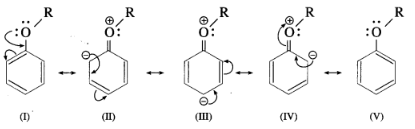
Draw the resonance structures of aromatic ethers.
Answer
The alkoxy group in aromatic ether is a ring activating and ortho-, paradirecting group toward electrophilic aromatic substitution.
Resonance structures :

Image
$+R$ Effect of - OR group results in increased electron density at the para- and two orthoposotions (see resonance structures II, III and IV).
View full question & answer
Question 182 Marks
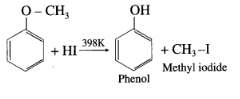
Describe the action of hydroiodic acid on the following :
Methyl phenyl ether (anisole).
Answer
When methyl phenyl ether (anisole) is treated with hydroiodic acid, phenol and methyl iodide is formed. Here, phenol does not react further with $HI$ because $- OH$ group is attached to $sp ^2$ hybridised carbon atom and it cannot be replaced by iodide (nucleophile).
Image
View full question & answer
Question 192 Marks
Describe the action of hydroiodic acid on the following :
Methyl n-propyl ether.
Answer
When methyl n-propyl ether (1-Methoxy propane) is treated with hydroiodic acid, a mixture of n-propyl alcohol and methyl iodide is formed.
Image
If excess of hydroiodic acid is available then n-propyl alcohol further reacts with hydroiodic acid at higher temperature to form n-propyl iodide and water.
Image
View full question & answer
Question 202 Marks
Describe the action of hydroiodic acid on the following :
Ethyl methyl ether.
Answer
When ethyl methyl (methoxy ethane) is treated with hydroiodic acid, a mixture of ethyl alcohol and methyl iodide is formed.
Image
If excess of hydroiodic acid is available, then ethyl alcohol further reacts with hydroiodic acid at higher temperature to form ethyl iodide and water.
$C _2 H _5 OH + HI \longrightarrow \underset{\text { Ethyl iodide }}{ C _2 H _5 I + H _2 O }$
View full question & answer
Question 212 Marks
Describe the action of hydroiodic acid on the following :
Diethyl ether.
Answer
When diethyl ether (ethoxy ethane) is treated with hydroiodic acid, a mixture of ethanol and ethyl iodide is formed.
$\begin{array}{ll} C _2 H _5- O - C _2 H _5+ HI \longrightarrow & C _2 H _5- OH +\underset{2}{ } C _2 H _5- I \\ \text { Diethyl ether } & \text { Ethanol } \quad \text { Ethyl iodide }\end{array}$

If excess of hydroiodic acid is available, then ethyl alcohol further reacts with hydroiodic acid at higher temperature to form ethyl iodide and water.
$\underset{\text { Ethanol }}{ C _2 H _5- OH + HI \longrightarrow} \underset{\text { Ethyl iodide }}{ C _2 H _5 I + H _2 O }$
View full question & answer
Question 222 Marks
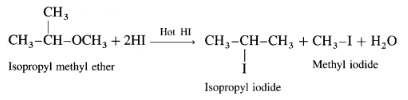
What is the action of hot HI on isopropyl methyl ether?
Answer
When isopropyl methyl ether is treated with excess of hot hydroiodic acid, a mixture of isopropyl iodide and methyl iodide is formed.
Image
View full question & answer
Question 232 Marks
What is the action of atmospheric oxygen on diethyl ether?
Answer
When atmospheric oxygen combines with diethyl ether, peroxide of diethyl ether is obtained.
Image
View full question & answer
Question 242 Marks
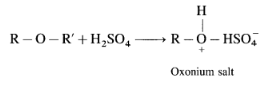
Explain laboratory test for ethers.
Answer
Ethers are neutral compounds in aqueous medium. Ethers do not react with bases, cold dilute acids, reducing agents, oxidizing agents and active metals. However, ethers dissolve in cold concentrated $H _2 SO _4$ due to formation of oxonium salts.
Image
This property distinguishes ethers from hydrocarbons.
View full question & answer
Question 252 Marks
Explain, the solubility/miscibility of ethers in water is similar to that of alcohols of comparable molecular mass.
Answer
The solubility/miscibility of ethers in water is similar to that of alcohols of comparable molecular mass. This is because ethers can form hydrogen bonds with water through ethereal oxygen.
Image
For example, diethyl ether and $n$-butyl alcohol have respective miscibilities of 7.5 and $9 g$ per 100 $g$ of water.
View full question & answer
Question 262 Marks
Explain, ethers posses a small net dipole moment.
Answer
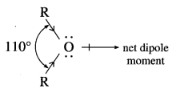
In ethers, Image bond angle is 110° and not 180°, bond dipole moments of the two C – O bonds do not cancel each other, therefore, ethers possess a smal net dipole moment, (for example, dipole moment of diethyl ether is 1.18 D)
Image
View full question & answer
Question 272 Marks
How is anisole obtained from phenol?###How is methoxy benzene prepared from carbolic acid?
Answer
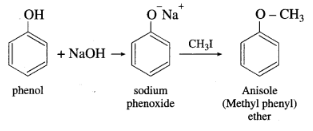
Phenol reacts with sodium hydroxide, sodium phenoxide is formed. When sodium phenoxide is heated with methyl iodide, anisole is obtained.
Image
View full question & answer
Question 282 Marks
How is diethyl ether (ethoxyethane) obtained from alcohol?
Answer
When excess of ethyl alcohol is distilled with concentrated sulphuric acid $\left( H _2 SO _4\right)$ at $413 K$, diethyl ether is formed.
$2 C _2 H _5 OH \xrightarrow[413 K ]{\text { Conc. } H _2 SO _4} \underset{\substack{\text { Ethexyethane } \\ \text { (diethyl ether) }}}{ C _2 H _5- O - C _2 H _5+ H _2 O }$
View full question & answer
Question 292 Marks
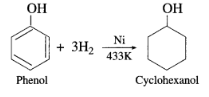
Explain catalytic hydrogenation of phenol.
Answer
When a mixture of vapours of phenol and hydrogen is passed over nickel catalyst at 433 K., cyclohexanol is obtained.
Image
View full question & answer
Question 302 Marks
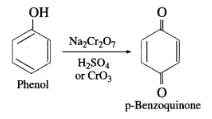
Explain the action of chromic acid on phenol.###How is phenol converted into benzoquinone?
Answer
When phenol is oxidised by chromic acid, a diketone, p-benzoquinone is formed. It is a conjugated diketone.
Image
View full question & answer
Question 312 Marks
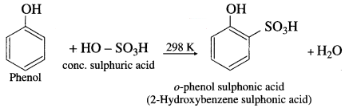
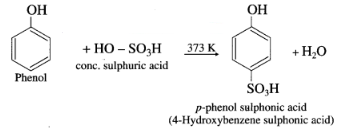
Explain the action of concentrated sulphuric acid on phenol at different temperatures.
Answer
(a) At room temperature : When phenol is treated with cone. $H _2 SO _4$ at room temperature (about $300 K$ ), o-phenol sulphonic acid is formed.
Image
(b) At $373 K$ : When phenol is treated with cone. $H _2 SO _4$ at about $373 K$, p-phenol sulphonic acid is formed.
Image
View full question & answer
Question 322 Marks
Explain the action of cone, nitric acid (nitrating mixture) on phenol (carbolic acid).###How is phenol converted into picric acid?
Answer
When phenol is warmed with a mixture of cone, nitric acid and cone, sulphuric acid (a nitrating mixture or the mixed acid), 2, 4, 6 – trinitrophenol, commonly called picric acid, is formed.
Image
View full question & answer
Question 332 Marks
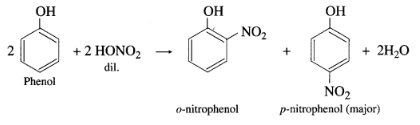
Explain the action of dilute nitric acid on phenol $($carbolic acid$).$Give equation of the reaction of dilute $HNO_3$ with phenol.
Answer
When phenol is treated with dilute nitric acid, a mixture of $o-$nitrophenol and $p-$nitrophenol is formed. In this reaction, $p-$nitrophenol is formed as the major product.
Image
View full question & answer
Question 342 Marks
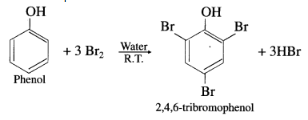
Explain the action of bromine water on phenol (carbolic acid).###Name the reagent used in the bromiriation of phenol to 2, 4, 6 tribromophenol.
Answer
When phenol is treated with bromine water, a yellowish white precipitate of 2, 4, 6 – tribromophenol is formed.

Image
View full question & answer
Question 352 Marks
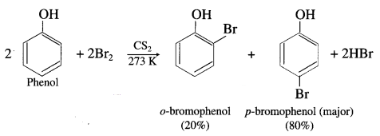
Explain the action of bromine in carbon disulphide $\left( CS _2\right)$ on phenol (carbolic acid).###Give equation of the reaction of bromine in $CS _2$ with phenol.
Answer
When phenol is stirred at a low temperature with bromine dissolved in a polar solvent such as carbon disulphide or $CCl _4$ at ( $273 K$ ), a mixture of o-bromophenol and p-bromophenol is formed, p-bromophenol is the major product.
Image
View full question & answer
Question 362 Marks
Explain oxidation of primary and secondary alcohols.
Answer
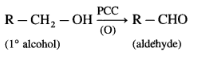
(1) Primary alcohol on oxidation with $CrO _3$ forms aldehyde. However, a better reagent to bring about this oxidation is PCC (pyridinium chlorochromate).
Image

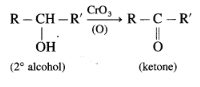
(2) Secondary alcohol on oxidation with chromic anhydride $\left( CrO _3\right)$ forms ketone.
Image
View full question & answer
Question 372 Marks
Describe the action of $SOCl_2$ on
$(1)$ ethanol   $(2)$ propan$-l-ol.$
Answer
$(1)$ Ethanol : When ethanol is treated with $SOCl _2$ in the presence of pyridine, ethyl chloride is obtained.
$CH _3- CH _2- OH + SOCl _2 \longrightarrow CH _3- CH _2- Cl + SO _2+ HCl$
 Ethanol  Ethyl Chloride 
$(2)$ Propan$-l-ol :$ When propan$-l-ol$ is treated with $SOCl_2$ in the presence of pyridine, $w-$propyl chloride is obtained.
Image
View full question & answer
Question 382 Marks
Describe the action of $PCl_5$ on
$(1)$ ethanol
$(2)$ propan$-2-ol.$
Answer
$(1)$ Ethanol : When ethanol is treated with $PCl_5,$ ethyl chloride is obtained.
Image
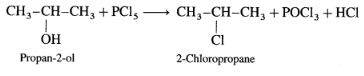
$(2)$ Propan$-2-ol :$ When propan$-2-ol$ is treated with $PCl_5, 2-$chloropropane is obtained.
Image
View full question & answer
Question 392 Marks
Explain the action of hydroiodic acid on the following :
(1) Propan-2-ol
(2) 3-Methyl butan-2-ol.
Answer
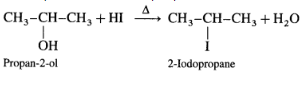
(1) Propan-2-ol : When propan-2-ol is heated with hydroiodic acid, 2-iodopropane is formed.
Image
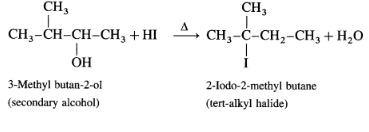
(2) 3-Methyl butan-2-ol : When 3-Methyl butan-2-ol is heated with hydroiodic acid, 2-Iodo-2-methyl butane is obtained. Here, secondary alcohol is converted into a tertiary alkyl halide.
Image
View full question & answer
Question 402 Marks
What is the action of acetic anhydride on salicyclic acid?
Answer
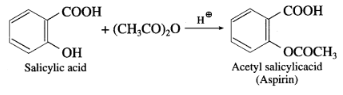
When acetic anhydride is treated with salicyclic acid in presence of glacial acetic acid, acetyl salicyclic acid (aspirin) is obtained.
Image
Aspirin is a common analgesic, antipyretic drug. Reactions involving breaking of C – O bond of alcohol :
View full question & answer
Question 412 Marks
What is Lucas reagent? What are its uses?
Answer
Lucas reagent is composed of a mixture of concentrated $HCl$ and Lewis acid. anhydrous $ZnCl _2$.

It is used to prepare alkyl chlorides and distinguish between $10,2^{\circ}$ and $3^{\circ}$ alcohols.

Image
View full question & answer
Question 422 Marks
Explain the action of sodium on ethanol.
Answer
When cthanol is treated with sodium metal, sodium ethoxide is formed and hydrogen gas is liberated.
$\underset{\text { Ethanol }}{2 CH _3- CH _2- OH +2 Na \longrightarrow} \underset{\text { Sodium ethoxide }}{2 CH _3- CH _2- ONa + H _2 \uparrow}$
Liberation of $H _2$ gas is used to detect the presence of alcoholic $- OH$ group of a molecule.
View full question & answer
Question 432 Marks
Write the action of aq NaOH on phenol and the product obtained is acidified.
Answer
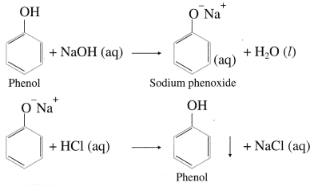
Phenols dissolve in aqueous NaOH by forming water soluble sodium phenoxide and are reprecipitated/ regenerated as phenols on acidification with HC1.
Image
View full question & answer
Question 442 Marks
Explain laboratory test of alcohols and phenols.
Answer
Laboratory test : Aqueous solution of alcohols and phenols can be tested with litmus paper. Aqueous solution of alcohols is neutral to litmus (neither blue nor red litmus change colour). Aqueous solutions of phenols turn blue litmus red. Thus, phenols have acidic character.
View full question & answer
Question 452 Marks
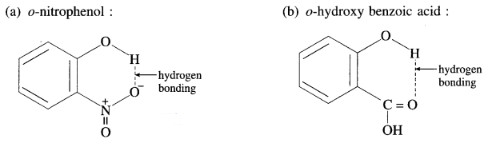
Draw intramolecular hydrogen bonding structures in the following compounds :
(a) o-nitrophenol
(b) o-hydroxy benzoic acid.
Answer
(a) o-nitrophenol :
Image
(b) o-hydroxy benzoic acid:
View full question & answer
Question 462 Marks
Image
Answer
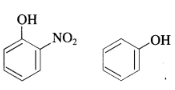
In p-nitrophenol, nitro group ( $NO2$ ) is an electron-withdrawing group present at ortho position which enhances the acidic strength ( -1 effect). The $O - H$ bond is under strain and release of proton $\left( H ^{+}\right)$becomes easily. Hence, o-nitrophenol is more acidic than phenol.
View full question & answer
Question 472 Marks
Image
Answer
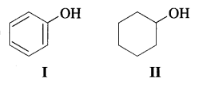
Due to high electronegativity of $sp ^2$-hybridized carbon, electron density on oxygen in phenol (I) decreases. This increases the polarity of $O - H$ bond and results in more ionization of phenol than that of cyclohexyl alcohol (II). Therefore, phenol is more acidic than cyclohexyl alcohol.
View full question & answer
Question 512 Marks
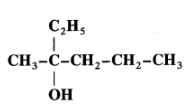
Using Grignard reagent, suggest synthesis of following alcohols from aldehydes or ketones. Wherever possible, suggest more than one combination.
Image
View full question & answer
Question 522 Marks
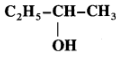
Using Grignard reagent, suggest synthesis of following alcohols from aldehydes or ketones. Wherever possible, suggest more than one combination.
Image
View full question & answer
Question 532 Marks
Using Grignard reagent, suggest synthesis of following alcohols from aldehydes or ketones. Wherever possible, suggest more than one combination.
$CH _3- CH _2- CH _2- OH$
View full question & answer
Question 542 Marks
Using Grignard reagent, suggest synthesis of following alcohols from aldehydes or ketones. Wherever possible, suggest more than one combination.
Image
View full question & answer
Question 552 Marks
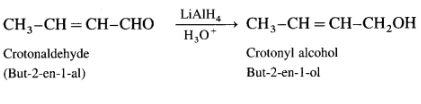
How is Crotoflyl alcohol obtained from crotonaldehyde?
Answer
When crotonaldehyde is reduced in the presence of lithium aluminium hydride, the produc obtained is hydrolysed to give crotonyl alcohol. Here. $LiA1H_4$ does not reduce carbon$-$carbon double bond.
Image
View full question & answer
Question 562 Marks
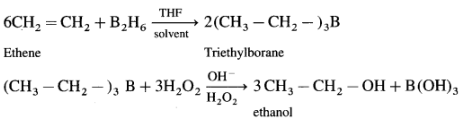
How is ethanol prepared using diborane?
Answer
When diborane is treated with ethene in the presence of THF an addition product triethylborane is formed.Triethylborane is then oxidised with hydrogen peroxide to form ethyl alcohol.
Image
View full question & answer
Question 572 Marks
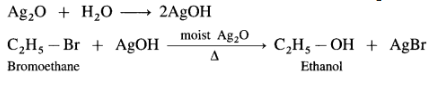
How are following compounds prepared from alkyl halides using moist silver oxide?
(1) Ethanol
(2) Propan-2-ol.
Answer
(1) Bromoethane $\left( C _2 H _5 Br \right)$ when boiled with moist $Ag _2 O$ undergoes hydrolysis and forms $C _2 H _5 OH$.
Image

(2) When 2-chloropropane is boiled with moist Ag20, propan-2-ol is formed.
Image
View full question & answer
Question 582 Marks
How is alkyl halide converted into alcohol by using
(1) Aqueous $NaOH$ (or $KOH$ ),
(2) Moist silver oxide?
Answer
(1) When an alkyl halide ( $R-X$ ), is boiled with aqueous $NaOH$ (or $KOH$ ) an alcohol is obtained,
$\begin{aligned}
& R - X + NaOH \xrightarrow[( aq )]{\text { boil }} R - OH + NaX \\
& (R-X+K O H \underset{(a q)}{\text { boil }} R-O H+K X)
\end{aligned}$

(2) Alkyl halide when heated with moist $Ag _2 O$, undergoes hydrolysis and forms an alcohol.
$\begin{aligned}
& Ag _2 O + H _2 O \longrightarrow 2 AgOH \\
& R - X + AgOH \xrightarrow{\Delta} R - OH + AgX
\end{aligned}$
View full question & answer
Question 592 Marks
What is phenol? ### Define carbolic acid.
Answer
The hydroxy derivative of benzene in which the OH group is directly attached to benzene ring is called phenol.
Image
View full question & answer
Question 602 Marks
What are phenols (carbolic acids)?
Answer
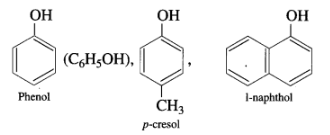
Hydroxy derivatives of aromatic hydrocarbons in which the hydroxyl group is directly attached to the aromatic ring are called phenols.
Examples:
Image
View full question & answer