Questions

Answer the following in brief.

Take a timed test

33 questions · self-marked practice — reveal the answer and mark yourself.

Question 13 Marks
It is enough to add a few mL of a buffer solution to maintain its pH. Which property of buffer is used here ?
Answer
The important property of reserve acidity and reserve basicity of a buffer solution is used to maintain constant pH. Weak acid or weak base along with ions (cations or anions) from salt react with excess of added acid (H+) or base [OH–] and maintain pH constant.

View full question & answer
Question 23 Marks
Home made jams and jellies without any added chemical preservative additives spoil in a few days whereas commercial jams and jellies have a long shelf life. Explain. What role does added sodium benzoate play ?
Answer
Sodium benzoate added to jams and jellies in commercial products maintains the pH constant and acts as a preservative. Hence jams and jellies are not spoiled for a very long time unlike homemade products.
View full question & answer
Question 33 Marks
Suppose that pH of monobasic and dibasic acid is the same. Does this mean that the molar concentrations of both acids are identical ?
Answer
Even if monobasic acid and dibasic acid give same pH , their molar concentrations are different. One mole of monobasic acid like HCl gives 1 mol of $H ^{+}$while one mole of dibasic acid gives 2 mol of $H ^{+}$in solution. Hence the concentration of dibasic acid will be half of the concentration of monobasic acid. For example, for same pH .
[Monobasic acid] $=[$ Dibasic acid $] / 2$
View full question & answer
Question 43 Marks
In NaOH solution $\left[ OH ^{-}\right]$is $2.87 \times 10^{-4}$. Calculate the pH of solution.
Answer
$\text { Given : }\left[ OH ^{-}\right]=2.87 \times 10^{-4} M , pH =?$
$pOH =-\log _{10}\left[ OH ^{-}\right]$
$=-\log _{10} 2.87 \times 10^{-4}$
$=-(\overline{4} .4579)$
$=(4-0.4579)$
$=3.5421$
$\because pH + pOH =14$
$\therefore pH =14- pOH =14-3.5421=10.4579$
$pH =10.4579 .$
View full question & answer
Question 53 Marks
pH of a weak monobasic acid is 3.2 in its 0.02 M solution. Calculate its dissociation constant.
Answer
$ \text { Given: } pH =3.2 ; C =0.02 M ; K _{ a }=?$
$pH =-\log _{10}\left[ H ^{+}\right]$
$\therefore\left[ H ^{+}\right]=\text {Antilog }- pH$
$=\text { Antilog }-3.2$
$=\text { Antilog } \overline{4} .8$
$=6.31 \times 10^{-4} M$
$HA _{( aq )} \rightleftharpoons H ^{+}+ A ^{-}$
$c(1-\alpha) \ \ \ c \alpha \ \ \ \ \ \ c \alpha$
$\because\left[ H ^{+}\right]=c \alpha$
$\alpha=\frac{\left[ H ^{+}\right]}{c}=\frac{6.31 \times 10^{-4}}{0.02}=0.0315$
$K _{ a }= c \alpha^2$
$=0.02 \times(0.0315)^2$
$=1.984 \times 10^{-5} $ Dissociation constant $= K _{ a }=1.984 \times 10^{-5}$
View full question & answer
Question 63 Marks
Aqueous solution of sodium carbonate is alkaline whereas aqueous solution of ammonium chloride is acidic. Explain.
Answer
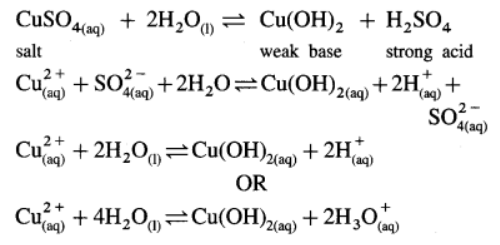
(A) (i) Sodium carbonate is a salt of weak acid and strong base.
(ii) In aqueous solution it undergoes hydrolysis.Image
(iii) Strong base dissociates completely while weak acid dissociates partially since $\left[ OH ^{-}\right]>\left[ H _3 O ^{+}\right]$, the solution is basic.
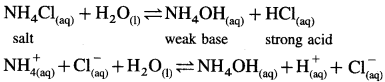
(B) (i) Ammonium chloride is a salt of strong acid and weak base.
(ii) In aqueous solution it undergoes hydrolysis
Image
(iii) Since $\left[ H ^{+}\right]$or $\left[ H _3 O ^{+}\right]>\left[ OH ^{-}\right]$the solution is acidic.
View full question & answer
Question 73 Marks
Derive the relation pH + pOH = 14.
Answer
The ionic product of water, Kw is given by, $KW =\left[ H _3 O ^{+}\right] \times\left[ OH ^{-}\right]$
At $298 K _{,} K _{ w }=1 \times 10^{-14}$
$\therefore pK _{ w }=-\log _{10} K _{ w }=\log _{10} 1 \times 10^{-14}=14$
$\because\left[ H _3 O ^{+}\right] \times\left[ OH ^{-}\right]=1 \times 10^{-14}$
Taking logarithm to base 10 of both sides, $\log _{10}\left[ H _3 O ^{+}\right]+\log _{10}\left[ OH ^{-}\right]=\log _{10} 1 \times 10^{-14}$
Multiplying both the sides by -1 ,
$-\log _{10}\left[ H _3 O ^{+}\right]-\log _{10}\left[ OH ^{-}\right]=-\log _{10} 1 \times 10^{-14}$
$\because pH =-\log _{10}\left[ H _3 O ^{+}\right] ; pOH =-\log _{10}\left[ OH ^{-}\right] ;$
pKw $=-\log _{10} K _{ w }$
$\therefore pH + pOH = pK _{ w }$
OR $ pH + pOH =14$
View full question & answer
Question 83 Marks
Acetic acid is 5% ionised in its decimolar solution. Calculate the dissociation constant of acid.
Answer
Given : $C =0.1 M ;$ Dissociation $=5 \%, K _{ a }=2$ Percent dissociation
$
\begin{aligned}
\alpha & =\frac{\text { Percent dissociation }}{100} \\
& =\frac{5}{100}=0.05 \\
K_{ a } & =\frac{C \alpha^2}{1-\alpha}=\frac{0.1 \times(0.05)^2}{1-0.05} \\
& =\frac{0.1 \times(0.05)^2}{0.95} \text { } \\
& =2.63 \times 10^{-4}
\end{aligned}
$
Dissociation constant of acid $= K _{ a }=2.63 \times 10^{-4}$Given : $C =0.1 M ;$ Dissociation $=5 \%, K _{ a }=2$ Percent dissociation
$
\begin{aligned}
\alpha & =\frac{\text { Percent dissociation }}{100} \\
& =\frac{5}{100}=0.05 \\
K_{ a } & =\frac{C \alpha^2}{1-\alpha}=\frac{0.1 \times(0.05)^2}{1-0.05} \\
& =\frac{0.1 \times(0.05)^2}{0.95} \text { } \\
& =2.63 \times 10^{-4}
\end{aligned}
$
Dissociation constant of acid $= K _{ a }=2.63 \times 10^{-4}$
View full question & answer
Question 93 Marks
Ammonia serves as a Lewis base whereas $AlCl _3$ is Lewis acid. Explain.
Answer
  • Since ammonia molecule, NH3 has a lone pair of electrons to donate it acts as a Lewis base.
  • $AlCl _3$ is a molecule with incomplete octet hence it is electron deficient and acts as a Lewis acid.
View full question & answer
Question 103 Marks
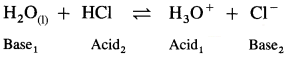
Write a reaction in which water acts as a base.
Answer

Image

Since water accepts a proton, it acts as a base.

View full question & answer
Question 113 Marks
Label the conjugate acid-base pair in the following reactions a. $HCl + H _2 O \rightleftharpoons H _3 O ^{+}+ Cl ^{-}$ b. $CO _3^{2-}+ H _2 O \rightleftharpoons OH ^{-}+ HCO _3^{-}$
View full question & answer
Question 123 Marks
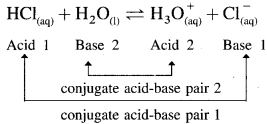
What is meant by conjugate acid-base pair?
Answer
Conjugate acid-base pair : A pair of an acid and a base differing by a proton is called a conjugate acid-base pair.

Image

View full question & answer
Question 133 Marks
What are acids and bases according to Arrhenius theory ?
Answer
According to Arrhenius theory: Acid: It is a substance which contains hydrogen and on dissolving in water produces hydrogen ions $\left( H ^{+}\right)$E.g. $HCl$ $ HCl _{( aq )} \rightleftharpoons H _{( aq )}^{+}+ Cl _{( aq )}^{-} $ Base : It is a substance which contains $OH$ group and on dissolving in water produces hydroxyl ions $\left( OH ^{-}\right)$. E.g. $NaOH$ $ NaOH _{( aq )} \rightleftharpoons Na _{( aq )}^{+}+ OH _{( aq )}^{-} $
View full question & answer
Question 143 Marks
Explain the effect of common ion on the dissociation of weak base.
Answer
(1) Consider the dissociation or ionisation of a weak base, $NH _4 OH$ in its dilute solution.
$NH _4 OH _{( aq )} \rightleftharpoons NH _{4( aq )}^{+}+ OH _{( aq )}^{-}$
The dissociation constant $K _{ b }$ for $NH _4 OH$ will be,
$K_{ b }=\frac{\left[ NH _4^{+}\right] \times\left[ OH ^{-}\right]}{\left[ NH _4 OH \right]}$
(2) If a strong electrolyte like salt $NH _4 Cl$ is added to the solution of $NH _4 OH$, then it gives common ion $NH _4^{+}$.
$NH _4 Cl \rightarrow NH _4^{+}+ Cl ^{-}$
(3) Due to common ion $NH _4^{+}$, overall concentration of $NH _4^{+}$is increased, which increases the ratio $\left[ NH _4^{+}\right] \times\left[ OH ^{-}\right] /\left[ NH _4 OH \right]$,
In order to keep this ratio constant, the equilibrium is shifted to the left hand side which satisfies Le Chatelier's principle.
(4) Thus the ionisation of a weak base is suppressed by a common ion.
View full question & answer
Question 153 Marks
Explain the common ion effect on dissociation of a weak acid.
Answer
(1) Consider the dissociation or ionisation of a weak acid, $CH _3 COOH$ in its solution.
$CH _3 COOH _{( aq )} \rightleftharpoons CH _3 COO _{( aq )}^{-}+ H _{( aq )}^{+}$
The dissociation constant $Ka$ for $CH _3 COOH$ will be,
$K _{ a }=\frac{\left[ CH _3 COO ^{-}\right] \times\left[ H ^{+}\right]}{\left[ CH _3 COOH \right]}$
$K _{ a }$ is constant for $CH _3 COOH$ at constant temperature.

(2) If a strong electrolyte like salt $CH _3 COONa$ is added to the solution of $CH _3 COOH$, then on dissociation it gives a common ion $CH _3 COO ^{-}$.
$CH _3 COONa \rightarrow CH _3 COO ^{-}+ Na ^{+}$

(3) Due to common ion $CH _3 COO ^{-}$, overall concentration of $CH _3 COO ^{-}$in the solution is increased which increases the ratio, $\frac{\left[ CH _3 COO ^{-}\right] \times\left[ H ^{+}\right]}{\left[ CH _3 COOH \right]}$. In order to keep this ratio constant, the concentration of $H ^{+}$is decreased, by shifting the equilibrium to the left hand side according to Le Chatelier's principle.

(4) Thus the ionisation of a weak acid is suppressed by a common ion.
View full question & answer
Question 163 Marks
Explain common ion effect with suitable example.
View full question & answer
Question 173 Marks
At $298 K$, the solubility of silver sulphate is $1.85 \times 10^{-2} mol dm ^{-3}$. Calculate the solubility product of silver sulphate.
Answer
Given : Silver sulphate dissociates as follows :
$\begin{aligned}
\underset{(solid)}{Ag _2 SO _4} \rightleftharpoons 2 Ag _{( aq )}^{+}+ SO _{4( aq )}^{2-} \\
K_{ sp }=\left[ Ag ^{+}\right]^2\left[ SO _{4( aq )}^{2-}\right]
\end{aligned}$
Solubility of $Ag _2 SO _4=1.85 \times 10^{-2} mol dm ^{-3}$
$K _{ sp }=$ Solubility product of $Ag _2 SO _4=$ ?
$\left[ Ag ^{+}\right]=$Concentration of $Ag ^{+}$ion
$=2 \times 1.85 \times 10^{-2}=3.70 \times 10^{-2} mol dm ^{-3}$
[latex $] \backslash$ mathrm $\{S O\}_{-}\{4\} \wedge\{2-\}[/$ latex $]=$ Concentration of $SO _4^{2-}$
$\begin{aligned}
& =1.85 \times 10^{-2} mol dm ^{-3} \\
& \therefore K _{\text {sp }}=\left(3.70 \times 10^{-2}\right)^2 \times\left(1.85 \times 10^{-2}\right) \\
& =13.69 \times 10^{-4} \times 1.85 \times 10^{-2} \\
& =25.33 \times 10^{-6} \\
& =2.533 \times 10^{-5}
\end{aligned}$
Solubility product of $Ag _2 SO _4$
$=2.533 \times 10^{-5}$
View full question & answer
Question 183 Marks
The solubility product of magnesium hydroxide is $1.4 \times 10^{-11}$. Calculate the solubility of magnesium hydroxide.
Answer
Given : $K _{\text {sp }}=1.4 \times 10^{-11} ; S =$ ?
Magnesium hydroxide dissociates as shown below:
$\begin{aligned}
& Mg ( OH )_2 \rightleftharpoons Mg ^{2+}+2( OH )^{-} \\
& K _{ sp }=\left[ Mg ^{2+}\right]\left[ OH ^{-}\right]^2
\end{aligned}$
Let the solubility of $Mg ( OH )_2$ be $S mol dm { }^{-3}$.
$\therefore\left[ Mg ^{2+}\right]=$ Concentration of $Mg ^{2+}$ ions
$= S mol dm ^{-3}$
$\therefore\left[ OH ^{-}\right]=$Concentration of $OH ^{-}$ions
$=2 S mol dm ^{-3}$$\begin{aligned}
& \therefore K _{\text {sp }}= S \times(25)^2=4 S ^3 \\
& K _{ sp }=1.4 \times 10^{-11} \\
& \therefore 1.4 \times 10^{-11}=4 S^3 \\
& 1.4 \times 10^{-11}=4 S^3 \text {. } \\
& S=\sqrt[3]{\frac{1.4 \times 10^{-11}}{4}}=\sqrt[3]{0.35 \times 10^{-11}} \\
& =\sqrt[3]{3.5 \times 10^{-12}} \quad \\
& S=1.518 \times 10^{-4} mol dm ^{-3} \\
\end{aligned}$
Solubility of $Mg ( OH )_2$
$=1.518 \times 10^{-4} mol dm ^{-3}$
View full question & answer
Question 193 Marks
The solubility of lead sulphate is $3.03 \times 10^{-5} kg / dm ^3$. Calculate its solubility product. [Molecular mass of $\left.PbSO _4=303\right]$
Answer
Given : $S=3.03 \times 10^{-5} kg dm ^{-3}, K _{ sp }=$ ?
Lead sulphate dissociates as
$PbSO _4 \rightleftharpoons Pb ^{2+}+ SO _4^{2-}$
$($ solid $) \quad(aq) \quad(aq)$
Molecular weight of $PbSO _4=303$
$=303 \times 10^{-3} kg$
The solubility of $PbSO _4$ is $3.03 \times 10^{-5} kg / dm ^3$.
Solubility in $mol dm ^{-3}$
Weight of $PbSO _4$ per $dm ^3$ Molecular weight $3.03 \times 10^{-5}$
$\begin{aligned}
& =\frac{\text { Weight of } PbSO _4 \text { per } dm ^3}{\text { Molecular weight }} \\
& =\frac{3.03 \times 10^{-5}}{303 \times 10^{-3}}=1.0 \times 10^{-4} mol dm ^{-3} \\
& K_{\text {sp }}=\left[ Pb ^{2+}\right]\left[ SO _4^{2-}\right] \\
& {\left[ Pb ^{2+}\right]=\left[ SO _4^{2-}\right]=1.0 \times 10^{-4} mol dm ^{-3}} \\
& \begin{aligned}
\therefore K_{\text {sp }} & =\left(1.0 \times 10^{-4}\right) \times\left(1.0 \times 10^{-4}\right) \\
= & 1.0 \times 10^{-8} \quad \text {  }
\end{aligned}
\end{aligned}$
Solubility product $= 1 . 0 \times 1 0 ^{-8}$.
View full question & answer
Question 203 Marks
Write expression for solubility and solubility product of following sparingly soluble salts :
$(1) \ AgBr\ (2) \ PbI _2\ (3) \ Al ( OH )_3$
Answer
In general, for a sparingly soluble salt $A_x B_y$,
$K _{ sp }= x ^{ x } \cdot y ^{ y } \cdot( S )^{ x + y }$
$(1)$ For binary electrolyte $(BA$ type$)$ :
$ AgBr _{( s )} {\rightleftharpoons} \underset{x=1}{ Ag _{( aq )}^{+}}+\underset{y=1}{ Br _{( aq )}^{-}}$
$ \therefore K_{ sp } =x^x \cdot y^y \cdot(S)^{x+y}$
$ =1^1 \times 1^1 \times( S )^{1+1}$
$ =S^2$
$\therefore S=\sqrt{K_{\text {sp }}} mol dm ^{-3}$
$\text { (2) } PbI _{2(s)} \rightleftharpoons \underset{x=1}{ Pb _{\text {(aq) }}^{2+}}+ \underset{y=2}{2 I _{( aq )}^{-}}$
$\therefore K_{ sp }=x^x \cdot y^y \cdot(S)^{x+y}$
$=1^1 \times 2^2 \times( S )^{1+2}$
$=4 S^3$
$\therefore S=\left(\frac{K_{ sp }}{4}\right)^{\frac{1}{3}} \ mol \ dm ^{-3}$
$(3) Al ( OH )_{3(s)} \rightleftharpoons Al _{( aq )}^{3+}+3 OH _{( aq )}^{-}$
$K_{ sp }= {\left[ Al ^{3+}\right] \times\left[ OH ^{-}\right]^3 }$
$\therefore K_{ sp } =x^x \cdot y^y .(S)^{x+y}$
$ =1^1 \times 3^3 \times(S)^{1+3}$
$ =27 S^4$
$ \therefore S=\left(\frac{K_{ sp }}{27}\right)^{\frac{1}{4}}\  mol \ dm ^3$
View full question & answer
Question 213 Marks
$0.2 dm ^3$ acidic buffer solution contains $1.18 g$ acetic acid and $2.46 g$ sodium acetate. If $K _{ a }$ for acetic acid is $1.8 \times 10^{-5}$ at $25^{\circ} C$, find $pH$ of the solution.
Answer
Given : $W_{ CH _3 COOH }=1.18 g$;
$W_{ CH _3 COONa }=2.46 g;$
$V=0.2 dm ^3, K_{ aCH _3 COOH }=1.8 \times 10^{-5} ; pH =$ ?
$n_{ CH _3 COOH }=\frac{W_{ CH _3 COOH }}{M_{ CH _3 COOH }}=\frac{1.20}{60}=0.02 mol$
$n_{ CH _3 COONa }=\frac{W_{ CH _3 COONa }}{M_{ CH _3 COONa }}=\frac{2.46}{82}=0.03 mol$
$\left[ CH _3 COOH \right]=\frac{n_{ CH _3 COOH }}{V}=\frac{0.02}{V} M$;
$\left[ CH _3 COONa \right]=\frac{n_{ CH _3 COONa }}{V}=\frac{0.03}{V}$
$\begin{aligned}
p K_{ a } & =-\log _{10} K_{ a } \\
& =-\log _{10} 1.8 \times 10^{-5} \\
& =-(\overline{5} .2553) \\
& =4.7447
\end{aligned}$

$pH = p K_{ a }+\log _{10} \frac{[\text { Salt }]}{[\text { Acid }]}$
$\begin{aligned}
& =4.7447+\log _{10} \frac{\frac{0.03}{V}}{\frac{0.02}{V}} \\
& =4.7447+0.1761 \\
& =4.9208 \quad
\end{aligned}$

$pH =4.9208$
View full question & answer
Question 223 Marks
Explain a buffer action of a basic buffer.
View full question & answer
Question 233 Marks
Explain a buffer action of an acidic buffer.
View full question & answer
Question 243 Marks
What are the types of buffer solutions ?
Answer
These are two types of buffer solutions :
(A) Acidic buffer solution : it is a solution containing a weak acid e.g. $\left( CH _3 COOH \right)$ and its salt of a strong base. e.g. ( $CH _3 COONa$ ).
$pH$ of an acidic buffer is given by following Henderson Hasselbalch equation,
$pH = p K_{ a }+\log _{10} \frac{[\text { Salt }]}{[\text { Acid }]}$
where $pK _{ a }=-\log _{10} K _{ a }$
and $K _{ a }$ is the dissociation constant of weak acid.

(B) Basic buffer solutions : It is a solution containing a weak base (e.g. $NH _4 OH$ ) and its salt of strong acid, (e.g. $NH _4 Cl$ ).
pOH of a basic buffer is given by Henderson Hassebalch equation,
$pOH = p K_{ b }+\log _{10} \frac{[\text { Salt }]}{[\text { Base }]}$
where $pK _{ b }=-\log 10 K _{ b }$
and $K_b$ is the dissociation constant of a weak base.
View full question & answer
Question 263 Marks
A salt of strong acid and strong base does not undergo hydrolysis. Explain.
###
An aqueous solution of sodium chloride is neutral. Explain.
Answer
(1) Sodium chloride is a salt of strong acid $HCl$ and strong base $NaOH$.
(2) In water, it reacts forming $HCl$ and $NaOH$.
(3) As both are strong, they dissociate almost completely to liberate $H ^{+}$and $OH ^{-}$ions, respectively.
(4) $H ^{+}$and $OH ^{-}$ions combine together to form weakly dissociating $H _2 O$. As there are no free $H ^{+}$ ions and $OH ^{-}$ions, the solution is neutral and the salt does not undergo hydrolysis.
$NaCl + H _2 O \rightleftharpoons NaOH + HCl$
$\begin{aligned}
& Na ^{+}+ Cl ^{-}+ H _2 O \rightleftharpoons Na ^{+}+ OH ^{-}+ H ^{+}+ Cl ^{-} \\
& H _2 O \rightleftharpoons H ^{+}+ OH ^{-}
\end{aligned}$
Since the solution contains equal number of $H ^{+}$and $OH ^{-}$ions, it is neutral.
Hence the salt of strong acid and strong base does not undergo hydrolysis.
View full question & answer
Question 273 Marks
$NH _4 OH$ is $4.3 \%$ ionised at $298 K$ in $0.01 M$ solution. Calculate the ionization constant and $pH$ of $NH _4 OH$.
Answer
Given : Per cent dissociation $=4.3$,
$C =0.01 M , K _{ b }=?, pH =?$
The degree of dissociation and dissociation constant of $NH _4 OH$ are related to each other by the formula :
$K_b=\alpha^2 C$
$K _{ b }=$ Dissociation constant of $NH _4 OH =$ ?
$\alpha=$ Degree of dissociation of $NH _4 OH =4.3 \%$
$=4.3 \times 10^{-2}$
$C =$ Molar concentration of $NH _4 OH =0.01 M$
$\begin{aligned}
& \therefore K _{ b }=\left(4.3 \times 10^{-2}\right)^2 \times 0.01 \\
& =18.49 \times 10^{-4} \times 10^{-2} \\
& \therefore K _{ b }=1.849 \times 10^{-5}
\end{aligned}$
>Since $NH _4 OH$ is a monoacidic base,
$\begin{aligned}
& {\left[ OH ^{-}\right]=\alpha C} \\
& =4.3 \times 10^{-2} \times 0.01 \\
& =4.3 \times 10^{-4} mol dm ^{-3} \\
& pOH =-\log _{10}[ OH -] \\
& =-\log _{10} 4.3 \times 10^{-4} \\
& =-[0.6335-4]=3.3665 \\
& pH + pOH =14 \\
& pH =14-3.3665=10.6335 \\
& K _{ b }=1.849 \times 10^{-5}, pH =10.6335 \\
&
\end{aligned}$
View full question & answer
Question 283 Marks
The $pH$ of a $0.2 M$ solution of ammonia is $10.78$ . Calculate $(i) \ OH ^{-}$ions concentration $(ii)$ the degree of dissociation $(iii)$ the dissociation constant.
Answer
Given: $pH =10.78, C =0.02 M ,\left[ OH ^{-}\right]=? K _{ b }=?$
As $NH _3$ is a base,
$pOH =14- pH$
$ pH =10.78$
$ \therefore pOH =14-10.78=3.22$
$ pOH =-\log _{10}\left[ OH ^{-}\right]$
$ \therefore 3.22=-\log _{10}\left[ OH ^{-}\right]$
$ \therefore-3.22=\log _{10}\left[ OH ^{-}\right]$
$ {\left[ OH ^{-}\right]=\operatorname{antilog}(-3.22)}$
$ \therefore\left[ OH ^{-}\right]=\operatorname{antilog}(\overline{4} .78)$
$ =6.026 \times 10^{-4} M$
As $NH _4 OH$ is a monoacidic base, $\left[ OH ^{-}\right]$
${\left[ OH ^{-}\right]=\alpha C \therefore \alpha=\frac{\left[ OH ^{-}\right]}{C}}$
$C=0.02\ mol\ dm ^{-3}$
$\therefore \alpha=\frac{6.026 \times 10^{-4}}{0.02}$
$=3.013 \times 10^{-2} $$ \therefore K_{ b } =\alpha^2 C$
$ =\left(3.013 \times 10^{-2}\right)^2 \times 0.02$
$ =9.078 \times 10^{-4} \times 2 \times 10^{-2}$
$ =18.156 \times 10^{-6} \doteqdot 1.816 \times 10^{-5} $
$\left[ OH ^{-}\right]=6.026 \times 10^{-4}\ mol\ dm ^{-3}$,
$\alpha=3.013 \times 10^{-2}$
$K_b=1.816 \times 10^{-5}$
View full question & answer
Question 293 Marks
What are approximate concentrations of $H _3 O ^{+}$and $OH ^{-}$in, (a) pure water or neutral solution, (b) acidic solution and (c) basic solution ? Also mention $pH$ values.
View full question & answer
Question 303 Marks
0.01 mole of a weak base is dissolved in $8 dm ^3$ of water. The dissociation constant of the base is $4.0 \times 10^{-10}$. Calculate the degree of dissociation of the base in the solution.
Answer
Given : $V=8 dm ^3 ; n =0.01$ mole; $K _{ b }=4 \times 10^{-10}$
$\alpha=?$
The degree of dissociation and dissociation constant of a weak base are related to each other by the following formula :
$K _{ b }=\alpha^2 COR \alpha=\sqrt{\frac{K_b}{C}}$
$K _{ b }=$ Dissociation constant of the base $=4.0 \times 10^{-10}$
$\alpha=$ Degree of dissociation of the base $=$ ?
$C=$ Molar concentration of the base
$\begin{aligned}
& =0.01 \text { mole in } 8 dm ^3 \\
& =\frac{0.01}{8} mol dm ^{-3} \\
& \therefore \alpha=\sqrt{\frac{4.0 \times 10^{-10}}{0.01 / 8}} \\
& =\sqrt{32 \times 10^{-8}} \\
& =4 \sqrt{2} \times 10^{-4}=4 \times 1.414 \times 10^{-4} \\
& =5.656 \times 10^{-4} \text {  } \\
\end{aligned}$
Degree of dissociation of the base $=5.656 \times 10^{-4}$
View full question & answer
Question 313 Marks
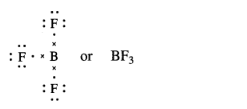
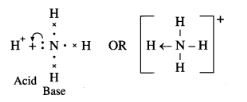
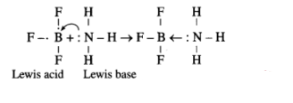
Explain : (A) $BF _3$ is a Lewis acid, (B) $NH _3$ is a Lewis base.
View full question & answer
Question 323 Marks
For each of the following reactions, identify the Lowry-Bronsted conjugate acid-base pairs:
(1) $CH _3 COOH _{( aq )}+ NH _3 \rightleftharpoons N H _{4( aq )}^{+}+$
$CH _3 COO _{( aq )}^{-}$
(2) $CN _{(\text {aq) }}^{-}+ H _2 O _{(i) } \rightleftharpoons OH _{( aq )}^{-}+ H C N _{( aq )}$ 
(3) $HPO _{4( aq )}^{2-}+ H _2 O _{( i )} \rightleftharpoons OH _{( aq )}^{-}+ H _2 PO _{4( aq )}^{-}$
View full question & answer
Question 333 Marks
Explain neutralisation reaction according to Arrhenius theory.
View full question & answer