Questions

Answer the following in brief.

Take a timed test

44 questions · self-marked practice — reveal the answer and mark yourself.

Question 13 Marks
Are there an similarities between transition and inner transition metals?
Answer
There are some properties similarity between transition and inner transition metals.
  • They are placed between s and p-block elements.
  • They are metals with filling of inner suhshells in their electronic configuration.
  • They show variable oxidation slates.
  • They show magnetism.
  • They form coloured compounds.
  • They have catalytic property.
View full question & answer
Question 23 Marks
Write steps involved in the metallurgical process
Answer
The various steps and principles involved in the extraction of pure metals from their ores are as follows.:
  • Concentration of ores in which impurities (gangue) are removed.
  • Conversion of ores into oxides or other reducible compounds of metals.
  • Reduction of ores to obtain crude metals.
  • Refining of metals giving pure metals.
View full question & answer
Question 33 Marks
Which of the following will have highest fourth ionisation enthalpy,$La^{4+}, Gd^{4+}, Lu^{4+}.$
Answer
$La : 4f^\circ5d^16s^2$
$Gd : 4f^15d^16s^2$
$Lu : 4f^{14}5d^16s^2$
Lu will have the highest fourth ionisation enthalpy since $Lu^{3+}$ has the most stable configuration of $4f^{14}$.
View full question & answer
Question 43 Marks
Why f-block elements are called inner transition metals?
Answer
f-block elements are called inner transition elements since f-orbital lies much inside the f-orbital in relation to the transition metals, These elements have 1 to 14 electrons in their f-orbital.
View full question & answer
Question 53 Marks
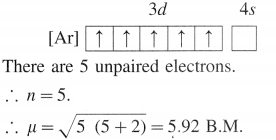
Calculate the spin-only magnetic moment of divalent cation of a transition metal with atomic number $25$.
Answer
For element with atomic number $25$. electronic configuration of its divalent cation will be $: [Ar] 3d^5$
.Image
View full question & answer
Question 63 Marks
A metal ion from the first transition series has two unpaired electrons. Calculate the magnetic moment.
Answer
$\begin{aligned} \mu & =\sqrt{n(n+2)} \\ & =\sqrt{2(2+2)} \\ & =\sqrt{8} \\ & =2.84 \text { B.M. }\end{aligned}$
View full question & answer
Question 73 Marks
What will be the magnetic moment of transition metal having 3 unpaired electrons?
(a) equal to 1.73 B.M.?
(b) less than 1.73 BM.
(c) more than 1.73 B.M.?
Answer
By spin-only formula, $\mu=\sqrt{n(n+2)}$ where $n$ is number of unpaired electrons. $\mu=\sqrt{3(3+2)}=\sqrt{3(5)}=3.87$ B. M
Thus the value is more than 1.73 B.M.
View full question & answer
Question 83 Marks
Which elements in the 4d and 5d-series will show maximum number of oxidation states?
Answer
In 4d-series maximum number of oxidation states are for Ruthenium Ru ( + 2, +3, + 4„ +6, +7, + 8). In 5d-series, maximum number of oxidation states are for Osmium, Os ( + 2 to + 8).
View full question & answer
Question 93 Marks
Which of the first transition series element shows the maximum number of oxidation states and why?
Answer
  • $25Mn$ shows the maximum number of oxidation states, $+ 2$ to $+7.$
  • $25Mn : [Ar] 3d^54s^3$
  • Mn has incompletely filled J-subshell.
  • Due to small difference in energy between 3d and 4s -orbitals, Mn can lose (or share) electrons from both the orbitals.
  • Hence Mn shows oxidation states from $+ 2$ to $+7.$
View full question & answer
Question 103 Marks
In which block of the modern periodic table are the transition and inner transition elements placed?
Answer
The transition elements are placed in d-block and inner transition elements are placed in f-block of the modern periodic table.
View full question & answer
Question 113 Marks
What is meant by ‘shielding of electrons’ in an atom?
Answer
The inner shell electrons in an atom screen or shield the outermost electron from the nuclear attraction. This effect is called the shielding effect.

The magnitude of the shielding effect depends upon the number of inner electrons.

View full question & answer
Question 123 Marks
Explain with the help of balanced chemical equation, why the solution of $Ce(IV)$ is prepared in acidic medium.
Answer
$Ce^{4+}$​​​​​​​ undergoes hydrolysis as, $Ce^{4+}+ 2H_2O \rightarrow Ce(OH)_4 + 4H^+.$
Due to the presence of $H^+$​​​​​​​ in the solution, the solution is acidic.
View full question & answer
Question 133 Marks
Why nobelium is the only actinoid with $+2$ oxidation state?
Answer
  • Nobelium has the electronic configuration ${ }_{102} NO :[ Rn ] 5 f^{14} 6 d^{\circ} 7 s^2$
  • $No ^{2+}$ : [Rn] $5 f^{14} 6 d^{\circ}$
  • Since the $4$ f subshell is completely filled and $6 d^{\circ}$ empty, $+2$ oxidation state is the stable oxidation state.
  • Other actinoids in $+ 2$ oxidation state are not as stable due to incomplete $4f$ subshell.
View full question & answer
Question 143 Marks
What are the stable oxidation states of plutonium, cerium, manganese, Europium?
Answer
Stable oxidation states :
Plutonium + 3 to + 7
Cerium + 3, + 4
Manganese + 2, + 4, + 6, + 7
Europium +2, +3
View full question & answer
Question 153 Marks
Balance the following equation
(i) $KMnO_4+ H_2C_2O4 + H_2SO_4 \rightarrow MnSO_4 + K_2SO_4 + H_2O + O_2$​​​​​​​
(ii) $K_2Cr_2O_7 + KI + H_2SO_4 \rightarrow K_2SO_4 + Cr_2(SO_4)_3 + 7H_2O + 3I_2​​​​​​​$​​​​​​​
Answer
(i) $2KMnO_4 + 3H_2SO_4 + 5H_2C_2O_4 \rightarrow K_2SO_4 + 2MnSO_4 + 8H_2O + 10CO_2$
(ii) Acidified potassium dichromate oxidises potassium iodide $(KI)$ to iodine $(I2)$. Potassium dichromate is reduced to chromic sulphate. Liberated iodine turns the solution brown $K_2Cr_2O_7 + 6KI + 7H_2SO_4 \rightarrow 4K_2SO_4 + Cr_2(SO_4)_3 + 7H_2O + 3I_2$​​​​​​​ [Oxidation state of iodine increases from – $1$ to zero]
View full question & answer
Question 163 Marks
Which steps are involved in the manufacture of potassium dichromate from chromite ore?
Answer
Steps in the manufacture of potassium dichromate from chromite ore are :
  • Concentration of chromite ore.
  • Conversion of chromite ore into sodium chromate $(Na_2CrO_4)$.
  • Conversion of $Na_2CrO_4$ into sodium dichromate $(Na_2Cr_2O_7)$.
  • Conversion of $Na_2Cr_2O_7$​​​​​​​ into $K_2Cr_2O_7$​​​​​​​_.
View full question & answer
Question 183 Marks
What are the similarities between lanthanides and actinides.
Answer
Lanthanides and actinides show similarities as follows :
  • Both, lanthanides and actinides show+ 3 oxidation state.
  • In both the series, the f-orbitals are filled gradually.
  • Ionic radius of the elements in both the series decreases with increase in atomic number.
  • Electronegativity in both the series is low for all the elements.
  • They all are highly reactive.
  • The nitrates, perchlorates and sulphates of all elements are soluble while their hydroxides, theorides and carbonates
    are insoluble.
View full question & answer
Question 193 Marks
What are post actinoid elements?
Answer
Elements from atomic number $104$ to $118$ are called postactinoid elements.
The post actinoid elements known so far are transition metals.
They can be synthesised in the nuclear reactions.
As they have very short half life period, it is difficult to study their chemistry.
Ruiherfordium forms a chloride $(RfCl_4)$ similar to zirconium and hafnium in $+ 4$ oxidation state.
Dubniurn resembles niobium and protactinium.
View full question & answer
Question 203 Marks
What are transuranic elements?
Answer
  • The man-made elements heavier titan Uranium (Z = 92) in the Actinoid señes are called transuranic elements.
  • These are synthetically or artificially prepared (man-made) elements starting from Neptunium (Z= 93).
  • Transuranic elements arc generally considered to be from Neptunium (Z = 93) to Lawrencium (Z = 103).
  • Recently elements from atomic number 104 (Rf) to atomic number 118 (Og) or (Uuo) in 6 d series have also been identified as transuranic elements.
  • All transuranic elements are radioactive.
View full question & answer
Question 213 Marks
Explain the position of actinoids in the periodic table.
What is the position of actinoids in the periodic table?
Answer
  • Position of actinoids in the periodic table : Group$-3;$ Period$-7.$
  • They interrupt the fourth transition series $(6d$ series$)$ in the seventh period in the periodic table.
  • After Actinium, $89Ac$ which has electronic configuration $[Rn] 6d^17s^2,$ the electrons enter progressively $5f$ orbital and they have general electronic configuration, $[Rn] 5f^{1 – 14} 6d^{0 – 1} 7s^2.$
  • They are fourteen elements from $_{90}Th$ to $_{103}Lr$ and since they follow actinium, they are called actinoids.
  • They are called $5f$ series or second inner transition series elements and for the convenience they are placed separately below the periodic table.
View full question & answer
Question 223 Marks
What are the application of lanthanoids?
Answer
$1.$ Lanthanoid compounds are used inside the colour television tubes and computer monitor. For example mixed oxide $(Eu, Y)_{2 }O_3$ releases an intense red colour when bombarded with high energy electrons.
$2.$ Lanthanoid ions are used as active ions in luminescent materials. $($Optoelectronic application$)$
$3. \ Nd : YAG$ laser is the most notable application. $(Nd : YAG =$ neodymium doped ytterium aluminium garnet$)$
$4.$ Erbium doped fibre amplifiers are used in optical fibre communication systems.
$5.$ Lanthanoids are used in cars, superconductors and permanent magnets.
View full question & answer
Question 233 Marks
Why do lanthanoids form coloured compounds?
Answer
The colour in lanthanoid ions is due to the presence of unpaired electrons in partially filled $4f  $ sub$-$shells.
Due to the absorption of radiations in the visible region there arises the excitations of the unpaired electrons from $f-$orbital of lower energy to the $f-$orbital of higher energy$-$giving $f \rightarrow f$ transitions.
The observed colour is complementary to the colour of the light absorbed.
The colour of try positive ions $(M^{3+})$ depends upon the number of unpaired electrons in $f-$orbitals. Hence the lanthanoid ions having equal number of unpaired electrons have similar colour.
The colours of $M^{3+}$ ions of the first seven lanthanoids, $La^{3+}$ to $Eu^{3+}$ are similar to those of seven elements $Lu^{3+}$ to $Tb^{3+}$ in the reverse order.
View full question & answer
Question 243 Marks
Explain oxidation states of lanthanoids.
Answer
  • The common oxidation state of the Lanthanoids is $3 +$ due to the loss of $2$ electrons from outermost $6s$ orbital and one electron from the penultimate $5d$ sub$-$shell.
  • $Gd^{3+}$ and $Lu^{3+}$ show extra stability due to their half$-$filled and completely filled $f-$orbitals, $Gd^{3+} = [Xe]4f^7, Lu^{3+} = [Xe]4f^{14}$
  • $Ce$ and $Tb$ attain the $4f^\circ$ and $4f^7$ configurations in the $4 +$ oxidation states. $Eu$ and $Yb$ attain the $4f^7$ and $4f^{14}$ configurations in the $2+$ oxidation states. $Sm$ and $Tm$ also show the $2+$ oxidation state although their stability can be explained based on thermodynamic factors.
  • Some lanthanoids show $2+$ and $4+$ oxidation states even though they do not have stable electronic configuration of $4f^\circ , 4f^7$ or $4f^{14}.$ E.g. $Pr^{4+} (4f^1), Nd^{2+} (4f^4), Sm^{2+} (4f^6), Dy^{4+} (4f^8)$ etc
View full question & answer
Question 263 Marks
Explain the position of lanthanoids in the periodic table.
How is the position of lanthanoids justified?
Answer
$1.$ Position of Lanthanoids in the periodic table : Group $– 3;$ Period $– 6.$
$2.$ They interrupt the third transition series of $t/-$block elements $($i.e. $5 d$ series$)$ in the sixth period.
$3.$ They are $14$ elements from $_{58}Ce$ to $_{71}Lu$ and their position is in between $La$ and $Hf.$ Since they follow lanthanum, they are called lanthanoids.
$4.$ They are called $4f-$series elements and for the convenience, they are placed separately below the main periodic table.
$5.$ The actual position of lanthanoids is in between Lanthanum $(Z = 57)$ and Hafnium $(Z = 72).$
$6.$ Their position is justified due to following reasons :
All these elements have the same electronic configuration in ultimate and penultimate shells, one electron in $5d-$orbital and two electrons in $6s-$orbital.
Group valence of all lanthanoids is $3.$
All lanthanoids from $_{58}Ce$ to $_{71}Lu$ have similar physical and chemical properties.
View full question & answer
Question 273 Marks
(A) What are f-block elements?
(B) What are inner transition elements?
Answer
(A)
  • Elements in which differentiating electron enters into the pre-penultimate shell the (n – 2) f-orbital are known as f.block elements.
  • They include 28 elements with atomic numbers ranging from 58-71 and atomic numbers 90 to 103 collectively.
  • There are two f-series or two f-block elements, namely 4f and 5f series.
  • The f-block includes two inner transition series namely the lanthanoid series. Cerium (58) to LuteUum (71) or the 4 f-block elements and the actinoid series. Thorium (90) to I.awrencium (103) or the 5f block elements.
(B) f-block elements are called inner transition elements since f-orbital lies much inside the f-orbital in relation to the transition metals, These elements have 1 to 14 electrons in their f-orbital.
View full question & answer
Question 283 Marks
What are common methods of concentration of an ore?
Answer
The concentration of an ore involves different methods depending upon the differences in physical properties of compounds or the metal present and the nature of the gangue. The common methods of concentration of ore are as follows :
  1. Gravity separation or hydraulic washing :
    This can be carried out by two processes as follows :  
    • Hydraulic washing by using Wilfley’s table method
    • Hydraulic classifier methods.
  2. Magnetic separation
  3. Froth floatation process.
  4. Leaching.
The method depends upon the nature of ore.
View full question & answer
Question 293 Marks
Define the following:
(1) Pyrometallurgy
(2) Hydrometallurgy
(3) Electrometallurgy.
Answer
  1. Pyrometallurgy : It is a process of extraction of metal from metal oxide from concentrated ore by reduction with a suitable reducing agent like carbon, hydrogen, aluminium, etc. at high temperature.
  2. Hydrometallurgy : It is a process of extraction of metals by converting their ores into aqueous solutions of metal compounds and reducing them by suitable reducing agents.
  3. Electrometallurgy : It is a process of extraction of highly electropositive metals like Na, K, Al, etc. by electrolysis of fused compounds of the metals where metal ions are reduced at cathode forming metals.
View full question & answer
Question 313 Marks
What are the common chemical properties of d-block elements?
Answer
The common chemical properties of the d-block elements are :
  • All d-block elements are electropositive metals.
  • They exhibit variable oxidation states and form coloured salts and complexes.
  • They are good reducing agents.
  • They form insoluble oxides and hydroxides.
  • Iron, cobalt, copper, molybdenum and zinc are biologically important metals.
  • They catalyse biological reactions.
View full question & answer
Question 323 Marks
What are the common physical properties of d-block elements?
Answer
The common physical properties of d-block elements are :
  • All d-block elements are lustrous and shining.
  • They are hard and have high density
  • They have high melting and boiling points.
  • They are good electrical and thermal conductors.
  • They have high tensile strength and malleability.
  • They can form alloys with transition and nontransition elements
  • Many metals and their compounds are paramagnetic.
  • Most of the metals are efficient catalysts.
View full question & answer
Question 333 Marks
What are the properties of the interstitial compounds of transition metals?
Answer
  • The chemical properties of the interstitial compounds are the same as that of parent transition metals.
  • They are hard and show the metallic properties like electrical and thermal conductivity, lustre, etc.
  • Since metal-non-metal bonds in the interstitial compounds are stronger than metal-metal bonds in pure metals, the compounds have very high melting points, higher than the pure metals.
  • They have lower densities than the parent metal.
  • The interstitial compounds containing hydrogen (i.e., hydrides of metals) are powerful reducing agents.
  • The compounds containing carbon, hence behaving as carbides, are chemically inert and extremely hard like diamond.
  • In these compounds, malleability and ductility are changed. For example steel and cast iron.
View full question & answer
Question 343 Marks
Explain the catalytic properties of the rf-block or transition metals.
Answer
  • d-block elements or transition metals and their compounds or complexes influence the rate of a chemical reaction and hence act as catalysts.
  • In homogeneous catalysis a catalyst forms an unstable intermediate compound which decomposes into products and regenerates the catalyst. But transition metals involve heterogeneous catalysis.
  • The transition metals have incompletely filled d-subshells which adsorb reactants on the surface and provide a large surface area for the reactants to react.
  • Since transition metals have variable oxidation states they are very good catalysts.
  • Hence, compounds of Fe, Co, Ni, Pt, Pd, Cr etc are used as catalysts in many reactions.
View full question & answer
Question 353 Marks
Explain why is cobalt chloride pink in colour when dissolved in water but turns deep blue when treated with concentrated hydrochloric acid.
Answer
  • The electronic configuration of $27 Co :[ Ar ] 3 d ^1 4 s ^2$ and $Co ^{2+}[ Ar ] 3 d ^1$.
  • When dissolved in water cobalt chloride, $Co^{2+}$ forms pink complex, $\left[ Co \left( H _2 O \right)_6\right]^{2+}$.
  • The complex has octahedral geometry.
  • Due to absorption of radiation in the visible region and $d – d$ transition, it forms pink coloured solution.
  • When $CoCl_2$ solution is treated with concentrated $HCl$ solution it turns deep blue.
  • This change is due to the formation of another complex, $\left[ CoCl _4\right]^{2+}$ which has a tetrahedral geometry.
  • Thus due to a change in geometry of the complex formed the colour of the solution changes from pink to deep blue.
View full question & answer
Question 363 Marks
Indicate which of the ions may be coloured- $V ^{3+}, Sc ^{3+}, Cr ^{31}, Cu ^{2+}, Ti ^{3+}, Cu ^{+}$
Answer
  • $V ^{3+}[ Ar ]^{18} 3 d ^2-(($ green $)$
    Since there are two unpaired electrons available, for d → d transition, it will show a Green colour.
  • $Sc ^{3+}[ Ar ]^{18} 3 d ^{\circ}$ (colourless/white).
    Since there are no unpaired electrons in the 3d subshell, it will not show colour.
  • $Cr ^{3+}[ Ar ]^{18} 3 d ^3-$ (violet)
    There are three unpaired electrons in the 3d subshell, hence due to d → d transition, it will show violet colour.
  • $Cu ^{2+}[ Ar ]^{18} 3 d ^9$ (blue)
    It has one unpaired electron that can undergo a d → d transition, hence it will show the colour blue.
  • $Ti ^{3+}[ Ar ]^{18} 3 d ^1$ (purple)
    It has one unpaired electron that can undergo a d → d transition, hence it will show the colour purple.
  • $Cu ^{1+}[ Ar ]^{18} 3 d ^{10}$ (colourless)
    There are no unpaired electrons in the 3d subshell, hence it will not show colour.
View full question & answer
Question 373 Marks
Explain why the solution of $Ti ^{3+}$ salt is purple in colour.
Why is $Ti ^{3+}$ coloured? $($atomic number $Ti = 22)$
Answer
$1. \ Ti^{2+}$ ions in the aqueous solution exist in the hydrated complex form as $\left[ Ti \left( H _2 O \right)_6\right]^{2+}$.
$2.$ The electronic configuration of $Ti$ is, $22 Ti [ Ar ]^{18} 3 d ^2 4 s ^2$ and $Ti ^{3+}[ Ar ]^{18} 3 d ^1$. Hence in complex, $Ti^{3+}$ has one unpaired electron in $3d$ subshell.
$3.$ Initially, the $3d$ electron occupies lower energy $d-$orbital $($in $t_{2g}-$orbitals$).$
$4.$ On the absorption of radiations of about $500 \ nm$ in yellow green region by a complex, $3d^1$ electron is excited to the higher energy $d-$orbital $(e_g-$orbitals$).$
$5.$ When the electron returns back to the lower energy $d-$orbital $(t_{2g})$, it transmits radiation of complementary colour i.e. red blue or purple colour. Hence, the solution of hydrated $Ti^{3+}$ is purple.
View full question & answer
Question 383 Marks
Mention the factors on which the colour of a transition metal ion depends.
Answer
The factors on which the colour of transition metal ion depends are as follows :
  • The presence of incompletely filled d-orbitals in metal ions. (The compounds with the configuration d° and d’0 are colourless.)
  • The presence of unpaired electrons in d-orbitals.
  • d → d transitions of electrons due to absorption of radiation in the visible region.
  • Nature of groups (anions) (or ligands) linked to the metal ion in the compound or a complex.
  • Type of hybridisation in metal ion in the complex.
  • Geometry of the complex of the metal ion.
View full question & answer
Question 393 Marks
Why do the d-block elements form coloured compounds?
Answer
  • Compounds (or ions) of many d-block elements or transition metals are coloured.
  • This is due to the presence of one or more unpaired electrons in (n – 1) d-orbital. The transition metals have incompletely filled (n – 1) cf-orbitals.
  • The energy required to promote one or more electrons within the d-orbitals involving d-d transitions is very low.
  • The energy changes for d-d transitions lie in visible region of electromagnetic radiation.
  • Therefore transition metal ions absorb the radiation in the visible region and appear coloured.
  • Colour of ions of d-block elements depends on the number of unpaired electrons in (n – 1) d-orbital. The ions having equal number of unpaired electrons have similar colour.
  • The colour of metal ions is complementary to the colour of the radiation absorbed.
View full question & answer
Question 403 Marks
How does metallic character vary in $3d$ transition elements?
Answer
$1.$ In $3d-$series elements as atomic number increases from scandium $\left( Sc [ Ar ]^{18} 3 d ^1 4 s ^2\right)$ the number of unpaired electrons increases up to $3d^5$ in chromium.
$2.$ As the number of unpaired electrons increases, the metallic character increases, hence the melting points and boiling points increase from ${ }_{21} Sc \left(3 d ^1\right)$ to ${ }_{24} Cr \left(3 d ^5\right)$.
$3.$ After chromium the number of unpaired electrons goes on decreasing due to the pairing of electrons, hence metallic character, melting points and boiling points decrease from $_{25}Mn$ to $ _{29}Cu.$
$4.$ Zinc has all electrons paired, hence it is soft, has a low melting and boiling points.
View full question & answer
Question 413 Marks
Explain the metalic character of transition metals.
Answer
$1.$ All the transition elements are metals.
$2.$ They are hard, lustrous, malleable, ductile and they have high tensile strength.
$3.$ They have high melting points and boiling points.
$4.$ Their metallic character is due to vacant or partially filled $(n – 1) \ d-$orbitals, and they involve both metallic and covalent bonding.
$5.$ Since the strength of metallic bonds depends upon the number of unpaired electrons, it increases up to middle i.e., up to $(n – 1 )d^5,$ hence accordingly melting points and boiling points also increase.
$6.$ After $(n – l)d^5$ configuration, the electrons start pairing, hence the metallic strength, melting points and boiling points decrease with the increase in atomic number.
View full question & answer
Question 423 Marks
Write the physical properties of first transition series.
Answer
Physical properties of first transition series :
  • All transition elements of the first series are metals.
  • Except Zn, they are very hard and have low volatility.
  • They show characteristic properties of metals. They are lustrous, malleable and ductile.
  • They are good conductors of heat and electricity.
  • They have high melting points and boiling points.
  • Except Zn and Mn, they have one or more typical metallic structures at normal temperatures.
View full question & answer
Question 433 Marks
Explain different oxidation states of chromium.
Answer
  • The observed electronic configuration of chromium is, ${ }_{24} \operatorname {Cr}[ Ar ] 3 d ^5 4 s ^1$..
  • Different possible oxidation states of $Cr$ are $4-1 \left(3 d^5\right),+2\left(3 d^4\right),+3\left(3 d^3\right),+4\left(3 d^2\right)$ + $5\left(3 d^1\right)$ and $+6\left(3 d^{\circ}\right)$.
  • Although in $+1$ state, $Cr$ gets extra stability of half$-$filled $3 d^5 \ -$orbital, it does not exhibit $+1$ state in common except with pyridine.
  • $Cr^{+2}$ has few stable salts like $CrCl_2, CrSO_4$ while $Cr^{+3}$ forms very stable salts like $CrCl_3.$
  • $Cr^{+4}$ and $Cr ^{+ 5}$ are unstable oxidation states.
  • $Cr^{+6}$ is the most stable state due to inert gas $[Ar]$ electronic configuration and form the salts like $K_2Cr_2O_7.$
View full question & answer
Question 443 Marks
Explain the variable oxidation states of metals of first transition series.
Answer
$1.$ The transition metals $($or, elements$)$ exhibit variable oxidation states due to their electronic configuration, $(n-1) d^{1-10} n s^{1-2}$ for the first row.
$2.$ They show only positive oxidation states due to loss of electrons from outer $45-$orbital and the penultimate $3rf-$orbital.
$3.$Loss of one $45$ electron forms $M+$ ion. Loss of two $45$ electrons form $M^{2+}$ ion.
$4. \ +2$ is the common oxidation state of these elements.
Higher oxidation states are due to loss of $3 \ d-$electrons along with $45$ electrons.
$5.$ As the number of unpaired electrons increases, the number of oxidation states shown by the element also increases.
$6. \ Sc$ has only one unpaired electron and it shows two oxidation states $( + 2$ and $+ 3)$
$7. \ Mn$  with $5$ unpaired d electrons show six different oxidation states. They are $+2, +3, +4, +5, +6$ and $+ 7$. Thus $Mn$ has the highest oxidation state.
$8.$ From Fe onwards variable oxidation states decreases as the number of unpaired electron decreases.
$9.$ The last element in the series, $Zn$ shows only one oxidation state $( + 2).$
View full question & answer