Question 13 Marks
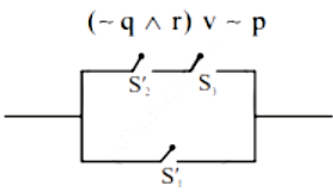
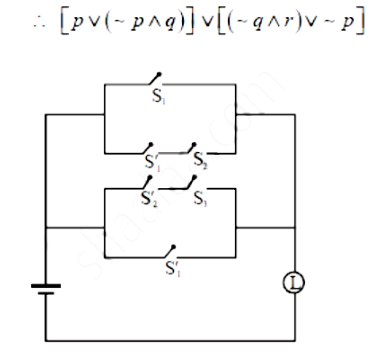
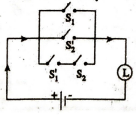
Construct the simplified circuit for the following circuit.
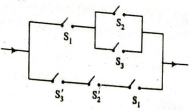
Answer
View full question & answer→coming soon
20 questions · timed · auto-graded
1 | 2 | 3 | 4 | 5 | 6 | 7 | 8 |
A | B | ||||||
P | q | $p \leftrightarrow q$ | $p \wedge q$ | $\sim p$ | $\sim q$ | $\begin{gathered}\sim p \wedge \\ \sim q\end{gathered}$ | $A \vee B$ |
T T F F
| T F T F | T F F T | T F F F | F F T T
| F T F T | F F F T | T F F T |
By column number 3 and 8
p ↔ q ≡ (p ∧ q) ∨ (~p ∧ ~q)
Given, p : It is a day time.
q : It is warm.
a) p ∧ ∼ q : It is a day time but it is not warm.
b) ∼p → q : It is not a day time then it is warm.
c) q ↔ p : It is warm if and only it is day time.
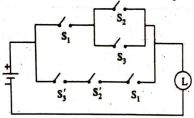
(1) Let p : 2 is rational number, q : $\sqrt{2}$ is an irrational number. . So given compound statement is p ^ q. Truth value of of p is T and that q is T. Hence, truth value p ^ q = T ^ T =T.
(2) Let p = 2 + 3 = 5 which is T.
q = $\sqrt{2}+\sqrt{3}=\sqrt{5}$ which is F
∴ Truth value of given statment is T ∨ F = T.
Converse: If the measure of an angle is 90° then it is a right angle
Inverse : If an angle is not a right angle then its measure is not 90°.
Contrapositive: If the measure of an angle is not 90° then it is not a right angle.
1 | 2 | 3 | 4 | 5 | 6 | 7 | 8 |
A | B | ||||||
P | q | $p \leftrightarrow q$ | $p \wedge q$ | $\sim p$ | $\sim q$ | $\begin{gathered}\sim p \wedge \\ \sim q\end{gathered}$ | $A \vee B$ |
T T F F
| T F T F | T F F T | T F F F | F F T T
| F T F T | F F F T | T F F T |
By column number 3 and 8
p ↔ q ≡ (p ∧ q) ∨ (~p ∧ ~q)
Let
$p =$ Switch $S_1$ is closed
$q =$ Switch $S_2$ is closed
$\sim p=$ switch $\quad S_1^{\prime}$ and $\sim q \equiv S_2^{\prime}$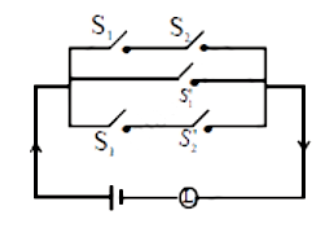
No of rows = 2n=23 =8
No. of columns = m+ n=3+3= 6
| P | q | r | $p \wedge q$ | $p \wedge r$ | $\begin{aligned} & (p \wedge q) \vee(p \wedge \\ & r)\end{aligned}$ |
| T | T | T | T | T | T |
| T | T | F | T | F | T |
| T | F | T | F | T | T |
| T | F | F | F | F | F |
| F | T | T | F | F | F |
| F | T | F | F | F | F |
| F | F | T | F | F | F |
| F | F | F | F | F | F |
In the last column, the truth values of the statement is neither all T nor all F. Hence, it is neither a tautology nor a contradiction i.e. it is a contingency.
~(p v q)v(~p ∧ q)
≡~(p v q)v~(p ∨ ~q) by De Morgan's Law
≡~[(p ∨ q) ∧ (p ∨ ~q)] by De Morgan's Law
≡~{[(p ∨ q) ∧ p] ∨ [(p ∨ q)∧ ~q)]} by Distributive Law
≡ ~{[p] ∨ [(p ∨ q) ∧ ~q]} by Absorption Law
≡ ~{[p] ∨ [(p∧ ~q) ∨ (q ∧ ~q)]} by Distributive Law
≡~{[p] ∨ [(p ∧ ~q) ∨ F]} by Complement Law
≡~{[p] ∨ [(p ∧ ~q)]} by Identity Law
≡~p ∧ (~p ∨ q) by De Morgan's Law
≡ ~p by Absorption Law
Consider the statement pattern : [(p → q) ∧ q ] → p
No. of rows = 2n = 2 × 2 = 4
No. of column = m + n = 3 + 2 = 5
Thus the truth table of the given logical statement:
[(p → q) ∧ q] → p
| P | q | $p \rightarrow q$ | $(p \rightarrow q) \wedge q$ | $[(p \rightarrow q) \wedge q] \rightarrow p$ |
| T | T | T | T | T |
| T | F | F | F | T |
| F | T | T | T | F |
| F | F | T | F | T |
The entries in the last column of the above truth table are neither all T nor all F.
∴ [(p → q) ∧ q] → p is contingency.
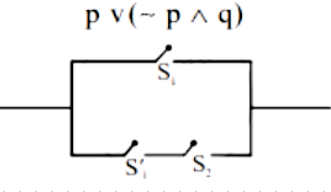
Consider the statement pattern: ∼ (∼ p ∧ ∼ q) ∨ q
Thus the truth table of the given logical statement: ~(~p ∧ ~q) ∨ q
| P | q | $\sim p$ | $\sim q$ | $\sim p \wedge \sim q$ | $\sim(\sim p$$\wedge \sim q)$ | $\sim(\sim p$$\wedge \sim q) \vee q$ |
| T | T | F | F | F | T | T |
| T | F | F | T | F | T | T |
| F | T | T | F | F | T | T |
| F | F | T | T | T | F | F |
The above statement is contingency.
| p | q | $\sim q$ | $p \wedge \sim q$ | $p \rightarrow q$ | $(p \wedge \sim q) \leftrightarrow(p \rightarrow q)$ |
| T | T | F | F | T | F |
| T | F | T | T | F | F |
| F | T | F | F | T | F |
| F | F | T | F | T | F |
All the entries in the last column of the above truth table are F.
$(p \wedge \sim q) \leftrightarrow(p \rightarrow q)$ is is a contradiction
L.H.S = p ↔ q
≡ (p → q) ∧ (q → p) ........(Biconditional Law)
≡ (∼ p ∨ q) ∧ (∼ q ∨ p) ........(Conditional Law)
≡ [∼ p ∧ (∼ q ∨ p)] ∨ [q ∧ (∼ q ∨ p)] ....(Distributive Law)
≡ [(∼ p ∧ ∼ q)] ∨ (∼ p ∧ p)] ∨ [(q ∧ ∼ q) ∨ (q ∧ p)] .........(Distributive Law)
≡ [(∼ p ∧ ∼ q) ∨ F] ∨ [F ∨ (q ∧ p)] ........(Complement Law)
≡ (∼ p ∧ ∼ q) ∨ (q ∧ p) .......(Identity Law)
≡ (∼ p ∧ ∼ q) ∨ (p ∧ q) ........(Commutative Law)
≡ (p ∧ q) ∨ (∼ p ∧ ∼ q) ........(Commutative Law)
≡ R.H.S.
Let
p : It rains,
q : the match will be cancelled.
The symbolic form of the given statement is p → q.
Converse: q → p
i.e., If the match is cancelled then it rains.
Inverse: ~p → ~q
i.e., If it does not rain then the match will not be cancelled.
Contrapositive: ~q → ~p
i.e. If the match is not cancelled then it does not rain.