MCQ 511 Mark
The ratio of frequencies of two oscillating pendulums are $3: 2$. Their lengths are in the ratio
- A
$\sqrt{3}: \sqrt{2}$
- B
$9: 4$
- ✓
$4: 9$
- D
$\sqrt{2}: \sqrt{3}$
AnswerCorrect option: C. $4: 9$
(c) : As $T=2 \pi \sqrt{\frac{l}{g}}$ $v \propto \frac{1}{T}$ so, $v=\frac{1}{T}=\frac{1}{2 \pi} \sqrt{\frac{g}{l}}$
For pendulum $1, v_1=\frac{1}{2 \pi} \sqrt{\frac{g}{l_1}}$
For pendulum $2, v_2=\frac{1}{2 \pi} \sqrt{\frac{g}{l_2}}$
$
\frac{v_1}{v_2}=\sqrt{\frac{l_2}{l_1}} \Rightarrow \frac{3}{2}=\sqrt{\frac{l_2}{l_1}}
$
On squaring both sides, we have
$
\frac{9}{4}=\frac{l_2}{l_1} ; l_1: l_2=4: 9
$
View full question & answer→MCQ 521 Mark
A rectangular block of mass ' $M$ ' and cross-sectional area ' $A$ ' floats on a liquid of density ' $\rho$ '. It is given a small vertical displacement from equilibrium, it starts oscillating with frequency ' $n$ ' then
- A
$n \propto A$
- B
$n \propto A^2$
- ✓
$n \propto \sqrt{A}$
- D
$n \propto A^3$
AnswerCorrect option: C. $n \propto \sqrt{A}$
(c) : Time period of SHM is given by
$
T=2 \pi \sqrt{\frac{l}{g}}...(i)
$
(where $l$ is length of rectangular block)
According to law of floatation,
Weight of block $=$ weight of the displaced liquid
$
\Rightarrow M g=A l \rho g \Rightarrow l=\frac{M}{A \rho}
$
using value of $T$ ' in equation (i), we get
$
T=2 \pi \sqrt{\frac{M}{A \rho g}}
$
As $T \propto \frac{1}{n}$ so $n \propto \sqrt{A}$.
Here ' $n$ ' is frequency of oscillations.
View full question & answer→MCQ 531 Mark
The equation of motion of a particle performing linear S.H.M is $x=5 \sin \left[4 t-\frac{\pi}{6}\right]$, where ' $x$ ' is its displacement in $cm$. The velocity of the particle when its displacement is $3 cm$, is
- A
$10 cm / s$
- ✓
$16 cm / s$
- C
$6 cm / s$
- D
$8 cm / s$
AnswerCorrect option: B. $16 cm / s$
(b) : The given equation is, $x=5 \sin \left(4 t-\frac{\pi}{6}\right)$ Amplitude, $a=5$
Angular velocity, $\omega=4$
The velocity of the wave obtained by,
$
v=\omega \sqrt{a^2-y^2}=4 \sqrt{(5)^2-(3)^2}=16 cm
$
View full question & answer→MCQ 541 Mark
Consider two SHMs along the same straight line $x_1=A_1 \sin \left(\omega t+\phi_1\right), x_2=A_2 \sin \left(\omega t+\phi_2\right)$, where $A_1$ and $A_2$ are their amplitudes and $\phi_1$ and $\phi_2$ are their initial phase angle. If the two SHMs meet simultaneously and ' $R$ ' is the resultant amplitude, match column I with column II. | Column-I | Column-II |
| A. | The two SHMs are in phase, $A_1=A_2=A$ | I. | $R=A_1+A_2$ |
| B. | The two SHMs are in phase, $A_1 \neq A_2$ | II. | $R=0$ |
| C. | The two SHMs are $90^{\circ}$ out of phase, $A_1=A_2=A$ | III. | $R=2 A$ |
| D. | The two SHMs are $180^{\circ}$out of phase, $A_1=A_2$ | IV. | $R=\sqrt{2} A$ |
Answer(a) : $x_1=A_1 \sin \left(\omega t+\phi_1\right)$
$
x_2=A_2 \sin \left(\omega t+\phi_2\right)
$
where $A_1, A_2$ are amplitudes of two SHM's and $\phi_1, \phi_2$ are phase angle.
Resultant amplitude,
$
R=\sqrt{A_1^2+A_2^2+2 A_1 A_2 \cos \left(\phi_1-\phi_2\right)}...(i)
$
(i) When two SHM's are in phase, $A_1=A_2=A$, then from equation (i)
$
R=\sqrt{A^2+A^2+2 A^2}=2 A
$
(ii) When two SHM's are in phase but $A_1 \neq A_2$, then
$
\begin{aligned}
& R=\sqrt{A_1^2+A_2^2+2 A_1 A_2}=\sqrt{\left(A_1+A_2\right)^2} \\
& R=A_1+A_2
\end{aligned}
$
(iii) When to SHMs are $90^{\circ}$ out of phase, then
$
R=\sqrt{A^2+A^2+0}=\sqrt{2} A
$
(iv) When two SHMs are $180^{\circ}$ out of phase and $A_1=A_2$,
$
\begin{aligned}
& R=\sqrt{A_1^2+A_1^2-2 A_1^2} \\
& R=0
\end{aligned}
$
Hence, option (a) is correct answer.
View full question & answer→MCQ 551 Mark
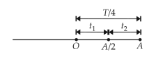
A particle executes SHM of type $x=A \sin \omega t$. It takes time $t_1$ from $x=0$ to $x=\frac{A}{2}$ and $t_2$ from $x=\frac{A}{2}$ to $x=A$. The ratio $t_1 ; t_2$ will be
- A
$1: 1$
- ✓
$1: 2$
- C
$1: 3$
- D
$2: 1$
AnswerCorrect option: B. $1: 2$
(b) : $t_1+t_2=\frac{T}{4}$ or $t_2=\frac{T}{4}-t_1$
At time, $t=t_1, x=\frac{A}{2}$
$\therefore \frac{A}{2}=A \sin \omega t_1$ or $\omega t_1=\frac{\pi}{6}$ or $t_1=\frac{\pi}{6 \omega}$
$\therefore \quad t_2=\frac{T}{4}-\frac{\pi}{6 \omega}=\frac{2 \pi}{4 \omega}-\frac{\pi}{6 \omega}=\frac{2 \pi}{6 \omega} \quad\left(\because T=\frac{2 \pi}{\omega}\right)$
$\therefore \quad t_1: t_2=1: 2$
View full question & answer→MCQ 561 Mark
- A
$\frac{k_1 A}{k_2}$
- B
$\frac{k_2 A}{k_1}$
- C
$\frac{k_1 A}{k_1+k_2}$
- ✓
$\frac{k_2 A}{k_1+k_2}$
AnswerCorrect option: D. $\frac{k_2 A}{k_1+k_2}$
(d) :
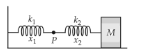
Here the two springs are in series. Let the mass $M$ be pulled through small distance $A$ towards right hand side. Due to it, let $x_1$ and $x_2$ be the extension in two springs. When two springs are in series, the tension or the force is same for both the springs. So $k_1 x_1=k_2 x_2$ or $x_2=\frac{k_1 x_1}{k_2}$ Total extension, $A=x_1+x_2=x_1+\frac{k_1 x_1}{k_2}$;
$
A=x_1\left(\frac{k_2+k_1}{k_2}\right)
$
$\therefore \quad$ Amplitude of point $P=$ extension of spring $k_1$
$
=x_1=\frac{k_2 A}{k_1+k_2}
$
View full question & answer→MCQ 571 Mark
If $x, V$ and $a$ denote the displacement, velocity and acceleration of a particle respectively executing simple harmonic motion of periodic time $T$, then which one of the following does not change with time?
- ✓
$\frac{a T}{x}$
- B
$a T+2 \pi V$
- C
$\frac{a T}{V}$
- D
$a T+4 \pi^2 V^2$
AnswerCorrect option: A. $\frac{a T}{x}$
(a) : Given $x, V$ and $a$ denote the displacement, velocity and acceleration of a particle respectively executing simple harmonic motion of periodic time $T$. Frequency is only factor in simple harmonic motion which does not change with time.
Now, $\frac{a T}{x}=\frac{ m s ^{-2} \times s }{ m }= s ^{-1} \Rightarrow$ unit of frequency
Therefore, $\frac{a T}{x}$ will not change with time.
View full question & answer→MCQ 581 Mark
Two pendulums begin to swing simultaneously. The first pendulum makes nine full oscillations when the other makes seven. The ratio of the lengths of the two pendulums is
- ✓
$\frac{49}{81}$
- B
$\frac{64}{81}$
- C
$\frac{8}{9}$
- D
$\frac{7}{9}$
AnswerCorrect option: A. $\frac{49}{81}$
(a) : Time period of a simple pendulum,
$
T \propto \sqrt{1} \Rightarrow T^2 \propto l
$
Now, $t=n T \Rightarrow t^2=n^2 T^2 \Rightarrow T^2=\frac{t^2}{n^2}$
$
\therefore \quad \frac{T_1^2}{T_2^2}=\frac{l_1}{l_2} \Rightarrow \frac{l_1}{l_2}=\frac{n_2^2 t^2}{n_1^2 t^2} \Rightarrow \frac{l_1}{l_2}=\frac{49}{81}
$
View full question & answer→MCQ 591 Mark
A clock pendulum having coefficient of linear expansion $\alpha=9 \times 10^{-7} /{ }^{\circ} C$ has a period of $0.5 s$ at $20^{\circ} C$. If the clock is used in a climate where the temperature is $30^{\circ} C$, how much time does the clock lose in each oscillation? ( $g=$ constant)
- A
$25 \times 10^{-7} s$
- B
$5 \times 10^{-7} s$
- C
$1.125 \times 10^{-6} s$
- ✓
$2.25 \times 10^{-6} s$
AnswerCorrect option: D. $2.25 \times 10^{-6} s$
(d) : Given, coefficient of linear expansion $(\alpha)$ $=9 \times 10^{-7} /{ }^{\circ} C$
Change in temperature $(\Delta \theta)=30^{\circ} C -20^{\circ} C =10^{\circ} C$
If time period of the clock was $0.5 s$ at $20^{\circ} C$, then time lost by the clock in each oscillation is,
$
\begin{gathered}
{\left[T=2 \pi \sqrt{\frac{l}{g}} \text { taking and differentiation on both sides }\right]} \\
\Delta T=\frac{1}{2} \alpha \Delta \theta T \\
\Delta T=\frac{1}{2} \times 9 \times 10^{-7} \times 10 \times 0.5=2.25 \times 10^{-6} s
\end{gathered}
$
View full question & answer→MCQ 601 Mark
The equation of simple harmonic progressive wave is given by $Y=a \sin 2 \pi(b t-c x)$. The maximum particle velocity will be twice the wave velocity if
- A
$c=\pi a$
- B
$c=\frac{1}{2 \pi a}$
- ✓
$c=\frac{1}{\pi a}$
- D
$c=2 \pi a$
AnswerCorrect option: C. $c=\frac{1}{\pi a}$
(c) : Given, $y=a \sin 2 \pi(b t-c x)$. . . . .(i)
Comparing equation (i) with the standard wave equation $y=a \sin (\omega t-k x)$ we get, $\omega=2 \pi b, k=2 \pi c$
Wave velocity $=\frac{\omega}{k}=\frac{b}{c}$. . . . .(ii)
Particle velocity, $v_P=\frac{d y}{d t}=2 \pi a b \cos (2 \pi b t-2 \pi c x)$
Maximum particle velocity, $\left(v_p\right)_{\max }=2 \pi a b$. . . . .(iii)
According to given problem
$
\begin{aligned}
& \left(v_p\right)_{\max }=2\left(\frac{b}{c}\right)=2 \pi a b \text { (Using (ii) and (iii)) } \\
& c=\frac{1}{\pi a}
\end{aligned}
$
View full question & answer→MCQ 611 Mark
A mass is suspended from a vertical spring which is executing. $\text{S.H.M.}$ of frequency $5\ Hz$. The spring is unstretched at the highest point of oscillation. Maximum speed of the mass is $[$acceleration due to gravity $g=10\ m / s ^2 ]$
- A
$2 \pi\ m / s$
- B
$\pi\ m / s$
- C
$\frac{1}{2 \pi}\ m / s$
- ✓
$\frac{1}{\pi}\ m / s$
AnswerCorrect option: D. $\frac{1}{\pi}\ m / s$
$T=2 \pi \sqrt{\frac{m}{k}}$
$v=\frac{1}{2 \pi} \sqrt{\frac{k}{m}} ;$
$25=\frac{1}{4 \pi^2} \frac{k}{m}$
$\therefore k=100 \pi^2 m$
At equilibrium,
$k A=m g \quad(x=A)$
$A=\frac{m g}{k}$
$v_{\text {max }}=\omega A=2 \pi v A$
$=\frac{10 \pi \times m \times 10}{100 \pi^2 m}$
$=\frac{1}{\pi} ms ^{-1}$
View full question & answer→MCQ 621 Mark
For a particle performing linear S.H.M., its average speed over one oscillation is ( $a=$ amplitude of S.H.M., $n=$ frequency of oscillation)
- A
$2 a n$
- ✓
$4 a n$
- C
$6 a n$
- D
$8 a n$
AnswerCorrect option: B. $4 a n$
(b) : Distance travelled in one oscillation is $4 a$ and time period is $T$.
$
\text { Velocity }=\frac{4 a}{T}=4 a n \quad\left[\because n=\frac{1}{T}\right]
$
View full question & answer→MCQ 631 Mark
The path length of oscillation of a simple pendulum of length 1 meter is $16 cm$. Its maximum velocity is $\left(g=\pi^2 m / s ^2\right)$
- A
$2 \pi cm / s$
- B
$4 \pi cm / s$
- ✓
$8 \pi cm / s$
- D
$16 \pi cm / s$
AnswerCorrect option: C. $8 \pi cm / s$
(c) : Amplitude, $a=\frac{\text { Path length }}{2}=\frac{16}{2}=8 cm$ Time period, $T=2 \pi \sqrt{\frac{l}{g}}=2 \pi \sqrt{\frac{1}{\pi^2}}=2 s$ Maximum velocity, $v_{\max }=a \omega=a \times \frac{2 \pi}{T}=8 \times \frac{2 \pi}{2}$ $=8 \pi cm / s$
View full question & answer→MCQ 641 Mark
A particle is performing S.H.M. starting from extreme position. Graphical representation shows that, between displacement and acceleration, there is a phase difference of
- A
$0 rad$
- B
$\frac{\pi}{4} rad$
- C
$\frac{\pi}{2} rad$
- ✓
$\pi rad$
AnswerCorrect option: D. $\pi rad$
(d) : Acceleration of a particle performing S.H.M. is $a=-\omega^2 x$ or $a \propto-x$
$\therefore \quad$ There is a phase difference of $\pi$ between displacement and acceleration.
View full question & answer→MCQ 651 Mark
A particle performs linear S.H.M. At a particular instant, velocity of the particle is $u$ and acceleration is $\alpha$ while at another instant velocity is $v$ and acceleration is $\beta(0<\alpha<\beta)$. The distance between the two positions is
- ✓
$\frac{u^2-v^2}{\alpha+\beta}$
- B
$\frac{u^2+v^2}{\alpha+\beta}$
- C
$\frac{u^2-v^2}{\alpha-\beta}$
- D
$\frac{u^2+v^2}{\alpha-\beta}$
AnswerCorrect option: A. $\frac{u^2-v^2}{\alpha+\beta}$
(a) : Let $x_1$ be distance travelled by the particle having velocity $u$ and acceleration $\alpha$. Let $x_2$ be the distance travelled by the particle having velocity $v$ and acceleration $\beta$.
If $\omega$ be the angular frequency then
$
\begin{aligned}
& \alpha=\omega^2 x_1 \\
& \beta=\omega^2 x_2 \\
& \text { or } \quad(\alpha+\beta)=\omega^2\left(x_1+x_2\right) .....(i)\\
& u^2=\omega^2 A^2-\omega^2 x_1^2 \\
& v^2=\omega^2 A^2-\omega^2 x_2^2
\end{aligned}
$
$\begin{aligned} \Rightarrow \quad v^2-u^2 & =\omega^2\left(x_1{ }^2-x_2{ }^2\right) \\ v^2-u^2 & =\omega^2\left(x_1+x_2\right)\left(x_1-x_2\right) \\ v^2-u^2 & =\left(x_1-x_2\right)(\alpha+\beta).....(using (i)) \\ \text { or } x_1-x_2 & =\frac{v^2-u^2}{(\alpha+\beta)} \text { or } x_2-x_1=\frac{u^2-v^2}{\alpha+\beta}\end{aligned}$
View full question & answer→MCQ 661 Mark
A particle performing S.H.M. starts from equilibrium position and its time period is 16 second. After 2 seconds its velocity is $\pi m / s$. Amplitude of oscillation is $\left(\cos 45^{\circ}=\frac{1}{\sqrt{2}}\right)$
- A
$2 \sqrt{2} m$
- B
$4 \sqrt{2} m$
- C
$6 \sqrt{2} m$
- ✓
$8 \sqrt{2} m$
AnswerCorrect option: D. $8 \sqrt{2} m$
(d) : The displacement of the particle performing
S.H.M. is given as
$
x=A \sin \omega t
$
Velocity of the particle $v=\frac{d x}{d t}=A \omega \cos \omega t$
Given, $v=\pi m / s , T=16$ second, $t=2$ second
$
\begin{aligned}
& \omega=\frac{2 \pi}{T}=\frac{2 \pi}{16}=\frac{\pi}{8} rad / s ; \pi=A \times \frac{\pi}{8} \cos \frac{\pi}{8} \cdot 2 \\
& \pi=A \times \frac{\pi}{8} \times \cos \frac{\pi}{4} \text { or } 1=\frac{A}{8} \times \frac{1}{\sqrt{2}} \Rightarrow A=8 \sqrt{2} m
\end{aligned}
$
View full question & answer→MCQ 671 Mark
A simple pendulum of length $L$ has mass $M$ and it oscillates freely with amplitude $A$. At extreme position, its potential energy is $( g=$ acceleration due to gravity$)$
- ✓
$\frac{M g A^2}{2 L}$
- B
$\frac{M g A}{2 L}$
- C
$\frac{M g A^2}{L}$
- D
$\frac{2 M g A^2}{L}$
AnswerCorrect option: A. $\frac{M g A^2}{2 L}$
$\text {(a) : The potential energy }=\frac{1}{2} M \omega^2 A^2$
$=\frac{1}{2} M \frac{g}{l} \cdot A^2$
$=\frac{M g A^2}{2 L} \left(\because \omega=\sqrt{\frac{g}{l}}\right)$
View full question & answer→MCQ 681 Mark
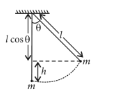
A simple pendulum of length $l$ has maximum angular displacement $\theta$. The maximum kinetic energy of the bob of mass $m$ is ( $g=$ acceleration due to gravity)
AnswerCorrect option: C. $m g l(1-\cos \theta)$
(c) : Refer to the figure.
Maximum kinetic energy of the bob $=$ total energy of the bob $=$ maximum potential energy of the bob
$
\begin{aligned}
& =m g h=m g(l-l \cos \theta) \\
& =m g l(1-\cos \theta)
\end{aligned}
$
View full question & answer→MCQ 691 Mark
Which of the following quantity does not change due to damping of oscillations?
Answer(c) : Due to damping of oscillations, time period increases, angular frequency and amplitude decrease but initial phase does not change.
View full question & answer→MCQ 701 Mark
The bob of a simple pendulum performs S.H.M. with period $T$ in air and with period $T_1$ in water. Relation between $T$ and $T_1$ is (neglect friction due to water, density of the material of the bob $=\frac{9}{8} \times 10^3 kg / m ^3$, density of water $1 g / cc$ )
- ✓
$T_1=3 T$
- B
$T_1=2 T$
- C
$T_1=T$
- D
$T_1=\frac{T}{2}$
AnswerCorrect option: A. $T_1=3 T$
(a) : Let $V$ be the volume of the bob, then its weight in air is $W_a=V \rho_b g$
When immersed in water, buoyancy force, $F_b=V \rho_w g$
$\therefore$ Effective weight in water, $W=W_a-F_b$
$
=V \rho_b g-V \rho_m g=V \rho_b g-V \frac{8}{9} \rho_b g=\frac{1}{9} V \rho_b g
$
$\therefore \quad$ Effective acceleration will be $g^{\prime}=\frac{g}{9}$
Now, $T=2 \pi \sqrt{\frac{l}{g}}$ and $T_1=2 \pi \sqrt{\frac{l}{g^{\prime}}}$
$
\Rightarrow \frac{T}{T_1}=\sqrt{\frac{g^{\prime}}{g}}=\sqrt{\frac{1}{9}}=\frac{1}{3} \text { or } T_1=3 T
$
View full question & answer→MCQ 711 Mark
A mass $m_1$ connected to a horizontal spring performs $\text{S.H.M.}$ with amplitude $A$. While mass $m_1$ is passing through mean position another mass $m_2$ is placed on it so that both the masses move together with amplitude $A_1$. The ratio of $\frac{A_1}{A}$ is $m_{2 <}m_1$
- ✓
$\left[\frac{m_1}{m_1+m_2}\right]^{\frac{1}{2}}$
- B
$\left[\frac{m_1+m_2}{m_1}\right]^{\frac{1}{2}}$
- C
$\left[\frac{m_2}{m_1+m_2}\right]^{\frac{1}{2}}$
- D
$\left[\frac{m_1+m_2}{m_2}\right]^{\frac{1}{2}}$
AnswerCorrect option: A. $\left[\frac{m_1}{m_1+m_2}\right]^{\frac{1}{2}}$
Applying principle of momentum conservation at the mean position,
$p_i=p_f$
$ \Rightarrow m_1 v=\left(m_1+m_2\right) v_1$
$ \Rightarrow \frac{v}{v_1}=\frac{m_1+m_2}{m_1}...(i)$
Also$, \frac{v}{v_1}=\frac{\omega A}{\omega_1 A_1}$
$\therefore \frac{A_1}{A}=\frac{\omega}{\omega_1} \times \frac{v_1}{v}....(ii)$
And $\frac{\omega}{\omega_1}=\sqrt{\frac{k}{m_1}} / \sqrt{\frac{k}{m_1+m_2}}=\sqrt{\frac{m_1+m_2}{m_1}}...(iii)$
From eqns. $(i), (ii)$ and $(iii),$
$\frac{A_1}{A}=\sqrt{\frac{m_1+m_2}{m_1}} \times \frac{m_1}{m_1+m_2}=\sqrt{\frac{m_1}{m_1+m_2}}$
View full question & answer→MCQ 721 Mark
A simple pendulum is oscillating with amplitude ' $A$ ' and angular frequency ' $\omega$ '. At displacement ' $x$ ' from mean position, the ratio of kinetic energy to potential energy is
- A
$\frac{x^2}{A^2-x^2}$
- B
$\frac{x^2-A^2}{x^2}$
- ✓
$\frac{A^2-x^2}{x^2}$
- D
$\frac{A-x}{x}$
AnswerCorrect option: C. $\frac{A^2-x^2}{x^2}$
(c) : For a particle executing SHM,
Kinetic energy at displacement $x$ from mean position,
$
K E=\frac{1}{2} m \omega^2\left(A^2-x^2\right)
$
At the same time, its potential energy
$
\begin{aligned}
& P E=\frac{1}{2} m \omega^2 x^2 \\
& \text { Required ratio }=\frac{K E}{P E}=\frac{\frac{1}{2} m \omega^2\left(A^2-x^2\right)}{\frac{1}{2} m \omega^2 x^2}=\frac{A^2-x^2}{x^2}
\end{aligned}
$
View full question & answer→MCQ 731 Mark
A mass is suspended from a spring having spring constant ' $K$ ' is displaced vertically and released, oscillates with period ' $T$ '. The weight of the mass suspended is ( $g=$ gravitational acceleration)
AnswerCorrect option: B. $\frac{K T^2 g}{4 \pi^2}$
(b) : Time period of spring - block system is given by $T=2 \pi \sqrt{\frac{M}{K}}$
Squaring both sides, we get
$
T^2=4 \pi^2 \frac{M}{K} ; M=\frac{K T^2}{4 \pi^2}
$
Weight of mass suspended, $W=M g$
$
W=\frac{K T^2 g}{4 \pi^2}
$
View full question & answer→MCQ 741 Mark
A particle is executing S.H.M. of periodic time ' $T$ '. The time taken by a particle in moving from mean position to half the maximum displacement is $\left(\sin 30^{\circ}=0.5\right)$
- A
$\frac{T}{2}$
- B
$\frac{T}{4}$
- C
$\frac{T}{8}$
- ✓
$\frac{T}{12}$
AnswerCorrect option: D. $\frac{T}{12}$
(d) : The displacement of a particle executing S.H.M. at any time $t$ is given by
$
\begin{array}{ll}
y=A \sin \omega t=A \sin \left(\frac{2 \pi t}{T}\right) \\
\frac{A}{2}=A \sin \left(\frac{2 \pi t}{T}\right) & \\
\sin \left(\frac{2 \pi t}{T}\right)=\frac{1}{2} \Rightarrow \sin \left(\frac{2 \pi t}{T}\right)=\sin \left(\frac{\pi}{6}\right) \\
\therefore \quad \frac{2 \pi}{T} \times t=\frac{\pi}{6} \text { or } t=\frac{T}{12}
\end{array}
$
View full question & answer→MCQ 751 Mark
A particle performs S.H.M. with amplitude $25 cm$ and period $3 s$. The minimum time required for it to move between two points $12.5 cm$ on either side of the mean position is
- A
$0.6 s$
- ✓
$0.5 s$
- C
$0.4 s$
- D
$0.2 s$
AnswerCorrect option: B. $0.5 s$
(b) : The displacement of a particle performing SHM, at any time $t$ is given by,
$
y=A \sin \omega t=A \sin \left(\frac{2 \pi t}{T}\right)
$
Here, $A=25 cm , T=3 s , y_1=12.5 cm$
So, $12.5=25 \sin \left(\frac{2 \pi}{3}\right) t_1 \Rightarrow \frac{1}{2}=\sin \left(\frac{2 \pi t_1}{3}\right)$
$
\begin{aligned}
& \sin \left(\frac{\pi}{6}\right)=\sin \left(\frac{2 \pi t_1}{3}\right) \\
\therefore & \frac{\pi}{6}=\frac{2 \pi}{3} t_1 \Rightarrow t_1=\frac{1}{4} s =0.25 s
\end{aligned}
$
Similarly, for other side of mean position, $t_2=0.25 s$ Required time, $t=t_1+t_2=2 t_1=2 \times 0.25=0.5 s$
View full question & answer→MCQ 761 Mark
A block resting on the horizontal surface executes S.H.M. in horizontal plane with amplitude $A$. The frequency of oscillation for which the block just starts to slip is $(\mu=$ coefficient of friction, $g=$ gravitational acceleration)
- ✓
$\frac{1}{2 \pi} \sqrt{\frac{\mu g}{A}}$
- B
$\frac{1}{4 \pi} \sqrt{\frac{\mu g}{A}}$
- C
$2 \pi \sqrt{\frac{A}{\mu g}}$
- D
$4 \pi \sqrt{\frac{A}{\mu g}}$
AnswerCorrect option: A. $\frac{1}{2 \pi} \sqrt{\frac{\mu g}{A}}$
(a) : Let $m$ be mass of the block. When the block is about to slip, then Force of friction $=$ Centrifugal force
$
\begin{aligned}
& \mu m g=m \omega^2 A \\
& \omega^2=\frac{\mu g}{A} \text { or } \omega=\sqrt{\frac{\mu g}{A}}
\end{aligned}
$
As $\omega=2 \pi \nu$
$
\therefore \quad v=\frac{\omega}{2 \pi}=\frac{1}{2 \pi} \sqrt{\frac{\mu g}{A}}
$
View full question & answer→