Questions

Answer the following questions.

Take a timed test

104 questions · self-marked practice — reveal the answer and mark yourself.

Question 12 Marks
Explain Avery, McCarty, and MacLeod’s experiment in detail.
Answer
  1. Avery, Macleod, and McCarty (1944) purified DNA, RNA, proteins (enzymes), and other materials from heat-killed S-type and mixed them with R-type to see which ones could transform living R-types to S-types.
  2. Only those mixed with DNA were transformed into S-type bacteria.
  3. They also discovered that protein-digesting enzymes (proteases) and RNA-digesting enzymes (RNases) did not affect transformation. This indicated the transforming substance was neither a protein nor RNA.
  4. DNA digested with DNase inhibited transformation, suggesting that DNA caused the transformation.
View full question & answer
Question 22 Marks
Explain the mechanism of sex determination in birds.
Answer
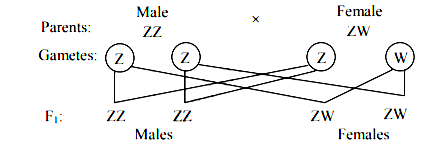
  1. In birds, the chromosomal mechanism of sex determination is ZW-ZZ type.
  2. In this type females are heterogametic and produce two types of eggs; 50% of eggs carry Z-chromosome, while 50% of eggs carry W- chromosome.
  3. Males are homogametic and produce one type of sperms. Each sperm carries a Z chromosome.
  4. Thus, the sex of an individual depends on the kind of egg (ova) fertilized by the sperm.
View full question & answer
Question 32 Marks
What is lactation? Which hormone is responsible for its regular secretion?
Answer
  1. Lactation is the process by which the mammary glands of the female start producing milk at the end of pregnancy.
  2. Prolactin is the hormone that is responsible for its regular secretion.
View full question & answer
Question 42 Marks
Mention significance of fruit and seed formation.
Answer
Significance of seed and fruit:
  1. Fruits provide nourishment to the developing seeds.
  2. Fruits protect the seeds in immature conditions.
  3. Seeds serve as important propagating organs (units) of plants.
  4. Seeds and fruits develop special devices for their dispersal and thus help in the distribution of the species.
View full question & answer
Question 52 Marks
Write a note on the packaging of DNA in Eukaryotes.
Answer
  1. The organization of DNA is much more complex in eukaryotes.
  2. Histone proteins are rich in lysine and arginine residues which are basic in nature and are positively charged.
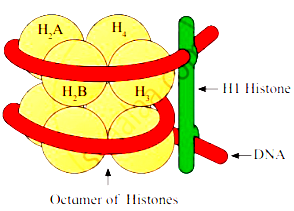
  3. These histones organize themselves to make a unit of 8 molecules known as histone octamer.
  4. The negatively charged helical DNA is wrapped around the positively charged histone octamer, forming a structure known as a nucleosome.
  5. The nucleosome core is made up of two molecules of each of four types of histone proteins viz. H2A, H2B, H3, and H4. H1 protein binds the DNA thread where it enters (arrives) and leaves the nucleosome.
  6. One nucleosome approximately contains 200 base pair long DNA helix wound around it.
  7. About 146 base pair long segment of DNA remains present in each nucleosome.
  8. Nucleosomes are the repeating units of chromatin, which are threadlike, stained (coloured) bodies present in the nucleus. These look like ‘beads-on-string’ when observed under an electron microscope.
  9. DNA helix of 200 bp wraps around the histone octamer by 1¾ turns.
  10. Six such nucleosomes get coiled and then form a solenoid that looks like a coiled telephone wire.
  11. The chromatin is packed to form a solenoid structure of 30 nm diameter (300Å) and further supercoiling tends to form a looped structure called chromatin fiber, which further coils and condenses at the metaphase stage to form the chromosomes.
  12. The packaging of chromatin at higher levels needs an additional set of proteins that are called Non-Histone Chromosomal proteins (NHC).
View full question & answer
Question 62 Marks
Differentiate between complete and incomplete linkage.
Answer
No. Complete Linkage Incomplete Linkage
1. The phenomenon of inheritance of completely linked genes is called complete linkage. The phenomenon of inheritance of incompletely linked genes is called incomplete linkage.
2. In complete linkage, the linked genes which are closely located on the chromosome do not separate (no crossing over) and inherit together. In incomplete linkage, the linked genes which are distantly located on the same chromosome and have chances of separation by crossing over are known as incompletely linked (weakly linked) genes.
e.g. X chromosome of Drosophila males- shows complete linkage. In Zea mays - colour and shape of grain show incomplete linkage.
View full question & answer
Question 72 Marks
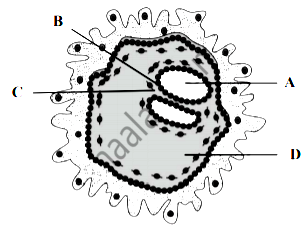
Identify the parts labelled in the given diagram.
Answer
A - Amniotic Cavity; B – Ectoderm; C – Mesoderm; D - Coelom.
View full question & answer
Question 82 Marks
Give any four points of significance of double fertilization.
Answer
Significance of double fertilization:
  1. It is a unique feature of angiosperms.
  2. It ensures that the parent plant invests a seed with a food store, only if the egg is fertilized.
  3. The diploid zygote develops into an embryo which consequently develops into a new plant.
  4. The triploid PEN develops into nutritive endosperm tissue.
  5. It restores the diploid condition by fusion of haploid male gamete with the haploid female gamete (i.e. through syngamy).
  6. It also helps to avoid polyembryony.
View full question & answer
Question 102 Marks
How a portal vein differs from normal vein?
Answer
Hepatic portal vein differs from normal veins in that it starts as capillaries from one organ and branches into some intermediate organ (e.g. liver), before taking the blood towards the heart.
View full question & answer
Question 112 Marks
Distinguish between Homo erectus and Neanderthal man
Answer
No. Homo erectus Neanderthal man
1. They are described as Apeman. They are described as an advanced prehistoric man.
2. Homo erectus fossils found in Java are called Java man, whereas the fossils of the prehistoric man discovered in a cave near Peking, China are called Peking man. Fossils of this advanced prehistoric man were collected by J.K. Fuhlrott (1856) from Neanderthal Valley, Germany.
3. It lived in the middle Pleistocene epoch about 1.5 million years ago. They existed in the late Pleistocene epoch about 100000 to 400000 years ago.
4. It was about five feet in height and walked erect. These were short and had heavily built.
5. Its face was prognathous and the jaws were massive with huge teeth. Chin was absent. Bony eyebrow ridge was present. They had short prominent brow ridges, the skull bones were thick, the forehead was low and slanting, the jaw was deeper than that of a modern man with no chin. They had outwardly curved thigh bones
6. Their cranial capacity was around 900 cc. Their cranial capacity was 1400 cc.
7. They probably ate meat and were omnivorous. They might have made use of fire. They were quite intelligent to use and construct flint tools.
View full question & answer
Question 122 Marks
Write a note on the packaging of DNA in prokaryotes.
Answer
  1. In prokaryotes like E. coli, cell size is almost 2-3 µm long.
  2. They lack a well-organized nucleus i.e. nucleus is without nuclear membrane and nucleolus.
  3. The nucleoid is a small, circular, highly folded, naked ring of DNA which is 1100 µm (approximately 1.1 mm) long in perimeter, containing about 4.6 million base pairs.
  4. The nucleoid is to be packaged into a cell that is approximately 2-3 µm long.
  5. Hence, the negatively charged DNA becomes circular, reducing the size to 350 µm in diameter. This is further reduced to 30 µm in diameter because of folding/looping. 40-50 domains (loops) are formed.
  6. The formation of loops is assisted by RNA connectors.
  7. Each domain is further coiled and supercoiled, thereby reducing the size down to 2 µm in diameter.
  8. This coiling (packaging) is assisted by positively charged HU (Histone like DNA binding proteins) proteins and enzymes like DNA gyrase and DNA topoisomerase I, for maintaining super coiled state.
View full question & answer
Question 132 Marks
Write a note on sex linkage.
Answer
  1. Complete sex linkage:
    a. It is exhibited by genes located on non-homologous regions of X and Y chromosomes.
    b. They inherit together because crossing over does not occur in nonhomologous regions.
    c. Examples of X-linked traits are haemophilia, red-green colour blindness, myopia (near sightedness) and for Y-linked are hypertrichosis, etc.
  2. Incomplete sex linkage:
    a. It is exhibited by genes located on homologous regions of X and Y chromosomes.
    b. They do not inherit together because crossing over occurs in homologous regions.
    c. Examples of X-Y linked traits are total colour blindness, nephritis, retinitis pigmentosa, etc.
View full question & answer
Question 142 Marks
Write an account of cleavage during embryonic development in humans.
Answer
  1. Cleavage:
    Cleavage is the process of early mitotic division of the zygote into a hollow multicellular blastula. It does not involve the growth of the daughter cells. The cells formed by cleavage are called blastomeres. Since there is no growth phase between the cleavages, the size of blastomeres will be reduced with every successive cleavage. As the size reduces, the metabolic rate increases. Subsequent cleavages are thus faster than the earlier ones. This requires rapid replication of DNA and high consumption of oxygen.
  2. Process of cleavage:
    In humans, cleavage is holoblastic i.e. the whole zygote gets divided. The cleavage planes may be longitudinal or meridional and equatorial or horizontal. It is radial and indeterminate i.e. fate of each blastomere is not predetermined. The 1st cleavage in the zygote is meridional and occurs about 30 hours after fertilization. It divides longitudinally into two blastomeres, one slightly larger than the other. The 2nd cleavage is also longitudinal but at the right angle to the 1st one and occurs after 30 hours of 1st cleavage. The 3rd cleavage is horizontal. After 3rd cleavage, the embryo is in the 8-cell stage. While the cleavages occur, the young embryo is gradually being pushed towards the uterus. By the end of the 4th day after fertilization, the embryo is a solid ball of 16-32 cells and externally looking like mulberry. This stage is thus called morula.
  3. Morula:
    The morula shows cells of two types:
  1. smaller, clearer cells towards the outer side.
  2. inner cell mass of larger cells. Cells are compactly arranged. Till the formation of morula, the zona pellucida is retained around the embryo and thus, there is no change in the overall size from zygote to morula. The morula reaches the isthmus and gains entry into the uterus by the end of day 4.
View full question & answer
Question 152 Marks
Define the term population interactions. State its two types.
Answer
Definition- The interaction between nature, animals, plants and microbes to form a biological community is known as population interaction.

These interactions can be intraspecific i.e. existing between organisms of same population, and interspecific i.e. between members of different species.

View full question & answer
Question 162 Marks
Define vector? write any two examples,
Answer
  1. Cloning vectors are DNA molecules that carry a foreign DNA segment and replicate inside the host cell.
  2. Following are the different types of vectors used in rDNA technology: Vectors may be plasmids, bacteriophages (M13, lambda virus).
View full question & answer
Question 192 Marks
Explain heterostyly and herkogamy with suitable example.
Answer
  1. Heterostyly (heteromorphy):
    Plants like Primula (Primrose) produce two or three types of flowers in which stigmas and anthers are placed at different levels (heterostyly and heteroanthy). This prevents the pollens from reaching the stigma and pollinating it. In heteromorphic flowers, pollen grains produced from anther pollinate stigmas produced at the same level. Thus self-pollination is not possible in such cases.
  2. Herkogamy:
    It is a mechanical device to prevent self-pollination in a bisexual flower. In plants, a natural physical barrier is present between two sex organs and avoid contact of pollen with the stigma of the same flower, in e.g. Calotropis, pentangular stigma is positioned above the level of anthers (pollinia).
View full question & answer
Question 222 Marks
Explain the different properties of water.
Answer
Properties of water:
  1. Water is in the liquid form at room temperature and is the best solvent for most of the solutes.
  2. In pure form, it is the inert inorganic compound with neutral pH. Due to this, water is the best transporting medium for dissolved minerals and food molecules.
  3. It is the best aqueous medium for all biochemical reactions occurring in the cells.
  4. It is an essential raw material for photosynthesis.
  5. Water has high specific heat, high heat of vaporization, and high heat of fusion. Due to this, it acts as a thermal buffer.
  6. Water molecules have good adhesive and cohesive forces of attraction.
  7. Due to high surface tension and high adhesive and cohesive force, it can easily rise in the capillaries.
View full question & answer
Question 232 Marks
Distinguish between Australopithecus and Neanderthal man
Answer
No. Australopithecus Neanderthal man
1. They are described as the connecting link between ape and man. They are described as advanced prehistoric men.
2. Fossils were found in Taung, South Africa, Ethiopia, and Tanzania Fossils of this advanced prehistoric man were collected by J.K. Fuhlrott (1856) from Neanderthal Valley, Germany.
3. They lived during the Late Pliocene or early Pleistocene epoch about 4-1.8mya. They existed in the late Pleistocene epoch about 100000 to 400000 years ago.
4. They were around 4 feet in height, with large jaws, prognathous face, and lumbar curvature. Chin was however absent. They had short prominent brow ridges, the skull bones were thick, the forehead was low and slanting, the jaw was deeper than that of a modern man with no chin. They had outwardly curved thigh bones
5. They had a cranial capacity of 450-600cc. Its cranial capacity was 1400 cc.
View full question & answer
Question 252 Marks
Write an account of the chromosomal theory of inheritance.
Answer
Chromosomal theory of inheritance was proposed by Sutton and Boveri. Following are the postulates of the chromosomal theory of inheritance:
  1. Chromosomes are found in pairs in somatic or diploid cells.
  2. During gamete formation, homologous chromosomes pair, segregate and assort independently at meiosis. Due to this, each gamete contains only one chromosome of a pair.
  3. Hereditary characters are carried by chromosomes which are present in the nucleus of these gametes.
  4. Gametes (sperm and egg) contain all the hereditary characters. They form the link between parents and offsprings.
  5. The union of sperm and egg during fertilization restores the diploid number of chromosomes.
View full question & answer
Question 262 Marks
Explain the structure of secondary oocyte.
Answer
The secondary oocyte is the unfertilized egg which is released from the ovary (ovulated).
  1. Size and structure:
    It is non-cleidoic (without shell) and microlecithal (yolk is present in very small quantities). It is approximately 0.1mm (100 microns) in size. It is a rounded, nonmotile, haploid female gamete. The egg shows polarity i.e. the side having a germinal vesicle and the first polar body is called an animal pole while the side opposite to it is called the vegetal pole.
  2. Nucleus:
    The nucleus of the egg appears large and is called a germinal vesicle. A typical nucleus or pronucleus is formed at the time of fertilization.
  3. Cytoplasm:
    The cytoplasm of the egg is also called ooplasm. It is devoid of centrioles.
  4. Membranes:
    The egg is surrounded by various coverings. The egg membrane is called the vitelline membrane. It secretes a non-cellular, glycoproteinous membrane with the zona pellucida on its outside. Adhering to the outer surface of zona pellucida are several radially elongated cells forming the corona radiata. These cells are derived from the innermost layer of granulosa cells. They are firmly held to the zona pellucida and to each other by hyaluronic acid (mucopolysaccharide). Between the vitelline membrane and the zona pellucida is a fluid-filled perivitelline space. The first polar body lies in this space.
View full question & answer
Question 272 Marks
What is Mortality? What are its two types?
Answer
Definition: Mortality is the death rate of a population. The two types of mortality are
  1. Absolute Mortality: The number of deaths under ideal conditions (with no competition, abundance of resources such as food and water, etc.).
  2. Realized Mortality: The number of deaths when environmental pressures come into play
View full question & answer
Question 282 Marks
Write a note on uses of somatic cell gene therapy.
Answer
Somatic cell gene therapy:
  1. In this type the gene is introduced only in somatic cells like bone marrow cells, hepatic cells, fibroblasts endothelium and pulmonary epithelial cells, central nervous system, endocrine cells and smooth muscle cells of blood vessel walls.
  2. Somatic cell gene therapy is the only feasible option and the clinical trials have already employed for the treatment of acquired disorders such as cancer and rheumatoid arthritis and blood disorders including SCID, Gaucher’s disease, familial hypercholesterolemia, haemophilia, phenylketonuria, cystic fibrosis, sickle cell anaemia, Duchenne muscular dystrophy, emphysema, thalassemia etc.
View full question & answer
Question 302 Marks
Enlist any two features of Acquired immunity.
Answer
Acquired or Adaptive immunity has the following unique features.
  1. Specificity: It can produce specific antibody or T-lymphocyte against a particular antigen/pathogen.
  2. Diversity: It can recognize a vast variety of diverse pathogens or foreign molecules.
View full question & answer
Question 312 Marks
What are the different adaptations shown by bird-pollinated flowers?
Answer
Ornithophilous plants shows the following adaptations:
  1. Flowers are usually brightly coloured, large, and showy.
  2. They secrete profuse, dilute nectar.
  3. Pollen grains are sticky and spiny.
  4. Flowers are generally without fragrance, as birds have a poor sense of smell.
View full question & answer
Question 322 Marks
Which hormone is secreted by Pineal gland? What is its function?
Answer
  1. Melatonin is secreted by the pineal gland.
  2. Melatonin plays a very important role in the regulation of biological clock (e.g. 24-hour diurnal rhythm) of our body. It helps in maintaining the normal rhythm of sleep-wake cycle and also influences body temperature, metabolism and reproductive cycles.
View full question & answer
Question 332 Marks
Name the pigment and enzyme found in erythrocytes?
Answer
  1. The pigment found in erythrocytes is haemoglobin.
  2. The enzyme found in erythrocytes is carbonic anhydrase.
View full question & answer
Question 342 Marks
In which forms water is available to roots for absorption?
Answer
Some amount of water is held in pores present between the neighbouring soil particles, due to capillarity. This is called capillary water which is available for absorption.
View full question & answer
Question 352 Marks
Describe modern man.
Answer
Modern man (Homo sapiens):
  1. It includes all the human beings existing today on the earth (modern man).
  2. The cranial capacity of Homo sapiens is 1450 cc.
  3. They had an erect posture.
  4. Homo sapiens developed distinct races and developed cave art about 18000 years ago.
View full question & answer
Question 362 Marks
Explain the role of Lactose as an inducer in Lac-operon.
Answer
  1. A few molecules of lactose enter into the cell by an enzyme permease.
  2. A small amount of this enzyme is present even when the operon is switched off.
  3. A few molecules of lactose, act as an inducer and bind to the repressor.
  4. This repressor–inducer complex fails to join with the operator gene, which is then turned on.
  5. Structural genes produce all enzymes. Thus, lactose acts as an inducer of its own breakdown.
  6. When the inducer level falls, the operator is blocked again by a repressor. So structural genes are repressed/inactivated again. This is negative feedback.
View full question & answer
Question 372 Marks
Explain codominance in colour coat in cattle with checker board method.
Answer
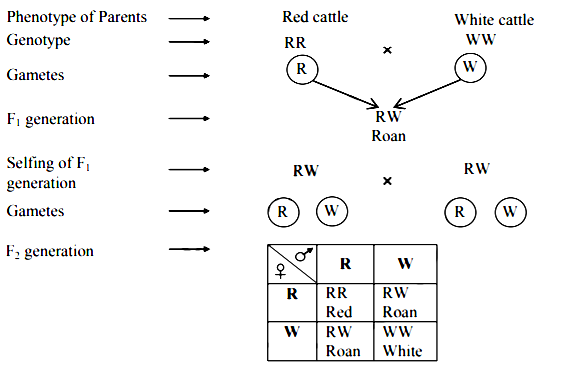
  1. Coat colour in cattle is a classic example of co-dominance.
  2. There are two types, one with a red coat (skin with red colour hair) and the other with a white coat (with white hair).
  3. When red cattle (RR) is crossed with white cattle (WW), F1 hybrids (RW) have roan colour. Roans have a mixture of red and white colour hair.
  4. Thus, both traits are expressed equally. In F2 generation (produced by interbreeding of roans), red (RR), roans (RW) and white (WW) are produced in the ratio 1: 2: 1.

Phenotypic ratio → 1 : 2 : 1 (1 Red coat : 2 Roan : 1 White coat)

Genotypic ratio → 1 : 2 : 1 (1 RR : 2 RW : 1 WW)

View full question & answer
Question 382 Marks
Give an account of external genitalia in human females.
Answer
External genitalia (Vulva):
The external genital organs of female include parts external to the vagina, collectively called vulva (covering or wrapping), or pudendum. They include the following parts:
  1. Vestibule:
    It is a median vertical depression of vulva enclosing the urethral and vaginal opening.
  2. Labia minora:
    These are another pair of thin folds inner to the labia majora with which they merge posteriorly to form the fourchette (frenulum), while towards the anterior end they converge into a hood-like covering around the clitoris.
  3. Clitoris:
    A small conical and sensitive projection lying at the anterior end of labia minora. It has a pair of erectile tissue i.e. corpora cavernosa which is homologous to the penis.
  4. Labia majora:
    These are a pair of fleshy folds of skin forming the boundary of the vulva. They are homologous to the scrotum. They surround and protect the other parts of the external genitalia and enclose the urethral and vaginal openings in the vestibule.
  5. Mons pubis:
    It is a fleshy elevation above the labia majora. The Mons pubis and outer part of labia majora show pubic hair.
View full question & answer
Question 392 Marks
Define the term Adaptation. State its two advantages.
Answer
Definition: Adaptation is an attribute of the organism (morphological, physiological, and behavioural) that enables the organism to survive and reproduce in its habitat.

i. Adaptations of plants for aquatic and desert habitats:

a. Adaptations of plants for aquatic habitats:

  1. Leaves and stem of some aquatic plants show presence of aerenchyma tissue which helps in exchange of gases between plant organs above the water surface and submerged plant organs.
  2. Many aquatic plants have flat leaves to receive maximum sunlight for photosynthesis. Leaves of submerged plants are often dissected to minimize water resistance.

b. Adaptations of plants for desert habitats:

  1. Many desert plants have a thick cuticle on their leaf surfaces and have their stomata in deep pits to minimize loss of water through transpiration.
  2. They show a special photosynthetic pathway (CAM - Crassulacean Acid Metabolism) that enables their stomata to remain closed during daytime.
View full question & answer
Question 402 Marks
For production of edible vaccines plants are used. Explain this any one example.
Answer
‘Melt in the mouth’ vaccines can be administered by placing them under tongue that delivers it into the blood stream.

Example- Potatoes, tomatoes, bananas, soybeans, alfalfa and cereals are the most common foods proposed for edible vaccine delivery

View full question & answer
Question 412 Marks
Name two bacteria which are responsible for fermenting dough of idli, dosa.
Answer
Leuconostoc and Streptococcus species of bacteria are responsible for fermenting dough of idli, dosa.
View full question & answer
Question 422 Marks
State the significance of mother’s milk to a newborn.
Answer
  1. Mother’s milk provides naturally acquired passive immunity to the newborn.
  2. After birth, antibodies are transferred from the mother to infant through colostrum (first milk of mother) and continue throughout the period breast feeding.
View full question & answer
Question 432 Marks
Mention various adaptations for wind pollination.
Answer
Adaptations in anemophilous flowers:
  1. The flowers are small, inconspicuous, colourless, without nectar and fragrance (odour).
  2. The pollen grains are light in weight, dry and produced in large numbers to increase chances of pollination considering wastage of pollen grains.
  3. Stigma is feathery to trap pollens carried by wind currents.
  4. Stamens are exserted with long filaments and versatile anthers.
  5. Stamens and stigmas are exposed to air currents.
View full question & answer
Question 442 Marks
Name the glucocorticoid used in treatment of allergy and why?
Answer
  1. Cortisol is the glucocorticoid used in treatment of allergy.
  2. Cortisol is immunosuppressive i.e. it suppresses the synthesis of antibodies Hence, it is used in treatment of allergy
View full question & answer
Question 452 Marks
Define intracellular transport and extracellular transport.
Answer
  1. Intracellular transport: In Parameocium, Amoeba, root hair cells of many plants and WBCs in animals, transportation of materials occurs within the cell due to the streaming movement of the cytoplasm known as cyclosis. This is known as intracellular transport.
  2. Extracellular transport: In roundworms there are no blood vessels and the body fluid is moved around the viscera by contraction of body wall and muscles. This is extracellular transport.
View full question & answer
Question 462 Marks
Describe structure of root hair.
Answer
  1. Root hair is a cytoplasmic extension (prolongation) of epiblema cell.
  2. Each root hair may be approximately 1 to 10 mm long and tube-like structure.
  3. It is colourless, unbranched, short-lived (ephemeral), and very delicate.
  4. It has a large central vacuole surrounded by a thin film of cytoplasm, plasma membrane, and thin cell wall, which is two-layered.
  5. Outer layer is composed of pectin and the inner layer is made up of cellulose.
  6. Cell wall of a root hair is freely permeable but the plasma membrane is selectively permeable.
View full question & answer
Question 472 Marks
What led to better utilization of hands for holding objects effectively and better motor skills?
Answer
  1. Freedom of forelimbs from locomotory function.
  2. Opposable thumb These factors led to better utilization of hands for holding objects effectively and development of motor skills etc.
View full question & answer
Question 482 Marks
Describe the Hershey-Chase experiment in detail.
Answer
  1. Hershey and Chase worked on viruses that infect bacteria and are called bacteriophages which are composed of DNA and protein.
  2. Hershey and Chase grew some viruses on a medium that contained radioactive phosphorus $(^{32}P)$ and some others on the medium that contained radioactive sulphur $(^{35}S)$.
  3. Viruses grown in presence of radioactive phosphorus contained radioactive DNA but not radioactive protein because DNA contains phosphorus.
  4. Viruses grown in presence of radioactive sulphur contained radioactive protein but not radioactive DNA, because DNA does not contain sulphur, but proteins contain sulphur.
  5. Radioactive bacteriophages were allowed to infect E. coli bacteria grown on the medium containing normal ‘P’ and ‘S’.
  6. As the infection proceeded, the viral coats were removed from the bacteria with the help of a centrifuge.
  7. Bacteria infected with viruses containing radioactive DNA were radioactive, whereas bacteria infected with viruses containing radioactive proteins were not radioactive.
  8. This indicates that DNA enters the bacterial cells and not protein.
  9. Thus, by this experiment, Hershey and Chase proved that DNA is the genetic material.
View full question & answer
Question 492 Marks
Give an account of incomplete dominance with a suitable example.
Answer
Incomplete dominance:
  1. Incomplete dominance is a deviation of Mendel’s law of dominance.
  2. In incomplete dominance, both the alleles (genes) of an allelomorphic pair express themselves partially.
  3. One allele (gene) cannot suppress the expression of the other allele (gene) completely.
  4. In such case, there is an intermediate expression in the F1 hybrid.
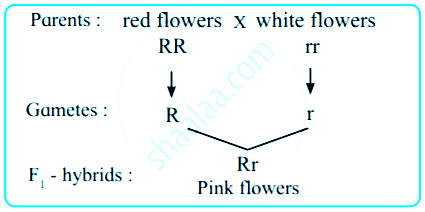
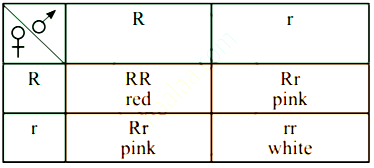
  5. In Mirabilis jalapa, if a red-flowered (RR) plant is crossed with a white-flowered (RR) plant, then F1 offsprings have pink (Rr) flowers.


F2 Generation: Selfing of F1

Result:
Genotypic ratio - 1RR : 2Rr : 1rr
Phenotypic ratio - 1Red : 2 Pink :1 White

View full question & answer
Question 502 Marks
Write a short note on fallopian tube.
Answer
Fallopian tubes:
These are a pair of muscular ducts lying horizontally over the peritoneal cavity. The proximal part of the tube lies close to the ovary and distally it opens into the uterus. Each tube is 10 to 12 cm in length. It is internally lined by ciliated epithelium.
It can be divided into three regions:
  1. Infundibulum:
    The proximal funnel-like part with an opening called ostium surrounded by many finger-like processes called fimbriae (of these at least one is long and connected to the ovary). The cilia and the movement of fimbriae help in transporting the ovulated egg to the ostium.
  2. Ampulla:
    It is the middle, long and straight part of the oviduct. Fertilization of the ovum takes place in this region.
  3. Isthmus/Cornua:
    The distal narrow part of the duct opening into the uterus.
  4. Functions:
  1. Fallopian tubes carry the released egg from the ovary to the uterus.
  2. Ampulla provides the site for fertilization of the ovum.
View full question & answer
Question 512 Marks
How ‘Temperature’ as an abiotic factor plays a role in ecology?
Answer
  1. It is considered the most ecologically relevant environmental factor
  2. Eurythermal organisms can tolerate and thrive in a wide range of temperatures and stenothermal organisms can tolerate narrow range of temperatures.
View full question & answer
Question 522 Marks
Write any two human disorders and to cure which recombinant proteins are produced?
Answer
No Human Disorders Recombinant Protein
i. Atherosclerosis Platelet derived growth factor
ii. Emphysema α1- antitrypsin
View full question & answer
Question 532 Marks
Match the column A with B and rewrite correct pairs.
A B
i Atlas 66 vit A
ii Rice vit C
iii Spinach protein
iv bitter gourd Iron
Answer
A B
i Atlas 66 Protein
ii Rice Iron
iii Spinach Vit A
iv bitter gourd Vit C
View full question & answer
Question 542 Marks
Give any four the symptoms of Ascariasis.
Answer
  1. Gastro-intestinal discomfort accompanied with vomiting and fever.
  2. Presence of live worms in faecal matter.
  3. Pulmonary disorders occur in some patients. e.g. Pneumonitis (inflammation in alveolar wall).
  4. Loss of appetite and weight loss.
View full question & answer
Question 552 Marks
Describe the structure of female gametophyte of angiosperms.
Answer
  1. In angiosperms, female gametophyte present in the ovule is haploid embryo-sac. Each embryo-sac contains egg apparatus, 3 antipodal cells, and 2 polar nuclei.
  2. The Egg apparatus consists of the large central, haploid egg cells and two supporting haploid synergid cells. Synergid shows hair-like projections called filiform apparatus, which guide the pollen tube towards the egg.
  3. Antipodal cells are a group of three cells present at the chalazal end.
  4. The two haploid polar nuclei of large central cells fuse to form a diploid secondary nucleus or definitive nucleus, just prior to fertilization.
View full question & answer
Question 562 Marks
Describe any two hormones produced by the ovaries.
Answer
  1. Progesterone: It is secreted by corpus luteum of the ovary after ovulation. It is essential for thickening of uterine endometrium, thus preparing the uterus for implantation of fertilized ovum. It is responsible for development of mammary glands during pregnancy. It inhibits uterine contractions during pregnancy.
  2. Oestrogen: It is secreted by developing follicles. Estradiol is the main oestrogen. It is responsible for development of secondary sexual characters in females.
View full question & answer
Question 572 Marks
Give any two effects of carbon monoxide poisoning.
Answer
  1. In the presence of carbon monoxide, haemoglobin readily combines to form a stable compound called carboxyhaemoglobin.
  2. The formation of carboxyhaemoglobin prevents the binding of oxygen with haemoglobin and less haemoglobin is available for oxygen transport depriving the cells of oxygen.
View full question & answer
Question 602 Marks
Define mutation. State its two types.
Answer
  1. Definition:
    The mutation is a phenomenon in which sudden change in the DNA sequence takes place which results in the change of genotype and ultimately variation in the phenotype.
  2. Types of mutations:
  1. Point mutations
  2. Frameshift mutation or deletion mutation.
View full question & answer
Question 612 Marks
Explain test cross with suitable example and state its ratios.
Answer
  1. A test cross is used to find out the genotype of any plant with dominant expression when it is not known whether it is homozygous (pure) or heterozygous for that trait.
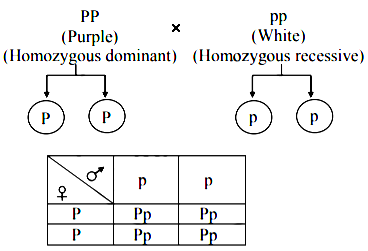
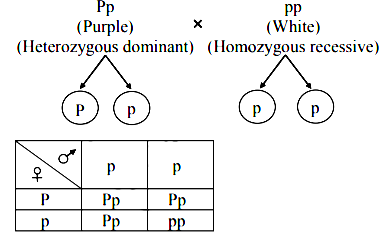
  2. For example, a pea plant having purple flowers (F1 hybrid with unknown genotype) is crossed with a pea plant with white flowers (recessive).
  3. If all flowers produced are purple, we can conclude that plant is pure or homozygous and if we get purple and white flowers in a 1:1 ratio, conclude that plant is heterozygous.
  4. Following is the graphical representation for test cross:
  1. Assume that purple flower is Homozygous dominant (PP).
    All flowers are purple. Thus, the F1 hybrid is homozygous dominant (PP).
  2. Assume that purple flower is Heterozygous dominant (Pp).

    Half of the flowers are purple and half are white. Thus, the F1 hybrid is heterozygous dominant (Pp).
View full question & answer
Question 622 Marks
Describe the structure of Graafian follicle.
Answer
Structure of Graafian follicle:
  1. The Graafian follicle is a mature ovarian follicle.
  2. The secondary oocyte is located eccentrically (away from the centre) and is surrounded by a non-cellular layer of zona pellucida secreted by the vitelline membrane of the oocyte,
  3. There are three layers covering the Graafian follicle. They are as follows:
  4. The outermost protective and fibrous covering is called theca externa.
  5. Inner to it is cellular theca interna which produces the hormone estrogen.
  6. Inner to the theca interna, the follicular cells from the membrane granulosa.
  7. From the membrane granulosa, the cells differentiate into discus proligerus and the corona radiata cells.
  8. Oocyte and the surrounding granulosa cells are together termed as Cumulus oophorus.
  9. A fluid-filled cavity called antrum lies between the oocyte and the membrane granulosa. It is filled with a fluid called liquor folliculi.
View full question & answer
Question 632 Marks
With the help of any one example explain Alien species invasion as one of the causes of Biodiversity losses.
Answer
When a new species gets introduced into any ecosystem accidentally or intentionally, there are chances that it proves harmful for existing species. Sometimes, it can lead to extinction of local species.

In such a case, it is called as invasive species. One of the major reasons of such a harmful effect of alien species is lack of local predator.

  1. Introduction of predator fish - Nile perch in Lake Victoria proved deleterious for 200 local species of Cichlid fish.
View full question & answer
Question 642 Marks
How Habitat differs from Niche?
Answer
Habitat Niche
1. A habitat is an area, where a species lives and interact with the other factors and prosper. Niche not only describes the position of a species in an environment but also describes the functional role played by an organism.
2. Habitat deals with effects of temperature, rainfall and other abiotic factors. Niche deals with the flow of energy from one organism to another.
View full question & answer
Question 652 Marks
Explain how transgenic fish is commercially beneficial.
Answer
Transgenic fish:
  1. The commercially important fish like Atlantic salmon, catfish, goldfish, Tilapia, zebra-fish, common carp, rainbow trout, etc. are transfected with growth hormone, chicken crystalline protein and E. coli hygromycin resistance gene.
  2. Transgenic fish showed increased cold tolerance and improved growth and it is the quantity and quality of fish proteins as well as its preservation, are the factors affecting the economic value of fish.
View full question & answer
Question 662 Marks
A young girl is health conscious. Her dietician advised her to include mushrooms in her diet. What must be the reason?
Answer
  1. Mushrooms are rich in proteins, vitamins, minerals and amino acids.
  2. They are also low in calories. Therefore, dietician advised her to include mushrooms in her diet.
View full question & answer
Question 672 Marks
Enlist any four therapies used to treat a cancer patient.
Answer
Cancer treatment consists of combination of a number of therapies which are follows:
  1. Chemotherapy
  2. Radiotherapy
  3. Surgery
  4. Immunotherapy
View full question & answer
Question 692 Marks
Which two hormones are responsible for the regulation of calcium and phosphorus in the blood?
Answer
Calcitonin and parathormone are responsible for regulation of calcium and phosphorous in the blood.
View full question & answer
Question 702 Marks
Define Bohr effect and Haldane effect.
Answer
  1. Bohr effect: Bohr effect is the shift of oxyhaemoglobin dissociation curve due to change in partial pressure of $CO_2$ in blood.
  2. Haldane effect: The amount of $CO_2$​​​​​​​ that can be transported in the blood is influenced by the percent saturation of haemoglobin with oxygen. The lower the amount of oxyhaemoglobin $(Hb-O_2)$, the higher the $CO_2​​​​​​​$​​​​​​​ carrying capacity of the blood, this relationship is known as the Haldane effect.
View full question & answer
Question 712 Marks
A gardener wants to give bushy appearance to plants in our college campus.
  1. What should he do to achieve the same?
  2. Which property of phytohormones he must be aware of?
Answer
i. a. Pruning is done to remove apical dominance in plants.

b. When plants are decapitated, removal of apical bud results in growth of lateral buds which gives bushy appearance to plants.

c. Thus, pruning is done to encourage growth of more shoots with softer leaves.

ii. The gardener should be aware of the property of apical dominance.

View full question & answer
Question 722 Marks
What are the different types of water?
Answer
The different types of water present in soil can be classified as:
  1. Gravitational water: The water which percolates deep in the soil, due to gravity is called ‘gravitational water’. This water goes beyond the reach of roots of most of the plants, thus is not available to plants for absorption.
  2. Hygroscopic water: Fine soil particles imbibe/absorb water and hold it very tightly. This is called ‘hygroscopic water. Roots cannot absorb it.
  3. Combined water: Water present in the form of hydrated oxides of silicon, aluminium, etc., is called ‘combined water’. It is also not available to plants for absorption. iv. Capillary water: Some amount of water is held in pores present between the neighbouring soil particles, due to capillarity. This is called capillary water which is available for absorption.
View full question & answer
Question 732 Marks
Distinguish New world and old world monkeys based on their tail along with their examples.
Answer
No. New World Monkeys Old World Monkeys
1. The New World monkeys have a long non-prehensile tail. The old-world monkeys have a short non-prehensile tail.
e.g. Squirrel monkey, spider monkey Baboons, macaques, etc
View full question & answer
Question 742 Marks
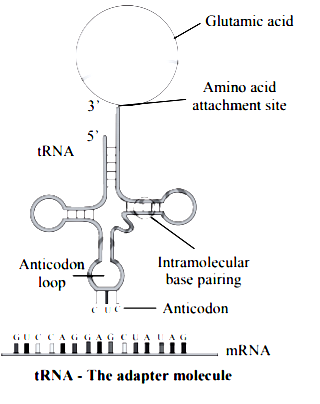
How t-RNA act as an adapter molecule?
Explain in detail with the help of a diagram.
Answer
Transfer RNAs are known as adapter molecules in protein synthesis because they are covalently linked to an amino acid at one end and they pair with the mRNA in such a way that amino acids are joined to a growing polypeptide in the correct sequence.

View full question & answer
Question 752 Marks
Give any two points of difference between homozygous and heterozygous.
Answer
No. Homozygous Heterozygous
1. Organisms having identical alleles for a character are homozygous. Organisms having dissimilar alleles for a character are heterozygous.
2. It is pure or true breeding. It is hybrid (Does not breed true).
3. They form only one type of gamete. They form more than one type of gametes.
e.g. Tall (TT), Dwarf (tt). Tall (Tt)
View full question & answer
Question 772 Marks
Give any four factors that favour high speciation at lower altitudes.
Answer
The factors that favour high speciation at lower latitudes (tropical regions) as compared to higher latitudes (towards the poles) are as follows:
  1. Factors like overall stability of tropical regions (at lower latitudes) for millions of years, lesser climatic changes throughout the year and availability of plenty of sunlight have favoured speciation.
  2. Tropical areas have less often experienced drastic disturbances like periodic glaciations observed at poles. Such stability over millions of years might have favoured speciation.
  3. Lesser migrations in tropics might have reduced gene flow between geographically isolated regions and favoured speciation.
  4. Scientists also have considered availability of more intense sunlight, warmer temperatures and higher annual rainfall in tropics, as factors responsible for bountifulness of these regions.
View full question & answer
Question 782 Marks
Give reasons – ‘Primary succession is always slower than secondary succession’
Answer
  1. Primary succession starts in the area where no living organisms ever existed.
  2. In case of secondary succession, since soil is already present, the succession rate is faster and hence climax is also reached quickly. Hence, primary succession is always slower than secondary succession.
View full question & answer
Question 792 Marks
Define Population.
Answer
Population: Organisms of the same kind inhabiting a geographical area constitute the population.

OR

Individuals live in groups in a well-defined geographical area, share or compete for similar resources, potentially interbreed and thus form a population.

OR

The population is defined as a group of individuals of a species occupying a definite geographic area at a given time.

View full question & answer
Question 802 Marks
Define the term Biome.
Answer
Biome constitutes a large regional terrestrial unit delimited by a specific climatic zone having a major vegetation zone (plant communities) and the associated fauna.
View full question & answer
Question 812 Marks
How Biotechnology is applicable with respect to Genomics?
Answer
Following are the applications of biotechnology with respect to genomics:
  1. Whole genome sequencing,
  2. Identifying gene function.
View full question & answer
Question 822 Marks
Give names of two organisations which provide most commonly used models of biogas plants.
Answer
KVIC and IARI provide the most commonly used models of biogas plants.
View full question & answer
Question 832 Marks
Enlist any four barriers that contribute to innate immunity.
Answer
The barriers that contribute to innate immunity are
  1. Epithelial surface
  2. Antimicrobial substances in blood and tissues
  3. Cellular factors in innate immunity
  4. Fever
View full question & answer
Question 842 Marks
Describe the structure of pollen grain.
Answer
  1. The process of formation of microspores from diploid microspore mother cell through meiotic cell division inside the microsporangia or pollen sacs is called microsporogenesis.
  2. Structure of microspore:
    Pollen grain/microspore is a non-motile, haploid, unicellular body with a single nucleus. It is surrounded by a two-layered wall called sporoderm. The outer wall is called exine and the inner wall is called intine.
  3. Exine:
    The exine is thick and made up of a complex, non-biodegradable, substance called sporopollenin and it is resistant to chemicals. It may be smooth or with a sculptured pattern (characteristic of the species). At some places, exine is very thin showing thin areas known as germ pores. Germ-pores are meant for the growth of emerging pollen tubes during the germination of the pollen grain.
  4. Intine:
    The inner wall layer, intine consists of cellulose and pectin.
View full question & answer
Question 852 Marks
‘Injury to the medulla oblongata causes sudden death’ Explain.
Answer
  1. Medulla oblongata is a part of brain stem which controls involuntary vital functions like heartbeat, respiration, vasomotor activities and peristalsis.
  2. Thus, injury to medulla oblongata may disrupt these vital functions and cause sudden death.
View full question & answer
Question 862 Marks
Fill in the blanks with the help of chart.
Organism Habitat Respiratory surface/ organ
Coelenterates
Spiders
Answer
Organism Habitat Respiratory surface/ organ
Coelenterates Aquatic Plasma membraneTerrestrial
Spiders Terrestrial Book lungs
View full question & answer
Question 872 Marks
Match the column A with B
A B
i. Epinasty of flower GA3
ii. Natural auxin NAA
iii. Flowering in Litchi IAA
iv. Bolting of Beet Ethylene
Answer
A B
i. Epinasty of flower Ethylene
ii. Natural auxin IAA
iii. Flowering in Litchi NAA
iv. Bolting of Beet GA3
View full question & answer
Question 882 Marks
Why water is called as ‘Elixir of Life’?
Answer
  1. Water is in liquid form at room temperature and is the best solvent for most of the solutes.
  2. In pure form, it is the inert inorganic compound with neutral pH. Due to this, water is the best transporting medium for dissolved minerals and food molecules.
  3. It is the best aqueous medium for all biochemical reactions occurring in the cells.
  4. It is an essential raw material for photosynthesis.
  5. Water has high specific heat, high heat of vaporization, and high heat of fusion. Due to this, it acts as a thermal buffer.
  6. Water molecules have good adhesive and cohesive forces of attraction.
  7. Due to high surface tension and high adhesive and cohesive force, it can easily rise in the capillaries. This is why water is called as ‘Elixir of Life'.
View full question & answer
Question 892 Marks
Mention any two developments in human which helped him to move around safely on land.
Answer
  1. Bipedal locomotion
  2. Erect posture
  3. Stereoscopic vision.
View full question & answer
Question 902 Marks
Differentiate between Heterochromatin & Euchromatin.
Answer
No. Heterochromatin Euchromatin
1. In eukaryotic cells, some segments of chromonema/ chromosome during interphase and early prophase remain in a condensed state. These regions constitute heterochromatin. The regions of chromonema which are in a non-condensed state constitute euchromatin.
2. It is genetically and transcriptionally inactive. It is genetically and transcriptionally very much active and fast replicating.
3. It stains strongly and appears dark. Euchromatic regions stain light.
View full question & answer
Question 912 Marks
Discuss any two points due to which Mendel got success in his experiment?
Answer
Following are the reasons for Mendel’s success:
  1. His experiments were carefully planned and involved a large sample.
  2. He carefully recorded the number of plants of each type and expressed his results as ratios.
  3. In the pea plant, contrasting characters can be easily recognized.
  4. The seven different characters in the pea plant were controlled by a single factor each.
  5. The factors are located on separate chromosomes and these factors are transmitted from generation to generation.
View full question & answer
Question 932 Marks
Write full form of
  1. IUCN
  2. NBA
Answer
  1. IUCN: International Union for Conservation of Nature and Natural Resources
  2. NBA: National Biodiversity Authority
View full question & answer
Question 942 Marks
Name the types of succession of plants based on the nature of habitat.
Answer
  1. Depending on the availability of water, there are two types of succession − hydrarch succession (hydrosere) and xerarch succession (xerosere).
  2. Xerarch succession takes place in dry areas and the series progress for xeric to mesic conditions.
View full question & answer
Question 962 Marks
What is Biopiracy? Explain it with respect to Turmeric.
Answer
Definition:
  1. Biopiracy is defined as ‘theft of various natural products and then selling them by getting patent without giving any benefits or compensation back to the host country’.
  2. Since ancient times, Indians have been using Haldi (Turmeric powder) as antiseptic for healing wounds for killing pests and medicinal purposes
View full question & answer
Question 972 Marks
Rearrange the names of tanks used in sewage treatment as per the flow of procedure.
  1. settling tank
  2. Grit Chamber
  3. aeration tanks
  4. primary sedimentation tank.
Answer
  1. Grit Chamber
  2. Primary sedimentation tank.
  3. Settling tank
  4. . Aeration tanks
View full question & answer
Question 982 Marks
Enlist the four types of T- lymphocytes, responsible for immune response of our body.
Answer
The four types of T- lymphocytes, responsible for immune response of our body are as followsi.
  1. Helper T-cells
  2. Killer T-cells or Cytotoxic T-cells
  3. Suppressor T-cells iv. Memory T-cells
View full question & answer
Question 1012 Marks
Give a detail account of thalassemia.
Answer
  1. Thalassemia is an autosomal, inherited recessive disease.
  2. A haemoglobin molecule is made of four polypeptide chains- 2 alpha (α) and 2 betas (β) chains.
  3. The synthesis of alpha chains is controlled by two closely linked genes (HBA1 and HBA2) on chromosome 16 while the synthesis of the beta chain is controlled by a single gene (HBB) on chromosome 11.
  4. Depending upon which chain of haemoglobin is affected, thalassemia is classified as alpha-thalassemia and beta-thalassemia.
  5. It is caused due to deletion or mutation of a gene that codes for alpha (α) and beta (β) globin chains that result in the abnormal synthesis of haemoglobin.
  6. Symptoms: In Thalassemia, the person shows symptoms like anemia, pale yellow skin, change in size and shape of RBCs, slow growth and development, dark urine, etc.
  7. Massive blood transfusion is needed for these patients.
  8. Thalassemia differs from sickle-cell anemia. Thalassemia is a quantitative problem of synthesizing few globin molecules, while sickle cell anemia is a qualitative problem of synthesizing an incorrectly functional globin.
View full question & answer
Question 1022 Marks
Give an account of polyembryony.
Answer
Polyembryony:
  1. Polyembryony is the occurrence of more than one embryo in a seed which consequently results in the emergence of multiple seedlings.
  2. The additional embryos result from the differentiation and development of various maternal and zygotic tissues associated with the ovule of the seed.
  3. In adventive polyembryony, an embryo develops directly from the diploid cell of nucellus and integuments as in Citrus.
  4. In cleavage polyembryony, zygote proembryo sometimes divides (cleaves) into many parts or units. Each unit then develops into an embryo.
View full question & answer
Question 1032 Marks
What is MTP?
Answer
The intentional or voluntary termination of pregnancy before full term is called Medical termination of Pregnancy (MTP) or induced abortion.
View full question & answer
Question 1042 Marks
Answer the following question.
What are the goals of RCH programme.
Answer
The goals of the Reproductive and Child Healthcare (RCH) programme are as follows:

i. To create awareness among people about various aspects related to reproduction.

ii. To provide facilities to people in order to understand and build up reproductive health.

iii. To provide support for building up a reproductively healthy society.

iv. To bring about a change mainly in three critical health indicators i.e. reducing total infertility rate, infant mortality rate, and maternal mortality rate.

View full question & answer