Questions

Answer the following in brief.

Take a timed test

41 questions · self-marked practice — reveal the answer and mark yourself.

Question 13 Marks
Which of the three lattices scc, bcc and fcc has the most efficient packing of particles ? Which one has the least efficient packing ?
Answer
fcc has the most efficient packing of particles while see has the least efficient packing.
View full question & answer
Question 23 Marks
Obtain the relationship between density of a substance and the edge length of unit cell.
Answer
(1) Consider a cubic unit cell of edge length $‘a’$.
The volume of unit cell = $a^3(2)$ If there are ‘n’ particles per unit cell and the mass of particle is $‘m’$, then
Mass of unit cell = $m × n.$
(3) If the density of the unit cell of the substance is p then
Density of unit cell = $\frac{\text { Mass of unit cell }}{\text { Volume of unit cell }}$
$\rho=\frac{m \times n}{a^3}$
View full question & answer
Question 33 Marks
Cu crystallizes in fee unit cell with edge length of 495 pm. What is the radius of Cu atom ?
Answer
Given $: a =495 pm$ Radius, $r=$ ? For fee structure, radius $=r=\frac{a}{2 \sqrt{2}}=\frac{495}{2 \times \sqrt{2}}=175 cm$. Radius of Cu atom $=175 pm$
View full question & answer
Question 43 Marks
Cesium chloride crystallizes in cubic unit cell with Cl -ions at the corners and $Cs +$ ion in the centre of the cube. How many CsCl molecules are there in the unit cell ?
Answer
Number of $Cs ^{+}$ion at body centre $=1$
Number of $Cl ^{-}$ions due to 8 comers $=8 \times \frac{1}{8}=1$
Hence unit cell contains 1 CsCl molecule.
View full question & answer
Question 53 Marks
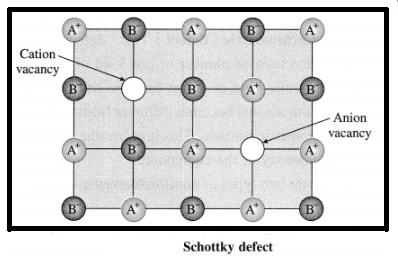
What are the consequences of Schottky defect?
Answer
Consequences of Schottky defect : Since the number of ions (cations and anions) decreases but volume remains unchanged, the density of a substance decreases. As the number of missing cations and anions is equal, the electrical neutrality of the compound remains same. This defect arises in ionic crystals like NaCl, AgBr, KCl, etc.
View full question & answer
Question 63 Marks
What are paramagnetic substances? Give examples.
Answer
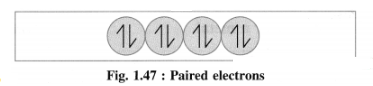
(1) The magnetic properties of a substance arise due to the presence of electrons.
(2) An electron while revolving around the nucleus, also spins around its own axis and generates a magnetic moment and magnetic properties.
(3) If an atom or a molecule contains one or more unpaired electrons spinning in same direction, clockwise or anticlockwise, then the substance is associated with net magnetic moment and magnetic properties. They experience a net force of attraction when placed in the magnetic field. This phenomenon is called paramagnetism and the substance is said to be paramagnetic.
For example, $O _2, Cu ^{2+}, Fe ^{3+}, Cr ^{3+}, NO$, etc.
View full question & answer
Question 73 Marks
Calculate the packing efficiency of metal crystal that has simple cubic structure.
Answer
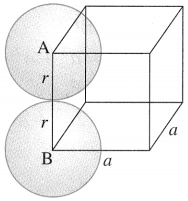
Step 1 : Radius of sphere : In simple cubic lattice, the atoms (spheres) are present at eight corners and in contact along the edge in the unit cell.
If ‘a’ is the edge length of the unit cell and ‘r’ is the radius of the atom, then
a = 2r or r = a/2
Image

scc structure

Step 2 : Volume of sphere :
Volume of one particle = $\frac{4 \pi}{3} \times r^3$

$=\frac{4 \pi}{3} \times( a / 2)^3=\frac{\pi a^3}{6}$

Step 3 : Total volume of particles : Since the unit cell contains one particle. Volume occupied by one particle in unit cell = $\frac{\pi a^3}{6}$

Step 4 : Packing efficiency :
Packing efficiency

$=\frac{\text { Volume occupied by particles in unit cell }}{\text { Volume of unit cell }} \times 100$

$=\frac{\pi a^3 / 6}{a^3} \times 100$

$=\frac{3.142 \times 100}{6}=52.36 \%$

∴ Packing efficiency = 52.36%
Percentage of void space = 100 – 52.36
= 47.64%
View full question & answer
Question 83 Marks
Calculate the number of atoms in fcc unit cell.
Answer
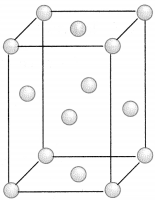
Number of atoms in face-centred cubic (fcc) unit cell :
In this unit cell, there are 8 atoms at 8 corners and 6 atoms at 6 face centres. Each corner contributes 1/8th atom to the unit cell, hence due to 8 corners,
Number of atoms = $\frac{1}{8} \times 8=1$

Each face centre contributes half of the atom to the unit cell, hence due to 6 face centres,
Number of atoms = $\frac{1}{2} \times 6=3$

∴ Total number of atoms present in fee unit cell = 1 + 3 = 4.Hence the volume of the unit cell is equal to the volume of four atoms.

Image
Face centered unit cell
View full question & answer
Question 93 Marks
What are valence band and conduction band?
Answer
There are two types of bands of molecular orbitals as follows : Valence band : The atomic orbitals with filled electrons from the inner shells form valence bands, where there are no free mobile electrons since they are involved in bonding. Conduction band : Atomic orbitals which are partially filled or empty on overlapping form closely placed molecular orbitals giving conduction bands where electrons are delocalised and can conduct, heat and electricity.
View full question & answer
Question 103 Marks
Explain diamagnetism.
View full question & answer
Question 113 Marks
Explain insulators.
Answer
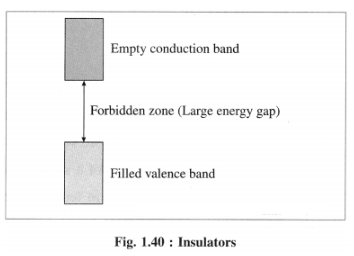
(1) In insulators the valence band is completely filled by electronics while conduction band is empty.
Image
(2) The energy gap between valence band and conduction band in insulator is very large.
(3) Thermal energy is not sufficient to promote electrons from valence band to conduction band.
(4) Therefore, the conduction band in insulator remains vacant and does not allow the conduction of electricity.
View full question & answer
Question 123 Marks
Metals are good conductors of electricity. Explain.
Answer
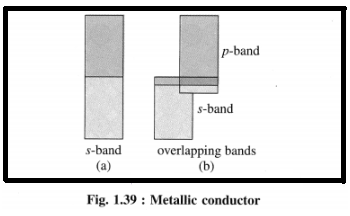
(1) Metals are good conductors of electricity since the outermost electrons of atoms in metallic crystal occupy conduction bands.
Image
(2) The number of electrons in conduction bands is very large.
(3) The conduction bands in metals can be labelled as ‘s’ band, overlapping s and p bands etc. according to overlapping of orbitals.
(4) This results in delocalisation of outermost electrons forming metal ions. Hence, this is analogous to metal cations immersed in the sea of electrons.
View full question & answer
Question 133 Marks
How are solids classified according to electrical conductivity?
Answer
According to electrical conductivity, solids are classified as follows :
$(1)$ Conductors :
The solids having electrical conductivity in the range of $10^4$ to $10^7$$Ohm ^{-1} m ^{-1}$ are called conductors.
The examples of conductors are metals and electrolytes.
Electrical conductivity in metals is due to free movement of electrons while electrolytes conduct electricity due to migration ions.
$(2)$ Insulators :
Solids having very low electrical conductivity in the range of $10^{-20}$ to $10^{-10} \ Ohm ^{-1} m ^{-1}$ are called insulators.
The examples of insulators are nonmetals and molecular solids.
$(3)$ Semiconductors :
Solids having conductivity in the range of $10^{-6}$  to $10^4 \ Ohm^{-1}m^{-1}$ are semiconductors.
The conductivity range is intermediate between conductors and insulators.
The examples of semiconductors are silicon and germanium.
View full question & answer
Question 143 Marks
Explain defects due to anion vacancies.
###
Explain colour of crystals or F centres.
Answer
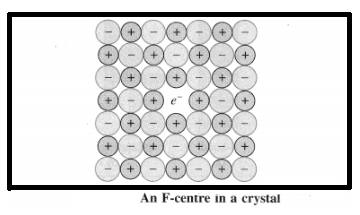
    • The defect due to anion vacancies imparts colour to the colourless crystal.
    • When a colourless crystal of $NaCl$ is heated in the atmosphere of sodium vapour, the sodium atoms are deposited on the crystal surface.
    • Due to diffusion of $Cl ^{-}$ions to the crystal surface vacancies are created at their regular sites.
    • These diffused $Cl ^{-}$ions combine with $Na$ atoms on the surface forming $NaCl$ along with releasing electrons from sodium atoms. $Na + Cl ^{-} \rightarrow NaCl + e ^{-}$

Image
    The released electrons diffuse into the crystal and occupy vacant sites of anions $Cl ^{-}$in the crystal. The anion vacant sites occupied by electrons are called F-centres or colour centres. Due to colour centres $NaCl$ shows yellow colour.
    Now $NaCl$ crystal has excess of $Na$ atoms having nonstoichiometric formula $Na _{1+ x } Cl _{1,0}$.
View full question & answer
Question 153 Marks
How does Frenkel defect arise?
Answer
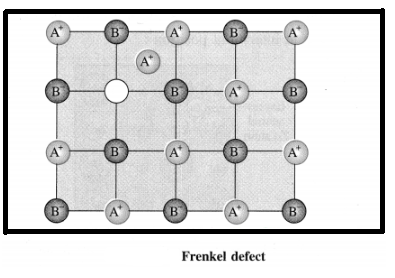
Image
  • Frenkel defect : This defect arises when an ion of an ionic compound is missing from its regular site and occupies interstitial vacant position between lattice points.
  • Cations have smaller size than anions, hence generally cations occupy the interstitial sites.
  • This creates a vacancy defect at its original position and interstitial defect at new position.
  • Frenkel defect is regarded as the combination of interstitial defect and vacancy defect.
Conditions for the formation of Frenkel defect :

  • This defect arises in ionic compounds with a large difference between the sizes of cation and anion.
  • The ionic compounds must have ions with low coordination number.
View full question & answer
Question 163 Marks
How does Schottky defect arise?
View full question & answer
Question 173 Marks
Explain vacancy defect.
Answer
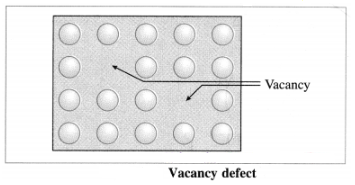
Vacancy defect :
(1) During crystallisation, some of regular sites in solid remain unoccupied and the missing particle creates a vacancy defect.
(2) The defect can be developed by heating the substance.
Image
(3) The mass of solid decreases due to absence of particles in regular sites.
(4) Since the volume remains the same the density of the substance decreases.
View full question & answer
Question 183 Marks
The density of iron crystal is $8.54 gram cm ^{-3}$. If the edge length of unit cell is $2.8 \mathring A$ and atomic mass is $56 gram mol ^{-1}$, find the number of atoms in the unit cell. What is the type of crystal?
Answer
Given:
Density of Fe crystal $= d =8.54 g cm ^{-3}$
$a =2.8 Å=2.8 \times 10^{-8} cm$

Atomic mass $= M =56 g mol ^{-1}$
Number of atoms in unit cell, $n =$ ?
Mass of one atom $=\frac{56}{6.022 \times 10^{23}}=9.3 \times 10^{-23} g$
Volume of unit cell $=a^3=\left(2.8 \times 10^{-8}\right)^3$
$=2.195 \times 10^{-23} cm ^3$

If there are $n$ atoms in the unit cell, then
Mass of unit cell $=n \times 9.3 \times 10^{-23} g$
$\begin{aligned}
& \text { Density of unit cell }=\frac{\text { Mass of unit cell }}{\text { Volume of unit cell }} \\
& 8.54=\frac{n \times 9.3 \times 10^{-23}}{2.195 \times 10^{-23}} \\
& \therefore n=\frac{8.54 \times 2.195 \times 10^{-23}}{9.3 \times 10^{-23}} \\
& =2.016 \\
& \cong 2 \\
\end{aligned}$
Since unit cell contains 2 atoms, the crystal has bcc structure.
Ans. Number of atoms in unit cell $=2$
Type of crystal = bcc
View full question & answer
Question 193 Marks
Aluminium having atomic mass $27 g mol ^{-1}$ crystallises in face centred packed cubic crystal. Find the number of $Al$ atoms in $10 g$ aluminium. How many unit cells will be present in it?
Answer
Given : Atomic mass of $Al =27 g mol ^{-1}$
Mass of $Al =10 g$
Avogadro number $= N _{ A }=6.022 \times 10^{23} mol ^{-1}$
Number of $Al$ atoms $=$ ?
Number of unit cells $=$ ?
1 gram atom of $Al =27 g Al$ contains $6.022 \times 10^{23}$
Al atoms
$\begin{aligned}
& \therefore \text { Number of Al atoms in } 10 g \\
& =\frac{10 \times 6.022 \times 10^{23}}{27} \\
& =2.23 \times 10^{23}
\end{aligned}$

In fcc structure, each unit cell contains $4 Al$ atoms.
$\begin{aligned}
& \therefore \text { Number of unit cells }=\frac{2.23 \times 10^{23}}{4} \\
& =5.575 \times 10^{22}
\end{aligned}$

Ans. Number of Al atoms $=2.23 \times 10^{23}$
Number of unit cells $=5.575 \times 10^{22}$.
View full question & answer
Question 203 Marks
The density of silver having atomic mass $107.8 gram mol ^{-1}$ is $10.8 gram cm ^{-3}$. If the edge length of cubic unit cell is $4.05 \times 10^{-8} cm$, find the number of silver atoms in the unit cell. $\left( N _A=\right.$ $\left.6.022 \times 10^{23}, 1 \mathring A=10^{-8} cm \right)$
Answer
$\begin{aligned}
& \text { Given : } d=10.8 g cm ^{-3} \\
& M=107.8 g mol ^{-1} \\
& a=4.05 \times 10^{-8} cm
\end{aligned}$
Number of $Ag$ atoms in unit cell $= n =$ ?
Mass of one Ag atom $=\frac{107.8}{6.022 \times 10^{23}}$
$=1.79 \times 10^{-22} g$
If there are $n$ atoms, then
$\begin{aligned}
& \text { Mass of unit cell }= n \times 1.79 \times 10^{-22} g \\
& \text { Volume of unit cell }= a 3=\left(4.05 \times 10^{-8}\right)^3 \\
& =6.643 \times 10^{-23} cm ^3
\end{aligned}$

$\text { Density of unit cell }=\frac{\text { Mass of unit cell }}{\text { Volume of unit cell }}$

$\begin{aligned}
& \therefore 10.8=\frac{n \times 1.79 \times 10^{-22}}{6.643 \times 10^{-23}} \\
& \therefore n=\frac{10.8 \times 6.643 \times 10^{-23}}{1.79 \times 10^{-22}}=4 \\
\end{aligned}$

Ans. Number of silver atoms (Ag) atoms in unit cell $=4$.
View full question & answer
Question 213 Marks
A metal crystallises into two cubic faces namely face centered (FCC) and body centered (BCC), whose unit cell edge lengths are 3.5 Å and 3.0 Å respectively. Find the ratio of the densities of FCC and BCC.
Answer
Given : Edge length of unit cell of fcc metal $=3.5 
 Å$
$=3.5 \times 10^{-8} cm$

Edge length of unit cell of bcc metal $=3 Å=3 \times 10^{-8} cm$
Density $d=\frac{n \times M }{a^3 \times N _{ A }}$
where, $n =$ Number of $Fe$ atoms in the unit cell
$M=$ Atomic mass of metal
$a=$ Edge length of unit cell
$N _{ A }=$ Avogadro number
$\therefore$ For fcc unit cell $= n =4$
For bcc unit cell $= n =2$
$\begin{aligned}
& \therefore \frac{\text { Density of fcc unit cell }}{\text { Density of bcc unit cell }}=\frac{d_{\text {fcc }}}{d_{ bcc }} \\
& =\frac{\frac{n_{\text {fcc }} \times M }{a_{ fcc }^3 \times N _{ A }}}{\frac{n_{ bcc } \times M }{a_{\text {bcc }}^3 \times N _{ A }}} \\
& =\frac{n_{ fcc }}{n_{ bcc }}\left(\frac{a_{ bcc }}{a_{ fcc }}\right)^3 \\
& =\frac{4}{2}\left(\frac{3 \times 10^{-8}}{3.5 \times 10^{-8}}\right)^3 \\
\end{aligned}$
$=1.26$
Ans. Ratio of densities, $\frac{d_{ fcc }}{d_{\text {bcc }}}= 1 . 2 6$.
View full question & answer
Question 223 Marks
A compound forms hep structure. What is the number of (a) octahedral voids, (b) tetrahedral voids, (c) total voids formed in 0.2 mol of the compound?
Answer
Number of atoms in $0.2 mol$ of the compound
$\begin{aligned}
& =0.2 \times N _{ A }=0.2 \times 6.022 \times 10^{23} \\
& =1.2044 \times 10^{23} \text { atoms }
\end{aligned}$

(a) Number of octahedral voids
$\begin{aligned}
& =\text { Number of atoms } \\
& =1.2044 \times 10^{23}
\end{aligned}$

(b) Number of tetrahedral voids
$\begin{aligned}
& =2 \times \text { Number of atoms } \\
& =2 \times 1.2044 \times 10^{23} \\
& =2.4088 \times 10^{23}
\end{aligned}$

(c) Total number of voids
$\begin{aligned}
& =1.2044 \times 10^{23}+2.4088 \times 10^{23} \\
& =3.6132 \times 10^{23}
\end{aligned}$

Ans. (a) Number of octahedral voids
$=1.2044 \times 10^{23}$
(b) Number of tetrahedral voids $=2.4088 \times 10^{23}$
(c) Total number of voids $=3.6132 \times 10^{23}$
View full question & answer
Question 233 Marks
In a cubic crystalline structure of zinc blende $( Z n S),$ sulphide ions are at corners and face centres while zinc ions occupy half of tetrahedral voids.
Find in the unit cell :
$(i)$ Number of $Zn ^{2+}$ ions
$(ii)$ Number of $S^{2-}$ ions
$(iii)$ Number of $ZnS$ molecules
$(iv)$ Molecular formula of zinc blende.
Answer
$S ^{2-}$ ions are at $8$ comers and $6$ face centres.
$Zn ^{2+}$ ions occupy half of tetrahedral voids.
Number of $S^{2-}$ ions in unit cell
$=\frac{1}{8} \times 8+\frac{1}{2} \times 6$
$\text { (corners) (face centres) }$
$=1+3=4$
Cubic unit cell has $8$ tetrahedral voids.
Since half of them are occupied by $Zn ^{2+}$ ions,
there are $4 Zn ^{2+}$ ions in the unit cell.
Hence number of zinc sulphide ( $ZnS$ ) molecules is $4.$
Molecular formula of zinc blende is $ZnS$.
Ans. $(i)$ Number of $Zn ^{2+}$ ions $=4$
$(ii)$ Number of $S ^{2-}$ ions $=4$
$(iii)$ Number of $ZnS$ molecules $=4$
$(iv)$ Molecular formula of zinc blende $= ZnS$.
View full question & answer
Question 243 Marks
Mention the number of atoms in the following unit cells :
(a) scc (b) bcc (c) fcc (d) hcp.
Answer
Unit cell                          Number of atoms
(a) scc1
(b) bcc2
(c) fcc4
(d) hcp3
View full question & answer
Question 253 Marks
An element A and B constitute bcc type crystalline structure. Element A occupies body centre position and B is at the corners of cube. What is the formula of the compound? What are the coordination numbers of A and B ?
Answer
Given : Crystalline structure is bcc type.
Atoms $A$ are at 8 comers and atom $B$ is at body centre.
$\therefore$ Number of atoms of $A$ in a unit cell
$=\frac{1}{8} \times 8=1 \text {. }$
Number of atom $B$ in a unit cell $=1$.
Since unit cell contains one atom each of $A$ and $B$, the formula of the compound is $A B$.
The coordination number of an atom $A$ at comer is 8 .
The coordination number of an atom $B$ at body centre is 8 .
Answer. Formula of the compound $= AB$.
Coordination number of $A=8$
Coordination number of $B=8$.
View full question & answer
Question 263 Marks
Explain octahedral void.
Answer
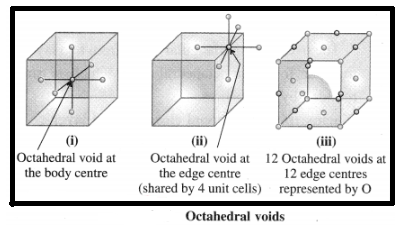
(1) Octahedral void : The vacant space or void at the centre of six spheres (or atoms) which are placed octahedrally is called octahedral void..

Image

(2) Characteristics of octahedral void :
  • The volume of the void is small.
  • There is one octahedral void at the body centre and twelve octahedral void positions at twelve edge centres.
  • If R is the radius of constituent atom, then the radius of the octahedral void is 0.414 R.
  • The coordination number of octahedral void is six.
  • There is one octahedral void per sphere in the crystal lattice. If the number of closed packed spheres is N then the number of octahedral voids is N.


View full question & answer
Question 273 Marks
Explain tetrahedral void.
Answer
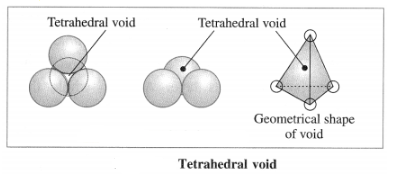
(1) Tetrahedral void : The vacant space or void among four constituent particles having tetrahedral arrangement in the crystal lattice is called tetrahedral void.
Image
The arrangement of four spheres around the void is tetrahedral. A tetrahedral void is formed when a triangular void made by three coplanar spheres is in contact with fourth sphere above or below it.

(2) Characteristics of tetrahedral void :
  • The volume of the void is much smaller than that of atom or sphere.
  • Larger the size of sphere, more is the size of void.
  • If R is the radius of the constituent atom, then the radius of the tetrahedral void is 0.225 R.
  • Coordination number of tetrahedral void is four.
  • There are two tetrahedral voids per sphere, in the crystal lattice. If the number of closed packed spheres is N then the number of tetrahedral voids is 2N.
View full question & answer
Question 283 Marks
Explain linear packing in one direction.
OR
Explain close packing in one dimension.
Answer
Linear packing in one direction or close packing in one dimension :
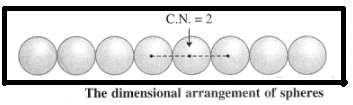
The constituent particles of the crystal may be of varying shapes but for better understanding we consider particles as hard spheres of equal size.
Image
There is only one way of arranging or packing spheres placed in a horizontal row touching one another. Since one sphere is in contact with two neighbouring spheres except the end atoms, the coordination number in this arrangement is two. This packing may be in any one direction x, y or z.
View full question & answer
Question 293 Marks
Give the number of lattice points in one unit cell of the following crystal structures :
(1) Simple cubic
(2) Face-centred cubic
(3) Body-centred cubic.
Answer
Lattice points in one unit cell represent the positions of atoms, ions or molecules in the unit cell.
(1) Simple cubic unit cell : In this primitive unit cell, the lattice points are at 8 corners of the unit cell. Hence there are 8 lattice points.
(2) Face-centred cubic unit cell : In this unit cell, the lattice points are at 8 comers and 6 face centres.
(In cubic close packing unit cell, the lattice points are also at edge centres and body centre.)
(3) Body-centred cubic unit cell : In this, the lattice points are at 8 comers and one at body centre.
View full question & answer
Question 303 Marks
What are Bravais lattices ?
Answer
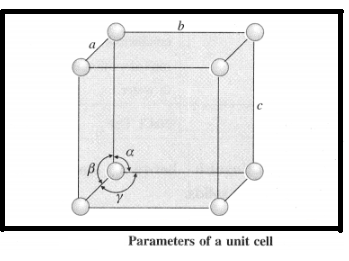
  1. There are seven crystal systems according to the edges (a. b, c) and angles (α, β, γ).
  2. The constituents of the crystal may be present at corners, face centres, body centres, edge centres and voids.
  3. By mathematical analysis, it has been proved that only fourteen different kinds of space lattices are possible.
  4. Hence there are fourteen different ways of arrangement of the lattice basis.
  5. These fourteen lattices of seven crystal systems are called Bravais lattices.
View full question & answer
Question 313 Marks
What are the types of unit cells?
Answer
Basically unit cells are of two types as follows :
  1. Primitive unit cells : The unit cells in which the constituent particles like atoms, ions or molecules are present only at the corners of the unit cell are called primitive unit cells or simple unit cells.
  2. Body-centred unit cell : A unit cell in which the constituent particles are present at the corners as well as at its body-centre is called body-centred unit cell.
  3. Face-centred unit cell : A unit cell in which the constituent particles are present at the corners as well as at the centre of each face is called face-centred unit cell or cubic close packed (CCP) unit cell.
  4. Base-centred unit cell : A unit cell in which the constituent particles are present at the corners as well as at the centres of two opposite faces is called end-centred unit cell.
View full question & answer
Question 323 Marks
What do you understand by the basis of crystal lattice ?
Answer
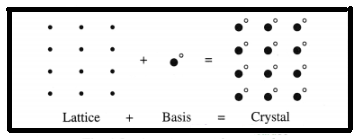
  • A crystal structure is formed by attaching a constituent particle to lattice points.
  • The constituent particles attached to the lattice points form the basis of the crystal lattice.
  • The crystal structure is obtained by attaching a basis to each of the lattice points.
This is represented by the following schematic equation :
Image
View full question & answer
Question 333 Marks
What are the parameters of a unit cell ?
View full question & answer
Question 343 Marks
What are intermolecular forces of attraction involved in molecular crystals ?
Answer
The intermolecular forces involved in molecular crystals are as follows:
(1) Weak dipole-dipole interactions :
The solids constituting polar molecules like $HCl , H _2 O , SO _2$, etc. which possess permanent dipole moment involve weak dipole-dipole interactions.

(2) Very weak dispersion or London forces :
The solids consisting of nonpolar molecules like $CH _4, H _2$, etc. involve weak dispersion forces. They are also involved in monoatomic solids like $Ar , Ne$.

(3) Intermolecular Hydrogen bonds :
  • In this crystalline solids, the constituent particles are the molecules which contain hydrogen atom linked to highly electronegative atom like F, O or N.
  • In these, molecules are held by hydrogen bonds in which H atom of one molecule is bonded to electronegative atom (like F, N or O) of another molecule.
  • Since hydrogen bonding is weak, these solids have very low melting points and generally at room temperature they exist in the liquid or gaseous state.
  • They are non-conductors of electricity.
View full question & answer
Question 353 Marks
What are the characteristics of covalent network crystals ?
Answer
The characteristics of covalent network crystals are as follows :
  • The constituent particles in these solids are atoms.
  • The atoms in these crystals are held by covalent bonds forming a rigid three dimensional network which gives a giant molecule. Hence, the entire crystal is a single molecule.
  • These crystals are very hard (or hardest) and most incompressible.
  • They have high melting points and boiling points.
  • Since the electrons are localised they are poor conductors of heat and electricity.
  • Example : Quartz  $\left( SiO _2\right)$ diamond.
View full question & answer
Question 363 Marks
What are the characteristics of ionic crystals ?
Answer
The characteristics of ionic crystals are as follows:

1. The constituents of ionic crystals are charged ions namely cations and anions. They differ in ionic size.
2. The ions in these crystals are held by strong electrostatic force of attraction.
3. Ionic crystals have high melting points and they are hard and brittle.
4. In solid state they are nonconductors of electricity but they are good conductors when melted or dissolved in water.
5. In aqueous solution they dissociate forming ions.
6. Example : $NaCl , KCl . CaF _2, K _2 SO _4$, etc.
View full question & answer
Question 373 Marks
Amorphous solids do not have sharp melting points. Explain.
Answer
  1. Amorphous solids do not have perfectly ordered crystalline structure.
  2. They have short range order of regular pattern hence periodically repeating regular pattern is over a short distance.
  3. The thermal energy required to break the structure and separate constituent particles is not uniform.
  4. Hence the temperature needed to melt the solid is not same, therefore amorphous solids do not have sharp melting points but melt over a range of temperature.
View full question & answer
Question 383 Marks
Explain the properties of amorphous solids.
Answer
  1. The constituent particles in amorphous solids are arranged randomly.
  2. They have short range ordered structure.
  3. Amorphous solids are called supercooled liquids having very high viscosity.
  4. They do not have sharp melting points and they melt gradually over a temperature interval.
  5. Amorphous substances appear like solids but they do not have perfectly ordered crystalline structure, hence they are not real solids. Therefore they are pseudo solids.
  6. They are isotropic and exhibit the same magnitude of any property in every direction.
View full question & answer
Question 393 Marks
Define the term anisotropy.
OR
Define and explain the term anisotropy.
Answer
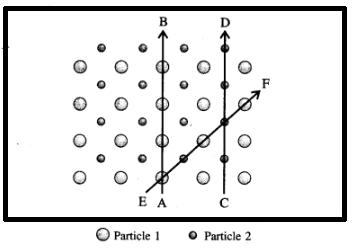
Anisotropy : The ability of crystalline solids to change their physical properties when measured in different directions is called anisotropy.

Explanation : This property is due to different arrangement of constituents in different directions. Different types of particles fall on the way of measurements in different directions. Hence the composition of crystalline solid changes with directions changing their physical properties.

Image
Fig. 1.1 : Anisotropy in crystals : Different arrangements of constituent particles about different directions, AB, CD and EF.

View full question & answer
Question 403 Marks
What are the characteristic properties of solids?
Answer
  • The solid state of matter is characterised by strong interparticle forces of attraction.
  • There is regularity and periodicity in the arrangement of constituent particles of solid.
  • Generally solids are hard, incompressible and rigid except some solids like Na, K, P which are soft.
  • The constituent particles of solids like molecules, atoms or ions have fixed stationary positions in solid and can only oscillate about their equilibrium or mean positions. Hence, they have fixed shape and cannot be poured like liquids.
  • Crystalline solids have sharp melting points and they melt at a definite temperature. Amorphous solids do not have sharp melting points.
  • They are anisotropic or isotropic.
View full question & answer
Question 413 Marks
What are the physical states of matter? How can they be changed into one another?
Answer
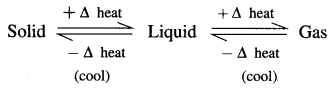
  • There are three physical states of matter namely solid, liquid and gas.
  • They differ in intermolecular or interatomic or interionic forces which are strongest in the solid-state.
  • By raising the temperature of solids to their melting point, solids are converted into liquids while heating liquids to their boiling points, they can be converted into vapour or gaseous state.
  • On the contrary, by cooling the gases to very low temperature and subjecting to high pressure they can be transformed into liquid which on further cooling can be transformed into solid-state.
The equilibrium existing between three states of matter may be represented as, 
Image
View full question & answer