Question 12 Marks
Evaluate: $\int_0^9 \frac{\sqrt{x}}{\sqrt{x}+\sqrt{9-x} d x}$
Answer$ \text { Let } I =\int_0^9 \frac{\sqrt{x}}{\sqrt{x}+\sqrt{9}-x} d x \quad \ldots \ldots . . \text { (i) }$
$=\int_0^9 \frac{\sqrt{9-x}}{\sqrt{9-x}+\sqrt{9-(9-x)}} d x \quad \ldots \ldots\left[\because \int_0^{ a } f (x) d x=\int_0^{ a } f ( a -x) d x\right]$
$\therefore I =\int_0^9 \frac{\sqrt{9-x}}{\sqrt{9-x}+\sqrt{x}} d x \quad \ldots \ldots \text { (ii) } $
Adding (i) and (ii), we get
$ 2 l =\int_0^9 \frac{\sqrt{x}}{\sqrt{x}+\sqrt{9-x}} d x+\int_0^9 \frac{\sqrt{9-x}}{\sqrt{9-x}+\sqrt{x}} d x$
$=\int_0^9 \frac{\sqrt{x}+\sqrt{9-x}}{\sqrt{x}+\sqrt{9-x}} d x$
$=\int_0^9 d x$
$=[x]_0^9$
$\therefore 2 l =9-0$
$\therefore I =\frac{9}{2} $
View full question & answer→Question 22 Marks
$\int \frac{\log (\log x)}{x} d x$
Answer$\text { Let } I =\int \frac{\log (\log x)}{x} d x$
Put $\log x=t$
$ \therefore \frac{1}{x} d x= dt$
$\therefore I =\int \log t d t =\int \log t \cdot 1 dt$
$=\log t \int 1 \cdot dt -\int\left[\frac{ d }{ dt }(\log t ) \int 1 \cdot dt \right] dt$
$=\log t \cdot t -\int\left(\frac{1}{ t } \times t \right) dt$
$= t \cdot \log t -\int dt$
$= t \log t - t + c$
$= t (\log t -1)+ c$
$\therefore I =\log x [\log (\log x )-1]+ c $
View full question & answer→Question 32 Marks
Find the values of $x$ for which the function $f(x) = 2x^3 – 6x^2 + 6x + 24$ is strictly increasing
Answer$f(x) = 2x^3 – 6x^2 + 6x + 24$
$\therefore f′(x) = 6x^2 – 12x + 6$
$= 6(x^2 – 2x + 1)$
$= 6(x – 1)^2$
$f(x)$ is strictly increasing, if f$′(x) > 0$
$\therefore 6(x – 1)^2 > 0$
$\therefore (x – 1)^2 > 0$ for all $x \in R, x \neq 1$
Thus, $f(x)$ is strictly increasing for $x \in R – {1}.$
View full question & answer→Question 42 Marks
Check the ordered points (1, −1), (2, −1) is a solution of 2x + 3y − 6 ≤ 0
AnswerGiven inequality: 2x + 3y – 6 ≤ 0
i.e., 2x + 3y ≤ 6 .......(i)
Consider point (1, –1).
Putting x = 1 and y = –1 in equation (i), we get
2(1) + 3(–1) = 2 – 3
= – 1 ≤ 6
which is true.
Consider point (2, –1)
Putting x = 2 and y = –1 in equation (i), we get
2(2) + 3(–1) = 4 – 3
= 1 ≤ 6
which is true.
∴ Given ordered pairs are solutions of 2x + 3y – 6 ≤ 0.
View full question & answer→Question 52 Marks
Find the position vector of point $R$ which divides the line joining the points $P$ and $Q$ whose position vectors are $2 \hat{ i }-\hat{ j }+3 \widehat{ k }$ and $-5 \hat{ i }+2 \hat{ j }-5 \widehat{ k }$ in the ratio $3: 2$
(i) internally
(ii) externally
AnswerLet $\overline{ p }, \overline{ q }$ and $\overline{ r }$ be the position vectors of points $P , Q$ and $R$ respectively.
$\therefore \overline{ p }=2 \hat{ i }-\hat{ j }+3 \widehat{ k }, \overline{ q }=-5 \hat{ i }+2 \hat{ j }-5 \widehat{ k }, m : n =3: 2$
(i) $R$ divides the line $PQ$ internally in the ratio $3: 2$
$\therefore$ By using section formula for internal division,
$ \overline{ r }=\frac{ m \overline{ q }+ n \overline{ p }}{ m + n }$
$=\frac{3(-5 \hat{ i }+2 \hat{ j }-5 \widehat{ k })+2(2 \hat{ i }-\hat{ j }+3 \widehat{ k })}{3+2}$
$=\frac{-15 \hat{ i }+6 \hat{ j }-15 \widehat{ k }+4 \hat{ i }-2 \hat{ j }+6 \widehat{ k }}{5}$
$\therefore \overline{ r }=\frac{-11 \hat{ i }+4 \hat{ j }-9 \widehat{ k }}{5}$
$=\frac{-11}{5} \hat{ i }+\frac{4}{5} \hat{ j }-\frac{9}{5} \widehat{ k } $
(ii) $R$ divides the line $PQ$ externally in ratio $3: 2$
$\therefore$ By using section formula for external division,
$ \overline{ r }=\frac{ m \overline{ q }- n \overline{ p }}{ m - n }$
$=\frac{3(-5 \hat{ i }+2 \hat{ j }-5 \widehat{ k })-2(2 \hat{ i }-\hat{ j }+3 \widehat{ k })}{3-2}$
$=\frac{-15 \hat{ i }+6 \hat{ j }-15 \widehat{ k }-4 \hat{ i }+2 \hat{ j }-6 \widehat{ k }}{1}$
$\therefore \overline{ r }=-19 \hat{ i }+8 \hat{ j }-21 \widehat{ k } $
View full question & answer→Question 62 Marks
Evaluate $\cos \left[\frac{\pi}{6}+\cos ^{-1}\left(-\frac{\sqrt{3}}{2}\right)\right]$
Answer$ \text { Let } \cos ^{-1}\left(\frac{-\sqrt{3}}{2}\right)=y$
$\therefore \cos y=\frac{-\sqrt{3}}{2}$
$=-\cos \left(\frac{\pi}{6}\right)$
$=\cos \left(\pi-\frac{\pi}{6}\right)$
$=\cos \frac{5 \pi}{6} $
The principal value branch of $\cos ^{-1}$ is $[0, \pi]$ and $0 \leq \frac{5 \pi}{6} \leq \pi$.
$ \therefore y=\frac{5 \pi}{6}$
$\therefore \cos ^{-1}\left(\frac{-\sqrt{3}}{2}\right)=\frac{5 \pi}{6}$
$\therefore \frac{\pi}{6}+\cos ^{-1}\left(\frac{-\sqrt{3}}{3}\right)$
$=\frac{\pi}{6}+\frac{5 \pi}{6}$
$=\pi$
$\therefore \cos \left[\frac{\pi}{6}+\cos ^{-1}\left(-\frac{\sqrt{3}}{2}\right)\right]=\cos \pi=-1 $
View full question & answer→Question 72 Marks
Find $A^{-1}$ using column transformations:$A=\left[\begin{array}{cc}2 & -3 \\-1 & 2\end{array}\right]$
AnswerWe know that $A A^{-1}=1$
$\left[\begin{array}{cc}2 & -3 \\-1 & 2\end{array}\right] A^{-1}=\left[\begin{array}{ll}1 & 0 \\0 & 1\end{array}\right]$
Applying $C _1 \rightarrow 2 C _1+ C _2$, we get
$\left[\begin{array}{cc}1 & -3 \\0 & 2\end{array}\right] A^{-1}=\left[\begin{array}{ll}2 & 0 \\1 & 1\end{array}\right]$
Applying $C_2 \rightarrow C_2+3 C_1$, we get
$\left[\begin{array}{ll}1 & 0 \\0 & 2\end{array}\right] A^{-1}=\left[\begin{array}{ll}2 & 6 \\1 & 4\end{array}\right]$
Applying $C_2 \rightarrow\left(\frac{1}{2}\right) C_2$, we get
$\begin{array}{l}{\left[\begin{array}{ll}1 & 0 \\0 & 1\end{array}\right] A ^{-1}=\left[\begin{array}{ll}2 & 3 \\1 & 2\end{array}\right]} \end{array}$
$\therefore A ^{-1}=\left[\begin{array}{ll}2 & 3 \\1 & 2\end{array}\right]$
View full question & answer→Question 82 Marks
Find $A ^{-1}$ using column transformations: $A=\left[\begin{array}{cc}5 & 3 \\3 & -2\end{array}\right]$
AnswerWe know that $A A^{-1}=1$
$\therefore\left[\begin{array}{cc}5 & 3 \\3 & -2\end{array}\right] A^{-1}=\left[\begin{array}{ll}1 & 0 \\ 0 & 1\end{array}\right]$
Applying $C_1 \rightarrow 2 C_2-C_1$, we get
$\left[\begin{array}{cc}1 & 3 \\-7 & -2\end{array}\right] A^{-1}=\left[\begin{array}{cc}-1 & 0 \\ 2 & 1 \end{array}\right]$
Applying $C_2 \rightarrow C_2-3 C_1$, we get
$\left[\begin{array}{cc}1 & 0 \\-7 & 19\end{array}\right] A^{-1}=\left[\begin{array}{cc}-1 & 3 \\2 & -5\end{array}\right]$
Applying $C_2 \rightarrow\left(\frac{1}{19}\right) C_2$, we get
$\left[\begin{array}{cc}1 & 0 \\-7 & 1\end{array}\right] A^{-1}=\left[\begin{array}{cc}-1 & \frac{3}{19} \\2 & \frac{-5}{19}\end{array}\right]$
Applying $C_1 \rightarrow C_1+7 C_2$, we get
$\begin{array}{l}{\left[\begin{array}{ll}1 & 0 \\0 & 1\end{array}\right] A ^{-1}=\left[\begin{array}{cc}\frac{2}{19} & \frac{3}{19} \\\frac{3}{19}& \frac{-5}{19}\end{array}\right]} \end{array}$
$\therefore A ^{-1}=\frac{1}{19}\left[\begin{array}{cc}2 & 3 \\3 & -5\end{array}\right]$
View full question & answer→Question 92 Marks
Evaluate: $\int_0^{\frac{\pi}{2}} \frac{\sin ^2 x}{(1+\cos x)^2} d x$
AnswerLet $I =\int_0^{\frac{\pi}{2}} \frac{\sin ^2 x}{(1+\cos x)^2} d x$
Put $\tan \left(\frac{x}{2}\right)= t$
$\therefore x =2 \tan ^{-1} t$
$\therefore dx =\frac{2 dt }{1+ t ^2}, \sin x \frac{2 t }{1+ t ^2} \text { and } x =\frac{1- t ^2}{1+ t ^2}$
When $x=0, t=0$ and when $x=\frac{\pi}{2}, t=1$
$ \therefore I=\int_0^1 \frac{\left(\frac{2 t }{1+ t ^2}\right)^2}{\left(1+\frac{1- t ^2}{1+ t ^2}\right)^2} \cdot \frac{2 dt }{1+ t ^2}$
$=\int_0^1 \frac{\frac{4 t ^2}{\left(1+ t ^2\right)^2}}{\frac{4}{\left(1+ t ^2\right)^2}} \cdot \frac{2 dt }{1+ t ^2}$
$=2 \int_0^1 \frac{ t ^2}{1+ t ^2} dt$
$=2 \int_0^1\left(\frac{1+ t ^2-1}{1+ t ^2}\right) dt$
$=2 \int_0^1\left(1+\frac{1}{1+ t ^2}\right) dt$
$=2\left[ t -\tan ^{-1} t \right]_0^1$
$=2\left[\left(1-\tan ^{-1} 1\right)-\left(0-\tan ^{-1} 0\right)\right]$
$=2\left(1-\frac{\pi}{4}\right)$
$=\frac{4-\pi}{2} $
View full question & answer→Question 102 Marks
$\int \frac{1}{\sqrt{2 x^2-5}} d x$
Answer$\text { Let } I =\int \frac{1}{\sqrt{2 x^2-5}} d x$
$=\int \frac{1}{\sqrt{2\left(x^2-\frac{5}{2}\right)}} d x$
$=\frac{1}{\sqrt{2}} \int \frac{1}{\sqrt{x^2-\left(\frac{\sqrt{5}}{\sqrt{2}}\right)^2}} d x$
$=\frac{1}{\sqrt{2}} \log \left|x+\sqrt{x^2-\left(\frac{\sqrt{5}}{\sqrt{2}}\right)^2 \mid+ c }\right|$
$\therefore I =\frac{1}{\sqrt{2}} \log \left|x+\sqrt{x^2-\frac{5}{2}}\right|+ c $
View full question & answer→Question 112 Marks
Test whether the following function $f(x) = 2 – 3x + 3x^2 – x^3, x \in R$ is increasing or decreasing
Answer$f(x) = 2 – 3x + 3x^2 – x^3$
$\therefore f′(x) = – 3 + 6x – 3x^2$
$= –3(x^2 – 2x + 1)$
$= –3(x – 1)^2$
$(x – 1)^2$ is always positive for $x ≠ 1$ and $– 3 < 0$.
$\therefore –3(x – 1)^2$ is always negative for $x ≠ 1$.
$\therefore f′(x) \leq 0$ for all $x \in R.$
Hence, f(x) is a decreasing function for all $x \in R.$
View full question & answer→Question 122 Marks
Differentiate $\sin^2 (\sin^{−1}(x^2))$ w.r. to $x$
Answer$ \text { Let } y=\sin ^2\left[\sin ^{-1}\left(x^2\right)\right]$
$=\left[\sin \left\{\sin ^{-1}\left(x^2\right)\right\}\right]^2$
$=\left(x^2\right)^2$
$\therefore y=x^4 $
Differentiating w. r. t. x, we get
$\frac{ d y}{ d x}=\frac{ d }{ d x}\left(x^4\right)=4 x ^3$
View full question & answer→Question 132 Marks
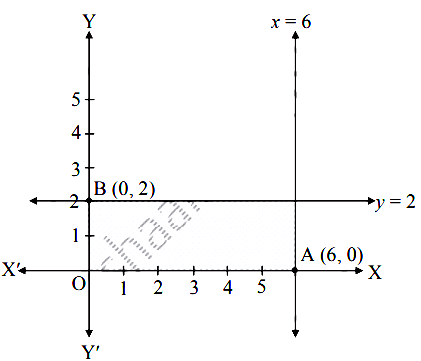
Draw the graph of inequalities $x ≤ 6, y −2 ≤ 0, x ≥ 0, y ≥ 0$ and indicate the feasible region
Answer
| Given inequalities |
$x \leq 6$ |
$y – 2 \leq 0$ |
| Corresponding equalities |
$x = 6$ |
$y = 2$ |
| Intersection of line with X-axis |
$A(6, 0)$ |
Parallel to $X-$axis |
| Intersection of line with Y-axis |
Parallel to $Y-$axis |
Parallel to $Y-$axis |
| Origin test |
$0 \leq 6$
which is true |
$2 \leq 0$
which is true |
| Region |
Origin side of the line |
Origin side of the line |
$x \geq 0, y \geq 0$ represent $1^{st}$ quadrant.
The shaded portion represents the feasible solution.
View full question & answer→Question 142 Marks
If $\overline{ a }$ and $\overline{ b }$ are two vectors perpendicular each other, prove that $(\overline{ a }+\overline{ b })^2=(\overline{ a }-\overline{ b })^2$
Answer$\overline{ a }$ is perpendicular to $\overline{ b }$.
$ \therefore \overline{ a } \cdot \overline{ b }=0$
$(\overline{ a }+\overline{ b })=(\overline{ a })^2+2 \overline{ a } \cdot \overline{ b }+(\overline{ b })^2$
$=(\overline{ a })^2+2(0)+(\overline{ b })^2$
$=(\overline{ a })^2+(\overline{ b })^2 \ldots \ldots . .( i )$
$(\overline{ a }-\overline{ b })^2=(\overline{ a })^2-2 \overline{ a } \cdot \overline{ b }+(\overline{ b })^2$
$=(\overline{ a })^2+2(0)+(\overline{ b })^2$
$=(\overline{ a })^2+(\overline{ b })^2\ldots(ii) $
From (i) and (ii), we get
$(\bar{a}+\bar{b})^2=(\bar{a}-\bar{b})^2$
View full question & answer→Question 152 Marks
Find the principal solutions of $\tan x=-\sqrt{3}$
Answer$ \tan x=-\sqrt{3}$
$\therefore \tan x=-\tan \left(\frac{\pi}{3}\right)$
$\therefore \tan x=\tan \left(\pi-\frac{\pi}{3}\right)$
$=\tan \left(\frac{2 \pi}{3}\right) \text { and } \tan x=\tan \left(2 \pi-\frac{\pi}{3}\right)$
$=\tan \left(\frac{5 \pi}{3}\right) $
such that $0 \leq \frac{2 \pi}{3}<2 \pi$ and $0 \leq \frac{5 \pi}{3}<2 \pi$
$\therefore$ The required principal solutions are $x=\frac{2 \pi}{3}$ and $x=\frac{5 \pi}{3}$.
View full question & answer→Question 162 Marks
Find $A ^{-1}$ using adjoint method, where $A =\left[\begin{array}{cc}\cos \theta & \sin \theta \\ -\sin \theta & \cos \theta\end{array}\right]$
Answer$|A|=\cos \theta(\cos \theta)-\sin \theta(-\sin \theta)$
$=\cos ^2 \theta+\sin ^2 \theta$
$=1 \neq 0$
$\therefore A^{-1} \text { exists. }$
$A_{11}=(-1)^{1+1} M_{11}=M_{11}=\cos \theta$
$A_{12}=(-1)^{1+2} M_{12}=-M_{12}=\sin \theta$
$A_{21}=(-1)^{2+1} M_{21}=-M_{21}=-\sin \theta$
$A_{22}=(-1)^{2+2} M_{22}=M_{22}=\cos \theta $
$ \therefore \operatorname{adj}(A)=\left[\begin{array}{cc}\cos \theta & \sin \theta \\ -\sin \theta & \cos \theta\end{array}\right]^{ T }$
$\begin{array}{l}=\left[\begin{array}{cc}\cos \theta & -\sin \theta \\ \sin \theta & \cos \theta\end{array}\right] \end{array}$
$ \therefore A ^{-1}=\frac{1}{| A |} \operatorname{adj}( A ) $
$ =\left[\begin{array}{cc}\cos \theta & -\sin \theta \\ \sin \theta & \cos \theta\end{array}\right]$
View full question & answer→Question 172 Marks
Evaluate: $\int_1^3 \frac{\cos (\log x)}{x} d x$
Answer$\text { Let } I =\int_1^3 \frac{\cos (\log x)}{x} d x$
Put $\log x=t$
$\therefore \frac{1}{x} d x= dt$
When $x =1, t =\log 1=0$ and when $x =3, t =\log 3$
$ \therefore I=\int_0^{\log 3} \cos t d t$
$=[\sin t]_0^{\log 3}$
$=\sin (\log 3)-\sin 0$
$=\sin (\log 3) $
View full question & answer→Question 182 Marks
$\int \frac{x^7}{\left(1+x^4\right)^2} d x$
Answer$ \text { Let } I =\int \frac{x^7}{\left(1+x^4\right)^2} d x$
$=\int \frac{x^4 \cdot x^3}{\left(1+x^4\right)^2} d x $
Put $1+x^4=t$
$ \therefore 4 x ^3 dx = dt$
$\therefore x ^3 d x =\frac{1}{4} dt$
$\therefore I =\frac{1}{4} \int \frac{( t -1)}{ t ^2} dt$
$=\frac{1}{4}\left(\int \frac{1}{ t } dt -\int \frac{1}{ t ^2} dt \right)$
$=\frac{1}{4}\left[\log | t |-\frac{ t ^{-1}}{-1}\right]+ c$
$\therefore \frac{1}{4}\left[\log \left|1+x^4\right|+\frac{1}{1+x^4}\right]+ c $
View full question & answer→Question 192 Marks
Test whether the function $f(x) = x^3 + 6x^2 + 12x − 5$ is increasing or decreasing for all $x \in R$
Answer$f(x)=x^3+6 x^2+12 x-5 \therefore f^{\prime}(x)=3 x^2+12 x+12$
$=3\left(x^2+4 x+4\right)$
$=3(x+2)^2$
$3(x+2)^2 \text { is always positive for } x \neq-2$
$\therefore f^{\prime}(x) \geq 0 \text { for all } x \in R$
Hence, $f(x)$ is an increasing function for all $x \in R$.
View full question & answer→Question 202 Marks
If $x =\sin \theta, y =\tan \theta$, then find $\frac{ d y}{ d x}$
Answer$x=\sin \theta$
Differentiating w. r. t. $\theta$, we get
$ \frac{ d x}{ d \theta}=\frac{ d }{ d \theta}(\sin \theta) \cos \theta$
$y =\tan \theta $
Differentiating w. r. t. $\theta$, we get
$ \frac{ d y}{ d \theta}=\frac{ d }{ d \theta}(\tan \theta)=\sec ^2 \theta$
$\therefore \frac{ d y}{ d x}=\frac{\left(\frac{ d y}{ d \theta}\right)}{\left(\frac{ d x}{ d \theta}\right)}$
$=\frac{\sec ^2 \theta}{\cos ^2 \theta}$
$=\sec ^3 \theta $
View full question & answer→Question 212 Marks
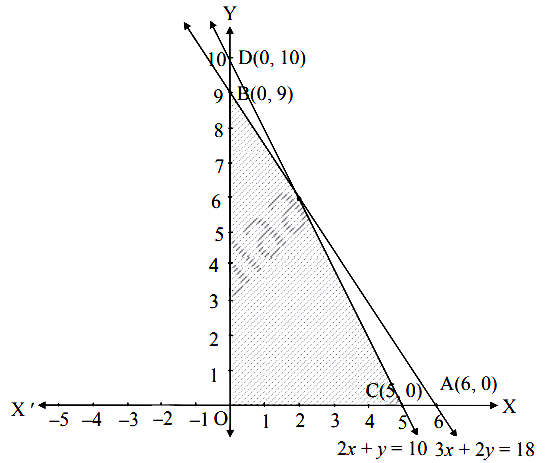
Find the feasible solution of the following inequation:
$3x + 2y \leq 18, 2x + y \leq 10, x \geq 0, y \geq 0$
Answer
| Given inequalities |
$3x + 2y \leq 18$ |
$2x + y \leq 10$ |
| Corresponding equalities |
$3x + 2y = 18$ |
$2x + y = 10$ |
| Intersection of line with X-axis |
$A(6, 0)$ |
$C(5, 0)$ |
| Intersection of line with Y-axis |
$B(0, 9)$ |
$D(0, 10)$ |
| Origin test |
$3(0) + 2(0) \leq 18$
i.e., $0 \leq 18$
which is true |
$2(0) + 0 ≤ 10$
i.e., $0 \leq 10$
which is true |
| Region |
Origin side of the line |
Origin side of the line |
$x \geq 0, y \geq 0$ represent $1^{st} $ quadrant.
The shaded portion represents the feasible solution.
View full question & answer→Question 222 Marks
Find the acute angle between the lines $x = y, z = 0$ and $x = 0, z = 0$
AnswerGiven equations of lines are $x=y, z=0$
i.e., $\frac{x}{1}=\frac{ y }{1}=\frac{ z }{0}$ and $x =0$,
$z=0$ which represents $Y$-axis.
Direction ratios of above lines are
$a_1=1, b_1=1, c_1=0 \text { and }$
$a_2=0, b_2=1, c_2=0$
...(Direction ratios of $Y$-axis)
Angle between two lines is
$ \cos \theta=\left|\frac{ a _1 a _2 b _1 b _2+ c _1 c _2}{\sqrt{ a _1^2+ b _1^2+ c _1^2}, \sqrt{ a _2^2+ b _2^2+ c _2^2}}\right|$
$\therefore \cos \theta=\left|\frac{(1)(0)+(1)(1)+(0)(0)}{\sqrt{1^2+1^2+0^2}, \sqrt{0^2+1^2+0^2}}\right|$
$\therefore \cos \theta=\left|\frac{1}{\sqrt{2}, \sqrt{1}}\right|$
$\therefore \theta=\cos ^{-1}\left(\frac{1}{\sqrt{2}}\right)$
$\therefore \theta=45^{\circ} $
View full question & answer→Question 232 Marks
If $|\bar{a} \cdot \bar{b}|=|\bar{a} \times \bar{b}|$ and $\bar{a} \cdot \bar{b}<0$, then find the angle between $\bar{a}$ and $\bar{b}$
Answer$ 5 \overline{ a }-3 \overline{ b }-2 \overline{ c }=0$
$\therefore 2 \overline{ c }=5 \overline{ a }-3 \overline{ b }$
$\therefore \overline{ c }=\frac{5 \overline{ a }-3 \overline{ b }}{2}$
$\therefore \overline{ c }=\frac{5 \overline{ a }-3 \overline{ b }}{5-3} $
$\therefore$ The point $C$ divides the line segment $B A$ externally in ratio $5: 3$.
View full question & answer→Question 242 Marks
In $\triangle A B C$, if $\frac{\cos A}{a}=\frac{\cos B}{b}$, then show that it is an isosceles triangle
AnswerIn $\triangle ABC$ by sine rule, we have
$ \frac{a}{\sin A}=\frac{b}{\sin B}=k$
$\therefore a=k \sin A, b=k \sin B $
Now, $\frac{\cos A }{ a }=\frac{\cos B }{ b }$ [Given]
$ \therefore \frac{\cos A}{k \sin A}=\frac{\cos B}{k \sin B}$
$\therefore \frac{\cos A}{\sin A}=\frac{\cos B}{\sin B}$
$\therefore \sin A \cos B=\cos A \sin B$
$\therefore \sin A \cos B-\cos A \sin B=0$
$\therefore \sin (A-B)=0=\sin 0$
$\therefore A-B=0$
$\therefore A=B $
Hence, $\triangle ABC$ is an isosceles triangle.
View full question & answer→Question 252 Marks
Find the matrix $X$ such that $A X=I$ where $A=\left[\begin{array}{cc}6 & 17 \\ 1 & 3\end{array}\right]$
AnswerGiven, $A X=1$
$\therefore\left[\begin{array}{cc}6 & 17 \\1 & 3\end{array}\right] X =\left[\begin{array}{ll}1 & 0 \\0 & 1\end{array}\right]$
Applying $R_1 \leftrightarrow R_2$, we get
$\left[\begin{array}{cc}1 & 3 \\6 & 17\end{array}\right] X=\left[\begin{array}{ll}0 & 1 \\1 & 0\end{array}\right]$
Applying $R_2 \rightarrow R_2-6 R_1$, we get
$\left[\begin{array}{cc}1 & 3 \\0 & -1\end{array}\right] X=\left[\begin{array}{cc}0 & 1 \\1 & -6\end{array}\right]$
Applying $R_1 \rightarrow R_1+3 R_2$, we get
$\left[\begin{array}{cc}1 & 0 \\0 & -1\end{array}\right] X=\left[\begin{array}{cc}3 & -17 \\1 & -6\end{array}\right]$
Applying $R_2 \rightarrow(-1) R_2$, we get
$\begin{array}{l}{\left[\begin{array}{ll}1 & 0 \\0 & 1\end{array}\right] X=\left[\begin{array}{cc}3 & -17 \\-1 & 6\end{array}\right]}\end{array} $
$\therefore X=\left[\begin{array}{cc}3 & -17 \\-1 & 6\end{array}\right]$
View full question & answer→Question 262 Marks
Evaluate: $\int_0^{\frac{\pi}{4}} \frac{\cos x}{4-\sin ^2 x} d x$
AnswerLet $I =\int_0^{\frac{\pi}{4}} \frac{\cos x}{4-\sin ^2 x} d x$
Put $\sin x=t$
$\therefore \cos x d x=d t$
When $x =0, t =0$ and when $x =\frac{\pi}{4}, t \frac{1}{\sqrt{2}}$
$ \therefore I=\int_0^{\frac{1}{\sqrt{2}}} \frac{ dt }{4- t ^2}$
$=\int_0^{\frac{1}{\sqrt{2}}} \frac{ dt }{2^2- t ^2}$
$=\left[\frac{1}{2 \times 2} \log \left|\frac{2+ t }{2- t }\right|\right]_0^{\frac{1}{\sqrt{2}}}$
$=\frac{1}{4}\left[\log \left|\frac{2+\frac{1}{\sqrt{2}}}{2-\frac{1}{\sqrt{2}}}\right|-\log 1\right.$
$=\frac{1}{4}\left[\log \left|\frac{2 \sqrt{2}+1}{2 \sqrt{2}-1}\right|-0\right]$
$\therefore I =\frac{1}{4} \log \left(\frac{2 \sqrt{2}+1}{2 \sqrt{2}-1}\right) $
View full question & answer→Question 272 Marks
$\int \cos ^7 x d x$
Answer$ \text { Let } I =\int \cos ^7 x d x$
$=\int\left(\cos ^2 x\right)^3 \cdot \cos x d x$
$=\int\left(1-\sin ^2 x\right)^3 \cdot \cos x d x $
Put $\sin x=t$
$ \therefore \cos x d d = dt$
$\therefore I =\int\left(1- t ^2\right)^3 dt$
$=\int\left(1-3 t ^2+3 t ^4- t ^6\right) dt$
$=\int 1 \cdot dt -3 \int t ^2 dt +3 \int t ^4 dt -\int t ^6 dt$
$\left.= t -3\left(\frac{ t ^3}{3}\right)+3 \frac{ t ^5}{5}\right)-\frac{ t ^7}{7}+ c$
$\therefore I =\sin x-\sin ^3 x+\frac{3}{5} \sin ^5 x-\frac{1}{7} \sin ^7 x+ c $
View full question & answer→Question 282 Marks
Water is being poured at the rate of $36\ m^3/sec$ in to a cylindrical vessel of base radius $3$ meters. Find the rate at which water level is rising
AnswerLet $h$ be the height of water level, $r$ be the radius of the base and $V$ be the volume of the cylindrical vessel.
Then, $r=3$ metres, $\frac{ dV }{ dT }$
$=36 m ^3 / sec$
$V=\pi r^2 h$
$=\pi(3)^2 h$
$=9 \pi h$
Differentiating w.r.t.t, we get
$ \frac{ dV }{ dt }=9 \pi \cdot \frac{ dh }{ dt }$
$\therefore \frac{ dh }{ dt }=\left(\frac{ dV }{ dt }\right) \times \frac{1}{9 \pi}$
$=\frac{36}{9 \pi}$
$=\frac{4}{\pi} m / sec $
Thus, water level is rising at the rate of $\frac{4}{\pi} m / sec$.
View full question & answer→Question 292 Marks
If $y =\tan ^{-1}\left[\frac{\sqrt{1+\cos x}}{1-\cos x}\right]$, find $\frac{ d y}{ d x}$
Answer$ \tan ^{-1}\left[\frac{\sqrt{1+\cos x}}{1-\cos x}\right]$
$=\tan ^{-1}\left[\sqrt{\left.\frac{2 \cos ^2\left(\frac{x}{2}\right)}{2 \sin ^2\left(\frac{x}{2}\right)}\right]}\right]$
$=\tan ^{-1}\left[\sqrt{\cot ^2\left(\frac{x}{2}\right)}\right]$
$=\tan ^{-1}\left[\cot \left(\frac{x}{2}\right)\right]$
$=\tan ^{-1}\left[\tan \left(\frac{\pi}{2}-\frac{x}{2}\right)\right]$
$=\frac{\pi}{2}-\frac{x}{2} $
Differentiating w. r. t. x, we get
$ \frac{ d y}{ d x}=\frac{ d }{ d x}\left(\frac{\pi}{2}-\frac{x}{2}\right)$
$\therefore \frac{ d }{ d x}=0-\frac{1}{2}$
$=-\frac{1}{2} $
View full question & answer→Question 302 Marks
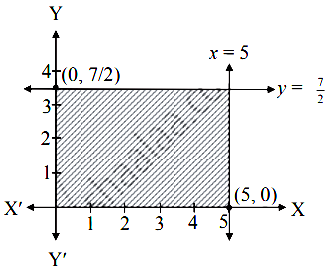
Find the solution set of inequalities 0 ≤ x ≤ 5, 0 ≤ 2y ≤ 7
AnswerGiven inequalities: $0 \leq x \leq 5,0 \leq 2 y \leq 7$
Corresponding equality: $x \quad 5, y=\frac{7}{2}, x=0$......(i.e., $Y$-axis) and $y=0 \quad$......(i.e., $X$-axis)
Note that $0 \leq 5$ and $0 \leq \frac{7}{2}$
$\therefore$ Solution set have line $x=5$ parallel to $Y$-axis passing through the point $(5,0)$, line $y=\frac{7}{2}$ parallel to $X$-axis passing through $\left(0, \frac{7}{2}\right)$, and origin side of both the lines.
Also, $x \geq 0$ and $y \geq 0$ represent $1^{\text {st }}$ quadrant
The shaded portion represents the graphical solution.
View full question & answer→Question 312 Marks
Find the perpendicular distance of origin from the plane $6x − 2y + 3z - 7 = 0$
AnswerGiven equation of plane is $6 x-2 y+3 z-7=0$
Comparing the given equation with $ax + by + cz + d =0$,
we get $a=6, b=-2, c=3, d=-7$
$\therefore$ Direction cosines are,
$ I =\frac{6}{\sqrt{6^2+(-2)^2+3^2}}$
$m =\frac{-2}{\sqrt{6^2+(-2)^2+3^2}}$
$n =\frac{3}{\sqrt{6^2+(-2)^2+3^2}}$
$\therefore I =\frac{6}{7}, m =\frac{-2}{7}, n =\frac{3}{7} $
Cartesian equation of a plane in normal form is $1 x+m y+n z=p$
$ \therefore \frac{6}{7} x-\frac{2}{7} y+\frac{3}{7} z=\frac{7}{7}$
$\therefore \frac{6}{7} x-\frac{2}{7} y+\frac{3}{z} z=1 $
$\therefore$ The distance of the origin from the plane is $1 .$
View full question & answer→Question 322 Marks
Find the direction ratios of a vector perpendicular to the two lines whose direction ratios are $1, 3, 2$ and $–1, 1, 2$
AnswerLet $L_1$ and $L_2$ be the two lines with direction ratios $1,3,2$ and $-1,1,2$ respectively.
Let the direction ratios of the vector perpendicular to $L_1$ and $L_2$ be $a, b, c.$
$\therefore a+3 b+2 c=0$
and $-a+b+2 c=0$
$\begin{array}{l}\therefore \frac{ a }{\left|\begin{array}{ll}3 & 2 \\1 & 2\end{array}\right|}=\frac{- b }{\left|\begin{array}{cc}1 & 2 \\-1 & 2\end{array}\right|}=\frac{ c }{\left|\begin{array}{cc}1 & 3 \\-1 & 1\end{array}\right|} \end{array}$
$\therefore \frac{ a }{6-2}=\frac{- b }{2+2}=\frac{ c }{1+3}$
$\therefore \frac{ a }{4}=\frac{- b }{4}=\frac{ c }{4}$
$\therefore$ The direction ratios of the vector are $4,-4,4$.
View full question & answer→Question 332 Marks
In $\triangle ABC,$ if $a = 13, b = 14, c = 15,$ then find the value of $\cos B$
AnswerBy cosine rule, we have
$ \cos B=\frac{c^2+a^2-b^2}{2 c a}$
$\therefore \cos B=\frac{15^2+13^2-14^2}{2 \times 15 \times 13}$
$=\frac{225+169-196}{390}$
$=\frac{198}{390}$
$\therefore \cos B=\frac{33}{65} $
View full question & answer→Question 342 Marks
If $A=\left[\begin{array}{ll}2 & 0 \\ 0 & 1\end{array}\right]$ and $B=\left[\begin{array}{l}1 \\ 2\end{array}\right]$ then find the matrix $X$ such that $A^{-1} X=B$
Answer$|A|=2 \\ A_{11}=(-1)^{1+1} M_{11}=M_{11}=1 $
$A_{12}=(-1)^{1+2} M_{12}=-M_{12}=0 $
$ A_{21}=(-1)^{2+1} M_{21}=-M_{21}=0 $
$ A_{22}=(-1)^{2+2} M_{22}=M_{22}=2$
$ \operatorname{adj}|A|=\left[\begin{array}{ll}1 & 0 \\ 0 & 2\end{array}\right]^{ T } $
$ =\left[\begin{array}{ll}1 & 0 \\ 0 & 2\end{array}\right] $
$ \therefore A^{-1}=\frac{1}{|A|}\left[\begin{array}{ll}1 & 0 \\ 0 & 2\end{array}\right] $
$ =\frac{1}{2}\left[\begin{array}{ll}1 & 0 \\ 0 & 2\end{array}\right]$
Let $X =\left[\begin{array}{l} a \\ b \end{array}\right] $
$ \therefore A ^{-1}= B $
$ \Rightarrow \frac{1}{2}\left[\begin{array}{ll}1 & 0 \\ 0 & 2\end{array}\right]\left[\begin{array}{l} a \\ b \end{array}\right]=\left[\begin{array}{l}1 \\ 2\end{array}\right] $
$ \Rightarrow \frac{1}{2}\left[\begin{array}{l} a \\ 2 b \end{array}\right]=\left[\begin{array}{l}1 \\ 2\end{array}\right] $
$ \Rightarrow \frac{ a }{2}=1 \text { and } b =2 $
$ \Rightarrow a =2 \text { an } b =2 $
$ \therefore X =\left[\begin{array}{l}2 \\ 2\end{array}\right]$
View full question & answer→Question 352 Marks
Let the p.m.f. of r.v. $X$ be $P ( x )={ }^4 C _x\left(\frac{5}{9}\right)^x\left(\frac{4}{9}\right)^{4-x}, x =0,1,2$, 3, 4. Find $E(X)$ and $\operatorname{Var}(X)$
AnswerHere $X \sim B \left(4, \frac{5}{9}\right)$
i.e., $n =4, p =\frac{5}{9}$ and $q =\frac{4}{9}$
$ \therefore E ( X )= np$
$=4 \times \frac{5}{9}$
$=\frac{20}{9}$
$=2.22 $
and
$ V(X)=n p q$
$=4 \times \frac{5}{9} \times \frac{4}{9}$
$=\frac{80}{81}$
$=0.9876 $
View full question & answer→Question 362 Marks
In the p.m.f. of r.v. X
| X |
1 |
2 |
3 |
4 |
5 |
| P(X) |
$\frac{1}{20}$ |
$\frac{3}{20}$ |
a |
2a |
$\frac{1}{20}$ |
Find a and obtain c.d.f. of X. AnswerFor p.m.f. of a r.v. X
$ \sum_{i=1}^5 P ( X = x )=1$
$\therefore P ( X =1)+ P ( X =2)+ P ( X =3)+ P ( X =4)+ P ( X =5)=1$
$\therefore \frac{1}{20}+\frac{3}{20}+ a +2 a +\frac{1}{20}=1$
$\therefore 3 a =1-\frac{5}{20}$
$\therefore 3 a =1-\frac{1}{4}$
$\therefore 3 a =\frac{3}{4}$
$\therefore a =\frac{1}{4} $
$\therefore$ The p.m.f. of the r.v. $X$ is
| X |
1 |
2 |
3 |
4 |
5 |
| P(X=x) |
$\frac{1}{20}$ |
$\frac{3}{20}$ |
$\frac{5}{20}$ |
$\frac{10}{20}$ |
$\frac{1}{20}$ |
Let $F(x)$ be the c.d.f. of $X$.
Then $F(x)=P(X \leq x)$
$ \therefore F(1)=P(X \leq 1)=P(X=1)=\frac{1}{20}$
$F(2)=P(X \leq 2)=P(X=1)+P(X=2)$
$=\frac{1}{20}+\frac{3}{20}$
$=\frac{4}{20}$
$=\frac{1}{5}$
$F(3)=P(X \leq 3)=P(X=1)+P(X=2)+P(X=3)$
$=\frac{1}{20}+\frac{3}{20}+\frac{5}{20}$
$=\frac{9}{20} $
$ F(4)=P(X \leq 4)=P(X=1)+P(X=2)+P(X=3)+P(X=4)$
$=\frac{1}{20}+\frac{3}{20}+\frac{5}{20}+\frac{10}{20}$
$=\frac{19}{20}$
$F(5)=P(X \leq 5)=P(X=1)+P(X=2)+P(X=3)+P(X=4)+P(X$
$=5)$
$=\frac{1}{20}+\frac{3}{20}+\frac{5}{20}+\frac{10}{20}+\frac{1}{20}$
$=\frac{20}{20}$
$=1 $
Hence, the c.d.f. of the random variable $X$ is as follows :
| $x _{ i }$ |
1 |
2 |
3 |
4 |
5 |
| $F\left(x_i\right)$ |
$\frac{1}{20}$ |
$\frac{1}{5}$ |
$\frac{9}{20}$ |
$\frac{19}{20}$ |
1 |
View full question & answer→Question 372 Marks
Evaluate: $\int_0^{\frac{\pi}{4}} \frac{\tan ^3 x}{1+\cos 2 x} d x$
Answer$ \text { Let } I =\int_0^{\frac{\pi}{4}} \frac{\tan ^3 x}{1+\cos 2 x} d x$
$=\int_0^{\frac{\pi}{4}} \frac{\frac{\sin ^3 x}{\cos ^3 x}}{2 \cos ^2 x} d x$
$=\frac{1}{2} \int_0^{\frac{\pi}{4}} \frac{\sin ^2 x}{\cos ^5 x} d x$
$=\frac{1}{2} \int_0^{\frac{\pi}{4}} \frac{\left(1-\cos ^2 x\right) \sin x}{\cos ^5 x} d x $
Put $\cos x=t$
$ \therefore-\sin xdx = dt$
$\therefore \sin xdx =- dt $
When $x =0, t =1$ and when $x =\frac{\pi}{4}, t =\frac{1}{\sqrt{2}}$
$ \therefore I =\frac{1}{2} \int_1^{\frac{1}{\sqrt{2}}} \frac{-\left(1- t ^2\right)}{ t ^5} dt$
$=\frac{1}{2} \int_1^{\frac{1}{\sqrt{2}}} \frac{ t ^2-1}{ t ^5} dt$
$=\frac{1}{2} \int_1^{\frac{1}{\sqrt{2}}}\left( t ^{-3}- t ^{-5}\right) dt $
$=\frac{1}{2} \int_1^{\frac{1}{\sqrt{2}}} t ^{-3} dt -\frac{1}{2} \int_1^{\frac{1}{\sqrt{2}}} t ^{-5} dt$
$=\frac{1}{2}\left[\frac{ t ^{-2}}{-2}\right]_1^{\frac{1}{\sqrt{2}}}-\frac{1}{2}\left[\frac{ t ^{-4}}{-4}\right]_1^{\frac{1}{\sqrt{2}}}$
$=-\frac{1}{4}\left[\frac{1}{ t ^2}\right]_1^{\frac{1}{\sqrt{2}}}+\frac{1}{8}\left[\frac{1}{ t ^4}\right]_1^{\frac{1}{\sqrt{2}}}$
$=-\frac{1}{4}\left(\frac{1}{\frac{1}{2}}-1\right)+\frac{1}{8}\left(\frac{1}{\frac{1}{4}}-1\right)$
$=-\frac{1}{4}+\frac{3}{8}$
$\therefore I =\frac{1}{8}$
View full question & answer→Question 382 Marks
$\int \frac{\sin (x-a)}{\cos (x+ b )} d x$
Answer$\text { Let } I =\int \frac{\sin (x- a )}{\cos (x+ b )} d x$
$=\int \frac{\sin [(x+ b )-( a + b )]}{\cos (x+b) d x}$
$=\int \frac{\sin (x+ b ) \cdot \cos ( a + b )-\cos (x+ b ) \cdot \sin ( a + b )}{\cos (x+ b )} d x$
$=\int\left[\frac{\sin (x+ b ) \cdot \cos ( a + b )}{\cos (x+ b )}-\frac{\cos (x+ b ) \cdot \sin ( a + b )}{\cos (x+ b )}\right] d x$
$=\int[\tan (x+ b ) \cdot \cos ( a + b )-\sin ( a + b )] d x$
$=\cos ( a + b ) \int \tan (x+ b ) \cdot d x-\sin ( a + b ) \int d x$
$\therefore I =\cos ( a + b ) \cdot \log |\sec ( x + b )|-[\sin ( a + b )] x + c $
View full question & answer→Question 392 Marks
A man of height 2 metres walks at a uniform speed of 6 km/hr away from a lamp post of 6 metres high. Find the rate at which the length of the shadow is increasing.
AnswerLet $OA$ be the lamp post, $MN$ the man, $MB = x$ his shadow and $OM = y$ the distance of the man from lamp post at time $t$.
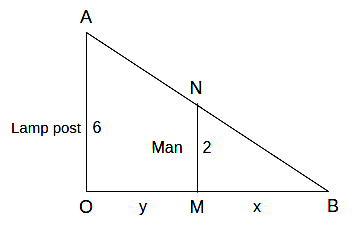
Then, $\frac{d y}{d t}=6 km / hr$ is the rate at which the man is moving away from the lamp post. $MN =2 m , OA =$ $6 m$ ...[Given]
$\frac{d x}{d t}$ is the rate at which his shadow is increasing.
From the figure,
$\triangle NMB \sim \triangle AOB$
$\therefore \frac{ MB }{ MN }=\frac{ OB }{ OA }$
$\therefore \frac{x}{2}=\frac{x+y}{6}$
$\therefore 6 x=2 x+2 y$
$\therefore 4 x =2 y$
$\therefore x=\frac{2 y}{4}$
$\therefore x=\frac{y}{2}$
Differentiating w.r.t.t, we get,
$ \therefore \frac{d x}{d t}=\frac{1}{2} \cdot \frac{d y}{d t}$
$=\frac{1}{2} \times 6$
$=3 km / hr $
Thus, the length of shadow is increasing at the rate of $3 km / hr$. View full question & answer→Question 402 Marks
If $y =\cos ^{-1}\left[\sin \left(4^{ x }\right)\right]$, find $\frac{ d y}{ d x}$
Answer$ y=\cos ^{-1}\left[\sin \left(4^x\right)\right]$
$=\cos ^{-1}\left[\cos \left(\frac{\pi}{2}-4^x\right)\right]$
$=y=\frac{\pi}{2}-4^x $
Differentiating w.r.t. $x$, we get
$ \frac{ d y}{ d x}=\frac{ d }{ d x}\left(\frac{\pi}{2}-4^x\right)$
$=0-4^{ x } \log 4$
$=-4^{ x } \log 4 $
View full question & answer→Question 412 Marks
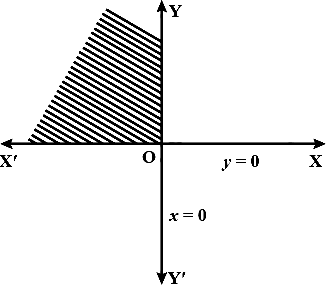
Solve graphically: x ≤ 0 and y ≥ 0
Answerx ≤ 0, y ≥ 0
Consider the lines whose equation are x = 0, y = 0.
These represents the equations of Y-axis and X-axis respectively, which divide the plane into four parts.
Since x ≤ 0, y ≥ 0, the solution set is in the first quadrant which is shaded in the graph.
View full question & answer→Question 422 Marks
Find the Cartesian equation of the line passing through A(1, 2, 3) and B(2, 3, 4)
AnswerThe Cartesian equation of the line passing through $A\left(x_1, y_1, z_1\right)$ and $B\left(x_2, y_2, z_2\right)$ is $\frac{x-x_1}{x_2-x_1}=\frac{y-y_1}{y_2-y_1}=\frac{z-z_1}{z_2-z_1}$
$\therefore$ The Cartesian equation of line is $\frac{x-1}{2-1}=\frac{y-2}{3-2}=\frac{z-3}{4-3}$
$\therefore x-1=y-2=z-3$
View full question & answer→Question 432 Marks
If $|\overline{ a } \cdot \overline{ b }|=|\overline{ a } \times \overline{ b }|$ and $\overline{ a } \cdot \overline{ b }<0$, then find the angle between $\overline{ a }$ and $\overline{ b }$
AnswerWe know that,
$ \overline{ a } \cdot \overline{ b }=|\overline{ a }||\overline{ b }| \cos \theta$
$\therefore|\overline{ a } \cdot \overline{ b }|=|| \overline{ a }|| \overline{ b }|\cos \theta|$
$\therefore|\overline{ a } \cdot \overline{ b }|=|\overline{ a }||\overline{ b }| \cos \theta \quad \ldots . . .( i )[\overline{ a } \cdot \overline{ b }<0] $
Also, $|\overline{ a } \times \overline{ b }|=|\overline{ a }||\overline{ b }| \sin \theta$
$ |\overline{ a } \cdot \overline{ b }|=|\overline{ a } \times \overline{ b }| \ldots . . .[\text { Given }]$
$\therefore-|\overline{ a }||\overline{ b }| \cos \theta=|\overline{ a }||\overline{ b }| \sin \theta \quad \ldots \ldots . .[\text { From (i) and (ii)] }$
$\therefore-1=\tan \theta$
$\therefore \tan \theta=-1$
$\therefore \theta=\tan ^{-1}(-1)=\frac{3 \pi^{ c }}{4} $
$\therefore$ The angle between $\overline{ a }$ and $\overline{ b }$ is $\frac{3 \pi^{ c }}{4}$.
View full question & answer→Question 442 Marks
Find the value of $\cos ^{-1}\left(\frac{1}{2}\right)+\tan ^{-1}\left(\frac{1}{\sqrt{3}}\right)$
Answer$ \text { Let } \cos ^{-1}\left(\frac{1}{2}\right)= x$
$\therefore \cos x=\frac{1}{2}$
$=\cos \frac{\pi}{3} $
The principal value branch of $\cos ^{-1}$ is $[0, \pi]$ and $0 \leq \frac{\pi}{3} \leq \pi$
$\therefore x =\frac{\pi}{3}$
$\therefore \cos ^{-1} \frac{1}{2}=\frac{\pi}{3}$
Let $\tan ^{-1}\left(\frac{1}{\sqrt{3}}\right)=y$
$ \therefore \tan y=$
$=\tan \frac{\pi}{6} $
The principal value branch of $\tan ^{-1}$ is $\left(\frac{-\pi}{2}, \frac{\pi}{2}\right)$ and $-\frac{\pi}{2},<\frac{\pi}{6}<\frac{\pi}{2}$
$ \therefore y=\frac{\pi}{6}$
$\therefore \tan ^{-1}\left(\frac{1}{\sqrt{3}}\right)=\frac{\pi}{6}$
$\therefore \cos ^{-1}\left(\frac{1}{2}\right)+\tan ^{-1}\left(\frac{1}{\sqrt{3}}\right)=\frac{\pi}{3}+\frac{\pi}{6}$
$=\frac{3 \pi}{6}$
$=\frac{\pi}{2} $
View full question & answer→Question 452 Marks
If $A=\left[\begin{array}{ll}2 & 4 \\ 1 & 3\end{array}\right]$ and $B=\left[\begin{array}{ll}1 & 1 \\ 0 & 1\end{array}\right]$ then find $\left(A^{-1} B^{-1}\right)$
Answer$\begin{array}{l}\left(A^{-1} B^{-1}\right)=(B A)^{-1} \ldots . .\left[\because(A B)^{-1}=B^{-1} A^{-1}\right] \end{array}$
$ \therefore A=\left[\begin{array}{ll}2 & 4 \\ 1 & 3\end{array}\right] $
$ A=(2 \times 3)-(4 \times 1) $
$ A=6-4 \\ A=2 $
$ \therefore B=\left[\begin{array}{ll}1 & 1 \\ 0 & 1\end{array}\right] $
$ B=(1 \times 1)-(1 \times 0)$
$ B=1-0$
$B=1$
$\left(A^{-1} B^{-1}\right)=\frac{1}{|A|}(\operatorname{adj} A) \cdot \frac{1}{|B|}(\operatorname{adj} B)$
$ =\frac{1}{2}\left[\begin{array}{cc}3 & -4 \\ -1 & 2\end{array}\right] \times \frac{1}{1}\left[\begin{array}{cc}1 & -1 \\ 0 & 1\end{array}\right] $
$ =\frac{1}{2}\left[\begin{array}{cc}3 & -4 \\ -1 & 2\end{array}\right]\left[\begin{array}{cc}1 & -1 \\ 0 & 1\end{array}\right] \\ =\frac{1}{2}\left[\begin{array}{cc}3 & -7 \\ -1 & 3\end{array}\right]$
View full question & answer→Question 462 Marks
Solve the following problem: Following is the probability distribution of a r.v.X.
| X | – 3 | – 2 | –1 | 0 | 1 | 2 | 3 |
| P(X = x) | 0.05 | 0.1 | 0.15 | 0.20 | 0.25 | 0.15 | 0.1 |
Find the probability that X is odd.
AnswerP(X is odd)
= P(X = –3 or X = –1 or X = 1 or X = 3)
= P(X = –3) + P(X = – 1) + P(X = 1) + P(X = 3)
= 0.05 + 0.15 + 0.25 + 0.10
= 0.55
View full question & answer→Question 472 Marks
Solve the following problem : Following is the probability distribution of a r.v.X.
| X | – 3 | – 2 | –1 | 0 | 1 | 2 | 3 |
| P(X = x) | 0.05 | 0.1 | 0.15 | 0.20 | 0.25 | 0.15 | 0.1 |
Find the probability that X is positive.
AnswerP(X is positive)
= P(X = 1 or X = 2 or X = 3)
= P(X = 1) + P(X = 2) + P(X = 3)
= 0.25 + 0.15 + 0.10
= 0.50
View full question & answer→Question 482 Marks
If $X \sim B(6, p)$ and $2P(X = 3) = P(X = 2),$ then find $p$
AnswerGiven that $X \sim B(6, p)$
$\therefore n =6$
Also, it is given that $2 P(X=3)=P(X=2)$
$ \therefore 2 \times{ }^6 C_3 p^3 q^3={ }^6 C_2 p^2 q^4$
$\therefore 2 \times 20 \times p=15 \times q$
$\therefore 8 \times p=3(1-p)$
$\therefore 8 p=3-3 p$
$\therefore 11 p=3$
$\therefore p=\frac{3}{11} $
View full question & answer→Question 492 Marks
Evaluate: $\int_0^\pi \cos ^2 x d x$
Answer$\int_0^\pi \cos ^2 x d x=\int_0^\pi\left(\frac{1+\cos 2 x}{2}\right) d x$
$=\frac{1}{2}\left[\int_0^\pi d x+\int_0^\pi \cos 2 x d x\right]$
$=\frac{1}{2}\left[[x]_0^\pi+\left[\frac{\sin 2 x}{2}\right]_0^\pi\right]$
$=\frac{1}{2}\left[(\pi-0)+\frac{1}{2}(\sin 2 \pi-\sin 0)\right]$
$=\frac{1}{2}\left[\pi+\frac{1}{2}(0-0)\right]$
$=\frac{\pi}{2}$
View full question & answer→Question 502 Marks
$\int e ^{3 \log x}\left(x^4+1\right)^{-1} d x$
Answer$ \text { Let } I =\int e ^{3 \log x}\left(x^4+1\right)^{-1} d x$
$=\int \frac{ e ^{\log \left(x^3\right)}}{x^4+1} d x$
$=\int \frac{x^3}{x^4+1} d x $
Put $x^4+1=t$
Differentiating w.r.t. $x$, we get
$ 4 x ^3 dx = dt$
$\therefore x ^3 dx =\frac{1}{4} dt$
$\therefore I =\frac{1}{4} \int \frac{ dt }{ t }$
$=\frac{1}{4} \log | t |+ c$
$\therefore I =\frac{1}{4} \log \left|x^4+1\right|+ c $
View full question & answer→Question 512 Marks
A car is moving in such a way that the distance it covers, is given by the equation $s = 4t^2 + 3t,$ where s is in meters and t is in seconds. What would be the velocity and the acceleration of the car at time $t = 20$ seconds?
AnswerLet $v$ be the velocity and a be the acceleration of the car.
Distance travelled by the car is given by
$ \therefore \text { Velocity }= v =\frac{ ds }{ dt }$
$=\frac{ d }{ dt }\left(4 t ^2+3 t \right)$
$=8 t +3 \quad \ldots \ldots . .( i ) $
Acceleration $= a =\frac{ dv }{ dt }$
$ =\frac{d}{d t}(8 t+3)$
$=8 \quad \ldots \ldots . .( ii ) $
Velocity of the car at $t=20$ seconds is
$ V _{( t =20)}=8(20)+3 \quad \ldots \ldots . .[\text { From (i) }]$
$=163 m / sec . $
Acceleration of the car at $t=20$ seconds is
$a _{( t =20)}=8 m / sec ^2 \quad \ldots \ldots . .[\text { From (ii) }]$
View full question & answer→Question 522 Marks
Let $f(x) = x^5 + 2x – 3$ find $\left(f^{-1}\right)^{\prime}(-3)$
Answer$f(x)=x^5+2 x-3$
Differentiating w.r.t. $x$, we get
$f^{\prime}(x)=5 x^4+2$
At $y=-3, x=0$
$ \therefore\left(f^{-1}\right)^{\prime}(-3)=\frac{1}{f^{\prime}(0)}$
$=\frac{1}{5(0)^4+2}$
$=\frac{1}{2} $
View full question & answer→Question 532 Marks
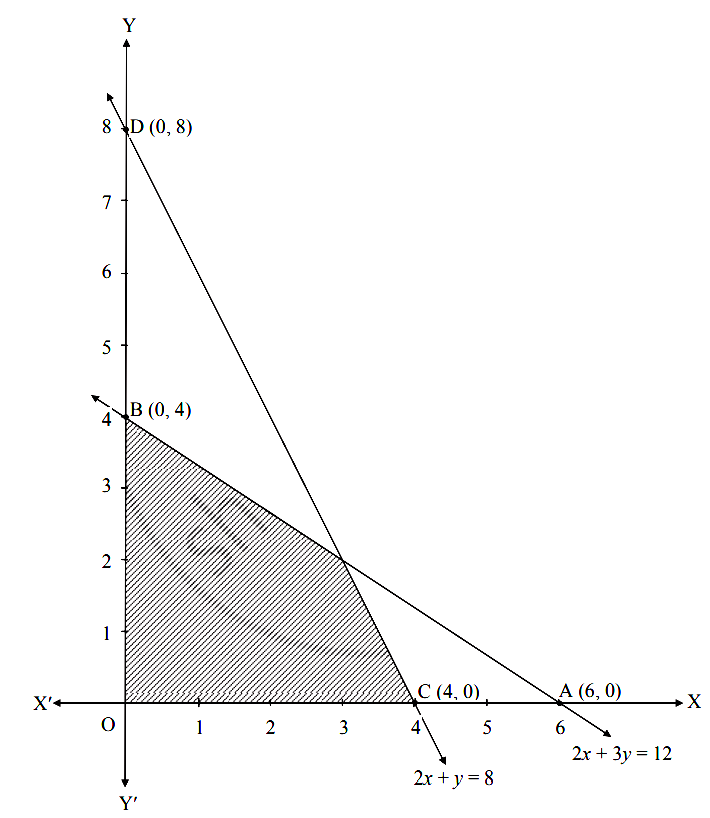
Find the feasible solution of linear inequation 2x + 3y ≤ 12, 2x + y ≤ 8, x ≥ 0, y ≥ 0 by graphically
AnswerTo find the feasible solution, construct the table as follows:| Inequation | Equation | Double intercept form | Points(x, y) | Region |
| 2x + 3y ≤ 12 | 2x + 3y = 12 | $\frac{x}{6}+\frac{y}{4}=1$ | A(6, 0)B(0, 4) | 2(0) + 3(0) ≤ 12 ∴ 0 ≤ 12 ∴ origin side |
| 2x + y ≤ 8 | 2x + y = 8 | $\frac{x}{4}+\frac{y}{8}=1$ | C(4, 0)D(0, 8) | 2(0) + 0 ≤ 8 ∴ 0 ≤ 8 ∴ origin side |
| x ≥ 0 | x = 0 | _ | _ | R.H.S. of Y-axis |
| y ≥ 0 | y = 0 | _ | _ | Above X-axis |
The shaded portion represents the graphical solution.
View full question & answer→Question 542 Marks
Reduce the equation $\overline{ r } \cdot(3 \hat{ i }+4 \hat{ j }+12 \widehat{ k })=8$ to normal form
AnswerEquation of plane is $\overline{ r } \cdot(3 \hat{ i }+4 \hat{ j }+12 \widehat{ k })=8$
This is of the form,
$\overline{ r } \cdot \overline{ n }=8 \text {, where } \overline{ n }=3 \hat{ i }+4 \hat{ j }+12 \widehat{ k }$
Now, $|\overline{ n }|=\sqrt{3^2+4^2+12^2}$
$ =\sqrt{9+16+144}$
$=13 $
The equation $\overline{ r } \cdot \overline{ n }=8$ can be written as
$ \overline{ r } \cdot \frac{\overline{ n }}{|\overline{ n }|}=\frac{8}{|\overline{ n }|}$
$\text { i.e., } \overline{ r } \cdot\left(\frac{3}{13} \hat{ i }+\frac{4}{13} \hat{ j }+\frac{12}{13} \hat{ k }\right)=\frac{8}{13} $
which is the normal form of the plane.
View full question & answer→Question 552 Marks
If $\overline{ c }=3 \overline{ a }-2 \overline{ b }$ then prove that $\left[\begin{array}{lll}\overline{ a } & \overline{ b } & \overline{ c }\end{array}\right]=0$
Answer$\bar{c}=3 \bar{a}-2 \bar{b}$
$[$Given$]$
$\begin{array}{l}{\left[\begin{array}{lll}\bar{a} & \bar{b} & \bar{c}\end{array}\right]=\bar{a} \cdot(\bar{b} \times \bar{c})}\end{array} $
$=\bar{a} \cdot[\bar{b} \times(3 \bar{a}-2 \bar{b})] $
$=\bar{a} \cdot[\bar{b} \times 3 \bar{a}-\bar{b} \times 2 \bar{b}] $
$=\bar{a} \cdot[\bar{b} \times 3 \bar{a}-\overline{0}] \quad \ldots \ldots \ldots \cdot[\because \bar{b} \times \bar{b}=\overline{0}] $
$=3 \bar{a} \cdot[\bar{b} \times \bar{a}] $
$=3\left[\begin{array}{lll}\bar{a} & \bar{b} & \bar{a} \end{array}\right] $
$=3(0) $
$\therefore\left[\begin{array}{lll}\bar{a} & \bar{b} & \bar{a}\end{array}\right]=0$
View full question & answer→Question 562 Marks
Find the measure of the acute angle between the line represented by $3 x^2-4 \sqrt{3} x y+3 y^2=0$
AnswerGiven equation of the lines is $3 x^2-4 \sqrt{3} x y+3 y^2=0$
Comparing with $a x^2+2 h x y+b y^2=0$,
We get, $a=3, h=-2 \sqrt{3}$ and $b=3$
Let $\theta$ be the acute angle between the lines.
$ \therefore \tan \theta=\left|\frac{2 \sqrt{ h ^2- ab }}{ a + b }\right|$
$=\left|\frac{2 \sqrt{(-2 \sqrt{3})^2-3(3)}}{3+3}\right|$
$=\left|\frac{2 \sqrt{12-9}}{6}\right|$
$=\left|\frac{\sqrt{3}}{3}\right|$
$\therefore \tan \theta=\frac{1}{\sqrt{3}}$
$=\theta=\tan ^{-1}\left(\frac{1}{\sqrt{3}}\right)$
$\therefore \theta=30^{\circ} $
View full question & answer→Question 572 Marks
Find the principal solutions of $\sin x=-\frac{1}{2}$
Answer$ \sin x=-\frac{1}{2}$
$\therefore \sin x=-\sin \left(\frac{\pi}{6}\right)$
$\therefore \sin x=\sin \left(\pi+\frac{\pi}{6}\right)$
$=\sin \left(\frac{7 \pi}{6}\right) \text { ans } \sin x=\sin \left(2 \pi-\frac{\pi}{6}\right)$
$=\sin \left(\frac{11 \pi}{6}\right) $
such that $0 \leq \frac{7 \pi}{6}<2 \pi$ and $0 \leq \frac{11 \pi}{6}<2 \pi$
$\therefore$ The required principal solutions are $x=\frac{7 \pi}{6}$ and $x=\frac{11 \pi}{6}$.
View full question & answer→Question 582 Marks
If $A=\left[\begin{array}{ll}6 & 5 \\ 5 & 6\end{array}\right]$ and $B=\left[\begin{array}{cc}11 & 0 \\ 0 & 11\end{array}\right]$ then find $A^{\prime} B^{\prime}$
Answer$\begin{array}{l}A^{\prime} B^{\prime}=\left[\begin{array}{ll}6 & 5 \\ 5 & 6\end{array}\right]^{\prime}\left[\begin{array}{cc}11 & 0 \\ 0 & 11\end{array}\right]^{\prime} \end{array}$
$ =\left[\begin{array}{ll}6 & 5 \\ 5 & 6\end{array}\right]\left[\begin{array}{cc}11 & 0 \\ 0 & 11\end{array}\right] $
$ =\left[\begin{array}{ll}66+0 & 0+55 \\ 55+0 & 0+66\end{array}\right] $
$ =\left[\begin{array}{ll}66 & 55 \\ 55 & 66\end{array}\right]$
View full question & answer→Question 592 Marks
Without using truth table prove that:
~ (p ∨ q) ∨ (~ p ∧ q) ≡ ~ p
AnswerWe have,
L.H.S. = ∼(p ∨ q) ∨ (∼p ∧ q)
= (∼ p ∧ ∼q) ∨ (∼p ∧ q) ....(By De Morgan's Law)
= ∼p ∧ (∼q ∨ q) ....(By Distributive Law)
= ∼p ∧ T ....(By Complement Law)
= ∼p
R.H.S. = ∼p
L.H.S. = R.H.S.
View full question & answer→Question 602 Marks
Without using truth table prove that:
~ (p ∨ q) ∨ (~ p ∧ q) ≡ ~ p
AnswerWe have,
L.H.S. = ∼(p ∨ q) ∨ (∼p ∧ q)
= (∼ p ∧ ∼q) ∨ (∼p ∧ q) ....(By De Morgan's Law)
= ∼p ∧ (∼q ∨ q) ....(By Distributive Law)
= ∼p ∧ T ....(By Complement Law)
= ∼p
R.H.S. = ∼p
L.H.S. = R.H.S.
View full question & answer→Question 612 Marks
If $X \sim B(n, p)$ with $n=10, p=0.4$, then find $E\left(X^2\right)$.
AnswerFor $X \sim B(n, p), E(X)=n p$ and $V(X)=n p q$ Given that $n=10$ and $p=0.4$
$\therefore q=1-p$
$=1-0.4$
$=0.6$
$\therefore E(X)=n p$
$=10 \times 0.4$
$=4$
and
$V(X)=npq$
$=10 \times 0.4 \times 0.6$
$=2.4$
Also, $V(X)=E\left(X^2\right)-[E(X)]^2$
$\therefore 2.4=E\left(X^2\right)-(4)^2$
$\therefore E\left(X^2\right)=2.4+16$
$\therefore E\left(X^2\right)=18.4$
View full question & answer→Question 622 Marks
The probability distribution of X is as follows:
| X | 0 | 1 | 2 | 3 | 4 |
| P(X = x) | 0.1 | k | 2k | 2k | k |
Find k and P[X < 2]
AnswerAs probability distribution of $r$. $v$. $X$ is given, $\sum P ( X =x)=1$
i.e., $P(X=0)+P(X=1)+P(X=2)+P(X=3)+P(X=4)=1$
$\therefore 0.1+ k +2 k +2 k + k =1$
$\therefore 6 k =0.9$
$
\therefore k =0.15\ldots(i)
$
$\therefore P [ X <2]= P ( X =0$ or 1$)$
$
=P(X=0)+P(X=1)
$
$
=0.1+ k
$
$
=0.1+0.15\ldots[From (i)]
$
$
=0.25
$
View full question & answer→Question 632 Marks
Evaluate: $\int_0^{\frac{\pi}{2}} \cos ^3 x d x$
Answer$\int_0^{\frac{\pi}{2}} \cos ^3 x d x=\int_0^{\frac{\pi}{2}}\left(\frac{\cos 3 x+3 \cos x}{4}\right) d x$
$=\frac{1}{4}\left[\int_0^{\frac{\pi}{2}} \cos x d x+3 \int_0^{\frac{\pi}{2}} \cos x d x\right]$
$=\frac{1}{4}\left[\left[\frac{\sin 3 x}{3}\right]_0^{\frac{\pi}{2}}+3[\sin x]_0^{\frac{\pi}{2}}\right]$
$=\frac{1}{4}\left[\frac{1}{3}\left(\sin \frac{3 \pi}{2}-\sin 0\right)+3\left(\sin \frac{\pi}{2}-\sin 0\right)\right]$
$=\frac{1}{4}\left[\frac{1}{3}(-1-0)+3(1-0)\right]$
$=\frac{1}{4}\left(\frac{-1}{3}+3\right)$
$=\frac{1}{4}\left(\frac{8}{3}\right)$
$=\frac{2}{3}$
View full question & answer→Question 642 Marks
$\int \frac{1}{4 x+5 x^{-11}} d x$
Answer$ \text { Let } I =\int \frac{1}{4 x+5 x^{-11}} d x$
$=\int \frac{1}{4 x+\frac{5}{x^{11}}} d x$
$=\int \frac{x^{11}}{4 x^{12}+5} d x $
Put $4 x ^{12}+5= t$
Differentiating w.r.t. $x$, we get
$ 4(12) x ^{11} dx = dt$
$\therefore x ^{11} dx =\frac{1}{48} dt$
$\therefore I =\frac{1}{48} \int \frac{ dt }{ t }$
$=\frac{1}{48} \log | t |+ c$
$\therefore I =\frac{1}{48} \log \left|4 x^{12}+5\right|+ c $
View full question & answer→Question 652 Marks
Find the equation of normal to the curve $y=2 x^3-x^2+2$ at $\left(\frac{1}{2}, 2\right)$
Answer$ y =2 x ^3- x ^2+2$
$\therefore \frac{ d y}{ d x}=6 x ^2-2 x$
$\therefore\left(\frac{ d y}{ d x}\right)_{\left(\frac{1}{2}, 2\right)}=6\left(\frac{1}{2}\right)^2-2\left(\frac{1}{2}\right)$
$=\frac{3}{2}-1$
$=2 \frac{1}{2} $
Slope of the normal at $\left(\frac{1}{2}, 2\right)$ is $\frac{-1}{\left(\frac{ d y}{ d x}\right)_{\left(\frac{1}{2}, 2\right)}}$
$ =\frac{-1}{\frac{1}{2}}$
$=-2 $
$\therefore$ Equation of the normal at $\left(\frac{1}{2}, 2\right)$ is
$y-2=-2\left(x-\frac{1}{2}\right)$
$\therefore y-2=-2 x+1$
$\therefore 2 x+y-3=0$
View full question & answer→Question 662 Marks
Find the derivative of the inverse of function $y = 2x^3 – 6x$ and calculate its value at $x = −2$
Answer$y=2 x^3-6 x$
Differentiating w.r.t. $x$, we get
$ \frac{ d y}{ d x}=\frac{ d }{ d x}\left(2 x^3-6 x\right)$
$=2\left(3 x ^2\right)-6$
$=6 x ^2-6$
$=6\left( x ^2-1\right)$
$\therefore\left(\frac{ d y}{ d x}\right)_{x=-2}=6\left[(-2)^2-1\right]$
$=6(3)$
$=18$
$\therefore\left(\frac{ d x}{ d y}\right)_{x=-2}=\frac{1}{\left(\frac{ d y}{ d x}\right)_{x=-2}}$
$=\frac{1}{18} $
View full question & answer→Question 672 Marks
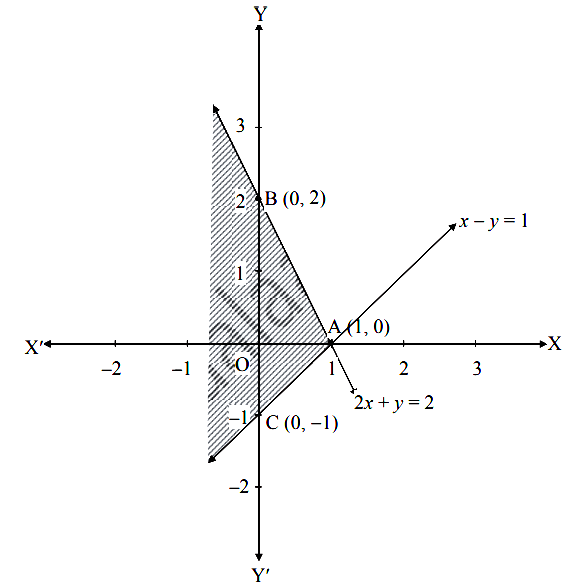
Find the graphical solution for the system of linear inequation 2x + y ≤ 2, x − y ≤ 1
AnswerTo find graphical solution, construct the table as follows:| Inequation | Equation | Double intercept form | Points(x, y) | Region |
| 2x + y ≤ 2 | 2x + y = 2 | $\frac{x}{1}+\frac{y}{2}=1$ | A(1, 0)B(0, 2) | 2(0) + 0 ≤ 2∴ 0 ≤ 2 ∴ origin side |
| x − y ≤ 1 | x − y = 1 | $\frac{x}{1}+\frac{y}{-1}=1$ | A(1, 0)C(0, −1) | 0 - 0 ≤ 1∴ 0 ≤ 1 ∴ origin side |
The shaded portion represents the graphical solution.
View full question & answer→Question 682 Marks
If the normal to the plane has direction ratios 2, −1, 2 and it’s perpendicular distance from origin is 6, find its equation
AnswerDirection ratios of the normal to the plane are $2,-1,2$
$\therefore a=2, b=-1$ and $c=2$
$\therefore$ Direction cosines are,
$ I =\frac{2}{\sqrt{2^2+(-1)^2+2^2}}$
$m =\frac{-1}{\sqrt{2^2+(-1)^2+2^2}}$
$n =\frac{2}{\sqrt{2^2+(-1)^2+2^2}}$
$\therefore I =\frac{2}{3}, m =\frac{-1}{3}, n =\frac{2}{3} $
Cartesian equation of a plane which is at the distance of 6 units from the origin is
$ \text { lx }+ my + nz =6$
$\therefore \frac{2}{3} x-\frac{1}{3} y+\frac{2}{3} z=6$
$\therefore 2 x - y +2 z =18 $
View full question & answer→Question 692 Marks
If a vector has direction angles 45° and 60°, find the third direction angle.
AnswerLet $\alpha, \beta, \gamma$ be the angles made by the vector with positive directions of $X, Y, Z$ axes respectively.
$\therefore \alpha=45^{\circ}, \beta=60^{\circ}$
We know that,
$ \because \cos ^2 \alpha+\cos ^2 \beta+\cos ^2 \gamma=1$
$\therefore \cos ^2 45^{\circ}+\cos ^2 60^{\circ}+\cos ^2 r=1 $
$\therefore\left(\frac{1}{\sqrt{2}}\right)^2+\left(\frac{1}{2}\right)^2+\cos ^2 \gamma=1$
$\therefore \frac{1}{2}+\frac{1}{4}+\cos ^2 \gamma=1$
$ \therefore \cos ^2 \gamma=1-\frac{1}{2}-\frac{1}{4}$
$\therefore \cos ^2 \gamma=\frac{1}{4} $
$\therefore \cos ^2 \gamma=\frac{1}{4}$
$\therefore \cos \gamma= \pm \frac{1}{2}$
$\therefore \cos \gamma=\frac{1}{2}$ or $\cos \gamma=-\frac{1}{2}$
$\therefore \cos \gamma=\frac{\pi}{3}$ or $\cos \gamma=-\frac{\pi}{3}$
$\therefore \cos \left(\pi-\frac{\pi}{3}\right)=\cos \frac{2 \pi}{3}$
$\therefore \gamma=\frac{\pi}{3}$ or $\gamma=\frac{2 \pi}{3}$
Hence, the third direction angle is $\frac{\pi}{3}$ or $\frac{2 \pi}{3}$
View full question & answer→Question 702 Marks
Find the condition that the line $4x + 5y = 0$ coincides with one of the lines given by $ax^2 + 2hxy + by^2 = 0$
AnswerThe auxiliary equation of the lines represented by $a x^2+2 h x y+b y^2=0$ is $b m^2+2 h m+a=$ 0
Given that $4 x+5 y=0$ is one of the lines represented by $a x^2+2 h x y+b y^2=0$
The slope of the line $4 x+5 y=0$ is $-\frac{4}{5}$
$\therefore m =-\frac{4}{5}$ is a root of the auxiliary equation $bm ^2+2 hm + a =0$
$\therefore b\left(-\frac{4}{5}\right)^2+2 h\left(-\frac{4}{5}\right)+a=0$
$\therefore \frac{16 b}{25}-\frac{8 h}{5}+a=0$
$\therefore 16 b-40 h+25 a=0$
$\therefore 25 a+16 b-40 h=0$
This is the required condition.
View full question & answer→Question 712 Marks
In $\triangle ABC$, prove that $( b - c )^2 \cos ^2\left(\frac{ A }{2}\right)+( b + c )^2 \sin ^2\left(\frac{ A }{2}\right)= a ^2$
Answer$\text { L.H.S. }=(b-c)^2 \cos ^2 \frac{A}{2}+(b+c)^2 \sin ^2 \frac{A}{2}$
$=\left(b^2+c^2-2 b c\right) \cos ^2 \frac{a}{2}+\left(b^2+c^2+2 b c\right) \sin ^2 \frac{A}{2}$
$=\left(b^2+c^2\right) \cos ^2 \frac{A}{2}-2 b c \cos ^2 \frac{A}{2}+\left(b^2+c^2\right) \sin ^2 \frac{A}{2}+2 b c \sin ^2 \frac{A}{2}$
$=\left(b^2+c^2\right)\left(\cos ^2 \frac{A}{2}+\sin ^2 \frac{A}{2}\right)-2 b c\left(\cos ^2 \frac{A}{2}-\sin ^2 \frac{A}{2}\right)$
$=\left(b^2+c^2\right)(1)-2 b c \cos A \ldots \ldots\left[\because \cos ^2 \theta-\sin ^2 \theta=\cos 2 \theta\right]$
$=b^2+c^2-2 b c \cos A$
$=a^2 \quad \ldots \ldots . .[\text { By cosine rule }]$
$=\text { R.H.S. }$
View full question & answer→Question 722 Marks
If $A$ is invertible matrix of order $3$ and $|A| = 5$, then find $|adj A|$
Answer$\text { We know that } A^{-1}=\frac{1}{|A|} \text { adj }(A)$
$\therefore A ^{-1}| A |=\operatorname{adj}( A )$
$\therefore A A^{-1}|A|=A \operatorname{adj}(A)$
$\therefore I|A|=A \operatorname{adj}(A)$
$\therefore \operatorname{det}(|| A \mid)=\operatorname{det}(A \operatorname{adj}(A))$
$\therefore \operatorname{det}(|| A \mid)=\operatorname{det}(A)(\operatorname{adj}(A))$
$\therefore\left|\begin{array}{lll}5 & 0 & 0 \\ 0 & 5 & 0 \\ 0 & 0 & 5\end{array}\right|=5|\operatorname{adj} A|$
$\therefore 5^3=5|\operatorname{adj} A |$
$\therefore|\operatorname{adj} A |=5^2=25$
View full question & answer→Question 732 Marks
Write the converse and contrapositive of the following statements.
“If a function is differentiable then it is continuous”
AnswerLet p: A function is differentiable,
q: It is continuous.
∴ The symbolic form of the given statement is p → q.
Converse: q → p
i.e. If a function is continuous then it is differentiable
Contrapositive: ~q → ~p
i.e. If a function is not continuous then it is not differentiable.
View full question & answer→Question 742 Marks
Write the converse and contrapositive of the following statements.
“If a function is differentiable then it is continuous”
AnswerLet p: A function is differentiable,
q: It is continuous.
∴ The symbolic form of the given statement is p → q.
Converse: q → p
i.e. If a function is continuous then it is differentiable
Contrapositive: ~q → ~p
i.e. If a function is not continuous then it is not differentiable.
View full question & answer→Question 752 Marks
Given $X \sim B(n, p).$ If $E(X) = 6, V(X) = 4.2,$ find $n$ and $p$
AnswerFor $X \sim B(n, p), E(X)=n p$ and $V(X)=n p q$
Given that $E(X)=6$ and $V(X)=4.2$
$ \therefore \frac{V(X)}{E(X)}=\frac{4.2}{6}$
$\therefore \frac{n p q}{n p}=0.7$
$\therefore q=0.7$
$\therefore p=1-q$
$=1-0.7$
$=0.3$
$\therefore E(X)=n p$
$=6$
$\Rightarrow n \times 0.3=6$
$=20 $
View full question & answer→Question 762 Marks
Find the probability distribution of number of heads in two tosses of a coin
AnswerLet $X$ denotes the number of heads.
Sample space of the experiment is $S =\{ HH , HT , TH , TT \}$
The values of $X$ corresponding to these outcomes are as follows:
$X(H H)=2$
$X(H T)=X(T H)=1$
$X(T T)=0$
$\therefore X$ is a discrete random variable that can take values $0,1,2$.
The probability distribution of $X$ is then obtained as follows:
| X |
0 |
1 |
2 |
| P(X=x) |
$\frac{1}{4}$ |
$\frac{2}{4}$ |
$\frac{1}{4}$ |
View full question & answer→Question 772 Marks
Evaluate: $\int_0^{\frac{\pi}{2}} \sqrt{1-\cos 4 x} d x$
Answer$\int_0^{\frac{\pi}{2}} \sqrt{1-\cos 4 x} d x$
$=\int_0^{\frac{\pi}{2}} \sqrt{2 \sin ^2 2 x} d x \quad \ldots \ldots . .\left[1-\cos \theta=2 \sin ^2 \frac{\theta}{2}\right]$
$=\sqrt{2} \int_0^{\frac{\pi}{2}} \sin 2 x d x$
$=\sqrt{2}\left[\frac{-\cos 2 x}{2}\right]_0^{\frac{\pi}{2}}$
$=\frac{\sqrt{2}}{2}\left[\cos 2 \frac{\pi}{2}-\cos 0\right]$
$=-\frac{\sqrt{2}}{2}[\cos \pi-\cos 0]$
$=-\frac{\sqrt{2}}{2}(-1-1)$
$=\sqrt{2}$
View full question & answer→Question 782 Marks
$\int \frac{(2 x-7)}{\sqrt{4 x-1}} d x$
AnswerLet $I =\int \frac{2 x-7}{\sqrt{4 x-1}} d x$
Let $2 x -7= A (4 x -1)+ B$
$\therefore 2 x-7=4 A x+(B-A)$
By equating the coefficients on both sides, we get
$4 A=2$ and $B-A=-7$
$\therefore A=\frac{1}{2}$ and $B=-7+A$
$=-7+\frac{1}{2}$
$=-\frac{13}{2}$
$\therefore 2 x-7=\frac{1}{2}(4 x-1)-\frac{13}{2}$
$\therefore I=\frac{1}{2} \int \frac{(4 x-1)-13}{\sqrt{4 x-1}} d x$
$=\frac{1}{2} \int\left(\frac{4 x-1}{\sqrt{4 x-1}}-\frac{13}{\sqrt{4 x-1}}\right) d x$
$=\frac{1}{2} \int\left(\sqrt{4 x-1}-\frac{13}{\sqrt{4 x-1}}\right) d x$
$=\frac{1}{2} \int(4 x-1)^{\frac{1}{2}} d x-\frac{13}{2} \int(4 x-1)^{\frac{1}{2}} d x$
$=\frac{1}{2}\left[\frac{(4 x-1)^{\frac{3}{2}}}{\frac{3}{2}} \times \frac{1}{4}\right]-\frac{13}{2}\left[\frac{(4 x-)^{\frac{1}{2}}}{\frac{1}{2}} \times \frac{1}{4}\right]$
$\therefore I =\frac{1}{12}(4 x-)^{\frac{3}{2}}-\frac{13}{4} \sqrt{4 x-1}+ c$
View full question & answer→Question 792 Marks
Find the slope of tangent to the curve $x=\sin \theta$ and $y=\cos 2 \theta$ at $\theta=\frac{\pi}{6}$
AnswerGiven, $x=\sin \theta$ and $y=\cos 2 \theta$
Differentiating w.r.t. $\theta$, we get
$ \frac{ d x}{ d \theta}=\cos \theta \text { and } \frac{ d y}{ d \theta}=-2 \sin 2 \theta$
$\therefore \frac{ d y}{ d x}=\frac{\left(\frac{ d y}{ d \theta}\right)}{\left(\frac{ d x}{ d \theta}\right)}=\frac{-2 \sin 2 \theta}{\cos \theta} $
Slope of the tangent at $\theta=\frac{\pi}{6}$ is
$ \left(\frac{ d y}{ d x}\right)_{\theta=\frac{\pi}{6}}=\frac{-2 \sin 2\left(\frac{\pi}{6}\right)}{\cos \left(\frac{\pi}{6}\right)}$
$=\frac{-2 \sin \left(\frac{\pi}{3}\right)}{\cos \left(\frac{\pi}{6}\right)}$
$=\frac{-2 \times \frac{\sqrt{3}}{2}}{\frac{\sqrt{3}}{2}}$
$=-2 $
View full question & answer→Question 802 Marks
If $y =\sqrt{\tan \sqrt{x}}$, find $\frac{ d y}{ d x}$
Answer$y =\sqrt{\tan \sqrt{x}}$
Differentiating w.r.t. $x$, we get
$ \frac{ d y}{ d x}=\frac{ d }{ d x}(\sqrt{\tan \sqrt{x}})$
$=\frac{1}{2 \sqrt{\tan \sqrt{x}}} \cdot \frac{ d }{ d x}(\tan \sqrt{x})$
$=\frac{1}{2 \sqrt{\tan \sqrt{x}}} \cdot \sec ^2(\sqrt{x}) \cdot \frac{ d }{ d x}(\sqrt{x})$
$=\frac{\sec ^2 \sqrt{x}}{2 \sqrt{\tan \sqrt{x}}} \cdot \frac{1}{2 \sqrt{x}}$
$\therefore \frac{ d y}{ d x}=\frac{\sec ^2 \sqrt{x}}{4 \sqrt{x \sqrt{\tan \sqrt{x}}}} $
View full question & answer→Question 812 Marks
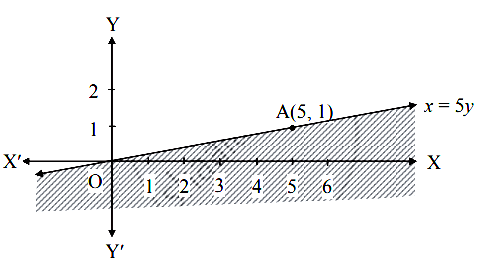
Sketch the graph of inequation x ≥ 5y in xoy co-ordinate system
AnswerGiven inequation: x ≥ 5y
i.e., x − 5y ≥ 0
∴ Corresponding equation is x − 5y = 0
It is a line passing through origin O (0, 0).
To find another point on the line, we can take any value of x.
Substituting x = 5 in x − 5y = 0, we get
5 − 5y = 0
∴ 5 = 5y
∴ y = 1
∴ Another point on the line is A(5, 1).
∴ The line passes through O(0, 0) and A(5, 1).
Choose a point (1, 0) not lying on the line.
∴ Substituting x = 1, y = 0 in x ≥ 5y, we get 1 ≥ 0
∴ (1, 0) satisfies the given inequality.
∴ The required region is on the side containing the point (1, 0).
The shaded portion represents the graphical solution.
View full question & answer→Question 822 Marks
Find direction cosines of the normal to the plane $\overline{ r } \cdot(3 \hat{ i }+4 \widehat{ k })=5$
AnswerEquation of the plane is $\overline{ r } \cdot(3 \hat{ i }+4 \widehat{ k })=5$
This is of the form,
$\overline{ r } \cdot \overline{ n }=5 \text {, where } \overline{ n }=3 \hat{ i }+4 \widehat{ k }$
Now, $|\overline{ n }|=\sqrt{3^2+4^2}$
$ =\sqrt{9+16}$
$=5 $
The equation $\overline{ r } \cdot \overline{ n }=5$ can be written as
$ \overline{ r } \cdot \frac{\overline{ n }}{|\overline{ n }|}=\frac{5}{|\overline{ n }|}$
$\text { i.e., } \overline{ r } \cdot\left(\frac{3}{5} \hat{ i }+\frac{4}{5} \widehat{ k }\right)=\frac{5}{5}$
$=1 $
$\therefore$ The direction cosines of the normal are $\frac{3}{5}, 0, \frac{4}{5}$.
View full question & answer→Question 832 Marks
Show that following points are collinear $P(4, 5, 2), Q(3, 2, 4), R(5, 8, 0)$
AnswerLet $\overline{ p }, \overline{ q }, \overline{ r }$ be the position vectors of points $P , Q , R$ respectively.
$ \therefore \overline{ p }=4 \hat{ i }+5 \hat{ j }+2 \widehat{ k }$
$\overline{ q }=3 \hat{ i }+2 \hat{ j }+4 \widehat{ k },$
$\overline{ r }=5 \hat{ i }+8 \hat{ j }$
$\therefore \overline{ PQ }=\overline{ q }-\overline{ p }$
$=(3 \hat{ i }+2 \hat{ j }+4 \widehat{ k })-(4 \hat{ i }+5 \hat{ j }+2 \widehat{ k })$
$\therefore \overline{ PQ }=\hat{ i }-3 \hat{ j }+2 \widehat{ k }$
$\overline{ QR }=\overline{ r }-\overline{ q }$
$=5 \hat{ i }+8 \hat{ j }-(3 \hat{ i }+2 \hat{ j }+4 \widehat{ k })$
$=2 \hat{ i }+6 \hat{ j }-4 \widehat{ k }$
$\therefore \overline{ QR }=(-2)(-\hat{ i }-3 \hat{ j }+2 \widehat{ k }) \quad \ldots \ldots \ldots .( ii )$
$\therefore \overline{ QR }=(-2) \overline{ PQ } \ldots \ldots .[\text { From (i) and (ii)] } $
$\therefore \overline{ QR }$ is a scalar multiple of $\overline{ PQ }$
$\therefore \overline{ QR }$ and $\overline{ PQ }$ are parallel to each other with point $Q$ in common.
$\therefore \overline{ PQ }$ and $\overline{ QR }$ lie on the same line.
$\therefore$ Points $P , Q$ and $R$ are collinear.
View full question & answer→Question 842 Marks
Find the joint equation of pair of lines through the origin which is perpendicular to the lines represented by $5x^2 + 2xy - 3y^2 = 0$
AnswerComparing the equation $5 x^2+2 x y-3 y^2=0$, we get,
$a=5,2 h=+2, b=-3$
Let $m _1$ and $m _2$ be the slopes of the lines represented by $5 x^2+2 x y-3 y^2=0$
$ m_1+m_2=-\frac{2 h}{b}=-\frac{2}{-3}=\frac{2}{3}\ldots(i)$
$m_1 m_2=\frac{a}{b}=\frac{5}{-3} $
Now required lines are perpendicular to these lines
their slopes are $-\frac{1}{m_1}$ and $-\frac{1}{m_2}$
Since these lines are passing through the origin, their separate equations are
$y=-\frac{1}{m_1} x \text { and } y=-\frac{1}{m_2} x$
$\therefore m_1 y=-x \text { and } m_2 y=-x$
$x+m_1 y=0 \text { and } x+m_2 y=0$
their combined equation is
$ \left(x+m_1 y\right)\left(x+m_2 y\right)=0$
$x^2+\left(m_1+m_2\right) x y+m_1 m_2 y^2=0$
$x^2+\frac{2}{3} x y+\frac{-5}{3} y^2=0$
$3 x^2+2 x y-5 y^2=0 $
View full question & answer→Question 852 Marks
Find the principal solutions of cos 2𝑥 = 1
Answercos 2x = 1
∴ cos 2x = cos (0) and cos 2x = cos (2π – 0) = cos 2π
such that 0 ≤ 0 < 2π and 0 ≤ π < 2π
∴ The required principal solutions are x = 0 and x = π.
View full question & answer→Question 862 Marks
If $A=\left[\begin{array}{c}-1 \\ 2 \\ 3\end{array}\right], B=\left[\begin{array}{lll}3 & 1 & -2\end{array}\right]$, find $B^{\prime} A^{\prime}$
Answer$\begin{array}{l} B ^{\prime} A ^{\prime}=\left[\begin{array}{lll}3 & 1 & -2\end{array}\right]^{\prime}\left[\begin{array}{c}-1 \\ 2 \\ 3\end{array}\right]^{\prime} \end{array}$
$ =\left[\begin{array}{c}3 \\ 1 \\ -2\end{array}\right]\left[\begin{array}{lll}-1 & 2 & 3\end{array}\right] $
$ =\left[\begin{array}{ccc}-3 & 6 & 9 \\ -1 & 2 & 3 \\ 2 & -4 & -6\end{array}\right]$
View full question & answer→Question 872 Marks
Write the following compound statements symbolically.
Triangle is equilateral or isosceles
AnswerLet p: Triangle is equilateral.
Let q: Triangle is isosceles.
Then the symbolic form of the given statement is p ∨ q.
View full question & answer→Question 882 Marks
Write the following compound statements symbolically.
Triangle is equilateral or isosceles
AnswerLet p: Triangle is equilateral.
Let q: Triangle is isosceles.
Then the symbolic form of the given statement is p ∨ q.
View full question & answer→Question 892 Marks
Write the following compound statement symbolically.
Nagpur is in Maharashtra and Chennai is in Tamil Nadu.
AnswerLet p: Nagpur is in Maharashtra.
Let q: Chennai is in Tamil Nadu.
Then the symbolic form of the given statement is p ∧ q.
View full question & answer→Question 902 Marks
Write the following compound statement symbolically.
Nagpur is in Maharashtra and Chennai is in Tamil Nadu.
AnswerLet p: Nagpur is in Maharashtra.
Let q: Chennai is in Tamil Nadu.
Then the symbolic form of the given statement is p ∧ q.
View full question & answer→Question 912 Marks
A r.v. X ~ B(n, p). If the values of mean and variance of X are 18 and 12 respectively, then find total number of positive values of X.
AnswerFor $X \sim B(n, p), E(X)=n p$ and $V(X)=n p q$
Given that $E(X)=18$ and $V(X)=12$
$ \therefore \frac{ V ( X )}{ E ( X )}=\frac{12}{18}$
$\therefore \frac{ npq }{ np }=\frac{2}{3}$
$\therefore q =\frac{2}{3}$
$\therefore p =1- q$
$=1-\frac{2}{3}$
$=\frac{1}{3}$
$\therefore E ( X )= np $
$ =18$
$\Rightarrow n \times \frac{1}{3}=18$
$\Rightarrow n =54$
$\Rightarrow X =0,1,2, \ldots, 54 $
$\therefore$ Total number of positive values of $X$ are 55 .
View full question & answer→Question 922 Marks
Find the expected value and variance of r.v. X whose p.m.f. is given below.
| X |
1 |
2 |
3 |
| P(X=x) |
$\frac{1}{5}$ |
$\frac{2}{5}$ |
$\frac{2}{5}$ |
Answer$ E ( X )=\sum_{ i =1}^3 x_{ i } \cdot P \left(x_{ i }\right)$
$=1\left(\frac{1}{5}\right)+2\left(\frac{2}{5}\right)+3\left(\frac{2}{5}\right)$
$=\frac{1+4+6}{5}$
$=\frac{11}{5}$
$E \left( x ^2\right)=\sum_{ i =1}^3 x_{ i }^2 \cdot P \left(x_{ i }\right)$
$=1^2\left(\frac{1}{5}\right)+2^2\left(\frac{2}{5}\right)+3^2\left(\frac{2}{5}\right)$
$=\frac{1+8+18}{5}$
$=\frac{27}{5}$
$\therefore \operatorname{Var}(X)=E\left(X^2\right)-[E(X)]^2$
$=\frac{27}{5}-\left(\frac{11}{5}\right)^2$
$=\frac{14}{25}$
View full question & answer→Question 932 Marks
Evaluate: $\int_{\frac{\pi}{6}}^{\frac{\pi}{3}} \sin ^2 x d x$
Answer$\int_{\frac{\pi}{6}}^{\frac{\pi}{3}} \sin ^2 x d x=\int_{\frac{\pi}{6}}^{\frac{\pi}{3}}\left(\frac{1-\cos 2 x}{2}\right) d x$
$=\frac{1}{2}\left[\int_{\frac{\pi}{6}}^{\frac{\pi}{3}} d x-\int_{\frac{\pi}{6}}^{\frac{\pi}{3}} \cos 2 x d x\right]$
$=\frac{1}{2}\left[[x]_{\frac{\pi}{3}}^{\frac{\pi}{6}}-\left[\frac{\sin 2 x}{2}\right]_{\frac{\pi}{6}}^{\frac{\pi}{3}}\right]$
$=\frac{1}{2}\left[\left(\frac{\pi}{3}-\frac{\pi}{6}\right)-\frac{1}{2}\left(\sin \frac{2 \pi}{3}-\sin \frac{\pi}{3}\right)\right]$
$=\frac{1}{2}\left[\frac{\pi}{6}-\frac{1}{2}\left(\frac{\sqrt{3}}{2}-\frac{\sqrt{3}}{2}\right)\right]$
$=\frac{1}{2}\left[\frac{\pi}{6}-\frac{1}{2}(0)\right]$
$=\frac{\pi}{12}$
View full question & answer→Question 942 Marks
$\int \frac{\sin x}{1+\sin x} d x$
Answer$\text { Let } I =\int \frac{\sin x}{1+\sin x} d x$
$=\int \frac{\sin x}{1+\sin x} \cdot \frac{1-\sin x}{1-\sin x} d x$
$=\int \frac{\sin x-\sin ^2 x}{1-\sin ^2 x} d x$
$=\int \frac{\sin x-\sin ^2 x}{\cos 2} d x$
$=\int\left(\frac{\sin x}{\cos 2}-\frac{\sin ^2 x}{\cos ^2 x}\right) d x$
$\left.=\int \frac{1}{\cos x} \cdot \frac{\sin x}{\cos x}-\tan ^2 x\right) d x$
$=\int\left[\sec x \tan x d x-\int \sec ^2 x d x+\int 1 \cdot d x\right.$
View full question & answer→Question 952 Marks
Find the slope of normal to the curve $3x^2 − y^2 = 8$ at the point $(2, 2)$
AnswerEquation of the curve is
$3 x^2-y^2=8$
Differentiating w.r.t. $x$, we get
$ 6 x-2 y \frac{ d y}{ d x}=0$
$\therefore \frac{ d y}{ d x}=\frac{3 x}{y}$
$\therefore\left(\frac{ d x}{ d x}\right)_{(2,2)}=\frac{3(2)}{2}$
$=3 $
Slope of the normal at $(2,2)$ is $\frac{-1}{\left(\frac{ d y}{ d x}\right)_2{ }_2}=\frac{-1}{3}$
View full question & answer→Question 962 Marks
If $y=\log \left[\cos \left(x^5\right)\right]$ then find $\frac{ d y}{ d x}$
Answer$y=\log \left[\cos \left(x^5\right)\right]$
Differentiating w.r.t. $x$, we get
$ \frac{ d y}{ d x}=\frac{ d }{ d x}\left[\log \left\{\cos \left(x^5\right)\right\}\right]$
$=\frac{1}{\cos \left(x^5\right)} \cdot \frac{ d }{ d x}\left[\cos \left(x^5\right)\right]$
$=\frac{1}{\cos \left(x^5\right)} \cdot\left[-\sin \left(x^5\right)\right] \cdot \frac{ d }{ d x}\left(x^5\right)$
$=\frac{-\sin \left(x^5\right)}{\cos \left(x^5\right)} \cdot 5 x^4$
$=-5 x^4 \tan \left(x^5\right) $
View full question & answer→Question 972 Marks
Solve each of the following inequations graphically using XY-plane: 4x - 18 ≥ 0
AnswerConsider the line whose equation is $4 x-18 \geq 0$ i.e. $x=\frac{18}{4}=\frac{9}{2}=4.5$
This represents a line parallel to $Y$-axis passing3through the point $(4.5,0)$
Draw the line $x=4.5$
To find the solution set, we have to check the position of the origin $(0,0)$.
When $x=0,4 x-18=4 \times 0-18=-18>0$
$\therefore$ the coordinates of the origin does not satisfy thegiven inequality.
$\therefore$ the solution set consists of the line $x =4.5$ and the non-origin side of the line which is shaded in the graph.
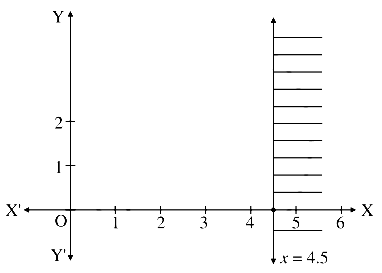
View full question & answer→Question 982 Marks
Find the direction ratios of the line perpendicular to the lines $\frac{x-7}{2}=\frac{y+7}{-3}=\frac{z-6}{1}$ and $\frac{x+5}{1}=\frac{y+3}{2}=\frac{z-6}{-2}$
AnswerLet $L_1$ and $L_2$ be the given lines with direction ratios $2,-3,1$ and $1,2,-2$ respectively.
Let the direction ratios of the line perpendicular to $L_1$ and $L_2$ be $a, b, c$.
$\therefore 2 a-3 b+c=0$ and $a+2 b-2 c=0$
$\therefore \frac{ a }{\left|\begin{array}{cc}-3 & 1 \\ 2 & -2\end{array}\right|}=\frac{ b }{\left|\begin{array}{cc}2 & 1 \\ 1 & -2\end{array}\right|}=\frac{ c }{\left|\begin{array}{cc}2 & -3 \\ 1 & 2\end{array}\right|}$
$\therefore \frac{ a }{6-2}=\frac{- b }{-4-1}=\frac{ c }{4+3}$
$\therefore \frac{ a }{4}=\frac{ b }{5}=\frac{ c }{7}$
$\therefore$ The direction ratios of the line are $4,5,7$.
View full question & answer→Question 992 Marks
The vector $\overline{ a }$ is directed due north and $|\overline{ a }|=24$. The vector $\overline{ b }$ is directed due west and $|\overline{ b }|=7$. Find $|\overline{ a }+\overline{ b }|$.
Answer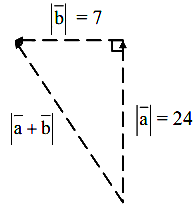
Let $\overline{ AB }=\overline{ a }, \overline{ BC }=\overline{ b }$
Then $\overline{ AC }=\overline{ AB }+\overline{ BC }=\overline{ a }+\overline{ b }$
Given: $|\overline{ a }|=|\overline{ AB }|$
$ =l( AB )$
$=24 $
and
$ |\overline{ b }|=|\overline{ BC }|$
$=l( BC )$
$=7$
$\because \angle ABC =90^{\circ}$
$\therefore[ l ( AC )]^2=[ l ( AB )]^2+[ l ( BC )]^2$
$=(24)^2+(7)^2$
$=625$
$\therefore||( AC ) \mid=25$
$\therefore|\overline{ AC }|=25$
$\therefore|\overline{ a }+\overline{ b }|=|\overline{ AC }|=25 $ View full question & answer→Question 1002 Marks
Find the combined equation of the following pair of line passing through (−1, 2), one is parallel to x + 3y − 1 = 0 and other is perpendicular to 2x − 3y − 1 = 0
AnswerLet $L_1$ be the line passing through the point $(-1,2)$ and parallel to the line $x+3 y-1=0$ whose slope is $-\frac{1}{3}$.
$\therefore$ slope of the line $L_1$ is $-\frac{1}{3}$
$\therefore$ equation of the line $L _1$ is
$y-2=-\frac{1}{3}(x+1)$
$\therefore 3 y-6=-x-1$
$\therefore x+3 y-5=0$
Let $L_1$ be the line passing through $(-1,2)$ and perpendicular to the line $2 x-3 y-1=0$ whose slope is $\frac{-2}{-3}=\frac{2}{3}$
$\therefore$ slope of the line $L_2$ is $-\frac{3}{2}$
$\therefore$ equation of the line $L _2$ is
$y-2=-\frac{3}{2}(x+1)$
$\therefore 2 y-4=-3 x-3$
$\therefore 3 x+2 y-1=0$
Hence, the equations of the required lines are
$
x+3 y-5=0 \text { and } 3 x+2 y-1=0
$
$\therefore$ their combined equation is
$
(x+3 y-5)(3 x+2 y-1)=0
$
$
\therefore 3 x^2+2 x y-x+9 x y+6 y^2-3 y-15 x-10 y+5=0
$
$\therefore 3 x^2+11 x y+6 y^2-16 x-13 y+5=0$
View full question & answer→Question 1012 Marks
With usual notations, prove that $\frac{\cos A }{ a }+\frac{\cos B }{ b }+\frac{\cos C }{ c }=\frac{ a ^2+ b ^2+ c ^2}{2 abc }$
Answer$\text { Consider L.H.S. }=\frac{\cos A }{ a }+\frac{\cos B }{ b }+\frac{\cos C }{ c }$
$=\frac{1}{ a }(\cos A )+\frac{1}{ b }(\cos B )+\frac{1}{ c }(\cos C )$
$=\frac{1}{ a }\left(\frac{ b ^2+ c ^2- a ^2}{2 bc }\right)+\frac{1}{ b }\left(\frac{ a ^2+ c ^2- b ^2}{2 ac }\right)+\frac{1}{ c }\left(\frac{ a ^2+ b ^2- c ^2}{2 ab }\right) \quad \ldots \ldots \text { [By consine rule] }$
$=\frac{ b ^2+ c ^2- a ^2}{2 abc }+\frac{ a ^2+ c ^2- b ^2}{2 abc }+\frac{ a ^2+ b ^2- c ^2}{2 abc }$
$=\frac{ b ^2+ c ^2- a ^2+ a ^2+ c ^2- b ^2+ a ^2+ b ^2- c ^2}{2 abc }$
$=\frac{ a ^2+ b ^2+ c ^2}{2 abc }$
$=\text { R.H.S. }$
$\therefore \frac{\cos A }{ a }+\frac{\cos B }{ b }+\frac{\cos C }{ c }=\frac{ a ^2+ b ^2+ c ^2}{2 abc }$
View full question & answer→Question 1022 Marks
If $f(x)=x^2-2 x-3$ then find $f(A)$ when $A=\left[\begin{array}{ll}1 & 2 \\ 2 & 1\end{array}\right]$
Answer$f(A)=A^2-2 A-3 l $
$ A^2=\left[\begin{array}{ll}1 & 2 \\ 2 & 1\end{array}\right] \left[\begin{array}{ll}1 & 2 \\ 2 & 1\end{array}\right] $
$ =\left[\begin{array}{ll}1+4 & 2+2 \\ 2+2 & 4+1\end{array}\right] $
$ =\left[\begin{array}{ll}5 & 4 \\ 4 & 5\end{array}\right]$
$ \therefore f (A)=\left[\begin{array}{ll}5 & 4 \\ 4 & 5\end{array}\right]-\left[\begin{array}{ll}2 & 4 \\ 4 & 2\end{array}\right]-\left[\begin{array}{ll}3 & 0 \\ 0 & 3\end{array}\right] $
$ =\left[\begin{array}{ll}5-2-3 & 4-4-0 \\ 4-4-0 & 5-2-3\end{array}\right] $
$=\left[\begin{array}{ll}0 & 0 \\ 0 & 0\end{array}\right]$
View full question & answer→Question 1032 Marks
$\int \frac{ e ^x \log \left(\sin e ^x\right)}{\tan e ^x} d x$
Answer$ \text { Let } I =\int \frac{ e ^x \cdot \log \left(\sin e ^x\right)}{\tan \left( e ^x\right)} d x$
$=\int e ^x \cdot \log \left(\sin e ^x\right) \cdot \cot \left( e ^x\right) d x $
Put $\log \left(\sin e^x\right)=t$
Differentiating w.r.t. $x_r$ we get
$ \frac{\cos e ^x}{\sin e ^x} \cdot e ^x d x= dt$
$\therefore e ^x \cdot \cot e ^x d x= dt$
$\therefore l =\int t \cdot dt =\frac{ t ^2}{2}+ c$
$\therefore I =\frac{\left[\log \left(\sin e ^x\right)\right]^2}{2}+ c $
View full question & answer→Question 1042 Marks
$\int \sin 4 x \cos 3 x d x$
Answer$\text { Let } I =\int \sin 4 x \cdot \cos 3 x d x$
$=\frac{1}{2} \int(2 \sin 4 x \cdot \cos 3 x) d x$
$=\frac{1}{2} \int[\sin (4 x+3 x)+\sin (4 x-3 x)] d x \quad \ldots \ldots[\because 2 \sin A \cos B =\sin ( A + B )+\sin ( A - B )]$
$=\frac{1}{2} \int(\sin 7 x+\sin x) d x$
$=\frac{1}{2}\left[\int \sin 7 x d x+\int \sin x d x\right]$
$=\frac{1}{2}\left(\frac{-\cos 7 x}{7}-\cos x\right)+ c$
$\therefore I =-\frac{1}{14} \cos 7 x-\frac{1}{2} \cos x+ c $
View full question & answer→Question 1052 Marks
$\int[\operatorname{cosec}(\log x)][1-\cot (\log x)] d x$
Answer$\text { Let } I =\int \frac{\cos 2 x}{\sin ^2 x \cdot \cos ^2 x} d x$
$=\int\left(\frac{\cos ^2 x-\sin ^2 x}{\sin ^2 x \cdot \cos ^2 x}\right) d x \ldots \ldots\left[\because \cos 2 \theta=\cos ^2 \theta-\sin ^2 \theta\right]$
$=\int\left(\frac{\cos ^2 x}{\sin ^2 x \cdot \cos ^2 x}-\frac{\sin ^2 x}{\sin ^2 x \cdot \cos ^2 x}\right) d x$
$=\int \frac{1}{\sin ^2 x} d x-\int \frac{1}{\cos ^2 x} d x$
$=\int \operatorname{cosec}^2 x d x-\int \sec ^2 x d x$
$\therefore I =-\cot x -\tan x + c $
View full question & answer→Question 1062 Marks
$\int[\operatorname{cosec}(\log x)][1-\cot (\log x)] d x$
Answer$ \text { Let } I =\int[\operatorname{cosec}(\log x)][1-\cot (\log x)] d x$
$\text { Put } \log _{ e } x = t$
$\therefore x = e ^{ t }$
$\therefore dx = e ^{ t } \cdot dt$
$\therefore I =\int \operatorname{cosec} t (1-\cot t ) e ^{ t } dt$
$=\int e ^{ t }(\operatorname{cosec} t -\operatorname{cosec} t \cdot \cot t ) dt $
Put $f(t)=\operatorname{cosec} t$
$ \therefore f ^{\prime}( t )=-\operatorname{cosec} t \cdot \cot t$
$\therefore I =\int e ^{ t }\left[ f ( t )+ f ^{\prime}( t )\right] dt$
$= e ^{ t } \cdot f ( t )+ c = e ^{ t } \operatorname{cosec} t + c$
$\therefore I =x \operatorname{cosec}(\log x)+ c $
View full question & answer→Question 1072 Marks
If statements p, q are true and r, s are false, determine the truth values of the following.
(p ∧ ~r) ∧ (~q ∨ s)
Answer(p ∧ ~r) ∧ (~q ∨ s)
≡ (T ∧ ∼F) ∧ (∼T ∨ F)
≡ (T ∧ T) ∧ (F ∨ F)
≡ T ∧ F
≡ F
∴ Truth value of (p ∧ ∼r) ∧ (∼q ∨ s) is F.
View full question & answer→Question 1082 Marks
$\int \sqrt{4^x\left(4^x+4\right)} d x$
Answer$ \text { Let } I =\int \sqrt{4^x\left(4^x+4\right)} d x$
$=\int \sqrt{\left(2^x\right)^2\left[\left(2^x\right)^2+4\right]} d x$
$=\int \sqrt{\left(2^x\right)^2+2^2 \cdot 2^x d x} $
Put $2^x=t$
$ \therefore 2^{ x } \log 2 dx = dt$
$\therefore 2^{ x } dx =\frac{1}{\log 2} dt$
$\therefore I =\frac{1}{\log 2} \int \sqrt{ t ^2+2^2} dt$
$=\frac{1}{\log 2}\left[\frac{ t }{2} \sqrt{ t ^2+2^2}+\frac{2^2}{2} \log \left| t +\sqrt{ t ^2+2^2}\right|\right]+ c$
$\therefore I =\frac{1}{\log 2}\left[\frac{2^x}{2} \sqrt{4 x+4}+2 \log \left|2^x+\sqrt{4^x+4}\right|\right]+ c $
View full question & answer→Question 1092 Marks
Transform $\left[\begin{array}{ccc}1 & 2 & 4 \\ 3 & -1 & 5 \\ 2 & 4 & 6\end{array}\right]$ into an upper triangular matrix by using suitable row transformations
AnswerLet $A=\left[\begin{array}{ccc}1 & 2 & 4 \\ 3 & -1 & 5 \\ 2 & 4 & 6\end{array}\right]$
Applying $R_2 \rightarrow R_2-3 R_1$ and $R_3 \rightarrow R_3-2 R_1$, we get
$
\left[\begin{array}{ccc}
1 & 2 & 4 \\
0 & -7 & -7 \\
0 & 0 & -2
\end{array}\right]
$
This is required upper triangular matrix.
View full question & answer→Question 1102 Marks
If statements p, q are true and r, s are false, determine the truth values of the following.
~ p ∧ (q ∨ ~ r)
Answer~ p ∧ (q ∨ ~ r)
≡ ∼T ∧ (T ∨ ∼ F)
≡ F ∧ (T ∨ T)
≡ F ∧ T
≡ F
∴ Truth value of ~ p ∧ (q ∨ ~ r) is F
View full question & answer→Question 1112 Marks
If statements p, q are true and r, s are false, determine the truth values of the following.
~ p ∧ (q ∨ ~ r)
Answer~ p ∧ (q ∨ ~ r)
≡ ∼T ∧ (T ∨ ∼ F)
≡ F ∧ (T ∨ T)
≡ F ∧ T
≡ F
∴ Truth value of ~ p ∧ (q ∨ ~ r) is F
View full question & answer→Question 1122 Marks
$\int x^2 \sqrt{ a ^2-x^6} d x$
Answer$ \text { Let } I =\int x^2 \sqrt{ a ^2-x^6} d x$
$=\int \sqrt{ a ^2-\left(x^3\right)^2} \cdot x^2 d x $
Put $x^3=t$
$ \therefore 3 x ^2 dx = dt$
$\therefore x ^2 dx =\frac{1}{3} dt$
$\therefore I =\frac{1}{3} \int \sqrt{ a ^2- t ^2} dt$
$=\frac{1}{3}\left[\frac{ t }{2} \sqrt{ a ^2- t ^2}+\frac{ a ^2}{2} \sin ^{-1}\left(\frac{ t }{ a }\right)\right]+ c$
$\therefore I =\frac{1}{6}\left[x^3 \sqrt{ a ^2-x^6}+ a ^2 \sin ^{-1}\left(\frac{x^3}{ a }\right)\right]+ c $
View full question & answer→Question 1132 Marks
Show the solution set of inequations 4x – 5y ≤ 20 graphically
Answer | Given inequality | 4x – 5y ≤ 20 |
| Corresponding equality | 4x – 5y = 20 |
| Intersection of line with X-axis | A(5, 0) |
| Intersection of line with Y-axis | B(0, – 4) |
| Origin test | 4(0) – 5(0) ≤ 20
i.e., 0 ≤ 20
which is true |
| Region | Origin side of the line |
The shaded portion represents the graphical solution.
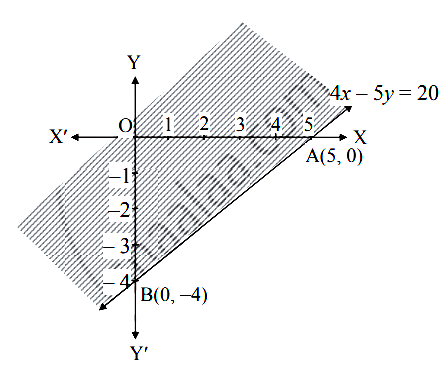
View full question & answer→Question 1142 Marks
Find a unit vector perpendicular to the vectors $\hat{ j }+2 \widehat{ k }$ and $\hat{ i }+\hat{ j }$.
Answer$\text { Let } \overline{ a }=\hat{ j }+2 \widehat{ k }$ and $ \overline{ b }=\hat{ i }+\hat{ j }$
Then $\overline{ a } \times \overline{ b }=\left|\begin{array}{ccc}\hat{ i } & \hat{ j } & \widehat{ k } \\ 0 & 1 & 2 \\ 1 & 1 & 0\end{array}\right|$
$=(0-2) \hat{ i }-(0-2) \hat{ j }+(0-1) \widehat{ k }$
$=-2 \hat{ i }+2 \hat{ j }-\widehat{ k }$
$\therefore|\overline{ a } \times \overline{ b }|=\sqrt{(-2)^2+2^2+(-1)^2}$
$=\sqrt{4+4+1}$
$=\sqrt{9}$
$=3$
$\therefore$ Unit vector perpendicular to both $\overline{ a }$ and $\overline{ b }$
$= \pm \frac{\overline{ a } \times \overline{ b }}{|\overline{ a } \times \overline{ b }|}= \pm\left(\frac{-2 \hat{ i }+2 \hat{ j }-\widehat{ k }}{3}\right)$
$= \pm\left(\frac{2}{3} \hat{ i }-\frac{2}{3} \hat{ j }+\frac{1}{3} \widehat{ k }\right)$
View full question & answer→Question 1152 Marks
Find the adjoint of matrix $A=\left[\begin{array}{ll}6 & 5 \\ 3 & 4\end{array}\right]$
Answer$A=\left[\begin{array}{ll}6 & 5 \\ 3 & 4\end{array}\right]$
$A_{11}=(-1)^{1+1} M_{11}=M_{11}=4$
$A_{12}=(-1)^{1+2} M_{12}=-M_{12}=-3$
$A_{21}=(-1)^{2+1} M_{21}=-M_{21}=-5$
$A_{22}=(-1)^{2+2} M_{22}=M_{22}=6$
$\begin{aligned} & \operatorname{adj} A=\left[\begin{array}{ll}A_{11} & A_{12} \\ A_{21} & A_{22}\end{array}\right]^T \\ & =\left[\begin{array}{cc}4 & -3 \\ -5 & 6\end{array}\right]^T \\ & =\left[\begin{array}{cc}4 & -5 \\ -3 & 6\end{array}\right]\end{aligned}$
View full question & answer→Question 1162 Marks
Find the differential equation of family of all ellipse whose major axis is twice the minor axis
AnswerLet the equation of ellipse be
$\frac{x^2}{ a ^2}+\frac{y^2}{ b ^2}=1\ldots(i)$
Since the major axis is twice the minor axis,
$ 2 a=2(2 b)$
$\therefore a=2 b\ldots(ii) $
Substituting (ii) in (i), we get
$\frac{x^2}{(2 b )^2}+\frac{y^2}{ b ^2}=1$
$\therefore \frac{x^2}{4 b ^2}+\frac{y^2}{ b ^2}=1$
$\therefore x ^2+4 y ^2=4 b ^2$
Differentiating w.r.t. $x$, we get
$2 x+8 y \frac{ d y}{ d x}=0$
$\therefore x+4 y \frac{ d y}{ d x}=0$, where is the required differential equation.
View full question & answer→Question 1172 Marks
Solve the differential equation $\frac{ d y}{ d x}= e ^{( x + y )}+ x ^2 e ^{ y }$
Answer$ \frac{ d y}{ d x}= e ^{( x + y )}+ x ^2 e ^{ y }$
$\therefore \frac{ d y}{ d x}= e ^{ x } \cdot e ^{ y }+ x ^2 e ^{ y }$
$\therefore \frac{ d y}{ d x}= e ^{ y }\left( e ^{ x }+ x ^2\right)$
$\therefore \frac{ d y}{ e ^y}=\left( e ^{ x }+ x ^2\right) dx $
Integrating on both sides, we get
$ \int_{ e }^{-y} d y=\int\left( e ^x+x^2\right) d x$
$\therefore \frac{ e ^{-y}}{-1}= e ^x+\frac{x^3}{3}+ c _1$
$\therefore e ^{- y }=- e ^x-\frac{x^3}{3}- c _1$
$\therefore e ^{-y}+ e ^x+\frac{x^3}{3}= c , \text { where } c = c _1 $
View full question & answer→Question 1182 Marks
Solve the differential equation $\sec ^2 y \tan x d y+\sec ^2 x \tan y d x=0$
Answer$\sec ^2 y \tan x d y+\sec ^2 x \tan y d x=0$
Dividing both sides by $\tan x \tan y$, we get
$ \frac{\sec ^2 y \tan x}{\tan x \tan y} d y+\frac{\sec ^2 x \tan y}{\tan x \tan y} d x=0$
$\therefore \frac{\sec ^2 x}{\tan x} d x+\frac{\sec ^2 y}{\tan y} d y=0 $
Integrating on both sides, we get
$ \int \frac{\sec ^2 x}{\tan x} d x+\int \frac{\sec ^2 y}{\tan y} d y=0$
$\therefore \log |\tan x |+\log |\tan y |=\log | c |$
$\therefore \log |\tan x \cdot \tan y |=\log | c |$
$\therefore \tan x \tan y = c $
View full question & answer→Question 1192 Marks
Form the differential equation of $y = (c_1 + c_2)e^x$
Answer$ y=\left(c_1+c_2\right) e^x$
$=A e^x, \quad \ldots(i) $
Where $A=\left(c_1+c_2\right)$
Here, A is an arbitrary constant.
Differentiating (i) w.r.t. x, we get
$ \frac{ d y}{ d x}= Ae ^{ x }$
$\therefore \frac{ d y}{d x}= y \quad \ldots . .[\text { From (i)] } $
View full question & answer→