Question 15 Marks
Find the shortest distance between the following pairs of lines whose cartesian equation are:
$\frac{\text{x}-1}{2}=\frac{\text{y}-2}{3}=\frac{\text{z}-3}{4}$ and $\frac{\text{x}-2}{3}=\frac{\text{y}-3}{4}=\frac{\text{z}-5}{5}$
AnswerThe equation of the given are
$\frac{\text{x}-1}{2}=\frac{\text{y}-2}{3}=\frac{\text{z}-3}{4}\dots(1)$
$\frac{\text{x}-2}{3}=\frac{\text{y}-3}{4}=\frac{\text{z}-5}{5}\dots(2)$
Since line (1) passes through the point (1, 2, 3) and has direction ratios proportional to 2, 3, 4, its vector equation is
$\vec{\text{r}}=\vec{\text{a}}_1+\lambda\vec{\text{b}}_1$
Here,
$\vec{\text{a}}_1=\hat{\text{i}}+2\hat{\text{j}}+3\hat{\text{k}}$
$\vec{\text{b}}_1=2\hat{\text{i}}+3\hat{\text{j}}+4\hat{\text{k}}$
Also, line (2) passes through the point (2, 3, 5) and has direction ratios proportional to 3, 4, 5.
Its vector equation is
$\vec{\text{a}}_2-\vec{\text{a}}_1=\hat{\text{i}}+\hat{\text{j}}+2\hat{\text{k}}$
and $\vec{\text{b}}_1\times\vec{\text{b}}_2=\begin{vmatrix}\hat{\text{i}}&\hat{\text{j}}&\hat{\text{k}}\\2&3&4\\3&4&5\end{vmatrix}$
$=-\hat{\text{i}}+2\hat{\text{j}}+\hat{\text{k}}$
$\Rightarrow\big|\vec{\text{b}}_1\times\vec{\text{b}}_2\Big|=\sqrt{(-1)^2+2^2+(-1)^2}$
$=\sqrt{1+4+1}$
$=\sqrt{6}$
and $\big(\vec{\text{a}}_2-\vec{\text{a}}_1\big).\big(\vec{\text{b}}_1\times\vec{\text{b}}_2\big)=\big(\hat{\text{i}}+\hat{\text{j}}+2\hat{\text{k}}\big).\big(-\hat{\text{i}}+2\hat{\text{j}}-\hat{\text{k}}\big)$
$=-1+2-2$
$=-1$
Now,
The shortest distance between the lines $\vec{\text{r}}=\vec{\text{a}}_1+\lambda\vec{\text{b}}_1$ and $\vec{\text{r}}=\vec{\text{a}}_2+\mu\vec{\text{b}}_2$ is given by
$\text{d}=\Bigg|\frac{\big(\vec{\text{a}}_2-\vec{\text{a}}_1\big).\big(\vec{\text{b}}_1\times\vec{\text{b}}_2\big)}{\big|\vec{\text{b}}_1\times\vec{\text{b}}_2\big|}\Bigg|$
$=\Big|\frac{-1}{\sqrt{6}}\Big|$
$=\frac{1}{\sqrt{6}}$
View full question & answer→Question 25 Marks
By computing the shortest distance determine whether the following pairs of lines intersect or not:
$\vec{\text{r}}=\big(\hat{\text{i}}+\hat{\text{j}}-\hat{\text{k}}\big)+\lambda\big(3\hat{\text{i}}-\hat{\text{j}}\big)$ and $\vec{\text{r}}=\big(4\hat{\text{i}}-\hat{\text{k}}\big)+\mu\big(2\hat{\text{i}}+3\hat{\text{k}}\big)$
AnswerGiven equations of lines are,
$\vec{\text{r}}=\big(\hat{\text{i}}+\hat{\text{j}}-\hat{\text{k}}\big)+\lambda\big(3\hat{\text{i}}-\hat{\text{j}}\big)$
$\Rightarrow\vec{\text{a}}_1=\big(\hat{\text{i}}+\hat{\text{j}}-\hat{\text{k}}\big),\vec{\text{b}}_1=\big(3\hat{\text{i}}-\hat{\text{j}}\big)$
and, $\vec{\text{r}}=\big(4\hat{\text{i}}-\hat{\text{k}}\big)+\mu\big(2\hat{\text{i}}+3\hat{\text{k}}\big)$
$\Rightarrow\vec{\text{a}}_2=\big(4\hat{\text{i}}-\hat{\text{k}}\big),\vec{\text{b}}_2=\big(2\hat{\text{i}}+3\hat{\text{k}}\big)$
We know that, shortest distance between lines $\vec{\text{r}}=\vec{\text{a}}_1+\lambda\vec{\text{b}}_1$ and $\vec{\text{r}}=\vec{\text{a}}_2+\lambda\vec{\text{b}}_2$ is given by
$\text{S.D.}=\Bigg|\frac{\big(\vec{\text{a}}_2-\vec{\text{a}}_1\big).\big(\vec{\text{b}}_1\times\vec{\text{b}}_2\big)}{\big|\vec{\text{b}}_1\times\vec{\text{b}}_2\big|}\Bigg|\dots(1)$
$\big(\vec{\text{a}}_2-\vec{\text{a}}_1\big)=\big(4\hat{\text{i}}-\hat{\text{k}}\big)-\big(\hat{\text{i}}+\hat{\text{j}}-\hat{\text{k}}\big)$
$=4\hat{\text{i}}-\hat{\text{k}}-\hat{\text{i}}-\hat{\text{j}}+\hat{\text{k}}$
$=3\hat{\text{i}}-\hat{\text{j}}$
$\vec{\text{b}}_1\times\vec{\text{b}}_2=\begin{vmatrix}\hat{\text{i}}&\hat{\text{j}}&\hat{\text{k}}\\3&-1&0\\2&0&3 \end{vmatrix}$
$=\hat{\text{i}}(-3-0)-\hat{\text{j}}(9-0)+\hat{\text{k}}(0+2)$
$=-3\hat{\text{i}}-9\hat{\text{j}}+2\hat{\text{k}}$
$\big|\vec{\text{b}}_1\times\vec{\text{b}}_2\big|=\sqrt{(-3)^2+(-9)^2+(2)^2}$
$\big|\vec{\text{b}}_1\times\vec{\text{b}}_2\big|=\sqrt{9+81+4}$
$=\sqrt{94}$
$\big(\vec{\text{a}}_2-\vec{\text{a}}_1\big).\big(\vec{\text{b}}_1\times\vec{\text{b}}_2\big)=\big(3\hat{\text{i}}-\hat{\text{j}}\big)\big(-3\hat{\text{i}}-9\hat{\text{j}}+2\hat{\text{k}}\big)$
$=(3)(-3)+(-1)(-9)+(0)(2)$
$=-9+9+0$
$=0$
Using $\big(\vec{\text{a}}_2-\vec{\text{a}}_1\big).\big(\vec{\text{b}}_1\times\vec{\text{b}}_2\big)$ and $\big|\vec{\text{b}}_1\times\vec{\text{b}}_2\big|$ in equation (1) to get shortest distance between given lines, so
$\text{S.D.}=\Big|\frac{0}{\sqrt{94}}\Big|$
$\text{S.D.}=0$
Since, shortest distance between the given lines is not zero, so lines are intersecting.
View full question & answer→Question 35 Marks
Find the shortest distance between the following pairs of lines whose vector equation are:
$\vec{\text{r}}=\big(\hat{\text{i}}+\hat{\text{j}}\big)+\lambda\big(2\hat{\text{i}}-\hat{\text{j}}+\hat{\text{k}}\big)$ and $\vec{\text{r}}=2\hat{\text{i}}+\hat{\text{j}}-\hat{\text{k}}+\mu\big(3\hat{\text{i}}-5\hat{\text{j}}+2\hat{\text{k}}\big)$
Answer$\vec{\text{r}}=\big(\hat{\text{i}}+\hat{\text{j}}\big)+\lambda\big(2\hat{\text{i}}-\hat{\text{j}}+\hat{\text{k}}\big)$ and $\vec{\text{r}}=2\hat{\text{i}}+\hat{\text{j}}-\hat{\text{k}}+\mu\big(3\hat{\text{i}}-5\hat{\text{j}}+2\hat{\text{k}}\big)$
Comparing the given equations with the equations $\vec{\text{r}}=\vec{\text{a}}_1+\lambda\vec{\text{b}}_1$ and $\vec{\text{r}}=\vec{\text{a}}_2+\mu\vec{\text{b}}_2,$ we get
$\vec{\text{a}}_1=\hat{\text{i}}+\hat{\text{j}}$
$\vec{\text{a}}_2=2\hat{\text{i}}+\hat{\text{j}}-\hat{\text{k}}$
$\vec{\text{b}}_1=2\hat{\text{i}}-\hat{\text{j}}+\hat{\text{k}}$
$\vec{\text{b}}_2=3\hat{\text{i}}-5\hat{\text{j}}+2\hat{\text{k}}$
$\therefore\vec{\text{a}}_2-\vec{\text{a}}_1=\hat{\text{i}}-\hat{\text{k}}$
and $\vec{\text{b}}_1\times\vec{\text{b}}_2=\begin{vmatrix}\hat{\text{i}}&\hat{\text{j}}&\hat{\text{k}}\\2&-1&1\\3&-5&2\end{vmatrix}$
$=3\hat{\text{i}}-\hat{\text{j}}-7\hat{\text{k}}$
$\Rightarrow\big|\vec{\text{b}}_1\times\vec{\text{b}}_2\big|=\sqrt{3^2+(-1)^2+(-7)^2}{}$
$=\sqrt{9+1+49}$
$=\sqrt{59}$
$\big(\vec{\text{a}}_2-\vec{\text{a}}_1\big).\big(\vec{\text{b}}_1\times\vec{\text{b}}_2\big)=\big(\hat{\text{i}}-\hat{\text{k}}\big).\big(3\hat{\text{i}}-\hat{\text{j}}-7\hat{\text{k}}\big)$
$=3+7$
$=10$
The shaortest distance between the lines $\vec{\text{r}}=\vec{\text{a}}_1+\lambda\vec{\text{b}}_1$ and $\vec{\text{r}}=\vec{\text{a}}_2+\mu\vec{\text{b}}_2$ is given by
$\text{d}=\Bigg|\frac{\big(\vec{\text{a}}_2-\vec{\text{a}}_1\big).\big(\vec{\text{b}}_1\times\vec{\text{b}}_2\big)}{\big|\vec{\text{b}}_1\times\vec{\text{b}}_2\big|}\Bigg|$
$=\Big|\frac{10}{\sqrt{59}}\Big|$
$=\frac{10}{\sqrt{59}}$
View full question & answer→Question 45 Marks
Find the shortest distance between the following pairs of lines whose vector equation are:
$\vec{\text{r}}=(\lambda-1)\hat{\text{i}}+(\lambda+1)\hat{\text{j}}-(1+\lambda)\hat{\text{k}}$ and $\vec{\text{r}}=(1-\mu)\hat{\text{i}}+(2\mu-1)\hat{\text{j}}+(\mu+2)\hat{\text{k}}$
Answer$\vec{\text{r}}=(\lambda-1)\hat{\text{i}}+(\lambda+1)\hat{\text{j}}-(1+\lambda)\hat{\text{k}}$ and $\vec{\text{r}}=(1-\mu)\hat{\text{i}}+(2\mu-1)\hat{\text{j}}+(\mu+2)\hat{\text{k}}$
The vector equation of the given lines can be re-written as
$\vec{\text{r}}=-\hat{\text{i}}+\hat{\text{j}}-\hat{\text{k}}+\lambda\big(\hat{\text{i}}+\hat{\text{j}}-\hat{\text{k}}\big)$ and $\vec{\text{r}}=\hat{\text{i}}-\hat{\text{j}}+2\hat{\text{k}}+\mu\big(-\hat{\text{i}}+2\hat{\text{j}}+\hat{\text{k}}\big)$
Comparing the given equation with the equations $\vec{\text{r}}=\vec{\text{a}}_1+\lambda\vec{\text{b}}_1$ and $\vec{\text{r}}=\vec{\text{a}}_2+\mu\vec{\text{b}}_2$ we get
$\vec{\text{a}}_1=-\hat{\text{i}}+\hat{\text{j}}-\hat{\text{k}}$
$\vec{\text{a}}_2=\hat{\text{i}}-\hat{\text{j}}+2\hat{\text{k}}$
$\vec{\text{b}}_1=\hat{\text{i}}+\hat{\text{j}}-\hat{\text{k}}$
$\vec{\text{b}}_2=-\hat{\text{i}}+2\hat{\text{j}}+\hat{\text{k}}$
$\therefore\vec{\text{a}}_2-\vec{\text{a}}_1=2\hat{\text{i}}-2\hat{\text{j}}+3\hat{\text{k}}$
and $\vec{\text{b}}_1\times\vec{\text{b}}_2=\begin{vmatrix}\hat{\text{i}}&\hat{\text{J}}&\hat{\text{k}}\\1&1&-1\\-1&2&1 \end{vmatrix}$
$=3\hat{\text{i}}+3\hat{\text{k}}$
$\Rightarrow\big|\vec{\text{b}}_1\times\vec{\text{b}}_2\big|=\sqrt{3^2+3^2}$
$=\sqrt{9+9}$
$=3\sqrt{2}$
$\big(\vec{\text{a}}_2-\vec{\text{a}}_1\big).\big(\vec{\text{b}}_1\times\vec{\text{b}}_2\big)=\big(2\hat{\text{i}}-2\hat{\text{j}}+3\hat{\text{k}}\big).\big(3\hat{\text{i}}+3\hat{\text{k}}\big)$
$=6+9$
$=15$
The shoetest distance between the line $\vec{\text{r}}=\vec{\text{a}}_1+\lambda\vec{\text{b}}_1$ and $\vec{\text{r}}=\vec{\text{a}}_2+\mu\vec{\text{b}}_2$ is given by
$\text{d}=\Bigg|\frac{\big(\vec{\text{a}}_2-\vec{\text{a}}_1\big).\big(\vec{\text{b}}_1\times\vec{\text{b}}_2\big)}{\big|\vec{\text{b}}_1\times\vec{\text{b}}_2\big|}\Bigg|$
$=\Big|\frac{15}{3\sqrt{2}}\Big|$
$=\frac{5}{\sqrt{2}}$
View full question & answer→Question 55 Marks
By computing the shortest distance determine whether the following pairs of lines intersect or not:3
$\frac{\text{x}-5}{4}=\frac{\text{y}-7}{-5}=\frac{\text{z}+3}{-5}$ and $\frac{\text{x}-8}{7}=\frac{\text{y}-7}{1}=\frac{\text{z}-5}{3}$
AnswerGiven lines are ,
$\frac{\text{x}-5}{4}=\frac{\text{y}-7}{-5}=\frac{\text{z}+3}{-5}=\lambda$ (say)
$\Rightarrow\text{x}=4\lambda+5,\text{y}=-5\lambda+7,\text{z}=-5\lambda-3$
$\Rightarrow\vec{\text{r}}=\text{x}\hat{\text{i}}+\text{y}\hat{\text{j}}+\text{z}\hat{\text{k}}$
$=(4\lambda+5)\hat{\text{i}}+(-5\lambda+7)\hat{\text{j}}+(-5\lambda-3)\hat{\text{k}}$
$\vec{\text{r}}=\big(5\hat{\text{i}}+7\hat{\text{j}}-3\hat{\text{k}}\big)+\lambda\big(4\hat{\text{i}}-5\hat{\text{j}}-5\hat{\text{k}}\big)$
$\Rightarrow\vec{\text{a}}_1=\big(5\hat{\text{i}}+7\hat{\text{j}}-3\hat{\text{k}}\big),\vec{\text{b}}_1=\big(4\hat{\text{i}}-5\hat{\text{j}}-5\hat{\text{k}}\big)$
and, $\frac{\text{x}-8}{7}=\frac{\text{y}-7}{1}=\frac{\text{z}-5}{3}=\mu$ (say)
$\Rightarrow\text{x}=7\mu+8,\text{y}=\mu+7,3\mu+5$
$\Rightarrow\vec{\text{r}}=\text{x}\hat{\text{i}}+\text{y}\hat{\text{j}}+\text{z}\hat{\text{k}}$
$=(7\mu+8)\hat{\text{i}}+(\mu+7)\hat{\text{j}}+(3\mu+5)\hat{\text{k}}$
$\vec{\text{r}}=\big(8\hat{\text{i}}+7\hat{\text{j}}+5\hat{\text{k}}\big)+\mu\big(7\hat{\text{i}}+\hat{\text{j}}+3\hat{\text{k}}\big)$
$\Rightarrow\vec{\text{a}}=\big(8\hat{\text{i}}+7\hat{\text{j}}+5\hat{\text{k}}\big),\vec{\text{b}}_2=\big(7\hat{\text{i}}+\hat{\text{j}}+3\hat{\text{k}}\big)$
we know that, shortest distance between lines $\vec{\text{r}}=\vec{\text{a}}_1+\lambda\vec{\text{b}}_1$ and $\vec{\text{r}}=\vec{\text{a}}_2+\lambda\vec{\text{b}}_2$ is given by
$\text{S.D.}=\Bigg|\frac{\big(\vec{\text{a}}_2-\vec{\text{a}}_1\big).\big(\vec{\text{b}}_1\times\vec{\text{b}}_2\big)}{\big|\vec{\text{b}}_1\times\vec{\text{b}}_2\big|}\Bigg|\dots(1)$
$\big(\vec{\text{a}}_2-\vec{\text{a}}_1\big)=\big(8\hat{\text{i}}+7\hat{\text{j}}+5\hat{\text{k}}\big)-\big(5\hat{\text{i}}+7\hat{\text{j}}-3\hat{\text{k}}\big)$
$=8\hat{\text{i}}+7\hat{\text{j}}+5\hat{\text{k}}-5\hat{\text{i}}-7\hat{\text{j}}+3\hat{\text{k}}$
$=3\hat{\text{i}}+8\hat{\text{k}}$
$\vec{\text{b}}_1\times\vec{\text{b}}_2=\begin{vmatrix}\hat{\text{i}}&\hat{\text{j}}&\hat{\text{k}}\\4&-5&-5\\7&1&3 \end{vmatrix}$
$=\hat{\text{i}}(-15+5)-\hat{\text{j}}(12+35)+\hat{\text{k}}(4+35)$
$=-10\hat{\text{i}}-47\hat{\text{j}}+39\hat{\text{k}}$
$\big(\vec{\text{a}}_2-\vec{\text{a}}_1\big)\big(\vec{\text{b}}_1\times\vec{\text{b}}_2\big)=\big(3\hat{\text{i}}+8\hat{\text{k}}\big)\big(-10\hat{\text{i}}-47\hat{\text{j}}+39\hat{\text{k}}\big)$
$=(3)(-10)+(0)(-4)+(8)(39)$
$=-30+312$
$=282$
Using equation (1) to get the shortest distance between the given lines, so
$\text{S.D.}=\Bigg|\frac{282}{\big|\vec{\text{b}}_1\times\vec{\text{b}}_2\big|}\Bigg|$
$\text{S.D.}\neq0$
Since, the shortest distance between given lines is not equal to zero, so Given lines are not intersecting.
View full question & answer→Question 65 Marks
Write the vector equation of the following lines and hence determine the distance between them $\frac{\text{x}-1}{2}=\frac{\text{y}-2}{3}=\frac{\text{z}+4}{6}$ and $\frac{\text{x}-3}{4}=\frac{\text{y}-3}{6}=\frac{\text{z}+5}{12}$
AnswerWe have
$\frac{\text{x}-1}{2}=\frac{\text{y}-2}{3}=\frac{\text{z}+4}{6}$
$\frac{\text{x}-3}{4}=\frac{\text{y}-3}{6}=\frac{\text{z}+5}{12}$
Since the first line passes line passes through the point (1, 2, -4) and has direction ratios proportional to 2, 3, 6, its vector equation is
$\vec{\text{r}}=\vec{\text{a}}_1+\lambda\vec{\text{b}}_1\dots(1)$
$\Rightarrow\vec{\text{r}}=\hat{\text{i}}+2\hat{\text{j}}+\lambda\big(2\hat{\text{i}}+3\hat{\text{j}}+6\hat{\text{k}}\big)$
Also, the second line passes through the point (3, 3, -5) and has directional to 4, 6, 12.
Its vector equation is
$\vec{\text{r}}=\vec{\text{a}}_2+\mu\vec{\text{b}}_2\dots(2)$
$\Rightarrow\vec{\text{r}}=3\hat{\text{i}}+3\hat{\text{j}}-5\hat{\text{k}}+\mu\big(4\hat{\text{i}}+6\hat{\text{j}}+12\hat{\text{k}}\big)$
$\Rightarrow\vec{\text{r}}=3\hat{\text{i}}+3\hat{\text{j}}-5\hat{\text{k}}+2\mu\big(2\hat{\text{i}}+3\hat{\text{j}}+6\hat{\text{k}}\big)$
These two lines pass through the points having position vectors
$\vec{\text{a}}_1=\hat{\text{i}}+2\hat{\text{j}}-4\hat{\text{k}}$ and $\vec{\text{a}}_2=3\hat{\text{i}}+3\hat{\text{j}}-5\hat{\text{k}}$ and are parallel to the vector $\vec{\text{b}}=2\hat{\text{i}}+3\hat{\text{j}}+6\hat{\text{k}}.$
Now,
$\vec{\text{a}}_2-\vec{\text{a}}_1=2\hat{\text{i}}+\hat{\text{j}}-\hat{\text{k}}$
and
$\big(\vec{\text{a}}_2-\vec{\text{a}}_1\big)\times\vec{\text{b}}=\big(2\hat{\text{i}}+\hat{\text{j}}-\hat{\text{k}}\big)\times\big(2\hat{\text{i}}+3\hat{\text{j}}+6\hat{\text{k}}\big)$
$=\begin{vmatrix}\hat{\text{i}}&\hat{\text{j}}&\hat{\text{k}}\\2&1&-1\\2&3&6 \end{vmatrix}$
$=9\hat{\text{i}}-14\hat{\text{j}}+4\hat{\text{k}}$
$\Rightarrow\big|\big(\vec{\text{a}}_2-\vec{\text{a}}_1\big)\times\vec{\text{b}}\big|=\sqrt{9^2+(-14)^2+4^2}$
$=\sqrt{81+196+16}$
$=\sqrt{293}$
and $\big|\vec{\text{b}}\big|=\sqrt{2^2+3^2+6^2}$
$=\sqrt{4+9+36}$
$=7$
The shortest distance between the two lines is given by
$\frac{\big|\big(\vec{\text{a}}_2-\vec{\text{a}}_1\big)\times\vec{\text{b}}\big|}{\big|\vec{\text{b}}\big|}=\frac{\sqrt{293}}{7}\text{ units}$
View full question & answer→Question 75 Marks
By computing the shortest distance determine whether the following pairs of lines intersect or not:
$\frac{\text{x}-1}{2}=\frac{\text{y}+1}{3}=\text{z}$ and $\frac{\text{x}+1}{5}=\frac{\text{y}-2}{1};\text{z}=2$
AnswerGiven equations of lines are,
$\frac{\text{x}-1}{2}=\frac{\text{y}+1}{3}=\frac{\text{z}}{1}=\lambda$ (say)
$\Rightarrow\text{x}=2\lambda+1,\text{y}=3\lambda-1,\text{z}=\lambda$
$\Rightarrow\vec{\text{r}}=\text{x}\hat{\text{i}}+\text{y}\hat{\text{j}}+\text{z}\hat{\text{k}}$
$=\big(2\lambda+1\big)\hat{\text{i}}+(3\lambda-1)\hat{\text{j}}+(\lambda)\hat{\text{k}}$
$\vec{\text{r}}=\big(\hat{\text{i}}-\hat{\text{j}}\big)+\lambda\big(2\hat{\text{i}}+3\hat{\text{j}}+\hat{\text{k}}\big)$
$\Rightarrow\vec{\text{a}}_1=\big(\hat{\text{i}}-\hat{\text{j}}\big),\vec{\text{b}}_1=\big(2\hat{\text{i}}+3\hat{\text{j}}+\hat{\text{k}}\big)$
and, $\frac{\text{x}+1}{5}=\frac{\text{y}-2}{1}=\mu\text{ (say) },\text{z}=2$
$\Rightarrow\text{x}=5\mu-1,\text{y}=\mu+2,\text{z}=2$
$\Rightarrow\vec{\text{r}}=\text{x}\hat{\text{i}}+\text{y}\hat{\text{j}}+\text{z}\hat{\text{k}}$
$=(5\mu-1)\hat{\text{i}}+(\mu+2)\hat{\text{j}}+2\hat{\text{k}}$
$\vec{\text{r}}=\big(-\hat{\text{i}}+2\hat{\text{j}}+2\hat{\text{k}}\big)+\mu\big(5\hat{\text{i}}+\hat{\text{j}}\big)$
$\Rightarrow\vec{\text{a}}_2=\big(-\hat{\text{i}}+2\hat{\text{j}}+2\hat{\text{k}}\big),\vec{\text{}b}_2=\big(5\hat{\text{i}}+\hat{\text{j}}\big)$
we know that, the shortest distance between $\vec{\text{r}}=\vec{\text{a}}_1+\lambda\vec{\text{b}}_1$ and $\vec{\text{r}}=\vec{\text{a}}_2+\lambda\vec{\text{b}}_2$ is given by
$\text{S.D.}=\Bigg|\frac{\big(\vec{\text{a}}_2-\vec{\text{a}}_1\big).\big(\vec{\text{b}}_1\times\vec{\text{b}}_2\big)}{\big|\vec{\text{b}}_1\times\vec{\text{b}}_2\big|}\Bigg|\dots(1)$
$\big(\vec{\text{a}}_2-\vec{\text{a}}_1\big)=\big(-\hat{\text{i}}+2\hat{\text{j}}+2\hat{\text{k}}\big)-\big(\hat{\text{i}}-\hat{\text{j}}\big)$
$=-\hat{\text{i}}+2\hat{\text{j}}+2\hat{\text{k}}-\hat{\text{i}}+\hat{\text{j}}$
$=-2\hat{\text{i}}+3\hat{\text{j}}+2\hat{\text{k}}$
$\vec{\text{b}}_1\times\vec{\text{b}}_2=\begin{vmatrix}\hat{\text{i}}&\hat{\text{j}}&\hat{\text{k}}\\2&3&1\\5&1&0 \end{vmatrix}$
$=\hat{\text{i}}(0-1)-\hat{\text{j}}(0-5)+\hat{\text{k}}(2+15)$
$\vec{\text{b}}_1\times\vec{\text{b}}_2=-\hat{\text{i}}+5\hat{\text{j}}-13\hat{\text{k}}$
$\big(\vec{\text{a}}_2-\vec{\text{a}}_1\big)\big(\vec{\text{b}}_1\times\vec{\text{b}}_2\big)=\big(-2\hat{\text{i}}+3\hat{\text{j}}+2\hat{\text{k}}\big)\big(-\hat{\text{i}}+5\hat{\text{j}}-13\hat{\text{k}}\big)$
$=(-2)(-1)+(3)(5)+(2)(-13)$
$=-9$
$\big|\vec{\text{b}}_1\times\vec{\text{b}}_2\big|=\sqrt{(-1)^2+(5)^2+(-13)^2}$
$=\sqrt{1+25+169}$
$=\sqrt{195}$
Substituting the value of $\big(\vec{\text{a}}_2-\vec{\text{a}}_1\big).\big(\vec{\text{b}}_1\times\vec{\text{b}}_2\big)$ and $\big|\vec{\text{b}}_1\times\vec{\text{b}}_2\big|$ in equation (1) to get shortest distance between given lines, so
$\text{S.D.}=\Big|\frac{-9}{\sqrt{195}}\Big|$
$=\frac{9}{\sqrt{195}}\text{ units}$
View full question & answer→Question 85 Marks
Show that the lines $\frac{\text{x}+1}{3}=\frac{\text{y}+3}{5}=\frac{\text{z}+5}{7}$ and $\frac{\text{x}-2}{1}=\frac{\text{y}-4}{3}=\frac{\text{z}-6}{5}$ intersect. Find their point of intersection.
AnswerGiven equation of first line is $\frac{\text{x}+1}{3}=\frac{\text{y}+3}{5}=\frac{\text{z}+5}{7}=\lambda\text{ (say) }\dots(1)$ General point on line (1) is $\big(3\lambda-1,5\lambda-3,7\lambda-5\big)$ Another equation of line is $\frac{\text{x}-2}{1}=\frac{\text{y}-4}{3}=\frac{\text{z}-6}{5}=\mu\text{ (say) }\dots(2)$ General point on line (2) is, $\big(\mu+2,3\mu+4,5\mu+6\big)$ If lines (1) and (2) are intersecting then, they have a common point. So for same value of $\lambda$ and $\mu,$ we must have, $3\lambda-1=\mu+2\Rightarrow3\lambda-\mu=3\dots(3)$ $5\lambda-3=3\mu+4\Rightarrow5\lambda-3\mu=7\dots(4)$ $7\lambda-5=5\mu+6\Rightarrow7\lambda-5\mu=11\dots(5)$ Solving equation (3) and (4) to get $\lambda$ and $\mu,$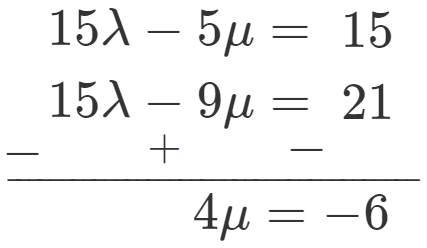
$\mu=\frac{3}{2}$ Put the value of $\mu$ in equation (3), $3\lambda-\mu=3$ $3\lambda-\Big(-\frac{3}{2}\Big)=3$ $3\lambda=3-\frac{3}{2}$ $\lambda=\frac{1}{2}$ put the value of $\lambda$ and $\mu$ in equation (5), $7\lambda-5\mu=11$ $7\Big(\frac{1}{2}\Big)-5\Big(-\frac{3}{2}\Big)=11$ $\frac{7}{2}+\frac{15}{2}=11$ $\frac{22}{2}=11$ $11=11$ $\text{LHS}\neq\text{RHS}$ Since, the values of $\lambda$ and $\mu$ obtained by solving (3) and (4) satisfy equation (5), Hence Given lines intersect each other. Point of intersection $=\big(3\lambda-1,5\lambda-3,7\lambda-5\big)$ $\Big\{\frac{3}{2}-1,\Big(\frac{5}{2}-3\Big),\Big(\frac{7}{2}-5\Big)\Big\}$ $=\Big(\frac{1}{2},\frac{-1}{2},\frac{-3}{2}\Big)$ Point of intersection is $\Big(\frac{1}{2},\frac{-1}{2},\frac{-3}{2}\Big).$ View full question & answer→Question 95 Marks
Find the shortest distance between the following pairs of lines whose vector equations are:
$\vec{\text{r}}=(1-\text{t})\hat{\text{i}}+(\text{t}-2)\hat{\text{j}}+(3-\text{t})\hat{\text{k}}$ and $\vec{\text{r}}=(\text{s}+1)\hat{\text{i}}+(2\text{s}-1)\hat{\text{j}}-(2\text{s}+1)\hat{\text{k}}$
Answer$\vec{\text{r}}=(1-\text{t})\hat{\text{i}}+(\text{t}-2)\hat{\text{j}}+(3-\text{t})\hat{\text{k}}$ and $\vec{\text{r}}=(\text{s}+1)\hat{\text{i}}+(2\text{s}-1)\hat{\text{j}}-(2\text{s}+1)\hat{\text{k}}$3
The vector equation of the given lines can be re-written as
$\vec{\text{r}}=\hat{\text{i}}-2\hat{\text{j}}+3\hat{\text{k}}+\text{t}\big(-\hat{\text{i}}+\hat{\text{j}}-\hat{\text{k}}\big)$ and $\vec{\text{r}}=\hat{\text{i}}-\hat{\text{j}}-\hat{\text{k}}+\text{s}\big(\hat{\text{i}}+2\hat{\text{j}}-2\hat{\text{k}}\big)$
Comparing the given equation with the equations $\vec{\text{r}}=\vec{\text{a}}_1+\lambda\vec{\text{b}}_1$ and $\vec{\text{r}}=\vec{\text{a}}_2+\mu\vec{\text{b}}_2,$ we get
$\vec{\text{a}}_1=\hat{\text{i}}-2\hat{\text{j}}+3\hat{\text{k}}$
$\vec{\text{a}}_2=\hat{\text{i}}-\hat{\text{j}}-\hat{\text{k}}$
$\vec{\text{b}}_1=-\hat{\text{i}}+\hat{\text{j}}-\hat{\text{k}}$
$\vec{\text{b}}_2=\hat{\text{i}}+2\hat{\text{j}}-2\hat{\text{k}}$
$\therefore\vec{\text{a}}_2-\vec{\text{a}}_1=\hat{\text{j}}-4\hat{\text{k}}$
and $\vec{\text{b}}_1\times\vec{\text{b}}_2=\begin{vmatrix}\hat{\text{i}}&\hat{\text{j}}&\hat{\text{k}}\\-1&1&-1\\1&2&-2\end{vmatrix}$
$=-3\hat{\text{j}}-3\hat{\text{k}}$
$\Rightarrow\big|\vec{\text{b}}_1\times\vec{\text{b}}_2\big|=\sqrt{(-3)^2+(-3)^2}$
$=\sqrt{9+9}$
$=3\sqrt{2}$
$\big(\vec{\text{a}}_2-\vec{\text{a}}_1\big).\big(\vec{\text{b}}_1\times\vec{\text{b}}_2\big)$
$=\big(\hat{\text{j}}-4\hat{\text{k}}\big).\big(-3\hat{\text{j}}-3\hat{\text{k}}\big)$
$=-3+12$
$=9$
The shortest distance between the line $\vec{\text{r}}=\vec{\text{a}}_1+\lambda\vec{\text{b}}_1$ and $\vec{\text{r}}=\vec{\text{a}}_2+\mu\vec{\text{b}}_2,$ is given by
$\text{d}=\Bigg|\frac{\big(\vec{\text{a}}_2-\vec{\text{a}}_1\big).\big(\vec{\text{b}}_1\times\vec{\text{b}}_2\big)}{\big|\vec{\text{b}}_1\times\vec{\text{b}}_2\big|}\Bigg|$
$=\Big|\frac{9}{3\sqrt{2}}\Big|$
$=\frac{3}{\sqrt{2}}$
View full question & answer→Question 105 Marks
Find the shortest distance between the lines
$\vec{\text{r}}=\hat{\text{i}}+2\hat{\text{j}}+3\hat{\text{k}}+\lambda\big(\hat{\text{i}}-3\hat{\text{j}}+2\hat{\text{k}}\big)$ and $\vec{\text{r}}=4\hat{\text{i}}+5\hat{\text{j}}+6\hat{\text{k}}+\mu\big(2\hat{\text{i}}+3\hat{\text{j}}+\hat{\text{k}}\big)$
Answer$\vec{\text{r}}=\hat{\text{i}}+2\hat{\text{j}}+3\hat{\text{k}}+\lambda\big(\hat{\text{i}}-3\hat{\text{j}}+2\hat{\text{k}}\big)$ and $\vec{\text{r}}=4\hat{\text{i}}+5\hat{\text{j}}+6\hat{\text{k}}+\mu\big(2\hat{\text{i}}+3\hat{\text{j}}+\hat{\text{k}}\big)$
Comparing the given equation with the equations $\vec{\text{r}}=\vec{\text{a}}_1+\lambda\vec{\text{b}}_1$ and $\vec{\text{r}}=\vec{\text{a}}_2+\mu\vec{\text{b}}_2,$ we get
$\vec{\text{a}}_1=\hat{\text{i}}+2\hat{\text{j}}+3\hat{\text{k}}$
$\vec{\text{a}}_2=4\hat{\text{i}}+5\hat{\text{j}}+6\hat{\text{k}}$
$\vec{\text{b}}_1=\hat{\text{i}}-3\hat{\text{j}}+2\hat{\text{k}}$
$\vec{\text{b}}_2=2\hat{\text{i}}+3\hat{\text{j}}+\hat{\text{k}}$
$\therefore\vec{\text{a}}_2-\vec{\text{a}}_1=3\hat{\text{i}}+3\hat{\text{j}}+3\hat{\text{k}}$
and $\vec{\text{b}}_1\times\vec{\text{b}}_2=\begin{vmatrix}\hat{\text{i}}&\hat{\text{j}}&\hat{\text{k}}\\1&-3&2\\2&3&1\end{vmatrix}$
$=-9\hat{\text{i}}+3\hat{\text{j}}+9\hat{\text{k}}$
$\Rightarrow\big|\vec{\text{b}}_1\times\vec{\text{b}}_2\big|=\sqrt{(-9)^2+3^2+9^2}$
$=\sqrt{81+9+81}$
$=\sqrt{171}$
and $\big(\vec{\text{a}}_2-\vec{\text{a}}_1\big).\big(\vec{\text{b}}_1\times\vec{\text{b}}_2\big)$
$=\big(3\hat{\text{i}}+3\hat{\text{j}}+3\hat{\text{k}}\big).\big(-9\hat{\text{i}}+3\hat{\text{j}}+9\hat{\text{k}}\big)$
$=-27+9+27$
$=9$
The shortest distence between the lines $\vec{\text{r}}=\vec{\text{a}}_1+\lambda\vec{\text{b}}_1$ and $\vec{\text{r}}=\vec{\text{a}}_2+\mu\vec{\text{b}}_2$ is given by
$\text{d}=\Bigg|\frac{\big(\vec{\text{a}}_2.\vec{\text{a}}_1\big).\big(\vec{\text{b}}_1\times\vec{\text{b}}_2\big)}{\big|\vec{\text{b}}_1\times\vec{\text{b}}_2\big|}\Bigg|$
$\Rightarrow\text{d}=\Big|\frac{9}{\sqrt{171}}\Big|$
$=\frac{3}{\sqrt{19}}$
View full question & answer→Question 115 Marks
Show that the lines $\frac{\text{x}-1}{3}=\frac{\text{y}+1}{2}=\frac{\text{z}-1}{5}$ and $\frac{\text{x}+2}{4}=\frac{\text{y}-1}{3}=\frac{\text{z}+1}{-2}$ do not intersect.
AnswerThe coordinates of any point on the first line are given by$\frac{\text{x}-1}{3}=\frac{\text{y}+1}{2}=\frac{\text{z}-1}{5}=\lambda$
$\Rightarrow\text{x}=3\lambda+1$
$\text{y}=2\lambda-1$
$\text{z}=5\lambda+1$
The coordinates of a general point on the first line are $\big(3\lambda+1,2\lambda-1,5\lambda+1\big).$
The coordinates of any point on the second line are given by
$\frac{\text{x}+2}{4}=\frac{\text{y}-1}{3}=\frac{\text{z}+1}{-2}=\mu$
$\Rightarrow\text{x}=4\mu-2$
$\text{y}=3\mu+1$
$\text{z}=-2\mu-1$
The coordinates of a general point on the second line are $\big(4\mu-2,3\mu+1,-2\mu-1\big).$
If the lines intersect, then they have a common point. so, for some values of $\lambda$ and $\mu,$ we must have
$3\lambda+1=4\mu-2,2\lambda-1=3\mu+1,5\lambda+1=-2\mu-1$
$\Rightarrow3\lambda-4\mu=-3\dots(1)$
$2\lambda-3\mu=2\dots(2)$
$5\lambda+2\mu=-2\dots(3)$
Solving (1) and (2), we get
$\lambda=-17$
$\mu=-12$
Substituting $\lambda=-17$ and $\mu=-12$ in (3), we get
$\text{LHS}=3\lambda+2\mu$
= 3(-17) + 2( -12)
= -75
≠ -2
$\Rightarrow\text{LHS}\neq\text{RHS}$
Hence, the given lines do not intersect.
View full question & answer→Question 125 Marks
Find the shortest distance between the following pairs of lines whose vector equation are:
$\vec{\text{r}}=\big(3\hat{\text{i}}+5\hat{\text{j}}+7\hat{\text{k}}\big)+\lambda\big(\hat{\text{i}}-2\hat{\text{j}}+7\hat{\text{k}}\big)$ and $\vec{\text{r}}=-\hat{\text{i}}-\hat{\text{j}}-\hat{\text{k}}+\mu\big(7\hat{\text{i}}-6\hat{\text{j}}+\hat{\text{k}}\big)$
Answer$\vec{\text{r}}=\big(3\hat{\text{i}}+5\hat{\text{j}}+7\hat{\text{k}}\big)+\lambda\big(\hat{\text{i}}-2\hat{\text{j}}+7\hat{\text{k}}\big)$and $\vec{\text{r}}=-\hat{\text{i}}-\hat{\text{j}}-\hat{\text{k}}+\mu\big(7\hat{\text{i}}-6\hat{\text{j}}+\hat{\text{k}}\big)$
Comparing the given equation with the quations $\vec{\text{r}}=\vec{\text{a}}_1+\lambda\vec{\text{b}}_1$ and $\vec{\text{r}}=\vec{\text{a}}_2+\mu\vec{\text{b}}_2,$ we get
$\vec{\text{a}}_1=3\hat{\text{i}}+5\hat{\text{j}}+7\hat{\text{k}}$
$\vec{\text{a}}_2=-\hat{\text{i}}-\hat{\text{j}}-\hat{\text{k}}$
$\vec{\text{b}}_1=\hat{\text{i}}-2\hat{\text{j}}+7\hat{\text{k}}$
$\vec{\text{b}}_2=7\hat{\text{i}}-6\hat{\text{j}}+\hat{\text{k}}$
$\therefore\vec{\text{a}}_2-\vec{\text{a}}_1=-4\hat{\text{i}}-6\hat{\text{j}}-8\hat{\text{k}}$
and $\vec{\text{b}}_1\times\vec{\text{b}}_2=\begin{vmatrix}\hat{\text{i}}&\hat{\text{J}}&\hat{\text{k}}\\1&-2&7\\7&-6&1 \end{vmatrix}$
$=40\hat{\text{i}}+48\hat{\text{j}}+8\hat{\text{k}}$
$\Rightarrow\big|\vec{\text{b}}_1\times\vec{\text{b}}_2\big|=\sqrt{40^2+48^2+8^2}$
$=\sqrt{1600+2304+64}$
$=\sqrt{3968}$
$\big(\vec{\text{a}}_2-\vec{\text{a}}_1\big).\big(\vec{\text{b}}_1\times\vec{\text{b}}_2\big)=\big(-4\hat{\text{i}}-6\hat{\text{j}}-8\hat{\text{k}}\big).\big(40\hat{\text{i}}+48\hat{\text{j}}+8\hat{\text{k}}\big)$
$=-160-288-64$
$=-512$
The shortest distance between the lines $\vec{\text{r}}=\vec{\text{a}}_1+\lambda\vec{\text{b}}_1$ and $\vec{\text{r}}=\vec{\text{a}}_2+\mu\vec{\text{b}}_2$ is given by
$\text{d}=\Bigg|\frac{\big(\vec{\text{a}}_2-\vec{\text{a}}_1\big).\big(\vec{\text{b}}_1\times\vec{\text{b}}_2\big)}{\big|\vec{\text{b}}_1\times\vec{\text{b}}_2\big|}\Bigg|$
$=\Big|\frac{-512}{\sqrt{3968}}\Big|$
$=\frac{512}{\sqrt{3968}}$
View full question & answer→Question 135 Marks
Find the shortest distance between the following pairs of lines whose vector equation are:
$\vec{\text{r}}=\big(\hat{\text{i}}+2\hat{\text{j}}+3\hat{\text{k}}\big)+\lambda\big(2\hat{\text{i}}+3\hat{\text{j}}+4\hat{\text{k}}\big)$ and $\vec{\text{r}}=\big(2\hat{\text{i}}+4\hat{\text{j}}+5\hat{\text{k}}\big)+\mu\big(3\hat{\text{i}}+4\hat{\text{j}}+5\hat{\text{k}}\big)$
Answer$\vec{\text{r}}=\big(\hat{\text{i}}+2\hat{\text{j}}+3\hat{\text{k}}\big)+\lambda\big(2\hat{\text{i}}+3\hat{\text{j}}+4\hat{\text{k}}\big)$ and $\vec{\text{r}}=\big(2\hat{\text{i}}+4\hat{\text{j}}+5\hat{\text{k}}\big)+\mu\big(3\hat{\text{i}}+4\hat{\text{j}}+5\hat{\text{k}}\big)$Comparing the given equations with the equations $\vec{\text{r}}=\vec{\text{a}}_1+\lambda\vec{\text{b}}_1$ and $\vec{\text{r}}=\vec{\text{a}}_2+\mu\vec{\text{b}}_2$ we get
$\vec{\text{a}}_1=\hat{\text{i}}+2\hat{\text{j}}+3\hat{\text{k}}$
$\vec{\text{a}}_2=2\hat{\text{i}}+4\hat{\text{j}}+5\hat{\text{k}}$
$\vec{\text{b}}_1=2\hat{\text{i}}+3\hat{\text{j}}+4\hat{\text{k}}$
$\vec{\text{b}}_2=3\hat{\text{i}}+4\hat{\text{j}}+5\hat{\text{k}}$
$\therefore\vec{\text{a}}_2-\vec{\text{a}}_1=\hat{\text{i}}+2\hat{\text{j}}+2\hat{\text{k}}$
and $\vec{\text{b}}_1\times\vec{\text{b}}_2=\begin{vmatrix}\hat{\text{i}}&\hat{\text{J}}&\hat{\text{k}}\\2&3&4\\3&4&5 \end{vmatrix}$
$=-\hat{\text{i}}+2\hat{\text{j}}-\hat{\text{k}}$
$\Rightarrow\big|\vec{\text{b}}_1\times\vec{\text{b}}_2\Big|=\sqrt{(-1)^2+2^2+(-1)^2}$
$=\sqrt{1+4+1}$
$=\sqrt{6}$
$\big(\vec{\text{a}}_2-\vec{\text{a}}_1\big).\big(\vec{\text{b}}_1\times\vec{\text{b}}_2\big)=\big(\hat{\text{i}}+2\hat{\text{j}}+2\hat{\text{k}}\big).\big(-\hat{\text{i}}+2\hat{\text{j}}-\hat{\text{k}}\big)$
$=-1+4-2$
$=1$
The shrtest distance between the lines $\vec{\text{r}}=\vec{\text{a}}_1+\lambda\vec{\text{b}}_1$ and $\vec{\text{r}}=\vec{\text{a}}_2+\mu\vec{\text{b}}_2$ is given by
$\text{d}=\Bigg|\frac{\big(\vec{\text{a}}_2-\vec{\text{a}}_1\big).\big(\vec{\text{b}}_1\times\vec{\text{b}}_2\big)}{\big|\vec{\text{b}}_1\times\vec{\text{b}}_2\big|}\Bigg|$
$=\Big|\frac{1}{\sqrt{6}}\Big|$
$=\frac{1}{\sqrt{6}}$
View full question & answer→Question 145 Marks
Find the shortest distance between the lines
$\vec{\text{r}}=6\hat{\text{i}}+2\hat{\text{j}}+2\hat{\text{k}}+\lambda\big(\hat{\text{i}}-2\hat{\text{j}}+2\hat{\text{k}}\big)$ and $\vec{\text{r}}=-4\hat{\text{i}}-\hat{\text{k}}+\mu\big(3\hat{\text{i}}-2\hat{\text{j}}+2\hat{\text{k}}\big)$
Answer$\vec{\text{r}}=6\hat{\text{i}}+2\hat{\text{j}}+2\hat{\text{k}}+\lambda\big(\hat{\text{i}}-2\hat{\text{j}}+2\hat{\text{k}}\big)$ and $\vec{\text{r}}=-4\hat{\text{i}}-\hat{\text{k}}+\mu\big(3\hat{\text{i}}-2\hat{\text{j}}-2\hat{\text{k}}\big)$
Comparing the given equations with the equations $\vec{\text{r}}=\vec{\text{a}}_1+\lambda\vec{\text{b}}_1$ and $\vec{\text{r}}=\vec{\text{a}}_2+\mu\vec{\text{b}}_2,$ we get
$\vec{\text{a}}_1=6\hat{\text{i}}+2\hat{\text{j}}+2\hat{\text{k}}$
$\vec{\text{a}}_2=-4\hat{\text{i}}-\hat{\text{k}}$
$\vec{\text{b}}_1=\hat{\text{i}}-2\hat{\text{j}}+2\hat{\text{k}}$
$\vec{\text{b}}_2=3\hat{\text{i}}-2\hat{\text{j}}-2\hat{\text{k}}$
$\therefore\vec{\text{a}}_2-\vec{\text{a}}_1=-10\hat{\text{i}}-2\hat{\text{j}}-3\hat{\text{k}}$
and $\vec{\text{b}}_1\times\vec{\text{b}}_2=\begin{vmatrix}\hat{\text{i}}&\hat{\text{j}}&\hat{\text{k}}\\1&-2&2\\3&-2&-2\end{vmatrix}$
$=8\hat{\text{i}}+8\hat{\text{j}}+4\hat{\text{k}}$
$\Rightarrow\big|\vec{\text{b}}_1\times\vec{\text{b}}_2\big|=\sqrt{8^2+8^2+4^2}$
$=\sqrt{64+64+16}$
$=\sqrt{144}$
$=12$
and $\big(\vec{\text{a}}_2-\vec{\text{a}}_1\big).\big(\vec{\text{b}}_1\times\vec{\text{b}}_2\big)$
$=\big(-10\hat{\text{i}}-2\hat{\text{j}}-3\hat{\text{k}}\big).\big(8\hat{\text{i}}+8\hat{\text{j}}+4\hat{\text{k}}\big)$
$=-80-16-12$
$=-108$
The shortest distence between the lines $\vec{\text{r}}=\vec{\text{a}}_1+\lambda\vec{\text{b}}_1$ and $\vec{\text{r}}=\vec{\text{a}}_2+\mu\vec{\text{b}}_2$ is given by
$\text{d}=\Bigg|\frac{\big(\vec{\text{a}}_2.\vec{\text{a}}_1\big).\big(\vec{\text{b}}_1\times\vec{\text{b}}_2\big)}{\big|\vec{\text{b}}_1\times\vec{\text{b}}_2\big|}\Bigg|$
$\Rightarrow\text{d}=\Big|\frac{-108}{12}\Big|$
$=9$
View full question & answer→Question 155 Marks
Find the direction cosines of the line $\frac{4-\text{x}}{2}=\frac{\text{y}}{6}=\frac{1-\text{z}}{3}.$ Also, reduce it to vector form
AnswerThe cartesian equation of the given line is
$\frac{4-\text{x}}{2}=\frac{\text{y}}{6}=\frac{1-\text{z}}{3}$ It can be re-written as
$\frac{\text{x}-4}{-2}=\frac{\text{y}-0}{6}=\frac{\text{z}-1}{-3}$
This shows that the given line passes through the point 4, 0, 1 and its direction ratios are proportional to -2, 6, -3.
So, its direction cosines are
$\frac{-2}{\sqrt{(-2)^2+6^2+(-3)^2}},\frac{6}{\sqrt{(-2)^2+6^2+(-3)^2}},\frac{-3}{\sqrt{(-2)^2+6^2+(-3)^2}}$
$=\frac{-2}{7},\frac{6}7{},\frac{-3}{7}$
Thus, the given line passes through the points having position vector $\vec{\text{a}}=4\hat{\text{i}}+\hat{\text{k}}$ and is parallel to the vector $\vec{\text{b}}=-2\hat{\text{i}}+6\hat{\text{j}}-3\hat{\text{k}}$
We know that the vector equation of a line passing through a point with position vector a and parallel to the vector b is $\vec{\text{r}}=\vec{\text{a}}+\lambda\vec{\text{b}}$
Here,
$\vec{\text{a}}=4\hat{\text{i}}+\hat{\text{k}};\vec{\text{b}}=-2\hat{\text{i}}+6\hat{\text{j}}-3\hat{\text{k}}$
Vector equation of the required line is
$\vec{\text{r}}=\big(4\hat{\text{i}}+0\hat{\text{j}}+\hat{\text{k}}\big)+\lambda\big(-2\hat{\text{i}}+6\hat{\text{j}}-3\hat{\text{k}}\big)$
Here, $\lambda$ is a parameter.
View full question & answer→Question 165 Marks
Find the shortest distance between the lines
$\vec{\text{r}}=\big(\hat{\text{i}}+2\hat{\text{j}}+\hat{\text{k}}\big)+\lambda\big(\hat{\text{i}}-\hat{\text{j}}+\hat{\text{k}}\big)$ and, $\vec{\text{r}}=2\hat{\text{i}}-\hat{\text{j}}-\hat{\text{k}}+\mu\big(2\hat{\text{i}}+\hat{\text{j}}+2\hat{\text{k}}\big)$
Answer$\vec{\text{r}}=\big(\hat{\text{i}}+2\hat{\text{j}}+\hat{\text{k}}\big)+\lambda\big(\hat{\text{i}}-\hat{\text{j}}+\hat{\text{k}}\big)$ and, $\vec{\text{r}}=2\hat{\text{i}}-\hat{\text{j}}-\hat{\text{k}}+\mu\big(2\hat{\text{i}}+\hat{\text{j}}+2\hat{\text{k}}\big)$
Comparing the given equations with the equations $\vec{\text{r}}=\vec{\text{a}}_1+\lambda\vec{\text{b}}_1$ and $\vec{\text{r}}=\vec{\text{a}}_2+\mu\vec{\text{b}}_2,$ we get
$\vec{\text{a}}_1=\hat{\text{i}}+2\hat{\text{j}}+\hat{\text{k}}$
$\vec{\text{a}}_2=2\hat{\text{i}}-\hat{\text{j}}+\hat{\text{k}}$
$\vec{\text{b}}_1=\hat{\text{i}}-\hat{\text{j}}+\hat{\text{k}}$
$\vec{\text{b}}_2=2\hat{\text{i}}+\hat{\text{j}}+2\hat{\text{k}}$
$\therefore\vec{\text{a}}_2-\vec{\text{a}}_1=\hat{\text{i}}-3\hat{\text{j}}-2\hat{\text{k}}$
and $\vec{\text{b}}_1\times\vec{\text{b}}_2=\begin{vmatrix}\hat{\text{i}}&\hat{\text{j}}&\hat{\text{k}}\\1&-1&1\\2&1&2\end{vmatrix}$
$=-3\hat{\text{i}}+3\hat{\text{k}}$
$\Rightarrow\big|\vec{\text{b}}_1\times\vec{\text{b}}_2\big|=\sqrt{(-3)^2+3^2}$
$=\sqrt{9+9}$
$=3\sqrt{2}$
and $\big(\vec{\text{a}}_2-\vec{\text{a}}_1\big).\big(\vec{\text{b}}_1\times\vec{\text{b}}_2\big)=\big(\hat{\text{i}}-3\hat{\text{j}}-2\hat{\text{k}}\big).\big(-3\hat{\text{i}}+3\hat{\text{k}}\big)$
$=-3-6$
$=-9$
The shortest distance between the lines $\vec{\text{r}}=\vec{\text{a}}_1+\lambda\vec{\text{b}}_1$ and $\vec{\text{r}}=\vec{\text{a}}_2+\mu\vec{\text{b}}_2$ is given by
$\text{d}=\Bigg|\frac{\big(\vec{\text{a}}_2-\vec{\text{a}}_1\big).\big(\vec{\text{b}}_1\times\vec{\text{b}}_2\big)}{\big|\vec{\text{b}}_1\times\vec{\text{b}}_2\big|}\Bigg|$
$\Rightarrow\text{d}=\Big|\frac{-9}{3\sqrt{2}}\Big|$
$=\frac{3}{\sqrt{2}}$
View full question & answer→Question 175 Marks
Determine whether the following pair of lines intersect or not:
$\frac{\text{x}-5}{4}=\frac{\text{y}-7}{4}=\frac{\text{z}+3}{-5}$ and $\frac{\text{x}-8}{7}=\frac{\text{y}-4}{1}=\frac{3-5}{3}$
AnswerGiven, equation of line is $\frac{\text{x}-5}{4}=\frac{\text{y}-7}{4}=\frac{\text{z}+3}{-5}=\lambda\text{ (say) }\dots(1)$ General point on line (1) is, $\big(4\lambda+5,4\lambda+7,-5\lambda-3\big)$ Another equation of line is, $\frac{\text{x}-8}{7}=\frac{\text{y}-4}{1}=\frac{3-5}{3}=\mu\text{ (say) }\dots(2)$ General point on line (2) is $\big(7\mu+8,\mu+4,3\mu+5\big)$ If line (1) and (2) intersecting, then there must have some common point to them, so, we must have value of $\lambda$ and $\mu$ such that $4\lambda+5=7\mu+8\Rightarrow4\lambda-7\mu=3\dots(3)$ $4\lambda+5=\mu+4\Rightarrow4\lambda-\mu=-3\dots(4)$ $-5\lambda-3=3\mu+5\Rightarrow-5\lambda-3\mu=8\dots(5)$ Solving equation (3) and (4) to find $\lambda$ and $\mu,$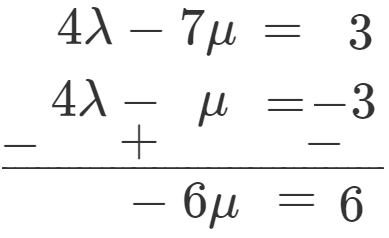
$\mu=-1$ Put value of $\lambda$ in equation (3), $4\lambda-7\mu=3$ $4\lambda-7(-1)=3$ $4\lambda=3-7$ $\lambda=-1$ Put the value of $\lambda$ and $\mu$ in equation (5), $-5\lambda-3\mu=8$ $-5(-1)-3(-1)=8$ $5+3=8$ $\text{LHS = RHS}$ View full question & answer→Question 185 Marks
Find the shortest distance between the lines
$\frac{\text{x}+1}{7}=\frac{\text{y}+1}{-6}=\frac{\text{z}+1}{1}$ and $\frac{\text{x}-3}{1}=\frac{\text{y}-5}{-2}=\frac{\text{z}-7}{1}$
Answer$\frac{\text{x}+1}{7}=\frac{\text{y}+1}{-6}=\frac{\text{z}+1}{1}$ and $\frac{\text{x}-3}{1}=\frac{\text{y}-5}{-2}=\frac{\text{z}-7}{1}$
Since the first line passes through the point (-1, -1, -1) and has diraction ratios proportional to 7, -6, 1, its vector equation is
$\vec{\text{r}}=\vec{\text{a}}_1+\lambda\vec{\text{b}}_1$
Here,
$\vec{\text{a}}_1=-\hat{\text{i}}-\hat{\text{j}}-\hat{\text{k}}$
$\vec{\text{b}}_1=7\hat{\text{i}}-6\hat{\text{j}}+\hat{\text{k}}$
Also, the second line passing through the point (3, 5, 7) has direction ratios proportional to 1, -2, 1.
Its vector equation is
Here,
$\vec{\text{a}}_2=3\hat{\text{i}}+5\hat{\text{j}}+7\hat{\text{k}}$
$\vec{\text{b}}_2=\hat{\text{i}}-2\hat{\text{j}}+\hat{\text{k}}$
Now,
$\vec{\text{a}}_2-\vec{\text{a}}_1=4\hat{\text{i}}+6\hat{\text{j}}+8\hat{\text{k}}$
and $\vec{\text{b}}_1\times\vec{\text{b}}_2=\begin{vmatrix}\hat{\text{i}}&\hat{\text{j}}&\hat{\text{k}}\\7&-6&1\\1&-2&1\end{vmatrix}$
$\Rightarrow\big|\vec{\text{b}}_1\times\vec{\text{b}}_2\big|=\sqrt{(-4)^2+(-6)^2+(-8)^2}$
$=\sqrt{16+36+64}$
$=\sqrt{116}$
and $\big(\vec{\text{a}}_2-\vec{\text{a}}_1\big).\big(\vec{\text{b}}_1\times\vec{\text{b}}_2\big)=\big(4\hat{\text{i}}+6\hat{\text{j}}+8\hat{\text{k}}\big).\big(-4\hat{\text{i}}-6\hat{\text{j}}-8\hat{\text{k}}\big)$
$=-16-36-64$
$=-116$
The shortest distence between the lines $\vec{\text{r}}=\vec{\text{a}}_1+\lambda\vec{\text{b}}_1$ and $\vec{\text{r}}=\vec{\text{a}}_2+\mu\vec{\text{b}}_2$ is given by
$\text{d}=\Bigg|\frac{\big(\vec{\text{a}}_2-\vec{\text{a}}_1\big).\big(\vec{\text{b}}_1\times\vec{\text{b}}_2\big)}{\big|\vec{\text{b}}_1\times\vec{\text{b}}_2\big|}\Bigg|$
$\Rightarrow\text{d}=\Big|\frac{-116}{\sqrt{116}}\Big|$
$=\sqrt{116}$
$=2\sqrt{29}$
View full question & answer→Question 195 Marks
Show that the lines
$\vec{\text{r}}=3\hat{\text{i}}+2\hat{\text{j}}-4\hat{\text{k}}+\lambda\big(\hat{\text{i}}+2\hat{\text{j}}+2\hat{\text{k}}\big)$ and $\vec{\text{r}}=5\hat{\text{i}}-2\hat{\text{j}}+\mu\big(3\hat{\text{i}}+2\hat{\text{j}}+6\hat{\text{k}}\big)$ are intersecting. Hence, find their point of intersection.
AnswerThe position vectors of two arbitrary points on the given lines are
$3\hat{\text{i}}+2\hat{\text{j}}-4\hat{\text{k}}+\lambda\big(\hat{\text{i}}+2\hat{\text{j}}+2\hat{\text{k}}\big)$
$=(3+\lambda)\hat{\text{i}}+(2+2\lambda)\hat{\text{j}}+(2\lambda-4)\hat{\text{k}}$
$5\hat{\text{i}}-2\hat{\text{j}}+\mu\big(3\hat{\text{i}}+2\hat{\text{j}}+6\hat{\text{k}}\big)$
$=(5+3\mu)\hat{\text{i}}+(-2+2\mu)\hat{\text{j}}+6\mu\hat{\text{k}}$
If the lines intersect, then they have a common point. so, for some values of $\lambda$ and $\mu,$ we must have
$(3+\lambda)\hat{\text{i}}+(2+2\lambda)\hat{\text{j}}+(2\lambda-4)\hat{\text{k}}$
$=(5+3\mu)\hat{\text{i}}+(-2+2\mu)\hat{\text{j}}6\mu\hat{\text{k}}$
Equation the coefficients of $\hat{\text{i}},\hat{\text{j}}$ and $\hat{\text{k}},$ we get
$3+\lambda=5+3\mu\dots(1)$
$2+2\lambda=-2+2\mu\dots(2)$
$2\lambda-4=6\mu\dots(3)$
Solving (1) and (2), we get
$\lambda=-4,\mu=-2.$
Substituting the values $\lambda=-4$ and $\mu=-2$ in (3), we get
$\text{LHS}=2\lambda-4$
$=2(-4)-4$
$=-12\text{ RHS}=6\mu$
$=6(-2)$
$=-12$
$\Rightarrow\text{LHS}=\text{RHS}$
Since $\lambda=-4$ and $\mu=-2$ satisfy (3), the lines intersect.
Substituting $\mu=-2$ in the second line, we get $\vec{\text{r}}=5\hat{\text{i}}-2\hat{\text{j}}-6\hat{\text{i}}-4\hat{\text{j}}-12\hat{\text{k}}=-\hat{\text{i}}-6\hat{\text{j}}-12\hat{\text{k}}$ the position vector of the point of intersection.
Thus, the coordinates of the points of intersection are (-1, -6, -12).
View full question & answer→Question 205 Marks
Find the shortest distance between the following pairs of lines whose cartesian equation are:
$\frac{\text{x}-3}{1}=\frac{\text{y}-5}{-2}=\frac{\text{z}-7}{1}$ and $\frac{\text{x}+1}{7}=\frac{\text{y}+1}{-6}=\frac{\text{z}+1}{1}$
Answer$\frac{\text{x}-3}{1}=\frac{\text{y}-5}{-2}=\frac{\text{z}-7}{1}\dots(1)$$\frac{\text{x}+1}{7}=\frac{\text{y}+1}{-6}=\frac{\text{z}+1}{1}\dots(2)$
Since line (1) passes through the point ( 3, 5, 7) and has direction ratios proportional to 1, -2, 1, its vector equation is
$\vec{\text{r}}=\vec{\text{a}}_1+\lambda\vec{\text{b}}_1$
Here,
$\vec{\text{a}}_1=3\hat{\text{i}}+5\hat{\text{j}}+7\hat{\text{k}}$
$\vec{\text{b}}_1=\hat{\text{i}}-2\hat{\text{j}}+\hat{\text{k}}$
Also, line (2) passes through the point (-1, -1, -1) and has diraction ratios proportional to 7, -6, 1.
Its vector equation is
$\vec{\text{r}}=\vec{\text{a}}_2+\mu\vec{\text{b}}_2$
Here,
$\vec{\text{a}}_2=-\hat{\text{i}}-\hat{\text{j}}-\hat{\text{k}}$
$\vec{\text{b}}_2=7\hat{\text{i}}-6\hat{\text{j}}+\hat{\text{k}}$
Now,
$\vec{\text{a}}_2-\vec{\text{a}}_1=-4\hat{\text{i}}-6\hat{\text{j}}-8\hat{\text{k}}$
and $\vec{\text{b}}_1\times\vec{\text{b}}_2=\begin{vmatrix}\hat{\text{i}}&\hat{\text{j}}&\hat{\text{k}}\\1&-2&1\\7&-6&1\end{vmatrix}$
$=4\hat{\text{i}}+6\hat{\text{j}}+8\hat{\text{k}}$
$\Rightarrow\big|\vec{\text{b}}_1\times\vec{\text{b}}_2\big|=\sqrt{4^2+6^2+8^2}$
$=\sqrt{16+36+64}$
$=\sqrt{116}$
$\big(\vec{\text{a}}_2-\vec{\text{a}}_1\big).\big(\vec{\text{b}}_1\times\vec{\text{b}}_2\big)=\big(-4\hat{\text{i}}-6\hat{\text{j}}-8\hat{\text{k}}\big).\big(4\hat{\text{i}}+6\hat{\text{j}}+8\hat{\text{k}}\big)$
$=-16-36-64$
$=-116$
The shortest distance between the lines $\vec{\text{r}}=\vec{\text{a}}_1+\lambda\vec{\text{b}}_1$ and $\vec{\text{r}}=\vec{\text{a}}_2+\mu\vec{\text{b}}_2$ is given by
$\text{d}=\Bigg|\frac{\big(\vec{\text{a}}_2-\vec{\text{a}}_1\big).\big(\vec{\text{b}}_1\times\vec{\text{b}}_2\big)}{\big|\vec{\text{b}}_1\times\vec{\text{b}}_2\big|}\Bigg|$
$=\Big|\frac{-116}{\sqrt{116}}\Big|$
$=\sqrt{116}$
$=2\sqrt{29}$
View full question & answer→Question 215 Marks
Find the shortest distance between the following pairs of lines whose vector equation are:
$\vec{\text{r}}=\big(2\hat{\text{i}}-\hat{\text{j}}-\hat{\text{k}}\big)+\lambda\big(2\hat{\text{i}}-5\hat{\text{j}}+2\hat{\text{k}}\big)$ and, $\vec{\text{r}}=\big(\hat{\text{i}}+2\hat{\text{j}}+\hat{\text{k}}\big)+\mu\big(\hat{\text{i}}-\hat{\text{j}}+\hat{\text{k}}\big)$
AnswerWe know that, the shortest distance between lines $\vec{\text{r}}=\vec{\text{a}}_1+\lambda\vec{\text{b}}_1$ and $\vec{\text{r}}=\vec{\text{a}}_2+\mu\vec{\text{b}}_2$ is given by
$\text{S.D.}=\Bigg|\frac{\big(\vec{\text{a}}_2-\vec{\text{a}}_1\big).\big(\vec{\text{b}}_1\times\vec{\text{b}}_2\big)}{\big|\vec{\text{b}}_1\times\vec{\text{b}}_2\big|}\Bigg|\dots(1)$
Given equation of line are,
$\vec{\text{r}}=\big(2\hat{\text{i}}-\hat{\text{j}}-\hat{\text{k}}\big)+\lambda\big(2\hat{\text{i}}-5\hat{\text{j}}+2\hat{\text{k}}\big)$ and $\vec{\text{r}}=\big(\hat{\text{i}}+2\hat{\text{j}}+\hat{\text{k}}\big)+\mu\big(\hat{\text{i}}-\hat{\text{j}}+\hat{\text{k}}\big)$
$\Rightarrow\vec{\text{a}}_1=\big(2\hat{\text{i}}-\hat{\text{j}}-\hat{\text{k}}\big),\vec{\text{b}}_1=\big(2\hat{\text{i}}-5\hat{\text{j}}+2\hat{\text{k}}\big)$ and $\vec{\text{a}}_2=\big(\hat{\text{i}}+2\hat{\text{j}}+\hat{\text{k}}\big),\vec{\text{b}}_2=\big(\hat{\text{i}}-\hat{\text{j}}+\hat{\text{k}}\big)$
$\big(\vec{\text{a}}_2-\vec{\text{a}}_1\big)=\big(\hat{\text{i}}+2\hat{\text{j}}+\hat{\text{k}}\big)-\big(2\hat{\text{i}}-\hat{\text{j}}-\hat{\text{k}}\big)$
$=\hat{\text{i}}+2\hat{\text{j}}+\hat{\text{k}}-2\hat{\text{i}}+\hat{\text{j}}+\hat{\text{k}}$
$\big(\vec{\text{a}}_2-\vec{\text{a}}_1\big)=-\hat{\text{i}}+3\hat{\text{j}}+2\hat{\text{k}}$
$\big|\vec{\text{b}}_1\times\vec{\text{b}}_2\big|=\begin{vmatrix}\hat{\text{i}}&\hat{\text{J}}&\hat{\text{k}}\\2&-5&2\\1&-1&1 \end{vmatrix}$
$=\hat{\text{i}}(-5+2)-\hat{\text{j}}(2-2)+\hat{\text{k}}(-2+5)$
$=-3\hat{\text{i}}+3\hat{\text{k}}$
$\big(\vec{\text{a}}_2-\vec{\text{a}}_1\big).\big(\vec{\text{b}}_1\times\vec{\text{b}}_2\big)=\big(-\hat{\text{i}}+3\hat{\text{j}}+2\hat{\text{k}}\big)\big(-3\hat{\text{i}}+3\hat{\text{k}}\big)$
$=(-1)(-3)+(3)(0)+(2)(3)$
$=3+0+6$
$\big(\vec{\text{a}}_2-\vec{\text{a}}_1\big)\big(\vec{\text{b}}_1\times\vec{\text{b}}_2\big)=9$
$\big|\vec{\text{b}}_1\times\vec{\text{b}}_2\big|=\sqrt{(-3)^2+(3)^2}$
$=\sqrt{9+9}$
$\big|\vec{\text{b}}_1\times\vec{\text{b}}_2\big|=3\sqrt{2}$
Substituting the values of $\big(\vec{\text{a}}_2-\vec{\text{a}}_1\big).\big(\vec{\text{b}}_1\times\vec{\text{b}}_2\big)$ and $\big|\vec{\text{b}}_1\times\vec{\text{b}}_2\big|$ in equation (1) to get the shortest distance between given lines, so
$\text{S.D.}=\Big|\frac{9}{3\sqrt{2}}\Big|$
$\text{S.D.}=\frac{3}{\sqrt{2}}$
View full question & answer→Question 225 Marks
Determine whether the following pair of lines intersect or not:
$\frac{\text{x}-1}{2}=\frac{\text{y}+1}{3}=\text{z}$ and $\frac{\text{x}+1}{5}=\frac{\text{y}-2}{1};\text{z}=2$
AnswerGiven, equation of first line is$\frac{\text{x}-1}{2}=\frac{\text{y}+1}{3}=\frac{\text{}z}{1}=\lambda\text{ (say) }\dots(1)$
General point on line (1) is
$\big(2\lambda+1,3\lambda-1,\lambda\big)$
Another equation of line is
$\frac{\text{x}-1}{5}=\frac{\text{y}-2}{1},\text{z}=3\dots(2)$
$\frac{\text{x}-5}{5}=\frac{\text{y}-2}{1}=\mu,\text{ (say) },\text{z}=3$
General point on line (2) is
$\big(5\mu+1,\mu+2,3\big)$
If line (1) and (2) intersect each other then, there is a common point to them, so, we must have of $\lambda$ and $\mu$ such that
$2\lambda+1=5\mu+1\Rightarrow2\lambda-5\mu=0\dots(3)$
$3\lambda-1=\mu+2\Rightarrow3\lambda-\mu=3\dots(4)$
$\lambda=3\Rightarrow\lambda=3\dots(5)$
Put value of $\lambda$ in equation (4),
$3\lambda-\mu=3$
$3(3)-\mu=3$
$-\mu=3-9$
$\mu=6$
Put the value of $\lambda$ and $\mu$ in equation (3), so
$2\lambda-5\mu=0$
$2(3)-5(6)=0$
$6-30=0$
$-24\neq0$
$\text{LHS}\neq\text{RHS}$
sice the values of $\lambda$ and $\mu$ obtained from equation (4) and (5) dose not satisfy equation (3),
So, given lines are not intersecting.
View full question & answer→Question 235 Marks
Determine whether the following pair of lines intersect or not:
$\frac{\text{x}-1}{3}=\frac{\text{y}-1}{-1}=\frac{\text{z}+1}{0}$ and $\frac{\text{x}-4}{2}=\frac{\text{y}-0}{0}=\frac{\text{z}+1}{3}$
AnswerGiven, equation of first line is,
$\frac{\text{x}-1}{3}=\frac{\text{y}-1}{-1}=\frac{\text{z}+1}{0}=\lambda\text{ (say) }\dots(1)$
General point on line (1) is,
$\big(3\lambda+1,-\lambda+1,-1\big)$
Another equation of line is
$\frac{\text{x}-4}{2}=\frac{\text{y}-0}{0}=\frac{\text{z}+1}{3}=\mu\text{ (say) }\dots(2)$
General point on line (2) is,
$\big(2\mu+4,0,3\mu-1\big)$
If line (1) and (2) intersecting then there must be a common point, so, we must have the value of $\lambda$ and $\mu$ as
$3\lambda+1=2\mu+4\Rightarrow3\lambda-2\mu=3\dots(1)$
$=\lambda+1=0\Rightarrow\lambda=1\dots(2)$
$3\mu-1=-1\Rightarrow\mu=0\dots(3)$
Put the value of $\lambda$ and $\mu$ in equation (1), so
$3\lambda-2\mu=3$
$3(1)-2(0)=3$
$3=3$
$\text{LHS}\neq\text{RHS}$
Since the values of $\lambda$ and $\mu$ obtained by equation (2) and (3) satisfy equation (1), so,
given lines are intersecting.
View full question & answer→Question 245 Marks
Find the shortest distance between the following pairs of lines whose vector equation are:
$\vec{\text{r}}=(8+3\lambda)\hat{\text{i}}-(9+16\lambda)\hat{\text{j}}+(10+7\lambda)\hat{\text{k}}$ and $\vec{\text{r}}=15\hat{\text{i}}+29\hat{\text{j}}+5\hat{\text{k}}+\mu\big(3\hat{\text{i}}+8\hat{\text{j}}-5\hat{\text{k}}\big)$
AnswerThe vector equations of the given lines can be re-written as
$\vec{\text{r}}=(8+3\lambda)\hat{\text{i}}-(9+16\lambda)\hat{\text{j}}+(10+7\lambda)\hat{\text{k}}$ and $\vec{\text{r}}=15\hat{\text{i}}+29\hat{\text{j}}+5\hat{\text{k}}+\mu\big(3\hat{\text{i}}+8\hat{\text{j}}-5\hat{\text{k}}\big)$
Comparing the given equation with the equations $\vec{\text{r}}=\vec{\text{a}}_1+\lambda\vec{\text{b}}_1$ and $\vec{\text{r}}=\vec{\text{a}}_2+\mu\vec{\text{b}}_2,$ we get
$\vec{\text{a}}_1=8\hat{\text{i}}-9\hat{\text{j}}+10\hat{\text{k}}$
$\vec{\text{b}}_1=3\hat{\text{i}}-16\hat{\text{j}}+7\hat{\text{k}}$
$\vec{\text{a}}_2=15\hat{\text{i}}+29\hat{\text{j}}+5\hat{\text{k}}$
$\vec{\text{b}}_2=3\hat{\text{i}}+8\hat{\text{j}}-5\hat{\text{k}}$
$\therefore\vec{\text{a}}_2-\vec{\text{a}}_1=\big(15\hat{\text{i}}+29\hat{\text{j}}+5\hat{\text{k}}\big)-\big(8\hat{\text{i}}-9\hat{\text{j}}+10\hat{\text{k}}\big)=7\hat{\text{i}}+38\hat{\text{j}}-5\hat{\text{k}}$
$\vec{\text{b}}_1\times\vec{\text{b}}_2=\begin{vmatrix}\hat{\text{i}}&\hat{\text{j}}&\hat{\text{k}}\\3&-16&7\\9&8&-5\end{vmatrix}=24\hat{\text{i}}+36\hat{\text{j}}+72\hat{\text{k}}$
$\Rightarrow\big|\vec{\text{b}}_1\times\vec{\text{b}}_2\big|=\sqrt{24^2+36^2+72^2}$
$=\sqrt{576+1296+5184}=\sqrt{7056}=84$
Also,
$\big(\vec{\text{a}}_2-\vec{\text{a}}_1\big).\big(\vec{\text{b}}_1\times\vec{\text{b}}_2\big)$
$=\big(7\hat{\text{i}}+38\hat{\text{j}}-5\hat{\text{k}}\big).\big(24\hat{\text{i}}+36\hat{\text{j}}+72\hat{\text{k}}\big )$
$=7\times24+38\times36+(-5)\times72$
$=168+1368-360$
$=1176$
WE know that the shortest distance between the lines $\vec{\text{r}}=\vec{\text{a}}_1+\lambda\vec{\text{b}}_1$ and $\vec{\text{r}}=\vec{\text{a}}_2+\mu\vec{\text{b}}_2$ is
given by $\text{d}=\Bigg|\frac{\big(\vec{\text{a}}_2-\vec{\text{a}}_1\big).\big(\vec{\text{b}}_1\times\vec{\text{b}}_2\big)}{\big|\vec{\text{b}}_1\times\vec{\text{b}}_2\big|}\Bigg|.$
$\therefore$ Required shortest distance between the given pairs of lines,
$\text{d}=\Bigg|\frac{\big(\vec{\text{a}}_2-\vec{\text{a}}_1\big).\big(\vec{\text{b}}_1\times\vec{\text{b}}_2\big)}{\big|\vec{\text{b}}_1\times\vec{\text{b}}_2\big|}\Bigg|$
$=\Big|\frac{1176}{84}\Big|$
$=14$
View full question & answer→Question 255 Marks
Find the shortest distance between the following pairs of lines whose cartesian equation are:
$\frac{\text{x}-1}{-1}=\frac{\text{y}+2}{1}=\frac{\text{z}-3}{-2}$ and $\frac{\text{x}-1}{1}=\frac{\text{y}+1}{2}=\frac{\text{z}+1}{-2}$
Answer$\frac{\text{x}-1}{-1}=\frac{\text{y}+2}{1}=\frac{\text{z}-3}{-2}\dots(1)$
$\frac{\text{x}-1}{1}=\frac{\text{y}+1}{2}=\frac{\text{z}+1}{-2}\dots(2)$
Since line (1) passes through the point (1, -2, 3) and has direction ratios proportional to -1, 1, -2, its vector equation is
$\vec{\text{r}}=\vec{\text{a}}_1+\lambda\vec{\text{b}}_1$
Here,
$\vec{\text{a}}_1=\hat{\text{i}}-2\hat{\text{j}}+3\hat{\text{k}}$
$\vec{\text{b}}_1=-\hat{\text{i}}+\hat{\text{j}}-2\hat{\text{k}}$
Also, line (2) passes through the point (1, -1, -1) and has diraction ratios proportional to 1, 2, -2.
Its vector equation is
$\vec{\text{r}}=\vec{\text{a}}_2+\mu\vec{\text{b}}_2$
Here,
$\vec{\text{a}}_2=\hat{\text{i}}-\hat{\text{j}}-\hat{\text{k}}$
$\vec{\text{b}}_2=\hat{\text{i}}+2\hat{\text{j}}-2\hat{\text{k}}$
Now,
$\vec{\text{a}}_2-\vec{\text{a}}_1=\hat{\text{j}}-4\hat{\text{k}}$
and $\vec{\text{b}}_1\times\vec{\text{b}}_2=\begin{vmatrix}\hat{\text{i}}&\hat{\text{j}}&\hat{\text{k}}\\-1&1&-2\\1&2&-2\end{vmatrix}$
$=2\hat{\text{i}}-4\hat{\text{j}}-3\hat{\text{k}}$
$\Rightarrow\big|\vec{\text{b}}_1\times\vec{\text{b}}_2\big|=\sqrt{2^2+(-4)^2+(-3)^2}$
$=\sqrt{4+16+9}$
$=\sqrt{29}$
$\big(\vec{\text{a}}_2-\vec{\text{a}}_1\big).\big(\vec{\text{b}}_1\times\vec{\text{b}}_2\big)$
$=\big(\hat{\text{j}}-4\hat{\text{k}}\big).\big(2\hat{\text{i}}-4\hat{\text{j}}-3\hat{\text{k}}\big)$
$=-4+12$
$=8$
The shortest distance between the lines $\vec{\text{r}}=\vec{\text{a}}_1+\lambda\vec{\text{b}}_1$ and $\vec{\text{r}}=\vec{\text{a}}_2+\mu\vec{\text{b}}_2$ is given by
$\text{d}=\Bigg|\frac{\big(\vec{\text{a}}_2-\vec{\text{a}}_1\big).\big(\vec{\text{b}}_1\times\vec{\text{b}}_2\big)}{\big|\vec{\text{b}}_1\times\vec{\text{b}}_2\big|}\Bigg|$
$=\Big|\frac{8}{\sqrt{29}}\Big|$
$=\frac{8}{\sqrt{29}}$
View full question & answer→Question 265 Marks
Find the equation of the line passing through the points $(1, -1, 1)$ and perpendicular to the lines joining the points $(4, 3, 2), (1, -1, 0)$ and $(1, 2, -1) (2, 1, 1).$
AnswerWe know that equation of a line passing through $(x_1, y_{1,}z_1)$ and direction ratios as a, b, c is given by
$\frac{\text{x}-\text{x}_1}{\text{a}}=\frac{\text{y}-\text{y}_1}{\text{b}}=\frac{\text{z}-\text{z}_1}{\text{c}}\dots(1)$
So, equation of a line passing through $(1, -1, 1)$ is
$\frac{\text{x}-1}{\text{a}}=\frac{\text{y}+1}{\text{b}}=\frac{\text{z}-1}{\text{c}}\dots(2)$
Now, Directions ratios of the line joining $A(4, 3, 2)$ and $B(1, -1, 0)$
$=(1 - 4), (-1 -3), (0 - 2)$
$\Rightarrow $ Direction ratios of line $AB = -3, -4, -2$
and, Direction ratios of the line joining $C(1, 2, -1)$ and $D(2, 1, 1)$
$=(2 - 1), (1 - 2), (1 + 1)$
$\Rightarrow $ Diraction ratios of line $CD =1, -1, 2$
Given that, line AB is perpendicular to line (2), so
$a_1a_2+ b_1b_2+ c_1c_2= 0$
$(a)(-3) + (b)(-4) + (c)(-2) = 0$
$-3a + 4b - 2c = 0$
$3a + 4b + 2c = 0 .....(3)$
and, line CD is also perpendicular to line (2), so
$a_1a_2+ b_1b_2+ c_1c_2= 0$
$(a)(1) + (b)(-1) + (c)(2) = 0$
$a - b + 2c = 0 .....(4)$
Solving equation (3) and (4) using cross multiplication,
$\frac{\text{a}}{(4)(2)-(-1)(2)}=\frac{\text{b}}{(1)(2)-(3)(2)}=\frac{\text{c}}{(3)(-1)-(4)(1)}$
$\Rightarrow\frac{\text{a}}{8+2}=\frac{\text{b}}{2-6}=\frac{\text{c}}{-3-4}$
$\Rightarrow\frac{\text{a}}{10}=\frac{\text{b}}{-4}=\frac{\text{c}}{-7}=\lambda$ (say)
$\Rightarrow\text{a}=10\lambda,\text{b}=-4\lambda,\text{c}=-7\lambda$
View full question & answer→Question 275 Marks
Find the equation of the lines joining the following pairs of vertices and then find the shortest distance between the lines(1) (0, 0, 0) and (1, 0, 2)
(2) (1, 3, 0) and (0, 3, 0)
AnswerEquation of line passing throught (0, 0, 0) and (1, 0, 2) is given by $\vec{\text{r}}=\vec{\text{a}}+\lambda\big(\vec{\text{b}}-\vec{\text{a}}\big)$
$\vec{\text{r}}=\big(0\hat{\text{i}}+0\hat{\text{j}}+0\hat{\text{k}}\big)+\lambda\big((1-0)\hat{\text{i}}+(0-0)\hat{\text{j}}+(2-0)\hat{\text{k}}\big)$
$\vec{\text{r}}=\big(0\hat{\text{i}}+0\hat{\text{j}}+0\hat{\text{k}}\big)+\lambda\big(\hat{\text{i}}+2\hat{\text{k}}\big)\dots(1)$
Equation of another line passing through (1, 3, 0) and (0, 3, 0) is
$\vec{\text{r}}=\big(\hat{\text{i}}+3\hat{\text{j}}+0\hat{\text{k}}\big)+\mu\big((0-1)\hat{\text{i}}+(3-3)\hat{\text{j}}+(0-0)\hat{\text{k}}\big)$
$\vec{\text{r}}=\big(\hat{\text{i}}+3\hat{\text{j}}+0\hat{\text{k}}\big)+\mu\big(-\hat{\text{i}}\big)\dots(2)$
From equation (1) and (2)
$\vec{\text{a}}_1=\big(0.\hat{\text{i}}+0.\hat{\text{j}}+0.\hat{\text{k}}\big),\vec{\text{b}}_1=\big(\hat{\text{i}}+2\hat{\text{k}}\big)$
$\vec{\text{a}}_2=\big(\hat{\text{i}}+3\hat{\text{j}}+0\hat{\text{k}}\big),\vec{\text{b}}_2=-\hat{\text{i}}$
we know that, shortest distance between the lines $\vec{\text{r}}=\vec{\text{a}}_1+\lambda\vec{\text{b}}_1$ and $\vec{\text{r}}=\vec{\text{a}}_2+\lambda\vec{\text{b}}_2$ is given by
$\text{S.D.}=\frac{\big|\big(\vec{\text{a}}_2-\vec{\text{a}}_1\big).\big(\vec{\text{b}}_1\times\vec{\text{b}}_2\big)}{\big|\vec{\text{b}}_1\times\vec{\text{b}}_2\big|}\dots(3)$
$\big(\vec{\text{a}}_2-\vec{\text{a}}_1\big)=\big(\hat{\text{i}}+3\hat{\text{j}}+0.\hat{\text{k}}\big)-\big(0.\hat{\text{i}}+0.\hat{\text{j}}+0.\hat{\text{k}}\big)$
$\big(\vec{\text{a}}_2-\vec{\text{a}}_1\big)=\big(\hat{\text{i}}+3\hat{\text{j}}\big)$
$\big(\vec{\text{b}}_1\times\vec{\text{b}}_2\big)=\begin{vmatrix}\hat{\text{i}}&\hat{\text{j}}&\hat{\text{k}}\\1&0&2\\-1&0&0 \end{vmatrix}$
$=\hat{\text{i}}(0-0)-\hat{\text{j}}(0+2)+\hat{\text{k}}(-2)$
$\big(\vec{\text{b}}_1\times\vec{\text{b}}_2\big)=-2\hat{\text{j}}$
$\big(\vec{\text{a}}_2-\vec{\text{a}}_1\big).\big(\vec{\text{b}}_1\times\vec{\text{b}}_2\big)=\big(\hat{\text{i}}+3\hat{\text{j}}\big)\big(-2\hat{\text{j}}\big)$
$=(1)(0)+(3)(-2)$
$\big(\vec{\text{a}}_2-\vec{\text{a}}_1\big).\big(\vec{\text{b}}_1\times\vec{\text{b}}_2\big)=-6$
$\big|\vec{\text{b}}_1\times\vec{\text{b}}_2\big|=\sqrt{(-2)^2}$
$\big|\vec{\text{b}}_1\times\vec{\text{b}}_2\big|=2$
Using $\big(\vec{\text{a}}_2-\vec{\text{a}}_1\big).\big(\vec{\text{b}}_1\times\vec{\text{b}}_2\big)$ and $\big|\vec{\text{b}}_1\times\vec{\text{b}}_2\big|$ in equation (1) to get shortest distance between the lines, so
$\text{S.D.}=\Big|\frac{-6}{2}\Big|$
$\text{S.D}=3\text{ units}$
View full question & answer→Question 285 Marks
Find the foot of perpendicular from the point (2, 3, 4) to the line $\frac{4-\text{x}}{2}=\frac{\text{y}}{6}=\frac{1-\text{z}}{3}.$ Also, find the perpendicular distance from the given point to the line.
AnswerLet foot of the perpendicular from P(2, 3, 4) is $\theta$ on the line $\frac{4-\text{x}}{2}=\frac{\text{y}}{6}=\frac{1-\text{z}}{3},$ so
Equation of given line is,
$\frac{4-\text{x}}{2}=\frac{\text{y}}{6}=\frac{1-\text{z}}{3}$
$\frac{\text{x}-4}{-2}=\frac{\text{y}}{6}=\frac{\text{z}-1}{-3}=\lambda$ (say)
Coordinate of Q $=(-2\lambda+4,6\lambda,-3\lambda+1)$
Direction ratios of PQ $=(-2\lambda+4-2),(6\lambda-3),(-3\lambda+1-4)$
$=(-2\lambda+2),(6\lambda-3),(-3\lambda-3)$
Line PQ is perpendicular to given line, so
$\text{a}_1\text{a}_2+\text{b}_1\text{b}_2+\text{c}_1\text{c}_2=0$
$(-2)(-2\lambda+2)+(6)(6\lambda-3)+(-3)(-3\lambda-3)=0$
$4\lambda-4+36\lambda-18+9\lambda+9=0$
$49\lambda-13=0$
$\lambda=\frac{13}{49}$
Coordinate of Q $=(-2\lambda+4,6\lambda,-3\lambda+1)$
$=\Big(-2\Big(\frac{13}{49}\Big)+4,6\Big(\frac{13}{49}\Big),-3\Big(\frac{13}{49}\Big)+1\Big)$
$=\Big(\frac{-26+196}{49},\frac{78}{49},\frac{-39+49}{49}\Big)$
Coordinate of Q $=\Big(\frac{170}{49},\frac{78}{49},\frac{10}{49}\Big)$
$\text{PQ}=\sqrt{(\text{x}_1-\text{x}_2)^2+(\text{y}_1-\text{y}_2)^2+(\text{z}_1-\text{z}_2)^2}$
$=\sqrt{\Big(\frac{170}{49}-2\Big)^2+\Big(\frac{78}{49}-3\Big)^2+\Big(\frac{10}{49}-4\Big)^2}$
$=\sqrt{\frac{72}{49}^2+\Big(\frac{69}{49}\Big)^2+\Big(-\frac{168}{49}\Big)^2}$
$=\sqrt{\frac{5184+4761+34596}{2401}}$
$=\sqrt{\frac{44541}{2401}}$
$=\sqrt{\frac{909}{49}}$
$=\frac{3\sqrt{101}}{49}$
Perpendicular distance from (2, 3, 4) to given line is $\frac{3\sqrt{101}}{49}$ units.
View full question & answer→Question 295 Marks
Find the equation of line passing through the point $A(0, 6, -9)$ and $B(-3, -6, 3)$. If D is the foot of perpendicular drawn from a point $C(7, 4, -1)$ on the line $AB$, then find the coordiantes of the point $D$ and the equation of line $CD$.
AnswerEquation of line AB is
$\frac{\text{x}-\text{x}_1}{\text{x}_2-\text{x}_1}=\frac{\text{y}-\text{y}_1}{\text{y}_2-\text{y}_1}=\frac{\text{z}-\text{z}_1}{\text{z}_2-\text{z}_1}$
$\Rightarrow\frac{\text{x}-0}{-3-0}=\frac{\text{y}-6}{-6-6}=\frac{\text{z}+9}{3+9}$
$\Rightarrow\frac{\text{x}}{-3}=\frac{\text{y}-6}{-12}=\frac{\text{z}+9}{12}=\lambda$ (say)
Coordinate of point D $=\big(-3\lambda,-12\lambda+6,12\lambda-9\big)$
Direction ratios of CD $=(-3\lambda-7),(-12\lambda+6-4),(12\lambda-9+1)$
$=(-3\lambda-7),(-12\lambda+2),(12\lambda-8)$
Line CD is perpendicular to line AB, so
$a_1a_2+ b_1b_2+ c_1c_2= 0$
$\Rightarrow(-3)(-3\lambda-7)+(-12)(-12\lambda+2)+(12)(12\lambda-8)=0$
$\Rightarrow9\lambda+21+144\lambda-24+144\lambda-96=0$
$\Rightarrow297\lambda-99=0$
$\Rightarrow\lambda=\frac{1}{3}$
Coordinate of D $=\big(-3\lambda,-12\lambda+6,12\lambda-9\big)$
$=\Big(-3\big(\frac{1}{3}\big),-12\big(\frac{1}{3}\big)+6,12\big(\frac{1}{3}\big)-9\Big)$
Coordinate of D = (-1, 2, -5)
Equation of CD is,
$\frac{\text{x}-\text{x}_1}{\text{x}_2-\text{x}_1}=\frac{\text{y}-\text{y}_1}{\text{y}_2-\text{y}_1}=\frac{\text{z}-\text{z}_1}{\text{z}_2-\text{z}_1}$
$\Rightarrow\frac{\text{x}-7}{-1-7}=\frac{\text{y}-4}{2-4}=\frac{\text{z}+1}{-5+1}$
$\Rightarrow\frac{\text{x}-7}{-8}=\frac{\text{y}-4}{-2}=\frac{\text{z}+1}{-4}$
or $\frac{\text{x}-7}{4}=\frac{\text{y}-4}{1}=\frac{\text{z}+1}{2}$
View full question & answer→Question 305 Marks
Find the angle between the following pairs of lines:$\frac{\text{x}-5}{1}=\frac{2\text{y}+6}{-2}=\frac{\text{z}-3}{1}$ and $\frac{\text{x}-2}{3}=\frac{\text{y}+1}{4}=\frac{\text{z}-6}{5}$
Answer$\frac{\text{x}-5}{1}=\frac{2\text{y}+6}{-2}=\frac{\text{z}-3}{1}$ and $\frac{\text{x}-2}{3}=\frac{\text{y}+1}{4}=\frac{\text{z}-6}{5}$The equation of the given lines can be re-written as
$\frac{\text{x}-5}{1}=\frac{\text{y}+3}{-1}=\frac{\text{z}-3}{1}$ and $\frac{\text{x}-2}{3}=\frac{\text{y}+1}{4}=\frac{\text{z}-6}{5}$
Let $\vec{\text{b}}_1$ and $\vec{\text{b}}_2$ be vectors parallel to the given lines.
Now,
$\vec{\text{b}}_1=\hat{\text{i}}-\hat{\text{j}}+\hat{\text{k}}$
$\vec{\text{b}}_2=3\hat{\text{i}}+4\hat{\text{j}}+5\hat{\text{k}}$
If $\theta$ is the angle between the given lines, then
$\cos\theta=\frac{\vec{\text{b}}_1.\vec{\text{b}}_2}{\big|\vec{\text{b}}_1\big|\big|\vec{\text{b}}_2\big|}$
$=\frac{\big(\hat{\text{i}}-\hat{\text{j}}+\hat{\text{k}}\big).\big(3\hat{\text{i}}+4\hat{\text{j}}+5\hat{\text{k}}\big)}{\sqrt{1^2+(-1)^2+1^2}\sqrt{3^2+4^2+5^2}}$
$=\frac{3-4+5}{\sqrt{3}\sqrt{50}}$
$=\frac{4}{5\sqrt{6}}$
$\Rightarrow\theta=\cos^{-1}\Big(\frac{4}{5\sqrt{6}}\Big)$
View full question & answer→Question 315 Marks
Find the vector equation of a line which is parallel to the vector $2\hat{\text{i}}-\hat{\text{j}}+3\hat{\text{k}}$ and which passes through the point (5, -2, 4). Also, reduce it to cartesian from.
AnswerWe know that, vector equation of line passing through a fixed point $\vec{\text{a}}$ and paralel to vector $\vec{\text{b}}$ is $\vec{\text{r}}=\vec{\text{a}}+\lambda\vec{\text{b}},$ where $\lambda$ is scalar Here, $\vec{\text{b}}=2\hat{\text{i}}-\hat{\text{j}}+3\hat{\text{k}}$ and $\vec{\text{a}}=5\hat{\text{i}}-2\hat{\text{j}}+4\hat{\text{k}}$ So, rquation of required line is $\vec{\text{r}}=\vec{\text{a}}+\lambda\vec{\text{b}}$ $\vec{\text{r}}=\big(5\hat{\text{i}}-2\hat{\text{j}}+4\hat{\text{k}}\big)+\lambda\big(2\hat{\text{i}}-\hat{\text{j}}+3\hat{\text{k}}\big)$ Put $\vec{\text{r}}=\text{x}\hat{\text{i}}+\text{y}\hat{\text{j}}+\text{z}\hat{\text{k}},$ so $\big(\text{x}\hat{\text{i}}+\text{y}\hat{\text{j}}+\text{z}\hat{\text{k}}\big)=(5+2\lambda)\hat{\text{i}}+(-2-\lambda)\hat{\text{j}}+(4+3\lambda)\hat{\text{k}}$ Comparing the cofficients of $\hat{\text{i}},\hat{\text{j}},\hat{\text{k}}$ so $\text{x}=5+2\lambda,\text{y}=-2-\lambda,\text{z}=4+3\lambda$ $\Rightarrow\frac{\text{x}-5}{2}=\lambda,\frac{\text{y}+2}{-0}=\lambda,\frac{\text{z}-4}{3}=\lambda$ Cortesian form of equation of the line is,$\frac{\text{x}-5}{5}=\frac{\text{y}+2}{-0}=\frac{\text{z}-4}{3}$
View full question & answer→Question 325 Marks
The cartesian equation of a line are $3x + 1 = 6y - 2 =1 - z.$ Find the fixed point through which it passes, its direction ratios and also its vector equation.
AnswerGiven equation of line is,
$3x + 1 = 6y - 2 = 1 - z$
Dividing all by 6,
$\frac{3\text{x}+1}{6}=\frac{6\text{y}-2}{6}=\frac{1-\text{z}}{6}$
$\Rightarrow\frac{3\text{x}}{6}+\frac{1}{6}=\frac{6\text{y}}{6}-\frac{2}{6}=\frac{1}{6}-\frac{\text{z}}{6}$
$\Rightarrow\frac{1}2{}\text{x}+\frac{1}{6}=\text{y}-\frac{1}{3}=-\frac{\text{z}}{6}+\frac{1}{6}$
$\Rightarrow\frac{1}{2}\Big(\text{x}+\frac{1}{3}\Big)=1\Big(\text{y}-\frac{1}{3}\Big)=+\frac{1}{6}(\text{z}-1)$
$\Rightarrow\frac{\text{x}\frac{1}{3}}{2}=\frac{\text{y}-\frac{1}{3}}{1}=\frac{\text{z}-1}{-6}=\lambda\text{ (say)}\dots(1)$
Comparing it with equation of line passing through ($x_1, y_{1,}z_1$) and direction ratios a, b, c,
$\frac{\text{x}-\text{x}_1}{\text{a}}=\frac{\text{y}-\text{y}_1}{\text{b}}=\frac{\text{z}-\text{z}_1}{\text{c}}$
$\Rightarrow\big(\text{x}_1,\text{y}_1,\text{z}_1\big)=\Big(-\frac{1}{3},\frac{1}{3},1\Big)$
$\text{a}=2,\text{b}=1,-6$
So, direction ratios of the line are = 2, 1, -6
From equation (1),
$\text{x}=\Big(2\lambda-\frac{1}{3}\Big),\text{y}=\Big(\lambda+\frac{1}{3}\Big),\text{z}=(-6\lambda+1)$
So, vector equation of the given line is,
$\text{x}\hat{\text{i}}+\text{y}\hat{\text{j}}+\text{z}\hat{\text{k}}=\Big(2\lambda-\frac{1}{3}\Big)\hat{\text{i}}+\Big(\lambda+\frac{1}{3}\Big)\hat{\text{j}}+(-6\lambda+1)\hat{\text{k}}$
$\vec{\text{r}}=\Big(-\frac{1}{3}\hat{\text{i}}+\frac{1}{3}\hat{\text{j}}+\hat{\text{k}}\Big)+\lambda\big(2\hat{\text{i}}+\hat{\text{j}}-6\hat{\text{k}}\big)$
View full question & answer→Question 335 Marks
Find the equation of the line passing through the points (-1, 2, 1) and parallel to the line $\frac{2\text{x}-1}{4}=\frac{3\text{y}+5}{4}=\frac{2-\text{z}}{3}.$
AnswerWe know that, equation of a line passing through ($x_1, y_1, z_1$) and direction ratios are a, b, c is given by
$\frac{\text{x}-\text{x}_1}{\text{a}}=\frac{\text{y}-\text{y}_1}{\text{b}}=\frac{\text{z}-\text{z}_1}{\text{c}}$
Here, $(x_1, y_1, z_1) =(-1, 2, 1)$
and required line is parallel to the given line
$\frac{2\text{x}-1}{4}=\frac{3\text{y}+5}{2}=\frac{2-\text{z}}{3}$
$\Rightarrow\frac{\text{x}-\frac{1}{2}}{2}=\frac{\text{y}+\frac{5}{3}}{\frac{2}{3}}=\frac{\text{z}-2}{-3}$
⇒ Diraction ratios of the required line are proportional to $2,\frac{2}{3},-3$
$\Rightarrow\text{a}=2\lambda,\text{b}=\frac{2}{3}\lambda,\text{c}=-3\lambda$
So, required equation of the line using eqoation (1),
$\frac{\text{x}+1}{2\lambda}=\frac{\text{y}-2}{\frac{2}{3}\lambda}=\frac{\text{z}-1}{-3\lambda}$
$\frac{\text{x}+1}{2}=\frac{\text{y}-2}{\frac{2}{3}}=\frac{\text{z}-1}{-3}$
View full question & answer→Question 345 Marks
Show that the three lines with direction cosines $\frac{12}{13},\frac{-3}{13},\frac{-4}{13},\frac{4}{13},\frac{12}{13},\frac{3}{13},\frac{3}{13},\frac{-4}{13},\frac{12}{13}$ are mutually perpendicular.
Answerlet $\text{l}_1=\frac{12}{13},\text{m}_1=-\frac{3}{13},\text{n}_1=-\frac{4}{13}$
$\text{l}_2=\frac{4}{13},\text{m}_2=\frac{12}{13},\text{n}_2=\frac{3}{13}$
$\text{l}_3=\frac{3}{13},\text{m}_3=-\frac{4}{13},\text{n}_3=\frac{12}{13}$
$\text{l}_1\text{l}_2+\text{m}_1\text{m}_2+\text{n}_1\text{n}_2$
$=\frac{12}{13}\times\frac{4}{13}+\big(-\frac{3}{13}\big)\times\frac{12}{13}+\big(-\frac{4}{13}\big)\times\frac{3}{13}$
$=\frac{48-36-13}{169}=0$
$\text{l}_2\text{l}_3+\text{m}_2\text{m}_3+\text{n}_2\text{n}_3$
$=\frac{4}{13}\times\frac{3}{13}+\frac{12}{13}\times\Big(-\frac{4}{13}\Big)+\frac{3}{13}\times\frac{12}{13}$
$=\frac{12-48+36}{169}=0$
$\text{l}_1\text{l}_3+\text{m}_1\text{m}_3+\text{n}_1\text{n}_3$
$=\frac{12}{13}\times\frac{3}{13}+\Big(-\frac{3}{13}\Big)\times\Big(-\frac{4}{13}\Big)+\Big(-\frac{4}{13}\Big)\times\frac{12}{13}$
$=\frac{36+12-48}{169}=0$
$\therefore$ The lines are mutually perpendicular.
View full question & answer→Question 355 Marks
Find the vector equation for the line which passes through the point (1, 2, 3) and parallel to the vector $\hat{\text{i}}-2\hat{\text{j}}+3\hat{\text{k}}.$ Reduce the corresponding equation in cartesian form.
AnswerWe know that the vector equation of a line passing through a point with position vector $\vec{\text{a}}$ and parallel to the vector $\vec{\text{b}}$ is $\vec{\text{r}}=\vec{\text{a}}+\lambda\vec{\text{b}}.$
Here,
$\vec{\text{a}}=\hat{\text{i}}+2\hat{\text{j}}+3\hat{\text{k}}$
$\vec{\text{b}}=\hat{\text{i}}-2\hat{\text{j}}+3\hat{\text{k}}$
vector equation of the required line is
$\vec{\text{r}}=\big(\hat{\text{i}}+2\hat{\text{j}}+3\hat{\text{k}}\big)+\lambda\big(\hat{\text{i}}+2\hat{\text{j}}+3\hat{\text{k}}\big)$
Here, $\lambda$ is a parameter.
Reducing (1) to cartesian form, we get
$\text{x}\hat{\text{i}}+\text{y}\hat{\text{i}}+\text{z}\hat{\text{k}}=\big(\hat{\text{i}}+2\hat{\text{j}}+3\hat{\text{k}}\big)+\lambda\big(\hat{\text{i}}-2\hat{\text{j}}+3\hat{\text{k}}\big)$ $\big[\text{putting }\vec{\text{r}}=\text{x}\hat{\text{i}}+\text{y}\hat{\text{j}}+\text{z}\hat{\text{k}} \text{ in }(1)\big]$
$\Rightarrow\text{x}\hat{\text{i}}+\text{y}\hat{\text{j}}+\text{z}\hat{\text{k}}=(1+\lambda)\hat{\text{i}}+(2-2\lambda)\hat{\text{j}}+(3+3\lambda)\hat{\text{k}}$
Comparing the cofficients of $\hat{\text{i}},\hat{\text{j}}$ and $\hat{\text{k}},$ we get
$\text{x}=1+\lambda,\text{y}=2-2\lambda,\text{z}=3+3\lambda$
$\Rightarrow\text{x}-1=\lambda,\frac{\text{y}-2}{-2}=\lambda,\frac{\text{z}-3}{3}=\lambda$
$\Rightarrow\frac{\text{x}-1}{1}=\frac{\text{y}-2}{-2}=\frac{\text{z}-3}{3}=\lambda$
Hence, the cartesian form of (1) is
$\frac{\text{x}-1}{1}=\frac{\text{y}-2}{-2}=\frac{\text{z}-3}{3}$
View full question & answer→Question 365 Marks
Determine the equation of the line passing through the points (1, 2, -4) and perpendicular to the lines $\frac{\text{x}-8}{8}=\frac{\text{y}+9}{-16}=\frac{\text{z}-10}{7}$ and $\frac{\text{x}-15}{3}=\frac{\text{y}-29}{8}=\frac{\text{z}-5}{-5}.$
AnswerWe have
$\frac{\text{x}-8}{8}=\frac{\text{y}+9}{-16}=\frac{\text{z}-10}{7}$
$\frac{\text{x}-15}{3}=\frac{\text{y}-29}{8}=\frac{\text{z}-5}{-5}$
Let:
$\vec{\text{b}}_1=8\hat{\text{i}}-16\hat{\text{j}}+7\hat{\text{k}}$
$\vec{\text{b}}_2=3\hat{\text{i}}+8\hat{\text{j}}-5\hat{\text{k}}$
Since the required line is perpendicular to the lines parallel to the vectors
$\vec{\text{b}}_1=8\hat{\text{i}}-16\hat{\text{j}}+7\hat{\text{k}}$ and $\vec{\text{b}}_2=3\hat{\text{i}}+8\hat{\text{j}}-5\hat{\text{k}}$
it is parallel to the vector $\vec{\text{b}}=\vec{\text{b}}_1\times\vec{\text{b}}_2$
Now,
$\vec{\text{b}}=\vec{\text{b}}_1\times\vec{\text{b}}_2$
$=\begin{vmatrix}\hat{\text{i}}&\hat{\text{j}}&\hat{\text{k}}\\8&-16&7\\3&8&-5\end{vmatrix}$
$=24\hat{\text{i}}+61\hat{\text{j}}+112\hat{\text{k}}$
The direction of the required line are proportional to 24, 81, 112.
The equation of the required line passing through the point (1, 2, -4) and having direction ratios proportional to 24, 61, 112 is $\frac{\text{x}-1}{24}=\frac{\text{y}-2}{61}=\frac{\text{z}+4}{112}$
View full question & answer→Question 375 Marks
Find the perpendicular distence of the point (1, 0, 0) from the line $\frac{\text{x}-1}{2}=\frac{\text{y}+1}{-3}=\frac{\text{z}+10}{8}.$ Also, find the coordinates of the perpendicular and the equation of the perpendicular.
AnswerLet foot of the perpemdicular drawn from the point P(1, 0, 0) to the line $\frac{\text{x}-1}{2}=\frac{\text{y}+1}{-3}=\frac{\text{z}+10}{8}$ is Q. we have to find lengh of PQ.
Q is a genelar point on the line,
$\frac{\text{x}-1}{2}=\frac{\text{y}+1}{-3}=\frac{\text{z}+10}{8}=\lambda$ (say)
coordinate of Q $=\big(2\lambda+1,-3\lambda-1,8\lambda-10\big)$
Direction ratios line PQ are
$=\big(2\lambda+1-1\big),\big(-3\lambda-1-0\big),\big(8\lambda-10-0\big)$
$=(2\lambda),\big(-3\lambda-1\big),\big(8\lambda-10\big)$
Since, line PQ is perpendicular to the given line, so
$\text{a}_1\text{a}_2+\text{b}_1\text{b}_2+\text{c}_1\text{c}_2=0$
$(2)(2\lambda)+(-3)(-3\lambda-1)+8(8\lambda-10)=0$
$4\lambda+9\lambda+3+64\lambda-80=0$
$77\lambda-77=0$
$\lambda=1$
Therefore, coordinate of Q is $\big(2\lambda+1,-3\lambda-1,8\lambda-10\big)$
$=\big(2(1)+1,-3(1)-1,8(1)-10\big)$
$=(3,-4,-2)$
$\text{PQ}=\sqrt{(\text{x}_1-\text{x}_2)^2+(\text{y}_1-\text{y}_2)^2+(\text{z}_1-\text{z}_2)^2}$
$=\sqrt{(1-3)^2+(0+4)^2+(0+2)^2}$
$=\sqrt{4+16+4}$
$=\sqrt{24}$
$=2\sqrt{6}$
So, foot of perpendicular $=(3,-1,-2)$
length of perpendicular $=2\sqrt{6}\text{ units}$
View full question & answer→Question 385 Marks
Find the angle between the pairs of lines with direction ratios proportional to1, $2, -2$ and $-2, 2, 1$
AnswerWe know that, angle $(\theta)$ between two lines$\frac{\text{x}-\text{x}_1}{\text{a}_1}=\frac{\text{y}-\text{y}_1}{\text{b}_1}=\frac{\text{z}-\text{z}_1}{\text{c}_1}$ and $\frac{\text{x}-\text{x}_2}{\text{a}_2}=\frac{\text{y}-\text{y}_2}{\text{b}_2}=\frac{\text{z}-\text{z}_2}{\text{c}_2}$
is given by,
$\cos\theta=\frac{\text{a}_1\text{a}_2+\text{b}_1\text{b}_2+\text{c}_1\text{c}_2}{\sqrt{{\text{a}_1}^2+{{\text{b}_1}^2}+{{\text{c}_1}^2}}\sqrt{{\text{a}_2}^2+{{\text{b}_2}^2}+{{\text{c}_2}^2}}}\dots(1)$
Here, $a_1= 1, b_1= 2, c_1= -2$
$a_2= -2, b_2= 2, c_2= 1$
Let $\theta$ be required angle, so using equation (1),
$\cos\theta=\frac{(1)(-2)+(2)(2)+(-2)(1)}{\sqrt{(1)^2+(2)^2+(-2)^2}\sqrt{(-2)^2+(2)^2+(1)^2}}$
$=\frac{-2+4-2}{3.3}$
$=\frac{0}{9}$
$\cos\theta=0$
$\theta=\frac{\pi}{2}$
View full question & answer→Question 395 Marks
Find the angle between the follwing pairs of lines:$\vec{\text{r}}=\lambda\big(\hat{\text{i}}+\hat{\text{j}}+2\hat{\text{k}}\big)$ and $\vec{\text{r}}=2\hat{\text{j}}+\mu\big\{\big(\sqrt{3}-1\big)\hat{\text{i}}-\big(\sqrt{3}+1\big)\hat{\text{j}}+4\hat{\text{k}}\big\}$
Answer$\vec{\text{r}}=\lambda\big(\hat{\text{i}}+\hat{\text{j}}+2\hat{\text{k}}\big)$ and $\vec{\text{r}}=2\hat{\text{j}}+\mu\big\{\big(\sqrt{3}-1\big)\hat{\text{i}}-\big(\sqrt{3}+1\big)\hat{\text{j}}+4\hat{\text{k}}\big\}$
Let $\vec{\text{b}}_1$ and $\vec{\text{b}}_2$ be vectors parallel to the given lines.
Now,
$\vec{\text{b}}_1=\hat{\text{i}}+\hat{\text{j}}+2\hat{\text{k}}$
$\vec{\text{b}}_2=\big(\sqrt{3}-1\big)\hat{\text{i}}-\big(\sqrt{3}+1\big)\hat{\text{j}}+4\hat{\text{k}}$
If $\theta$ is the angle between the given lines, then
$\cos\theta=\frac{\vec{\text{b}}_1.\vec{\text{b}}_2}{\big|\vec{\text{b}}_1\big|\big|\vec{\text{b}}_2\big|}$
$=\frac{\big(\hat{\text{i}}+\hat{\text{j}}+2\hat{\text{k}}\big).\big(\big(\sqrt{3}-1\big)\hat{\text{i}}-\big(\sqrt{3}+1\big)\hat{\text{j}}+4\hat{\text{k}}\big)}{\sqrt{1^2+1^2+2^2}\sqrt{(\sqrt{3}-1)^2+(\sqrt{3}+1)^2+4^2}}$
$=\frac{\big(\sqrt{3}-1\big)-\big(\sqrt{3}+1\big)+8}{\sqrt{6}\sqrt{24}}$
$=\frac{6}{12}$
$=\frac{1}{2}$
$\Rightarrow\theta=\frac{\pi}{3}$
View full question & answer→Question 405 Marks
Prove that the line $\vec{\text{r}}=\big(\hat{\text{i}}+\hat{\text{j}}-\hat{\text{k}}\big)+\lambda\big(3\hat{\text{i}}-\hat{\text{j}}\big)$ and $\vec{\text{r}}=\big(4\hat{\text{i}}-\hat{\text{k}}\big)+\mu\big(2\hat{\text{i}}+3\hat{\text{k}}\big)$ intersect and find their point of intersection.
AnswerThe position vectors of two arbitrary points on the given lines are
$\big(\hat{\text{i}}+\hat{\text{j}}-\hat{\text{k}}\big)+\lambda\big(3\hat{\text{i}}-\hat{\text{j}}\big)=(1+3\lambda)\hat{\text{i}}+(1-\lambda)\hat{\text{j}}-\hat{\text{k}}$
$\big(4\hat{\text{i}}-\hat{\text{k}}\big)+\mu\big(2\hat{\text{i}}+3\hat{\text{k}}\big)=(4+2\mu)\hat{\text{i}}+0\hat{\text{j}}+(3\mu-1)\hat{\text{k}}$
If the lines intersect, then they have a common point. so, for some values of $\lambda$ and $\mu,$ we must have
$(1+3\lambda)\hat{\text{i}}+(1-\lambda)\hat{\text{j}}-\hat{\text{k}}=(4+2\mu)\hat{\text{i}}+0\hat{\text{j}}+(3\mu-1)\hat{\text{k}}$
Equating the coefficients of $\hat{\text{i}},\hat{\text{j}}$ and $\hat{\text{k}},$ we get
$1+3\lambda=4+2\mu\dots(1)$
$1-\lambda=0\dots(2)$
$3\mu-1=-1\dots(3)$
Solving (2) and (3), we get
$\lambda=1$
$\mu=0$
Substituting the valuse $\lambda=1$ and $\mu=0$ in (1), we get
$\text{LHS}=1+3\lambda$
$=1+3(1)$
$=4$
$\text{RHS}=4+2\mu$
$=4+2(0)$
$=4$
$\Rightarrow\text{LHS}=\text{RHS}$
Since $\lambda=1$ and $\mu=0$ satisfy (3), the given lines intersect.
Substituting $\mu=0$ in the second line, we get $\vec{\text{r}}=4\hat{\text{i}}+0\hat{\text{j}}-\hat{\text{k}}$ as the position vector of the point of intersection.
Thus, the coordinates of the point of intersection are (4, 0, -1).
View full question & answer→Question 415 Marks
A(1, 0, 4) B(0, -11, 1), C(2, -3, 1) are three points and D is the fool of perpendicular from A on BC. Find the coordinates of D.
AnswerPoint D is the foot of the perpendicular drawn from the point A(1, 0, 4) to the line BC.
The coordinates of a general point on the line BC are given by
$\frac{\text{x}-0}{2-0}=\frac{\text{y}+11}{-3+11}=\frac{\text{z}-3}{1-3}=\lambda$
$\Rightarrow\text{x}=2\lambda$
$\text{y}=8\lambda-11$
$\text{z}=-2\lambda+3$
Let the coordinates of D be $(2\lambda,8\lambda-11,-2\lambda+3).$
The direction ratios of AD are proportional to
$2\lambda-1,8\lambda-11,-2\lambda+3-4,$
i.e. $2\lambda-1,8\lambda-11,-2\lambda-1.$
The direction ratios of the line BC are proportional to 2, 8 -2, but AD is perpendicular to the line BC.
$\therefore2(2\lambda-1)+8(8\lambda-11)-2(-2\lambda-1)=0$
$\Rightarrow\lambda=\frac{11}9{}$
Substituting $\lambda=\frac{11}{9}$ in $(2\lambda,8\lambda-11,-2\lambda+3),$ we get the coordinates of D as $\Big(\frac{22}{9},-\frac{11}{9},\frac{5}{9}\Big).$
View full question & answer→Question 425 Marks
By computing the shortest distance determine whether the following pairs of lines intersect or not:
$\vec{\text{r}}=\big(\hat{\text{i}}-\hat{\text{j}}\big)+\lambda\big(2\hat{\text{i}}+\hat{\text{k}}\big)$ and $\vec{\text{r}}=\big(2\hat{\text{i}}-\hat{\text{j}}\big)+\mu\big(\hat{\text{i}}+\hat{\text{j}}-\hat{\text{k}}\big)$
AnswerGiven equations of lines are,
$\vec{\text{r}}=\big(\hat{\text{i}}-\hat{\text{j}}\big)+\lambda\big(2\hat{\text{i}}+\hat{\text{k}}\big)$
$\Rightarrow\vec{\text{a}}_1=\big(\hat{\text{i}}-\hat{\text{j}}\big),\vec{\text{b}}_1=\big(2\hat{\text{i}}+\hat{\text{k}}\big)$
and, $\vec{\text{r}}=\big(2\hat{\text{i}}-\hat{\text{j}}\big)+\mu\big(\hat{\text{i}}+\hat{\text{j}}-\hat{\text{k}}\big)$
$\Rightarrow\vec{\text{a}}_2=\big(2\hat{\text{i}}-\hat{\text{j}}\big),\vec{\text{b}}_2=\big(\hat{\text{i}}+\hat{\text{j}}-\hat{\text{k}}\big)$
We know that, shortest distance between lines $\vec{\text{r}}=\vec{\text{a}}_1+\lambda\vec{\text{b}}_1$ and $\vec{\text{r}}=\vec{\text{a}}_2+\lambda\vec{\text{b}}_2$ is given by
$\text{S.D.}=\Bigg|\frac{\big(\vec{\text{a}}_2-\vec{\text{a}}_1\big).\big(\vec{\text{b}}_1\times\vec{\text{b}}_2\big)}{\big|\vec{\text{b}}_1\times\vec{\text{b}}_2\big|}\Bigg|\dots(1)$
$\big(\vec{\text{a}}_2-\vec{\text{a}}_1\big)=\big(2\hat{\text{i}}-\hat{\text{j}}\big)-\big(\hat{\text{i}}-\hat{\text{j}}\big)$
$=2\hat{\text{i}}-\hat{\text{j}}-\hat{\text{i}}+\hat{\text{j}}$
$=\hat{\text{i}}$
$\big|\vec{\text{b}}_1\times\vec{\text{b}}_2\big|=\begin{vmatrix}\hat{\text{i}}&\hat{\text{j}}&\hat{\text{k}}\\2&0&1\\1&1&-1 \end{vmatrix}$
$=\hat{\text{i}}(0-1)-\hat{\text{j}}(-2-1)+\hat{\text{k}}(2-0)$
$=-\hat{\text{i}}+3\hat{\text{j}}+2\hat{\text{k}}$
$\big(\vec{\text{a}}_2-\vec{\text{a}}_1\big)\big(\vec{\text{b}}_1\times\vec{\text{b}}_2\big)=(\hat{\text{i}})\big(-\hat{\text{i}}+3\hat{\text{j}}+2\hat{\text{k}}\big)$
$=(1)(-1)+(0)(3)+(0)(2)$
$=-1+0+0$
$\big(\vec{\text{a}}_2-\vec{\text{a}}_1\big)\big(\vec{\text{b}}_1\times\vec{\text{b}}_2\big)=-1$
$\big|\vec{\text{b}}_1\times\vec{\text{b}}_2\big|=\sqrt{(-1)^2+(3)^2+(2)^2}$
$=\sqrt{1+9+4}$
$\big|\vec{\text{b}}_1\times\vec{\text{b}}_2\big|=\sqrt{14}$
So, shortest distance between the given lines using equation (1) is,
$\text{S.D.}=\Big|\frac{-1}{\sqrt{14}}\Big|$
$=\frac{1}{\sqrt{14}}\text{ units}$
$\text{S.D.}\neq0$
Since, shortest distance between lines is not zero, so lines are not intersecting.
View full question & answer→Question 435 Marks
Find the coordinates of the foot of perpendicular drawn from the point A(1, 8, 4) to the line joining the points B(0, -1, 3) and C(2, -3, -1).
AnswerThe cartesian equation of the line joining points B(0, -1, 3) and C(2, -3, -1) is
$\frac{\text{x}-0}{2-0}=\frac{\text{y}-(-1)}{-3-(-1)}=\frac{\text{z}-3}{-1-3}$
Or $\frac{\text{x}}{2}=\frac{\text{y}+1}{-2}=\frac{\text{z}-3}{-4}$
Let L be the foot of the perpendicular drawn from the point A(1, 8, 4) to the line $\frac{\text{x}}{2}=\frac{\text{y}+1}{-2}=\frac{\text{z}-3}{-4}.$
The coordinates of general point on the line $\frac{\text{x}}{2}=\frac{\text{y}+1}{-2}=\frac{\text{z}-3}{-4}$ are given by
$\frac{\text{x}}{2}=\frac{\text{y}+1}{-2}=\frac{\text{z}-3}{-4}=\lambda$
Or $\text{x}=2\lambda,\text{y}=-2\lambda-1,\text{z}=-4\lambda+3$
Let the coordinates of L be $(2\lambda,-2\lambda-1,-4\lambda+3).$ Therefore, the direction ratios of AL are proportional to
$2\lambda-1,-2\lambda-1-8,-4\lambda+3-4$ or $2\lambda-1,-2\lambda-9,-4\lambda-1$
Direction ratios of the given line are proportional to 2, -2, -4.
But, AL is perpendicular to the given line.
$\therefore2\times(2\lambda-1)+(-2)\times(-2\lambda-9)+(-4)\times(-4\lambda-1)=0$
$\Rightarrow4\lambda-2+4\lambda+18+16\lambda+4=0$
$\Rightarrow24\lambda+20=0$
$\Rightarrow\lambda=-\frac{5}{6}$
Puting $\lambda=-\frac{5}{6} $ in $(2\lambda,-2\lambda-1,-4\lambda+3),$ we get
$\Big(2\times\Big(-\frac{5}{6}\Big),-2\times\Big(-\frac{5}{6}\Big)-1,-4\times\Big(-\frac{5}{6}\Big)+3\Big)=\Big(-\frac{5}{3},\frac{2}{3},\frac{19}{3}\Big)$
Thus, the required coordinates of the foot of the perpendicular are $\Big(-\frac{5}{3},\frac{2}{3},\frac{19}{3}\Big).$
View full question & answer→Question 445 Marks
Find the angle between the following pairs of lines:$\frac{-\text{x}+2}{-2}=\frac{\text{y}-1}{7}=\frac{\text{z}+3}{-3}$ and $\frac{\text{x}+2}{-1}=\frac{2\text{y}-8}{4}=\frac{\text{z}-5}{4}$
Answer$\frac{-\text{x}+2}{-2}=\frac{\text{y}-1}{7}=\frac{\text{z}+3}{-3}$ and $\frac{\text{x}+2}{-1}=\frac{2\text{y}-8}{4}=\frac{\text{z}-5}{4}$
The equation of the given lines can be re-written as
$\frac{\text{x}-2}{2}=\frac{\text{y}-1}{7}=\frac{\text{z}+3}{-3}$ and $\frac{\text{x}+2}{-1}=\frac{\text{y}-4}{2}=\frac{\text{z}-5}{4}$
Let $\vec{\text{b}}_1$ and $\vec{\text{b}}_2$ be vectors parallel to the given line.
Now,
$\vec{\text{b}}_1=2\hat{\text{i}}+7\hat{\text{j}}-3\hat{\text{k}}$
$\vec{\text{b}}_2=-1\hat{\text{i}}+2\hat{\text{j}}+4\hat{\text{k}}$
If $\theta$ is the angle between the given lines, then
$\cos\theta=\frac{\vec{\text{b}}_1.\vec{\text{b}}_2}{\big|\vec{\text{b}}_1\big|\big|\vec{\text{b}}_2\big|}$
$=\frac{\big(2\hat{\text{i}}+7\hat{\text{j}}-3\hat{\text{k}}\big).\big(-1\hat{\text{i}}+2\hat{\text{j}}+4\hat{\text{k}}\big)}{\sqrt{2^2+7^2+(-3)^2}\sqrt{(-1)^2+2^2+4^2}}$
$=\frac{-2+14-12}{\sqrt{62}\sqrt{21}}$
$=0$
$\Rightarrow\theta=\frac{\pi}{2}$
View full question & answer→Question 455 Marks
Show that the lines $\frac{\text{x}}{1}=\frac{\text{y}-2}{2}=\frac{\text{z}+3}{3}$ and $\frac{\text{x}-2}{2}=\frac{\text{y}-6}{3}=\frac{\text{z}-3}{4}$ intersect and find their point of intersection.
AnswerThe coordinates of any point on the first line are given by
$\frac{\text{x}}{1}=\frac{\text{y}-2}{2}=\frac{\text{z}+3}{3}=\lambda$
$\Rightarrow\text{x}=\lambda$
$\text{y}=2\lambda+2$
$\text{z}=3\lambda-3$
The coordinales of a general point on the first line are $\big(\lambda,2\lambda+2,3\lambda-3\big)$
Also, the coordinates of any point on the second line are given by
$\frac{\text{x}-2}{2}=\frac{\text{y}-6}{3}=\frac{\text{z}-3}{4}=\mu$
$\Rightarrow\text{x}=2\mu+2$
$\text{y}=3\mu+6$
$\text{z}=4\mu+3$
The coordinates of a general point on the second line are $\big(2\mu+2,3\mu+6,4\mu+3\big)$
It the lines intersect, then they have a common point. so, for some veluse of $\lambda$ and $\mu,$ we must have
$\lambda=2\mu+2,2\lambda+2=3\mu+6,3\lambda-3=4\mu+3$
$\Rightarrow\lambda-2\mu=2\dots(1)$
$2\lambda-3\mu=4\dots(2)$
$3\lambda-4\mu=6\dots(3)$
Solving (1) and (2), we get
$\lambda=2$ and $\mu=0$
Substituting $\lambda=2$ and $\mu=0$ in (3), we get
$\text{LHS}=3\lambda-4\mu$
$=3(2)-4(0)$
$=6$
$=\text{RHS}$
Since $\lambda=2$ and $\mu=0$ satisty the thied equation, the given lines intersect at (2, 6, 3).
View full question & answer→Question 465 Marks
Find the angle between the pairs of lines with direction ratios proportional toa, b, c and b - c, c - a, a - b.
Answera, b, c and b - c, c - a, a - b are direction ratios these are the vectors with above direction ratios $\hat{\text{x}}=\text{a}\hat{\text{i}}+\text{b}\hat{\text{j}}+\text{c}\hat{\text{k}},\hat{\text{y}}=(\text{b}-\text{c})\hat{\text{i}}+(\text{c}-\text{a})\hat{\text{j}}+(\text{a}-\text{b})\hat{\text{k}}$ are the vectors parallel to two given lines $\therefore$ angle between the lines with above direction ratios are $\hat{\text{x}}$ and $\hat{\text{y}}\rightarrow\cos\theta=\frac{\hat{\text{x}}.\hat{\text{y}}}{|\hat{\text{x}}||\hat{\text{y}}|}$ $\cos\theta=\frac{\big(\text{a}\hat{\text{i}}+\text{b}\hat{\text{j}}+\text{c}\hat{\text{k}}\big).\big((\text{b}-\text{c})\hat{\text{i}}+(\text{c}-\text{a})\hat{\text{j}}+(\text{a}-\text{b})\hat{\text{k}}\big)}{\big|\big(\text{a}\hat{\text{i}}+\text{b}\hat{\text{j}}+\text{c}\hat{\text{k}}\big)\big|\big|\big((\text{b}-\text{c})\hat{\text{i}}+(\text{c}-\text{a})\hat{\text{j}}+(\text{a}-\text{b})\hat{\text{k}}\big)\big|}$ $=\frac{\text{a}(\text{b}-\text{c})+\text{b}(\text{c}-\text{a})+\text{c}(\text{a}-\text{b})}{\sqrt{\text{a}^2+\text{b}^2+\text{c}^2}\sqrt{(\text{b}-\text{c})^2+(\text{c}-\text{a})^2+(\text{a}-\text{b})^2}}$ $=\frac{\text{ab}-\text{ac}+\text{bc}-\text{ba}+\text{ca}-\text{cb}}{\sqrt{\text{a}^2+\text{b}^2+\text{c}^2}\sqrt{(\text{b}-\text{c})^2+(\text{c}-\text{a})^2+(\text{a}-\text{b})^2}}=0$$\cos\theta=0\rightarrow\theta=90^\circ$
View full question & answer→Question 475 Marks
Find the angle between the following pairs of lines:$\frac{5-\text{x}}{-2}=\frac{\text{y}+3}{1}=\frac{1-\text{z}}{3}$ and $\frac{\text{x}}{3}=\frac{1-\text{y}}{-2}=\frac{\text{z}+5}{-1}$
Answer$\frac{5-\text{x}}{-2}=\frac{\text{y}+3}{1}=\frac{1-\text{z}}{3}$ and $\frac{\text{x}}{3}=\frac{1-\text{y}}{-2}=\frac{\text{z}+5}{-1}$The equations of the given lines can be re-written as
$\frac{\text{x}-5}{2}=\frac{\text{y}+3}{1}=\frac{\text{z}-1}{-3}$ and $\frac{\text{x}}{3}=\frac{\text{y}-1}{2}=\frac{\text{z}+5}{-1}$
Let $\vec{\text{b}}_1$ and $\vec{\text{b}}_2$ be vectors parallel to the given lines.
Now,
$\vec{\text{b}}_1=2\hat{\text{i}}+\hat{\text{j}}-3\hat{\text{k}}$
$\vec{\text{b}}_2=3\hat{\text{i}}+2\hat{\text{j}}-\hat{\text{k}}$
If $\theta$ is the angle between the given lines, then
$\cos\theta=\frac{\vec{\text{b}}_1.\vec{\text{b}}_2}{\big|\vec{\text{b}}_1\big|\big|\vec{\text{b}}_2\big|}$
$=\frac{\big(2\hat{\text{i}}+\hat{\text{j}}-3\hat{\text{k}}\big).\big(3\hat{\text{i}}+2\hat{\text{j}}-\hat{\text{k}}\big)}{\sqrt{2^2+1^2+(-3)^2}\sqrt{3^2+2^2+(-1)^2}}$
$=\frac{6+2+3}{\sqrt{14}\sqrt{14}}$
$=\frac{11}{14}$
$\Rightarrow\theta=\cos^{-1}\Big(\frac{11}{14}\Big)$
View full question & answer→Question 485 Marks
Find the angle between the following pairs of lines:
$\frac{\text{x}+4}{3}=\frac{\text{y}-1}{5}=\frac{\text{z}+3}{4}$ and $\frac{\text{x}+1}{1}=\frac{\text{y}-4}{1}=\frac{\text{z}-5}{2}$
Answer$\frac{\text{x}+4}{3}=\frac{\text{y}-1}{5}=\frac{\text{z}+3}{4}$ and $\frac{\text{x}+1}{1}=\frac{\text{y}-4}{1}=\frac{\text{z}-5}{2}$ Let $\vec{\text{b}}_1$ and $\vec{\text{b}}_2$ be vectors parallel to the given lines. $\vec{\text{b}}_1=3\hat{\text{i}}+5\hat{\text{j}}+4\hat{\text{k}}$ $\vec{\text{b}}_2=\hat{\text{i}}+\hat{\text{j}}+2\hat{\text{k}}$ If $\theta$ is the angle between the given lines, then $\cos\theta=\frac{\vec{\text{b}}_1.\vec{\text{b}}_2}{\big|\vec{\text{b}}_1\big|\big|\vec{\text{b}}_2\big|}$ $=\frac{\big(3\hat{\text{i}}+5\hat{\text{j}}+4\hat{\text{k}}\big).\big(\hat{\text{i}}+\hat{\text{j}}+2\hat{\text{k}}\big)}{\sqrt{3^2+5^2+4^2}\sqrt{1^2+1^2+2^2}}$ $=\frac{3+5+8}{10\sqrt{3}}$ $=\frac{8}{5\sqrt{3}}$$\Rightarrow\theta=\cos^{-1}\Big(\frac{8}{5\sqrt{3}}\Big )$
View full question & answer→Question 495 Marks
Find the vector and cartesian equation of the line through the point (5, 2, -4) and which is parallel to the vector $3\hat{\text{i}}+2\hat{\text{j}}-8\hat{\text{k}}.$
AnswerWe know that the vector equation of a line passing through a point with position vector $\vec{\text{a}}$ and parallel to vector $\vec{\text{b}}$ is $\vec{\text{r}}=\vec{\text{a}}+\lambda\vec{\text{b}}.$
Here,
$\vec{\text{a}}=5\hat{\text{i}}+2\hat{\text{j}}-4\hat{\text{k}}$
$\vec{\text{b}}=3\hat{\text{i}}+2\hat{\text{j}}-8\hat{\text{k}}$
Vector equation of the required line is given by
$\vec{\text{r}}=\big(5\hat{\text{i}}+2\hat{\text{j}}-4\hat{\text{k}}\big)+\lambda\big(3\hat{\text{i}}+2\hat{\text{j}}-8\hat{\text{k}}\big)\dots(1)$
Here, $\lambda$ is a parameter.
reducing (1) to cartesian from, we get
$\text{x}\hat{\text{i}}+\text{y}\hat{\text{j}}+\text{z}\hat{\text{k}}=\big(5\hat{\text{i}}+2\hat{\text{j}}-4\hat{\text{k}}\big)+\lambda\big(3\hat{\text{i}}+2\hat{\text{j}}-8\hat{\text{k}}\big)$ $\big[\text{putting }\vec{\text{r}}=\text{x}\hat{\text{i}}+\text{y}\hat{\text{j}}+\text{z}\hat{\text{k}}\text{ in}(1)\big]$
$\Rightarrow\text{x}\hat{\text{i}}+\text{y}\hat{\text{j}}+\text{z}\hat{\text{k}}=(5+3\lambda)\hat{\text{i}}+(2+2\lambda)\hat{\text{j}}+(-4-8\lambda)\hat{\text{k}}$
Comparing the cofficients of $\hat{\text{i}},\hat{\text{j}}$ and $\hat{\text{k}},$ we get
$\text{x}=5+3\lambda,\text{y}=2+2\lambda,\text{z}=-4-8\lambda$
$\Rightarrow\frac{\text{x}-5}{3}=\lambda,\frac{\text{y}-2}{2}=\lambda,\frac{\text{z+4}}{-8}=\lambda$
$\Rightarrow\frac{\text{x}-5}{3}=\frac{\text{y}-2}{2}=\frac{\text{z}+4}{-8}=\lambda$
Hence, the cartesian form of (1) is
$\frac{\text{x}-5}{3}=\frac{\text{y}-2}{2}=\frac{\text{z}+4}{-8}$
View full question & answer→Question 505 Marks
Find the shortest distance between the following pairs of lines whose vector equation are:
$\vec{\text{r}}=3\hat{\text{i}}+8\hat{\text{j}}+3\hat{\text{k}}+\lambda\big(3\hat{\text{i}}-\hat{\text{j}}+\hat{\text{k}}\big)$ and $\vec{\text{r}}=-3\hat{\text{i}}-7\hat{\text{j}}+6\hat{\text{k}}+\mu\big(-3\hat{\text{i}}+2\hat{\text{j}}+4\hat{\text{k}}\big)$
AnswerWe know that, shortest distance betwee lines
$\vec{\text{r}}=\vec{\text{a}}_1+\lambda\vec{\text{b}}_1$ and $\vec{\text{r}}=\vec{\text{a}}_2+\mu\vec{\text{b}}_2$ is given by
$\text{S.D}=\Bigg|\frac{(\vec{\text{a}}_2-\vec{\text{a}}_1).(\vec{\text{b}}_1\times\vec{\text{b}}_2)}{\big|\vec{\text{b}}_1\times\vec{\text{b}}_2\big|}\Bigg|\dots(1)$
Given equation of lines are.
$\vec{\text{r}}=3\hat{\text{i}}+8\hat{\text{j}}+3\hat{\text{k}}+\lambda\big(3\hat{\text{i}}-\hat{\text{j}}+\hat{\text{k}}\big)$
$\vec{\text{r}}=\big(-3\hat{\text{i}}-7\hat{\text{j}}+9\hat{\text{k}}\big)+\mu\big(-3\hat{\text{i}}+2\hat{\text{j}}+4\hat{\text{k}}\big)$
$\Rightarrow\vec{\text{a}}_1=\big(3\hat{\text{i}}+8\hat{\text{j}}+3\hat{\text{k}}\big),\vec{\text{b}}_1=3\hat{\text{i}}-\hat{\text{j}}+\hat{\text{k}}$
$\Rightarrow\vec{\text{a}}_2=\big(-3\hat{\text{i}}-7\hat{\text{j}}+6\hat{\text{k}}\big),\vec{\text{b}}_2=\big(-3\hat{\text{i}}+2\hat{\text{j}}+4\hat{\text{k}}\big)$
Now,
$\vec{\text{a}}_2-\vec{\text{a}}_1=\big(-3\hat{\text{i}}-7\hat{\text{j}}+6\hat{\text{k}}\big)-\big(3\hat{\text{i}}+8\hat{\text{j}}+3\hat{\text{k}}\big)$
$=-3\hat{\text{i}}-7\hat{\text{j}}+6\hat{\text{k}}-3\hat{\text{i}}-8\hat{\text{j}}-3\hat{\text{k}}$
$\big(\vec{\text{a}}_2-\vec{\text{a}}_1\big)=-6\hat{\text{i}}-15\hat{\text{j}}+3\hat{\text{k}}$
$\big(\vec{\text{b}}_1\times\vec{\text{b}}_2\big)=\begin{vmatrix}\hat{\text{i}}&\hat{\text{J}}&\hat{\text{k}}\\3&-1&1\\-3&2&4 \end{vmatrix}$
$=\hat{\text{i}}(-4-2)-\hat{\text{j}}(12+3)+\hat{\text{k}}(6-3)$
$=\big(-6\hat{\text{i}}-15\hat{\text{j}}+3\hat{\text{k}}\big)$
$\big(\vec{\text{a}}_2-\vec{\text{a}}_1\big).\big(\vec{\text{b}}_1-\vec{\text{b}}_2\big)$
$=\big(-6\hat{\text{i}}-15\hat{\text{j}}+3\hat{\text{k}}\big).\big(-6\hat{\text{i}}-15\hat{\text{j}}+3\hat{\text{k}}\big)$
$=(-6)(6)+(-15)(-15)+(3)(3)$
$=36+225+9$
$=270$
$\big|\vec{\text{b}}_1\times\vec{\text{b}}_2\big|=\sqrt{(-6)^2+(-15)^2+(3)^2}$
$=\sqrt{36+25+9}$
$=\sqrt{270}$
Substituting values of $\big|\vec{\text{b}}_1\times\vec{\text{b}}_2\big|$ and $\big(\vec{\text{a}}_2-\vec{\text{a}}_1\big).\big(\vec{\text{b}}_1\times\vec{\text{b}}_2\big)$ in equation (1) to get shortest distance between given lines, so
$\text{S.D.}=\frac{270}{\sqrt{270}}$
$=\sqrt{270}$
$\text{S.D.}=3\sqrt{30}\text{ units}$
View full question & answer→Question 515 Marks
the cartesian equation of a line are $\frac{\text{x}-5}{3}=\frac{\text{y}+4}{7}=\frac{\text{z}-6}{2}.$ Find a vector equation for the line.
AnswerThe cartesian equation of the given line is $\frac{\text{x}-5}{3}=\frac{\text{y}+4}{7}=\frac{\text{z}-6}{2}.$
It can be re-written as
$\frac{\text{x}-5}{3}=\frac{\text{y}-(-4)}{7}=\frac{\text{z}-6}{2}.$
Thus, the given line passes through the point having position vector $\vec{\text{a}}=5\hat{\text{i}}-4\hat{\text{j}}+6\hat{\text{k}}$ and is parallel to the vector $\vec{\text{b}}=3\hat{\text{i}}+7\hat{\text{j}}+2\hat{\text{k}}.$
We know that the vector equation of a line passing through a point with position vector $\vec{\text{a}}$ and parallel to the vector $\vec{\text{b}}$ is $\vec{\text{r}}=\vec{\text{a}}+\lambda\vec{\text{b}}.$
Vector equation of the required line is
$\vec{\text{r}}=\big(5\hat{\text{i}}-4\hat{\text{j}}+6\hat{\text{k}}\big)+\lambda\big(3\hat{\text{i}}+7\hat{\text{j}}+2\hat{\text{k}}\big)$
Here, $\lambda$ is a parameter.
View full question & answer→Question 525 Marks
Find the equation of the perpendicular drawn from the point P(2, 4, -1) to the line $\frac{\text{x}+5}{1}=\frac{\text{y}+3}{4}=\frac{\text{z}-6}{-9}.$ Also, write down the coordinates of the foot of the perpendicular from P.
AnswerLet L be the foot of the perpendicular drawn from the point P(2, 4, -1) to the given line. The coordinates of a general point on the line $\frac{\text{x}+5}{1}=\frac{\text{y}+3}{4}=\frac{\text{z}-6}{-9}$ are given by $\frac{\text{x}+5}{1}=\frac{\text{y}+3}{4}=\frac{\text{z}-6}{-9}=\lambda$ $\Rightarrow\text{x}=\lambda-5$ $\text{y}=4\lambda-3$ $\text{z}=-9\lambda+6$ Let the coordinates of L be $\lambda-5,4\lambda-3,-9\lambda+6.$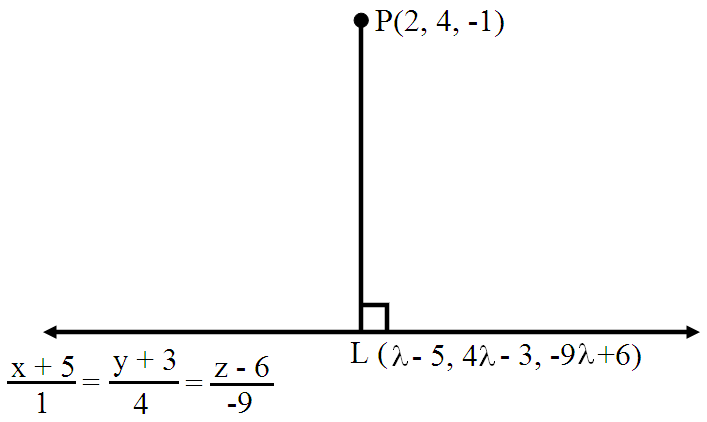
The direction ratios of PL are proportional to $\lambda-5-2,4\lambda-3-4,-9\lambda+6+1,$ i,e. $4\lambda-7,-9\lambda+7.$ The direction ratios of the given line are proportional to 1, 4, -9, but PL is perpendicular to the given line. View full question & answer→Question 535 Marks
Find the equation of the line passing through the points $\hat{\text{i}}+\hat{\text{j}}-3\hat{\text{k}}$ and perpendicular to the lines $\vec{\text{r}}=\hat{\text{i}}+\lambda\big(2\hat{\text{i}}+\hat{\text{j}}-3\hat{\text{k}}\big)$ and $\vec{\text{r}}=\big(2\hat{\text{i}}+\hat{\text{j}}-\hat{\text{k}}\big)+\mu\big(\hat{\text{i}}+\hat{\text{j}}+\hat{\text{k}}\big).$
AnswerWe know that equation of a line passing through a point with position vector $\vec{\text{a}}$ and perpendiculat to $\vec{\text{r}}=\vec{\text{a}}_1+\lambda\vec{\text{b}}_1$ and $\vec{\text{r}}=\vec{\text{a}}_2+\lambda\vec{\text{b}}_2$ is given by
$\vec{\text{r}}=\vec{\text{a}}+\lambda\big(\vec{\text{b}}_1\times\vec{\text{b}}_2\big)\dots(1)$
Here, $\vec{\text{a}}=\big(\hat{\text{i}}+\hat{\text{j}}-3\hat{\text{k}}\big)$
and required line is perpendicular to
$\vec{\text{r}}=\hat{\text{i}}+\lambda\big(2\hat{\text{i}}+\hat{\text{j}}-3\hat{\text{k}}\big)$ and
$\vec{\text{r}}=\big(2\hat{\text{i}}+\hat{\text{j}}-\hat{\text{k}}\big)+\mu\big(\hat{\text{i}}+\hat{\text{j}}+\hat{\text{k}}\big)$
$\Rightarrow\vec{\text{b}}_1=\big(2\hat{\text{i}}+\hat{\text{j}}-3\hat{\text{k}}\big),\vec{\text{b}}_2=\hat{\text{i}}+\hat{\text{j}}+\hat{\text{k}}$
Now,
$\vec{\text{b}}_1\times\vec{\text{b}}_2=\begin{vmatrix}\hat{\text{i}}&\hat{\text{j}}&\hat{\text{k}}\\2&1&-3\\1&1&1\end{vmatrix}$
$=\hat{\text{i}}(1+3)-\hat{\text{j}}(2+3)+\hat{\text{k}}(2-1)$
$\vec{\text{b}}_1\times\vec{\text{b}}_2=4\hat{\text{i}}-5\hat{\text{j}}+\hat{\text{k}}$
Using equation, required equation of line is
$\vec{\text{r}}=\vec{\text{a}}+\lambda\big(\vec{\text{b}}_1\times\vec{\text{b}}_2\big)$
$\vec{\text{r}}=\big(\hat{\text{i}}+\hat{\text{j}}-3\hat{\text{k}}\big)+\lambda\big(4\hat{\text{i}}-5\hat{\text{j}}+\hat{\text{k}}\big)$
View full question & answer→Question 545 Marks
Find the foot of the perpendicular drawn from the point $\hat{\text{i}}+6\hat{\text{j}}+3\hat{\text{k}}$ to the line $\vec{\text{r}}=\hat{\text{j}}+2\hat{\text{k}}+\lambda\big(\hat{\text{i}}+2\hat{\text{j}}+3\hat{\text{k}}\big).$ Also, find the length of the perpendicylar
AnswerLet $\angle$ be the foot of the perpendicular drawn from the point $\text{p}\big(\hat{\text{i}}+6\hat{\text{j}}+3\hat{\text{k}}\big)$ to the line $\vec{\text{r}}=\hat{\text{j}}+2\hat{\text{k}}+\lambda\big(\hat{\text{i}}+2\hat{\text{j}}+3\hat{\text{k}}\big).$ Let the position vector $\angle$ be $\vec{\text{r}}=\hat{\text{j}}+2\hat{\text{k}}+\lambda\big(\hat{\text{i}}+2\hat{\text{j}}+3\hat{\text{k}}\big)$ $=\lambda\hat{\text{i}}+(1+2\lambda)\hat{\text{j}}+(2+3\lambda)\hat{\text{k}}\dots(1)$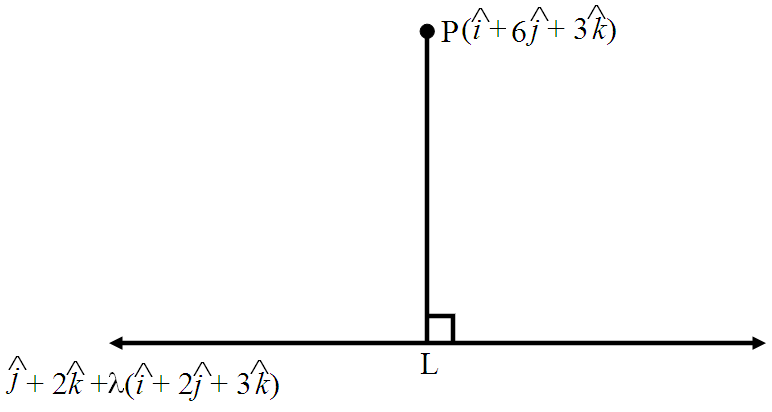
Now, $\overrightarrow{\text{PL}}=$ Position vector of L - Position vector of P $\Rightarrow\overrightarrow{\text{PL}}=\Big\{\lambda\hat{\text{i}}+(1+2\lambda)\hat{\text{j}}+(2+3\lambda)\hat{\text{k}}\Big\}-\big(\hat{\text{i}}+6\hat{\text{j}}+3\hat{\text{k}}\big)$ $\Rightarrow\overrightarrow{\text{PL}}=(\lambda-1)\hat{\text{i}}+(2\lambda-5)\hat{\text{j}}+(3\lambda-1)\hat{\text{k}}\dots(2)$ Since $\overrightarrow{\text{PL}}$ is perpandicular to the given line, which is parallel to $\vec{\text{b}}=\hat{\text{i}}+2\hat{\text{j}}+3\hat{\text{k}},$ we have $\overrightarrow{\text{PL}}.\vec{\text{b}}=0$ $\Rightarrow\Big\{(\lambda-1)\hat{\text{i}}+(2\lambda-5)\hat{\text{j}}+(3\lambda-1)\hat{\text{k}}\Big\}.\big(\hat{\text{i}}+2\hat{\text{j}}+3\hat{\text{k}}\big)=0$ $\Rightarrow1(\lambda-1)+2(2\lambda-5)+3(3\lambda-1)=0$ $\Rightarrow\lambda=1$ Substituting $\lambda=1$ in (1), we get the position vector of $\angle$ as $\hat{\text{i}}+3\hat{\text{j1}}+5\hat{\text{k}}.$ Substituting $\lambda=1$ in (2), we get $\overrightarrow{\text{PL}}=-3\hat{\text{j}}+2\hat{\text{k}}$ $=\sqrt{(-3)^2+2^2}$ $=\sqrt{13}$ Hence, the length of the perpendicular from point P on PL is $\sqrt{13}\text{ units}.$ View full question & answer→Question 555 Marks
Find the angle between the follwing pairs of lines:$\vec{\text{r}}=\big(4\hat{\text{i}}-\hat{\text{j}}\big)+\lambda\big(\hat{\text{i}}+2\hat{\text{j}}-2\hat{\text{k}}\big)$ and $\vec{\text{r}}=\hat{\text{i}}-\hat{\text{j}}+2\hat{\text{k}}-\mu\big(2\hat{\text{i}}+4\hat{\text{j}}-4\hat{\text{k}}\big)$
Answer$\vec{\text{r}}=\big(4\hat{\text{i}}-\hat{\text{j}}\big)+\lambda\big(\hat{\text{i}}+2\hat{\text{j}}-2\hat{\text{k}}\big)$ and $\vec{\text{r}}=\hat{\text{i}}-\hat{\text{j}}+2\hat{\text{k}}-\mu\big(2\hat{\text{i}}+4\hat{\text{j}}-4\hat{\text{k}}\big)$
Let $b_1$ and $b_2$ be vectors parallel to the given lines.
Now,
$\vec{\text{b}}_1=\hat{\text{i}}+2\hat{\text{j}}-2\hat{\text{k}}$
$\vec{\text{b}}_2=2\hat{\text{i}}+4\hat{\text{j}}-4\hat{\text{k}}$
If $\theta$ is the angle between the given lines, then
$\cos\theta=\frac{\vec{\text{b}}_1.\vec{\text{b}}_2}{\big|\vec{\text{b}}_1\big|\big|\vec{\text{b}}_2\big|}$
$=\frac{\big(\hat{\text{i}}+2\hat{\text{j}}-2\hat{\text{k}}\big).\big(2\hat{\text{i}}+4\hat{\text{j}}-4\hat{\text{k}}\big)}{\sqrt{1^2+2^2+(-2)^2}\sqrt{2^2+4^2+(-4)^2}}$
$=\frac{2+8+8}{3\times6}$
$=1$
$\Rightarrow\theta=0^{\circ}$
View full question & answer→Question 565 Marks
Show that the points whose position vectors are $-2\hat{\text{i}}+3\hat{\text{j}},\hat{\text{i}}+2\hat{\text{j}}+3\hat{\text{k}}$ and $7\hat{\text{i}}-\hat{\text{k}}$ are collinear.
AnswerLet the given points be P, Q and R and let their position vectors be $\vec{\text{a}},\vec{\text{b}}$ and $\vec{\text{c}},$ respectively.
$\vec{\text{a}}=-2\hat{\text{i}}+3\hat{\text{j}}$
$\vec{\text{b}}=\hat{\text{i}}+2\hat{\text{j}}+3\hat{\text{k}}$
$\vec{\text{c}}=7\hat{\text{i}}+9\hat{\text{k}}$
Vector equation of line passing through P and Q is
$\vec{\text{r}}=\vec{\text{a}}+\lambda\big(\vec{\text{b}}-\vec{\text{a}}\big)$
$\Rightarrow\vec{\text{r}}=\big(-2\hat{\text{i}}+3\hat{\text{j}}\big)+\lambda\big\{\big(\hat{\text{i}}+2\hat{\text{j}}+3\hat{\text{k}}\big)-\big(-2\hat{\text{i}}+3\hat{\text{j}}\big)\big\}$
$\Rightarrow\vec{\text{r}}=\big(-2\hat{\text{i}}+3\hat{\text{j}}\big)+\lambda\big(3\hat{\text{i}}-\hat{\text{j}}+3\hat{\text{k}}\big)\dots(1)$
If points P, Qand R are collinear, then point R must satisfy (1).
Replacing $\vec{\text{r}}$ by $\vec{\text{c}}=7\hat{\text{i}}+9\hat{\text{k}}$ in (1), we get
$7\hat{\text{i}}+9\hat{\text{k}}=\big(-2\hat{\text{i}}+3\hat{\text{j}}\big)+\lambda\big(3\hat{\text{i}}-\hat{\text{j}}+3\hat{\text{k}}\big)$
Comparing the coefficients of $\hat{\text{i}},\hat{\text{j}}$ and $\hat{\text{k}},$ we get
$7=-2+3\lambda,0=3-\lambda,9=3\lambda$
$\therefore\lambda=3$
These three equations are consistent, i.e. they give the same value of $\lambda.$
Hence, the given three points are colinear.
Disclaimar: The question given in the book has a minor error. The third vectors should be $7\hat{\text{i}}+9\hat{\text{k}}.$
The solution here is created accordingly
View full question & answer→Question 575 Marks
Find the foot of the perpendicular from (1, 2, -3) on the line $\frac{\text{x}+1}{2}=\frac{\text{y}-3}{-2}=\frac{\text{z}}{-1}.$
AnswerLet L be the foot of the perpendicular drawn from the point P(1, 2, -3) to the given line. The coordinates of a general point on the line $\frac{\text{x}+1}{2}=\frac{\text{y}-3}{-2}=\frac{\text{z}}{-1}=\lambda$ are given by $\frac{\text{x}+1}{2}=\frac{\text{y}-3}{-2}=\frac{\text{z}}{-1}=\lambda$ $\Rightarrow\text{x}=2\lambda-1$ $\text{y}=-2\lambda+3$ $\text{z}=-\lambda$ Let the coordinates of L be $2\lambda-1,-2\lambda+3,-\lambda.$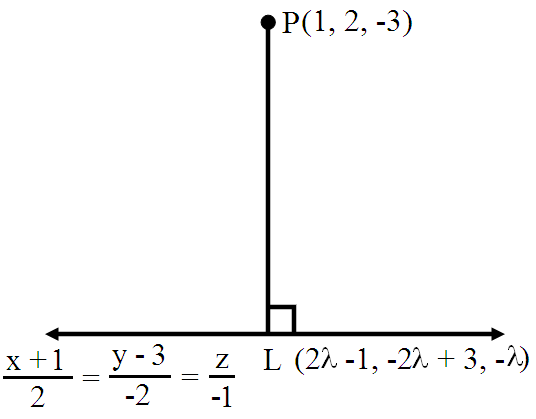
The direction ratios of PL are proportional to $2\lambda-1-1,-2\lambda+3-2,-\lambda+3,$ i.e. $2\lambda-2,-2\lambda+1,-\lambda+3.$ The direction ratios of the given line are proportional to 2, -2, -1, but PL is perpendicular to the given line. $\therefore22\lambda-2-2-2\lambda+1-1-\lambda+3=0\Rightarrow\lambda=1$ Substituting $\lambda=1$ in $2\lambda-1,-2\lambda+3,-\lambda,$ we get the coordinates of L as 1, 1, -1. View full question & answer→Question 585 Marks
Find the vector equation of a line passing through the point with position vector $\hat{\text{i}}-2\hat{\text{j}}-3\hat{\text{k}}$ and parallel to the line joining the points with position vectors $\hat{\text{i}}-\hat{\text{j}}+4\hat{\text{k}}$ and $2\hat{\text{i}}+\hat{\text{j}}+2\hat{\text{k}}.$ Also, find the cartesian equivalent of this equation.
AnswerWe know that, equation of a line passing through $\vec{\text{a}}$ and parallel to vector $\vec{\text{b}}$ is,
$\vec{\text{r}}=\vec{\text{a}}+\lambda\vec{\text{b}}\dots(1)$
Here, $\vec{\text{a}}=\hat{\text{i}}-2\hat{\text{j}}-3\hat{\text{k}}$
and, $\vec{\text{b}}=$ line joining $\big(\hat{\text{i}}-\hat{\text{j}}+4\hat{\text{k}}\big)$ and $\big(2\hat{\text{i}}+\hat{\text{j}}+2\hat{\text{k}}\big)$
$=\big(2\hat{\text{i}}+\hat{\text{j}}+2\hat{\text{k}}\big)-\big(\hat{\text{i}}-\hat{\text{j}}+4\hat{\text{k}}\big)$
$=2\hat{\text{i}}-\hat{\text{i}}+\hat{\text{j}}+\hat{\text{j}}+2\hat{\text{k}}-4\hat{\text{k}}$
$=\hat{\text{i}}+2\hat{\text{j}}-2\hat{\text{k}}$
Equation of the line is
$\vec{\text{r}}=\big(\hat{\text{i}}-2\hat{\text{j}}-3\hat{\text{k}}\big)+\lambda\big(\hat{\text{i}}+2\hat{\text{j}}-2\hat{\text{k}}\big)$
For cortesion form of equation put $\text{x}\hat{\text{i}}+\text{y}\hat{\text{j}}+\text{z}\hat{\text{k}},$
$\text{x}\hat{\text{i}}+\text{y}\hat{\text{j}}+\text{z}\hat{\text{k}}=(1+\lambda)\hat{\text{i}}+(-2+2\lambda)\hat{\text{j}}+(-3-2\lambda)\hat{\text{k}}$
Equating coeffcients of $\hat{\text{i}},\hat{\text{j}},\hat{\text{k}}$ so
$\text{x}=1+\lambda,\text{y}=-2+2\lambda,\text{z}=-3-2\lambda$
$\Rightarrow\frac{\text{x}-1}{1}=\lambda,\frac{\text{y}+2}{2}=\lambda,\frac{\text{z}+3}{-2}=\lambda$
So, $\frac{\text{x}-1}{1}=\frac{\text{y}+2}{2}=\frac{\text{z}+3}{-2}$
View full question & answer→Question 595 Marks
Find the angle between the pairs of lines with direction ratios proportional to
$5, -12, 13$ and $-3, 4, 5$
AnswerWe know that, angle $(\theta)$ between two lines
$\frac{\text{x}-\text{x}_1}{\text{a}_1}=\frac{\text{y}-\text{y}_1}{\text{b}_1}=\frac{\text{z}-\text{z}_1}{\text{c}_1}$ and $\frac{\text{x}-\text{x}_2}{\text{a}_2}=\frac{\text{y}-\text{y}_2}{\text{b}_2}=\frac{\text{z}-\text{z}_2}{\text{c}_2}$
Is given by,
$\cos\theta=\frac{\text{a}_1\text{a}_2+\text{b}_1\text{b}_2+\text{c}_1\text{c}_2}{\sqrt{{\text{a}_1}^2+{{\text{b}_1}^2}+{{\text{c}_1}^2}}\sqrt{{\text{a}_2}^2+{{\text{b}_2}^2}+{{\text{c}_2}^2}}}\dots(1)$
Here, $a_1= 5, b_1= -12, c_{1 =}13$
$a_2= -3, b_2= 4, c_2= 5$
Let $\theta$ be the required angle, so using equation (1),
$\cos\theta=\frac{(5)(-3)+(-12)(4)+(13)(5)}{\sqrt{(5)^2+(-12)^2+(13)^2}\sqrt{(-3)^2+(4)^2+(5)^2}}$
$=\frac{-15-48+65}{\sqrt{169\times2}\sqrt{25\times2}}$
$=\frac{2}{65\times2}$
$\cos\theta=\frac{1}{65}$
$\theta=\cos^{-1}\Big(\frac{1}{65}\Big)$
View full question & answer→Question 605 Marks
Find the direction cosines of the line $\frac{\text{x}+2}{2}=\frac{2\text{y}-7}{6}=\frac{5-\text{z}}{6}.$ Also, find the vector equation of the line through the point A(-1, 2, 3) and parallel to the given line.
AnswerThe equation of the given line is $\frac{\text{x}+2}{2}=\frac{2\text{y}-7}{6}=\frac{5-\text{z}}{6}.$
The given equation can be re-written as $\frac{\text{x}+2}{2}=\frac{\text{y}-\frac{7}{2}}{3}=\frac{\text{z}-5}{-6.}$
This line passes through the point $\big(-2, \frac{7}{2}, 5\big)$ and has direction ratios proportionl to 2, 3, -6.
So, its direction cosines are
$\frac{2}{\sqrt{2^2+3^2+(-6)^2}},\frac{3}{\sqrt{2^2+3^2+(-6)^2}},\frac{-6}{\sqrt{2^2+3^2+(-6)^2}}$
$\text{or }\frac{2}{7},\frac{3}{7},\frac{-6}{7}$
The required line passes throuth the point having position vector $\vec{\text{a}}=-\hat{\text{i}}+2\hat{\text{j}}+3\hat{\text{k}}$ and is parallel to the vector $\vec{\text{b}}=2\hat{\text{i}}+3\hat{\text{j}}-6\hat{\text{k}}.$
So, its vector equation is
$\vec{\text{r}}=\big(-\hat{\text{i}}+2\hat{\text{j}}+3\hat{\text{k}}\big)+\lambda\big(2\hat{\text{i}}+3\hat{\text{j}}-6\hat{\text{k}}\big)$
View full question & answer→Question 615 Marks
Find the shortest distance between the following pairs of parallel lines whose equations are:
$\vec{\text{r}}=\big(\hat{\text{i}}+\hat{\text{j}}\big)+\lambda\big(2\hat{\text{i}}-\hat{\text{j}}+\hat{\text{k}}\big)$ and $\vec{\text{r}}=\big(2\hat{\text{i}}+\hat{\text{j}}-\hat{\text{k}}\big)+\mu\big(4\hat{\text{i}}-2\hat{\text{j}}+2\hat{\text{k}}\big)$
Answer$\vec{\text{r}}=\big(\hat{\text{i}}+\hat{\text{j}}\big)+\lambda\big(2\hat{\text{i}}-\hat{\text{j}}+\hat{\text{k}}\big)$ and $\vec{\text{r}}=\big(2\hat{\text{i}}+\hat{\text{j}}-\hat{\text{k}}\big)+\mu\big(4\hat{\text{i}}-2\hat{\text{j}}+2\hat{\text{k}}\big)$ or $\vec{\text{r}}=\big(2\hat{\text{i}}+\hat{\text{j}}-\hat{\text{k}}\big)+2\mu\big(2\hat{\text{i}}-\hat{\text{j}}+\hat{\text{k}}\big)$
These two lines pass through the points having position vectors
$\vec{\text{a}}_1=\hat{\text{i}}+\hat{\text{j}}$ and $\vec{\text{a}}_2=2\hat{\text{i}}+\hat{\text{j}}-\hat{\text{k}}$ and are parallel to the vector $\vec{\text{b}}=2\hat{\text{i}}-\hat{\text{j}}+\hat{\text{k}}.$
Now,
$\vec{\text{a}}_2-\vec{\text{a}}_1=\hat{\text{i}}-\hat{\text{k}}$
and
$\big(\vec{\text{a}}_2-\vec{\text{a}}_1\big)\times\vec{\text{b}}=\big(\hat{\text{i}}-\hat{\text{k}}\big)\times\big(2\hat{\text{i}}-\hat{\text{j}}+\hat{\text{k}}\big)$
$=\begin{vmatrix}\hat{\text{i}}&\hat{\text{j}}&\hat{\text{k}}\\1&0&-1\\2&-1&1 \end{vmatrix}$
$=-\hat{\text{i}}-3\hat{\text{j}}-\hat{\text{k}}$
$\Rightarrow\big|\big(\vec{\text{a}}_2-\vec{\text{a}}_1\big)\times\vec{\text{b}}\big|=\sqrt{(-1)^2+(-3)^2+(-1)^2}$
$=\sqrt{1+9+1}$
$=\sqrt{11}$
The shortest distance between the two lines is given by
$\frac{\big|\big(\vec{\text{a}}_2-\vec{\text{a}}_1\big)\times\vec{\text{b}}\big|}{\big|\vec{\text{b}}}\big|=\frac{\sqrt{11}}{\sqrt{6}}$
View full question & answer→Question 625 Marks
Find the foot of the perpendicular drawn from the point A(1, 0, 3) to the joint of the points B(4, 7, 1) and C(3, 5, 3).
AnswerLet the foot of the perpendicular drawn from A(1, 0, 3) to the line joining the points B(4, 7, 1) And C(3, 5, 3) be D
Equation of line passing through B(4, 7, 1) and C(3, 5, 3) is
$\frac{\text{x}-\text{x}1}{\text{x}2-\text{x}1}=\frac{\text{y}-\text{y}1}{\text{y}2-\text{y}1}=\frac{\text{z}-\text{z}1}{\text{z}2-\text{z}1}$
$\Rightarrow\frac{\text{x}-4}{3-4}=\frac{\text{y}-7}{5-7}=\frac{\text{z}-1}{3-1}$
$\Rightarrow\frac{\text{x}-4}{-1}=\frac{\text{y}-7}{-2}=\frac{\text{z}-1}{2}=\lambda$ (say)
Direction ratios of AD are
$(-\lambda+4-1),(-2\lambda+7-0),(2\lambda+1-3)$
$=(-\lambda+3),(-2\lambda+7),(2\lambda-2)$
Line AD is perpendicular to BC so
$\text{a}_1\text{a}_2+\text{b}_1\text{b}_2+\text{c}_1\text{c}_2=0$
$\Rightarrow(-1)(-\lambda+3)+(-2)(-2\lambda+7)+2(2\lambda-2)=0$
$\Rightarrow\lambda-3+4\lambda-14+4\lambda-4=0$
$\Rightarrow9\lambda-21=0$
$\Rightarrow\lambda=\frac{21}{9}$
Co-ordinates of D are
$=\Big(-\frac{21}{9}+4,(-2)\Big(\frac{21}{9}+7\Big),2\Big(\frac{21}{9}+1\Big)\Big)$
$=\Big(\frac{15}{9},\frac{21}{9},\frac{51}{9}\Big)$
$=\Big(\frac{5}{3},\frac{7}{3},\frac{17}{3}\Big)$
View full question & answer→Question 635 Marks
Find the angle between the following pairs of lines:$\frac{\text{x}-1}{2}=\frac{\text{y}-2}{3}=\frac{\text{z}-3}{-3}$ and $\frac{\text{x}+3}{-1}=\frac{\text{y}-5}{8}=\frac{\text{z}-1}{4}$
Answer$\frac{\text{x}-1}{2}=\frac{\text{y}-2}{3}=\frac{\text{z}-3}{-3}$ and $\frac{\text{x}+3}{-1}=\frac{\text{y}-5}{8}=\frac{\text{z}-1}{4}$
Let $\vec{\text{b}}_1$ and $\vec{\text{b}}_2$ be vectors parallel to the given lines.
Now,
$\vec{\text{b}}_1=2\hat{\text{i}}+3\hat{\text{j}}-3\hat{\text{k}}$
$\vec{\text{b}}_2=-\hat{\text{i}}+8\hat{\text{j}}+4\hat{\text{k}}$
If $\theta$ is the angle between the given lines, then
$\cos\theta=\frac{\vec{\text{b}}_1.\vec{\text{b}}_2}{\big|\vec{\text{b}}_1\big|\big|\vec{\text{b}}_2\big|}$
$=\frac{\big(2\hat{\text{i}}+3\hat{\text{j}}-3\hat{\text{k}}\big).\big(-\hat{\text{i}}+8\hat{\text{j}}+4\hat{\text{k}}\big)}{\sqrt{2^2+3^2+(-3)^2}\sqrt{(-1)^2+8^2+4^2}}$
$=\frac{-2+24-12}{9\sqrt{22}}$
$=\frac{10}{9\sqrt{22}}$
$\Rightarrow\theta=\cos^{-1}\Big(\frac{10}{9\sqrt{22}}\Big)$
View full question & answer→Question 645 Marks
Prove that the lines through A(0, -1, -1) and B(4, 5, 1) intersects the line through C(3, 9, 4) and D(-4, 4, 4). Also, find their point of intersection.
AnswerThe coordinates of any point on the line AB are given by
$\frac{\text{x}-0}{4-0}=\frac{\text{y}+1}{5+1}=\frac{\text{z}+1}{1+1}=\lambda$
$\Rightarrow\text{x}=4\lambda$
$\text{y}=6\lambda-1$
$\text{z}=2\lambda-1$
The coordinates of a general point on AB are $4\lambda,6\lambda-1,2\lambda-1.$
The coordinates of any point on the line CD are given by
$\frac{\text{x}-3}{3+4}=\frac{\text{y}-9}{9-4}=\frac{\text{z}-4}{4-4}=\mu$
$\Rightarrow\text{x}=7\mu+3$
$\text{y}=5\mu+9$
$\text{z}=4$
The coordinates of a general point on CD are $7\mu+3,5\mu+9,4.$
If the lines AB and CD intersect, then they have a common point. so, for some valuse of $\lambda$ and $\mu,$
We must have
$4\lambda=7\mu+3,6\lambda-1=5\mu+9,2\lambda-1=4$
$\Rightarrow4\lambda-7\mu=3\dots(1)$
$6\lambda-5\mu=10\dots(2)$
$\lambda=\frac{5}{2}\dots(3)$
Solving (2) and (3), we get
$\lambda=\frac{5}{2}$
$\mu=1$
Substituting $\lambda=\frac{5}{2}$ and $\mu=1$ in (1), we get
$\text{LHS}=4\lambda-7\mu$
$=4\Big(\frac{5}{2}\Big)-7(1)$
$=3$
$=\text{RHS}$
Since $\lambda=\frac{5}{2}$ and $\mu=1$ satisfy (3), the given lines intersect.
substituting the value of $\lambda$ in the coordinates of a general point on the line AB, we get
x = 10
y = 14
z = 4
Hence, AB and CD intersect at point (10, 14, 4).
View full question & answer→Question 655 Marks
Find the distance between the lines $l_1$ and$ l_2$ given by$\vec{\text{r}}=\hat{\text{i}}+2\hat{\text{j}}-4\hat{\text{k}}+\lambda\big(2\hat{\text{i}}+3\hat{\text{j}}+6\hat{\text{k}}\big)$ and, $\vec{\text{r}}=3\hat{\text{i}}+3\hat{\text{j}}-5\hat{\text{k}}+\mu\big(2\hat{\text{i}}+3\hat{\text{j}}+6\hat{\text{k}}\big)$
Answer$\vec{\text{a}}_1=\hat{\text{i}}+2\hat{\text{j}}-4\hat{\text{k}}$
$\vec{\text{a}}_2=3\hat{\text{i}}+3\hat{\text{j}}-5\hat{\text{k}}$
$\vec{\text{a}}_2-\vec{\text{a}}_1=3\hat{\text{i}}+3\hat{\text{j}}-5\hat{\text{k}}-\hat{\text{i}}-2\hat{\text{j}}+4\hat{\text{k}}$
$=2\hat{\text{i}}+\hat{\text{j}}-\hat{\text{k}}$
$\vec{\text{b}}=2\hat{\text{i}}+3\hat{\text{j}}+6\hat{\text{k}}$
$\big(\vec{\text{a}}_2-\vec{\text{a}}_1\big)\times\vec{\text{b}}=\begin{vmatrix}\hat{\text{i}}&\hat{\text{j}}&\hat{\text{k}}\\2&1&-1\\2&3&6\end{vmatrix}$
$=\hat{\text{i}}(6+3)-\hat{\text{j}}(12+2)+\hat{\text{k}}(6-2)$
$=9\hat{\text{i}}-14\hat{\text{j}}+4\hat{\text{k}}$
Shortest distance between 2 lines
$=\Bigg|\frac{\big(\vec{\text{a}}_2-\vec{\text{a}}_1\big)\times\vec{\text{b}}}{\big|\vec{\text{b}}\big|}\Bigg|$
$=\Bigg|\frac{9\hat{\text{i}}-14\hat{\text{j}}+4\hat{\text{k}}}{\big|\sqrt{2^2+3^2+6^2}\big|}\Bigg|$
$=\Bigg|\frac{9\hat{\text{i}}-14\hat{\text{j}}+4\hat{\text{k}}}{\sqrt{49}}\Bigg|$
$=\Bigg|\frac{\sqrt{9^2+(-14)^2+4^2}}{\sqrt{49}}\Bigg|$
$=\Big|\frac{\sqrt{293}}{\sqrt{49}}\Big|=\frac{\sqrt{293}}{7}\text{ units}$
View full question & answer→Question 665 Marks
Find the angle between the follwing pairs of lines:$\vec{\text{r}}=\big(3\hat{\text{i}}+2\hat{\text{j}}-4\hat{\text{k}}\big)+\lambda\big(\hat{\text{i}}+2\hat{\text{j}}+2\hat{\text{k}}\big)$ and $\vec{\text{r}}=\big(5\hat{\text{j}}-2\hat{\text{k}}\big)+\mu\big(3\hat{\text{i}}+2\hat{\text{j}}+6\hat{\text{k}}\big)$
Answer$\vec{\text{r}}=\big(3\hat{\text{i}}+2\hat{\text{j}}-4\hat{\text{k}}\big)+\lambda\big(\hat{\text{i}}+2\hat{\text{j}}+2\hat{\text{k}}\big)$ and $\vec{\text{r}}=\big(5\hat{\text{j}}-2\hat{\text{k}}\big)+\mu\big(3\hat{\text{i}}+2\hat{\text{j}}+6\hat{\text{k}}\big)$
Let $b_1$ and $b_2$ be vectors parallel to the given lines.
Now,
$\vec{\text{b}}_1=\hat{\text{i}}+2\hat{\text{j}}+2\hat{\text{k}}$
$\vec{\text{b}}_2=3\hat{\text{i}}+2\hat{\text{j}}+6\hat{\text{k}}$
If $\theta$ is the angle between the given lines, then
$\cos\theta=\frac{\vec{\text{b}}_1.\vec{\text{b}}_2}{\big|\vec{\text{b}}_1\big|\big|\vec{\text{b}}_2\big|}$
$=\frac{\big(\hat{\text{i}}+2\hat{\text{j}}+2\hat{\text{k}}\big).\big(3\hat{\text{i}}+2\hat{\text{j}}+6\hat{\text{k}}\big)}{\sqrt{1^1+2^2+2^2}\sqrt{3^2+2^2+6^2}}$
$=\frac{3+4+12}{3\times7}$
$=\frac{19}{21}$
$\Rightarrow\theta=\cos^{-1}\Big(\frac{19}{21}\Big)$
View full question & answer→Question 675 Marks
Find the vector equation of the line passing through the points (-1, 0, 2) and (3, 4, 6).
AnswerWe know that the vector equation of a line passing through the points with position vectors $\vec{\text{a}}$ and $\vec{\text{b}}$ is $\vec{\text{r}}=\vec{\text{a}}+\lambda\big(\vec{\text{b}}-\vec{\text{a}}\big) $ where $\lambda$ is a scalar.
Here,
$\vec{\text{a}}=-1\hat{\text{i}}+0\hat{\text{j}}+2\hat{\text{k}}$
$\vec{\text{b}}=3\hat{\text{i}}+4\hat{\text{j}}+6\hat{\text{k}}$
Vector equation of the required line is
$\vec{\text{r}}=\big(-1\hat{\text{i}}+0\hat{\text{j}}+2\hat{\text{k}}\big)+\lambda\big\{\big(3\hat{\text{i}}+4\hat{\text{j}}+6\hat{\text{k}}\big)-\big(-1\hat{\text{i}}+0\hat{\text{j}}+12\hat{\text{k}}\big)\big\}$
$\Rightarrow\vec{\text{r}}=\big(-1\hat{\text{i}}+0\hat{\text{j}}+2\hat{\text{k}}\big)+\lambda\big(4\hat{\text{i}}+4\hat{\text{j}}+4\hat{\text{k}}\big)$
Here, $\lambda$ is a parameter.
View full question & answer→Question 685 Marks
Find the angle between the following pairs of lines:$\frac{\text{x}-2}{3}=\frac{\text{y}+3}{-2},\text{z}=5$ and $\frac{\text{x}+1}{1}=\frac{2\text{y}-3}{3}=\frac{\text{z}-5}{2}$
Answer$\frac{\text{x}-2}{3}=\frac{\text{y}+3}{-2},\text{z}=5$ and $\frac{\text{x}+1}{1}=\frac{2\text{y}-3}{3}=\frac{\text{z}-5}{2}$ The equations of the given lines can be re-written as $\frac{\text{x}-2}{3}=\frac{\text{y}+3}{-2}=\frac{\text{z}-5}{0}$ and $\frac{\text{x}+1}{1}=\frac{\text{y}-\frac{3}{2}}{\frac{3}{2}}=\frac{\text{z}-5}{2}$ Let $\vec{\text{b}}_1$ and $\vec{\text{b}}_2$ be vectors parallel to the given lines. Now, $\vec{\text{b}}_1=3\hat{\text{i}}-2\hat{\text{j}}+0\hat{\text{k}}$ $\vec{\text{b}}_2=\hat{\text{i}}+\frac{3}{2}\hat{\text{j}}+2\hat{\text{k}}$ If $\theta$ is the angle between the given lines, then $\cos\theta=\frac{\vec{\text{b}}_1.\vec{\text{b}}_2}{\big|\vec{\text{b}}_1\big|\big|\vec{\text{b}}_2\big|}$ $=\frac{\big(3\hat{\text{i}}-2\hat{\text{j}}+0\hat{\text{k}}\big).\big(\hat{\text{i}}+\frac{3}{2}\hat{\text{j}}+2\hat{\text{k}}\big)}{\sqrt{3^2+(-2)^2+0^2}\sqrt{1^2+\Big(\frac{3}{2}\Big)+2^2}}$ $=\frac{3-3+0}{\sqrt{13}\sqrt{\frac{29}{4}}}$ $=0$$\Rightarrow\theta=\frac{\pi}{2}$
View full question & answer→Question 695 Marks
Find the equation of the perpendicular drawn from the point P(-1, 3, 2) to the line $\vec{\text{r}}=\big(2\hat{\text{j}}+3\hat{\text{k}}\big)+\lambda\big(2\hat{\text{i}}+\hat{\text{j}}+3\hat{\text{k}}\big).$ Also, find the coordinates of the foot of the perpendicular from P.
AnswerLet Q be the perpendicular drow from $\text{p}\big(\hat{-\text{i}}+3\hat{\text{j}}+2\hat{\text{k}}\big)$ on the line
$\vec{\text{r}}=\big(2\hat{\text{j}}+3\hat{\text{k}}\big)+\lambda\big(2\hat{\text{i}}+\hat{\text{j}}+3\hat{\text{k}}\big)$
Let the position vector of Q be
$\big (2\hat{\text{j}}+3\hat{\text{k}}\big)+\lambda\big(2\hat{\text{i}}+\hat{\text{j}}+3\hat{\text{k}}\big)$
$\big(2\lambda\big)\hat{\text{i}}+\big(2+\lambda\big)\hat{\text{j}}+\big(3+3\lambda\big)\hat{\text{k}}$
$\overrightarrow{\text{PQ}}=$ position vector of Q-position vector of P
$\big\{\big(2\lambda\big)\hat{\text{i}}+\big(2+\lambda\big)\hat{\text{j}}+\big(3+3\lambda\big)\hat{\text{k}}\big\}-\big(-\hat{\text{i}}+3\hat{\text{j}}+2\hat{\text{k}}\big)$
$=(2\lambda+1)\hat{\text{i}}+(2\lambda-3)\hat{\text{j}}+(3+3\lambda-2)\hat{\text{k}}$
$\overrightarrow{\text{PQ}}=(2\lambda+1)\hat{\text{i}}+(\lambda-1)\hat{\text{j}}+(3\lambda+1)\hat{\text{k}}$
Since, $\overrightarrow{\text{PQ}}$ is perpendicular to given line, so
$\big\{(2\lambda+1)\hat{\text{i}}+(\lambda-1)\hat{\text{j}}+(3\lambda+1)\hat{\text{k}}\big\}\big(2\hat{\text{i}}+\hat{\text{j}}+3\hat{\text{k}}\big)=0$
$(2\lambda+1)(2)+(\lambda-1)(1)+(3\lambda+1)3=0$
$4\lambda+2+\lambda-1+9\lambda+3=0$
$14\lambda+4=0$
$\lambda=-\frac{4}{14}$
$\lambda=-\frac{2}{7}$
Position vector of Q $=(2\lambda)\hat{\text{i}}+(2+\lambda)\hat{\text{j}}+(3+3\lambda)\hat{\text{k}}$
$=2\Big(-\frac{2}{7}\Big)\hat{\text{i}}+\Big(2-\frac{2}{7}\Big)\hat{\text{j}}+\Big(3+3\Big(-\frac{2}{7}\Big)\Big)\hat{\text{k}}$
$=-\frac{4}{7}\hat{\text{i}}+\frac{12}{7}\hat{\text{j}}+\frac{15}{7}\hat{\text{k}}$
Coordinates of foot of the perpendicular $=\Big(-\frac{4}{7},\frac{12}{7},\frac{15}{7}\Big)$
Equation of PQ is
$\vec{\text{r}}=\vec{\text{a}}+\lambda\big(\vec{\text{b}}-\vec{\text{a}}\big)$
$\Rightarrow\vec{\text{r}}=\big(-\hat{\text{i}}+3\hat{\text{j}}+2\hat{\text{k}}\big)+\lambda\Big(\Big(-\frac{4}{7}\hat{\text{i}}+\frac{12}{7}\hat{\text{j}}+\frac{15}{7}\hat{\text{k}}\Big)-\big(-\hat{\text{i}}+3\hat{\text{j}}+2\hat{\text{k}}\big)\Big)$
View full question & answer→Question 705 Marks
Find the shortest distance between the following pairs of lines whose cartesian equation are:
$\frac{\text{x}-1}{2}=\frac{\text{y}+1}{3}=\text{z}$ and $\frac{\text{x}+2}{3}=\frac{\text{y}-2}{1};\text{z}=2$
AnswerThe equation of the given are
$\frac{\text{x}-1}{2}=\frac{\text{y}+1}{3}=\frac{\text{z}-0}{1}\dots(1)$
$\frac{\text{x}+1}{3}=\frac{\text{y}-2}{1}=\frac{\text{z}-2}{0}\dots(2)$
Since line (1) passes through the point (1, -1, 0) and has direction ratios proportional to 2, 3, 1, its vector equation is
$\vec{\text{r}}=\vec{\text{a}}_1+\lambda\vec{\text{b}}_1$
Here,
$\vec{\text{a}}_1=\hat{\text{i}}-\hat{\text{j}}+0\hat{\text{k}}$
$\vec{\text{b}}_1=2\hat{\text{i}}+3\hat{\text{j}}+\hat{\text{k}}$
Also, line (2) passes through the point (-1, 2, 2) and has diraction ratios proportional to 3, 1, 0.
Its vector equation is
$\vec{\text{r}}=\vec{\text{a}}_2+\mu\vec{\text{b}}_2$
Here,
$\vec{\text{a}}_2=-\hat{\text{i}}+2\hat{\text{j}}+2\hat{\text{k}}$
$\vec{\text{b}}_2=3\hat{\text{i}}+\hat{\text{j}}+0\hat{\text{k}}$
Now,
$\vec{\text{a}}_2-\vec{\text{a}}_1=-2\hat{\text{i}}+3\hat{\text{j}}+2\hat{\text{k}}$
and $\vec{\text{b}}_1\times\vec{\text{b}}_2=\begin{vmatrix}\hat{\text{i}}&\hat{\text{j}}&\hat{\text{k}}\\2&3&1\\3&1&0\end{vmatrix}$
$=-\hat{\text{i}}+3\hat{\text{j}}-7\hat{\text{k}}$
$\Rightarrow\big|\vec{\text{b}}_1\times\vec{\text{b}}_2\big|=\sqrt{(-1)^2+3^2(-7)^2}$
$=\sqrt{1+9+49}$
$=\sqrt{59}$
and $\big(\vec{\text{a}}_2-\vec{\text{a}}_1\big).\big(\vec{\text{b}}_1\times\vec{\text{b}}_2\big)=\big(-2\hat{\text{i}}+3\hat{\text{j}}+2\hat{\text{k}}\big).\big(-\hat{\text{i}}+3\hat{\text{j}}-7\hat{\text{k}}\big)$
$=2+9-14$
$=-3$
The shortest distance between the lines $\vec{\text{r}}=\vec{\text{a}}_1+\lambda\vec{\text{b}}_1$ and $\vec{\text{r}}=\vec{\text{a}}_2+\mu\vec{\text{b}}_2$ is given by
$\text{d}=\Bigg|\frac{\big(\vec{\text{a}}_2-\vec{\text{a}}_1\big).\big(\vec{\text{b}}_1\times\vec{\text{b}}_2\big)}{\big|\vec{\text{b}}_1\times\vec{\text{b}}_2\big|}\Bigg|$
$=\Big|\frac{-3}{\sqrt{59}}\Big|$
$=\frac{3}{\sqrt{59}}$
View full question & answer→Question 715 Marks
Find the shortest distance between the following pairs of parallel lines whose equations are:$\vec{\text{r}}=\big(\hat{\text{i}}+2\hat{\text{j}}+3\hat{\text{k}}\big)+\lambda\big(\hat{\text{i}}-\hat{\text{j}}+\hat{\text{k}}\big)$ and $\vec{\text{r}}=\big(2\hat{\text{i}}-\hat{\text{j}}-\hat{\text{k}}\big)+\mu\big(-\hat{\text{i}}+\hat{\text{j}}-\hat{\text{k}}\big)$
AnswerThe vector equation of the given lines are
$\vec{\text{r}}=\big(\hat{\text{i}}+2\hat{\text{j}}+3\hat{\text{k}}\big)+\lambda\big(\hat{\text{i}}-\hat{\text{j}}+\hat{\text{k}}\big)$
$\vec{\text{r}}=\big(2\hat{\text{i}}-\hat{\text{j}}-\hat{\text{k}}\big)+\mu\big(-\hat{\text{i}}+\hat{\text{j}}-\hat{\text{k}}\big)$
$=\big(2\hat{\text{i}}-\hat{\text{j}}-\hat{\text{k}}\big)-\mu\big(\hat{\text{i}}-\hat{\text{j}}+\hat{\text{k}}\big)$
These two lines pass through the points having position vectors $\vec{\text{a}}_1=\hat{\text{i}}+2\hat{\text{j}}+3\hat{\text{k}}$ and $\vec{\text{a}}_2=2\hat{\text{i}}-\hat{\text{j}}-\hat{\text{k}}$ and are parallel to the vector $\vec{\text{b}}=\hat{\text{i}}-\hat{\text{j}}+\hat{\text{k}}$
Now,
$\big(\vec{\text{a}}_2-\vec{\text{a}}_1\big)\times\vec{\text{b}}=\big(\hat{\text{i}}-3\hat{\text{j}}-4\hat{\text{k}}\big)\times\big(\hat{\text{i}}-\hat{\text{j}}+\hat{\text{k}}\big)$
$=\begin{vmatrix}\hat{\text{i}}&\hat{\text{j}}&\hat{\text{k}}\\1&-3&-4\\1&-1&1 \end{vmatrix}$
$=-7\hat{\text{i}}-5\hat{\text{j}}+2\hat{\text{k}}$
$\Rightarrow\big|\big(\vec{\text{a}}_2-\vec{\text{a}}_1\big)\times\vec{\text{b}}\big|=\sqrt{(-7)^2+(-5)^2+2^2}$
$=\sqrt{49+25+4}$
$=\sqrt{78}$
The shortest distance between the two lines is given by
$\frac{\big|\big(\vec{\text{a}}_2-\vec{\text{a}}_1\big)\times\vec{\text{b}}\big|}{\big|\vec{\text{b}}\big|}=\frac{\sqrt{78}}{\sqrt{3}}=\sqrt{26}$
View full question & answer→Question 725 Marks
Find the cartesian and vector equations of a line which passes through the point ($1, 2, 3$) and is parallel to the line $\frac{-\text{x}-2}{1}=\frac{\text{y}+3}{7}=\frac{2\text{z}-6}{3}.$
Answerwe know that, equation of a line passing through a point ($x_1, y_1, z_1$) and having direction ratios proportional to a, b, c is
$\frac{\text{x}-\text{x}_1}{\text{a}}=\frac{\text{y}-\text{y}_1}{\text{b}}=\frac{\text{z}-\text{z}_1}{\text{c}}\dots(1)$
Here, $(x_1, y_1, z_1) = (1, 2, 3)$ and
Given line $\frac{-\text{x}-2}{1}=\frac{\text{y}+3}{7}=\frac{2\text{z}-6}{3}$
$\Rightarrow\frac{\text{x}+2}{-1}=\frac{\text{y}+3}{7}=\frac{\text{z}-6}{\frac{3}{2}}$
It parallel to the required line, so
$\text{a}=\mu,\text{b}7\mu,\text{c}=\frac{3}{2}\mu$
So, equation of required line using equation (1) is,
$\frac{\text{x}-1}{-\mu}=\frac{\text{y}-2}{7\mu}=\frac{\text{z}-3}{\frac{3}{2}\mu}$
$\Rightarrow\frac{\text{x}-1}{-1}=\frac{\text{y}-2}{7}=\frac{\text{z}-3}{\frac{3}{2}}$
View full question & answer→Question 735 Marks
Find the cartesian equation of a line passing through (1, -1, 2) and parallel to the line whose equation are $\frac{\text{x}-3}{1}=\frac{\text{y}-1}{2}=\frac{\text{z}+1}{-2}.$ Also, reduce the equation obtained in vector form.
AnswerWe know that the cartesian equation of a line passing through a point with position vector $\vec{\text{a}}$ and parallel to the vector $\vec{\text{m}}$ is $\frac{\text{x}-\text{x}_1}{\text{a}}=\frac{\text{y}-\text{y}_1}{\text{b}}=\frac{\text{z}-\text{z}_1}{\text{c}}.$
Here,
$\vec{\text{a}}=\text{x}_1\hat{\text{i}}+\text{y}_1\hat{\text{j}}+\text{z}_1\hat{\text{k}}$
$\vec{\text{m}}=\text{a}\hat{\text{i}}+\text{b}\hat{\text{j}}+\text{c}\hat{\text{k}}$
Here, $\vec{\text{a}}=\hat{\text{i}}-\hat{\text{j}}+2\hat{\text{k}}$ and $\vec{\text{b}}=\hat{\text{i}}+2\hat{\text{j}}-2\hat{\text{k}}$
Cartesian equation of the required line is
$\frac{\text{x}-1}{1}=\frac{\text{y}-(-1)}{2}=\frac{\text{z}-2}{-2}$
$\Rightarrow\frac{\text{x}-1}{1}=\frac{\text{y}+1}{2}=\frac{\text{z}-2}{-2}$
We know that the cartesian equation of a line passing through a points with position vector $\vec{\text{a}}$ and parallel to the vector $\vec{\text{m}}$ is $\vec{\text{r}}=\vec{\text{a}}+\lambda\vec{\text{m}}.$
Here, the line is passing through the point (1, 1, -2) and its direction ration are proportional to 1, 2, -2.
Vector equation of the required line is
$\vec{\text{r}}=\big(\hat{\text{i}}-\hat{\text{j}}+2\hat{\text{k}}\big)+\lambda\big(\hat{\text{i}}+2\hat{\text{j}}-2\hat{\text{k}}\big)$
View full question & answer→Question 745 Marks
Find the foot of the perpendicular from (0, 2, 7) on the line $\frac{\text{x}+2}{-1}=\frac{\text{y}-1}{3}=\frac{\text{z}-3}{-2}.$
AnswerLet L be the foot of the perpendicular drawn from the point P (0, 2, 7) to the given line. The coordoinates of a general point on the line $\frac{\text{x}+2}{-1}=\frac{\text{y}-1}{3}=\frac{\text{z}-3}{-2}$ are given by $\frac{\text{x}+2}{-1}=\frac{\text{y}-1}{3}=\frac{\text{z}-3}{-2}=\lambda$ $\Rightarrow\text{x}=-\lambda-2$ $\text{y}=3\lambda+1$ $\text{z}=-2\lambda+3$ Let the coordinates of L be $-\lambda-2,3\lambda+1,-2\lambda+3.$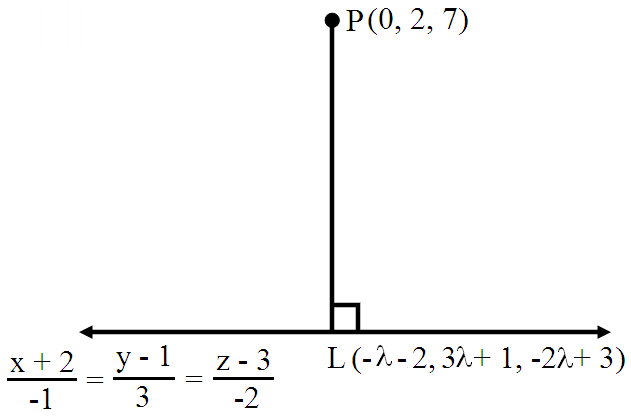
The direction ratios of PL are proportional to $-\lambda-2-0,3\lambda+1-2,-2\lambda+3-7,$ i,e. $-\lambda-2,3\lambda-1,-2\lambda-4.$ The direction ratios of the given line are proportionl to -1, 3, -2, but PL is perpendicular to the given line. $\therefore-1-\lambda-2+33\lambda-1-2\lambda-4=0\Rightarrow\lambda=-12$ Substituting $\lambda=-12$ in $-\lambda-2,3\lambda+1.-2\lambda+3,$ we get the coordinates of L as -32, -12, 4. View full question & answer→Question 755 Marks
Find the angle between the pairs of lines with direction ratios proportional to
$2, 2, -2$ and $4, 1, 8$
AnswerWe know that, angle $(\theta)$ between lines
$\frac{\text{x}-\text{x}_1}{\text{a}_1}=\frac{\text{y}-\text{y}_1}{\text{b}_1}=\frac{\text{z}-\text{z}_1}{\text{c}_1}$ and $\frac{\text{x}-\text{x}_2}{\text{a}_2}=\frac{\text{y}-\text{y}_2}{\text{b}_2}=\frac{\text{z}-\text{z}_2}{\text{c}_2}$
is given by,
$\cos\theta=\frac{\text{a}_1\text{a}_2+\text{b}_1\text{b}_2+\text{c}_1\text{c}_2}{\sqrt{{\text{a}_1}^2+{{\text{b}_1}^2}+{{\text{c}_1}^2}}\sqrt{{\text{a}_2}^2+{{\text{b}_2}^2}+{{\text{c}_2}^2}}}\dots(1)$
Here, $a_1= 2, b_1= 2, c_1= 1$
$a_2= 4, b_2= 1, c_2= 8$
Let $\theta$ be required angle, so using equation (1),
$\cos\theta=\frac{(2)(4)+(2)(1)+(1)(8)}{\sqrt{(2)^2+(2)^2+(1)^2}\sqrt{(4)^2+(1)^2+(8)^2}}$
$=\frac{8+2+8}{3.9}$
$=\frac{18}{27}$
$\cos\theta=\frac{2}{3}$
$\theta=\cos^{-1}\Big(\frac{2}{3}\Big)$
View full question & answer→Question 765 Marks
ABCD is aparallelogram. the position vectora of the points A, B and C are respectively, $4\hat{\text{i}}+5\hat{\text{j}}-10\hat{\text{k}},2\hat{\text{i}}-3\hat{\text{j}}+4\hat{\text{k}}$ and $-\hat{\text{i}}+2\hat{\text{j}}+\hat{\text{k}}.$ Find the vector equation of the line BD. Also, reduce it to cartesian form.
AnswerWe know that the position vector of the mid-point of $\vec{\text{a}}$ and $\vec{\text{b}}$ is $\frac{\vec{\text{a}}+\vec{\text{b}}}{2}.$
Let the position of mid-point of A and C= position vector of mid-point of B and D
$\therefore\frac{\big(4\hat{\text{i}}+5\hat{\text{j}}-10\hat{\text{k}}\big)+\big(-\hat{\text{i}}+2\hat{\text{j}}+\hat{\text{k}}\big)}{2}=\frac{\big(2\hat{\text{i}}-3\hat{\text{j}}+4\hat{\text{k}}\big)+\big(\text{x}\hat{\text{i}}+\text{y}\hat{\text{j}}+\text{z}\hat{\text{k}}\big)}{2}$
$\Rightarrow\frac{3}{2}\hat{\text{i}}+\frac{7}{2}\hat{\text{j}}-\frac{9}2{}\hat{\text{k}}=\Big(\frac{\text{x}+2}{2}\Big)\hat{\text{i}}+\Big(\frac{-3+\text{y}}{2}\Big)\hat{\text{j}}+\Big(\frac{4+\text{z}}{2}\Big)\hat{\text{k}}$
Comparing the coeffient of $\hat{\text{i}},\hat{\text{j}}$ and $\hat{\text{k}},$ we get
$\frac{\text{x}+2}{2}=\frac{3}{2}$
$\Rightarrow\text{x}=1$
$\frac{-3+\text{y}}{2}=\frac{7}{2}$
$\Rightarrow\text{y}=10$
$\frac{4+\text{z}}{2}=-\frac{9}{2}$
$\Rightarrow\text{z}=-13$
Position vector of point $\text{D}=\hat{\text{i}}+10\hat{\text{j}}-13\hat{\text{k}}$
View full question & answer→Question 775 Marks
Determine whether the following pair of lines intersect or not:
$\vec{\text{r}}=\big(\hat{\text{i}}-\hat{\text{j}}\big)+\lambda\big(2\hat{\text{i}}+\hat{\text{k}}\big)$ and $\vec{\text{r}}=\big(2\hat{\text{i}}-\hat{\text{j}}\big)+\mu\big(\hat{\text{i}}+\hat{\text{j}}-\hat{\text{k}}\big)$
AnswerGiven equation of lines are
$\vec{\text{r}}=\big(\hat{\text{i}}-\hat{\text{j}}\big)+\lambda\big(2\hat{\text{i}}+\hat{\text{k}}\big)$ and $\vec{\text{r}}=\big(2\hat{\text{i}}-\hat{\text{j}}\big)+\mu\big(\hat{\text{i}}+\hat{\text{j}}-\hat{\text{k}}\big)$
If these lines intersect each other, there must be some common point, So, we must have $\lambda$ and $\mu$ such that
$\big(\hat{\text{i}}-\hat{\text{j}}\big)+\lambda\big(2\hat{\text{i}}+\hat{\text{k}}\big)=\big(2\hat{\text{i}}-\hat{\text{j}}\big)+\mu\big(\hat{\text{i}}+\hat{\text{j}}-\hat{\text{k}}\big)$
$(1+2\lambda)\hat{\text{i}}-\hat{\text{j}}+\lambda\hat{\text{k}}=(2+\mu)\hat{\text{i}}+(-1+\mu)\hat{\text{j}}-\mu\hat{\text{k}}$
Equation the cofficients of $\hat{\text{i}},\hat{\text{j}}$ and $\hat{\text{k}},$
$1+2\lambda=2+\mu\Rightarrow2\lambda-\mu=1\dots(1)$
$-1=-1+\mu\Rightarrow\mu=0\dots(2)$
$\lambda=-\mu\Rightarrow\lambda=0\dots(3)$
Put value of $\lambda$ and $\mu$ in equation (1),
$2\lambda=\mu=1$
$2(0)-(0)=1$
$0=1$
$\text{LHS}\neq\text{RHS}$
Since, the values of $\lambda$ and $\mu$ form equation (2) and (3) dose not satisfy equation (1),
Hence, given lines do not intersect each other.
View full question & answer→