MCQ 1012 Marks
If $\tan ^{-1} \frac{x-1}{x+2}+\tan ^{-1} \frac{x+1}{x+2}=\frac{\pi}{4}$, then $x=$
- A
$\frac{1}{\sqrt{2}}$
- B
$-\frac{1}{\sqrt{2}}$
- ✓
$\pm \sqrt{\frac{5}{2}}$
- D
$\pm \frac{1}{2}$
AnswerCorrect option: C. $\pm \sqrt{\frac{5}{2}}$
(C) $\tan ^{-1} \frac{x-1}{x+2}+\tan ^{-1} \frac{x+1}{x+2}=\frac{\pi}{4}$
$\therefore \tan ^{-1}\left[\frac{\frac{x-1}{x+2}+\frac{x+1}{x+2}}{1-\left(\frac{x-1}{x+2}\right)\left(\frac{x+1}{x+2}\right)}\right]=\frac{\pi}{4}$
$\therefore\left[\frac{2 x(x+2)}{x^2+4+4 x-x^2+1}\right]=\tan \frac{\pi}{4}$
$\therefore \quad \frac{2 x(x+2)}{4 x+5}=1$
$\therefore \quad 2 x^2+4 x=4 x+5 \Rightarrow x= \pm \sqrt{\frac{5}{2}}$
View full question & answer→MCQ 1022 Marks
$\cos ^{-1} \frac{4}{5}+\tan ^{-1} \frac{3}{5}=$
- ✓
$\tan ^{-1} \frac{27}{11}$
- B
$\sin ^{-1} \frac{11}{27}$
- C
$\cos ^{-1} \frac{11}{27}$
- D
$\cot ^{-1} \frac{27}{11}$
AnswerCorrect option: A. $\tan ^{-1} \frac{27}{11}$
(A) Let $\alpha=\cos ^{-1}\left(\frac{4}{5}\right)$
$\therefore \cos \alpha=\left(\frac{4}{5}\right) \Rightarrow \tan \alpha=\left(\frac{3}{4}\right)$
$\therefore \quad \alpha=\tan ^{-1}\left(\frac{3}{4}\right)$
$\therefore \quad \cos ^{-1} \frac{4}{5}+\tan ^{-1} \frac{3}{5}=\tan ^{-1} \frac{3}{4}+\tan ^{-1} \frac{3}{5}$
$=\tan ^{-1}\left(\frac{\frac{3}{4}+\frac{3}{5}}{1-\frac{3}{4} \cdot \frac{3}{5}}\right)=\tan ^{-1}\left(\frac{27}{11}\right)$
View full question & answer→MCQ 1032 Marks
$\cos \left[\tan ^{-1} \frac{1}{3}+\tan ^{-1} \frac{1}{2}\right]=$
- ✓
$\frac{1}{\sqrt{2}}$
- B
$\frac{\sqrt{3}}{2}$
- C
$\frac{1}{2}$
- D
$\frac{\pi}{4}$
AnswerCorrect option: A. $\frac{1}{\sqrt{2}}$
(A) $\cos \left[\tan ^{-1} \frac{1}{3}+\tan ^{-1} \frac{1}{2}\right]=\cos \left[\tan ^{-1}\left(\frac{\frac{1}{3}+\frac{1}{2}}{1-\frac{1}{3} \times \frac{1}{2}}\right)\right]$
$\begin{array}{l}=\cos \left\{\tan ^{-1}(1)\right\} \\ =\cos \frac{\pi}{4}=\frac{1}{\sqrt{2}}\end{array}$
View full question & answer→MCQ 1042 Marks
If $\left(\tan ^{-1} x\right)^2+\left(\cot ^{-1} x\right)^2=\frac{5 \pi^2}{8}$, then $x$ equals
Answer(A) $\left(\tan ^{-1} x\right)^2+\left(\cot ^{-1} x\right)^2=\frac{5 \pi^2}{8}$
$\Rightarrow\left(\tan ^{-1} x+\cot ^{-1} x\right)^2$ $-2 \tan ^{-1} x\left(\frac{\pi}{2}-\tan ^{-1} x\right)=\frac{5 \pi^2}{8}$
$\Rightarrow \frac{\pi^2}{4}-2 \times \frac{\pi}{2} \tan ^{-1} x+2\left(\tan ^{-1} x\right)^2=\frac{5 \pi^2}{8}$
$\Rightarrow 2\left(\tan ^{-1} x\right)^2-\pi \tan ^{-1} x-\frac{3 \pi^2}{8}=0$
$\Rightarrow \tan ^{-1} x=-\frac{\pi}{4}, \frac{3 \pi}{4}$
$\Rightarrow \tan ^{-1} x=-\frac{\pi}{4} \Rightarrow x=-1$
View full question & answer→MCQ 1052 Marks
$2 \tan ^{-1} \frac{1}{5}+\sec ^{-1} \frac{5 \sqrt{2}}{7}+2 \tan ^{-1} \frac{1}{8}=$
- A
$\frac{\pi}{6}$
- ✓
$\frac{\pi}{4}$
- C
$\frac{\pi}{3}$
- D
$\frac{\pi}{8}$
AnswerCorrect option: B. $\frac{\pi}{4}$
(B) $2 \tan ^{-1} \frac{1}{5}+\sec ^{-1} \frac{5 \sqrt{2}}{7}+2 \tan ^{-1} \frac{1}{8}$
$=2\left(\tan ^{-1} \frac{1}{5}+\tan ^{-1} \frac{1}{8}\right)+\sec ^{-1} \frac{5 \sqrt{2}}{7}$
$=2 \tan ^{-1}\left[\frac{\frac{1}{5}+\frac{1}{8}}{1-\frac{1}{5}\left(\frac{1}{8}\right)}\right]+\tan ^{-1} \sqrt{\left(\frac{5 \sqrt{2}}{7}\right)^2-1}$
$\ldots\left[\because \sec ^{-1} x=\tan ^{-1} \sqrt{x^2-1}\right]$
$=2 \tan ^{-1} \frac{13}{39}+\tan ^{-1} \frac{1}{7}$
$=2 \tan ^{-1} \frac{1}{3}+\tan ^{-1} \frac{1}{7}$
$=\tan ^{-1}\left[\frac{2\left(\frac{1}{3}\right)}{1-\left(\frac{1}{3}\right)^2}\right]+\tan ^{-1} \frac{1}{7}$
$\ldots\left[\because 2 \tan ^{-1} x=\tan ^{-1} \frac{2 x}{1-x^2}\right.$, if $\left.-1<x<1\right]$
$=\tan ^{-1} \frac{3}{4}+\tan ^{-1} \frac{1}{7}$
$=\tan ^{-1}\left[\frac{\frac{3}{4}+\frac{1}{7}}{1-\frac{3}{4}\left(\frac{1}{7}\right)}\right]=\tan ^{-1}(1)=\frac{\pi}{4}$
View full question & answer→MCQ 1062 Marks
If $\sin ^{-1} x+\sin ^{-1} y+\sin ^{-1} z=\frac{\pi}{2}$, then the value of $x^2+y^2+z^2+2 x y z$ is equal to
Answer(B) $\sin ^{-1} x+\sin ^{-1} y+\sin ^{-1} z=\frac{\pi}{2}$
Put $\sin ^{-1} x=\alpha, \sin ^{-1} y=\beta, \sin ^{-1} z=\gamma$
$\therefore \quad \alpha+\beta+\gamma=\frac{\pi}{2}$
$\Rightarrow \alpha+\beta=\frac{\pi}{2}-\gamma \Rightarrow \cos (\alpha+\beta)=\cos \left(\frac{\pi}{2}-\gamma\right)$
$\Rightarrow \cos \alpha \cos \beta-\sin \alpha \sin \beta=\sin \gamma$ and, we have...(i)
$\sin \alpha=x \Rightarrow \cos \alpha=\sqrt{1-x^2}$
Similarly, $\cos \beta=\sqrt{1-y^2}$
∴ From (i), we get
$\sqrt{1-x^2} \cdot \sqrt{1-y^2}=x y+z$
Squaring on both sides, we get
$x^2+y^2+z^2+2 x y z=1$
View full question & answer→MCQ 1072 Marks
If $\theta=\sin ^{-1} x+\cos ^{-1} x-\tan ^{-1} x, x \geq 0$, then the smallest interval in which $\theta$ lies is given by
- A
$\frac{\pi}{2} \leq \theta \leq \frac{3 \pi}{4}$
- ✓
$0<\theta<\pi$
- C
$-\frac{\pi}{4} \leq \theta \leq 0$
- D
$\frac{\pi}{4} \leq \theta \leq \frac{\pi}{2}$
AnswerCorrect option: B. $0<\theta<\pi$
(B) $\theta=\sin ^{-1} x+\cos ^{-1} x-\tan ^{-1} x=\frac{\pi}{2}-\tan ^{-1} x$
Since, $-\frac{\pi}{2}<\tan ^{-1} x<\frac{\pi}{2}$
$\Rightarrow \frac{\pi}{2}>-\tan ^{-1} x>-\frac{\pi}{2}$
$\Rightarrow 0<\frac{\pi}{2}-\tan ^{-1} x<\pi$
View full question & answer→MCQ 1082 Marks
If $\sin ^{-1} x=\frac{\pi}{5}$ for some $x \in(-1,1)$, then the value of $\cos ^{-1} x$ is
- ✓
$\frac{3 \pi}{10}$
- B
$\frac{5 \pi}{10}$
- C
$\frac{7 \pi}{10}$
- D
$\frac{9 \pi}{10}$
AnswerCorrect option: A. $\frac{3 \pi}{10}$
(A) $\sin ^{-1} x+\cos ^{-1} x=\frac{\pi}{2}$
$\Rightarrow \cos ^{-1} x=\frac{\pi}{2}-\sin ^{-1} x=\frac{\pi}{2}-\frac{\pi}{5}=\frac{3 \pi}{10}$
View full question & answer→MCQ 1092 Marks
$\sin ^{-1} x+\sin ^{-1} \frac{1}{x}+\cos ^{-1} x+\cos ^{-1} \frac{1}{x}=$
- ✓
$\pi$
- B
$\frac{\pi}{2}$
- C
$\frac{3 \pi}{2}$
- D
$\frac{2 \pi}{3}$
Answer(A) $\sin ^{-1} x+\sin ^{-1} \frac{1}{x}+\cos ^{-1} x+\cos ^{-1} \frac{1}{x}$
$=\left\{\sin ^{-1}(x)+\cos ^{-1}(x)\right\}+\left\{\sin ^{-1}\left(\frac{1}{x}\right)+\cos ^{-1}\left(\frac{1}{x}\right)\right\}$
$=\frac{\pi}{2}+\frac{\pi}{2}=\pi$
View full question & answer→MCQ 1102 Marks
If $\sin \left(\sin ^{-1} \frac{1}{5}+\cos ^{-1} x\right)=1$, then $x$ is equal to
- A
- B
$0$
- C
$\frac{4}{5}$
- ✓
$\frac{1}{5}$
AnswerCorrect option: D. $\frac{1}{5}$
(D) $\sin ^{-1} \frac{1}{5}+\cos ^{-1} x=\frac{\pi}{2}$
$\begin{array}{l}\therefore \sin ^{-1} \frac{1}{5}=\frac{\pi}{2}-\cos ^{-1} x=\sin ^{-1} x \\ \therefore x=\frac{1}{5}\end{array}$
View full question & answer→MCQ 1112 Marks
If $\cos ^{-1}\left(\frac{1}{x}\right)=\theta$, then $\tan \theta=$
- A
$\frac{1}{\sqrt{x^2-1}}$
- B
$\sqrt{x^2+1}$
- C
$\sqrt{1-x^2}$
- ✓
$\sqrt{x^2-1}$
AnswerCorrect option: D. $\sqrt{x^2-1}$
(D) $\cos ^{-1}\left(\frac{1}{x}\right)=\theta \Rightarrow \sec ^{-1} x=\theta$
$\begin{array}{l}\therefore \quad x=\sec \theta \\ \therefore \quad \tan \theta=\sqrt{\sec ^2 \theta-1}=\sqrt{x^2-1}\end{array}$
View full question & answer→MCQ 1122 Marks
$\sin ^{-1}\left[x \sqrt{1-x}-\sqrt{x} \sqrt{1-x^2}\right]=$
- A
$\sin ^{-1} x+\sin ^{-1} \sqrt{x}$
- ✓
$\sin ^{-1} x$$-\sin ^{-1}$$\sqrt{x}$
- C
$\sin ^{-1} \sqrt{x}-\sin ^{-1} x$
- D
$\sin ^{-1}$$(x-\sqrt{x})$
AnswerCorrect option: B. $\sin ^{-1} x$$-\sin ^{-1}$$\sqrt{x}$
(B) Let $x=\sin \theta$ and $\sqrt{x}=\sin \phi$ Hence
$\therefore \sin ^{-1}\left(x \sqrt{1-x}-\sqrt{x} \sqrt{1-x^2}\right)$
$\begin{array}{l}=\sin ^{-1}\left(\sin \theta \sqrt{1-\sin ^2 \phi}-\sin \phi \sqrt{1-\sin ^2 \theta}\right) \\ =\sin ^{-1}(\sin \theta \cos \phi-\sin \phi \cos \theta) \\ =\sin ^{-1} \sin (\theta-\phi) \\ =\theta-\phi=\sin ^{-1}(x)-\sin ^{-1}(\sqrt{x})\end{array}$
View full question & answer→MCQ 1132 Marks
$\tan ^{-1}\left(\frac{\sqrt{1+x^2}-1}{x}\right)=$
AnswerCorrect option: B. $\frac{1}{2} \tan ^{-1} x$
(B) $\tan ^{-1}\left(\frac{\sqrt{1+x^2}-1}{x}\right)$
$=\tan ^{-1}\left[\frac{\sqrt{1+\tan ^2 \theta}-1}{\tan \theta}\right]$
(Putting $x=\tan \theta$ )
$=\tan ^{-1}\left[\frac{\sec \theta-1}{\tan \theta}\right]=\tan ^{-1}\left[\frac{1-\cos \theta}{\sin \theta}\right]$
$=\tan ^{-1}\left[\frac{2 \sin ^2 \frac{\theta}{2}}{2 \sin \frac{\theta}{2} \cos \frac{\theta}{2}}\right]$
$=\tan ^{-1}\left(\tan \frac{\theta}{2}\right)$
$=\frac{\theta}{2}=\frac{1}{2} \tan ^{-1} x$
View full question & answer→MCQ 1142 Marks
If $3 \sin ^{-1} \frac{2 x}{1+x^2}-4 \cos ^{-1} \frac{1-x^2}{1+x^2}$ $+2 \tan ^{-1} \frac{2 x}{1-x^2}=\frac{\pi}{3}$, then $x=$
- A
$\sqrt{3}$
- ✓
$\frac{1}{\sqrt{3}}$
- C
$1$
- D
$\frac{2}{\sqrt{3}}$
AnswerCorrect option: B. $\frac{1}{\sqrt{3}}$
(B) $3 \sin ^{-1} \frac{2 x}{1+x^2}-4 \cos ^{-1} \frac{1-x^2}{1+x^2}$ $+2 \tan ^{-1} \frac{2 x}{1-x^2}=\frac{\pi}{3}$
Putting $x=\tan \theta$, we get
$3 \sin ^{-1}\left(\frac{2 \tan \theta}{1+\tan ^2 \theta}\right)-4 \cos ^{-1}\left(\frac{1-\tan ^2 \theta}{1+\tan ^2 \theta}\right)$ $+2 \tan ^{-1}\left(\frac{2 \tan \theta}{1-\tan ^2 \theta}\right)=\frac{\pi}{3}$
$\Rightarrow 3 \sin ^{-1}(\sin 2 \theta)-4 \cos ^{-1}(\cos 2 \theta)$ $+2 \tan ^{-1}(\tan 2 \theta)=\frac{\pi}{3}$
$\Rightarrow 3(2 \theta)-4(2 \theta)+2(2 \theta)=\frac{\pi}{3}$
$\Rightarrow 6 \theta-8 \theta+4 \theta=\frac{\pi}{3}$
$\Rightarrow \theta=\frac{\pi}{6} \Rightarrow \tan ^{-1} x=\frac{\pi}{6}$
$\Rightarrow x=\tan \frac{\pi}{6}=\frac{1}{\sqrt{3}}$
View full question & answer→MCQ 1152 Marks
$\tan ^{-1}\left\{\frac{3 a ^2 x-x^3}{ a \left( a ^2-3 x^2\right)}\right\}=$
- ✓
$3 \tan ^{-1} \frac{x}{a}$
- B
$2 \tan ^{-1} \frac{x}{a}$
- C
$\tan ^{-1} \frac{x}{a}$
- D
$\tan ^{-1} \frac{ a }{x}$
AnswerCorrect option: A. $3 \tan ^{-1} \frac{x}{a}$
(A) $\tan ^{-1}\left\{\frac{3 a ^2 x-x^3}{ a \left( a ^2-3 x^2\right)}\right\}=\tan ^{-1}\left\{\frac{3 a ^2 x-x^3}{ a ^3-3 ax ^2}\right\}$
$=\tan ^{-1}\left(\frac{3\left(\frac{x}{ a }\right)-\left(\frac{x}{ a }\right)^3}{1-3\left(\frac{x}{ a }\right)^2}\right)$
Put $\frac{x}{ a }=\tan \theta$
$\therefore \quad$ The given expression becomes
$\tan ^{-1}\left(\frac{3 \tan \theta-\tan ^3 \theta}{1-3 \tan ^2 \theta}\right)=\tan ^{-1}(\tan 3 \theta)$
$=3 \theta=3 \tan ^{-1} \frac{x}{ a }$
View full question & answer→MCQ 1162 Marks
$\tan ^{-1}\left(\frac{\cos x}{1+\sin x}\right)=$
AnswerCorrect option: A. $\frac{\pi}{4}-\frac{x}{2}$
(A) $\tan ^{-1}\left(\frac{\cos x}{1+\sin x}\right)=\tan ^{-1}\left[\frac{\sin \left(\frac{\pi}{2}-x\right)}{1+\cos \left(\frac{\pi}{2}-x\right)}\right]$
$=\tan ^{-1}\left[\frac{2 \sin \left(\frac{\pi}{4}-\frac{x}{2}\right) \cos \left(\frac{\pi}{4}-\frac{x}{2}\right)}{2 \cos ^2\left(\frac{\pi}{4}-\frac{x}{2}\right)}\right]$
$=\tan ^{-1}\left[\tan \left(\frac{\pi}{4}-\frac{x}{2}\right)\right]=\frac{\pi}{4}-\frac{x}{2}$
View full question & answer→MCQ 1172 Marks
If $\frac{ a }{ b } \tan x>-1$, then $\tan ^{-1}\left[\frac{ a \cos x- b \sin x}{b \cos x+ a \sin x}\right]$ is
- A
$\tan ^{-1}\left(\frac{ a }{ b }-x\right)$
- B
$\cot ^{-1} \frac{a}{b} x$
- ✓
$\tan ^{-1} \frac{a}{b}-x$
- D
$\cot ^{-1}\left(\frac{ a }{ b }-x\right)$
AnswerCorrect option: C. $\tan ^{-1} \frac{a}{b}-x$
(C) $\tan ^{-1}\left[\frac{\frac{ a \cos x- b \sin x}{b \cos x}}{\frac{b \cos x+ a \sin x}{b \cos x}}\right]=\tan ^{-1}\left[\frac{\frac{ a }{ b }-\tan x}{1+\frac{ a }{ b } \tan x}\right]$
$=\tan ^{-1} \frac{ a }{ b }-\tan ^{-1}(\tan x)$
$=\tan ^{-1} \frac{ a }{ b }-x$
View full question & answer→MCQ 1182 Marks
$\tan ^{-1}\left(\frac{\cos x-\sin x}{\cos x+\sin x}\right)=$
- A
$\frac{\pi}{2}-x$
- ✓
$\frac{\pi}{4}-x$
- C
$\frac{\pi}{2}$
- D
$\frac{\pi}{4}$
AnswerCorrect option: B. $\frac{\pi}{4}-x$
(B) $\tan ^{-1}\left(\frac{\cos x-\sin x}{\cos x+\sin x}\right)=\tan ^{-1}\left(\frac{1-\tan x}{1+\tan x}\right)$
$=\tan ^{-1}\left(\tan \left(\frac{\pi}{4}-x\right)\right)$
$=\frac{\pi}{4}-x$
View full question & answer→MCQ 1192 Marks
If $\theta=\sin ^{-1}\left[\sin \left(-600^{\circ}\right)\right]$, then one of the possible value of $\theta$ is
- ✓
$\frac{\pi}{3}$
- B
$\frac{\pi}{2}$
- C
$\frac{2 \pi}{3}$
- D
$\frac{-2 \pi}{3}$
AnswerCorrect option: A. $\frac{\pi}{3}$
(A) $\theta=\sin ^{-1}\left[\sin \left(-600^{\circ}\right)\right]$
$\begin{array}{l}\Rightarrow \theta=\sin ^{-1}\left[-\left(\sin 240^{\circ}\right)\right] \\ \Rightarrow \theta=\sin ^{-1}\left[-\sin \left(180^{\circ}+60^{\circ}\right)\right]\end{array}$
$\Rightarrow \theta=\sin ^{-1}\left(\sin 60^{\circ}\right)=\sin ^{-1}\left[\sin \left(\frac{\pi}{3}\right)\right]=\frac{\pi}{3}$
View full question & answer→MCQ 1202 Marks
$\cos \left(\sin ^{-1} \frac{5}{13}\right)=$
- ✓
$\frac{12}{13}$
- B
$-\frac{12}{13}$
- C
$\frac{5}{12}$
- D
$-\frac{5}{12}$
AnswerCorrect option: A. $\frac{12}{13}$
(A) Let $\sin ^{-1} \frac{5}{13}=x \Rightarrow \sin x=\frac{5}{13}$
$\Rightarrow \cos x=\sqrt{1-\frac{25}{169}}=\frac{12}{13}$
$\Rightarrow \cos \left(\sin ^{-1} \frac{5}{13}\right)=\cos \left(\cos ^{-1} \frac{12}{13}\right)=\frac{12}{13}$
View full question & answer→MCQ 1212 Marks
The principal value of $\sin ^{-1}\left[\sin \left(\frac{2 \pi}{3}\right)\right]$ is
- A
$-\frac{2 \pi}{3}$
- B
$\frac{2 \pi}{3}$
- C
$\frac{4 \pi}{3}$
- ✓
$\frac{\pi}{3}$
AnswerCorrect option: D. $\frac{\pi}{3}$
(D) The principal value of $\sin ^{-1}\left[\sin \left(\frac{2 \pi}{3}\right)\right]$
$=\sin ^{-1}\left[\sin \left(\pi-\frac{2 \pi}{3}\right)\right]=\sin ^{-1}\left[\sin \left(\frac{\pi}{3}\right)\right]=\frac{\pi}{3}$
View full question & answer→MCQ 1222 Marks
$\sin ^2\left(2 \tan ^{-1} \sqrt{\frac{1+x}{1-x}}\right)=$ $\_\_\_\_$ , where $-1 \leq x<1$
- ✓
$1-x^2$
- B
$1+x^2$
- C
$x^2-1$
- D
$-x^2$
AnswerCorrect option: A. $1-x^2$
(A) $\sin ^2\left(2 \tan ^{-1} \sqrt{\frac{1+x}{1-x}}\right)$
$=\sin ^2(2 \theta)$, where $\theta=\tan ^{-1} \sqrt{\frac{1+x}{1-x}}$
$=\left(\frac{2 \tan \theta}{1+\tan ^2 \theta}\right)^2$, where $\tan \theta=\sqrt{\frac{1+x}{1-x}}$
$=\left\{\frac{\frac{2 \sqrt{1+x}}{\sqrt{1-x}}}{1+\left(\frac{1+x}{1-x}\right)}\right\}^2=\frac{4(1+x)(1-x)}{(1-x+1+x)^2}=1-x^2$
View full question & answer→MCQ 1232 Marks
The value of $\cot \left[\tan ^{-1}\left(\frac{2}{3}\right)+\operatorname{cosec}^{-1}\left(\frac{5}{3}\right)\right]$ is
- A
$\frac{5}{17}$
- ✓
$\frac{6}{17}$
- C
$\frac{3}{17}$
- D
$\frac{4}{17}$
AnswerCorrect option: B. $\frac{6}{17}$
(B) $A=\tan ^{-1}\left(\frac{2}{3}\right) \Rightarrow \tan A=\frac{2}{3}$
$B=\operatorname{cosec}^{-1}\left(\frac{5}{3}\right) \Rightarrow \tan B=\frac{3}{4}$
$\cot (A+B)=\frac{1-\tan A \tan B}{\tan A+\tan B}$
$=\frac{1-\frac{2}{3} \cdot \frac{3}{4}}{\frac{2}{3}+\frac{3}{4}}=\frac{\frac{6}{12}}{\frac{17}{12}}=\frac{6}{17}$
View full question & answer→MCQ 1242 Marks
If $\sin ^{-1} x+\sin ^{-1} y+\sin ^{-1} z=\frac{3 \pi}{2}$, then the value of $x^{100}+y^{100}+z^{100}-\frac{9}{x^{101}+y^{101}+z^{101}}$ is equal to
Answer(A) Since $\sin ^{-1} x$ cannot be greater than $\frac{\pi}{2}$.
$\therefore \quad \sin ^{-1} x=\sin ^{-1} y=\sin ^{-1} z=\frac{\pi}{2}$
Therefore, $x=y= z =1$
Putting these values in the expression, we get
$1+1+1-\frac{9}{1+1+1}=0$
View full question & answer→MCQ 1252 Marks
For the equation $\cos ^{-1} x+\cos ^{-1} 2 x+\pi=0$, the number of real solution is
Answer(C) $\cos ^{-1} x+\cos ^{-1}(2 x)=-\pi$
$\begin{array}{l}\Rightarrow \cos ^{-1} 2 x=-\pi-\cos ^{-1} x \\ \Rightarrow 2 x=\cos \left(\pi+\cos ^{-1} x\right) \\ \Rightarrow 2 x=(\cos \pi) \cos \left(\cos ^{-1} x\right)-(\sin \pi) \sin \left(\cos ^{-1} x\right) \\ \Rightarrow 2 x=-x \Rightarrow x=0\end{array}$
But $x=0$ does not satisfy the given equation.
$\therefore \quad$ No solution will exist.
View full question & answer→MCQ 1262 Marks
In $\triangle A B C,\left(\cot \frac{A}{2}+\cot \frac{B}{2}\right)\left(a \sin ^2 \frac{B}{2}+b \sin ^2 \frac{A}{2}\right)=$
- A
$\cot C$
- B
$c \cot C$
- C
$\cot \frac{ C }{2}$
- ✓
$c \cot \frac{C}{2}$
AnswerCorrect option: D. $c \cot \frac{C}{2}$
(D) $\{\cot \frac{ A }{2}+\cot \frac{ B }{2}\}\{ asin ^2 \frac{B}{2}+ b \sin ^2 \frac{A}{2}\}$
$=\{\frac{\cos \frac{ C }{2}}{\sin \frac{A}{2} \sin \frac{B}{2}}\}\{a \sin ^2 \frac{B}{2}+ b \sin ^2 \frac{A}{2}\}$
$=\{\cos \frac{ C }{2}\}\{ a \frac{\sin \frac{ B }{2}}{\sin \frac{A}{2}}+ b \frac{\sin \frac{ A }{2}}{\sin \frac{B}{2}}\}$
$=\sqrt{\frac{s(s-c)}{a b}}\{a \frac{\sqrt{\frac{(s-a)(s-c)}{a c}}}{\sqrt{\frac{(s-b)(s-c)}{b c}}}+b \frac{\sqrt{\frac{(s-b)(s-c)}{b c}}}{\sqrt{\frac{(s-a)(s-c)}{a c}}}\}$
$=\sqrt{\frac{s(s-c)}{a b}}\{\sqrt{(\frac{s-a}{s-b}) a b}+\sqrt{(\frac{s-b}{s-a}) a b}\}$
$=\sqrt{s(s-c)}\{\frac{s-a+s-b}{\sqrt{(s-a)(s-b)}}\}$
$=\sqrt{s(s-c)}\{\frac{2 s-a-b}{\sqrt{(s-a)(s-b)}}\}$
$=c \sqrt{\frac{s(s-c)}{(s-a)(s-b)}}=c \cot \frac{C}{2}$
Alternate Method:
Let $a =1, b=\sqrt{3}, c =2$ and $A =30^{\circ}$,
$B =60^{\circ}, C =90^{\circ}$.
Hence, the given expression is equal to 2 , which is given by option (D).
View full question & answer→MCQ 1272 Marks
Let POR be a triangle of area $\Delta$ with $a =2$, $b =\frac{7}{2}$ and $c =\frac{5}{2}$, where $a, b$ and $c$ are the lenghts of the sides of the triangle opposite to the angles at $P, Q$ and $R$ respectively. Then $\frac{2 \sin P-\sin 2 P}{2 \sin P+\sin 2 P}$ equals
AnswerCorrect option: C. $\left(\frac{3}{4 \Delta}\right)^2$
(C) $a =2= QR$,
$b =\frac{7}{2}= PR$,
$c =\frac{5}{2}= PQ$
$s=\frac{a+b+c}{2}=\frac{8}{2}=4$
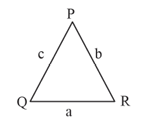
$\frac{2 \sin P-2 \sin P \cos P}{2 \sin P+2 \sin P \cos P}=\frac{2 \sin P(1-\cos P)}{2 \sin P(1+\cos P)}$
$=\frac{1-\cos P }{1+\cos P }=\frac{2 \sin ^2 \frac{ P }{2}}{2 \cos ^2 \frac{ P }{2}}=\tan ^2 \frac{ P }{2}$
$=\frac{( s - b )( s - c )}{ s ( s - a )}=\frac{( s - b )^2(s- c )^2}{\Delta^2}$
$=\frac{\left(4-\frac{7}{2}\right)^2\left(4-\frac{5}{2}\right)^2}{\Delta^2}=\left(\frac{3}{4 \Delta}\right)^2$ View full question & answer→MCQ 1282 Marks
If the area of a triangle $A B C$ is given by $\Delta=a^2-(b-c)^2$. then $\tan \frac{A}{2}$ is equal to
- A
$-1$
- B
$0$
- ✓
$\frac{1}{4}$
- D
$\frac{1}{2}$
AnswerCorrect option: C. $\frac{1}{4}$
(C) $\Delta= a ^2-( b - c )^2$
$=2 b c-\left(b^2+c^2-a^2\right)$
$=2 b c-2 b c\left(\frac{b^2+c^2-a^2}{2 b c}\right)=2 b c(1-\cos A)$
$\therefore \quad \Delta=2 bc \cdot 2 \sin ^2 \frac{A}{2}$ ....(i)
Also, $\Delta=\frac{1}{2} bc \sin A$
$=\frac{1}{2} bc \cdot 2 \sin \frac{A}{2} \cos \frac{A}{2}$
$\therefore \quad \Delta= bc \cdot \sin \frac{ A }{2} \cos \frac{A}{2}$ ....(ii)
$\therefore \quad \tan \frac{ A }{2}=\frac{1}{4}$ .....[From (i) and (ii)]
View full question & answer→MCQ 1292 Marks
The area (in square units) of $\triangle ABC$ if $\angle A =75^{\circ}, \angle B =45^{\circ}$ and $a =2(\sqrt{3}+1)$ is
- A
- B
$2 \sqrt{3}$
- C
$6-2 \sqrt{3}$
- ✓
$6+2 \sqrt{3}$
AnswerCorrect option: D. $6+2 \sqrt{3}$
(D) $\angle A =75^{\circ}, \angle B =45^{\circ}$
$\Rightarrow \angle C =180^{\circ}-75^{\circ}-45^{\circ}=60^{\circ}$
By sine rule,
$\frac{a}{\sin A}=\frac{b}{\sin B}$
$\Rightarrow \frac{2(\sqrt{3}+1)}{\sin 75^{\circ}}=\frac{b}{\sin 45^{\circ}}$
$\Rightarrow b =4$
area of $\triangle A B C=\frac{1}{2} a b \sin C$
$=\frac{1}{2} \times 2(\sqrt{3}+1) \times 4 \times \sin 60^{\circ}=6+2 \sqrt{3}$
View full question & answer→MCQ 1302 Marks
If in a triangle $ABC , b =\sqrt{3}, c =1$ and $B-C=90^{\circ}$, then $\angle A$ is
- ✓
$30^{\circ}$
- B
$45^{\circ}$
- C
$75^{\circ}$
- D
$15^{\circ}$
AnswerCorrect option: A. $30^{\circ}$
(A) $\tan \left(\frac{ B - C }{2}\right)=\frac{ b - c }{ b + c } \cot \frac{ A }{2}$
$\Rightarrow \tan \left(\frac{90^{\circ}}{2}\right)=\frac{\sqrt{3}-1}{\sqrt{3}+1} \cot \frac{A}{2}$
$\Rightarrow \tan \left(\frac{ A }{2}\right)=\frac{\sqrt{3}-1}{\sqrt{3}+1}=\frac{3+1-2 \sqrt{3}}{2}=2-\sqrt{3}$
$\Rightarrow \frac{ A }{2}=15^{\circ} \Rightarrow A =30^{\circ}$
View full question & answer→MCQ 1312 Marks
The area of an isosceles triangle is $9 cm^2$. If the equal sides are 6 cm in length, the angle between them is
- A
$60^{\circ}$
- ✓
$30^{\circ}$
- C
$90^{\circ}$
- D
$45^{\circ}$
AnswerCorrect option: B. $30^{\circ}$
(B) $\Delta=\frac{1}{2} bc \sin A \Rightarrow 9=\frac{1}{2} \cdot 36 \sin A$
$\Rightarrow \sin A=\frac{1}{2} \Rightarrow A=30^{\circ}$
View full question & answer→MCQ 1322 Marks
If $c^2=a^2+b^2$, then $4 s(s-a)(s-b)(s-c)=$
- A
$s^4$
- B
$b^2 c^2$
- C
$c^2 a^2$
- ✓
$a^2 b^2$
AnswerCorrect option: D. $a^2 b^2$
(D) $\Delta$ is right angled, $\angle C =90^{\circ}$
$\therefore \quad \Delta=\frac{1}{2} ab \sin 90^{\circ}=\frac{1}{2} ab$
$\therefore \quad 4 \Delta^2-4\left(\frac{1}{2} a b\right)^2-a^2 b^2$
View full question & answer→MCQ 1332 Marks
In $a \triangle A B C$, if $2 s=a+b+c$ and $( s - b )( s - c )=x \sin ^2 \frac{A}{2}$, then $x=$
Answer(A) $\sin \frac{A}{2}=\sqrt{\frac{(s-b)(s-c)}{b c}}$
$\Rightarrow b c \sin ^2 \frac{A}{2}=(s-b)(s-c)$
$\Rightarrow x= bc$
View full question & answer→MCQ 1342 Marks
In $\triangle ABC , \operatorname{cosec} A (\sin B \cos C +\cos B \sin C )=$
Answer(C) $\frac{\sin B \cos C}{\sin A}+\frac{\cos B \sin C}{\sin A}$
$=\left(\frac{ b }{ a } \cos C +\frac{ c }{ a } \cos B \right)$
$=1$ ...[By projection rule]
View full question & answer→MCQ 1352 Marks
In triangle ABC , $(b+c) \cos A+(c+a) \cos B+(a+b) \cos C=$
- A
$0$
- B
$1$
- ✓
$a+b+c$
- D
$2(a+b+c)$
AnswerCorrect option: C. $a+b+c$
(C) $(b+c) \cos A+(c+a) \cos B+(a+b) \cos C$ $= a + b + c$
$=(b \cos C+c \cos B)+(c \cos A+a \cos C)$ $+(a \cos B+b \cos A)$
$=a+b+c \quad \ldots .[$ By projection rule $]$
View full question & answer→MCQ 1362 Marks
The two adjacent sides of a cyclic quadrilateral are 2 and 5 and the angle between them is $60^{\circ}$ If the third side is 3 , the remaining fourth side is
Answer(A) Let the fourth side be of length d .
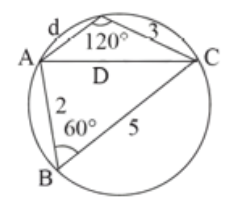
From the figure,
In $\triangle ADC$,
$AC ^2= CD ^2+ DA ^2-2 \cdot CD \cdot DA \cdot \cos 120^{\circ}$ ...[By Cosine rule]
In $\triangle BAC$,
$AC ^2= AB ^2+ BC ^2-2 \cdot AB \cdot BC \cdot \cos 60^{\circ}$ …[By Cosine rule]
$\therefore \quad 3^2+ d ^2-2 \times 3 \times d \cos 120^{\circ}=2^2+5^2$ $-2 \times 2 \times 5 \cos 60^{\circ}$
$\Rightarrow d ^2+3 d-10=0 \Rightarrow d=-5$ or $d =2$
$\therefore \quad d =2$ View full question & answer→MCQ 1372 Marks
If the line segment joining the points $A ( a , b )$ and $B(c, d)$ subtends an angle $\theta$ at the origin, then $\cos \theta$is equal to
- A
$\frac{a b+c d}{\sqrt{\left(a^2+b^2\right)\left(c^2+d^2\right)}}$
- ✓
$\frac{a c+b d}{\sqrt{\left(a^2+b^2\right)\left(c^2+d^2\right)}}$
- C
$\frac{a c-b d}{\sqrt{\left(a^2+b^2\right)\left(c^2+d^2\right)}}$
- D
$\frac{a d+b c}{\sqrt{\left(a^2+c^2\right)\left(b^2+d^2\right)}}$
AnswerCorrect option: B. $\frac{a c+b d}{\sqrt{\left(a^2+b^2\right)\left(c^2+d^2\right)}}$
(B)
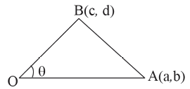
$(A B)^2=(a-c)^2+(b-d)^2$
$( OA )^2=( a -0)^2+( b -0)^2= a ^2+ b ^2$ and $( OB )^2= c ^2+ d ^2$
Now from triangle AOB ,
$\cos \theta=\frac{( OA )^2+( OB )^2-( AB )^2}{2 OA \cdot OB }$
$=\frac{ a ^2+ b ^2+ c ^2+ d ^2-\left\{( a - c )^2+( b - d )^2\right\}}{2 \sqrt{ a ^2+ b ^2} \cdot \sqrt{ c ^2+ d ^2}}$
$=\frac{ ac + bd }{\sqrt{\left( a ^2+ b ^2\right)\left( c ^2+ d ^2\right)}}$ View full question & answer→MCQ 1382 Marks
In a $\triangle A B C$, if $b ^2+ c ^2=3 a ^2$, then $\cot B+$ $\cot C$ $-\cot A=$
Answer(C) $\cot B +\cot C -\cot A =\frac{\cos B }{\sin B }+\frac{\cos C }{\sin C }-\cot A$
$=\frac{\sin C \cos B +\cos C \sin B }{\sin B \sin C }-\cot A$
$=\frac{\sin ( B + C )}{\sin B \sin C }-\frac{\cos A }{\sin A }$
$=\frac{\sin ^2 A-\sin B \sin C \cos A}{\sin A \sin B \sin C}=\frac{a^2-b c \cos A}{(a b c)}$
$=\frac{ a ^2- bc \frac{\left( b ^2+ c ^2- a ^2\right)}{2 bc }}{( abc )}$
$=\frac{3 a ^2- b ^2- c ^2}{2( abc )}=\frac{3 a ^2-\left( b ^2+ c ^2\right)}{2( abc )}$
$\therefore \quad \cot B +\cot C -\cot A =\frac{3 a ^2-3 a ^2}{2( abc )}=0$ $\ldots\left[\because b^2+c^2=3 a^2\right]$
View full question & answer→MCQ 1392 Marks
If in $\triangle A B C, 2 b^2=a^2+c^2$, then $\frac{\sin 3 B}{\sin B}=$
- A
$\frac{ c ^2- a ^2}{2 ca }$
- B
$\frac{c^2-a^2}{c a}$
- C
$\left(\frac{ c ^2- a ^2}{ ca }\right)^2$
- ✓
$\left(\frac{ c ^2- a ^2}{2 ca }\right)^2$
AnswerCorrect option: D. $\left(\frac{ c ^2- a ^2}{2 ca }\right)^2$
(D) $\frac{\sin 3 B}{\sin B}=\frac{3 \sin B-4 \sin ^3 B}{\sin B}=3-4 \sin ^2 B$
$=3-4+4 \cos ^2 B$
$=-1+\frac{4\left(a^2+c^2-b^2\right)^2}{4(a c)^2}$
$=-1+\frac{\left(\frac{a^2+c^2}{2}\right)^2}{(a c)^2} \ldots\left[\because 2 b^2=a^2+c^2\right]$
$=-1+\frac{\left( a ^2+ c ^2\right)^2}{4( ac )^2}$
$=\frac{\left( a ^2+ c ^2\right)^2-4 a ^2 c ^2}{4( ac )^2}$
$=\left(\frac{ c ^2- a ^2}{2 ac }\right)^2$
View full question & answer→MCQ 1402 Marks
In $\triangle A B C$, if $\cot A, \cot B, \cot C$ be in $A$. $P$., then $a ^2, b^2, c ^2$ are in
Answer(C) $\cot A , \cot B$ and $\cot C$ are in A. P.
$\Rightarrow \cot A +\cot C =2 \cot B$
$\Rightarrow \frac{\cos A}{\sin A}+\frac{\cos C}{\sin C}=\frac{2 \cos B}{\sin B}$
$\Rightarrow \frac{ b ^2+ c ^2- a ^2}{2 bc ( ka )}+\frac{ a ^2+ b ^2- c ^2}{2 ab ( kc )}=2 \frac{ a ^2+ c ^2- b ^2}{2 ac ( kb )}$
$\Rightarrow a^2+c^2=2 b^2$
Hence, $a ^2, b^2, c ^2$, are in $A . P$.
View full question & answer→MCQ 1412 Marks
In a triangle ABC , $\frac{2 \cos A}{a}+\frac{\cos B}{b}+\frac{2 \cos C}{c}=\frac{a}{b c}+\frac{b}{c a}$, then the value of angle A is
- A
$45^{\circ}$
- B
$30^{\circ}$
- ✓
$90^{\circ}$
- D
$60^{\circ}$
AnswerCorrect option: C. $90^{\circ}$
(C) $\frac{2 \cos A}{a}+\frac{\cos B}{b}+\frac{2 \cos C}{c}=\frac{a}{b c}+\frac{b}{c a}$
$\Rightarrow \frac{2\left(b^2+ c ^2- a ^2\right)}{2 abc }+\frac{ a ^2+ c ^2- b ^2}{2 abc }+\frac{2\left( a ^2+ b ^2- c ^2\right)}{2 abc }$ $=\frac{ a }{ bc }+\frac{ b }{ ca }$
$\Rightarrow \frac{3 b^2+ c ^2+ a ^2}{2 abc }=\frac{ a }{ bc }+\frac{ b }{ ca }$
$\Rightarrow \frac{3 b}{2 a c}+\frac{c}{2 a b}+\frac{a}{2 b c}=\frac{a}{b c}+\frac{b}{c a}$
$\Rightarrow b ^2+ c ^2= a ^2$
Hence, $\angle A =90^{\circ}$
View full question & answer→MCQ 1422 Marks
In a triangle $ABC , a =4, b=3, \angle A=60^{\circ}$. Then c is the root of the equation
- ✓
$c^2-3 c-7=0$
- B
$c^2+3 c+7=0$
- C
$c^2-3 c+7=0$
- D
$c^2+3 c-7=0$
AnswerCorrect option: A. $c^2-3 c-7=0$
(A) $\cos A =\frac{ b ^2+ c ^2- a ^2}{2 bc }$
$\Rightarrow \cos 60^{\circ}=\frac{1}{2}=\frac{9+ c ^2-16}{2 \times 3 \times c }$
$\begin{array}{l}\Rightarrow 3 c=c^2-7 \\ \Rightarrow c^2-3 c-7=0\end{array}$
View full question & answer→MCQ 1432 Marks
The lengths of the sides of a triangle are $\alpha-\beta, \alpha+\beta$ and $\sqrt{3 \alpha^2+\beta^2}, \quad(\alpha>\beta>0)$. Its largest angle is
- A
$\frac{3 \pi}{4}$
- B
$\frac{\pi}{2}$
- ✓
$\frac{2 \pi}{3}$
- D
$\frac{5 \pi}{6}$
AnswerCorrect option: C. $\frac{2 \pi}{3}$
(C) Let $a=\alpha-\beta, b=\alpha+\beta, c=\sqrt{3 \alpha^2+\beta^2}$
Since $\sqrt{3 \alpha^2+\beta^2}$ is the largest side, the largest angle is $C$.
$\therefore \quad \cos C =\frac{ a ^2+ b ^2- c ^2}{2 ab }$
$\Rightarrow \cos C=\frac{\alpha^2+\beta^2-2 \alpha \beta+\alpha^2+\beta^2+2 \alpha \beta-3 \alpha^2-\beta^2}{2\left(\alpha^2-\beta^2\right)}$
$\Rightarrow \cos C=-\frac{\left(\alpha^2-\beta^2\right)}{2\left(\alpha^2-\beta^2\right)}=\cos \left(\frac{2 \pi}{3}\right)$
$\Rightarrow C=\frac{2 \pi}{3}$
View full question & answer→MCQ 1442 Marks
In any triangle ABC , the value of $a\left(b^2+c^2\right) \cos A+b\left(c^2+a^2\right) \cos B+c\left(a^2+b^2\right)$ $\cos C$ is
- A
$3 abc ^2$
- B
$3 a ^2 bc$
- ✓
- D
$3 a b^2 c$
Answer(C) $a b^2 \cos A+b a^2 \cos B+a c^2 \cos A+c a^2 \cos C$ $+b c^2 \cos B+b^2 c \cos C$
$=a b(b \cos A+a \cos B)+a c(c \cos A+a \cos C)$ $+b c(c \cos B+b \cos C)$
$=a b c+a b c+a b c=3 a b c$
View full question & answer→MCQ 1452 Marks
In a $\triangle A B C, a=5, b=4$ and $\cos (A-B)=\frac{31}{32}$ then side c is equal to
Answer(A) We have,
$\tan \left(\frac{ A - B }{2}\right)=\sqrt{\frac{1-\cos ( A - B )}{1+\cos ( A - B )}}=\sqrt{\frac{1-\left(\frac{31}{32}\right)}{1+\left(\frac{31}{32}\right)}}$
$\Rightarrow \frac{a-b}{a+b} \cot \frac{C}{2}=\frac{1}{\sqrt{63}}$
$\Rightarrow \frac{1}{9} \cot \frac{C}{2}=\frac{1}{\sqrt{63}}$
$\Rightarrow \tan \frac{C}{2}=\frac{\sqrt{7}}{3}$
Now, $\cos C =\frac{1-\tan ^2\left(\frac{ C }{2}\right)}{1+\tan ^2\left(\frac{ C }{2}\right)}$
$\Rightarrow \cos C=\frac{1-\left(\frac{7}{9}\right)}{1+\left(\frac{7}{9}\right)}=\frac{1}{8}$
$\therefore \quad c^2=a^2+b^2-2 a b \cos C$
$\Rightarrow c^2=25+16-40 \times \frac{1}{8}=36 \Rightarrow c=6$
View full question & answer→MCQ 1462 Marks
If the sides of a triangle are in the ratio $2: \sqrt{6}:(\sqrt{3}+1)$, then the largest angle of the triangle will be
- A
$60^{\circ}$
- ✓
$75^{\circ}$
- C
$90^{\circ}$
- D
$120^{\circ}$
AnswerCorrect option: B. $75^{\circ}$
(B) Let the common multiple be $x$.
∴ the sides are $(2 x),(\sqrt{6} x),(\sqrt{3}+1) x$
$\because(\sqrt{3}+1) x$ is the largest side.
If $\theta$ is the angle opposite to side $(\sqrt{3}+1) x$, then
$\cos \theta=\frac{(2 x)^2+(\sqrt{6} x)^2-[(\sqrt{3}+1) x]^2}{2 \times(2 x) \times(\sqrt{6} x)}$
$=\frac{3-\sqrt{3}}{2 \sqrt{6}}$
$\therefore \quad \cos \theta=\frac{\sqrt{3}-1}{2 \sqrt{2}} \Rightarrow \theta=75^{\circ}$
View full question & answer→MCQ 1472 Marks
If in $\triangle A B C, a=6, b=3$ and $\cos (A-B)$ $=\frac{4}{5}$, then its area will be
Answer(C) Let $t =\tan \left(\frac{ A - B }{2}\right)$
$\cos (A-B)=\frac{1-t^2}{1+t^2} \Rightarrow \frac{4}{5}=\frac{1-t^2}{1+t^2} \Rightarrow t=\frac{1}{3}$
So, $\tan \left(\frac{ A - B }{2}\right)=\frac{1}{3}$
Then, $\tan \left(\frac{ A - B }{2}\right)=\frac{ a - b }{ a + b } \cot \frac{ C }{2}$
$\Rightarrow \frac{1}{3}=\frac{6-3}{6+3} \cot \frac{C}{2} \Rightarrow C=90^{\circ}$
$\therefore \quad \Delta=\frac{1}{2}(6)(3) \sin 90^{\circ}=9$ square units.
View full question & answer→MCQ 1482 Marks
In any triangle $A B C, \frac{\tan \frac{A}{2}-\tan \frac{B}{2}}{\tan \frac{A}{2}+\tan \frac{B}{2}}=$
- A
$\frac{a-b}{a+b}$
- ✓
$\frac{a-b}{c}$
- C
$\frac{a-b}{a+b+c}$
- D
$\frac{c}{a+b}$
AnswerCorrect option: B. $\frac{a-b}{c}$
(B) $\frac{\tan \frac{A}{2}-\tan \frac{B}{2}}{\tan \frac{A}{2}+\tan \frac{B}{2}}$
$=\frac{\sqrt{\frac{(s-b)(s-c)}{s(s-a)}}-\sqrt{\frac{(s-a)(s-c)}{s(s-b)}}}{\sqrt{\frac{(s-b)(s-c)}{s(s-a)}}+\sqrt{\frac{(s-a)(s-c)}{s(s-b)}}}$
$=\frac{(s-b) \sqrt{s(s-c)}-(s-a) \sqrt{s(s-c)}}{(s-b) \sqrt{s(s-c)}+(s-a) \sqrt{s(s-c)}}$
$=\frac{\sqrt{s(s-c)}(s-b-s+a)}{\sqrt{s(s-c)}(s-b+s-a)}$
$=\frac{ a - b }{ c }$
View full question & answer→MCQ 1492 Marks
If in a triangle $A B C,(s-a)(s-b)=s(s-c)$, then angle $C$ is equal to
- ✓
$90^{\circ}$
- B
$45^{\circ}$
- C
$30^{\circ}$
- D
$60^{\circ}$
AnswerCorrect option: A. $90^{\circ}$
(A) $\tan \frac{C}{2}=\sqrt{\frac{(s-a)(s-b)}{s(s-c)}}=1$
$\Rightarrow \tan \frac{ C }{2}=\tan 45^{\circ} \Rightarrow \frac{ C }{2}=45^{\circ}$
$\Rightarrow C=90^{\circ}$
View full question & answer→MCQ 1502 Marks
In $\triangle A B C$, if $2 s=a+b+c$, then the value of $\frac{s(s-a)}{b c}-\frac{(s-b)(s-c)}{b c}=$
- A
$\sin A$
- ✓
$\cos A$
- C
$\tan A$
- D
$-\cos A$
AnswerCorrect option: B. $\cos A$
(B) $\frac{ s ( s - a )}{ bc }-\frac{( s - b )( s - c )}{ bc }$
$=\cos ^2 \frac{A}{2}-\sin ^2 \frac{A}{2}=\cos \frac{2 A}{2}=\cos A$
View full question & answer→