MCQ 1512 Marks
The sides of a triangle are $\sin \theta, \cos \theta$ and $\sqrt{1+\sin \theta \cos \theta}$, where $0<\theta<\frac{\pi}{2}$, then the greatest angle of a triangle is
- A
$60^{\circ}$
- B
$90^{\circ}$
- ✓
$120^{\circ}$
- D
$150^{\circ}$
AnswerCorrect option: C. $120^{\circ}$
(C) $a=\sin \theta, b=\cos \theta$ and $c=\sqrt{1+\sin \theta \cos \theta}$
Since $\sqrt{1+\sin \theta \cos \theta}$ is greater than $\sin \theta$ and $\cos \theta$.
$\therefore \quad C$ is the greatest angle,
$\therefore \quad \cos C=\frac{a^2+b^2-c^2}{2 a b}$
$=\frac{\sin ^2 \theta+\cos ^2 \theta-(1+\sin \theta \cos \theta)}{2 \sin \theta \cos \theta}$
$=-\frac{1}{2}=\cos 120^{\circ}$
$\therefore \quad C =120^{\circ}$
View full question & answer→MCQ 1522 Marks
Let D be the middle point of the side BC of a triangle ABC . If the triangle ADC is equilateral, then $a^2: b^2: c^2$ is equal to
- A
$1: 4: 3$
- ✓
$4: 1: 3$
- C
$4: 3: 1$
- D
$3: 4: 1$
AnswerCorrect option: B. $4: 1: 3$
(B)
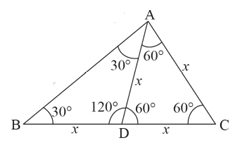
From the figure,
$\cos 120^{\circ}=\frac{x^2+x^2- AB ^2}{2 x^2} \Rightarrow \frac{2 x^2- AB ^2}{2 x^2}=\frac{-1}{2}$
$\begin{array}{l}\Rightarrow 4 x^2-2 AB ^2=-2 x^2 \\ \Rightarrow 3 x^2= AB ^2 \Rightarrow AB =x \sqrt{3} \\ \Rightarrow a ^2: b ^2: c ^2=(2 x)^2: x^2:(x \sqrt{3})^2=4: 1: 3\end{array}$ View full question & answer→MCQ 1532 Marks
If one side of a triangle is double the other and the angles opposite to these sides differ by $60^{\circ}$, then the triangle is
Answer(B) $\frac{\sin A}{a}=\frac{\sin B}{b}=\frac{\sin C}{c}$
According to the given condition,
In $\triangle ABC , a =2 b$ and
$A-B=60^{\circ} \Rightarrow A=60^{\circ}+B$
$\Rightarrow \frac{\sin \left(60^{\circ}+ B \right)}{2 b}=\frac{\sin B }{ b }$
$\Rightarrow \frac{\sin B}{\sin \left(B+60^{\circ}\right)}=\frac{1}{2}$
$\Rightarrow 2 \sin B=\sin B \cos 60^{\circ}+\cos B \sin 60^{\circ}$
$\Rightarrow \frac{3}{2} \sin B=\frac{\sqrt{3}}{2} \cos B$
$\therefore \quad \tan B=\frac{1}{\sqrt{3}} \Rightarrow B=30^{\circ}$
$\therefore \quad A =30^{\circ}+60^{\circ}=90^{\circ}$
$\therefore \quad \triangle ABC$ is right angled.
View full question & answer→MCQ 1542 Marks
In triangle $A B C$, if $\sin A \sin B=\frac{a b}{c^2}$, then the triangle is
Answer(C) $\sin A \sin B =\frac{ ab }{ c ^2}$
$\Rightarrow \sin A \sin B =\frac{( k \sin A )( k \sin B )}{ k ^2 \sin ^2 C }$
$\Rightarrow \sin ^2 C=1 \Rightarrow \sin C=1 \quad \ldots[\because \sin C \neq-1]$
$\begin{array}{l}\Rightarrow \angle C =90^{\circ} \\ \Rightarrow \triangle ABC \text { is right angled. }\end{array}$
View full question & answer→MCQ 1552 Marks
In a triangle ABC , if $b + c =2 a$ and $\angle A =60^{\circ}$, then $\triangle ABC$ is
Answer(B) We have, $b+c=2 a$ ...(i)
$\cos 60^{\circ}=\frac{b^2+c^2-a^2}{2 b c}=\frac{(b+c)^2-2 b c-a^2}{2 b c}$
$\Rightarrow \frac{1}{2}=\frac{4 a ^2-2 bc - a ^2}{2 bc } \Rightarrow \frac{1}{2}=\frac{3 a ^2}{2 bc }-1$
$\Rightarrow \frac{3}{2}=\frac{3 a ^2}{2 bc }$
$\Rightarrow bc = a ^2$ ...(ii)
From (i) and (ii), we get
$b + c =2 \sqrt{b} \sqrt{ c }$
$\Rightarrow(\sqrt{ b }-\sqrt{ c })^2=0 \Rightarrow b= c$
From (i), $a=b=c$
$\therefore \quad \triangle ABC$ is equilateral.
View full question & answer→MCQ 1562 Marks
If in triangle $A B C, \cos A=\frac{\sin B}{2 \sin C}$, then the triangle is
Answer(B) $\cos A =\frac{\sin B }{2 \sin C } \Rightarrow \frac{ b ^2+ c ^2- a ^2}{2 bc }=\frac{ b }{2 c }$
$\begin{array}{l}\Rightarrow b^2+c^2-a^2-b^2=0 \Rightarrow c^2=a^2 \\ \Rightarrow c=a \Rightarrow \text { Triangle is isosceles }\end{array}$
View full question & answer→MCQ 1572 Marks
In $\triangle A B C, 1-\tan \frac{A}{2} \tan \frac{B}{2}=$
- ✓
$\frac{2 c}{a+b+c}$
- B
$\frac{a}{a+b+c}$
- C
$\frac{2}{a+b+c}$
- D
$\frac{4 a}{a+b+c}$
AnswerCorrect option: A. $\frac{2 c}{a+b+c}$
(A) $1-\tan \frac{ A }{2} \tan \frac{B}{2}=\frac{\cos \frac{ A }{2} \cos \frac{B}{2}-\sin \frac{ A }{2} \sin \frac{B}{2}}{\cos \frac{A}{2} \cos \frac{B}{2}}$
$=\frac{\cos \left(\frac{ A }{2}+\frac{ B }{2}\right)}{\cos \frac{ A }{2} \cos \frac{B}{2}}$
$=\frac{\sin \frac{ C }{2}}{\cos \frac{A}{2} \cos \frac{B}{2}}$
$=\left[\frac{(s-a)(s-b) b c \cdot a c}{a b \cdot s(s-a) s(s-b)}\right]^{1 / 2}$
$=\frac{ c }{ s }=\frac{2 c }{ a + b + c }$
View full question & answer→MCQ 1582 Marks
In $\triangle ABC ,( a - b )^2 \cos ^2 \frac{ C }{2}+( a + b )^2 \sin ^2 \frac{ C }{2}=$
Answer(C) $\left(a^2+b^2-2 a b\right) \cos ^2 \frac{C}{2}+\left(a^2+b^2+2 a b\right) \sin ^2 \frac{C}{2}$
$=\left(a^2+b^2\right)\left(\cos ^2 \frac{C}{2}+\sin ^2 \frac{C}{2}\right)$ $-2 a b\left(\cos ^2 \frac{C}{2}-\sin ^2 \frac{C}{2}\right)$
$=a^2+b^2-2 a b \cos C$
$=a^2+b^2-\left(a^2+b^2-c^2\right)=c^2$
View full question & answer→MCQ 1592 Marks
In $\triangle A B C, \frac{\cos A}{a}+\frac{\cos B}{b}+\frac{\cos C}{c}=$
- A
$\frac{a^2+b^2+c^2}{a b c}$
- ✓
$\frac{a^2+b^2+c^2}{2 a b c}$
- C
$\frac{2\left( a ^2+ b ^2+ c ^2\right)}{ abc }$
- D
$a^2+b^2+c^2$
AnswerCorrect option: B. $\frac{a^2+b^2+c^2}{2 a b c}$
(B) $\frac{\cos A}{a}+\frac{\cos B}{b}+\frac{\cos C}{c}$
$=\frac{ b ^2+ c ^2- a ^2+ a ^2+ c ^2- b ^2+ a ^2+ b ^2- c ^2}{2 abc }$
$=\frac{ a ^2+ b ^2+ c ^2}{2 abc }$
View full question & answer→MCQ 1602 Marks
If angles $A , B$ and C are in A.P., then $\frac{ a + c }{ b }$ is equal to
- A
$2 \sin \frac{A- C }{2}$
- ✓
$2 \cos \frac{A- C }{2}$
- C
$\cos \frac{ A - C }{2}$
- D
$\sin \frac{A-C}{2}$
AnswerCorrect option: B. $2 \cos \frac{A- C }{2}$
(B) $\frac{a+c}{b}=\frac{\sin A+\sin C}{\sin B}$
$=\frac{2 \sin \left(\frac{A+ C }{2}\right) \cos \left(\frac{ A - C }{2}\right)}{\sin B }$
$=\frac{2 \sin B}{\sin B } \cos \left(\frac{ A - C }{2}\right) \quad \ldots[\because 2 B= A + C ]$
$=2 \cos \left(\frac{A- C }{2}\right)$
View full question & answer→MCQ 1612 Marks
If the angles of a triangle ABC be in A.P., then
- A
$c^2=a^2+b^2-a b$
- ✓
$b^2=a^2+c^2-a c$
- C
$a^2=b^2+c^2-a c$
- D
$b^2=a^2+c^2$
AnswerCorrect option: B. $b^2=a^2+c^2-a c$
(B) $A , B , C$ are in A . P. then angle $B =60^{\circ}$, $\ldots\left[\begin{array}{l}\because A+B+C=180^{\circ} \\ \Rightarrow A+C=2 B \Rightarrow B=60^{\circ}\end{array}\right]$
$\therefore \quad \cos B=\frac{a^2+c^2-b^2}{2 a c}$,
$\Rightarrow \frac{1}{2}=\frac{ a ^2+ c ^2- b ^2}{2 ac } \Rightarrow a ^2+ c ^2- b ^2= ac$
$\Rightarrow b ^2= a ^2+ c ^2- ac$
View full question & answer→MCQ 1622 Marks
In a $\triangle A B C$, if $\frac{\sin A}{\sin C}=\frac{\sin (A-B)}{\sin (B-C)}$, then $a^2, b^2, c^2$ are in
Answer(A) $\frac{\sin A}{\sin C}=\frac{\sin A \cos B-\cos A \sin B}{\sin B \cos C-\cos B \sin C}$
$\Rightarrow \frac{a}{c}=\frac{a \cos B-b \cos A}{b \cos C-c \cos B}$
$\begin{array}{l}\Rightarrow a b \cos C-a c \cos B=a c \cos B-b c \cos A \\ \Rightarrow a b \cos C+b c \cos A=2 a c \cos B\end{array}$
$\Rightarrow \frac{ a ^2+ b ^2- c ^2}{2}+\frac{ b ^2+ c ^2- a ^2}{2}=\frac{ c ^2+ a ^2- b ^2}{1}$
$\Rightarrow b^2=c^2+a^2-b^2 \Rightarrow b^2=\frac{c^2+a^2}{2}$
$\Rightarrow a ^2, b^2, c ^2$ are in A.P.
View full question & answer→MCQ 1632 Marks
In $\triangle A B C$, if $\sin ^2 \frac{A}{2}, \sin ^2 \frac{B}{2}, \sin ^2 \frac{C}{2}$ be in H.P., then a, b, c will be in
Answer(C) $\frac{1}{\sin ^2 \frac{\Lambda}{2}}, \frac{1}{\sin ^2 \frac{B}{2}}, \frac{1}{\sin ^2 \frac{C}{2}}$ are in A.P.
$\Rightarrow \frac{1}{\sin ^2 \frac{C}{2}}-\frac{1}{\sin ^2 \frac{B}{2}}=\frac{1}{\sin ^2 \frac{B}{2}}-\frac{1}{\sin ^2 \frac{A}{2}}$
$\Rightarrow \frac{a b}{(s-a)(s-b)}-\frac{a c}{(s-a)(s-c)}$ $=\frac{a c}{(s-a)(s-c)}-\frac{b c}{(s-b)(s-c)}$
$\Rightarrow\left(\frac{ a }{ s - a }\right)\left(\frac{ b ( s - c )- c ( s - b )}{( s - b )( s - c )}\right)$ $=\left(\frac{ c }{ s - c }\right)\left(\frac{ a ( s - b )- b ( s - a )}{( s - a )( s - b )}\right)$
$\begin{array}{l}\Rightarrow a b s-a b c-a c s+a b c=a c s-a b c-b c s+a b c \\ \Rightarrow a b-a c=a c-b c \Rightarrow a b+b c=2 a c\end{array}$
$\Rightarrow \frac{1}{ c }+\frac{1}{ a }=\frac{2}{b} \Rightarrow a , b , c$ are in H.P.
View full question & answer→MCQ 1642 Marks
If in a triangle, $a \cos ^2 \frac{C}{2}+c \cos ^2 \frac{A}{2}=\frac{3 b}{2}$, then its sides will be in
Answer(A) $a \cos ^2 \frac{C}{2}+c \cos ^2 \frac{A}{2}=\frac{3 b}{2}$
$\therefore \quad a \frac{s(s-c)}{a b}+c \frac{s(s-a)}{b c}=\frac{3 b}{2}$
$\begin{array}{l}\therefore 2 s(s-c+s-a)=3 b^2 \\ \therefore 2 s(b)=3 b^2 \Rightarrow 2 s=3 b \Rightarrow a+b+c=3 b \\ \therefore a+c=2 b \Rightarrow a, b, c \text { are in A.P. }\end{array}$
View full question & answer→MCQ 1652 Marks
If the angles $A , B , C$ of a triangle are in A.P. and the sides $a, b, c$ opposite to these angles are in G. P., then $a^2, b^2, c^2$ are in
Answer(A) Since $A , B$ and C are in A.P., therefore
$B=60^{\circ} \quad \cdots\left[\begin{array}{c}\because A+B+C=180^{\circ} \\ \Rightarrow A+C=2 B \Rightarrow B=60^{\circ}\end{array}\right]$
Since sides $a , b$ and c are in G.P., therefore $b ^2= ac$
$\cos B =\frac{ a ^2+ c ^2- b ^2}{2 ac }$
$\Rightarrow \frac{1}{2}=\frac{a^2+c^2-b^2}{2 b^2}, \quad \quad \ldots .\left[\because b^2=a c\right]$
$\begin{array}{l}\Rightarrow b^2=a^2+c^2-b^2 \\ \Rightarrow a^2+c^2=2 b^2 \\ \Rightarrow a^2, b^2, c^2 \text { are in A.P. }\end{array}$
View full question & answer→MCQ 1662 Marks
In $\triangle A B C, \frac{1+\cos (A-B) \cos C}{1+\cos (A-C) \cos B}=$
AnswerCorrect option: D. $\frac{a^2+b^2}{a^2+c^2}$
(D) $\frac{1+\cos C \cos (A-B)}{1+\cos (A-C) \cos B}=\frac{1-\cos (A+B) \cos (A-B)}{1-\cos (A-C) \cos (A+C)}$
$=\frac{1-\frac{1}{2}(\cos 2 A+\cos 2 B)}{1-\frac{1}{2}(\cos 2 A+\cos 2 C )}$
$=\frac{1-\frac{1}{2}\left(1-2 \sin ^2 A+1-2 \sin ^2 B\right)}{1-\frac{1}{2}\left(1-2 \sin ^2 A+1-2 \sin ^2 C \right)}$
$=\frac{\sin ^2 A+\sin ^2 B}{\sin ^2 A+\sin ^2 C }=\frac{ a ^2+ b ^2}{ a ^2+ c ^2}$
View full question & answer→MCQ 1672 Marks
Which of the following is true in a triangle $A B C$ ?
- A
$(b+c) \sin \frac{B-C}{2}=2 a \cos \frac{A}{2}$
- B
$(b+c) \cos \frac{A}{2}=2 a \sin \frac{B-C}{2}$
- ✓
$(b-c) \cos \frac{A}{2}=a \sin \frac{B-C}{2}$
- D
$(b-c) \sin \frac{B-C}{2}=2 a \cos \frac{A}{2}$
AnswerCorrect option: C. $(b-c) \cos \frac{A}{2}=a \sin \frac{B-C}{2}$
(C) $\frac{b-c}{a}=\frac{\sin B-\sin C}{\sin A}$
$=\frac{2 \sin \frac{B- C }{2} \cos \frac{B+ C }{2}}{2 \sin \frac{A}{2} \cos \frac{A}{2}}$
$=\frac{\sin \left(\frac{ B - C }{2}\right) \cos \left(\frac{ B + C }{2}\right)}{\cos \left(\frac{ B + C }{2}\right) \cos \frac{ A }{2}}$
$=\frac{\sin \frac{B-C}{2}}{\cos \frac{A}{2}}$
$\Rightarrow( b - c ) \cos \frac{ A }{2}= a \sin \frac{ B - C }{2}$
View full question & answer→MCQ 1682 Marks
In $\triangle A B C, \frac{\cos \frac{1}{2}(B-C)}{\sin \frac{1}{2} A}=$
- A
$\frac{ b - c }{ a }$
- ✓
$\frac{ b + c }{ a }$
- C
$\frac{ a }{ b - c }$
- D
$\frac{a}{b+c}$
AnswerCorrect option: B. $\frac{ b + c }{ a }$
(B) $\frac{\cos \frac{ B - C }{2}}{\sin \frac{A}{2}}=\frac{\sin \frac{ B + C }{2} \cos \frac{B- C }{2}}{\sin \frac{B+ C }{2} \sin \frac{A}{2}}$
$=\frac{2 \sin \frac{B+ C }{2} \cos \frac{B- C }{2}}{2 \sin \left(\frac{\pi}{2}-\frac{ A }{2}\right) \sin \frac{ A }{2}}$
$=\frac{\sin B+\sin C}{\sin A}=\frac{b+c}{a}$
View full question & answer→MCQ 1692 Marks
If the angles of a triangle are in the ratio $4: 1: 1$, then the ratio of the longest side to the perimeter is
- ✓
$\sqrt{3}:(2+\sqrt{3})$
- B
$1: 6$
- C
$1:(2+\sqrt{3})$
- D
$2:3$
AnswerCorrect option: A. $\sqrt{3}:(2+\sqrt{3})$
(A) Let the angles of the triangle be $4 x, x$ and $x$.
$\therefore 4 x+x+x=180^{\circ} \Rightarrow 6 x=180^{\circ} \Rightarrow x=30^{\circ}$
$\frac{\sin 120^{\circ}}{ a }=\frac{\sin 30^{\circ}}{ b }=\frac{\sin 30^{\circ}}{ c }$
$\therefore \quad a:(a+b+c)$
$=\left(\sin 120^{\circ}\right):\left(\sin 120^{\circ}+\sin 30^{\circ}+\sin 30^{\circ}\right)$
$=\frac{\sqrt{3}}{2}: \frac{\sqrt{3}+2}{2}=\sqrt{3}: \sqrt{3}+2$
View full question & answer→MCQ 1702 Marks
In a $\triangle A B C, A: B: C=3: 5: 4$. Then $a+b+c \sqrt{2}$ is equal to
Answer(C) Let $x$ be the common multiple.
$\begin{array}{ll}\therefore & A + B + C =12 x=180^{\circ} \Rightarrow x=15^{\circ} \\ \therefore & A =45^{\circ}, B =75^{\circ}, C =60^{\circ}\end{array}$
$\frac{ a }{\sin 45^{\circ}}=\frac{ b }{\sin 75^{\circ}}=\frac{ c }{\sin 60^{\circ}}= k$
$\therefore \quad a=\frac{1}{\sqrt{2}} k, b=\frac{\sqrt{3}+1}{2 \sqrt{2}} k, c=\frac{\sqrt{3}}{2} k$
$\therefore \quad a+b+c \sqrt{2}=\frac{3+3 \sqrt{3}}{2 \sqrt{2}}=3 b$
View full question & answer→MCQ 1712 Marks
If in $\triangle ABC , \sin \frac{ A }{2} \sin \frac{ C }{2}=\sin \frac{ B }{2}$ and 2s is the perimeter of the triangle, then $s$ is
Answer(A) $\sin \frac{ A }{2} \cdot \sin \frac{ C }{2}=\sin \frac{ B }{2}$
$\therefore \sqrt{\frac{( s - b )( s - c )}{ bc }} \times \sqrt{\frac{( s - a )( s - b )}{ ab }}=\sqrt{\frac{( s - a )( s - c )}{ ac }}$
$\Rightarrow \frac{( s - b )}{ b } \sqrt{\frac{( s - a )( s - c )}{ ac }}=\sqrt{\frac{( s - a )( s - c )}{ ac }}$
$\Rightarrow s-b=b \Rightarrow s=2 b$
View full question & answer→MCQ 1722 Marks
The perimeter of a $\triangle A B C$ is 6 times the arithmetic mean of the sines of its angles. If the side a is 1 , then the angle A is
- ✓
$\frac{\pi}{6}$
- B
$\frac{\pi}{3}$
- C
$\frac{\pi}{2}$
- D
$\pi$
AnswerCorrect option: A. $\frac{\pi}{6}$
(A) According to the given condition,
$a+b+c=\frac{6(\sin A+\sin B+\sin C)}{3}$
$\Rightarrow k(\sin A+\sin B +\sin C )$ $=2(\sin A+\sin B +\sin C )$
where $k =\frac{ a }{\sin A }=\frac{ b }{\sin B }=\frac{ c }{\sin C }$
$\Rightarrow k=2 \quad \ldots . .[\because \sin A+\sin B+\sin C \neq 0]$
$\therefore \quad \frac{a}{\sin A}=2 \Rightarrow \sin A=\frac{1}{2} \quad \ldots . .[\because a=1]$
$\Rightarrow A=\frac{\pi}{6}$
View full question & answer→MCQ 1732 Marks
If in a $\triangle A B C, a^2 \cos ^2 A-b^2-c^2=0$, then
AnswerCorrect option: B. $\frac{\pi}{2}< A <\pi$
(B) $a^2 \cos ^2 A-b^2-c^2=0$
$\Rightarrow \cos ^2 A=\frac{ b ^2+ c ^2}{ a ^2}$
Since, $\cos ^2 A \leq 1$ i.e., $\cos ^2 A<1$
$\therefore \quad \frac{ b ^2+ c ^2}{ a ^2}<1 \Rightarrow b^2+ c ^2- a ^2<0$
$\therefore \quad \frac{ b ^2+ c ^2- a ^2}{2 bc }<0$ $\ldots .[\because 2 b c>0]$
$\therefore \cos A <0 \Rightarrow A \in\left(\frac{\pi}{2}, \pi\right)$
View full question & answer→MCQ 1742 Marks
In a triangle ABC , if $\frac{1}{a+c}+\frac{1}{b+c}=\frac{3}{a+b+c}$ then angle $C$ is equal to
- A
$30^{\circ}$
- ✓
$60^{\circ}$
- C
$90^{\circ}$
- D
$120^{\circ}$
AnswerCorrect option: B. $60^{\circ}$
(B) $\frac{1}{a+c}+\frac{1}{b+c}=\frac{3}{a+b+c}$
$\Rightarrow \frac{ a + b +2 c }{( a + c )( b + c )}=\frac{3}{ a + b + c }$
$\begin{array}{l}\Rightarrow( a + b +2 c )( a + b + c )=3( a + c )( b + c ) \\ \Rightarrow a ^2+ b ^2- c ^2= ab \end{array}$
$\therefore \quad \cos C=\frac{a^2+b^2-c^2}{2 a b}=\frac{a b}{2 a b}=\frac{1}{2}=\cos 60^{\circ}$
$\Rightarrow C =60^{\circ}$
View full question & answer→MCQ 1752 Marks
In a triangle ABC , if $a =2, B=60^{\circ}$ and $C =75^{\circ}$, then $b=$
- A
$\sqrt{3}$
- ✓
$\sqrt{6}$
- C
$\sqrt{9}$
- D
$1+\sqrt{2}$
AnswerCorrect option: B. $\sqrt{6}$
(B) $B =60^{\circ}, C =75^{\circ}$
$\Rightarrow A =180^{\circ}-60^{\circ}-75^{\circ}=45^{\circ}$
By sine rule,
$\frac{b}{\sin B}-\frac{a}{\sin A} \Rightarrow \frac{b}{\sin 60^{\circ}}-\frac{2}{\sin 45^{\circ}} \Rightarrow b-\sqrt{6}$
View full question & answer→MCQ 1762 Marks
If in a triangle the angles are in A. P. and $b: c=\sqrt{3}: \sqrt{2}$, then $\angle A$ is equal to
- A
$30^{\circ}$
- B
$60^{\circ}$
- C
$15^{\circ}$
- ✓
$75^{\circ}$
AnswerCorrect option: D. $75^{\circ}$
(D) Since the angles are in A.P., therefore $B =60^{\circ}$ By sine rule,
$\frac{b}{c}=\frac{\sin B}{\sin C} \Rightarrow \frac{\sqrt{3}}{\sqrt{2}}=\frac{\sqrt{3}}{2 \sin C} \Rightarrow C=45^{\circ}$
$\therefore \quad A=180^{\circ}-60^{\circ}-45^{\circ}=75^{\circ}$
View full question & answer→MCQ 1772 Marks
In a triangle ABC , if $a =2$, $b=3$ and $\sin A=\frac{2}{3}$, then $\cos C$ is equal to
- ✓
$\frac{2}{3}$
- B
$\frac{1}{3}$
- C
$\frac{1}{2}$
- D
$\frac{1}{\sqrt{3}}$
AnswerCorrect option: A. $\frac{2}{3}$
(A) We know that,
$\frac{a}{\sin A}=\frac{b}{\sin B}=\frac{c}{\sin C}=k$
$\Rightarrow \frac{2}{\frac{2}{3}}=\frac{3}{\sin B}=\frac{ c }{\sin C }= k$
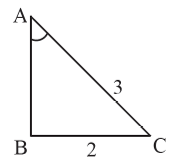
$\Rightarrow k =3$
$\therefore \quad \frac{3}{\sin B}=3$
$\begin{array}{l}\Rightarrow \sin B =1 \\ \Rightarrow B=90^{\circ}\end{array}$
Hence, the triangle is a right angled triangle. From the figure,
$\cos C =\frac{ BC }{ AC }=\frac{2}{3}$ View full question & answer→MCQ 1782 Marks
In $\triangle A B C, \frac{\sin (A-B)}{\sin (A+B)}=$
- ✓
$\frac{a^2-b^2}{c^2}$
- B
$\frac{a^2+b^2}{c^2}$
- C
$\frac{c^2}{a^2-b^2}$
- D
$\frac{c^2}{a^2+b^2}$
AnswerCorrect option: A. $\frac{a^2-b^2}{c^2}$
(A) $\frac{\sin ( A - B )}{\sin ( A + B )}=\frac{\sin A \cos B -\sin B \cos A }{\sin C }$
$=\frac{ a }{ c } \cos B -\frac{ b }{ c } \cos A$
But $\cos B =\frac{ a ^2+ c ^2- b ^2}{2 ac }, \cos A =\frac{ b ^2+ c ^2- a ^2}{2 bc }$
$\therefore \quad \frac{\sin ( A - B )}{\sin ( A + B )}=\frac{1}{2 c ^2}\left( a ^2+ c ^2- b ^2- b ^2- c ^2+ a ^2\right)$
$=\frac{a^2-b^2}{c^2}$
View full question & answer→MCQ 1792 Marks
If $a =9, b=8$ and $c =x$ satisfies $3 \cos C =2$, then
Answer(D) $\cos C =\frac{81+64-x^2}{2.9 .8} \Rightarrow \frac{2}{3}=\frac{145-x^2}{144}$
$\Rightarrow x^2=49 \Rightarrow x=7$
View full question & answer→MCQ 1802 Marks
If the sides of a triangle are $p, q$ and $\sqrt{p^2+p q+q^2}$, then the biggest angle is
- A
$\frac{\pi}{2}$
- ✓
$\frac{2 \pi}{3}$
- C
$\frac{5 \pi}{4}$
- D
$\frac{7 \pi}{4}$
AnswerCorrect option: B. $\frac{2 \pi}{3}$
(B) Largest side is $\sqrt{ p ^2+ pq + q ^2}$. If largest angle is $\theta$, then
$\cos \theta=\frac{p^2+q^2-p^2-p q-q^2}{2 p q}=-\frac{1}{2}=\cos \left(\frac{2 \pi}{3}\right)$
$\Rightarrow \theta=\frac{2 \pi}{3}$
View full question & answer→MCQ 1812 Marks
In a triangle $ABC , b =\sqrt{3}, c =1$ and $\angle A =30^{\circ}$, then the largest angle of the triangle is
- A
$135^{\circ}$
- B
$90^{\circ}$
- C
$60^{\circ}$
- ✓
$120^{\circ}$
AnswerCorrect option: D. $120^{\circ}$
(D) We have, $b =\sqrt{3}, c =1, \angle A=30^{\circ}$
$\cos A =\frac{ b ^2+ c ^2- a ^2}{2 bc }$
$\Rightarrow \frac{\sqrt{3}}{2}=\frac{(\sqrt{3})^2+1^2- a ^2}{2 \cdot \sqrt{3} \cdot 1}$
$\Rightarrow a =1, b=\sqrt{3}, c =1$
$\therefore b$ is the largest side. Therefore, the largest angle B is given by
$\cos B =\frac{ a ^2+ c ^2- b ^2}{2 ac }=\frac{1+1-3}{2 \cdot 1 \cdot 1}=-\frac{1}{2}=\cos 120^{\circ}$
$\Rightarrow B =120^{\circ}$
View full question & answer→MCQ 1822 Marks
In a $\triangle A B C$, if $\frac{b+c}{11}=\frac{c+a}{12}=\frac{a+b}{13}$, then $\cos C=$
- A
$\frac{7}{5}$
- ✓
$\frac{5}{7}$
- C
$\frac{17}{16}$
- D
$\frac{16}{17}$
AnswerCorrect option: B. $\frac{5}{7}$
(B) Let $\frac{b+c}{11}=\frac{c+a}{12}=\frac{a+b}{13}=k$
$\therefore b + c =11 k$ ...(i)
$c + a =12 k$ ...(ii)
and $a + b =13 k$ ...(iii)
From (i) + (ii) + (iii), $2(a+b+c)=36 k$
$\therefore \quad a+b+c=18 k$ ...(iv)
Now, (iv) - (i) gives, $a =7 k$
(iv) - (ii) gives, $b =6 k$
(iv) - (iii) gives, $c =5 k$
Now,
$\cos C =\frac{ a ^2+ b ^2- c ^2}{2 ab }=\frac{(7 k )^2+(6 k )^2-(5 k )^2}{2 \times(7 k ) \times(6 k )}$
$=\frac{49 k ^2+36 k ^2-25 k ^2}{84 k ^2}=\frac{60 k ^2}{84 k ^2}=\frac{5}{7}$
View full question & answer→MCQ 1832 Marks
In $\triangle A B C, a=2 cm, b=3 cm$ and $c=4 cm$, then angle A is
- A
$\cos ^{-1}\left(\frac{1}{24}\right)$
- B
$\cos ^{-1}\left(\frac{11}{16}\right)$
- ✓
$\cos ^{-1}\left(\frac{7}{8}\right)$
- D
$\cos ^{-1}\left(-\frac{1}{4}\right)$
AnswerCorrect option: C. $\cos ^{-1}\left(\frac{7}{8}\right)$
(C) $\cos A=\frac{b^2+c^2-a^2}{2 b c}=\frac{9+16-4}{2 \times 3 \times 4}=\frac{7}{8}$
$\Rightarrow A =\cos ^{-1}\left(\frac{7}{8}\right)$
View full question & answer→MCQ 1842 Marks
If in a triangle $A B C, 2 \cos A=\sin B \operatorname{cosec} C$, then
- A
$a=b$
- B
$b=c$
- ✓
$c=a$
- D
$2 a=b c$
Answer(C) $2 \cos A=\frac{\sin B}{\sin C} \Rightarrow \frac{2\left(c^2+b^2-a^2\right)}{2 b c}=\frac{b}{c}$
$\Rightarrow c^2=a^2 \Rightarrow c=a$
View full question & answer→MCQ 1852 Marks
If the sides of a triangle are $3,5,7$, then
Answer(B) $\cos C =\frac{3^2+5^2-7^2}{2 \times 3 \times 5}$
$\begin{array}{l}\Rightarrow \cos C =-\frac{1}{2} \\ \Rightarrow C =120^{\circ}\end{array}$
$\therefore \quad$ option (B) is the correct answer.
View full question & answer→MCQ 1862 Marks
If the lengths of the sides of a triangle are $3,5,7$, then the largest angle of the triangle is
- A
$\frac{\pi}{2}$
- B
$\frac{5 \pi}{6}$
- ✓
$\frac{2 \pi}{3}$
- D
$\frac{3 \pi}{4}$
AnswerCorrect option: C. $\frac{2 \pi}{3}$
(C) Let $a =3, b=5, c =7$
$\cos C =\frac{ a ^2+ b ^2- c ^2}{2 ab }=\frac{9+25-49}{2 \times 3 \times 5}=\frac{-15}{30}=-\frac{1}{2}$
$\therefore \quad \angle C =\frac{2 \pi}{3}$
View full question & answer→MCQ 1872 Marks
If sum of all the solutions of the equation $8 \cos x \cdot\left[\cos \left(\frac{\pi}{6}+x\right) \cdot \cos \left(\frac{\pi}{6}-x\right)-\frac{1}{2}\right]=1 \ in$ $[0, \pi]$ is $k \pi$, then k is equal to
- ✓
$\frac{13}{9}$
- B
$\frac{8}{9}$
- C
$\frac{20}{9}$
- D
$\frac{2}{3}$
AnswerCorrect option: A. $\frac{13}{9}$
(A) $8 \cos x\left[\cos \left(\frac{\pi}{6}+x\right) \cdot \cos \left(\frac{\pi}{6}-x\right)-\frac{1}{2}\right]=1$
$\Rightarrow 8 \cos x\left(\cos ^2 \frac{\pi}{6}-\sin ^2 x-\frac{1}{2}\right)=1$
$\Rightarrow 8 \cos x\left(\frac{3}{4}-\sin ^2 x-\frac{1}{2}\right)=1$
$\Rightarrow 8 \cos x\left(\frac{1}{4}-\left(1-\cos ^2 x\right)\right)=1$
$\begin{array}{l}\Rightarrow 2\left(4 \cos ^3 x-3 \cos x\right)=1 \\ \Rightarrow 2 \cos 3 x=1\end{array}$
$\Rightarrow \cos 3 x=\frac{1}{2}$
$\Rightarrow \cos 3 x=\cos \frac{\pi}{3}$
$\Rightarrow x=\frac{2 n \pi}{3} \pm \frac{\pi}{9}$
$\Rightarrow x=\frac{\pi}{9}, \frac{5 \pi}{9}, \frac{7 \pi}{9} \quad \ldots[\because x \in[0, \pi]]$
Sum $=\frac{\pi}{9}+\frac{5 \pi}{9}+\frac{7 \pi}{9}=\frac{13 \pi}{9}$
$\Rightarrow k=\frac{13}{9}$
View full question & answer→MCQ 1882 Marks
The number of integeral values of $k$ for which the equestion $7 \cos x+5 \sin x=2 k +1$ has a solution is
Answer(C) $-\sqrt{7^2+5^2} \leq(7 \cos x+5 \sin x) \leq \sqrt{7^2+5^2}$
$\begin{array}{l}\Rightarrow-\sqrt{74} \leq(7 \cos x+5 \sin x) \leq \sqrt{74} \\ \Rightarrow-8.6 \leq 2 k +1 \leq 8.6 \\ \Rightarrow-4.8 \leq 2 k \leq 3.8\end{array}$
Integral values of k are $-4,-3,-2,-1,0,1,2,3$
Number of integral values of $k=8$
View full question & answer→MCQ 1892 Marks
If $0 \leq x<2 \pi$, then the number of real values of $x$, which satisfy the equation
$\cos x+\cos 2 x+\cos 3 x+\cos 4 x=0$, is
Answer(B) $\cos x+\cos 2 x+\cos 3 x+\cos 4 x=0$
$\therefore \cos x+\cos 4 x+\cos 2 x+\cos 3 x=0$
$\therefore 2 \cos \frac{5 x}{2} \cdot \cos \frac{3 x}{2}+2 \cos \frac{5 x}{2} \cdot \cos \frac{x}{2}=0$
$\Rightarrow \cos \frac{5 x}{2} \cdot\left[\cos \frac{3 x}{2}+\cos \frac{x}{2}\right]=0$
$\Rightarrow \cos \frac{5 x}{2} \cdot 2 \cos x \cdot \cos \frac{x}{2}=0$
$\Rightarrow x=(2 n +1) \frac{\pi}{5},(2 k +1) \frac{\pi}{2} \text { or }(2 m+1) \pi$
$\Rightarrow x=\frac{\pi}{5}, \frac{3 \pi}{5}, \pi, \frac{7 \pi}{5}, \frac{9 \pi}{5}, \frac{\pi}{2}, \frac{3 \pi}{2} \text { in } 0 \leq x<2 \pi$
View full question & answer→MCQ 1902 Marks
The number of solutions of the equation $\cos ^2\left(x+\frac{\pi}{6}\right)+\cos ^2 x-2 \cos \left(x+\frac{\pi}{6}\right) \cos \left(\frac{\pi}{6}\right)$ $=\sin ^2 \frac{\pi}{6}$ in the interval $\left(-\frac{\pi}{2}, \frac{\pi}{2}\right)$ is
Answer(C) $\cos ^2\left(x+\frac{\pi}{6}\right)+\cos ^2 x-2 \cos \left(x+\frac{\pi}{6}\right) \cos \left(\frac{\pi}{6}\right)$ $=\sin ^2 \frac{\pi}{6}$
$\Rightarrow \cos ^2\left(x+\frac{\pi}{6}\right)+\left(\cos ^2 x-\sin ^2 \frac{\pi}{6}\right)$ $-2 \cos \left(x+\frac{\pi}{6}\right) \cos \left(\frac{\pi}{6}\right)=0$
$\Rightarrow \cos ^2\left(x+\frac{\pi}{6}\right)+\cos \left(x+\frac{\pi}{6}\right) \cos \left(x-\frac{\pi}{6}\right)$ $-2 \cos \left(x+\frac{\pi}{6}\right) \cos \frac{\pi}{6}=0$
$\Rightarrow \cos \left(x+\frac{\pi}{6}\right)\left\{\cos \left(x+\frac{\pi}{6}\right)+\cos \left(x-\frac{\pi}{6}\right)\right.$ $\left.-2 \cos \frac{\pi}{6}\right\}=0$
$\Rightarrow \cos \left(x+\frac{\pi}{6}\right)\left\{2 \cos x \cos \frac{\pi}{6}-2 \cos \frac{\pi}{6}\right\}=0$
$\Rightarrow 2 \cos \left(x+\frac{\pi}{6}\right) \cos \frac{\pi}{6}(\cos x-1)=0$
$\Rightarrow \cos \left(x+\frac{\pi}{6}\right)(\cos x-1)=0$
$\Rightarrow \cos \left(x+\frac{\pi}{6}\right)=0$ or $\cos x=1$
$\Rightarrow x+\frac{\pi}{6}=(2 n +1) \frac{\pi}{2}$ or $x=2 n \pi$
$\begin{array}{l}\Rightarrow x+\frac{\pi}{6}= \pm \frac{\pi}{2} \text { or } x=0 \\ \Rightarrow x=\frac{\pi}{3}, \frac{-2 \pi}{3}, 0\end{array}$
$\Rightarrow x=0, \frac{\pi}{3} \quad \ldots\left[\because x \in\left(-\frac{\pi}{2}, \frac{\pi}{2}\right)\right]$
$\therefore$ number of solutions $=2$.
View full question & answer→MCQ 1912 Marks
The number of values of $\theta$ in the interval $\left(-\frac{\pi}{2}, \frac{\pi}{2}\right)$ such that $\theta \neq \frac{ n \pi}{5}$ for $n =0, \pm 1, \pm 2$ and $\tan \theta=\cot 5 \theta$ as well as $\sin 2 \theta=\cos 4 \theta$ is
Answer(D) $\tan \theta=\cot 5 \theta$
$\begin{array}{l}\Rightarrow \tan \theta-\cot 5 \theta=0 \\ \Rightarrow \frac{\sin \theta}{\cos \theta}-\frac{\cos 5 \theta}{\sin 5 \theta}=0\end{array}$
$\begin{array}{l}\Rightarrow \cos 5 \theta \cos \theta-\sin 5 \theta \sin \theta=0 \\ \Rightarrow \cos (5 \theta+\theta)=0\end{array}$
$\Rightarrow \cos 6 \theta=0=\cos \frac{\pi}{2}$
$\Rightarrow 60=2 n \pi \pm \frac{\pi}{2}$
$\begin{array}{l}\Rightarrow 6 \theta= \pm \frac{\pi}{2}, \pm \frac{3 \pi}{2}, \frac{5 \pi}{2} \\ \Rightarrow \theta= \pm \frac{\pi}{12}, \pm \frac{\pi}{4}, \frac{5 \pi}{12}\end{array}$
and $\sin 2 \theta=\cos 4 \theta$
$\begin{array}{l}\Rightarrow \sin 2 \theta=1-2 \sin ^2 2 \theta \\ \Rightarrow 2 \sin ^2 2 \theta+\sin 2 \theta-1=0 \\ \Rightarrow(2 \sin 2 \theta-1)(\sin 2 \theta+1)=0\end{array}$
$\Rightarrow \sin 2 \theta=\frac{1}{2}$ or $\sin 2 \theta=-1$
$\Rightarrow \sin 2 \theta=\sin \left(\frac{\pi}{6}\right)$ or $\sin 2 \theta=-1$
$\Rightarrow 2 \theta=n \pi+(-1)^n \frac{\pi}{6}$ or $2 \theta=(4 n-1) \frac{\pi}{2}$
$\Rightarrow 2 \theta=\frac{\pi}{6}, \frac{5 \pi}{6}$ or $2 \theta=-\frac{\pi}{2}$
$\Rightarrow \theta=\frac{\pi}{12}, \frac{5 \pi}{12}$ or $\theta=-\frac{\pi}{4}$
∴ the common values of $\theta$ are $-\frac{\pi}{4}, \frac{\pi}{12}$ and $\frac{5 \pi}{12}$. Hence, there are 3 values of $\theta$ satisfying the given equation.
View full question & answer→MCQ 1922 Marks
The number of values of $\theta$ in $[0,2 \pi]$ satisfying the equation $2 \sin ^2 \theta=4+3 \cos \theta$ are
Answer(A) $2 \sin ^2 \theta=4+3 \cos \theta$
$\begin{array}{l}\Rightarrow 2-2 \cos ^2 \theta=4+3 \cos \theta \\ \Rightarrow 2 \cos ^2 \theta+3 \cos \theta+2=0\end{array}$
$\Rightarrow \cos \theta=\frac{-3 \pm \sqrt{9-16}}{4}$,
which are imaginary, hence no solution.
View full question & answer→MCQ 1932 Marks
The number of solution of the given equation a $\sin x+ b \cos x= c$, where $| c |>\sqrt{ a ^2+ b ^2}$, is
Answer(D) $a \sin x+ b \cos x= c$
$\Rightarrow \frac{ a }{\sqrt{ a ^2+ b ^2}} \sin x+\frac{ b }{\sqrt{ a ^2+ b ^2}} \cos x=\frac{ c }{\sqrt{ a ^2+ b ^2}}$
$\Rightarrow \cos \alpha \sin x+\sin \alpha \cos x=\frac{ c }{\sqrt{ a ^2+ b ^2}}$
$\Rightarrow \sin (x+\alpha)=\frac{ c }{\sqrt{ a ^2+ b ^2}}>1$, which is not possible.
$\therefore$ there is no solution.
View full question & answer→MCQ 1942 Marks
The number of solutions of $\cos 2 \theta=\sin \theta$ in $(0,2 \pi)$ is
Answer(C) $\cos 2 \theta=\sin \theta \Rightarrow 1-2 \sin ^2 \theta=\sin \theta$
$\Rightarrow 2 \sin ^2 \theta+\sin \theta-1=0$
$\Rightarrow(2 \sin \theta-1)(\sin \theta+1)=0$
$\Rightarrow \sin \theta=\frac{1}{2}$ or $\sin \theta=-1$
$\therefore \sin \theta=\frac{1}{2}=\sin \frac{\pi}{6} \Rightarrow \theta=n \pi+(-1)^n \frac{\pi}{6}$
and $\sin \theta=-1=\sin \frac{3 \pi}{2}$
$\Rightarrow \theta=m \pi+(-1)^m \frac{3 \pi}{2}$
$\therefore \theta=\frac{\pi}{6}, \frac{5 \pi}{6}, \frac{3 \pi}{2}$
$\therefore$ number of solutions $=3$
View full question & answer→MCQ 1952 Marks
If $\sin 2 \theta=\cos 3 \theta$ and $\theta$ is an acute angle, then $\sin \theta$ is equal to
- ✓
$\frac{\sqrt{5}-1}{4}$
- B
$\frac{-\sqrt{5}-1}{4}$
- C
$0$
- D
AnswerCorrect option: A. $\frac{\sqrt{5}-1}{4}$
(A) $\cos 3 \theta=\sin 2 \theta$
$\begin{array}{l}\Rightarrow \cos 3 \theta=\cos \left(\frac{\pi}{2}-2 \theta\right) \\ \Rightarrow 3 \theta=2 n \pi \pm\left(\frac{\pi}{2}-2 \theta\right)\end{array}$
$\begin{array}{l}\Rightarrow \theta=\frac{2 n \pi}{3} \pm\left(\frac{\pi}{6}-\frac{2 \theta}{3}\right) \\ \Rightarrow \theta=\frac{2 n \pi}{5}+\frac{\pi}{10} \text { or } \theta=2 n \pi-\frac{\pi}{2}\end{array}$
Since, $\theta$ is acute
$\Rightarrow \theta=\frac{\pi}{10}=18^{\circ}$
$\Rightarrow \sin \theta=\frac{\sqrt{5}-1}{4} \quad \ldots\left[\because \sin 18^{\circ}=\frac{\sqrt{5}-1}{4}\right]$
View full question & answer→MCQ 1962 Marks
The values of $\theta$ satisfying $\sin 7 \theta=\sin 4 \theta-\sin \theta$ and $0<\theta<\frac{\pi}{2}$ are
- ✓
$\frac{\pi}{9}, \frac{\pi}{4}$
- B
$\frac{\pi}{3}, \frac{\pi}{9}$
- C
$\frac{\pi}{6}, \frac{\pi}{9}$
- D
$\frac{\pi}{3}, \frac{\pi}{4}$
AnswerCorrect option: A. $\frac{\pi}{9}, \frac{\pi}{4}$
(A) $\sin 7 \theta=\sin 4 \theta-\sin \theta$
$\begin{array}{l}\Rightarrow \sin 7 \theta+\sin \theta-\sin 4 \theta=0 \\ \Rightarrow 2 \sin 4 \theta \cos 3 \theta-\sin 4 \theta=0 \\ \Rightarrow \sin 4 \theta(2 \cos 3 \theta-1)=0\end{array}$
$\Rightarrow \sin 4 \theta=0$ or $\cos 3 \theta=\frac{1}{2}$
Now, $\sin 4 \theta=0 \Rightarrow 4 \theta=\pi \Rightarrow \theta=\frac{\pi}{4}$
and $\cos 3 \theta=\frac{1}{2} \Rightarrow 3 \theta=\frac{\pi}{3} \Rightarrow \theta=\frac{\pi}{9}$
Hence, option (A) is the correct answer.
View full question & answer→MCQ 1972 Marks
If $2 \sin ^2 x+\sin ^2 2 x=2,-\pi < x <\pi $, then $x=$
- A
$\pm \frac{\pi}{6}$
- ✓
$\pm \frac{\pi}{4}$
- C
$\frac{3 \pi}{2}$
- D
AnswerCorrect option: B. $\pm \frac{\pi}{4}$
(B) $2 \sin ^2 x+\sin ^2 2 x=2$
$\Rightarrow(1-\cos 2 x)+\left(1-\cos ^2 2 x\right)=2$ $\ldots .\left[\because \sin ^2 \theta+\cos ^2 \theta=1\right.$ and $2 \sin ^2 \theta=1-\cos 2 \theta$ ]
$\Rightarrow \cos 2 x(\cos 2 x+1)=0$
$\Rightarrow \cos 2 x=0 \text { or } \cos 2 x=-1$
$\Rightarrow 2 x=(2 n+1) \frac{\pi}{2}$ or $(2 n+1) \pi$
$\Rightarrow x=(2 n+1) \frac{\pi}{4}$ or $(2 n+1) \frac{\pi}{2}$
Putting $n =-2,-1,0,1,2$, we get
$x=\frac{-3 \pi}{4}, \frac{-\pi}{4}, \frac{\pi}{4}, \frac{3 \pi}{4}, \frac{5 \pi}{4}$
and $\frac{-3 \pi}{2}, \frac{-\pi}{2}, \frac{\pi}{2}, \frac{3 \pi}{2}, \frac{5 \pi}{2}$
Since, $-\pi < x <\pi$
$\therefore x=±\frac{\pi}{4}, ±\frac{\pi}{2}, ±\frac{3 \pi}{4}$
$\therefore$ option (B) is the correct answer.
View full question & answer→MCQ 1982 Marks
The smallest positive angle which satisfies the equation $2 \sin ^2 \theta+\sqrt{3} \cos \theta+1=0$, is
- ✓
$\frac{5 \pi}{6}$
- B
$\frac{2 \pi}{3}$
- C
$\frac{\pi}{3}$
- D
$\frac{\pi}{6}$
AnswerCorrect option: A. $\frac{5 \pi}{6}$
(A) $2 \sin ^2 \theta+\sqrt{3} \cos \theta+1=0$
$\begin{array}{l}\Rightarrow 2-2 \cos ^2 \theta+\sqrt{3} \cos \theta+1=0 \\ \Rightarrow 2 \cos ^2 \theta-\sqrt{3} \cos \theta-3=0\end{array}$
$\Rightarrow \cos \theta=\frac{\sqrt{3} \pm \sqrt{3+24}}{4}=\frac{\sqrt{3}(1 \pm 3)}{4}=\sqrt{3}\left(-\frac{1}{2}\right)$
$\Rightarrow \theta=\frac{5 \pi}{6}$
View full question & answer→MCQ 1992 Marks
If $5 \cos 2 \theta+2 \cos ^2 \frac{\theta}{2}+1=0,-\pi<\theta<\pi$, then $\theta=$
- A
$\frac{\pi}{3}$
- B
$\frac{\pi}{3}, \cos ^{-1} \frac{3}{5}$
- C
$\cos ^{-1} \frac{3}{5}$
- ✓
$\frac{\pi}{3}, \pi-\cos ^{-1} \frac{3}{5}$
AnswerCorrect option: D. $\frac{\pi}{3}, \pi-\cos ^{-1} \frac{3}{5}$
(D) $5 \cos 2 \theta+2 \cos ^2 \frac{\theta}{2}+1=0$
$\begin{array}{l}\Rightarrow 5\left(2 \cos ^2 \theta-1\right)+(1+\cos \theta)+1=0 \\ \Rightarrow 10 \cos ^2 \theta+\cos \theta-3=0 \\ \Rightarrow(5 \cos \theta+3)(2 \cos \theta-1)=0\end{array}$
$\Rightarrow \cos \theta=\frac{1}{2}, \cos \theta=-\frac{3}{5}$
$\Rightarrow \theta=\frac{\pi}{3}, \pi-\cos ^{-1}\left(\frac{3}{5}\right)$
View full question & answer→MCQ 2002 Marks
If $2 \sin ^2 \theta=3 \cos \theta$, where $0 \leq \theta \leq 2 \pi$, then $\theta=$
- A
$\frac{\pi}{6}, \frac{7 \pi}{6}$
- ✓
$\frac{\pi}{3}, \frac{5 \pi}{3}$
- C
$\frac{\pi}{3}, \frac{7 \pi}{3}$
- D
$\frac{-2 \pi}{3}, \frac{-7 \pi}{3}$
AnswerCorrect option: B. $\frac{\pi}{3}, \frac{5 \pi}{3}$
(B) $2 \sin ^2 \theta=3 \cos \theta$
$\begin{array}{l}\Rightarrow 2-2 \cos ^2 \theta=3 \cos \theta \\ \Rightarrow 2 \cos ^2 \theta+3 \cos \theta-2=0\end{array}$
$\Rightarrow \cos \theta-\frac{-3 \pm \sqrt{9+16}}{4}-\frac{-3 \pm 5}{4}$
Neglecting (-) sign, we get
$\cos \theta=\frac{1}{2}=\cos \left(\frac{\pi}{3}\right) \Rightarrow \theta=2 n \pi \pm \frac{\pi}{3}$
The values of $\theta$ between 0 and $2 \pi$ are $\frac{\pi}{3}, \frac{5 \pi}{3}$.
View full question & answer→