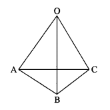
Let O-ABC be a tetrahedron. Then o (OA, BC), (OB, CA) and (OC, AB) are the pair of opposite edges.
Take $O$ as the origin of reference and let $\bar{a} \bar{b}$ and
$\begin{aligned} & \overline{\mathrm{OA}}=\bar{a}, \overline{\mathrm{OB}}=\bar{b}, \overline{\mathrm{OC}}=\bar{c} \\ & \overline{\mathrm{AB}}=\bar{b}-\bar{a}, \overline{\mathrm{BC}}=\bar{c}-\bar{b} \text { and } \overline{\mathrm{CA}}=\bar{a}-\bar{c}\end{aligned}$
Now, suppose the pairs $(O A, B C)$ and $(O B, C A)$ are
perpendicular to each other.
Then $\overline{\mathrm{OA}} \cdot \overline{\mathrm{BC}}=0$, i.e. $\bar{a} \cdot(\bar{c}-\bar{b})=0$
$\therefore \bar{a} \cdot \bar{c}-\bar{a} \cdot \bar{b}=0$
... (1)
and $\overline{\mathrm{OB}} \cdot \overline{\mathrm{CA}}=0$, i.e. $\bar{b} \cdot(\bar{a}-\bar{c})=0$
$\begin{aligned} & \therefore \bar{b} \cdot \bar{a}-\bar{b} \cdot \bar{c}=0 \\ & \therefore \bar{a} \cdot \bar{b}-\bar{b} \cdot \bar{c}=0\end{aligned}$
$\ldots(2)$
Adding (1) and (2), we get
$\begin{aligned} & \bar{a} \cdot \bar{c}-\bar{b} \cdot \bar{c}=0 \\ \therefore & \bar{c} \cdot \bar{b}-\bar{c} \cdot \bar{a}=0\end{aligned}$
$\begin{aligned} & \text { i.e. } \bar{c} \cdot(\bar{b}-\bar{a})=0 \\ & \therefore \overline{\mathrm{OC}} \cdot \overline{\mathrm{AB}}=0\end{aligned}$
∴ the third pair (OC, AB) is perpendicular.