Question types

Electrostatics question types

220 questions across 4 question groups — pick any mix to generate a Physics paper with step-by-step answer keys.

220
Questions
4
Question groups
5
Question types
Sample Questions

Electrostatics questions

One sample from each question group in this chapter. Select any group above to see the full set with answer keys.

The potential energy of a dipole iii a uniform electric held $\vec{E}$ is minimum when the dipole moment is
  • A
    transverse to $\vec{E}$
  • parallel to $\vec{E}$
  • C
    antiparallel to $\vec{E}$
  • D
    either parallel or antiparallel to $\vec{E}$.

Answer: B.

View full solution
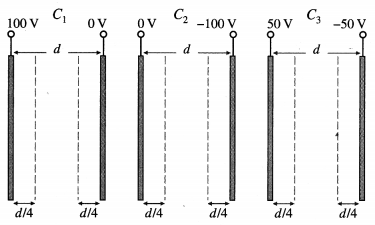
The figure shows three capacitors $C_1 C_2$ and $C_3$. The dashed lines are equipotential surfaces within each capacitor. In which of the capacitors is the po. between the two equipotentials $\Delta V =50 V$ ?

Image

  • A
    Only in $C_1$
  • B
    Only in $C _1$ and $C _2$
  • C
    Only in $C _3$
  • In all three capacitors

Answer: D.

View full solution
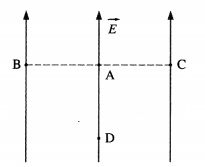
In the diagram, $\vec{E}$ is a uniform electric field. Point $B$ is to the west of point $A$ while point $C$ is to the east and point $D$ is to the south. Which of the following is correct?

Image

  • A
    $V_B>V_A>V_C$
  • B
    $V_B<V_A<V_C$
  • $V_B=V_C$
  • D
    $V_D=V_A$

Answer: C.

View full solution
The intensity of electric field at a point clone but outside a charged conducting cylinder is proportional to

[r is the distance of the point from the axis of the cylinder]

  • $\frac{1}{r}$
  • B
    $\frac{1}{r^2}$
  • C
    $\frac{1}{r^3}$
  • D
    $r$.

Answer: A.

View full solution
If the charge on a capacitor is $2 \mu C$ and the potential difference across the conductors forming the capacitor is $100 V$, what is the electrostatic energy stored in the capacitor?
View full solution
If we apply a large enough electric field, we can ionize the atoms and create a condition for electric charge to flow like a conductor. The fields required for the breakdown of dielectric is called dielectric strength.
View full solution
(1) If there are n parallel plates then there will be $(n-1)$ capacitors, hence
$
C=(n-1) \frac{A \varepsilon_0}{d}
$
(2) For a spherical capacitor, consisting of two concentric spherical conducting shells with inner and outer radii as $a$ and $b$ respectively, the capacitance $C$ is given by $C=4 \pi \varepsilon_0\left(\frac{a b}{b-a}\right)$
(3) For a cylindrical capacitor, consisting of two coaxial cylindrical shells with radii of the inner and outer cylinders as $a$ and $b$, and length $I$, the capacitance $C$ is given by
$
C=\frac{2 \pi \varepsilon_0 \ell}{\log _e \frac{b}{a}}
$
View full solution
In a parallel plate capacitor with air between the plates, each plate has an area of $6 \times 10^{-3}\ m^2$​​​​​​​ and the separation between the plates is $2 mm$.
i) Calculate the capacitance of the capacitor.
ii) If this capacitor is connected to $100\ V$ supply, what would be the charge on each plate?
iii) How would charge on the plates be affected if a $2$ mm thick mica sheet of $k = 6$ is inserted between the plates while the voltage supply remains connected ?
View full solution

Generate a Electrostatics paper free

Pick question groups from the list above, set marks and difficulty, and export a branded PDF with step-by-step answer keys. First 3 chapters free — no signup.

Download App