Question 13 Marks
Is electrostatic potential necessarily zero at a point where electric field strength is zero? Justify.
AnswerElectric potential is a scalar quantity while electric field intensity is a vector quantity. When we add potentials at a point due two or more point charges, the operation is simple scalar addition along with the sign of V, determined by the sign of the q that produces V. At a point, the net field is the vector sum of the fields due to the individual charges. Midway between the two charges of an electric dipole, the potentials due to the two charges are equal in magnitude but opposite in sign, and thus add up to zero. But the electric fields due to the charges are equal in magnitude and direction-towards the negative charge-so that the net field there is not zero. But midway between two like charges of equal magnitudes, the potentials are equal in magnitude and have the same sign, so that the net potential is nonzero. However, the fields due to the two equal like charges are equal in magnitude but opposite in direction, and thus vectorially add up to zero.
View full question & answer→Question 23 Marks
If we apply a large enough electric field, we can ionize the atoms and create a condition for electric charge to flow like a conductor. The fields required for the breakdown of dielectric is called dielectric strength.
AnswerIn a sufficiently strong electric field, the molecules of a dielectric material become ionized, allowing flow of charge. The insulating properties of the dielectric breaks down, permanently or temporarily, and the phenomenon is called dielectric breakdown. During dielectric breakdown, electrical discharge through the dielectric follows random-path patterns like tree branches, called a Lichtenberg figure. Dielectric strength is the voltage that an insulating material can withstand before breakdown occurs. It usually depends on the thickness of the material. It is expressed in kV/mm. For example, the dielectric strengths of air, polystyrene and mica in kV/mm are 3, 20 and 118. Higher dielectric strength corresponds to better insulation properties.
View full question & answer→Question 33 Marks
What is gravitational Potential ?
AnswerWe measure the gravitational potential energy U of a body (1) by assigning U = 0 for a reference configuration (such as the body at a reference level) (2) then equating U to the work W done by an external force to move the body up or down from that level to a point. We then define gravitational potential of the point as gravitational potential energy per unit mass of the body.
We follow the same procedure with the electric force, which is also a conservative force with the only difference that while the gravitational force is always attractive, electric force can be attractive (for unlike charges) or repulsive (for like charges).
View full question & answer→Question 43 Marks
A spherical shell of radius b with charge Q is expanded to a radius a. Find the work done by the electrical forces in the process.
AnswerConsider a spherical conducting shell of radius r placed in a medium of permittivity ε. The mechanical force per unit area on the charged conductor is
$
f=\frac{F}{d S}=\frac{\sigma^2}{2 \varepsilon}
$
where a is the surface charge density on the conductor. Given the charge on the spherical shell is $Q_1\left(\sigma= Q / \pi r^2\right.$. The force acts outward, normal to the surface.
Suppose the force displaces a charged area element adS through a small distance dx, then the work done by the force is
$
d W=F d x=\left(\frac{\sigma^2}{2 \varepsilon} d S\right) d x
$
During the displacement, the area element sweeps out a volume $d V=d S \cdot d x$.
Since $V=\frac{4}{3} \pi r^3, d V=4 \pi r^2 d r$
$
\begin{aligned}
\therefore d W & =\frac{\sigma^2}{2 \varepsilon} d V=\frac{1}{2 \varepsilon}\left(\frac{Q}{4 \pi r^2}\right)^2\left(4 \pi r^2 d r\right) \\
& =\frac{Q^2}{8 \pi \varepsilon} \frac{1}{r^2} d r
\end{aligned}
$
Therefore, the work done by the force in expanding the shell from radius $r=b$ to $r=a$ is
$
\begin{aligned}
W=\int d W & =\frac{Q^2}{8 \pi \varepsilon} \int_b^a \frac{1}{r^2} d r \\
& =\frac{Q^2}{8 \pi \varepsilon}\left[-\frac{1}{r}\right]_b^a=\frac{Q^2}{8 \pi \varepsilon}\left(\frac{1}{b}-\frac{1}{a}\right)
\end{aligned}
$
This gives the required expression for the work done.
View full question & answer→Question 53 Marks
The safest way to protect yourself from lightening is to be inside a car. Justify.
AnswerThere is danger of lightning strikes during a thunderstorm. Because trees are taller than people and therefore closer to the clouds above, they are more likely to get hit by lightnings. Similarly, a person standing in open ground is the tallest object and more likely to get hit by a lightning. But car with a metal body is an almost ideal Faraday cage. When a car is struck by lightning, the charge flows on the outside surface of the car to the ground but the electric field inside remains zero. This leaves the passengers inside unharmed.
View full question & answer→Question 63 Marks
A metal plate is introduced between the plates of a charged parallel plate capacitor. What is its effect on the capacitance of the capacitor?
AnswerSuppose the parallel-plate capacitor has capacitance $C_0$, plates of area $A$ and separation d. Assume the metal sheet introduced has the same area A.
Case (1) : Finite thickness $t$. Free electrons in the sheet will migrate towards the positive plate of the capacitor. Then, the metal sheet is attracted towards whichever capacitor plate is closest and gets stuck to it, so that its potential is the same as that of that plate. The gap between the capacitor plates is reduced to $d-t$, so that the capacitance increases.
Case (2) : Negligible thickness. The thin metal sheet divides the gap into two of thicknesses $d_1$ and $d_1$ of capacitances $C_1 = ε_0A/d_1$ and $C_2 = ε_0A/d_2$ in series.
Their effective capacitance is
$C=\frac{C_1 C_2}{C_1+C_2}=\frac{\varepsilon_0 A}{d_1+d_2}=\frac{\varepsilon_0 A}{d}=C_0$
i.e., the capacitance remains unchanged.
View full question & answer→Question 73 Marks
An electric dipole consists of two unlike charges of magnitude $2 \times 10^{-6} C$ separated by $4 \ cm$. The dipole is placed in an external field of $10^5 N / C$. Find the work done by an external agent to turn the dipole through $180^{\circ}$.
AnswerData : $q =2 \times 10^{-6},$
$ 2 l =4 \ cm =4 \times 10^{-2} m$.
$E =10^5 N / C , \theta=180^{\circ}+\theta_0$
Let us assume the dipole is initially aligned parallel to the field,
i.e., $\theta_0=0$.
Then, $\theta=180^{\circ}$.
The work done by an external agent,
$W=p E(1-\cos \theta)$
$=q(2 l ) E \left(1-\cos 180^{\circ}\right)$
$=\left(2 \times 10^{-6} C \right)\left(4 \times 10^{-2} m \right)\left(10^5 N / C \right)[1-(-1)]$
$=16 \times 10^{-3} J$
View full question & answer→Question 83 Marks
The energy stored in a charged capacitor of capa city $25 \mu F$ is $4J.$ Find the charge on its plate.
AnswerData: $C=25 p F=25 \times 10^{-12} F , U =4 J$
$U=\frac{1}{2} \frac{Q^2}{C}$
$\therefore$ The charge, $Q =\sqrt{2 U C}$
$=\sqrt{2 \times 4 \times 25 \times 10^{-12}}$
$=1.414 \times 10^{-5} C (=14.14 \mu C )$
View full question & answer→Question 93 Marks
A parallel$-$plate air capacitor has rectangular plates, each of area $20 \ cm ^2$ separated by a distance of $2 \ mm$. The potential difference between the plates is $500$ volts. Calculate $(i)$ its capacitance $(ii)$ the charge on each plate $(iii)$ the electric field intensity between the two plates.
AnswerData : $A=20 \ cm ^2=20 \times 10^{-4} m ^2=2 \times 10^{-3} m ^2, k =1, V =500 V , d =2\ mm =2 \times 10^{-3}m , \varepsilon_0=8.85 \times 10^{-12} F / m$
$(i)$ Capacitance :
$C=\frac{A \varepsilon_0 k}{d}=\frac{\left(2 \times 10^{-3}\right)\left(8.85 \times 10^{-12}\right)(1)}{2 \times 10^{-3}}$
$=8.85 \times 10^{-12} F (=8.85 pF )$
$(ii)$ Charge:
$Q = CV =\left(8.85 \times 10^{-12}\right)(500)$
$=4.425 \times 10^{-9} C\ (=4.425\ nC )$
$(iii)$ Intensity of the electric field:
$E =\frac{V}{d}=\frac{500}{2 \times 10^{-3}}=2.5 \times 10^5 V / m$
View full question & answer→Question 103 Marks
A parallel-plate air capacitor has circular plates, each of diameter $20 cm$, separated by a distance of $2 mm$. The potential difference between the plates is maintained at 360 volts. Calculate its capacitance and charge. What is the intensity of the electric field between the plates of the capacitor? $[k=1]$
AnswerData : The diameter of each plate is $20 cm$. Hence, its radius is $r=10 cm =0.1 m , d =$ $2 mm =2 \times 10^{-3} m , V =360 V , k =1, \varepsilon_0=8.85 \times 10^{-12} F / m$
(i) Capacitance :
$
\begin{aligned}
C & =\frac{A \varepsilon_0 k}{d}=\frac{\pi r^2 \varepsilon_0 k}{d} \\
& =\frac{3.14 \times(0.1)^2 \times 8.85 \times 10^{-12} \times 1}{2 \times 10^{-3}} \\
& =1.39 \times 10^{-10} F
\end{aligned}
$
(ii) Charge :
$
\begin{aligned}
Q & =C V=1.39 \times 10^{-10} \times 360 \\
& = 5 . 0 0 4 \times 1 0 ^{-8} C
\end{aligned}
$
(iii) Intensity of the electric field :
$
\begin{aligned}
E=\frac{V}{d} & =\frac{360}{2 \times 10^{-3}} \\
& =1.8 \times 10^5 V / m
\end{aligned}
$
View full question & answer→Question 113 Marks
A parallel$-$plate air capacitor has an area $2 \times 10^{-4} m ^2$ and the separation between the two plates is $1 \ mm$. Find its capacitance.
AnswerData : $A=2 \times 10^{-4} m ^2, d =1 \ mm =10^{-3} m$, $\varepsilon_0=8.85 \times 10^{-12} C ^2 / N \cdot m ^2, k =1($ for air$)$
The capacitance,
$C =\frac{A k \varepsilon_0}{d}$
$=\frac{\left(2 \times 10^{-4}\right)(1)\left(8.85 \times 10^{-12}\right)}{10^{-3}}$
$=1.77 \times 10^{-12} F $
$=1.77 pF$
View full question & answer→Question 123 Marks
Which combination of four identical capacitors has the maximum capacitance? Which combination of these capacitors will store minimum energy when a constant p.d. is applied across it?
AnswerThe maximum capacitance of four identical capacitors, each of capacitance $C_r$ is obtained for their parallel combination : $C_p=4 C$.
Their series combination has the minimum capacitance. The charge stored in their parallel combination is four times that in their series combination. For the same constant p.d. V, the energy stored in the parallel combination is $\frac{1}{2}(4 Q) V$ and that in the series combination is $\frac{1}{2}$ QV. Thus, the series combination will store minimum energy.
View full question & answer→Question 133 Marks
What are the functions of a dielectric in a capacitor?
AnswerA dielectric material between the plates of a capacitor
1. increases the capacitance of the capacitor
2. provides mechanical support to the plates
3. increases the maximum operating voltage, i.e, the maximum voltage to which the capacitor may be charged without breakdown of the insulating property of the medium between the plates.
View full question & answer→Question 143 Marks
State the expression for the capacitance of a parallel-plate capacitor filled with a dielectric. Explain how its capacitance can be increased.
AnswerThe capacitance of a parallel-plate capacitor filled with a dielectric is $C =\frac{A k \varepsilon_0}{d}$
where $A$ is the area of each plate, $k$ is the relative permittivity (dielectric constant) of the medium between the plates, $\varepsilon_0$ is the permittivity of free space and $d$ is the uniform plate separation.
The capacitance of a parallel-plate capacitor can be increased by
1. increasing the area of each plate
2. decreasing the distance between the two plates
3. filling the space between the two plates by a medium of greater relative permittivity.
View full question & answer→Question 153 Marks
Three capacitors are connected as shown in the figure below. Calculate the effective capacitance between $A$ and $B.$
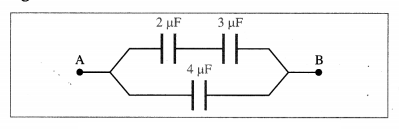
AnswerData: $C _1=2 \mu F , C _2=3 \mu F , C _3=4 \mu F$
The resultant capacitance $C_5$ of $C_1$ and $C_2$ in series is given by
$\frac{1}{C_n}=\frac{1}{C_1}+\frac{1}{C_2}=\frac{1}{2}+\frac{1}{3}=\frac{5}{6}$
$\therefore C_5=\frac{6}{5}=1.2 \mu F$
The effective capacitance between $A$ and $B$ is due to the parallel combination of $C_5$ and $C_3$.
$C_p=C_5+C_3=1.2+4=5.2 \mu F$
View full question & answer→Question 163 Marks
Two capacitors of capacities C1 and C2 are joined in series and this combination is joined in parallel with a capacitor of capacity C3. Show that the capacity of the system is C = $\frac{C_{1}\left(C_{2}+C_{3}\right)}{C_{2}}$
AnswerThe equivalent capacitance of the series combination of $C_1$ and $C_2$ is $C_s=[$ latex $]$ frac $\left\{C_{-}\{1\} C_{-}\{2\}\right\}\left\{C_{-}\{1\}+C_{-}\{2\}\right\}$
The equivalent capacitance of the parallel combination of $C_5$ and $C_3$ is
$
\begin{aligned}
C=C_8 \| C_3 & =C_5+C_3=\frac{C_1 C_2}{C_1+C_2}+C_3 \\
& =\frac{C_1 C_2+C_1 C_3+C_2 C_3}{C_1+C_2} \\
& =\frac{C_1\left(C_2+C_3\right)+C_2 C_3}{C_1+C_2}
\end{aligned}
$
as required.
View full question & answer→Question 173 Marks
With four capacitors of the same capacity, when three of them are connected in parallel and the remaining one in connected in series with this combination, the resultant capacity is 3.75 $\mu F$. Find the capacity of each capacitor.
AnswerData : $C _{\text {eff }}=3.75 \mu F$
Let the capacity of each of the four capacitors be $C$. The equivalent capacity of three of them in parallel is
$
C_p= C + C + C =3 C
$
The equivalent capacity of the series combination of $C_p$ and the fourth capacitor is
$
C_{\text {eff }}=\frac{C_{ p } C}{C_{ P }+C}=\frac{(3 C) C}{3 C+C}=\frac{3}{4} C
$
$\therefore$ By the data, $\frac{3}{4} C =3.75 \mu F$
$
\therefore C =\frac{4}{3} \times 3.75=5 \mu F
$
$\therefore$ The capacity of each capacitor $=5 \mu F$.
View full question & answer→Question 183 Marks
Three capacitors have capacities $2 \mu F , 4 \mu F$ and $8 \mu F$. Find the equivalent capacity when they are connected in (a) series (b) parallel.
AnswerData: $C_1=2 \mu F, C_2=4 \mu F, C_3=8 \mu F$
(a) Series arrangement:
$
\frac{1}{C_s}=\frac{1}{C_1}+\frac{1}{C_2}+\frac{1}{C_3}=\frac{1}{2}+\frac{1}{4}+\frac{1}{8}=\frac{7}{8}
$
The equivalent capacity,
$
\therefore C _{ s }=\frac{8}{7}=1.143 \mu F
$
(b) Parallel arrangement:
The equivalent capacity is
$
C_p=C_1+C_2+C_3=2+4+8=14 \mu F
$
View full question & answer→Question 193 Marks
Define the capacitance of a capacitor. State and define the SI unit of capacitance.
Answer(1) Definition: The capacitance (capacity) of a capacitor is defined as the ratio of the charge on either conductor to the potential difference between the two conductors forming the capacitor.
(2) The SI unit of capacitance is the farad.
Definition: The capacitance of a capacitor is said to be one farad if a charge of one coulomb is required to increase the potential difference between the two conductors forming the capacitor by one volt.
1 farad $=1$ coulomb $/$ volt; $1 F =1 CN$
[Note : Capacitors in common electronic circuits are in microfarad $\left(10^{-6} F \right)$, nanofarad $\left(10^{-9} F \right)$ or picofarad $\left(10^{-12} F \right)$.]
View full question & answer→Question 203 Marks
How does the electric field inside a dielectric decrease when it is placed in an external electric field?
AnswerSuppose a rectangular slab of dielectric is placed in an electric field $\overrightarrow{E_0}$, with two of its parallel sides perpendicular to the field. The dielectric becomes polarized. Polarization charges appear on the external surfaces of these two parallel sides such that within the dielectric the field due to the polarization charges is opposite to $\overrightarrow{E_0}$. Thus, the magnitude of the net electric field $\vec{E}$ within the dielectric is less than $\left|\overrightarrow{E_0}\right| \cdot E=\frac{E_0}{k}$, where $k$ is the relative permittivity (dielectric constant) of the dielectric.
View full question & answer→Question 213 Marks
What is electric susceptibility?
AnswerIn a linearly isotropic dielectric placed in a uniform electric field, the electric polarization $\vec{P}$ is directly proportional to the electric field intensity $\vec{E}$ inside the dielectric.
$
\therefore \vec{P}=\chi_e \varepsilon_0 \vec{E}
$
where the proportionality constant $\chi_{e,}$ a positive quantity, is called the electric susceptibility of the dielectric.
[Note $: \chi_e$ is dimensionless. $SI$ units of $P$ and $E$ are $C / m ^2$ and $N / C$ ]
View full question & answer→Question 223 Marks
What is a dielectric? State its two types. Give two examples in each case,
AnswerA dielectric is an electrical insulator i.e., a nonconducting material, that can be polarised by an applied electric field which slightly displaces the positive and negative charges of each molecule. A dielectric can sustain a high electric field up to a certain limit. An ideal dielectric has no free charges.
Important commercial dielectrics are of two types, polar and nonpolar.
Examples:
Polar dielectrics : Silicones, halogenated hydrocarbons.
Nonpolar dielectrics : (1) Solid: Ceramics, glasses, plastics (polyethylene, polystyrene, etc.) mica, paper. (2) Liquid : Mineral oils.
View full question & answer→Question 233 Marks
You can charge a glass or rubber rod by holding one end of the rod and rubbing the other end with a silk cloth. But you cannot charge a copper rod in the same way. Explain.
AnswerGlass and rubber are insulators. An excess charge (positive or negative) building up on some part of an insulator remains localized. So, a glass or rubber rod can be held at one end while the far end is being rubbed with silk. The far end of the rod acquires a surplus of electrons but those electrons never flow into the ground through the hand.A copper rod is an example of a conductor which has free conduction electrons. On holding one end of the copper rod and rubbing the other end with silk, electrons are transferred from the silk to the copper rod, and those excess electrons are free to flow. Because like charges repel, the electrons move away from one another, travel through the rod to the ground through the hand. As a result, the copper rod remains neutral despite the rod being rubbed with silk.
View full question & answer→Question 243 Marks
State the properties of conductors in electrostatic conditions.
AnswerProperties of a charged conductor in electrostatic conditions:
1. Net electric field inside the conductor is zero.
2. Net electric field just outside the conductor is normal to its surface at every point.
3. Electric potential inside the conductor is constant and equal to that on its surface.
4. Excess charges reside only on the surface of the conductor but, for a conductor of arbitrary shape, the surface charge density at a point is inversely proportional to the local curvature of the surface.
View full question & answer→Question 253 Marks
Birds perched on electrical transmission wires do not suffer electric shock, but if a person touches both the wires at once receives a tremendous shock. Why?
AnswerThe danger of electric shock arises not from mere contact with a live wire but rather from simultaneous contact with a live wire and another body or wire at a different potential so that our body provides a conducting path between the two and a current passes through our body.
Touching a single wire by the birds does not result in a current through their bodies because then the electric circuit is not complete. But if a person touches two wires at different potentials at once, or if a bare-footed person touches the live wire only, the electric circuit is complete and the person receives an electric shock. In the latter case, the current from the wire passes to the Earth through the body.
[Notes : (1) We must not touch any electric appliance. when bare-footed or with wet hands. When a bare-footed person touches a short-circuited electric appliance, the current from such an appliance goes to the Earth through his body, thus completing the circuit. When our skin is dry, the electrical resistance of our body is about $50 k \Omega$, a wet skin lowers the resistance to $10 k \Omega$. It needs a minimum of $1 mA$ of electric current to pass through our body for us to experience a shock. Thus, when dry, it needs at least $50 V$ potential difference to get a shock, but only $10 V$ is enough when wet. (2) The Earth often serves as a charge reservoir known as a ground. A ground can accept or provide electrons freely, and it is so large that the addition or subtraction of electrons has a negligible effect on it. So, the ground remains essentially neutral at all times. When something is connected to the ground by a conductor, we say that it is earthed or grounded.]
View full question & answer→Question 263 Marks
An electric dipole has opposite charges of magnitude $2 \times 10^{-15} C$ separated by $0.2\ mm$. It is placed in a uniform electric field of $10^3 N / C. (i)$ Find the magnitude of the dipole moment. $(ii)$ What is the torque on the dipole when the dipole moment is at $60^{\circ}$ with respect to the field?
Answer$q =2 \times 10^{-15} C ,$
$2 l =0.2 \ mm =2 \times 10^{-4} m$,
$E=10^3 N / C , \theta=60^{\circ}$
$(i)$ The magnitude of the dipole moment is
$V=q(2 l )$
$=\left(2 \times 10^{-15} C \right)\left(2 \times 10^{-4} m \right)$
$=4 \times 10^{-19} C \cdot m$
$(ii)$ The torque on the dipole is
$\tau=p E \sin \theta$
$=\left(4 \times 10^{-19} C \cdot m \right)\left(10^3 N / C \right) \sin 60^{\circ}$
$=4 \times 10^{-16} \times 0.866$
$=3.46 \times 10^{-16} N \cdot m$
View full question & answer→Question 273 Marks
Two charged spherical conductors, of radii $R_1$ and $R_2$ and surface charge densities $\sigma_1$ and $\sigma_2$, are connected by a thin conducting wire. Except for this connecting wire, the spheres are sufficiently separated to be considered as isolated. Show that $\sigma_1 R_1=\sigma_2 R_2$.
AnswerThe electrical potential at the surface of an isolated, charged conducting sphe of radius $R$ is
$V =\frac{1}{4 \pi \varepsilon_0} \frac{q}{r}=\frac{1}{4 \pi \varepsilon_0} \frac{\sigma\left(4 \pi R^2\right)}{R}=\frac{\sigma R}{\varepsilon_0}$
$\therefore V_1 =\frac{\sigma_1 R_1}{\varepsilon_0}$ and $V_2=\frac{\sigma_2 R_2}{\varepsilon_0}$
Since the spherical conductors are connected by a conducting wire, the syste must be equipotential, i.e.,
$V _1= V _2 .$
$\therefore \frac{\sigma_1 R_1}{\varepsilon_0}=\frac{\sigma_2 R_2}{\varepsilon_0}$
$\therefore \sigma_1 R_1=\sigma_2 R_2$ as required
$[$Note : Although the above connected system is different from a typical conductor with a variable radius of curvature, the above relation qualitatively indicates how charge density varies over the surface of a conductor of arbitrary shape. The equation indicates that $\sigma$ and $E$ are small where the radius of curvature is large. Conversely$, \sigma$ and $E$ are higher at locations with a small radius of curvature. A practical application of this phenomenon is the lightning rod.$]$
View full question & answer→Question 283 Marks
Consider a point charge $q =1.5 \times 10^{-8} C$. What is the radius of an equipotential surface having a potential of $30V$ ?
AnswerData : $ q =1.5 \times 10^{-8} C$
$1 / 4 \pi \varepsilon_0=9 \times 10^9 N \cdot m ^2 / C ^2, V =30 V$
An equipotential surface surrounding an isolated point charge is a sphere centred on the charge.
Let $r$ be the radius of such an equipotential for which $V= 30 V$
$V =\frac{1}{4 \pi \varepsilon_0} \frac{q}{r}$
$\therefore r =\frac{1}{4 \pi \varepsilon_0} \frac{q}{V}$
$ =\left(9 \times 10^9 N \cdot m ^2 / C ^2\right)$
$ = \frac{1.5 \times 10^{-8} C }{30 V }$
$ =4.5 m$
View full question & answer→Question 293 Marks
What is the potential energy of a point charge in an external electric field?
AnswerConsider a charge q placed in an external electric field at a point whose position vector with respect to an arbitrary reference frame is $\vec{r}$. If $V (\vec{r})$ is the potential of the point, with respect to an arbitrary reference zero at infinity, then the potential energy of the charge $q$ at the point is
$
U (\vec{r})= qV (\vec{r})
$
where it is assumed that $q$ is sufficiently small and does not significantly distort the electric field and the potential at the point.
View full question & answer→Question 303 Marks
A system consisting of a charged spherical shell and an electron has negative electric potential energy $U=-15 \times 10^{-20} J$, with $U(\infty)=0$.
(a) What is the sign of the charge on the shell?
(b) If the electron is replaced by a proton, what would be the electric potential energy of the new system?
AnswerA charged spherical conductor is equivalent to a point charge at its centre. For $U(\infty)=0$, the potential energy of two point charges $q_1$ and $q_2$ a distance $r_{21}$ apart is
$
U =\frac{1}{4 \pi \varepsilon_0} \frac{q_1 q_2}{r_{21}}
$
Since the FE of the charged shell and electron system is negative, the shell must be positively charged, electron being negatively charged.If the electron is replaced by a proton, the PE of the new system would be positive equal to $U ^{\prime}= \pm 15 \times 10^{-20} J$
View full question & answer→Question 313 Marks
What are the advantages of using electrostatic potential?
AnswerThe electrostatic potential at each point in space in the vicinity of the source charges represents a scalar field.
The advantages of electrostatic potential field associated with a given distribution of charges are as follows:
- If we know the potential difference between any two points, we can easily obtain the change in potential energy and the work done when a charge placed in the field moves between these two points.
- Electric field is a vector field. Electrostatic potential being a scalar field, the potential at any point due to several charges is simply the algebraic sum of the potentials due to the individual charges.
- The construction of equipotential surfaces helps to visualize the electric field pattern.
- It is possible to calculate the electric field $\vec{E}$ from the scalar potential field function $V$ (by differentiating $V$ with respect to the space coordinates.)
View full question & answer→Question 323 Marks
A proton and an $\alpha$-particle are accelerated from rest through the same potential difference. Compare their final speeds. Charge on an $\alpha$-particle $=2 \times$ charge on a proton, mass of an $\alpha$ particle $=4 \times$ mass of a proton.
AnswerLution: Let $q _1=$ charge on an $\alpha$-partic $1 e , q _2=$ charge on a proton, $m _1=$ mass of an $\alpha$-particle, $m_2=$ mass of a proton, $v_1=$ final speed of the $\alpha$-particle, $v_2=$ final speed of the proton
$
\therefore \frac{q_1}{q_2}=2 \text { and } \frac{m_1}{m_2}=4 \quad \therefore \frac{m_2}{m_1}=\frac{1}{4}
$
If the particles are accelerated from rest, through a potential difference $V$,
$
\begin{aligned}
& \frac{1}{2} m_1 v_1^2=q_1 V \text { and } \frac{1}{2} m_2 v_2^2=q_2 V \\
\therefore & \frac{m_1 v_1^2}{m_2 v_2^2}=\frac{q_1}{q_2} \quad \text {} \\
\therefore & \frac{v_1^2}{v_2^2}=\frac{q_1}{q_2} \times \frac{m_2}{m_1}=2 \times \frac{1}{4}=\frac{1}{2} \\
\therefore & \frac{v_1}{v_2}=\frac{1}{\sqrt{2}}=0.707
\end{aligned}
$
View full question & answer→Question 333 Marks
A proton is accelerated from rest through a potential difference of $500$ volts. Find its final momentum. $\left[ m _{ p }=1.67 \times 10^{-27} kg , e =1.6 \times 10^{-19} C \right]$
Answer$m _{ p }=1.67 \times 10^{-27} \ kg ,$
$e =1.6 \times 10^{-19} C ,$
$u =0,$
$V =500 V$
Initial $K E , KE _i=\frac{1}{2} m _{ p } u ^2=0$
$\therefore \Delta K E=K E_f-K E_{ i }= KE _{ f }$
$\Delta K E= qV$
$\therefore KE _{ f }= qV KE_{f } =\frac{1}{2} m _{ p } v ^2=\frac{p_{ f }^2}{2 m_{ p }}$
where $p _{ f }= m _{ p } v \equiv$ the magnitude of the final momentum of the proton.
$\therefore P _{ f }{ }^2=2 m _{ p } qV$
$\therefore P _{ f }=\sqrt{2 m_{ p } q V}$
$=\sqrt{2\left(1.67 \times 10^{-27} \ kg \right)\left(1.6 \times 10^{-19} C \right)(500 V )}$
$=5.169 \times 10^{-22} \ kg \cdot m / s$
The momentum is directed along the applied electric field.
View full question & answer→Question 343 Marks
A particle carrying $5$ electrons starts from rest and is accelerated through a potential difference of $8900 V$. Calculate the $KE$ acquired by it in $MeV. [$Charge on electron $=1.6 \times 10^{-} \left.{ }^{19} C \right]$
AnswerData : $q =5 e , u =0, V =8900$
$V _{ l } e =1.6 \times 10^{-19} C$
$q =5\left(1.6 \times 10^{-19} C \right)=8 \times 10^{-19} C$
Initial $ KE = KE _{ i }=\frac{1}{2} mu ^2=0$
$\therefore \Delta KE = KE _{ f }- KE _{ i }= KE _{ f }$
$\Delta KE = qV$
$\therefore $ The final $ KE , KE _{ f }= qV$
$=\left(8 \times 10^{-19} C \right)(8900 V )$
$=7.12 \times 10^{-15} J$
$=\frac{7.12 \times 10^{-15}}{1.6 \times 10^{-19}} eV$
$=4.45 \times 10^4 eV$
$=\left(4.45 \times 10^{-2}\right) \times 10^6 eV$
$=4.45 \times 10^{-2} MeV $
View full question & answer→Question 353 Marks
The electric potential due to a dipolar molecule of electric dipole moment $6 \times 10^{-30} A \cdot m ^2$ at a point along the axis of the dipole is $1 V$. Find the distance of the point from the centre of the dipole.
AnswerData $: p=6 \times 10^{-30} A \cdot m ^2, V =1 V$,
$\theta=0^{\circ} \ ($axial point$), 1 / 4 \pi \varepsilon_0=9 \times 10^9 N \cdot m ^2 / C ^2$
Electric potential,
$V=\frac{1}{4 \pi \varepsilon_0} \frac{p \cos \theta}{r^2}$
$\therefore 1 V =\left(9 \times 10^9 N \cdot m ^2 / C ^2\right)$
$ =\frac{\left(6 \times 10^{-30} A \cdot m ^2\right) \cos 0^{\circ}}{r^2}$
$\therefore r^2=54 \times 10^{-21}=5.4 \times 10^{-20}$
$\therefore $ The distance $, r=\sqrt{5.4 \times 10^{-20}}$
$=2.324 \times 10^{-10} m $ or $ 2.324 \mathring A$
View full question & answer→Question 363 Marks
The electric field and electric potential at a certain point due to a point charge in vacuum are $9000 V / m$ and $18000 V,$ respectively. Find the distance of the point from the charge and the magnitude of the charge.
AnswerData : $E =9000 V / m , V =18000 V ,$
$1 / 4 \pi \varepsilon_0=9 \times 10^9 N \cdot m ^2 / C ^2$
$E =\frac{q}{4 \pi \varepsilon_0 r^2}, V =\frac{q}{4 \pi \varepsilon_0 r}$
$\frac{V}{E}= r$
$\therefore $ The distance $, r =\frac{18000 V }{9000 V / m }=2 m$
$\therefore$ The magnitude of the charge is
$q =\frac{V r}{\left(1 / 4 \pi \varepsilon_0\right)}$
$ =\frac{(18000 V )(2 m )}{9 \times 10^9 N \cdot m ^2 / C ^2}$
$ = 4 \times 1 0 ^{-6} C$
View full question & answer→Question 373 Marks
Determine the electric potential at the midpoint of the line joining two charges $2 \times 10^{-6} C$ and $-1 \times 10^{-6} C$ placed in vacuum $10 \ cm$ apart.
AnswerData : $q _1=2 \times 10^{-6} C _1$
$q _2=-1 \times 10^{-6} C$,
$r =\frac{10 \ cm }{2}=5 \ cm =0.05 m$
$1 / 4 \pi \varepsilon_0=9 \times 10^9 N \cdot m ^2 / C ^2$
The electric potential at a distance $r$ from a charge $q$ is
$V =\frac{q}{4 \pi \varepsilon_0 r}$
Since potential is a scalar quantity, the total electric potential at the midpoint is
$V=V_1+V_2=\frac{1}{4 \pi \varepsilon_0}\left(q_1+q_2\right)$
$=\frac{\left(9 \times 10^9 N \cdot m ^2 / C ^2\right)}{0.05 m }(2-1) \times 10^{-6} C$
$=1.8 \times 10^5 V$
View full question & answer→Question 383 Marks
A helium nucleus carries a charge of $+2 e,$ where $e$ is the elementary charge. Find the electric potential at $10^{-10} m$ from the helium nucleus. $[e =1.6 \times 10^{-19} C] $
AnswerData : If $q$ is the charge on helium nucleus,
$q =+2 e =2 \times 1.6 \times 10^{-19} C , r =10^{-10} m ,$
$1 / 4 \pi \varepsilon_0=9 \times 10^9 N \cdot m ^2 / C ^2$
The electric potential,
$V =\frac{1}{4 \pi \varepsilon_0} \frac{q}{r}$
$=\frac{2\left(9 \times 10^9 N \cdot m ^2 / C ^2\right)\left(1.6 \times 10^{-19} C \right)}{10^{-10} m }$
$=28.8 V$
View full question & answer→Question 393 Marks
Distinguish between the volt and the electron volt.
Question 403 Marks
Distinguish between electric field intensity and electric potential.
Question 413 Marks
What is the electric potential at a point on the axis of a short electric dipole of moment $27 \ cm$ if the point is at $0.5 m$ from the centre of the dipole and is located in vacuum? $\left[\frac{1}{4 \pi \varepsilon_0}=9\right.$ $\left.\times 10^9 N \cdot m ^2 / C ^2\right]$
Answer$V= \pm \frac{1}{4 \pi \varepsilon_0} \cdot \frac{p}{r^2}$
$= \pm \frac{\left(9 \times 10^9 N \cdot m ^2 / C ^2\right)\left(10^{-27} C \cdot m \right)}{(0.5 m )^2}$
$= \pm 3.6 \times 10^{-17} V$
is the required electric potential.
View full question & answer→Question 423 Marks
A long cylindrical conductor of radius $2 cm$ carries a charge of $5 \mu C / m$ and is kept in a
medium of dielectric constant 10. Find the electric field intensity at a point $1 m$ from the axis of the cylinder.
$\left[\frac{1}{4 \pi+10}=9 \times 10^9 \frac{ N - m ^2}{ C ^2}\right]$
AnswerData $: R=2 cm , \lambda=5 \times 10^{-6} C / m , k =10$ $r =1 m , \frac{1}{4 \pi \varepsilon_0}=9 \times 10^9 N \cdot m ^2 / C ^2$
Electric field intensity,
$
\begin{aligned}
E & =\frac{\lambda}{2 \pi k \varepsilon_0 r}=\frac{2 \lambda}{4 \pi \varepsilon_0 k r} \\
& =\frac{\left(9 \times 10^9\right) \times 2\left(5 \times 10^{-6}\right)}{10 \times 1}=9 \times 10^3 N / C
\end{aligned}
$
$\vec{E}$ is directed outward.
View full question & answer→Question 433 Marks
The electric field intensity at a point $1 m$ from the centre of a charged sphere of radius $25 \ cm$ in air is $10^4 N / C$. Find the surface charge density of the sphere.
AnswerData $: r=1 m , R =0.25 m , $
$E =10^4 N / C , \varepsilon_0=8.85 \times 10^{-12} F / m$
$E =\frac{\sigma R^2}{\varepsilon r^2}$
As the sphere is situated in air $,\varepsilon \cong \varepsilon_0$.
$\therefore$ The surface charge density,
$\sigma=\varepsilon_0 E \left(\frac{r}{R}\right)^2$
$=\left(8.85 \times 10^{-12}\right)\left(10^4\right)\left(\frac{1}{0.25}\right)^2$
$=1.416 \times 10^{-10} C / m ^2$
View full question & answer→Question 443 Marks
A hollow metal ball $10 cm$ in diameter is given a charge of $1 \times 10^{-2} C$. What is the magnitude of the electric fiald intensity at a point $20 cm$ from the centre of the ball ?
AnswerData $: D =10 cm , R =\frac{D}{2}=5 cm , q =1 \times 10^{-2} C$, $r=20 cm =0.2 m , \varepsilon_0=8.85 \times 10^{-12}$
Electric field intensity,
$
\begin{aligned}
E & =\frac{q}{4 \pi \varepsilon_0 r^2} \\
& =\frac{1 \times 10^{-2}}{4 \times 3.142 \times 8.85 \times 10^{-12} \times(0.2)^2} \\
& =\frac{1000 \times 10^9}{16 \times 3.142 \times 8.85}=2.248 \times 10^9 N / C
\end{aligned}
$
View full question & answer→Question 453 Marks
An infinitely long positively charged straight wire has a linear charge density $\lambda$. An electron is revolving around the wire as its centre with a constant speed in a circular plane perpendicular to the wire. Deduce the expression for its kinetic energy.
AnswerLet $r$ be the radius of the uniform circular motion of the electron. The electric field intensity $\vec{E}$ at every point on the circular path is radially outward and has the same magnitude $E=$ $\frac{\lambda}{2 \pi \varepsilon r}$.
$\therefore$ The centripetal force on the electron,
$
F _{ c }=\frac{m_{ e } v^2}{r}= eE =\frac{e \lambda}{2 \pi \varepsilon r}
$
where $m_e$ and $v$ are the mass and linear speed of the electron.
$
\therefore m _{ e } v ^2=\frac{e \lambda}{2 \pi \varepsilon}
$
$\therefore$ The kinetic energy of the electron,
$
\frac{1}{2} m _{ e } v ^2=\frac{e \lambda}{4 \pi \varepsilon}
$
View full question & answer→Question 463 Marks
State Gauss's law in electrostatics.
AnswerGauss's law: The net flux through a closed surface in free space is related to the net charge qenci that is enclosed by that surface and is given by
$
\Phi=\oint \vec{E} \cdot \vec{d} s =\frac{q m }{ m }
$
where $eO$ is the permittivity of free space and the electric flux $\vec{E} \cdot \vec{d} s$ is integrated over the entire area of the surface.
[Note: The SI unit of electric flux is the newton metre squared per coulomb $\left( N \cdot m ^2 / C \right)$ or, equivalently, the voltmetre $V\vec{E} \cdot \overrightarrow{d \mathrm{~s}}m).$
View full question & answer→