Question 14 Marks
State the differential equation of linear SHM. Hence, obtain the expressions for the acceleration, velocity and displacement of a particle performing linear SHM.
Question 24 Marks
View full question & answer→Question 34 Marks
Explain
(1) free vibrations
(2) forced vibrations.
Answer
(1) Free vibrations : A body capable of vibrations is said to perform free vibrations when it is disturbed from its equilibrium position and left to itself.
In the absence of dissipative forces such as friction due to surrounding air and internal forces, the total energy and hence the amplitude of vibrations of the body remains constant. The frequencies of the free vibrations of a body are called its natural frequencies and depend on the body itself.In the absence of a maintaining force, in practice, the total energy and hence the amplitude decreases due to dissipative forces and the vibration is said to be damped. The frequency of damped vibrations is less than the natural frequency.
(2) Forced vibrations : The vibrations of a body in response to an external periodic force are called forced vibrations.The external force supplies the necessary energy to make up for the dissipative losses. The frequency of the forced vibrations is equal to the frequency of the external periodic force.
The amplitude of the forced vibrations depends upon the mass of the vibrating body, the amplitude of the external force, the difference between the natural frequency and the frequency of the periodic force, and the extent of damping.
View full question & answer→Question 44 Marks
A steel sphere of mass $0.02 kg$ attains a terminal speed $vi =0.5 m / s$ when dropped into a tall cylinder of oil. The same sphere is then attached to the free end of an ideal vertical spring of spring constant $8 N / m$. The sphere is immersed in the same oil and set into vertical oscillation. Find
(i) the damping constant
(ii) the angular frequency of the damped SHM.
(iii) Hence, write the equation for displacement of the damped SHM as a function of time, assuming that the initial amplitude is $10 cm .\left[ g =10 m / s ^2\right]$
Answer$ \text { Data : } m=0.02 kg , v_t=0.5 m / s , k =8 N / m ,$
$A=10 cm =0.1 m , g =10 m / s ^2 $
When the sphere falls with terminal velocity in oil, the resultant force on it is zero. Therefore, theThe equation of motion of the damped oscillation is resistive force and its weight are equal in magnitude and opposite in direction.
$\therefore\left|F_r\right|=\beta v_t=m g$
where $\beta$ is the damping constant.
$\therefore \beta=\frac{m g}{v_{ t }}=\frac{0.02 \times 10}{0.5}=0.4 kg / s$
The angular frequency of the damped oscillation in oil,
$\omega^{\prime} =\sqrt{\frac{k}{m}-\left(\frac{\beta}{2 m}\right)^2}=\sqrt{\frac{8}{0.02}-\left(\frac{0.4}{2 \times 0.02}\right)^2}$
$ =\sqrt{400-(10)^2}=\sqrt{300}= 1 7 . 3 2 rad / s$
The equation of motion of the damped oscillation is
$ x = Ae \left( e ^{(\beta / 2 m ) t } \cos \left(w^{\prime} t +\varphi\right)\right.$
$\therefore x =(0.1 m ) e ^{-(0.4 / 004) t } \cos (17.32 t +\varphi)$
$x =(0.1 m ) e ^{-10 t } \cos (17.32 t +\varphi) $
View full question & answer→Question 54 Marks
For a damped spring-and-block oscillator, the mass of the block is $0.2 kg$, the spring constant is $90 N / m$ and the damping constant is $0.06 kg / s$. Calculate
(i) the period of oscillation
(ii) the time taken for its amplitude to become half its initial value.
AnswerData : $m=0.2 kg , k =90 N / m , \beta=0.06 kg / s$
(i) The period of the damped oscillation is
$T^{\prime} =\frac{2 \pi}{\sqrt{\omega^2-\frac{\beta^2}{4 m^2}}}=\frac{2 \pi}{\sqrt{\frac{k}{m}-\left(\frac{\beta}{2 m}\right)^2}}$
$ =\frac{2 \times 3.142}{\sqrt{\frac{90}{0.2}-\left(\frac{0.06}{2 \times 0.2}\right)^2}}=\frac{6.284}{\sqrt{180-\frac{90}{400}}} $
$ =\frac{6.284 \times 20}{\sqrt{71991}} \quad $
$ =\frac{125.7}{268.3}=0.4685 s$
(ii) The amplitude of the damped oscillation is
$A^{\prime}=A e^{-(B / 2 m) t}$
If the amplitude becomes half the initial amplitude $A$ at time $f_{\text {, }}$
$ A e^{-(\beta / 2 m) t}=\frac{A}{2}$
$\therefore e^{(\beta / 2 m) t}=2 \quad \therefore \frac{\beta}{2 m} t=\ln 2$
$\therefore t=\frac{2 m \times \ln 2}{\beta}=\frac{2 \times 0.2 \times 2.303 \log 2}{0.06}$
$=\frac{0.4 \times 2.303 \times 0.3010}{0.06}=4.621 s$
View full question & answer→Question 64 Marks
Write the differential equation of motion for an oscillator in the presence of a damping force directly proportional to the velocity. Under what condition is the motion oscillatory? Hence, discuss the frequency, amplitude and energy of the damped oscillations.
OR
Oscillations in the presence of a force proportional to the velocity are periodic but not simple harmonic. Explain.
OR
The presence of a damping force changes the character of a simple harmonic motion. Explain this qualitatively.
Question 74 Marks
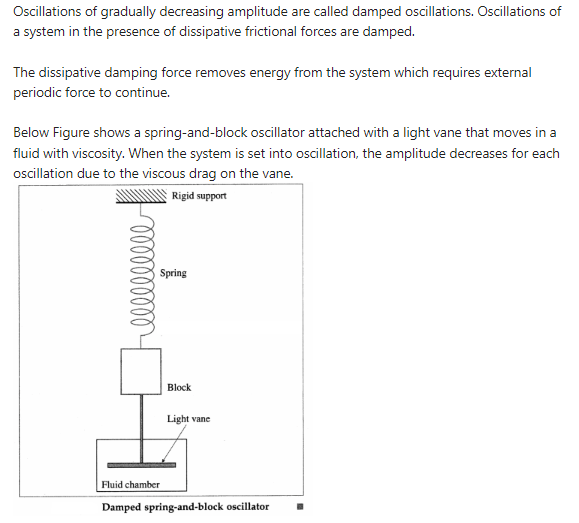
What is meant by damped oscillations ? Draw a neat, labelled diagram of a damped spring-and-block oscillator.
AnswerSolution is as follows:
View full question & answer→Question 84 Marks
Define angular SHM. State the differential equation of angular SHM. Hence derive an expression for the period of angular SHM in terms of
(i) the torsion constant
(ii) the angular acceleration.
Answer
Definition : Angular SHM is defined as the oscillatory motion of a body in which the restoring torque responsible for angular acceleration is directly proportional to the angular displacement and its direction is opposite to that of angular displacement. The differential equation of angular SHM is $I \frac{d^2 \theta}{d t^2}+c \theta=0 \ldots$ (1)
where $I=$ moment of inertia of the
where $I$ = moment of inertia of the oscillating body,
$\frac{d^2 \theta}{d t^2}=$ angular acceleration of the body when its angular displacement is $\theta$, and $c =$ torsion constant of the suspension wire,
$
\therefore \frac{d^2 \theta}{d t^2}+\frac{c}{I} \theta=0
$
Let $\frac{c}{I}=\omega^2$, a constant. Therefore, the angular frequency, $\omega=\sqrt{c / I}$ and the angular acceleration,
$
a=\frac{d^2 \theta}{d t^2}=-\omega^2 \theta
$
The minus sign shows that the $\alpha$ and $\theta$ have opposite directions. The period $T$ of angular SHM is
$
T=\frac{2 \pi}{\omega}=\frac{2 \pi}{\sqrt{C / I}}=2 \pi \sqrt{\frac{I}{c}}
$
This is the expression for the period in terms of torque constant. Also, from Eq. (2),
$\omega=\sqrt{\left|\frac{\alpha}{\theta}\right|} \quad$
$=\sqrt{\text { angular acceleration per unit angular displacement }}$
$\therefore T=\frac{2 \pi}{\omega}=\frac{2 \pi}{\sqrt{|\alpha / \theta|}}$
$2 \pi$
$=\frac{2 \pi}{\sqrt{\text { angular acceleration per unit angular displacement }}}$
View full question & answer→Question 94 Marks
Obtain the differential equation of linear simple harmonic motion.
AnswerWhen a particle performs linear SHM, the force acting on the particle is always directed towards the mean position. The magnitude of the force is directly proportional to the magnitude of the displacement of the particle from the mean position. Thus, if $\vec{F}$ is the force acting on the particle when its displacement from the mean position is $\vec{x}, \vec{F}=-k \vec{x} \ldots$ (1) where the constant $k$, the force per unit displacement, is called the force constant. The minus sign indicates that the force and the displacement are oppositely directed.
The velocity of the particle is $\frac{d \vec{x}}{d t}$ and its acceleration is $\frac{d^2 \vec{x}}{d t^2}$.
Let $m$ be the mass of the particle.
Force $=$ mass $\times$ acceleration
$\therefore \vec{F}= m \frac{d^2 \vec{x}}{d t^2}$
Hence, from Eq. (1),
$ m \frac{d^2 \vec{x}}{d t^2}=- k \vec{x}$
$\therefore \frac{d^2 \vec{x}}{d t^2}+\frac{k}{m} \vec{x}=0 . $
This is the differential equation of linear SHM.
View full question & answer→Question 104 Marks
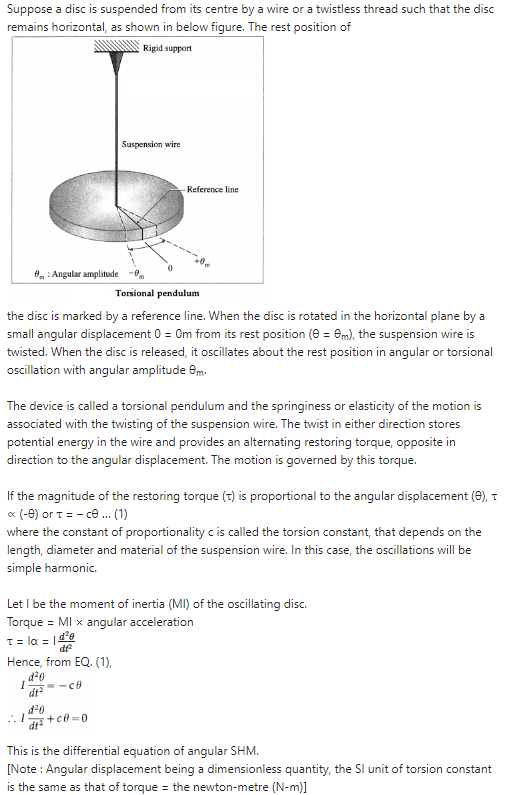
Explain angular or torsional oscillations.
Hence obtain the differential equation of the motion.
AnswerSolution is as follows:
View full question & answer→Question 114 Marks
A small drop of mercury oscillates simple harmonically inside a watch glass whose radius of curvature is $2.5 m$. Find the period of the motion. $\left[ g =9.8 m / s ^2\right.$ ]
View full question & answer→Question 124 Marks
The period of oscillation of a simple pendulum increases by $20 \%$ when the length of the pendulum is increased by $44 cm$. Find its
(i) initial length
(ii) initial period of oscillation at a place where $g$ is $9.8 m / s ^2$.
AnswerLet $T$ and $L$ be the initial period and length of the pendulum. Let $T_1$ and $L_1$ be the final period and length.
Data : $T_1=T+0.2 T=1.2 T, L_1=L+0.44 m$
$\therefore T=2 \pi \sqrt{\frac{L}{g}}, \quad T_1=2 \pi \sqrt{\frac{L_1}{g}}$
$\therefore \frac{T}{T_1}=\sqrt{\frac{L}{L_1}}$
$\therefore \frac{1}{1.2}=\sqrt{\frac{L}{L+0.44}}$
Squaring and cross-multiplying, we get,
$ L +0.44=1.44 L$
$\therefore 0.44 L =0.44$
$\therefore L =\frac{0.44}{0.44}=1 m$
$\therefore T =2 \pi \sqrt{\frac{L}{g}}=2 \times 3.142 \times \sqrt{\frac{1}{9.8}}$
$=2.007 s $
View full question & answer→Question 134 Marks
Define a seconds pendulum. Find an expression for its length at a given place. Show that the length of a seconds pendulum has a fixed value at a given place.
Answer
(1) Seconds pendulum: A simple pendulum of period two seconds is called a seconds pendulum.
(2) The period of a simple pendulum is
$
T =2 \pi \sqrt{\frac{L}{g}}
$
For a seconds pendulum, $T =2 s$.
$
\therefore 2=2 \pi \sqrt{\frac{L}{g}} \therefore L =\frac{g}{\pi^2}
$
This expression gives the length of the seconds pendulum at a place where acceleration due to gravity is $g$.
(3) At a given place, the value of $g$ is constant.
$\therefore L = g / \pi^2=$ a fixed value, at a given place.
[Note: Because the effective gravitational acceleration varies from place to place, the length of a seconds pendulum should be changed in direct proportion. Since the effective gravitational acceleration increases from the equator to the poles, so should the length of a seconds pendulum be increased.]
View full question & answer→Question 144 Marks
A particle executes SHM with a period of $8 s$. Find the time in which half the total energy is potential.
AnswerData : $T =8 s , PE =\frac{1}{2} E$
$\omega=\frac{2 \pi}{T}=\frac{2 \pi}{8}=\frac{\pi}{4} rad / s$
The total energy, $E=\frac{1}{2} kA ^2$ and the potential
energy $=\frac{1}{2} k x^2$
Therefore, from the data,
$ \frac{1}{2} k x^2=\frac{1}{2}\left(\frac{1}{2} k A^2\right) $
$\therefore x^2=\frac{A^2}{2} $
$\therefore x = \pm \frac{A}{\sqrt{2}}$
Assuming that the particle starts from the mean position, the equation of motion is $x = A \sin \omega t$
$ \therefore \pm \frac{A}{\sqrt{2}}=A \sin \frac{\pi t}{4} \quad \therefore \sin \frac{\pi t}{4}= \pm \frac{1}{\sqrt{2}}$
$\therefore \frac{\pi t}{4}=\sin ^{-1}\left( \pm \frac{1}{\sqrt{2}}\right)=\frac{\pi}{4}, \frac{3 \pi}{4}, \frac{5 \pi}{4}, \frac{7 \pi}{4}$
$\therefore t=1 s , 3 s , 5 s , 7 s $
Therefore, in one oscillation, the particle's potential energy is half the total energy $1 s , 3 s , 5 s$ and $7 s$ after passing through the mean position.
View full question & answer→Question 154 Marks
An object of mass $0.5 kg$ performs SHM with force constant $10 N / m$ and amplitude $3 cm$.
(i) What is the total energy of the object?
(ii) What is its maximum speed?
(iii) What is its speed at $x=2 cm$ ?
(iv) What are its kinetic and potential energies at $x=2 cm$ ?
Answer$ \text { Data }: m =0.5 kg , A :=10 N / m ,$
$A =3 cm =3 \times 10^{-2} m , x =2 cm =2 \times 10^{-2} m$
$\therefore \omega^2=\frac{k}{m}=\frac{10}{0.5}=20( rad / s )^2 $
(i) Total energy, $E=\frac{1}{2} k A^2$
$=\frac{1}{2} \times 10 \times\left(3 \times 10^{-2}\right)^2=4.5 \times 10^{-3} J$
(ii) $E=\frac{1}{2} m v_{\max }^2$
$\therefore$ The maximum speed,
$v_{\max }=\sqrt{\frac{2 E}{m}} =\sqrt{\frac{2 \times 4.5 \times 10^{-3}}{0.5}} $
$ =0.1342 m / s$
OR
MaharashtraBoardSolutions.Guru
$v_{\max }=\omega A=\sqrt{20} \times 3 \times 10^{-2}=0.1342 m / s$
(iii) Speed $v=\omega \sqrt{A^2-x^2}$
$ =\sqrt{20} \times \sqrt{\left(3 \times 10^{-2}\right)^2-\left(2 \times 10^{-2}\right)^2}$
$=\sqrt{20} \times \sqrt{5 \times 10^{-4}}=0.1 m / s $
(iv) Potential energy $=\frac{1}{2} k x^2$
$=\frac{1}{2} \times 10 \times\left(2 \times 10^{-2}\right)^2= 2 \times 10^{-3} J$
Kinetic energy $=$ total energy -
potential energy
$ =4.5 \times 10^{-3} J -2 \times 10^{-3} J$
$=2.5 \times 10^{-3} J $
View full question & answer→Question 164 Marks
The total energy of a particle of mass $100$ grams performing SHM is $0.2 J$. Find its maximum velocity and period if the amplitude is $2 \sqrt{2} cm$.
Answer
Data : $m=100 g =0.1 kg , E =0.2 J$,
$A=2 \sqrt{2} cm =2 \sqrt{2} \times 10^{-2} m$
(i) The total energy,
$ E=\frac{1}{2} m \omega^2 A^2=\frac{1}{2} m(\omega A)^2$
$\therefore \omega A=\sqrt{\frac{2 E}{m}}$
$\text { But } \omega A=\text { maximum velocity }\left(v_{\max }\right)$
$\quad v_{\max }=\sqrt{\frac{2 E}{m}}=\sqrt{\frac{2 \times 0.2}{0.1}}=2 m / s $
But $\omega A=$ maximum velocity $\left(v_{\max }\right)$
$v_{\max }=\sqrt{\frac{2 E}{m}}=\sqrt{\frac{2 \times 0.2}{0.1}}=2 m / s$
(ii) The period of $SHM$,
$ T=\frac{2 \pi}{\omega}$
$\therefore \omega=\frac{2 \pi}{T} $
Now $\omega A=v_{\max }=2 m / s$
$\therefore \frac{2 \pi A}{T}=2 m / s $
$\therefore T =\frac{2 \pi A}{2}=\pi A=3.142 \times 2 \sqrt{2} \times 10^{-2} $
$ =0.0889 s$
View full question & answer→Question 174 Marks
Represent graphically the variation of potential energy, kinetic energy and total energy of a particle performing SHM with time.
Question 184 Marks
State the expressions for the kinetic energy (KE) and potential energy (PE) at a displacement $x$ for a particle performing linear SHM. Find
(i) the displacement at which $KE$ is equal to $PE$
(ii) the $KE$ and $PE$ when the particle is halfway to a extreme position.
AnswerFor a particle of mass $m$ executing SHM with force constant $k$, amplitude $A$ and angular frequency $\omega=\sqrt{k / m}$, its kinetic and potential energies are respectively,
$K E=\frac{1}{2} E\left(A^2-x^2\right)$ and
$P E=\frac{1}{2} k x^2$
and total energy, $E =\frac{1}{2} kA { }^2$
(i) For $PE = KE$
$\frac{1}{2} k x^2 =\frac{1}{2} k\left(A^2-x^2\right) $
$\therefore 2 x^2 =A^2 \quad \therefore x= \pm \frac{A}{\sqrt{2}} $
$\therefore \text { At } x = \pm \frac{A}{\sqrt{2}}, PE = KE =\frac{1}{2} E$
(ii)
$ \text { At } x= \pm \frac{A}{2}$
$\qquad PE =\frac{1}{2} k\left(\frac{A^2}{4}\right)=\frac{1}{4}\left(\frac{1}{2} k A^2\right)=\frac{1}{4} E$
$\text { and } KE =\frac{1}{2} k\left(A^2-\frac{A^2}{4}\right)=\frac{3}{4}\left(\frac{1}{2} k A^2\right)=\frac{3}{4} E=3 PE $
$\therefore$ At $x = \pm \frac{A}{2}$, the energy is $25 \%$ potential energy and $75 \%$ kinetic energy.
View full question & answer→Question 194 Marks
Show that the total energy of a particle performing linear SHM is directly proportional to
(1) the square of the amplitude
(2) the square of the frequency.
AnswerFor a particle of mass $m$ executing SHM with angular frequency $\omega$ and amplitude $A$, its kinetic and potential energies are respectively,
$ KE =\frac{1}{2} m \omega^2\left( A ^2- x ^2\right) .$
$\text { and } PE =\frac{1}{2} m \omega^2 x ^2 \ldots $
and $PE =\frac{1}{2} m \omega^2 x^2$
Then, the total energy,
$ E=P E+K E$
$=\frac{1}{2} m \omega^2 x^2+\frac{1}{2} m \omega^2\left(A^2-x^2\right)$
$=\frac{1}{2} m \omega^2 A^2 \ldots . \text { (3) } $
Therefore, total energy of the particle is
1. directly proportional to the mass $(E \propto m)$,
2. directly proportional to the square of the amplitude $\left(E \propto A^2\right)$
3. proportional to the square of the frequency
$\left(E \propto f^2\right)$, as $f=\omega / 2 \pi$
View full question & answer→Question 204 Marks
An SHM is given by the equation $x=[8 \sin (4 \pi t)+6 \cos (4 \pi t)] cm$. Find its
(1) amplitude
(2) initial phase
(3) period
(4) frequency.
Answer
Data : $x=[8 \sin (4 \pi t)+6 \cos (4 \pi t)] c m$
$x=8 \sin (4 \pi t)+6 \cos (4 \pi t)$
$=8 \sin (4 \pi t)+6 \sin \left(4 \pi t+\frac{\pi}{2}\right)$
Thus, $x$ is the superposition of two parallel SHMs of the same period : $x=x_1+x_2$, where
$ x _1=8 \sin (4 \pi t ) cm = A _1 \sin (\omega t +\alpha) \text { and }$
$x _2=6 \sin \left(4 \pi t+\frac{\pi}{2}\right)= A _2 \sin (\omega t +\beta)$
$\therefore A _1=8 cm , A _2=6 cm , \omega=4 \pi rad / s , \alpha=0,$
$\beta=\frac{\pi}{2} rad $
(1) Resultant amplitude,
$R =\sqrt{A_1^2+A_2^2+2 A_1 A_2 \cos (\alpha-\beta)} $
$ =\sqrt{(8)^2+(6)^2+2 \times 8 \times 6 \cos (0-\pi / 2)} $
$ =\sqrt{100}=10 cm \text { MaharashtraBoardSolutions. Guru }$
(2) The initial phase of resultant SHM,
$\delta =\tan ^{-1}\left(\frac{A_1 \sin \alpha+A_2 \sin \beta}{A_1 \cos \alpha+A_2 \cos \beta}\right) $
$ =\tan ^{-1}\left(\frac{8 \sin (0)+6 \sin (\pi / 2)}{8 \cos (0)+6 \cos (\pi / 2)}\right)$
$ =\tan ^{-1}\left(\frac{6}{8}\right)=\tan ^{-1}(0.75)=36^{\circ} 52^{\prime}$
(3) Period, $T=\frac{2 \pi}{\omega}=\frac{2 \pi}{4 \pi}=\frac{1}{2} s$
(4) Frequency, $f=\frac{1}{T}=2 Hz$
View full question & answer→Question 214 Marks
The displacement of a particle performing SHM is given by $x=\left[5 \sin \pi t+12 \sin \left(\pi t+\frac{\pi}{2}\right)\right.$ $cm$. Determine the amplitude, period and initial phase of the motion.
Answer
Data : $x=\left[5 \sin \pi t+12 \sin \left(\pi t+\frac{\pi}{2}\right)\right] cm$
The given expression for displacement may be written as the superposition of two parallel SHMs of the same period as $x=x_1+x_2$, where $x_1=5 \sin \pi t cm =A_1 \sin (\omega t+\alpha)$ and $x _2=12 \sin \left(\pi t+\frac{\pi}{2}\right) cm = A _2 \sin (\omega t +\beta)$
$\therefore A_1=5 cm , A_2=12 cm , \omega=\pi rad / s , \alpha=0, \beta=\frac{\pi}{2} rad$.
(1) Resultant amplitude,
$
\begin{aligned}
R & =\sqrt{A_1^2+A_2^2+2 A_1 A_2 \cos (\alpha-\beta)} \\
& =\sqrt{(5)^2+(12)^2+2 \times 5 \times 12 \cos (0-\pi / 2)} \\
& =\sqrt{169}=13 cm
\end{aligned}
$
(2) Period, $T=\frac{2 \pi}{\omega}=\frac{2 \pi}{\pi}=2 s$
(3) Initial phase of resultant SHM,
$
\begin{aligned}
\delta & =\tan ^{-1}\left(\frac{A_1 \sin \alpha+A_2 \sin \beta}{A_1 \cos \alpha+A_2 \cos \beta}\right) \\
& =\tan ^{-1}\left(\frac{5 \sin (0)+12 \sin (\pi / 2)}{5 \cos (0)+12 \cos (\pi / 2)}\right) \\
& =\tan ^{-1}\left(\frac{12}{5}\right)=\tan ^{-1}(2.4)=67^{\circ} 23^{\prime}
\end{aligned}
$
View full question & answer→Question 224 Marks
Two parallel SHMs are given by $x_1=20 \sin (8 \pi t) cm$ and $x_2=10 \sin (8 \pi t+\pi / 2) cm$. Find the amplitude and the epoch of the resultant SHM.
Answer$ \text { Data }: x_1=20 \sin (8 \pi t) cm =A_1 \sin (\omega t+\alpha), x_2=10 \sin (8 \pi t+\pi / 2) cm =A_2 \sin (\omega t+\beta)$
$\therefore A_1=20 cm , A_2=10 cm , \alpha=0, \beta=\pi / 2 $
(1) Resultant amplitude,
$R=\sqrt{A_1{ }^2+A_2{ }^2+2 A_1 A_2 \cos (\alpha-\beta)} $
$ =\sqrt{(20)^2+(10)^2+2 \times 20 \times 10 \times \cos (0-\pi / 2)} $
$ =\sqrt{500}=10 \sqrt{5}=22.37\ cm$
(2) Initial phase of resultant SHM,
$\delta =\tan ^{-1}\left(\frac{A_1 \sin \alpha+A_2 \sin \beta}{A_1 \cos \alpha+A_2 \cos \beta}\right) $
$ =\tan ^{-1}\left(\frac{20 \sin (0)+10 \sin (\pi / 2)}{20 \cos (0)+10 \sin (\pi / 2)}\right)$
$=\tan ^{-1}\left(\frac{1}{2}\right)=26^{\circ} 34^{\prime}$
View full question & answer→Question 234 Marks
Discuss analytically the composition of two SHMs of the same period and parallel to each other (along the same path). Find the resultant amplitude when the phase difference is
(1) zero
(2) $\frac{\pi}{3} rad$
(3) $\frac{\pi}{2} rad$
(4) $\pi rad$.
View full question & answer→Question 244 Marks
State the expressions for the displacement, velocity and acceleration of a particle performing linear SHM, starting from the positive extreme position. Hence, draw their graphs with respect to time. Draw your conclusions from the graphs.
OR
A particle performs linear SHM starting from the positive extreme position. Plot the graphs of its displacement, velocity and acceleration against time.
Question 254 Marks
State the expressions for the displacement, velocity and acceleration of a particle performing linear SHM, starting from the mean position towards the positive extreme position. Hence, draw their graphs with respect to time. Draw your conclusions from the graphs.
OR
Represents graphically the displacement, velocity and acceleration against time for a particle performing linear SHM when it starts from the mean position.
Question 264 Marks
The equation of linear SHM is a: $=10 \sin \left(4 \pi t+\frac{1}{24}\right) cm$. Find the amplitude, period and phase constant of the motion. Also, find the phase angle $\frac{1}{24}$ second after the start.
Answer
Data : $x =10 \sin \left(4 \pi t+\frac{\pi}{6}\right)+ cm , f =\frac{1}{24} s$
(1) Comparing the given equation with $x = A \sin (\omega t+\alpha)$, we get,
$A=10 cm , \omega=4 \pi rad / s , \alpha=\frac{\pi}{6} rad$
1. Amplitude, $A=10 cm$
2. Period, $T =\frac{2 \pi}{\omega}=\frac{2 \pi}{4 \pi}=0.5 s$
3. Phase constant, $\alpha=\frac{\pi}{6}$ rad
(2) Phase angle $=(\omega t+\alpha)=4 \pi t+\frac{\pi}{6}$
The phase angle $\frac{1}{24}$ second after the start is obtained by substituting $t=\frac{1}{24}$ in the above expression.
$\therefore$ Phase angle $=4 \pi t+\frac{\pi}{6}=\left(4 \pi \times \frac{1}{24}\right)+\frac{\pi}{6}$
$=\frac{\pi}{6}+\frac{\pi}{6}=\frac{\pi}{3} rad$
View full question & answer→Question 274 Marks
A load of $100 g$ increases the length of a light spring by $10 cm$. Find the period of its linear SHM if it is allowed to oscillate freely in the vertical direction. What will be the period if the load is increased to $400 g$ ? $\left[ g =9.8 m / s ^2\right.]$
AnswerData : $m =100 g =100 \times 10^{-3} kg , x =10 cm =0.1 mg =9.8 m / s ^2, m _1=400 g =400 \times 10^{-3}$ $kg$
(1) Stretching force $F=m g$
Now $F=k x$ (numerically), where $k$ is the force constant.
$\therefore mg = kx $
$\therefore k \therefore \frac{m g}{x}=\frac{100 \times 10^{-3} \times 9.8}{0.1}=9.8 N / m$
The period is
$T =2 \pi \sqrt{\frac{m}{k}} $
$ =2 \times 3.142 \times \sqrt{\frac{0.1}{9.8}}=0.6348 s$
(2) Now, $T_1=2 \pi \sqrt{\frac{m_1}{k}} \quad \therefore \frac{T_1}{T}=\sqrt{\frac{m_1}{m}}$
$\therefore$ the new period, $T_1=T \sqrt{\frac{m_1}{m}}$
$ =0.6348 \times \sqrt{\frac{400 \times 10^{-3}}{100 \times 10^{-3}}}$
$=0.6348 \times 2=1.2696 s $
View full question & answer→Question 284 Marks
A body oscillates in SHM according to the equation $x=5 \cos \left(2 \pi t+\frac{\pi}{4}\right)$, where $x$ and $t$ are in Sl units. Calculate the
(i) displacement and
(ii) speed of the body at $t =1.5 s$.
AnswerData: $x=\cos \left(2 \pi t+\frac{\pi}{4}\right), t=1.5 s$
(i) The displacement at $t =1.5 s$ is
$x =5 \cos \left(2 \pi \times \frac{3}{2}+\frac{\pi}{4}\right)$
$ =5 \cos \left(3 \pi+\frac{\pi}{4}\right)=5 \cos \left(2 \pi+\pi+\frac{\pi}{4}\right)$
$ =5 \cos \left(\pi+\frac{\pi}{4}\right)[\because \cos (2 \pi+\theta)=\cos \theta]$
$ =-5 \cos \frac{\pi}{4} \quad[\because \cos (\pi+\theta)=-\cos \theta]$
$ =-\frac{5}{\sqrt{2}}=-\frac{5}{1.414}$
$=-3.537 m$
(ii) The speed,
$ v=\frac{d x}{d t}=-5 \sin \left(2 \pi t+\frac{\pi}{4}\right) \times 2 \pi$
$\therefore \text { At } t=1.5 s , \quad$
$v=-10 \pi \sin \left(2 \pi \times \frac{3}{2}+\frac{\pi}{4}\right)$
$=-10 \pi \sin \left(3 \pi+\frac{\pi}{4}\right)$
$=-10 \pi \sin \left(2 \pi+\pi+\frac{\pi}{4}\right)$
$=-10 \pi \sin \left(\pi+\frac{\pi}{4}\right)[\because \sin (2 \pi+\theta)=\sin \theta]$
$=-10 \pi\left(-\sin \frac{\pi}{4}\right)[\because \sin (\pi+\theta)=-\sin \theta]$
$=10 \pi \times \frac{1}{\sqrt{2}}=5 \sqrt{2} \pi$
$=5(1.414)(3.142)=22.21 m / s $
View full question & answer→Question 294 Marks
What do you understand by the phase and epoch of an SHM ?
Answer
(1) Phase of simple harmonic motion (SHM) represents the state of oscillation of the particle performing SHM, i.e., it gives the displacement of the particle, its direction of motion from its equilibrium position and the number of oscillations completed.
The displacement of a particle in SHM is given by $x=A \sin (\omega t+\alpha)$. The angle $(\omega t+\alpha)$ is called the phase angle or simply the phase of SHM. The SI unit of phase angle is the radian (symbol, rad).
(2) Epoch of simple harmonic motion (SHM) represents the initial phase of the particle performing SHM, i.e., it gives the displacement of the particle and its direction of motion at time $t =0$.If $x_0$ is the initial position of the particle, i.e., the position at time $t=0, x_0=A \sin \alpha$ or $\alpha=\sin ^{-}$ ${ }^1\left(x_0 / A\right)$. The angle $\alpha$, therefore, determines the initial state of the particle. Hence, the angle $\alpha$ is the epoch or initial phase or phase constant of SHM.
[Note : The symbol for the unit radian is rad, not superscripted c]
View full question & answer→Question 304 Marks
A particle of mass $2 g$ executes SHM with a period of $12 s$ and amplitude $10 cm$. Find the acceleration of the particle and the restoring force on the particle when it is $2 cm$ from its mean position. Also find the maximum velocity of the particle.
Answer$ \text { Data: } m =2 g =2 \times 10^{-3} kg , T =12 s$
$A =10 cm =0.1 m , x = \pm 2 cm = \pm 2 \times 10^{-2} m$
$\omega=\frac{2 \pi}{T}=\frac{2 \times 3.142}{12}=\frac{3.142}{6}=0.5237 rad / s $
The acceleration of the particle, $a=\omega^2=(0.5237)^2\left( \pm 2 \times 10^{-2}\right)$
$= \pm 0.2743 \times 2 \times 10^{-2}= \pm 5.486 \times 10^{-3} m / s ^2$
The restoring force on the particle at that position, $F = ma = \pm\left(2 \times 10^{-2}\right)\left(5.486 \times 10^{-3}\right)$ $= \pm 1.097 \times 10^{-5} N$
The maximum velocity of the particle, $v_{\max }=\omega A=0.5237 \times 0.15 .237 \times 10^{-2} m / s$
View full question & answer→Question 314 Marks
A particle executes SHM with amplitude $10 cm$ and period $10 s$. Find the velocity and acceleration of the particle at a distance of $5 cm$ from the equilibrium position.
Answer
$
\begin{array}{c}
\text { Data : } A =10 cm =0.1 m , T =10 s , x = \pm 5 cm = \pm 0.05 m \\
\omega=\frac{2 \pi}{T}=\frac{2 \pi}{10}=\frac{\pi}{5} rad / s
\end{array}
$
The velocity of the particle,
$
\begin{aligned}
v & = \pm \omega \sqrt{A^2-x^2}= \pm \frac{\pi}{5} \sqrt{(0.1)^2-( \pm 0.05)^2} \\
& = \pm \frac{\pi}{5} \sqrt{(0.1+0.05)(0.1-0.05)} \\
& = \pm \frac{\pi}{5} \sqrt{0.15 \times 0.05}= \pm \frac{\pi}{5} \sqrt{75 \times 10^{-4}} \\
& = \pm \frac{3.142}{5} \times 8.660 \times 10^{-2} \\
& = \pm 5.442 \times 10^{-2} m / s \text { or } \pm 5 . 4 4 2 c m / s
\end{aligned}
$
The acceleration of the particle,
$
\begin{aligned}
a & =-\omega^2 x \\
& =-\left(\frac{\pi}{5}\right)^2 \times( \pm 0.05)= \pm \frac{(3.142)^2}{5} \times 10^{-2} \\
& = \pm 1.974 \times 10^{-2} m / s ^2 \text { or } \pm 1.974 cm / s ^2
\end{aligned}
$
View full question & answer→Question 324 Marks
A particle performs SHM of period $12$ seconds and amplitude $8 cm$. If initially the particle is at the positive extremity, how much time will it take to cover a distance of $6 cm$ from that position?
AnswerData : $T =12 s , A =8 cm$
$\therefore \omega=2 \pi / T =\pi / 6 rad / s$
When the particle covers a distance of $6 cm$ from the positive extremity, its displacement measured from the mean position is $x=8-6=2 cm$.
As the particle starts from the positive extreme position, its displacement is
$ x=A \cos \omega t$
$\therefore 2=8 \cos \left(\frac{\pi}{6} t\right) \quad \therefore \cos \left(\frac{\pi}{6} t\right)=0.25$
$\therefore \frac{\pi}{6} t=\cos ^{-1} 0.25=75^{\circ} 31^{\prime}=75.52^{\circ}$
$=75.52^{\circ} \times \frac{\pi}{180^{\circ}}(\text { in rad) }$
$\therefore$ The required time,
$t=\frac{6 \times 75.52}{180}=\frac{75.52}{30}=2.517 s$
View full question & answer→Question 334 Marks
Explain
(i) a series combination
(ii) a parallel combination of springs. Obtain the spring constant in each case.
Question 344 Marks
A particle executing SHM has velocities $v _1$ and $v _2$ when at distances $x _1$ and $x _2$ respectively from the mean position. Show that its period is $T=2 \pi \sqrt{\frac{x_1^2-x_2^2}{v_2^2-v_1^2}}$ and the amplitude of SHM is $A =\sqrt{\frac{v_2^2 x_1^2-v_1^2 x_2^2}{v_2^2-v_1^2}}$
AnswerIf $A$ is the amplitude and co is the angular frequency, $V _1=\omega \sqrt{A^2-x_1^2}$
$\text { and } v _2=\omega \sqrt{A^2-x_2^2} \ldots \text { (2) } $
$\therefore v_2^2-v_1^2 =\omega^2\left(A^2-x_2^2-A^2+x_1^2\right) $
$ =\omega^2\left(x_1^2-x_2^2\right)$
But $\omega=2 \pi / T \quad \therefore v_2^2-v_1^2=\frac{4 \pi^2}{T^2}\left(x_1^2-x_2^2\right)$
$\therefore T^2=4 \pi^2\left(\frac{x_1^2-x_2^2}{v_2^2-v_1^2}\right)$ MaharashtraBoardSolutions. Guru
$\therefore$ Period, $T=2 \pi \sqrt{\frac{x_1^2-x_2^2}{v_2^2-v_1^2}}$
Also, from Eqs. (1) and (2),
$ v_1^2=\omega^2\left(A^2-x_1^2\right) \text { and } v_2^2=\omega^2\left(A^2-x_2^2\right)$
$\therefore \frac{v_2^2}{v_1^2}=\frac{A^2-x_2^2}{A^2-x_1^2}$
$\therefore v_2^2\left(A^2-x_1^2\right)=v_1^2\left(A^2-x_2^2\right)$
$\therefore A^2\left(v_2^2-v_1^2\right)=v_2^2 x_1^2-v_1^2 x_2^2$
$\therefore A^2=\frac{v_2^2 x_1^2-v_1^2 x_2^2}{v_2^2-v_1^2}$
$\therefore \text { Amplitude, } A= \pm \sqrt{\frac{v_2^2 x_1^2-v_1^2 x_2^2}{v_2^2-v_1^2}} \text {. }$
View full question & answer→Question 354 Marks
With a neat diagram, describe a spring-and-block oscillator.
Question 364 Marks
A small uniform cylinder floats upright to a depth $d$ in a liquid. If it is depressed slightly and released, find its period of oscillations.
Answer
Consider a cylinder, of length $L$, area of cross section A and density $\rho$, floating in a liquid of density $\sigma$. If the cylinder floats up to depth $d$ in the liquid, then by the law of floatation, the weight of the cylinder equals the weight of the liquid displaced, i.e.,
$ALpg = Ad \sigma g$
$\therefore L = d \sigma / p$
Let the cylinder be pushed down by a distance $y$. Then, the weight of the liquid displaced by the cylinder of length y will exert a net upward force on the cylinder :
$F = Ay \sigma g$,
which produces an acceleration,
$
a=\frac{F}{m}=-\frac{A y \sigma g}{A L \rho}=-\frac{\sigma g}{\rho L} y=-\frac{\sigma g}{\rho(d \sigma / \rho)}=-\frac{g}{d} y
$
[from Eq. (1)]
$\therefore$ Acceleration per unit displacement, $|a / y|=\frac{g}{d}$
$\therefore$ Period of SHM of the floating cylinder,
$
T=\frac{2 \pi}{\sqrt{\text { acceleration per unit displacement }}}=2 \pi \sqrt{d / g}
$
View full question & answer→Question 374 Marks
Derive expressions for the period of SHM in terms of
(1) angular frequency
(2) force constant
(3) acceleration.
AnswerThe general expression for the displacement $( x )$ of a particle performing SHM is $x = A \sin$ ( $\omega t$ $+\alpha)$
(1) Let T be the period of the SHM and $x_1$ the displacement after a further time interval T. Then
$ x_1=A \sin [\omega(t+T)+\alpha]$
$=A \sin (\omega t+\omega T+\alpha)$
$=A \sin (\omega t+\alpha+\omega T) $
Since $T \neq 0$, for $x_1$ to be equal to $x$, we must have $(\omega T)_{\min }=2 \pi$.
Hence, the period $(T)$ of SHM is $T=2 \pi / \omega$
This is the expression for the period in terms of the constant co, the angular frequency.
(2) If $m$ is the mass of the particle and $k$ is the force constant, $\omega=\sqrt{ k / m}$.
$\therefore T =\frac{2 \pi}{\omega}=\frac{2 \pi}{\sqrt{k / m}}=2 \pi \sqrt{\frac{m}{k}}$
(3) The acceleration of a particle performing SHM has a magnitude $a=\omega^2 x$
$ \therefore \omega=\sqrt{a / x}$
$$
$\therefore T=\frac{2 \pi}{\omega}=\frac{\sqrt{\text { acceleration per unit displacement }}}{\sqrt{\text { acceleration per unit displacement }}} $
View full question & answer→Question 384 Marks
Assuming the general expression for displacement of a particle in SHM, obtain the expressions for the displacement when the particle starts from
(i) the mean position
(ii) an extreme position.
AnswerThe general expression for the displacement of a particle in SHM at time $t$ is $x=A \sin (\omega t+$ $\alpha$ ) ... (1) where $A$ is the amplitude and re is a constant in a particular case.
$\therefore \omega t+\alpha=\sin ^{-1} \frac{x}{A} \ldots(2)$
(i) When the particle starts from the mean position, $x=0$ at $t=0$. Then, from Eq. (2),
$\alpha=\sin ^{-1} 0=0 \text { or } \pi \ldots \text { (3) }$
Substituting for $\alpha$ into Eq. (1),
$x=A \sin \omega t$ for $\alpha=0$ and $x=-A \sin \omega t$ for $\alpha=\pi$
$\therefore x = \pm A \sin \omega t \ldots(4)$
where the plus sign is taken if the particle's initial velocity is to the right, while the minus sign is taken when the initial velocity is to the left.
(ii) $x = \pm A$ at $t =0$ when the particle starts from the right or left extreme position, respectively. Then, from Eq. (2),
$ x= A \sin \left(\omega t+\frac{\pi}{2}\right)= A \cos \omega t \text { for } \alpha=\frac{\pi}{2}$
$x=A \sin \left(\omega t+\frac{3 \pi}{2}\right)=-A \cos \omega t \text { for } \alpha=\frac{3 \pi}{2}$
$x= \pm A \cos \omega t $
where the plus sign is taken when the particle starts from the positive extreme, while the minus sign is taken when the particle starts from the negative extreme.
View full question & answer→Question 394 Marks
State the laws of simple pendulum.
AnswerThe period of a simple pendulum at a given place is
$\top=2 \pi \sqrt{\frac{L}{g}}$where L is the length of the simple pendulum and g is the acceleration due to gravity at that place. From the above expression, the laws of simple pendulum are as follows :
(1) Law of length : The period of a simple pendulum at a given place (g constant) is directly proportional to the square root of its length.
$\therefore T \propto \sqrt{L}$
(2) Law of acceleration due to gravity : The period of a simple pendulum of a given length (L constant) is inversely proportional to the square root of the acceleration due to gravity.
$\therefore T \propto \frac{1}{\sqrt{g}}$
(3) Law of mass : The period of a simple pendulum does not depend on the mass or material of the bob of the pendulum.
(4) Law of isochronism : The period of a simple pendulum does not depend on the amplitude of oscillations, provided that the amplitude is small.
View full question & answer→Question 404 Marks
Obtain the expression for the period of a simple pendulum performing S.H.M.
AnswerAn ideal simple pendulum is defined as a heavy point mass suspended from a rigid support by a weightless, inextensible and twistless string, and set oscillating under gravity through a small angle in a vertical plane.In practice, a small but heavy sphere, called the bob, is used. The distance from the point of suspension to the centre of gravity of the bob is called the length of the pendulum.
Consider a simple pendulum of length $L_1 $– suspended from a rigid support O. When displaced from its initial position of rest through a small angle θ in a vertical plane and released, it performs oscillations between two extremes, B and C, as shown in below figure.
At B, the forces on the bob are its weight $m \vec{g}$ and the tension $\overrightarrow{F_1}$ in the string. Resolve $m \vec{g}$ into two components : $mg \cos \theta$ in the direction opposite to that of the tension and $mg$ $\sin \theta$ perpendicular to the string.
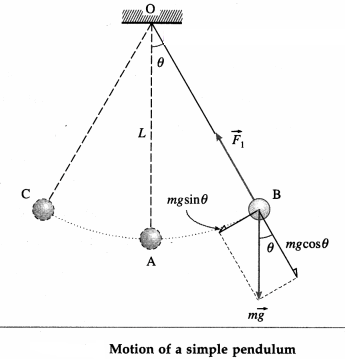
mg cos θ balanced by the tension in the string. mg sin θ restores the bob to the equilibrium position.
Restoring force, F = – mg sin θ
If θ is small and expressed in radian,
$ \sin \theta \approx \theta=\frac{\operatorname{arc}}{\text { radius }}=\frac{ AB }{ OB }=\frac{x}{L}$
$\therefore F =- mg \theta=- mg \frac{x}{L} \ldots .(1)$
Since $m, g$ and $L$ are constant,
$F \propto(-x) \ldots .(2)$
Thus, the net force on the bob is in the direction opposite to that of displacement x of the bob from its mean position as indicated by the minus sign, and the magnitude of the force is proportional to the magnitude of the displacement. Hence, it follows that the motion of a simple pendulum is linear SHM.
Acceleration, $a =\frac{F}{m}=-\frac{g}{L} \times \ldots$ (3)
Therefore, acceleration per unit displacement $=\left|\frac{a}{x}\right|=\frac{g}{L} \ldots .$. (4)
Period of SHM,
$T=\frac{2 \pi}{\sqrt{\text { acceleration per unit displacement }}}$
$=\frac{2 \pi}{\sqrt{g / L}} \quad \therefore T=2 \pi \sqrt{\frac{L}{g}}$
This gives the expression for the period of a simple pendulum. View full question & answer→Question 414 Marks
A wooden block of mass m is kept on a piston that can perform vertical vibrations of adjustable frequency and amplitude. During vibrations, we don’t want the block to leave the contact with the piston. How much maximum frequency is possible if the amplitude of vibrations is restricted to $25\ cm$? In this case, how much is the energy per unit mass of the block? $(g ≈ \pi ^2 ≈ 10 m s^{-2})$
AnswerData : $A = 0.25 m, g = \pi ^2 = 10 m/s^2$
During vertical oscillations, the acceleration is maximum at the turning points at the top and bottom. The block will just lose contact with the piston when its apparent weight is zero at the top, i. e., when its acceleration is $a_{max} = g$, downwards.
$ \left|a_{\max }\right|=\omega^2 A=4 \pi^2 f_{\max }^2 A$
$\therefore 4 \pi^2 f^2{ }_{\max } A=g$
$\therefore f_{\max }=\sqrt{\frac{g}{\pi^2} \cdot \frac{1}{4 A}}=\sqrt{\frac{10}{10} \cdot \frac{1}{4(0.25)}}=1 Hz$
This gives the required frequency of the piston.
$E=\frac{1}{2} m \omega^2 A^2=\frac{1}{2} m\left(4 \pi^2 f^2\right) A^2$
$\begin{aligned} \therefore \frac{E}{m}=2 \pi^2 f^2 A^2 & =2(10)(1)^2\left(\frac{1}{4}\right)^2 \\ & =\frac{20}{16}=\frac{5}{4}=1.25 J / kg \end{aligned}$
View full question & answer→Question 424 Marks
Find the number of oscillations performed per minute by a magnet is vibrating in the plane of a uniform field of $1.6 \times 10^{-5} Wb/m^2$. The magnet has moment of inertia $3 \times 10^{-6} kgm^2$ and magnetic moment $3 A m^2$.
AnswerData: $B=1.6 \times 10^{-5} T , I =3 \times 10^{-6} kg / m ^2$, $\mu=3 A \cdot m ^2$
The period of oscillation, $T=2 \pi \sqrt{\frac{I}{\mu B_{ h }}}$
$\therefore$ The frequency of oscillation is $f =\frac{1}{2 \pi} \sqrt{\frac{\mu B}{I}}$
$\therefore$ The number of oscillations per minute $=60 f=\frac{60}{2 \pi} \sqrt{\frac{3\left(1.6 \times 10^{-5}\right)}{3 \times 10^{-6}}}=\frac{60}{2 \pi} \sqrt{16}=\frac{120}{3.142}$ $=38.19$ per minute
View full question & answer→Question 434 Marks
A $20\ cm$ wide thin circular disc of mass $200\ g$ is suspended to a rigid support from a thin metallic string. By holding the rim of the disc, the string is twisted through 60° and released. It now performs angular oscillations of period $1$ second. Calculate the maximum restoring torque generated in the string under undamped conditions. $(\pi ^3 ≈ 31)$
AnswerData: $R=10 cm =0.1 m , M =0.2 kg , \theta_{ m }=60^{\circ}=\frac{\pi}{3} rad , T =1 s , \pi^3 \approx 31$
The $Ml$ of the disc about the rotation axis (perperdicular through its centre) is $I=\frac{1}{2} M^2=(0.2)(0.1)^2=10^{-3} kg \cdot m ^2$
The period of torsional oscillation, $T=2 \pi \sqrt{\frac{I}{c}}$
$\therefore$ The torsion constant, $c =4 \pi r ^2 \frac{I}{T^2}$
The magnitude of the maximum restoring torque,
$\tau_{\max }=c \theta_m=\left(4 \pi^2 \frac{I}{T^2}\right)\left(\frac{\pi}{3}\right)$
$=\frac{4}{3} \pi^3 \frac{I}{T^2}=\frac{4}{3}(31)\left(\frac{10^{-3}}{1^2}\right)$
$=41.33 \times 10^{-3}= 0 . 0 4 1 3 3 ~ N \cdot m $
View full question & answer→Question 444 Marks
Two parallel S.H.M.s represented by $x_1=5 \sin \left(4 \pi t +\frac{\pi}{3}\right) cm$ and $x_2=3 \sin (4 \pi t+\pi / 4) cm$ are superposed on a particle. Determine the amplitude and epoch of the resultant S.H.M.
AnswerData: $x_1=5 \sin \left(4 \pi t+\frac{\pi}{3}\right)=A_1 \sin (\omega t+\alpha)$
$ x_2=3 \sin \left(4 \pi t +\frac{\pi}{4}\right)=A_2 \sin (\omega t+\beta)$
$\therefore A_1=5 cm , A_2=3 cm , \alpha=\frac{\pi}{3} rad , \beta=\frac{\pi}{4} rad $
(i) Resultant amplitude,
$R =\sqrt{A_1^2+A_2^2+2 A_1 A_2 \cos (\alpha-\beta)}$
$ =\sqrt{(5)^2+(3)^2+2(5)(3) \cos \left(\frac{\pi}{3}-\frac{\pi}{4}\right)}$
$=\sqrt{25+9+30 \cos \frac{\pi}{12}}=\sqrt{34+30(0.9659)}$
$=\sqrt{34+28.98}=\sqrt{62.98}=7.936 cm $
(ii) Epoch of the resultant SHM,
$ \delta =\tan ^{-1} \frac{A_1 \sin \alpha+A_2 \sin \beta}{A_1 \cos \alpha+A_2 \cos \beta} $
$ =\tan ^{-1} \frac{5 \sin (\pi / 3)+3 \sin (\pi / 4)}{5 \cos (\pi / 3)+3 \cos (\pi / 4)} $
$ =\tan ^{-1} \frac{5(0.866)+3(0.7071)}{5(0.5)+3(0.7071)}$
$ =\tan ^{-1} \frac{4.33+2.1213}{2.5+2.1213}=\tan ^{-1} 1.396=54^{\circ} 23^{\prime}$
View full question & answer→Question 454 Marks
The displacement of an oscillating particle is given by $x=\operatorname{asin} \omega t+$ bcoswt where $a_t b$ and $\omega$ are constants. Prove that the particle performs a linear S.H.M. with amplitude $A =$ $\sqrt{a^2+b^2}$
Answer$x=\operatorname{asin} \omega t+b \cos \omega t$
Let $a=A \cos \varphi$ and $b=A \sin \varphi$, so that
$A ^2= a ^2+ b ^2$ and $\tan \varphi=\frac{b}{a}$
$\therefore x=A \cos \varphi \sin \omega t+A \sin \varphi \cos \omega t$
$\therefore x=A \sin (\omega t+\varphi)$
which is the equation of a linear SHM with amplitude $A =\sqrt{a^2+b^2}$ and phase constant $\varphi$ $=\tan ^{-1} \frac{b}{a}$, as required.
View full question & answer→Question 464 Marks
The period of oscillation of a body of mass $m_1$ suspended from a light spring is $T.$ When a body of mass $m_2$ is tied to the first body and the system is made to oscillate, the period is $2T.$ Compare the masses $m_1$ and $m_2$
Answer$ T=2 \pi \sqrt{\frac{m}{k}} \quad \therefore \frac{2 T}{T}=2=\sqrt{\frac{m_1+m_2}{m_1}}$
$\therefore \frac{m_1+m_2}{m_1}=4 \quad \therefore \frac{m_2}{m_1}=\frac{3}{1} \quad \therefore \frac{m_1}{m_2}=\frac{1}{3} $
This gives the required ratio of the masses.
View full question & answer→Question 474 Marks
A particle performing linear S.H.M. of period $2 \pi$ seconds about the mean position $O$ is observed to have a speed of $b \sqrt{3} m / s$, when at a distance $b$ (metre) from $O$. If the particle is moving away from $O$ at that instant, find the
time required by the particle, to travel a further distance b.
AnswerData: $T=2 \pi s , v = b \sqrt{3} m / s$ at $x=b$
$\therefore \omega=\frac{2 \pi}{T}=\frac{2 \pi}{2 \pi}=1 rad / s$
$v=\omega \sqrt{ A ^2- x ^2}$
$\therefore \text { At } x=b, \quad b \sqrt{3}=(1) \sqrt{ A ^2-b^2}$
$\therefore 3 b^2=A^2-b^2 \quad \therefore A=2 b$
∴ Assuming the particle starts from the mean position, its displacement is given by
x = A sin ωt = 2b sin t
If the particle is at x = b at $t = t_1$,
$b =2 b \sin t _1 \therefore t _1=\sin ^{-1} \frac{1}{2}=\frac{\pi}{6} s$
Also, with period $T=2 \pi s$, on travelling a further distance $b$ the particle will reach the positive extremity at time $t_2=\frac{\pi}{2} s$.
$\therefore$ The time taken to travel a further distance $b$ from $x = b$ is $t _2- t _1=\frac{\pi}{2}-\frac{\pi}{6}=\frac{\pi}{3} s$.
View full question & answer→Question 484 Marks
Find the change in length of a second’s pendulum, if the acceleration due to gravity at the place changes from $9.75\ m/s^2$ to $9.80 m/s^2.$
AnswerData $: g _1=9.75 m / s ^2, g _2=9.8 m / s ^2$
Length of a seconds pendulum, $L=\frac{g}{\pi^2}$
$\therefore L_1=\frac{g_1}{\pi^2}=\frac{9.75}{9.872}=0.9876 m$
and $L_2=\frac{g_2}{\pi^2}=\frac{9.8}{9.872}=0.9927 m$
$\therefore $The length of the seconds pendulum must be increased from $0.9876\ m$ to $0.9927\ m$, i.e., by $0.0051\ m$.
View full question & answer→Question 494 Marks
A simple pendulum of length $100\ cm$ performs $S.H.M.$ Find the restoring force acting on its bob of mass $50\ g$ when the displacement from the mean position is $3\ cm.$
AnswerData: $L =100\ cm , m =50\ g =5 \times 10^{-2} kg _{,} x =3\ cm , g =9.8 m / s ^2$
Restoring force, $F = mg \sin \theta=m g \theta$
$ =\left(5 \times 10^{-2}\right)(9.8)\left(\frac{3}{100}\right)$
$=1.47 \times 10^{-2} N $
View full question & answer→Question 504 Marks
A simple pendulum performs $S.H.M$ of period $4$ seconds. How much time after crossing the mean position, will the displacement of the bob be one third of its amplitude.
AnswerData: $T=4 s_t x=A / 3$
The displacement of a particle starting into SHM from the mean position is $x=A$ sin $\omega t=$ $A \sin \frac{2 \pi}{T} t$
$\therefore A \sin \frac{2 \pi}{T} t=\frac{A}{3}$
$\therefore \frac{2 \pi}{T} t=\sin ^{-1} 0.3333=19.47^{\circ}=19.47 \times \frac{\pi}{180} rad$
$\therefore \frac{2}{4} t=\frac{19.47}{180} \quad \therefore t=\frac{19.47}{90}=0.2163 s $
$\therefore$ the displacement of the bob will be one-third of its amplitude $0.2163$ s after crossing the mean position.
View full question & answer→Question 514 Marks
The total energy of a body of mass $2\ kg$ performing S.H.M. is $40\ J$. Find its speed while crossing the centre of the path.
AnswerData: $m =2 kg, E =40 J$
The speed of the body while crossing the centre of the path (mean position) is $v _{\text {max }}$ and the total energy is entirely kinetic energy.
$\therefore \frac{1}{2} m v_{\max }^2=E$
$\therefore v_{\max }=\sqrt{\frac{2 E}{m}}=\sqrt{\frac{2 \times 40}{2}}=6.324 m / s$
View full question & answer→Question 524 Marks
Potential energy of a particle performing linear S.H.M is $0.1 \pi ^2 x^2$ joule. If mass of the particle is $20\ g$, find the frequency of S.H.M.
Answer$ \text { Data }: P E=0.1 \pi^2 x^2 J, m=20 g =2 \times 10^{-2} kg$
$P E=\frac{1}{2} m \omega^2 x^2=\frac{1}{2} m\left(4 \pi^2 f ^2\right) x ^2$
$\therefore \frac{1}{2} m\left(4 \pi^2 f ^2\right) x^2=0.1 \pi^2 x ^2$
$\therefore 2 m f^2=0.1 \therefore f ^2=\frac{1}{20\left(2 \times 10^{-2}\right)}=2.5 $
$\therefore$ The frequency of SHM is $f =\sqrt{2.5}=1.581 Hz$
View full question & answer→Question 534 Marks
A needle of a sewing machine moves along a path of amplitude $4 cm$ with frequency $5 Hz$. Find its acceleration $\frac{1}{30} s$ after it has crossed the mean position.
Answer$\text { Data: } A=4 cm =4 \times 10^{-2} m , f =5 Hz , t =\frac{1}{30} s$
$\omega=2 \pi f =2 \pi(5)=10 \pi rad / s$
$\text { Therefore, the magnitude of the acceleration, }$
$|a|=\omega^2 x =\omega^2 A \sin \omega t$
$=(10 \pi)^2\left(4 \times 10^2\right)$
$=10 \pi^2 \sin \frac{\pi}{3}=10(9.872)(0.866)=34.20 m / s ^2$
View full question & answer→Question 544 Marks
In SI units, the differential equation of an S.H.M. is $\frac{d^2 x}{d t^2}=-36 x$. Find its frequency and period. Find its frequency and period.
Answer$
\frac{d^2 x}{d t^2}=-36 x
$
Comparing this equation with the general equation,
$
\frac{d^2 x}{d t^2}=-\omega^2 X
$
We get, $\omega^2=36 \therefore \omega=6 rad / s$
$\omega=2 \pi f$
$\therefore$ The frequency, $f =\frac{\omega}{2 \pi}=\frac{6}{2(3.142)}=\frac{6}{6.284}=0.9548 Hz$ and the period, $T =\frac{1}{f}=\frac{1}{0.9548}=1.047 s$
View full question & answer→Question 554 Marks
At what distance from the mean position is the speed of a particle performing $S.H.M.$ half its maximum speed. Given path length of $S.H.M. = 10\ cm.$
AnswerData: $v=\frac{1}{2} v_{\max t} 2 A =10 cm$
$ \therefore A=5 cm$
$v=\omega \sqrt{A^2-x^2} \text { and } v_{\max }=\omega A $
Since $v=\frac{1}{2} v_{\max t}$
$\omega \sqrt{A^2-x^2}=\frac{\omega A}{2}$
$ \therefore A^2-x^2=\frac{A^2}{4} \quad \therefore x^2=A^2-\frac{A^2}{4}=\frac{3 A^2}{4}$
$\therefore x= \pm \frac{\sqrt{3}}{2} A= \pm 0.866 \times 5= \pm 4.33 cm $
This gives the required displacement.
View full question & answer→Question 564 Marks
Deduce the expression for period of simple pendulum. Hence state the factors on which its period depends.
AnswerAn ideal simple pendulum is defined as a heavy point mass suspended from a rigid support by a weightless, inextensible and twistless string, and set oscillating under gravity through a small angle in a vertical plane.In practice, a small but heavy sphere, called the bob, is used. The distance from the point of suspension to the centre of gravity of the bob is called the length of the pendulum.
Consider a simple pendulum of length $L_1 – $suspended from a rigid support O. When displaced from its initial position of rest through a small angle θ in a vertical plane and released, it performs oscillations between two extremes, B and C, as shown in below figure.
At $B$, the forces on the bob are its weight $m \vec{g}$ and the tension $\overrightarrow{F_1}$ in the string. Resolve $m \vec{g}$ into two components : $m g \cos \theta$ in the direction opposite to that of the tension and $mg$ $\sin \theta$ perpendicular to the string.
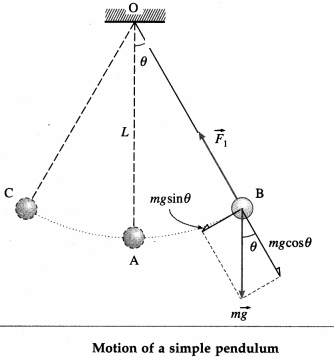
mg cos θ balanced by the tension in the string. mg sin θ restores the bob to the equilibrium position.
Restoring force, F = – mg sin θ
If θ is small and expressed in radian,
$\sin \theta \approx \theta=\frac{\operatorname{arc}}{\text { radius }}=\frac{ AB }{ OB }=\frac{x}{L}$
$\therefore F =- mg \theta=- mg \frac{x}{L} \ldots .(1)$
Since $m, g$ and $L$ are constant,
$F \propto(-x) \ldots(2)$
Thus, the net force on the bob is in the direction opposite to that of displacement x of the bob from its mean position as indicated by the minus sign, and the magnitude of the force is proportional to the magnitude of the displacement. Hence, it follows that the motion of a simple pendulum is linear SHM.
Acceleration, $a =\frac{F}{m}=-\frac{g}{L} \times \ldots$ (3)
Therefore, acceleration per unit displacement $=\left|\frac{a}{x}\right|=\frac{g}{L} \ldots .$. (4)
Period of $SHM$
$T=\frac{2 \pi}{\sqrt{\text { acceleration per unit displacement }}}$
$=\frac{2 \pi}{\sqrt{g / L}} \quad \therefore T=2 \pi \sqrt{\frac{L}{g}}$
This gives the expression for the period of a simple pendulum.
The period of a simple pendulum at a given place is
$T =2 \pi \sqrt{\frac{L}{g}}$
where L is the length of the simple pendulum and g is the acceleration due to gravity at that place. From the above expression, the laws of simple pendulum are as follows :
(1) Law of length : The period of a simple pendulum at a given place (g constant) is directly proportional to the square root of its length.
$\therefore T \propto \sqrt{L}$
(2) Law of acceleration due to gravity : The period of a simple pendulum of a given length (L constant) is inversely proportional to the square root of the acceleration due to gravity.
$\therefore T \propto \frac{1}{\sqrt{g}}$ View full question & answer→Question 574 Marks
Deduce the expressions for the kinetic energy and potential energy of a particle executing $S.H.M$. Hence obtain the expression for total energy of a particle performing $S.H.M$ and show that the total energy is conserved. State the factors on which total energy depends.
AnswerConsider a particle of mass m performing linear SHM with amplitude A. The restoring force acting r on the particle is $F = – kx,$ where k is the force constant and x is the displacement of the particle from its mean position.
(1) Kinetic energy : At distance x from the mean position, the velocity is
$v=\omega \sqrt{A^2-x^2}$
where $\omega=\sqrt{k / m}$. The kinetic energy (KE) of the particle is
$ KE =\frac{1}{2} m v^2=\frac{1}{2} m \omega^2\left(A^2-x^2\right)$
$=\frac{1}{2} k \left( A ^2- x ^2\right) \ldots(1) $
If the phase of the particle at an instant $t$ is $\theta=\omega t+\alpha$, where $\alpha$ is initial phase, its velocity at that instant is
$v=\omega A \cos (\omega t+\alpha)$
and its KE at that instant is
$KE =\frac{1}{2} m v^2=\frac{1}{2} m \omega^2 A^2 \cos ^2(\omega t+\alpha) \ldots . . \text { (2) }$
Therefore, the KE varies with time as $\cos ^2 \theta$.
(2) Potential energy : The potential energy of a particle in linear SHM is defined as the work done by an external agent, against the restoring force, in taking the particle from its mean position to a given point in the path, keeping the particle in equilibirum.
Suppose the particle in below figure is displaced from $P_1$ to $P_2$, through an infinitesimal distance dx against the restoring force F as shown.
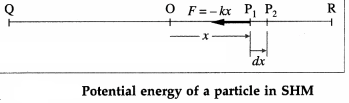
The corresponding work done by the external agent will be dW = ( – F)dx = kx dx. This work done is stored in the form of potential energy. The potential energy (PE) of the particle when its displacement from the mean position is x can be found by integrating the above expression from 0 to x.
$\therefore PE =\int dW =\int_0^x kx dx =\frac{1}{2} kx ^2 \ldots \text { (3) }$
The displacement of the particle at an instant $t$ being
$x=A \sin (w t+\alpha)$
its $P E$ at that instant is
$P E=\frac{1}{2} k x^2=\frac{1}{2} k A^2 \sin ^2(\omega t+\alpha) \ldots \text { (4) }$
Therefore, the PE varies with time as $\sin ^2 \theta$.
(3) Total energy : The total energy of the particle is equal to the sum of its potential energy and kinetic energy.
From Eqs. (1) and (2), total energy is E = PE + KE
$ =\frac{1}{2} k x^2+\frac{1}{2} k\left(A^2-x^2\right)$
$=\frac{1}{2} k x^2+\frac{1}{2} k A^2-\frac{1}{2} k x^2$
$\therefore E=\frac{1}{2} k A^2=\frac{1}{2} m \omega^2 A^2 \ldots \text { (5) } $
As $m$ is constant, $\omega$ and $A$ are constants of the motion, the total energy of the particle remains constant (or its conserved). View full question & answer→Question 584 Marks
Show that a linear $S.H.M$. is the projection of a $U.C.M$. along any of its diameter.
AnswerConsider a particle which moves anticlockwise around a circular path of radius A with a constant angular speed ω. Let the path lie in the x-y plane with the centre at the origin O. The instantaneous position P of the particle is called the reference point and the circle in which the particle moves as the reference circle.
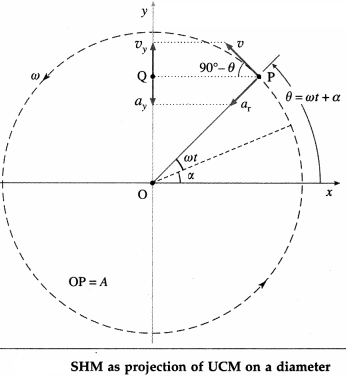
The perpendicular projection of $P$ onto the $y$-axis is $Q$. Then, as the particle travels around the circle, $Q$ moves to-and-fro along the $y$-axis. Line OP makes an angle $\alpha$ with the $x$-axis at $t=0$. At time $t$, this angle becomes $\theta=\omega t+\alpha$. The projection Q of the reference point is described by the $y$-coordinate,
$y=O Q=O P \sin \angle O P Q, \text { Since } \angle O P Q=\omega t+\alpha, y=A \sin (\omega t+\alpha)$
which is the equation of a linear SHM of amplitude A. The angular frequency w of a linear SHM can thus be understood as the angular velocity of the reference particle.
The tangential velocity of the reference particle is $v=\omega A$. Its $y$-component at time $t$ is $v_y=\omega A \sin \left(90^{\circ}-\theta\right)=\omega A$ $\cos \theta$
$\therefore v_y=\omega A \cos (\omega t+\alpha)$
The centripetal acceleration of the reference particle is $a_r=\omega^2 A$, so that its $y$-component at time $t$ is $a_x=a_r \sin$
$\angle OPQ$
$\therefore a_{x}=-\omega^2 A \sin (\omega t+\alpha)$ View full question & answer→Question 594 Marks
Obtain the expression for the period of a magnet vibrating in a uniform magnetic field and performing S.H.M.
AnswerDefinition : Angular SHM is defined as the oscillatory motion of a body in which the restoring torque responsible for angular acceleration is directly proportional to the angular displacement and its direction is opposite to that of angular displacement.
The differential equation of angular SHM is
$I \frac{d^2 \theta}{d t^2}+c \theta=0 \ldots$
where $I =$ moment of inertia of the oscillating body, $\frac{d^2 \theta}{d t^2}=$ angular acceleration of the body when its angular displacement is $\theta$, and $c =$ torsion constant of the suspension wire, $\therefore \frac{d^2 \theta}{d t^2}+\frac{c}{I} \theta=0$
Let $\frac{c}{I}=\omega^2$, a constant. Therefore, the angular frequency, $\omega=\sqrt{c / I}$ and the angular acceleration, $a =\frac{d^2 \theta}{d t^2}=-\omega^2 \theta$
The minus sign shows that the $\alpha$ and $\theta$ have opposite directions. The period $T$ of angular SHM is
$T=\frac{2 \pi}{\omega}=\frac{2 \pi}{\sqrt{C / I}}=2 \pi \sqrt{\frac{I}{C}}$
This is the expression for the period in terms of torque constant. Also, from Eq. (2),
$\omega=\sqrt{\left|\frac{\alpha}{\theta}\right|}$
$=\sqrt{\text { angular acceleration per unit angular displacement }}$
$\therefore T=\frac{2 \pi}{\omega}=\frac{2 \pi}{\sqrt{|\alpha / \theta|}}$
$=\frac{2 \pi}{\sqrt{\text { angular acceleration per unit angular displacement }}}$
View full question & answer→