MCQ 11 Mark
The centripetal acceleration of the bob of a conical pendulum is
AnswerCorrect option: D. $\frac{r g}{L \cos \theta}$.
$\frac{r g}{L \cos \theta}$.
View full question & answer→MCQ 21 Mark
A conical pendulum of string length $L$ and bob of mass $m$ performs UCM along a circular path of radius $r$. The tension in the string is
- ✓
$\frac{m g L}{\sqrt{L^2-r^2}}$
- B
$\frac{m g L}{\sqrt{L^2+r^2}}$
- C
$\frac{m g L}{\sqrt{2} r}$
- D
$\frac{m r g \tan \theta}{L}$
AnswerCorrect option: A. $\frac{m g L}{\sqrt{L^2-r^2}}$
$\frac{m g L}{\sqrt{L^2-r^2}}$
View full question & answer→MCQ 31 Mark
The period of a conical pendulum in terms of its length $(I)$, semivertical angle $(\theta)$ and acceleration due to gravity $(\mathrm{g})$, is
- A
$\frac{1}{2 \pi} \sqrt{\frac{l \cos \theta}{g}}$
- B
$\frac{1}{2 \pi} \sqrt{\frac{l \sin \theta}{g}}$
- ✓
$4 \pi \sqrt{\frac{l \cos \theta}{4 g}}$
- D
$4 \pi \sqrt{\frac{l \tan \theta}{g}}$.
AnswerCorrect option: C. $4 \pi \sqrt{\frac{l \cos \theta}{4 g}}$
$4 \pi \sqrt{\frac{l \cos \theta}{4 g}}$
View full question & answer→MCQ 41 Mark
A track for a certain motor sport event is in the form of a circle and banked at an angle 6 . For a car driven in a circle of radius $r$ along the track at the optimum speed, the periodic time is
- A
$\sqrt{\frac{r}{g}}$
- B
$2 \pi \sqrt{\frac{r}{g}}$
- ✓
$2 \pi \sqrt{\frac{r}{g \tan \theta}}$
- D
$2 \pi \sqrt{\frac{r \tan \theta}{g}}$.
AnswerCorrect option: C. $2 \pi \sqrt{\frac{r}{g \tan \theta}}$
$2 \pi \sqrt{\frac{r}{g \tan \theta}}$
View full question & answer→MCQ 51 Mark
The maximum speed with which a car can be driven safely along a curved road of radius $17.32 \mathrm{~m}$ and banked at $30^{\circ}$ with the horizontal is $\left[\mathrm{g}=10 \mathrm{~m} / \mathrm{s}^2\right.$ ]
- A
$5 \mathrm{~m} / \mathrm{s}$
- ✓
$10 \mathrm{~m} / \mathrm{s}$
- C
$15 \mathrm{~m} / \mathrm{s}$
- D
$20 \mathrm{~m} / \mathrm{s}$.
AnswerCorrect option: B. $10 \mathrm{~m} / \mathrm{s}$
$10 \mathrm{~m} / \mathrm{s}$
View full question & answer→MCQ 61 Mark
When a motorcyclist takes a circular turn on a level race track, the centripetal force is
- A
the resultant of the normal reaction and frictional force
- B
the horizontal component of the normal reaction
- ✓
the frictional force between the tyres and road
- D
the vertical component of the normal reaction.
AnswerCorrect option: C. the frictional force between the tyres and road
the frictional force between the tyres and road
View full question & answer→MCQ 71 Mark
Two particles with their masses in the ratio $2: 3$ perform uniform circular motion with orbital radii in the ratio $3: 2$. If the centripetal force acting on them is the same, the ratio of their speeds is
- A
$4: 9$
- B
$1: 1$
- ✓
$3: 2$
- D
$9: 4$.
AnswerCorrect option: C. $3: 2$
$3: 2$
View full question & answer→MCQ 81 Mark
A circularly symmetric body of radius $\mathrm{R}$ and radius of gyration $\mathrm{k}$ rolls without slipping along a flat surface. Then, the fraction of its total energy associated with rotation is $\left[c=k^2 / R^2\right]$
- A
$\mathrm{c}$
- ✓
$\frac{c}{1+c}$
- C
$\frac{1}{c}$
- D
$\frac{1}{1+c}$
AnswerCorrect option: B. $\frac{c}{1+c}$
$\frac{c}{1+c}$
View full question & answer→MCQ 91 Mark
Two uniform solid spheres, of the same mass but radii in the ratio $R_1: R_2=1: 2$, roll without slipping on a plane surface with the same total kinetic energy. The ratio $\omega_1: \omega_2$ of their angular speed is
- ✓
$2: 1$
- B
$\sqrt{2}: 1$
- C
$1: 1$
- D
$1: 2$.
AnswerCorrect option: A. $2: 1$
$2: 1$
View full question & answer→MCQ 101 Mark
The flywheel of a motor has mass $300 \mathrm{~kg}$ and radius of gyration $1.5 \mathrm{~m}$. The motor develops a constant torque of $2000 \mathrm{~N} . \mathrm{m}$ and the flywheel starts from rest. The work done by the motor during the first 4 revolutions is
- A
$2 \mathrm{~kJ}$
- B
$8 \mathrm{~kJ}$
- C
$8 n \mathrm{~kJ}$
- ✓
$16 \pi \mathrm{kJ}$.
AnswerCorrect option: D. $16 \pi \mathrm{kJ}$.
$16 \pi \mathrm{kJ}$.
View full question & answer→MCQ 111 Mark
A thin uniform rod of mass $3 \mathrm{~kg}$ and length $2 \mathrm{~m}$ rotates about an axis through its $\mathrm{CM}$ and perpendicular to its length. An external torque changes its frequency by $15 \mathrm{~Hz}$ in $10 \mathrm{~s}$. The magnitude of the torque is
- A
$3.14 \mathrm{~N} . \mathrm{m}$
- B
$6.28 \mathrm{~N} . \mathrm{m}$
- ✓
$9.42 \mathrm{~N} \cdot \mathrm{m}$
- D
$12.56 \mathrm{~N} \cdot \mathrm{m}$.
AnswerCorrect option: C. $9.42 \mathrm{~N} \cdot \mathrm{m}$
$9.42 \mathrm{~N} \cdot \mathrm{m}$
View full question & answer→MCQ 121 Mark
If $\mathrm{L}$ is the angular momentum and $\mathrm{I}$ is the moment of inertia of a rotating body, then $\frac{L^2}{2 I}$ represents its
View full question & answer→MCQ 131 Mark
A body of mass $0.4 \mathrm{~kg}$ is revolved in a horizontal circle of radius $5 \mathrm{~m}$. If it performs $120 \mathrm{rpm}$, the centripetal force acting on it is
- A
$4 \pi^2 N$
- B
$8 \pi^2 N$
- C
$16 \pi^2 \mathrm{~N}$
- ✓
$32 \pi^2 \mathrm{~N}$.
AnswerCorrect option: D. $32 \pi^2 \mathrm{~N}$.
$32 \pi^2 N$.
View full question & answer→MCQ 141 Mark
When a planet in its orbit changes its distance from the Sun, which of the following remains constant?
- A
The moment of inertia of the planet about the Sun
- B
The gravitational force exerted by the Sun on the planet
- C
- ✓
The planet's angular momentum about the Sun
AnswerCorrect option: D. The planet's angular momentum about the Sun
The planet's angular momentum about the Sun
View full question & answer→MCQ 151 Mark
A thin wire of length $L$ and uniform linear mass density $\lambda$ is bent into a circular ring. The $\mathrm{MI}$ of the ring about a tangential axis in its plane is
- A
$\frac{3 \lambda L^2}{8 \pi^2}$
- B
$\frac{8 \pi^2}{3 \lambda L^3}$
- ✓
$\frac{3 \lambda L^3}{8 \pi^2}$
- D
$\frac{8 \pi^2}{3 \lambda L^2}$,
AnswerCorrect option: C. $\frac{3 \lambda L^3}{8 \pi^2}$
$\frac{3 \lambda L^3}{8 \pi^2}$
View full question & answer→MCQ 161 Mark
A thin uniform rod of mass $M$ and length $L$ has a small block of mass $M$ attached at one end. The moment of inertia of the system about an axis through its $\mathrm{CM}$ and perpendicular to the length of the rod is
- A
$\frac{13}{12} \mathrm{ML}^2$
- B
$\frac{1}{3} \mathrm{ML}^2$
- ✓
$\frac{5}{24} \mathrm{ML}^2$
- D
$\frac{7}{48} \mathrm{ML}^2$
AnswerCorrect option: C. $\frac{5}{24} \mathrm{ML}^2$
$\frac{5}{24} \mathrm{ML}^2$
View full question & answer→MCQ 171 Mark
The moment of inertia of a thin uniform rod of mass $M$ and length $L$, about an axis passing through a point midway between the centre and one end, and perpendicular to its length, is
- A
$\frac{48}{7} \mathrm{ML}^2$
- ✓
$\frac{7}{48} M L^2$
- C
$\frac{1}{48} \mathrm{ML}^2$
- D
$\frac{1}{16} \mathrm{ML}^2$
AnswerCorrect option: B. $\frac{7}{48} M L^2$
$\frac{7}{48} \mathrm{ML}^2$
View full question & answer→MCQ 181 Mark
Three point masses $\mathrm{m}, 2 \mathrm{~m}$ and $3 \mathrm{~m}$ are located at the three vertices of an equilateral triangle of side l. The moment of inertia of the system of particles about an axis perpendicular to their plane and equidistant from the vertices is
AnswerCorrect option: A. $2 m l^2$
$2 m l^2$
View full question & answer→MCQ 191 Mark
The radius of gyration $\mathrm{k}$ for a rigid body about a given rotation axis is given by
- A
$k=\frac{1}{M} \int r d m$
- ✓
$k^2=\frac{1}{M} \int r^2 d m$
- C
$k^2=\frac{1}{M} \int r d m$
- D
$k=\frac{1}{M} \int r^2 d m$.
AnswerCorrect option: B. $k^2=\frac{1}{M} \int r^2 d m$
$k^2=\frac{1}{M} \int r^2 d m$
View full question & answer→MCQ 201 Mark
Two bodies with moments of inertia $I_1$ and $I_2\left(l_1>I_2\right)$ rotate with the same angular momentum. If $E_1$ and $E_2$ are their rotational kinetic energies, then
- ✓
$E_2>E_1$
- B
$\mathrm{E}_2=\mathrm{E}_1$
- C
$\mathrm{E}_2<\mathrm{E}_1$
- D
$\mathrm{E}_2 \leq \mathrm{E}_1$
AnswerCorrect option: A. $E_2>E_1$
$E_2>E_1$
View full question & answer→MCQ 211 Mark
A small object, tied at the end of a string of length $r$, is launched into a vertical circle with a speed $2 \sqrt{g r}$ at the lowest point. Its speed when the string is horizontal is
- A
$>3 \sqrt{g r}$
- B
$=3 \sqrt{g r}$
- ✓
$=2 \sqrt{g r}$
- D
AnswerCorrect option: C. $=2 \sqrt{g r}$
$=2 \sqrt{g r}$
View full question & answer→MCQ 221 Mark
A small bob of mass $m$ is tied to a string and revolved in a vertical circle of radius $r$. If its speed at the highest point is $\sqrt{3 r g}$, the tension in the string at the lowest point is
- A
$5 \mathrm{mg}$
- B
$6 \mathrm{mg}$
- C
$7 \mathrm{mg}$
- ✓
$8 \mathrm{mg}$.
AnswerCorrect option: D. $8 \mathrm{mg}$.
$8 \mathrm{mg}$.
View full question & answer→MCQ 231 Mark
A small object tied at the end of a string is to be whirled in a vertical circle of radius $r$. If its speed at the lowest point is $2 \sqrt{g r}$, then
AnswerCorrect option: D. it will just reach the highest point with zero speed.
it will just reach the highest point with zero speed.
View full question & answer→MCQ 241 Mark
The bulging of the Earth at the equator and flattening at the poles is due to
MCQ 251 Mark
A thin walled hollow cylinder is rolling down an incline, without slipping. At any instant, the ratio ”Rotational K.E.:
Translational K.E.: Total K.E.” is
- A
$1: 1: 2$
- B
$1: 2: 3$
- C
$1: 1: 1$
- ✓
$2: 1: 3$
AnswerCorrect option: D. $2: 1: 3$
$2: 1: 3$
View full question & answer→MCQ 261 Mark
Consider following cases:
(P) A planet revolving in an elliptical orbit.
(Q) A planet revolving in a circular orbit.
Principle of conservation of angular momentum comes in force in which of these?
- A
- B
- ✓
- D
Neither for (P), nor for (Q)
View full question & answer→MCQ 271 Mark
In a certain unit, the radius of gyration of a uniform disc about its central and transverse axis is $\sqrt{2.5}$. Its radius of gyration about a tangent in its plane (in the same unit) must be
- A
$\sqrt{5}$
- ✓
$2.5$
- C
$2 \sqrt{2.5}$
- D
$\sqrt{12.5}$
View full question & answer→MCQ 281 Mark
Select correct statement about the formula (expression) of moment of inertia (M.I.) in terms of mass M of the object and some of its distance parameter/s, such as R, L, etc.
- A
Different objects must have different expressions for their M.I.
- ✓
When rotating about their central axis, a hollow right circular cone and a disc have the same expression for the M.I.
- C
Expression for the M.I. for a parallelepiped rotating about the transverse axis passing through its centre includes its depth.
- D
Expression for M.I. of a rod and that of a plane sheet is the same about a transverse axis.
AnswerCorrect option: B. When rotating about their central axis, a hollow right circular cone and a disc have the same expression for the M.I.
When rotating about their central axis, a hollow right circular cone and a disc have the same expression for the M.I.
View full question & answer→MCQ 291 Mark
A particle of mass 1 kg, tied to a 1.2 m long string is whirled to perform vertical circular motion, under gravity. Minimum speed of a particle is 5 m/s. Consider the following statements.
P) Maximum speed must be 5 5 m/s.
Q) Difference between maximum and minimum tensions along the string is 60 N. Select correct option.
- A
Only statement P is correct.
- B
Only statement Q is correct.
- ✓
Both the statements are correct.
- D
Both the statements are incorrect.
AnswerCorrect option: C. Both the statements are correct.
Both the statements are correct.
View full question & answer→MCQ 301 Mark
When seen from below, the blades of a ceiling fan are seen to be revolving anticlockwise and their speed is decreasing. Select the correct statement about the directions of its angular velocity and angular acceleration.
- ✓
Angular velocity upwards, angular acceleration downwards
- B
Angular velocity downwards, angular acceleration upwards.
- C
Both, angular velocity and angular acceleration, upwards.
- D
Both, angular velocity and angular acceleration, downwards.
AnswerCorrect option: A. Angular velocity upwards, angular acceleration downwards
Angular velocity upwards, angular acceleration downwards
View full question & answer→MCQ 311 Mark
A disc of radius $R$ and thickness $R / 6$ has moment of inertia $I$ about an axis passing through its centre and perpendicular to its plane. Disc is melted and recast into a solid sphere. The moment of inertia of a sphere about its diameter is
- ✓
$\frac{I}{5}$
- B
$\frac{I}{6}$
- C
$\frac{I}{32}$
- D
$\frac{I}{64}$
AnswerCorrect option: A. $\frac{I}{5}$
(a) : Mass of disc, $m=$ Volume $\times \rho$
$m=\pi R^2 \times \frac{R}{6} \rho=$ mass of sphere
$
\pi R^2 \cdot \frac{R}{6} \rho=\frac{4}{3} \pi R^{\prime 3} \rho ; \quad \frac{R^3}{6}=\frac{4}{3} R^{\prime 3} ; \quad R^{\prime}=\frac{R}{2}
$
Moment of inertia of disc, $I=\frac{1}{2} m R^2$
Moment of inertia of sphere, $I^{\prime}=\frac{2}{5} m R^{\prime 2}=\frac{2}{5} m \times \frac{R^2}{4}$
$
\therefore \quad \frac{I^{\prime}}{I}=\frac{\frac{2}{5} m \times \frac{R^2}{4}}{\frac{1}{2} m R^2}=\frac{2 \times 2}{5 \times 1} \times \frac{1}{4}=\frac{1}{5} \quad \text { or } \quad I^{\prime}=\frac{I}{5}
$
View full question & answer→MCQ 321 Mark
A solid sphere rolls without slipping on an inclined plane at angle $\theta$. The ratio of total kinetic energy to its rotational kinetic energy is
- ✓
$\frac{7}{2}$
- B
$\frac{5}{2}$
- C
$\frac{7}{3}$
- D
$\frac{5}{4}$
AnswerCorrect option: A. $\frac{7}{2}$
As, $I_{\text {(solid sphere) }}=\frac{2}{5} M R^2$ and $v=R \omega$
$KE _R=\frac{1}{2} I \omega^2=\frac{1}{2} \times \frac{2}{5} M R^2 \times \frac{v^2}{R^2}=\frac{1}{5} M v^2$
$KE _T=\frac{1}{2} M v^2+\frac{1}{5} M v^2=\frac{7}{10} M v^2 ;$
$\frac{ KE _T}{ KE _R}=\frac{7 \times 5}{10 \times 1}=\frac{7}{2}$
View full question & answer→MCQ 331 Mark
Two discs of same mass and same thickness ( $t$ ) are made from two different materials of densities ' $d_1$ ' and ' $d_2$ ' respectively. The ratio of the moment of inertia $I_1$ to $I_2$ of two discs about an axis passing through the centre and perpendicular to the plane of disc is
- A
$d_1: d_2$
- ✓
$d_2: d_1$
- C
$1: d_1 d_2$
- D
$1: d_1^2 d_2$
AnswerCorrect option: B. $d_2: d_1$
(b) : Moment of Inertia of disc $=\frac{1}{2} m R^2$
$\frac{\text { mass }}{\text { density }}=$ volume
Volume of disc $=\pi R^2 t$
So, $\pi R_1^2 t=\frac{m}{d_1} ; \pi R_2^2 t=\frac{m}{d_2}$
$
\frac{R_1}{R_2}=\sqrt{\frac{d_2}{d_1}} ; \frac{I_1}{I_2}=\frac{\frac{1}{2} m R_1^2}{\frac{1}{2} m R_2^2}=\frac{d_2}{d_1}
$
View full question & answer→MCQ 341 Mark
A square lamina of side ' $b$ ' has same mass as a disc of radius ' $R$ ', the moment of inertia of the two objects about an axis perpendicular to the plane and passing through the centre is equal. The ratio b/R is
- A
$1: 1$
- ✓
$\sqrt{3}: 1$
- C
$\sqrt{6}: 1$
- D
$1: \sqrt{3}$
AnswerCorrect option: B. $\sqrt{3}: 1$
(b) : Square side $=b$; Radius of disc $=R$ Moment of Inertia of square, $I_s=\frac{M b^2}{6}$
Moment of Inertia of disc, $I_d=\frac{M R^2}{2}$ So, $I_s=I_d$
$
\frac{M b^2}{6}=\frac{M R^2}{2} ; \quad \frac{b}{R}=\sqrt{3}: 1
$
View full question & answer→MCQ 351 Mark
A solid cylinder and a solid sphere having same mass and same radius roll down on the same inclined plane. The ratio of the acceleration of the cylinder ' $a_c$ ' to that of sphere ' $a_s$ ' is
- A
$\frac{11}{15}$
- B
$\frac{13}{14}$
- C
$\frac{15}{14}$
- ✓
$\frac{14}{15}$
AnswerCorrect option: D. $\frac{14}{15}$
(d) : Acceleration of rolling body on inclined plane,
$
a=\frac{g \sin \theta}{1+\frac{K^2}{R^2}}
$
Here, $K$ is radius of gyration.
For solid cylinder, $I=\frac{1}{2} M R^2=M K_C^2 \Rightarrow K_C=\frac{R}{\sqrt{2}}$
For solid sphere, $I=\frac{2}{5} M R^2=M K^2{ }_S \Rightarrow K_{ S }=\sqrt{\frac{2}{5}} R$
$
\begin{aligned}
& a_c=\frac{g \sin \theta}{1+\frac{R^2}{2 R^2}}=\frac{2 g \sin \theta}{3} ...(i)\\
& a_s=\frac{g \sin \theta}{1+\frac{2 R^2}{5 R^2}}=\frac{5}{7} g \sin \theta ...(ii)\\
& \frac{a_c}{a_s}=\frac{2 \times 7}{3 \times 5}=\frac{14}{15}
\end{aligned}
$
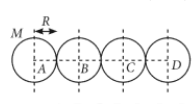
View full question & answer→MCQ 361 Mark
- A
$24 M R^2$
- ✓
$32 M R^2$
- C
$56 MR ^2$
- D
$80 MR ^2$
AnswerCorrect option: B. $32 M R^2$
(b) : Use parallel axis theorem,
$
\begin{aligned}
& I_A=\frac{2}{5} M R^2+\left(\frac{2}{5}+4\right) M R^2+\left(\frac{2}{5}+16\right) M R^2+\left(\frac{2}{5}+36\right) M R^2 \\
& I_A=\left(4 \times \frac{2}{5}+56\right) M R^2 \\
& I_B=\left(\frac{2}{5}+4\right) M R^2+\frac{2}{5} M R^2+\left(\frac{2}{5}+4\right) M R^2+\left(\frac{2}{5}+16\right) M R^2 \\
& I_B=\left(2 \times \frac{4}{5}+24\right) M R^2
\end{aligned}
$
Now, $I_A-I_B=(56-24) M R^2=32 M R^2$
View full question & answer→MCQ 371 Mark
A mass ' $M$ ' is moving with constant velocity parallel to $X$-axis. Its angular momentum with respect to the origin is
View full question & answer→MCQ 381 Mark
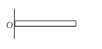
A thin uniform rod of mass ' $m$ ' and length ' $l$ ' is suspended from one end which can oscillate in a vertical plane about the point of intersection. It is pulled to one side and then released. It passes through the equilibrium position with angular speed ' $\omega$ '. The kinetic energy while passing through mean position is
- A
- B
$\frac{m l^2 \omega^2}{4}$
- C
$\frac{m l^2 \omega^2}{6}$
- D
$\frac{m l^2 \omega^2}{12}$
View full question & answer→MCQ 391 Mark
- A
$v / 4 L$
- B
$2 v / L$
- ✓
$v / L$
- D
$v / 3 L$
AnswerCorrect option: C. $v / L$
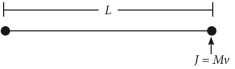
(c) : System of balls will rotate about its entre of mass.
Initial angular momentum $=M v\left(\frac{L}{2}\right)$
Final angular momentum $=2 I \omega=2 M\left(\frac{L}{2}\right)^2 \omega$
By conservation of momentum, $M v\left(\frac{L}{2}\right)=2 M\left(\frac{L}{2}\right)^2 \omega$
$
\Rightarrow \quad \omega=\frac{v}{L}
$
View full question & answer→MCQ 401 Mark
- A
$5 mr ^2$
- ✓
$4 m r^2$
- C
$3 mr ^2$
- D
$6 mr ^2$
AnswerCorrect option: B. $4 m r^2$
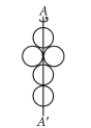
(b) : M.I of solid sphere about its axis $=\frac{2}{5} m r^2$ where ' $m$ ' is mass of solid sphere and ' $r$ ' is radius of solid sphere.
So, M. I of system about $A A^{\prime}$ is
$
I=3\left(\frac{2}{5} m r^2\right)+2\left(\frac{2}{5} m r^2+m r^2\right)
$
(By parallel axis theorem )
$
I=\frac{6}{5} m r^2+\frac{14}{5} m r^2=\frac{20}{5} m r^2 ; I \Rightarrow 4 m r^2
$
View full question & answer→MCQ 411 Mark
A solid sphere of mass $M$ and radius $R$ is rotating about its diameter. A solid cylinder of same mass and same radius is also rotating about its geometrical axis. If both are rotating with same angular speed, then the ratio of their kinetic energies of rotation is
- A
$1: 2$
- B
$2: 1$
- C
$3: 5$
- ✓
$4: 5$
AnswerCorrect option: D. $4: 5$
(d) : $\frac{E_{\text {pphere }}}{E_{\text {cylinder }}}=\frac{\frac{1}{2} I_5 \omega_S^2}{\frac{1}{2} I_C \omega_C^2}=\frac{I_S}{I_C} \quad\left(\because \omega_S=\omega_C\right)$
Here, $I_S=\frac{2}{5} M R^2$ and $I_C=\frac{1}{2} M R^2$
$
\frac{E_{\text {Sphere }}}{E_{\text {Cylindar }}}=\frac{\frac{2}{5} M R^2}{\frac{1}{2} M R^2}=\frac{4}{5}
$
View full question & answer→MCQ 421 Mark
The ratio of angular speed of hour hand of a watch to the angular speed of earth's rotation about its axis, is
- ✓
$2: 1$
- B
$4: 1$
- C
$5: 1$
- D
$3: 1$
AnswerCorrect option: A. $2: 1$
(a) : Time taken by hour hand to complete one rotation is $12 hrs$.
$
\therefore \quad \omega_H=\frac{2 \pi}{12} rad / hr
$
Time taken by Earth to complete one rotation is $24 hrs$.
$\therefore \quad \omega_t=\frac{2 \pi}{24} rad / hr$
Required ratio, $\frac{\omega_H}{\omega_p}=2: 1$
View full question & answer→MCQ 431 Mark
An electric motor drill, rated $350 W$ has an efficiency of $35 \%$. The torque produced, if it is working at $3000 rpm$ is
- A
$0.25 N m$
- B
$0.35 N m$
- ✓
$0.39 N m$
- D
$0.30 Nm$
AnswerCorrect option: C. $0.39 N m$
(c) : Angular velocity of the motor drill,
$
\omega=\frac{2 \pi \nu}{60}=\frac{2 \pi \times 3000}{60}
$
Let $\tau$ be the torque produced by the motor.
Power produced $=\tau \omega=\tau \times \frac{2 \pi \times 3000}{60}$
Now, $\tau \times \frac{2 \pi \times 3000}{60}=35 \%$ of $350 W$
or $\tau \times 2 \pi \times 50=\frac{35}{100} \times 350$
or $\tau=\frac{35 \times 350}{100 \times 2 \pi \times 50}=0.39 N m$
View full question & answer→MCQ 441 Mark
From a circular disc of radius $R$ and mass $9 M$, a small disc of mass $M$ and radius $R / 3$ is removed concentrically. The moment of inertia of the remaining disc about an axis perpendicular to the plane of the disc and passing through its centre is
- ✓
$\frac{40}{9} M R^2$
- B
$M R^2$
- C
$4 M R^2$
- D
$\frac{4}{9} M R^2$
AnswerCorrect option: A. $\frac{40}{9} M R^2$
(a) : Mass of the disc $=9 M$
Mass of removed portion of disc $=M$
The moment of inertia of the complete disc about an axis passing through its centre $O$ and perpendicular to its plane is, $I_1=\frac{9}{2} M R^2$
Now, the moment of inertia of the disc with removed portion, $I_2=\frac{1}{2} M\left(\frac{R}{3}\right)^2=\frac{1}{18} M R^2$
Therefore, moment of inertia of the remaining portion of disc about centre $O$ is $I=I_1-I_2$
$
=\frac{9 M R^2}{2}-\frac{M R^2}{18}=\frac{40 M R^2}{9}
$
View full question & answer→MCQ 451 Mark
A rigid body is rotating with angular velocity $\omega$ about an axis of rotation. Let $v$ be the linear velocity of particle which is at perpendicular distance $r$ from the axis of rotation. Then the relation $v=r 0$ implies that
AnswerCorrect option: A. $\omega$ does not depend on $r$
(a) : The relation $v=r \omega$ implies that $\omega$ does not depend on ' $r$ '. As the particles of rigid body residing over the axis of rotation will not have any linear velocity and tangential acceleration. So, whatever be the value of ' $r$ ', angular velocity and tangential acceleration will remain same for all the particles.
View full question & answer→MCQ 461 Mark
When a 12000 joule of work is done on a flywheel, its frequency of rotation increases from 10 to $20 Hz$. The moment of inertia of flywheel about its axis of rotation is $\left(\pi^2=10\right)$
- A
$1 kg m ^2$
- ✓
$2 kg m ^2$
- C
$1.688 kg m ^2$
- D
$1.5 kg m ^2$
AnswerCorrect option: B. $2 kg m ^2$
(b) : From the work-energy principle we get,
$
\begin{aligned}
& \frac{1}{2} l \omega^2=\text { work done } \\
\Rightarrow & \frac{1}{2} \times I \times 4 \pi^2\left[(20)^2-(10)^2\right]=12000 \\
\Rightarrow & \frac{1}{2} \times I \times 4 \pi^2 \times 300=12000 \\
\Rightarrow & I=\frac{12000 \times 2}{4 \pi^2 \times 300}=\frac{12000 \times 2}{4 \times 10 \times 300}=2 kg m ^2
\end{aligned}
$
View full question & answer→MCQ 471 Mark
Three point masses each of mass $m$ are kept at the corners of an equilateral triangle of side $L$. The system rotates about the center of the triangle without any change in the separation of masses during rotation. The period of rotation is directly proportional to $\left(\cos 30^{\circ}=\sin 60^{\circ}=\sqrt{3} / 2\right)$
- A
$\sqrt{L}$
- ✓
$L^{3 / 2}$
- C
$L$
- D
$L^{-2}$
AnswerCorrect option: B. $L^{3 / 2}$
(b) : The two force acting on any of the particle is gravitational attraction from the rest of the two and the centripetal force due to rotation. As the system is rotating about centre of the triangle,
So, $\frac{m V^2}{O C}=2 F \cos 30^{\circ}$
or $\frac{m V^2}{(L / \sqrt{3})}=\frac{2 G M m \cos 30^{\circ}}{L^2}$
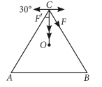
or $V=\sqrt{\frac{G M}{L}}$
so, the period of rotation, $T=\frac{2 \pi(O C)}{V}=\frac{2 \pi(L / \sqrt{3})}{\sqrt{G M / L}}$ or $T \propto L^{M / 2}$ View full question & answer→MCQ 481 Mark
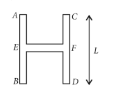
Three identical rods of mass $M$ and length $L$ are joined to form a symbol $H$. The moment of inertia of the system about one of the sides of $H$ is
- A
$2 M L^2 / 3$
- B
$M L^2 / 2$
- C
$M L^2 / 6$
- ✓
$4 M L^2 / 3$
AnswerCorrect option: D. $4 M L^2 / 3$
(d) : Moment of inertia of the system about one of the sides $A B$ is,
$
\begin{aligned}
& I_H=I_{C D}+I_{E F}+I_{A B} \\
& =M L^2+\left(\frac{M L^2}{12}+\frac{M L^2}{4}\right)+0 \\
& =M L^2+\frac{M L^2}{3}=\frac{4 M L^2}{3}
\end{aligned}
$
View full question & answer→MCQ 491 Mark
A thin metal wire of length Land uniform linear mass density $\rho$ is bent into a circular coil with $O$ as centre. The moment of inertia of a coil about the axis $X X^{\prime}$ is
- ✓
$3 \rho L^3 / 8 \pi^2$
- B
$\rho L^3 / 4 \pi^2$
- C
$3 \rho L^2 / 4 \pi^2$
- D
$\rho L^3 / 8 \pi^2$
AnswerCorrect option: A. $3 \rho L^3 / 8 \pi^2$
(a) : Moment of inertia of a circular loop is, $I=\frac{1}{2} M R^2$ (about diameter)
Now, mass of the loop $M=L \rho$ where $\rho$ is the linear mass density.
$
\begin{aligned}
& \text { Again, } 2 \pi R=L \Rightarrow R=\frac{L}{2 \pi} \\
& \therefore \quad I_{c m}=\frac{1}{2} M R^2=\frac{1}{2} L \rho \cdot\left(\frac{L}{2 \pi}\right)^2=\frac{L^3 \rho}{8 \pi^2} \\
& \therefore \quad I_{X X^r}=I_{c m}+M R^2=\frac{L^3 \rho}{8 \pi^2}+L \rho\left(\frac{L}{2 \pi}\right)^2=\frac{3 \rho L^3}{8 \pi^2}
\end{aligned}
$
View full question & answer→MCQ 501 Mark
A uniform rod of length $6 L$ and mass $8 m$ is pivoted at its centre $C$. Two masses $m$ and $2 m$ with speed $2 v$, $v$ as shown strikes the rod and stick to the rod. Initially the rod is at rest. Due to impact, If it rotates with angular velocity $\omega_1$ then $\omega$ will be
- ✓
$\frac{v}{5 L}$
- B
- C
$\frac{8 v}{6 L}$
- D
$\frac{11 v}{3 L}$
AnswerCorrect option: A. $\frac{v}{5 L}$
(a) : Final linear momentum, $(2 m) v-(m) 2 v=0$.
Zero linear momentum means the rod can have only angular momentum after the masses strike it.
Now, total angular momentum $=(2 m ) v L+( m ) 2 v \cdot 2 L$
$
=2 m v L+4 m v L=6 m v L
$
From the conservation of angular momentum, angular momentum $=I \omega$
$
\therefore \quad 6 v L=\left[\frac{1}{12} 8 m(6 L)^2+m(2 L)^2+2 m(L)^2\right] \omega
$
$6 m v L=30 m L^2 \omega$ or $\omega=\frac{v}{5 L}$
View full question & answer→