Questions

Answer the following in Detail

🎯

Test yourself on this topic

4 questions · timed · auto-graded

Question 14 Marks
Using the energy conservation, derive the expression for minimum speeds at different locations along a al circular motion controlled by gravity.
Answer
coming soon...
View full question & answer
Question 24 Marks
State an expression for the moment of inertia of a solid uniform disc, rotating about an axis passing through its centre, perpendicular to its plane. Hence derive an expression for the moment of inertia and radius of gyration:
(i) about a tangent in the plane of the disc, and (ii) about a tangent perpendicular to the plane of the disc
Answer
The M. I of a thin uniform disc about an axis passing through its centre and perpendicular to its plane is given by, $I _{ C }=(1 / 2) M R ^2$
i. According to theorem of parallel axis,
$I_T=I_{d}+M h^2=I_{d}+M R^2(\because h=R)$
$\text { But } I_{d}=M R^2 / 4$
$\therefore I_T=\frac{M R^2}{4}+M R^2$
$\therefore I_T=\frac{5}{4} M R^2$
Now, radius of gyration is given by,
$K=\sqrt{\frac{I}{M}}$
$\therefore K=\sqrt{\frac{5 M R^2}{4 M}}$
$\therefore K=\frac{\sqrt{5}}{2} R$
ii. Applying theorem of parallel axis,
$I_T=I_O+M h^2=I_O+M R^2(\because h=R)$
But $I _{ O }= MR ^2 / 2$
$I_T=\frac{M R^2}{2}+M R^2=\frac{3}{2} M R^2$
Now, radius of gyration is given by,
$K=\sqrt{\frac{I}{M}}$
$\therefore K=\sqrt{\frac{3 M R^2}{2 M}}$
$\therefore K=\sqrt{\frac{3}{2}} R$
View full question & answer
Question 34 Marks
Derive an expression for linear velocity at lowest position, midway position and the top-most position for a particle revolving in a vertical circle, if it has to just complete circular motion without string slackening at top.
Answer
Image
Vertical circular motion
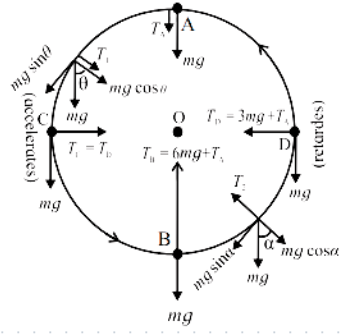
Consider a bob (treated as a point mass) tied to a (practically) massless, inextensible and flexible string. It is whirled along a vertical circle so that the bob performs a vertical circular motion and the string rotates in a vertical plane. At any position of the bob, there are only two forces acting on the bob:
1. Its weight is mg , vertically downwards, which is constant.
2. The force due to the tension along the string is directed along the string and towards the centre. Its magnitude changes periodically with time and location.
Top-most position (A):
Force due to tension in the string and mg are both in the same direction (downward).
$\therefore T_A+m g=\frac{m v_A^2}{r}$
At the topmost position, A , the tension in the string is 0 .
$\therefore T_A=0$
$\therefore m g=\frac{m v_A^2}{r}$
$\therefore\left(v_A\right)_{\min }=\sqrt{T g} \ldots \text { (i) }$
Lower-most position (B):
Force due to tension in the string is in an upward direction towards the center and opposite to the direction of mg .
$\therefore T_B-m g=\frac{m v_B^2}{r}$
While moving down from the uppermost to the lowermost point, the gravitational potential energy is converted into kinetic energy because the motion is governed only by gravity.
$\therefore m g(2 r)=\frac{1}{2} m v_B^2-\frac{1}{2} m v_A^2$
$\therefore v_B^2-v_A^2=4 r g$
$\therefore v_B^2-r g=4 r g \ldots \ldots \ldots(\text { from (i) })$
$\therefore\left(v_B\right)_{\min }=\sqrt{5 r g \ldots} \ldots \text { (ii) }$
Mid-way Positions (C and D):
Let $v_C$ be the velocity at point $C$.
Total energy at point $C=$ Kinetic energy + Potential Energy
$=\frac{1}{2} m v_C^2+m g r$
Total energy at point $B=$ Kinetic energy + Potential Energy
$=\frac{1}{2} m v_B^2+0=\frac{5}{2} m g r \ldots \text { (From (ii)) }$
From the law of conservation of energy,
Total energy at point $C=$ Total energy at point $B$
$\therefore \frac{1}{2} m v_C^2+m g r=\frac{5}{2} m g r$
$\therefore v_C^2+2 r g=5 rg$
$\therefore\left(v_C\right)_{\min }=\sqrt{3 rg}$
View full question & answer
Question 44 Marks
State and prove the theorem of 'parallel axes'.
Answer
Statement: The moment of inertia $\left(l_0\right)$ of an object about any axis is the sum of its moment of inertia ( $l_c$ ) about an axis parallel to the given axis, and passing through the centre of mass and the product of the mass of the object and the square of the distance between the two axes. Mathematically, $I _0= I _{ C }+ Mh ^2$
Proof:
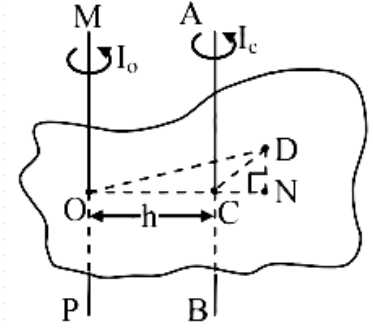
1.Consider an object of mass M. Axis MOP is an axis passing through point $O$.
2.Axis $A C B$ is passing through the centre of mass $C$ of the object, parallel to the axis MOP, and at a distance $h$ from it ( $\therefore h = CO$ ). 

Image
The theorem of parallel axes
3.Consider a mass element 'dm' located at point D. Perpendicular on OC (produced) from point D is DN.
4. The moment of inertia of the object about the axis $A C B$ is $I _{ C }=\int(D C)^2 dm$, and about the axis MOP, it is $I _0=\int$ (DO) ${ }^2 dm$.
$\text { 5. } I_0=\int(DO)^2 dm$
$=\int\left((DN)^2+(NO)^2\right) dm$
$=\int\left((DN)^2+(NC)^2+2 \cdot NC \cdot CO+(CO)^2\right) dm$
$=\int\left((DC)^2+2 NC \cdot h+h^2\right) dm . . . . . . . . . . . . .(\text { using Pythagoras theorem in } \Delta DNC)$
$=\int(DC)^2 dm+2 h \int NC \cdot dm+h^2 \int dm$
Now, $\int(D C)^2 dm = I _{ C }$ and $\int dm = M$
6.NC is the distance of a point from the centre of mass. Any mass distribution is symmetric about the centre of mass. Thus, from the definition of the centre of mass, $\int NC . dm =0$
$\therefore I_0=I_{C}+M \cdot h^2$
This is the mathematical form of the theorem of parallel axes.
View full question & answer
Answer the following in Detail - Physics STD 12 Questions - Vidyadip