Question 13 Marks
What is the internal energy of one mole of argon and oxygen?
Answer
Argon is a monatamic gas. In this case, with three degrees of freedom, the average kinetic energy per molecule $=\left(\frac{3}{2}\right) \mathrm{k}_{\mathrm{B}} \mathrm{T}$, where $\mathrm{k}_{\mathrm{B}}$ is the Boltzmann constant and $\mathrm{T}$ is the absolute (thermodynamic) temperature of the gas. Hence, the internal energy of one mole of argon = $\mathrm{N}_{\mathrm{A}}\left(\frac{3}{2} k_{\mathrm{B}} T\right)=\frac{3}{2} \mathrm{RT}$, where $\mathrm{N}_{\mathrm{A}}$ is the Avogadro number and $\mathrm{R}=\mathrm{N}_{\mathrm{A}} \mathrm{k}_{\mathrm{B}}$ is the universal gas constant. Oxygen is a diatomic gas. In this case, with five degrees of freedom at moderate temperatures, the internal energy of one mole of oxygen $=\frac{3}{2} R T$.
View full question & answer→Question 23 Marks
Answer
Internal energy of a system is defined as the sum of the kinetic energies of the atoms and molecules belonging to the system, and the potential energies associated with the interactions between these constituents (atoms and molecules).
[Note : Internal energy does not include the potential energy and kinetic energy of the system as a whole. In the case of an ideal gas, internal energy is purely kinetic. In the case of real gases, liquids and solids, internal energy is the sum of potential and kinetic energies. For an ideal gas, internal energy depends on temperature only. In other cases, internal energy depends on temperature, as well as on pressure and volume. According to quantum theory, internal energy never becomes zero. Even at OK. particles have energy called zero-point energy.]
View full question & answer→Question 33 Marks
The coefficient of performance of a Carnot refrigerator is $4.$ If the temperature of the hot reservoir is $47^{\circ} C$, find the temperature of the cold reservoir.
Answer$ \text { Data: } K =4, T _H=47^{\circ} C =(273+47) K =320$
$K =\frac{T_{ c }}{T_{ H }-T_{ c }} \therefore KT _{ H }- KT _{ c }= T _{ c }$
$\therefore KT T _{ H }=(1+ K ) T _{ c }$
$\therefore T _{ c }=\frac{K T_{ H }}{1+ K }=\frac{(4)(320)}{1+4} K =(0.8)(320) K$
$=256 K =(256-273)^{\circ} C =-17^{\circ} C $
This is the temperature of the cold reservoir.
[Note : A hot-air type engine consisting of two cylinders, was developed by Robert Stirling $(1790 -1878),$ a Scottish engineer and clergyman. He developed the concept in $1816$ and obtained a patent for his design in $1827.$ Some engines were made in $1844 .$ He also used helium and hydrogen in some engines developed thereafter. Stirling engines are used in submarines and spacecrafts.]
View full question & answer→Question 43 Marks
A Carnot engine receives $6 \times 10^4 J$ from a reservoir at $600 K$, does some work, and rejects some heat to a reservoir at $500 K$. Find the
(i) the heat rejected by the engine
(ii) the work done by the engine
(iii) the efficiency of the engine.
AnswerData : $Q_H=6 \times 10^4 J , T _{ H }=600 K , T _{ C }=500 K$
(i) The heat rejected by the engine
$ Q_{ C }=-Q_{ H } \frac{T_{ C }}{T_{ H }}=-\left(6 \times 10^4 J \right) \frac{(500 K )}{(600 K )}$
$=- 5 \times 10^4 J \quad $
(ii) The work done by the engine, $W=Q_{ H }+Q_{ C }=$ $6 \times 10^4 J +\left(-5 \times 10^4 J \right)= 1 \times 10^4 J$
(iii) The efficiency of the engine $=\frac{W}{Q_H}=\frac{1 \times 10^4 J }{6 \times 10^4 J }$
$=\frac{1}{6} \simeq 16.67 \%$
View full question & answer→Question 53 Marks
What is a Carnot refrigerator? State the expressions for the coefficient of performance of a Carnot refrigerator.
AnswerA Carnot refrigerator is a Carnot engine operated in the reverse direction. Here, heat $Q_c$ is absorbed from a cold reservoir at temperature $T_C$, work $W$ is provided externally, and heat $Q_H$ is given out to a hot reservoir at temperature $T_H$.
The coefficient of performance of a Carnot refrigerator is
$ K=\frac{\left|Q_{ C }\right|}{|W|}=\frac{\left|Q_{ C }\right|}{\left|Q_{ C }\right|-\left|Q_{ H }\right|}$
$=\frac{T_{ C }}{T_{ H }-T_{ C }} \text { as } \frac{\left|Q_{ C }\right|}{\left|Q_{ H }\right|}=\frac{T_{ C }}{T_{ H }} $
[Note: $K$ is large if $T _{ H }- T _{ C }$ is small. It means a large quantity of heat can be removed from the body at lower temperature to the body at higher temperature by doing small amount of work. $K$ is small if $T_H-T_C$ is large.
It means a small quantity of heat can be removed from the body at lower temperature to the body at higher temperature even with large amount of work.]
View full question & answer→Question 63 Marks
State the difference between a reversible process and an irreversible process.
OR
Distinguish between a reversible process and an irreversible process.
Answer
A reversible process is a bidirectional process, i.e., its path in P-V plane is the same in either direction. In contrast, an irreversible process is a undirectional process, i.e., it can take place only in one direction.A reversible process consists of a very large number of infinitesimally small steps so that the system is all the time in thermodynamic equilibrium with its environment. In contrast an irreversible process may occur so rapidly that it is never in thermodynamic equilibrium with its environment.
View full question & answer→Question 73 Marks
Draw neat labelled diagrams to illustrate
(i) energy flow diagram for engine statement.
(ii) energy flow diagram for a perfect refrigerator.
Question 83 Marks
State the two forms of the second law of thermodynamics.
Answer
Second law of thermodynamics :
1. It is impossible to extract an amount of heat $Q_H$ from a hot reservoir and use it all to do work W. Some amount of heat $Q_c$ must be exhausted (given out) to a cold reservoir. This prohibits the possibility of a perfect heat engine.
This statement is called the first form or the engine law or the engine statement or the Kelvin-Planck statement of the second law of thermodynamics.
2. It is not possible for heat to flow from a colder body to a warmer body without any work having been done to accomplish this. This prohibits the possibility of a perfect refrigerator.
This statement is called the second form or the Clausius statement of the second law of thermodynamics.
Notes:
1. Max Planck (Karl Ernst Ludwig) (1858-1947) German physicist, put forward quantum therory of radiation.
2. Rudolf Clausius (1822-88) German theoretical physicist, made significant contribution to thermodynamics.
View full question & answer→Question 93 Marks
Explain the zeroth law of thermodynamics.
Question 103 Marks
What are the steps through which a refrigerant goes in one complete cycle of refrigeration?
Answer
In one complete cycle of refrigeration, the refrigerant, a liquid such as fluorinated hydrocarbon, goes through the following steps:
1. The refrigerant in the closed tube passes through the nozzle and expands, into a lowpressure area. This adiabatic expansion results in reduction in pressure and temperature of the fluid and the fluid turns into a gas.
2. The cold gas is in thermal contact with the inner compartment of the fridge. Here it absorbs heat at constant pressure from the contents of the fridge.
3. The gas passes to a compressor where it does work in adiabatic compression. This raises its temperature and converts it back into a liquid.
4. The hot liquid passes through the coils on the outside of the refrigerator and releases heat to the air outside in an isobaric compression process.
The compressor, driven by an external source of energy, does work on the refrigerant during each cycle.
View full question & answer→Question 113 Marks
Draw a neat labelled diagram to illustrate schematics of a refrigerator.
Question 123 Marks
Draw a neat labelled schematic diagram of transferring heat from a cold region to a hot region.
Question 133 Marks
The thermal efficiency of a heat engine is $25 \%$. If in one cycle the heat absorbed from the hot reservoir is $50000 J$, what is the heat rejected to the cold reservoir in one cycle?
Answer$\text { Data }: \eta=25 \%=0.25, Q_H=50000 J W$
$ \eta=\frac{W}{Q_{ H }}$
$\therefore W ={ }_\eta Q_H=(0.25)(50000) J =12500 J $
Now, $W = Q _4-\left| Q _{ C }\right|$
$ \therefore\left|Q_C\right|=Q_{4-}-W$
$=(50000-12500) J$
$=37500 J $
This is the heat rejected to the cold reservoir in one cycle.
[Notes: $\left.Q_c=-37500 J \right]$
View full question & answer→Question 143 Marks
Draw a neat labelled $P - V$ diagram for a typical heat engine.
View full question & answer→Question 153 Marks
State the basic steps involved in the working of a heat engine.
Answer1. The working substance absorbs heat $\left(Q_H\right)$ from a hot reservoir at constant temperature. $T_H$. It is an isothermal process $Q_H$ is positive.
2. Part of the heat absorbed by the working substance is converted into work ( $W$ ), i.e. mechanical energy. In this case, there is a change in the volume of the substance.
3. The remaining heat $\left(\left|Q_C\right|=\left|Q_H\right|-W\right)$ is transferred to a cold reservoir at constant temperature $T_C<T_H$. $Q_C$ is negative.
View full question & answer→Question 163 Marks
What are the two basic types of heat engines?
Answer
(i) External combustion engine in which the working substance is heated externally as in a steam engine.
(ii) Internal combustion engine in which the working substance is heated internally as in a petrol engine or diesel engine.
[Note : A steam engine was invented by Thomas New-comen (1663-1729), English engineer. The first practical steam engine was constructed in 1712. The modem steam engine was invented in 1790 by James Watt (1736-1819), British instrument maker and engineer. A hotair type engine was developed by Robert Stirling (1790-1878), Scottish engineer and clergyman.
A four-stroke internal combustion engine was devised by Nikolaus August Otto (1832-1891), German engineer. A compression-ignition internal combustion engine was devised by Rudolph (Christian Karl) Diesel (1858 - 1913), German engineer.]
View full question & answer→Question 173 Marks
In an adiabatic compression of a gas with $\gamma=1.4$, the final pressure is double the initial pressure. If the initial temperature of the gas is $300 K$, find the final temperature.
Answer$ \text { Data: } \gamma=1.4, P_f=2 P_i T_i=300 K$
$\frac{T_f}{T_{ i }}=\left(\frac{P_f}{P_{ i }}\right)^{(\gamma-1) / \gamma}=2^{(1.4-1) / 1.4}=2^{0.4 / 1.4}=2^{0.2857}$
$\therefore \log \frac{T_{ r }}{T_1}=0.2857 \log 2=0.2857(0.3010)=0.086$
$\therefore \frac{T_{ F }}{T_{ i }}=\text { antilog } 0.086=1.219$
$\therefore T _{ f }=1219 T _{ i }$
$=(1.219)(300)=365.7 K $
This is the final temperature of the gas.
View full question & answer→Question 183 Marks
In an adiabatic compression of a gas with $\gamma=1.4$, the initial temperature of the gas is $300 K$ and the final temperature is $360 K$. If the initial volume of the gas is $2 \times 10^{-3} m ^3$, find the final volume.
Answer$ \text { Data: } \gamma=1.4, T _{ i }=300 K , T _{ f }=360 K$
$\therefore T _{ f } / T _{ i }=1.2, V _{ i }=2 \times 10^{-3} m ^3$
$\frac{T_{ f }}{T_{ i }}=\left(\frac{V_{ i }}{V_{ i }}\right)^{\gamma-1}$
$\therefore 1.2=\left(\frac{V_{ i }}{V_{ f }}\right)^{1.4-1}=\left(\frac{V_{ i }}{V_{ f }}\right)^{0.4}$
$\therefore \log 1.2=0.4 \log \frac{V_{ i }}{V_{ f }}$
$\therefore \log \left(\frac{V_{ i }}{V_{ f }}\right)=\frac{0.0792}{0.4}=0.198$
$ \therefore \frac{V_{ i }}{V_{ f }}=\text { antilog } 0.198=1.578 \quad \therefore V_{ f }=\frac{V_{ i }}{1.578}$
$\therefore V_{ f }=2 \times 10^{-3} / 1.578 \quad=1.267 \times 10^{-3} m ^3 $
This is the final volume of the gas.
View full question & answer→Question 193 Marks
A gas with adiabatic constant $\gamma=1.4$, expands adiabatically so that the final pressure becomes half the initial pressure. If the initial volume of the gas $1 \times 10^{-2} m ^3$, find the final volume.
Answer$ \text { Data : } \gamma=1.4, P_{ f }=0.5 P_{ i }, V_{ i }=1 \times 10^{-2} m ^3$
$P_{ i } V_{ i }^\gamma=P_{ f } V_{ f }^\gamma \quad \therefore\left(\frac{V_{ f }}{V_{ i }}\right)^\gamma=\frac{P_{ i }}{P_{ f }}=2$
$\therefore \gamma \log \left(\frac{V_{ f }}{V_{ i }}\right)=\log 2 \quad \therefore \log \left(\frac{V_{ f }}{V_{ i }}\right)=\frac{\log 2}{\gamma}=$
$\frac{0.3010}{1.4}=0.215$
$\therefore \frac{V_{ f }}{V_{ i }}=\text { antilog } 0.215=1.641$
$\therefore V_{ f }=1.641 V_{ i }=(1.641)\left(1 \times 10^{-2}\right) m ^3$
$=1.641 \times 10^{-2} m ^3 $
This is the final volume of the gas.
View full question & answer→Question 203 Marks
Ten litres of water are boiled at $100^{\circ} C$, at a pressure of $1.013 \times 10^5 Pa$, and converted into steam. The specific latent heat of vaporization of water is $539 cal / g$. Find
(a) the heat supplied to the system
(b) the work done by the system
(c) the change in the internal energy of the system. $1 cm ^3$ of water on conversion into steam, occupies $1671 cm ^3( J =4.186 J / cal )$
Answer$ \text { Data : P = } 1.013 \times 10^5 Pa , V (\text { water })=10 L =10 \times 10^{-3} m ^3, V (\text { steam })=1671 \times 10 \times 10^{-3} m ^3, L$
$=539 cal / g =539 \times 10^3 \frac{ cal }{ kg }=539 \times 10^3 \times 4.186 \frac{ J }{ kg } \text { as J }=4.186 J / \text { cal, mass of the water }( M )$
$=\text { volume } \times \text { density }=10 \times 10^{-3} m ^3 \times 10^3 kg / m ^3=10 kg $
$ \text { (a) } Q=M L=(10)\left(5.39 \times 4.186 \times 10^5\right) J$
$=2.256 \times 10^7 J $
This is the heat supplied to the system
$ \text { (b) } W = P \Delta V =\left(1.013 \times 10^5\right)(1671-1) \times 10^{-2} J$
$=(1.013)(1670) \times 10^3 J =1.692 \times 10^6 J $
This is the work done by the system.
$ \text { (c) } \Delta U=Q-W=22.56 \times 10^6-1.692 \times 10^6$
$=2.0868 \times 107 J $
This is the change (increase) in the internal energy of the system.
View full question & answer→Question 213 Marks
If the adiabatic ratio for a gas is $5 / 3$, find the molar specific heat of the gas at
(i) constant volume
(ii) constant pressure.
$( R =8.314 J / mol . K )$
AnswerData : $r=5 / 3, R=8.314 J / mol . K$
$ \therefore \gamma-1=\frac{R}{C_V}$
$\therefore C_V=\frac{R}{\gamma-1}=\frac{8.314}{\frac{5}{3}-1}$
$\therefore C_V=\frac{8.314}{2 / 3}=12.47 J / mol . K $
This is the required quantity.
(ii) $C_P={ }_\gamma C_V=\left(\frac{5}{3}\right)(12.47)=20.78 J / mol$.
View full question & answer→Question 223 Marks
The initial pressure, volume and temperature of a gas are respectively $1 \times 10^5 Pa , 2 \times 10^{-2} m ^3$ and $400 K$. The temperature of the gas is reduced from $400 K$ to $300 K$ at constant volume. Then the gas is compressed at constant temperature so that its volume becomes $1.5 \times 10^{-2}$ $m ^3$.
View full question & answer→Question 233 Marks
A resistor of resistance $200 \Omega$ carries a current of $2 A$ for 10 minutes. Assuming that almost all the heat produced in the resistor is transferred to water (mass $=5 kg$, specific heat capacity = $1 kcal / kg$ ), and the work done by the water against the external pressure during the expansion of water can be ignored, find the rise in the temperature of the water. $(J=$ $4186 J / cal )$
Answer
Data $: \mid=2 A , R =200 \Omega, t =10 min =10 \times 60 s =600 s , M =5 kg , S =(1 kcal / kg )(4186$ $J / kcal )$
$=4186 J / kg$
$Q =\Delta U + W = MS \Delta T + W \simeq MS \Delta T$ ignoring $W$.
Also, $Q=1^2 R t \therefore I^2 R T=M S \Delta T$
$\therefore$ The rise in the temperature of water $=\Delta T =\frac{I^2 R t}{M S}$
$
=\frac{(2)^2(200)(600)}{(5)(4186)}{ }^{\circ} C =22.93^{\circ} C
$
View full question & answer→Question 243 Marks
In an adiabatic expansion of 2 moles of a gas, the temperature of the gas decreases from $37^{\circ} C$ to $27^{\circ} C$. Find the work done by the gas on its surroundings. Take $\gamma=5 / 3$ and $R =8.314$ $J / mol . K$
Answer$ \text { Data: } n=2, T_i=(273+37)=310 K,$
$T_f=(273+27) K=300 K, \gamma=5 / 3,$
$R=8.314 J / mol . K . $
The work done by the gas on its surroundings,
$ W=\frac{n R\left(T_i-T_f\right)}{\gamma-1}$
$=\frac{(2)(8.314)(310-300)}{\frac{5}{3}-1} J$
$=\frac{(2)(8.314)(10)}{2 / 3}=(83.14)(3)$
$=249.42 J $
View full question & answer→Question 253 Marks
In an adiabatic expansion of $2$ moles of a gas, the initial pressure was $1.013 \times 10^5 Pa$, the initial volume was $22.4 L$, the final pressure was $3.191 \times 10^4 Pa$ and the final volume was $44.8\ L.$ Find the work done by the gas on its surroundings. Take $\gamma=5 / 3$.
Answer$ \text { Data: } H =2, P _{ i }=1.013 \times 10^5 Pa , P _{ f }=3.191 \times 10^4 Pa ,$
$V _{ i }=22.4 L =22.4 \times 10^{-3} m ^3,$
$V _{ f }=44.8 L =44.8 \times 10^{-3} m ^3, Y =5 / 3 $
The work done by the gas on its surroundings,
$ W=\frac{P_{ i } V_{ i }-P_{ f } V_{ f }}{\gamma-1}$
$=\frac{\left(1.013 \times 10^5\right)\left(22.4 \times 10^{-3}\right)-\left(3.191 \times 10^4\right)\left(44.8 \times 10^{-3}\right)}{\frac{5}{3}-1} J$
$=\frac{2269-1430}{2 / 3}$
$=\frac{(839)(3)}{2} J = 1 2 5 8 . 5 J $
View full question & answer→Question 263 Marks
The initial pressure and volume of a gas enclosed in a cylinder are respectively $1 \times 10^5 N / m ^2$ and $5 \times 10^{-3} m ^3$. If the work done in compressing the gas at constant pressure is $100 J$. Find the final volume of the gas.
Answer$ \text { Data }: P=1 \times 10^5 N / m ^2, V_i=5 \times 10^{-3} m ^3,$
$W=-100 J$
$W=P\left(V_f-V_i\right) \therefore V_f-V_i=\frac{W}{P}$
$\therefore V_f=V_i+\frac{W}{P}=5 \times 10^{-3}+\frac{(-100)}{\left(1 \times 10^5\right)}$
$=5 \times 10^{-3}-1 \times 10^{-3}=4 \times 10^{-3} m ^3 $
This is the final volume of the gas.
View full question & answer→Question 273 Marks
The molar specific heat of Ar at constant volume is $12.47 J / mol$. K. Two moles of $Ar$ are heated at constant pressure so that the rise in temperature is $20 K$. Find the work done by the gas on its surroundings and the heat supplied to the gas. Take $R=8.314 J / mol . K$.
AnswerData : $C _{ v }=12.47 j / mol . K , n =2, T _{ f }- T _{ i }=20 K$,
$R =8.314 J / mol . K$
$ \text {1. } W=n R\left(T_f-T_i\right)=(2)(8.314)(20) J =332.6 J$
This is the work done by the gas on its surroundings.
$ \text { 2. } Q ={ }_n C _{ v }\left( T _{ f }- T _{ j }\right)+ W =(2)(12.47)(20)+332.6$
$=498.8+332.6=831.4 J$
This is the heat supplied to the gas.
View full question & answer→Question 283 Marks
Four moles of a gas expand isothermally at $300 K$. If the final pressure of the gas is $80 \%$ of the initial pressure, find the work done by the gas on its surroundings. ( $R=8.314 J / mol . K )$
Answer$ \text { Data: } n =4, T =300 K , P _{ f }=0.8 P _{ i }$
$\therefore \frac{P_t}{P_f}=\frac{10}{8}, R =8.314 j / mol . K $
The work done by the gas on its surroundings,
$ W=n R T \ln \left(\frac{P}{P_1}\right)$
$=(4)(8.314)(300) 2.303 \log _{10}\left(\frac{10}{8}\right)$
$=2.3 \times 10^4 \log _{10}(1.25)=2.3 \times 10^4 \times 0.0969$
$=2.229 \times 10^3 J $
View full question & answer→Question 293 Marks
Two moles of a gas expand isothermally at $300 K$. If the initial volume of the gas is $23 L$ and the final volume is $46 L$, find the work done by the gas on its surroundings. ( $R=8.314$ $J / mol . K )$
AnswerData ; $n=2, T=300 K , V ,=23 L =23 \times 10^{-3} m ^3, V _{ f }=46 L =46 \times 10^{-3} m ^3, R =8.314 J / mol . K$
The work done by the gas on its surroundings,
$ W=n R T \ln \left(\frac{V_{ f }}{V_1}\right)=2.303 nRT \log _{10}\left(\frac{V_{ f }}{V_1}\right)$
$=(2.303)(2)(8.314)(300) \log _{10}\left(\frac{46 \times 10^{-3}}{23 \times 10^{-3}}\right)$
$=(4.606)(8.314)(300) \log 2$
$10$
$=(4.606)(8.314)(300)(0.3010)$
$=3458 J $
View full question & answer→Question 303 Marks
In an adiabatic process, the final pressure of the gas is half the initial pressure. If the initial temperature of the gas is $300 K$, find the final temperature of the gas. (Take $\gamma=\frac{5}{3}$ )
Answer$\text { Data : } P_{ f }=\frac{P_{ i }}{2} \quad \therefore \frac{P_{ i }}{P_{ f }}=2, T_{ i }=300 K , \gamma=\frac{5}{3}$
In this case, $\frac{T_{ f }}{T_{ i }}=\left(\frac{P_{ i }}{P_{ f }}\right)^{1 / \gamma-1}=2^{1 / \gamma-1}$
$ =2^{3 / 5-1}=2^{0.6-1}=2^{-0.4} \quad \quad$
$\therefore \log \frac{T_{ f }}{T_{ i }}=-0.4 \log 2=-0.4 \times 0.3010$
$\quad=-0.1204=1.8796$
$\therefore \frac{T_{ f }}{T_{ i }}=\operatorname{antilog} \overline{1} .8796=0.7578$
$\therefore T_{ f }=(0.7578)(300)=227.3 K $
This is the final temperature of the gas.
View full question & answer→Question 313 Marks
In an adiabatic expansion of a gas, the final volume of the gas is double the initial volume. If the initial pressure of the gas is $105 Pa$, find the final pressure of the gas. $(\gamma=5 / 3)$
Answer$ \text { Data: } V_{ f }=2 V_{ i } \therefore \frac{V_{ i }}{V_{ f }}=\frac{1}{2}, P_{ i }=10^5 Pa ,$
$\gamma=5 / 3 $
Here, $P_{ i } V_{ i }^7=P_{ f } V_{ f }^{ y }$
$ \therefore P_{ f }=P_{ i }\left(\frac{V_{ i }}{V_{ f }}\right)^\gamma=\left(10^5\right)\left(\frac{1}{2}\right)^{5 / 3} Pa$
$\quad=\frac{10^5}{2^{5 / 3}} Pa \quad$
$\text { Let } 2^{5 / 3}= x \therefore \frac{5}{3} \log 2=\log x$
$\therefore \log x =\left(\frac{5}{3}\right)(0.3010)=0.5017$
$\therefore x =\text { antilog } 0.5017=3.175$
$\therefore P _{ f }=\frac{10^5}{3.175}=3.15 \times 10^4 Pa $
This is the final pressure of the gas.
View full question & answer→Question 323 Marks
A gas enclosed in a cylinder fitted with a movable, massless and frictionless piston is expanded so that its volume increases from $5 L$ to $6 L$ at a constant pressure of $1.013 \times 10^5$ Pa. Find the work done by the gas in this process.
Answer$ \text { Data: } P=1.013 \times 10^5 Pa , V _{ i }=5 L =5 \times 10^{-3} m ^3 \text {, }$
$V _{ f }=6 L =6 \times 10^{-3} m ^3 $
The work done by the gas, in this process,
$ W=P\left(V_f-V_i\right)$
$=\left(1.013 \times 10^5\right)\left(6 \times 10^{-3}-5 \times 10^{-3}\right) J$
$=1.013 \times 10^2 J $
View full question & answer→Question 333 Marks
What is meant by thermal equilibrium ? What is meant by the expression "two systems are in thermal equilibrium" ?
Answer
A system is in a state of thermal equilibrium if there is no transfer of heat (energy) between the various parts of the system or between the system and its surroundings.Two systems are said to be in thermal equilibrium when they are in thermodynamic states such that, if they are separated by a diathermic (heat conducting) wall, the combined system would be in thermal equilibrium, i.e., there would be no net transfer of heat (energy) between them.
[Note :It is the energy in transfer that is called the heat.]
View full question & answer→Question 343 Marks
Explain the term free expansion of a gas.
Answer
When a balloon is ruptured suddenly, or a tyre is punctured suddenly, the air inside the balloon/ tyre rushes out rapidly to the atmosphere. This process (expansion of air inside the balloon/tyre) is so quick that there is no time for transfer of heat from the system to the surroundings or from the surroundings to the system. Such an adiabatic expansion is called free expansion. It is characterized by Q = W = 0, implying ∆ U = 0. Free expansion is an uncontrolled change and the system is not in thermodynamic equilibrium. Free expansion cannot be illustrated with a P-V diagram as only the initial state and final state are known.
View full question & answer→Question 353 Marks
What is an isochoric process ? Write the expressions for the work done, change in internal energy and heat supplied in this case. Also draw the corresponding P-V diagram.
Question 363 Marks
What is a thermodynamic process ? Explain.
Answer
A procedure by which the initial state of a system changes to its final state is called a thermodynamic process. During the process/ there may be
1. addition of heat to the system
2. removal of heat from the system
3. change in the temperature of the system
4. change in the volume of the system
5. change in the pressure of the system.
View full question & answer→Question 373 Marks
What is chemical equilibrium ?
Answer
A system is said to be in chemical equilibrium when there are no chemical reactions going on within the system.
OR
A system is said to be in chemical equilibrium when its chemical composition is the same throughout the system and does not change with time.
[Note : In this case, in the absence of concentration gradient, there is no diffusion, i.e., there is no transport of matter from one part of the system to the other.]
View full question & answer→Question 383 Marks
What is mechanical equilibrium?
Answer
A system is said to be in mechanical equilibrium when there are no unbalanced forces within the system and between the system and its surroundings.
OR
A system is said to be in mechanical equilibrium when the pressure in the system is the same throughout and does not change with time.
[Note: The constituents of a system, atoms, molecules, ions, etc, are never at rest. Within a system, even in the condition of equilibrium, statistical fluctuations do occur, but the time of observation is usually very large so that these fluctuations can be ignored.]
View full question & answer→Question 393 Marks
Answer
When two bodies are in thermal contact with each other, there is a transfer of energy from the body at higher temperatures to the body at lower temperatures. The energy in the transfer is called heat. Also when two parts of a body are at different temperatures, there is a transfer of energy from the part at a higher temperature to the other part. The SI unit of heat is the joule.
[Note: Count Rumford [Benjamin Thompson] (1753-1814) Anglo-American adventurer, social reformer, inventor, and physicist, measured the relationship between work and heat. When he visited Arsenal in Munich, he found that a tremendous amount of heat was produced in a short time when a brass cannon was being bored. He found that even with a blunt borer a lot of heat can be produced from a piece of metal. At that time it was thought that heat consists of a fluid called caloric. Rumford's experiments showed that caloric did not exist and heat is the motion of the particles of a body. He measured the relation between work done and corresponding heat produced. The result was not accurate, but important in the development of thermodynamics.]
View full question & answer→Question 403 Marks
Explain the term thermodynamic system.
Question 413 Marks
A system is taken to its final state from initial state in hypothetical paths as shown figure. Calculate the work done in each case.
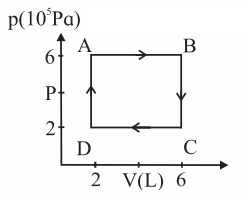
Answer
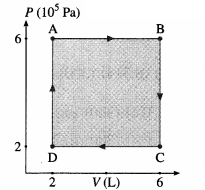
Data: $P_A=P_B=6 \times 10^5 \mathrm{~Pa}, \mathrm{P}_{\mathrm{C}}=\mathrm{P}_{\mathrm{D}}=2 \times 10^5 \mathrm{~Pa} \mathrm{~V}_{\mathrm{A}}=$ $V_D=2 L_{,} V_B=V_C 6 L, 1 \mathrm{~L}=10^{-3} \mathrm{~m}^3$ (i) The work done along the path $A \rightarrow B$ (isobaric process), $W_{A B}=P_A\left(V_B-V_A\right)=\left(6 \times 10^5 \mathrm{~Pa}\right)(6-2)\left(10^{-3}\right.$ $\left.m^3\right)=2.4 \times 10^3 \mathrm{~J}$ (ii) $\mathrm{W}_{\mathrm{BC}}=$ zero as the process is isochoric $\mathrm{V}=$ constant). (iii) The work done along the path $\mathrm{C} \rightarrow \mathrm{D}$ (isobaric process), $W_{C D}=P_C\left(V_D-V_C\right)$ $=\left(2 \times 10^5 \mathrm{~Pa}\right)(2-6)\left(10^{-3} \mathrm{~m}^3\right)=-8 \times 10^2 J$ (iv) $\mathrm{W}_{\mathrm{DA}}=$ zero as $\mathrm{V}=$ constant. View full question & answer→Question 423 Marks
The figure shows the V-T diagram for one cycle of a hypothetical heat engine which uses the ideal gas. Draw the p-V diagram and P-V diagram of the system.
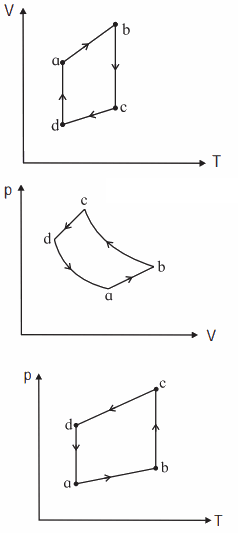
Answer(a) P-V diagram (Schematic)
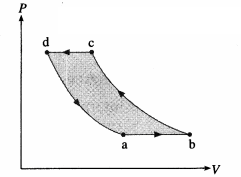
ab: isobaric process,
bc : isothermal process,
cd : isobaric process,
da : isothermal process
$\frac{P_{ a } V_{ a }}{T_{ a }}=\frac{P_{ b } V_{ b }}{T_{ b }}=\frac{P_{ c } V_{ c }}{T_{ c }}=\frac{P_{ d } V_{ d }}{T_{ d }}= nR$
(b) P—T diagram (Schematic)
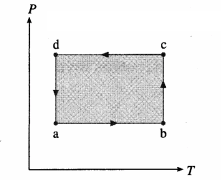
View full question & answer→Question 433 Marks
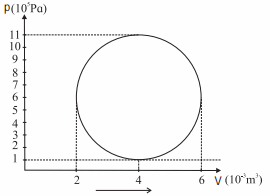
A hypothetical thermodynamic cycle is shown in the figure. Calculate the work done in $25$ cycles.
Answer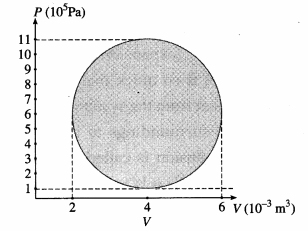
$\text { Data }: a=\left(\frac{\Delta V_{\max }}{2}\right)=\left(\frac{6-2}{2}\right) \times 10^{-3} m ^3$
$=2 \times 10^{-3} m ^3,$
$b=\left(\frac{\Delta P_{\max }}{2}\right)=\left(\frac{11-1}{2}\right) \times 10^5 Pa =5 \times 10^5 Pa ,$
$25$ cycles
The work done in one cycle, $\oint PdV$
$ =\pi a b=(3.142)\left(2 \times 10^{-3} m ^3\right)\left(5 \times 10^5 Pa \right)$
$=3.142 \times 10^3 J $
Hence, the work done in 25 cycles
$= (25) (3.142 \times 10^3 J) = 7.855 \times 10^4J$ View full question & answer→Question 443 Marks
An ideal monatomic gas is adiabatically compressed so that its final temperature is twice its initial temperature. What is the ratio of the final pressure to its initial pressure?
AnswerData: $T _{ f }=2 T _{ i }$, monatomic gas $\therefore \gamma=5 / 3$ $P_{ i } V_{ i }^\gamma=P_{ f } V_{ f }^\gamma$ in an adiabatic process
Now, $P V=n R T \quad \therefore V=\frac{n R T}{P}$
$\therefore V_{ i }=\frac{n R T_{ i }}{P_{ i }}$ and $V_{ f }=\frac{n R T_{ f }}{P_{ f }}$
$\therefore P_{ i }\left(\frac{n R T_{ i }}{P_{ i }}\right)^\gamma=P_{ f }\left(\frac{n R T_{ f }}{P_{ f }}\right)^\gamma$
$ \therefore P_{ i }^{1-\gamma} T_{ i }^\gamma=P_{ f }^{1-\gamma} T_{ f }^\gamma \quad \therefore\left(\frac{T_{ f }}{T_{ i }}\right)^\gamma=\left(\frac{P_{ i }}{P_{ f }}\right)^{1-\gamma}$
$\therefore\left(\frac{T_{ f }}{T_{ i }}\right)^\gamma=\left(\frac{P_{ f }}{P_{ i }}\right)^{\gamma-1} \quad \therefore 2^{5 / 3}=\left(\frac{P_{ f }}{P_{ i }}\right)^{5 / 3-1}=\left(\frac{P_{ f }}{P_{ i }}\right)^{2 / 3}$
$\therefore \frac{5}{3} \log 2=\frac{2}{3} \log \frac{P_{ f }}{P_{ i }} \quad \therefore \frac{5}{3} \times 0.3010=\frac{2}{3} \log \left(\frac{P_{ f }}{P_{ i }}\right)$
$\therefore(2.5)(0.3010)=\log \left(\frac{P_{ f }}{P_{ i }}\right) \therefore 0.7525=\log \left(\frac{P_{ f }}{P_{ i }}\right)$
$\therefore \frac{P_{ f }}{P_{ i }}=\operatorname{antilog} 0.7525=5.656 $
This is the ratio of the final pressure $\left(P_f\right)$ to the initial pressure $\left(P_i\right)$.
View full question & answer→Question 453 Marks
An ideal gas is taken through an isothermal process. If it does 2000 J of work on its environment, how much heat is added to it?
AnswerData : W = 2000 J, isothermal process
In this case, the change in the internal energy of the gas, ∆u, is zero as the gas is taken through an isothermal process.
Hence, the heat added to it,
Q = ∆ u + W = 0 + W = 200J
View full question & answer→Question 463 Marks
A Carnot refrigerator operates between 250K and 300K. Calculate its coefficient of performance.
AnswerData: $T _{ C }=250 K _{,} T _{ H }=300 K$
$
K =\frac{T_{ C }}{T_{ H }-T_{ C }}=\frac{250 K }{300 K -250 K }=\frac{250}{50}=5
$
This is the coefficient of performance of the refrigerator.
View full question & answer→Question 473 Marks
Efficiency of a Carnot cycle is $75\%.$ If temperature of the hot reservoir is $727\ {}^\circ C,$ calculate the temperature of the cold reservoir.
Answer$ \text { Data }: \eta=75 \%=0.75, T_{ H }=(273+727) K =1000 K$
$\eta=1-\frac{T_{ C }}{T_{ H }} \therefore \frac{T_{ C }}{T_{ H }}=1-\eta$
$\therefore T_{ C }= T _{ C }(1-\eta)=1000 K (1-0.75)$
$=250 K =(250-273)^{\circ} C$
$=-23^{\circ} C $
This is the temperature of the cold reservoir.
View full question & answer→Question 483 Marks
A system releases 130 kJ of heat while 109 kJ of work is done on the system. Calculate the change in internal energy.
AnswerData : Q = -130kj, W= – 109kJ
∆u = Q – W = – 130kJ – ( – 109kJ)
= (-130 + 104) kJ = – 26 kj.
This is the change (decrease) in the internal energy.
View full question & answer→Question 493 Marks
A gas contained in a cylinder fitted with a frictionless piston expands against a constant external pressure of 1 atm from a volume of 5 litres to a volume of 10 litres. In doing so it absorbs 400 J of thermal energy from its surroundings. Determine the change in internal energy of system.
AnswerData $: P=1 \mathrm{~atm}=1.013 \times 10^5 \mathrm{~Pa}, V_1=5$ litres $=5 \times$ $10^{-3} \mathrm{~m}^3 \mathrm{~V}_2=10$ litres $=10 \times 10^{-3} \mathrm{~m}^3, \mathrm{Q}=400 \mathrm{~J}$.
The work done by the system (gas in this case) on its surroundings,
$
\begin{aligned}
& W=P\left(V_2-V_1\right) \\
& =\left(1.013 \times 10^5 \mathrm{~Pa}\right)\left(10 \times 10^{-3} \mathrm{~m}^3-5 \times 10^{-3} \mathrm{~m}^3\right) \\
& =1.013\left(5 \times 10^2\right) \mathrm{J}=5.065 \times 10^2 \mathrm{~J}
\end{aligned}
$
The change in the internal energy of the system, $\Delta \mathrm{u}=$
$
\mathrm{Q}-\mathrm{W}=400 \mathrm{~J}-506.5 \mathrm{~J}=-106.5 \mathrm{~J}
$
The minus sign shows that there is a decrease in the internal energy of the system.
View full question & answer→Question 503 Marks
Why should a Carnot cycle have two isothermal two adiabatic processes?
AnswerWith two isothermal and two adiabatic processes, all reversible, the efficiency of the Carnot engine depends only on the temperatures of the hot and cold reservoirs.
[Note : This is not so in the Otto cycle and Diesel cycle.]
View full question & answer→