Question
An ideal monatomic gas is adiabatically compressed so that its final temperature is twice its initial temperature. What is the ratio of the final pressure to its initial pressure? 

Answer

Data: $T _{ f }=2 T _{ i }$, monatomic gas $\therefore \gamma=5 / 3$ $P_{ i } V_{ i }^\gamma=P_{ f } V_{ f }^\gamma$ in an adiabatic process
Now, $P V=n R T \quad \therefore V=\frac{n R T}{P}$
$\therefore V_{ i }=\frac{n R T_{ i }}{P_{ i }}$ and $V_{ f }=\frac{n R T_{ f }}{P_{ f }}$
$\therefore P_{ i }\left(\frac{n R T_{ i }}{P_{ i }}\right)^\gamma=P_{ f }\left(\frac{n R T_{ f }}{P_{ f }}\right)^\gamma$
$ \therefore P_{ i }^{1-\gamma} T_{ i }^\gamma=P_{ f }^{1-\gamma} T_{ f }^\gamma \quad \therefore\left(\frac{T_{ f }}{T_{ i }}\right)^\gamma=\left(\frac{P_{ i }}{P_{ f }}\right)^{1-\gamma}$
$\therefore\left(\frac{T_{ f }}{T_{ i }}\right)^\gamma=\left(\frac{P_{ f }}{P_{ i }}\right)^{\gamma-1} \quad \therefore 2^{5 / 3}=\left(\frac{P_{ f }}{P_{ i }}\right)^{5 / 3-1}=\left(\frac{P_{ f }}{P_{ i }}\right)^{2 / 3}$
$\therefore \frac{5}{3} \log 2=\frac{2}{3} \log \frac{P_{ f }}{P_{ i }} \quad \therefore \frac{5}{3} \times 0.3010=\frac{2}{3} \log \left(\frac{P_{ f }}{P_{ i }}\right)$
$\therefore(2.5)(0.3010)=\log \left(\frac{P_{ f }}{P_{ i }}\right) \therefore 0.7525=\log \left(\frac{P_{ f }}{P_{ i }}\right)$
$\therefore \frac{P_{ f }}{P_{ i }}=\operatorname{antilog} 0.7525=5.656 $
This is the ratio of the final pressure $\left(P_f\right)$ to the initial pressure $\left(P_i\right)$.

Need a full question paper?

Generate a complete, print-ready paper with questions like this in minutes — across 16+ boards, with answer keys.
Start Generating Free

Similar questions

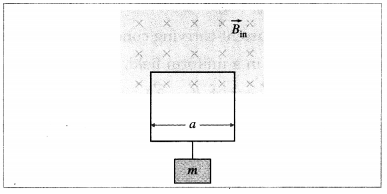
A rectangular loop of wire hanging vertically with one end in a uniform magnetic field $\vec{B}$, supports a small block of mass $m . \vec{B}$ points into the page in the shaded region of below figure. For what current I in the loop would the magnetic force exactly balance the downward gravitational force?
Image
Explain the formation of energy band diagram in case of conductor and semiconductor.
When is the magnetic flux through an area element (i) maximum (ii) zero? Explain.
A Carnot engine receives $6 \times 10^4 J$ from a reservoir at $600 K$, does some work, and rejects some heat to a reservoir at $500 K$. Find the
(i) the heat rejected by the engine
(ii) the work done by the engine
(iii) the efficiency of the engine.
A cyclotron is used to accelerate protons to a kinetic energy of \(5 MeV\). If the strength of magnetic field in the cyclotron is \(2 T\), find the radius and the frequency needed for the applied alternating voltage of the cyclotron. (Given: Velocity of proton \(=3 \times 10^7 m / s\) )
Explain experimental setup for Fraunhofer diffraction with neat diagram.
A magnet of magnetic moment $3Am^2$​​​​​​​ weighs $75\ g$. The density of the material of the magnet is $7500\ kg/m^3​​​​​​​$​​​​​​​. what is magnetization?
Derive an expression for the radius of the $n^{th}$ Bohr orbit for the hydrogen atom.
Explain the term inductive reactance. State its unit and dimensions.
A dynamo attached to a bicycle has a 200 turn coil, each of area $0.10 m ^2$. The coil rotates half a revolution per second and is placed in a uniform magnetic field of $0.02 T$. Find the maximum voltage generated in the coil.