Questions

5 Mark Question

Take a timed test

15 questions · self-marked practice — reveal the answer and mark yourself.

Question 15 Marks
Find the least 5-digit number which is exactly divisible by 20, 25, 30.
Answer
Least five digit number = 10000
$\begin{array}{c|c}5&20,25,30\\\hline2&4,5,6\\\hline2&2,5,3\\\hline3&1,5,3\\\hline5&1,5,1\\\hline&1,1,1\end{array}$
LCM of 20, 25, 30 is 300.
But we want the least five digit number which is divisible by 20, 25, 30.
So, we will multiply the LCM by a number that makes it the least five digit number divisible by 20, 25, 30.
300 × 31 = 9300
300 × 32 = 9600
300 × 33 = 9900
300 × 34 = 10200
So, the least five digit number divisible by 20, 25, 30 is 10200.
View full question & answer
Question 25 Marks
Find the HCF of the numbers in the following using the division method:754, 1508, 1972
Answer
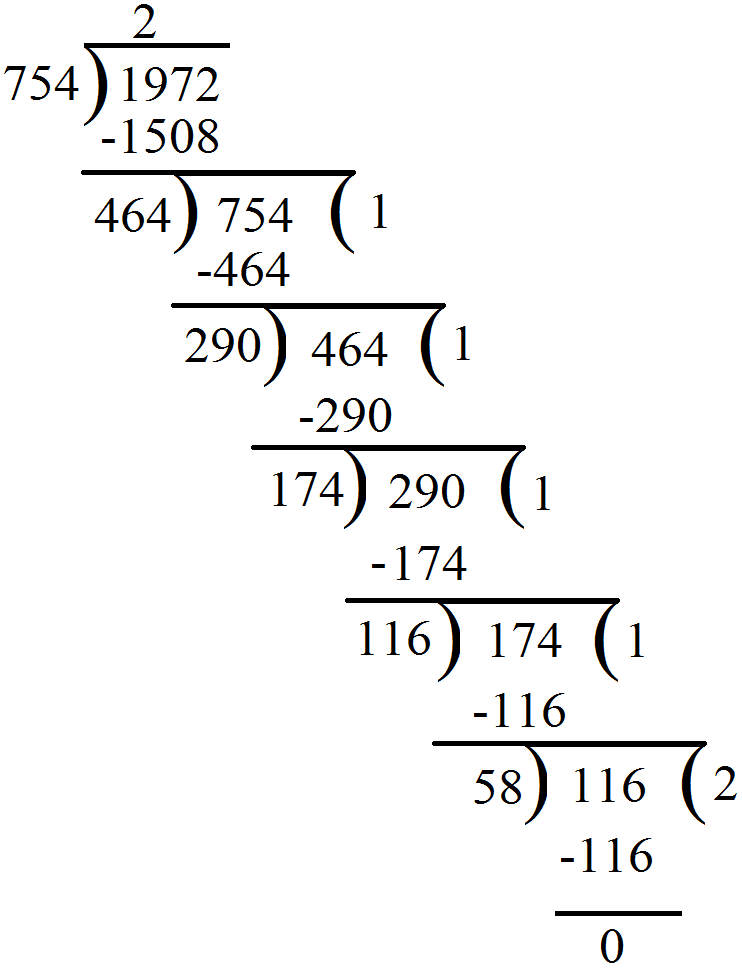
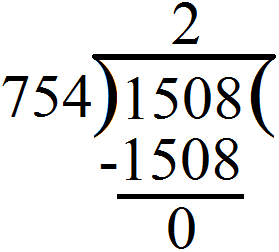
The given numbers are 754, 1508 and 1972.First we will find the HCF of 754 and 1508.

So, the HCF of 754 and 1508 is 754.
Now, we will find the HCF of 754 and 1972.

So, the HCF of 754 and 1972 is 58.
$\therefore$ The HCF of 754, 1058 and 1972 is 58.
View full question & answer
Question 35 Marks
Find the greatest number of five digits exactly divisble by $9, 12, 15, 18$ and $24$.
Answer
First, we will find the LCM Of $9, 12, 15, 18$ and $24.$
$\begin{array}{c|c}2&9,12,15,18,24\\\hline2&9,6,15,9,12\\\hline2&9,3,15,9,6\\\hline3&9,3,15,9,3\\\hline3&3,1,5,3,1\\\hline5&1,1,5,1,1\\\hline&1,1,1,1,1\end{array}$
$\therefore$ LCM of the numbers = $2^3 \times 3^2 \times 5 = 360$
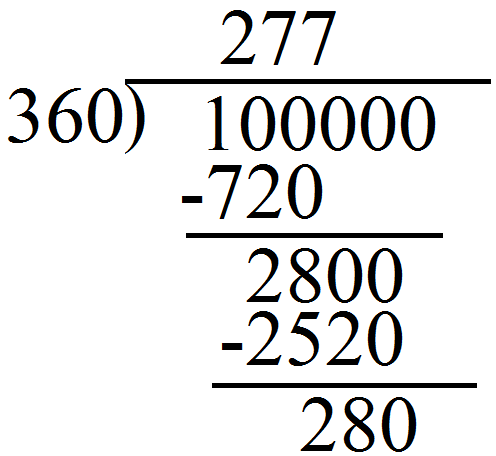
The least six-digit number = $100000$
The greatest five-digit number divisible by 360.
Weill be the quatient of $\frac{100000}{360}$ multiplied by 360.


So, the greatest five-digit number exactly divisible by the given numbers will be
$360 \times 277 = 99720.$
View full question & answer
Question 45 Marks
Find the greatest number that will divide 445, 572 and 699, leaving remainders 4, 5, 6 respectively.
Answer
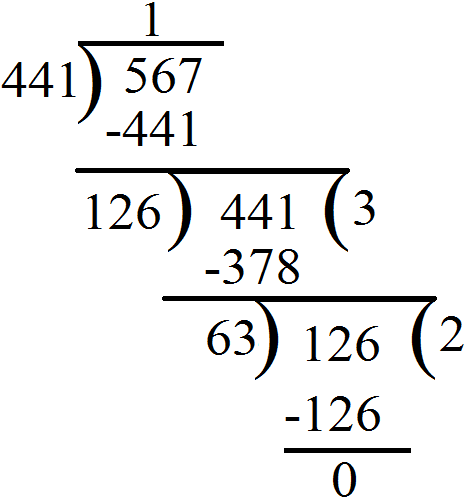
Since the respective remainders of 445, 572 and 699 are 4, 5 and 6, we have to find the number which exactly devides (445 - 4), (572 - 5) and (696 - 6).So, the required number is the HCF of 441, 567 and 693.
Firstly, we will find the HCF of 441 and 567.

$\therefore$ HCF = 63
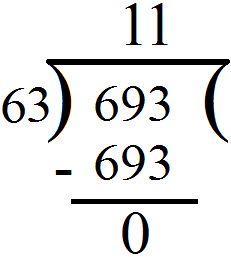
Now, we will find the HCF of 63 and 693.

$\therefore$ HCF = 63
Hence, the required numbers is 63.
View full question & answer
Question 55 Marks
Three different containers contain 403L, 434L and 465L of milk respectively. Find the capacity of a container which can measure the milk of all containers in an exact number of times.
View full question & answer
Question 65 Marks
The circumferences of four wheels are 50cm, 60cm, 75cm and 100cm. They start moving simultaneously. what least distance should they cover so that each wheel makes a complete number of revolutions?
Answer
Distance covered by a wheel for one complete revolution = circumference of the wheel.
All the wheels will make complete numbers of revolutions when the distances covered by them equal to their LCM.
$\begin{array}{c|c}5&50,60,75,100\\\hline5&10,12,15,20\\\hline2&2,12,3,4\\\hline2&1,6,3,2\\\hline3&1,3,3,1\\\hline&1,1,1,1\end{array}$
Required least distance = 5 × 5 × 2 × 2 × 3
= 25 × 4 × 3
= 300cm = 3m
So each wheel will make a complete number of revolutions after travelling 3m.
View full question & answer
Question 75 Marks
Show that the following pairs are co-primes:512, 945
Answer
Given numbers are 512 and 945.$\begin{array}{c|c}2&512\\\hline2&256\\\hline2&128\\\hline2&64\\\hline2&32\\\hline2&16\\\hline2&8\\\hline2&4\\\hline2&2\\\hline&1\end{array}$
$\begin{array}{c|c}3&315\\\hline3&105\\\hline5&35\\\hline7&7\\\hline&1\end{array}$
Now, $512=2\times2\times2\times2\times2\times2\times2\times2\times2=2^9$
$945=3\times3\times3\times5\times7=3^3\times5\times7$
Thus, the HCF of 512 and 945 is 1.
$\therefore$ 512 and 945 are co-primes.
View full question & answer
Question 85 Marks
There are 527 apples, 646 pears and 748 oranges. These are to be arranged in heaps containing the same number of fruits. Find the greatest number of fruits. Find the greatest number of fruits possible in each heap. How many heaps are formed?
Answer
Number of apples = 527
Number of pears = 646
Number of oranges = 748
The fruits are to be arranged in heaps containing the same number of fruits.
The greatest number of fruits posible in each heaps will be given by the HCF of 527, 646 and 748.
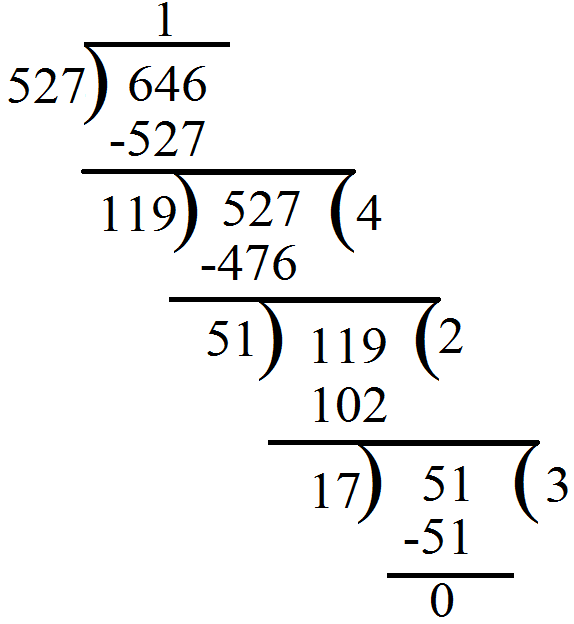
Firstly, we will find the HCF of 527 and 646.


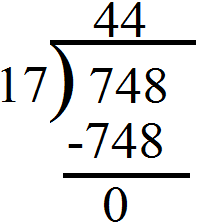
$\therefore$ HCF of 527, 646 and 748 = 17
So, the greatest number of fruits in each heaps will be 17.
View full question & answer
Question 95 Marks
Find the least number of five digits that is exactly divisible by $16,18,24$ and $30$ .
Answer
LCM of $16,18,24$ and $30.$

$\begin{array}{c|c}2&16,18,24,30\\\hline2&8,9,12,15\\\hline2&4,9,6,15\\\hline2&2,9,3,15\\\hline3&1,9,3,15\\\hline3&1,3,1,5\\\hline5&1,1,1,5\\\hline&1,1,1,1\end{array}$

$LCM=2^4 \times 3^2 \times 5=720$
We have to find the least five-digit number that is exactly divisible by 16,18 , and 30 .
But LCM $=720$ is a three digit number.
The least five digit number $=10000$.
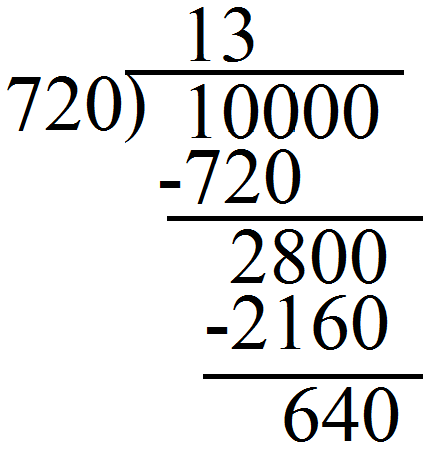
Dividing 10000 by 720 , we get:


The greatest fout- digits number exactly divisible by $720=10000-640=9360$
So, the least five-digit number exactly divisible by $720=9360+720=10080$
View full question & answer
Question 105 Marks
A rectangular courtyard is 18m, 72cm long and 13m, 20cm board. It is to be paved with square tiles of the same size. Find the least possibele number of such tiles.
Answer
Length of the courtyard = 18m, 72cm = 1872cmBreadth of the courtyard = 13m, 20cm = 1320cm
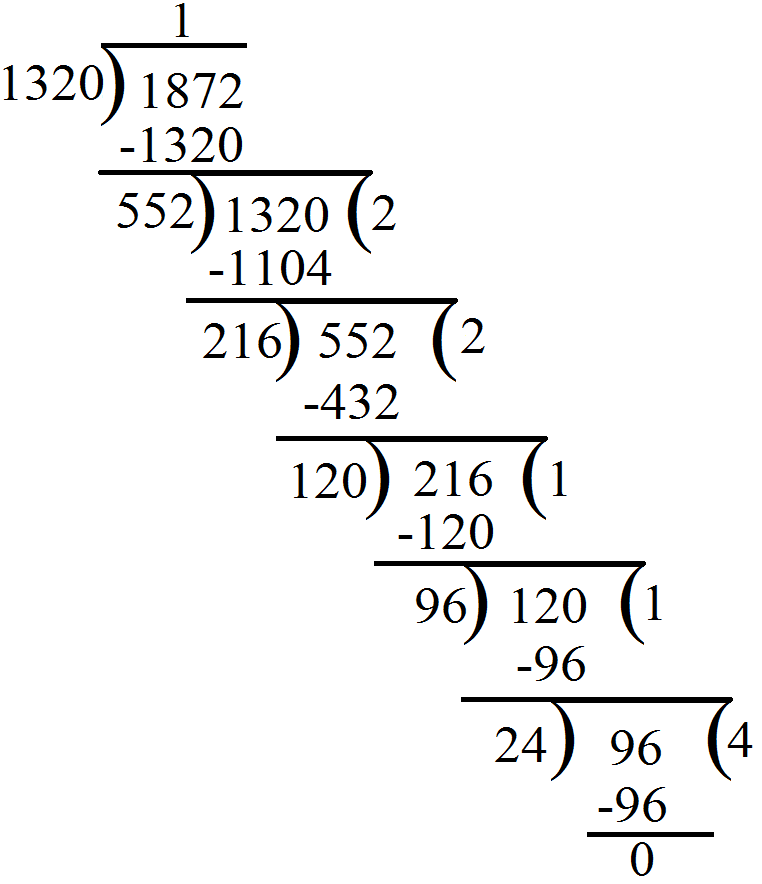
Now, maximum edge of the square tile is given by the HCF of 1872cm and 1320cm.

HCF of 1872 and 1320 = 24
$\therefore$ maximum edge of the squre tile = 24cm
Required number of tiles $=\frac{\text{area of courtyard}}{\text{area of each square tile}}$
$=\frac{1872\times1320}{24\times24}$
$=4290$
View full question & answer
Question 115 Marks
Find the HCF of the numbers in the following using the division method $:1794, 2346, 4761$
Answer
The given numbers are $1794, 2346$ and $4761.$
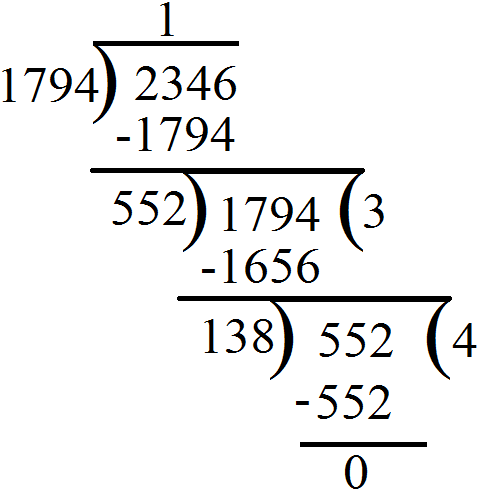
First we will find the HCF of $1794$ and $2346.$

So, the HCF of $1794$ and $2346$ is $138.$
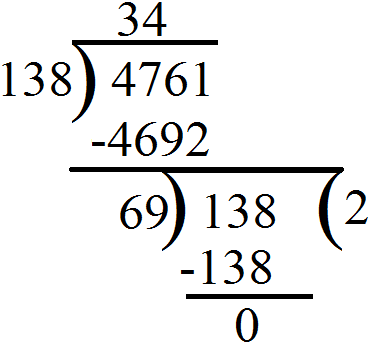
Now, we will find the HCF of $138$ and $4761.$

So, the HCF of $138$ and $4761$ is $69.$
$\therefore$ The HCF of $1794, 2346$ and $4761$ is $69.$
View full question & answer
Question 135 Marks
Find the HCF of the numbers in the following using the division method:658, 940, 1128
Answer
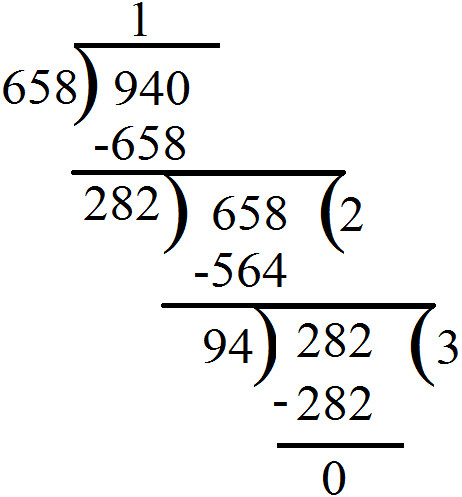
The given numbers are 658, 940 and 1128.First we will find the HCF of 658 and 940.

Thus, the HCF of 658 and 940 is 94.
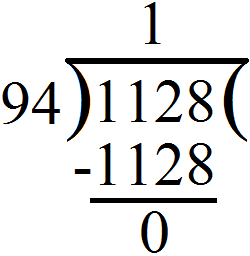
Now, we will find the HCF of 94 and 1128.

Thus, the HCF of 94 and 1128 is 94.
$\therefore$ The HCF of 658, 9402 and 1128 is 94.
View full question & answer
Question 145 Marks
Find the largest number which divides 630 and 940 leaving remainders 6 and 4 respectively.
Answer
Since 6 and 4 are the remainders, the number must exactly divide the following:
630 - 6 = 624 and 940 - 4 = 936
$\begin{array}{c|c}3&642\\\hline2&204\\\hline2&104\\\hline2&52\\\hline2&26\\\hline13&13\\\hline&1\end{array}$
$\begin{array}{c|c}3&936\\\hline2&312\\\hline2&156\\\hline2&78\\\hline3&39\\\hline13&13\\\hline&1\end{array}$
624 = 2 × 2 × 2 × 2 × 3 × 13
936 = 2 × 2 × 2 × 3 × 3 × 13
HCF of 624 and 936 = 8 × 3 × 13
= 312
So, 312 is the greatest number that divides 630 and 940, leaving 6 and 4 as the respective remainders.
View full question & answer
Question 155 Marks
Define (i) FACTOR, (ii) MULTIPLE. Give five example of each.
Answer
Factor: A factor of a number is an exact divisor of that number.
Multiple: A multiple of a number is a number obtained by multiplying it by a natural number.
Example 1: We know that 15 = 1 × 15 and 15 = 3 × 5
$\therefore$ 1, 3, 5 and 15 are the factors of 15.
In other words, we can say that 15 is a multiple of 1, 3, 5 and 15.
Example 2: We know that 8 = 8 × 1, 8 = 2 × 4 and 8 = 4 × 2
$\therefore$ 1, 2, 4 and 8 are the factors of 8.
In other words, we can say that 8 is a multiple of 1, 2, 4 and 8.
Example 3: We know that 30 = 30 × 1, 30 = 5 × 6 and 30 = 6 × 5
$\therefore$ 1, 5, 6 and 30 are factors of 30.
In other words, we can say that 30 is a multiple of 1, 5, 6 and 30.
Example 4: We know that 20 = 20 × 1, 20 = 4 × 5 and 20 = 5 × 4
$\therefore$ 1, 4, 5 and 20 are factors of 20.
In other words, we can say that 20 is a multiple of 1, 4, 5 and 20.
Example 5: We know that 10 = 10 × 1, 10 = 2 × 5 and 10 = 5 × 2
$\therefore$ 1, 2, 5 and 10 are factors of 10.
In other words, we can say that 10 is a multiple of 1, 2, 5 and 10.
View full question & answer