Question
A rectangular courtyard is 18m, 72cm long and 13m, 20cm board. It is to be paved with square tiles of the same size. Find the least possibele number of such tiles.
Answer

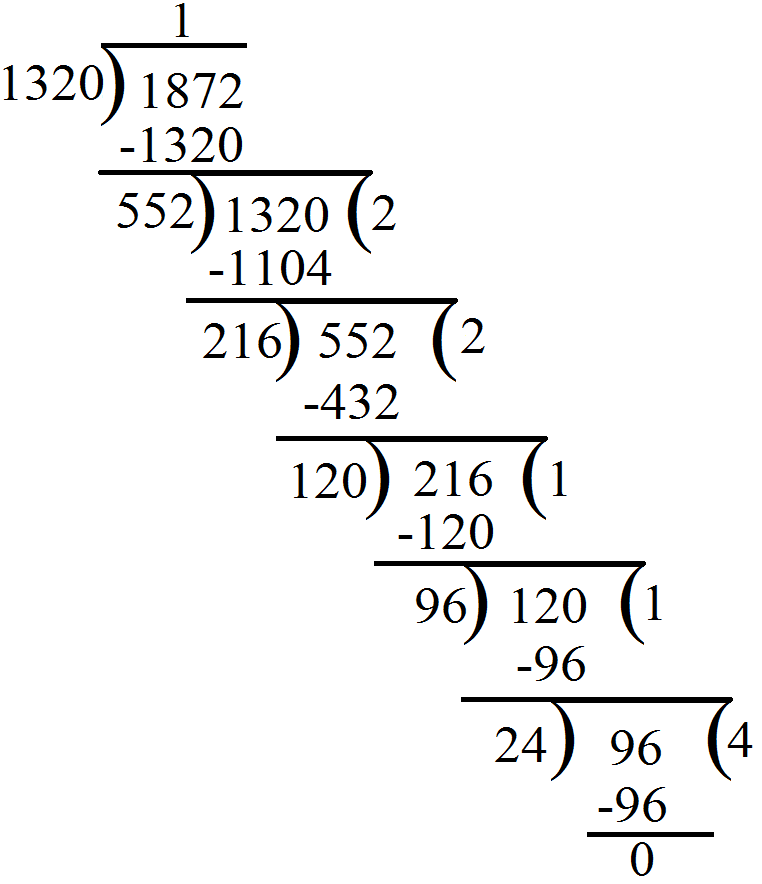
Length of the courtyard = 18m, 72cm = 1872cmBreadth of the courtyard = 13m, 20cm = 1320cm
Now, maximum edge of the square tile is given by the HCF of 1872cm and 1320cm.

HCF of 1872 and 1320 = 24
$\therefore$ maximum edge of the squre tile = 24cm
Required number of tiles $=\frac{\text{area of courtyard}}{\text{area of each square tile}}$
$=\frac{1872\times1320}{24\times24}$
$=4290$

Need a full question paper?

Generate a complete, print-ready paper with questions like this in minutes — across 16+ boards, with answer keys.
Start Generating Free

Similar questions

Draw a line segment AB of length 10cm. Mark a point P on AB such that AP = 4cm. Draw a line through P perpendicular to AB.
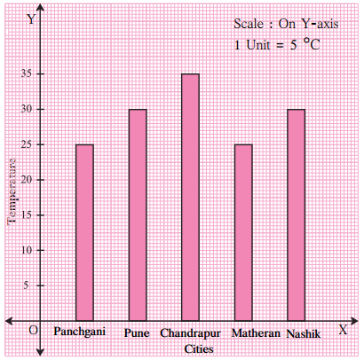
This bar graph shows the maximum temperatures in degrees Celsius in different cities on a certain day in February. Observe the graph and answer the questions:

Image

  1. What data is shown on the vertical and the horizontal lines?
  2. Which city had the highest temperature?
  3. Which cities had equal maximum temperatures?
  4. Which cities had a maximum temperature of 30 °C?
  5. What is the difference between the maximum temperatures of Panchgani and Chandrapur?
Draw a line segment AB = 5.6cm. Draw the right bisector of AB.
Total number of students of a school in different years is shown in the following table:
Year
Number of students
1996
400
1998
550
2000
450
2002
600
2006
650
Represent the above data by a pictograph.
Prepare a pictograph of students using one symbol an icon of a student to represent students and answer the following questions:
  1. How many symbols represent total number of students in the year 2002?
  2. How many symbols represent total number of students for the year 1998?
Ravish's house is $\frac{9}{10}\text{km}$ from his school. He walked some distance and then took a bus for $\frac{1}{2}\text{km}$ up to the school. How far did he walk?
Construct an angle bisector to obtain an angle of 30°.
Round off each of the following numbers to nearest tens, hundreds and thousands:
  1. 964
  2. 1049
  3. 45,634
  4. 79,085
Draw a line AB and take two points C and E on opposite sides of AB. Through C, draw $\text{CD}\perp\text{AB}$ and through E draw $\text{EF}\perp\text{AB}.$ ruler and set-squares.
Use a pair of compasses and construct the following angles:
150°
Ramanujan’s Magic square.

22121887
8817925
10248916
19862311
  • Add the four numbers in the rows, the columns and along the diagonals of this square.
  • What is the sum?
  • Is it the same every time?
  • What is the peculiarity?
  • Look at the numbers in the first row, 22 – 12 – 1887. Find out why this date is special.

Obtain and read a biography of the great Indian mathematician Srinivasa Ramanujan.