Question
Define (i) FACTOR, (ii) MULTIPLE. Give five example of each.

Answer

Factor: A factor of a number is an exact divisor of that number.
Multiple: A multiple of a number is a number obtained by multiplying it by a natural number.
Example 1: We know that 15 = 1 × 15 and 15 = 3 × 5
$\therefore$ 1, 3, 5 and 15 are the factors of 15.
In other words, we can say that 15 is a multiple of 1, 3, 5 and 15.
Example 2: We know that 8 = 8 × 1, 8 = 2 × 4 and 8 = 4 × 2
$\therefore$ 1, 2, 4 and 8 are the factors of 8.
In other words, we can say that 8 is a multiple of 1, 2, 4 and 8.
Example 3: We know that 30 = 30 × 1, 30 = 5 × 6 and 30 = 6 × 5
$\therefore$ 1, 5, 6 and 30 are factors of 30.
In other words, we can say that 30 is a multiple of 1, 5, 6 and 30.
Example 4: We know that 20 = 20 × 1, 20 = 4 × 5 and 20 = 5 × 4
$\therefore$ 1, 4, 5 and 20 are factors of 20.
In other words, we can say that 20 is a multiple of 1, 4, 5 and 20.
Example 5: We know that 10 = 10 × 1, 10 = 2 × 5 and 10 = 5 × 2
$\therefore$ 1, 2, 5 and 10 are factors of 10.
In other words, we can say that 10 is a multiple of 1, 2, 5 and 10.

Need a full question paper?

Generate a complete, print-ready paper with questions like this in minutes — across 16+ boards, with answer keys.
Start Generating Free

Similar questions

Draw a line segment AB and bisect it. Bisect one of the equal parts to obtain a line segment of length $\frac{1}{2}(\text{AB}).$
A square sheet of side 5cm is cut out from a rectangular piece of an aluminimum sheet of length 9cm and breadth 6cm. What is the area of the aluminium sheet left over?
Using a pair of compasses construct the following angles:
60°
The circumferences of four wheels are 50cm, 60cm, 75cm and 100cm. They start moving simultaneously. what least distance should they cover so that each wheel makes a complete number of revolutions?
If AB = 7.5cm and CD = 2.5cm, construct a segment whose length is equal to:
2AB + 3CD
Draw a circle with centre at point O. Draw its two chords AB and CD such that AB is not parallel to CD. Draw the perpendicular bisectors of AB and CD. At what point do they intersect?
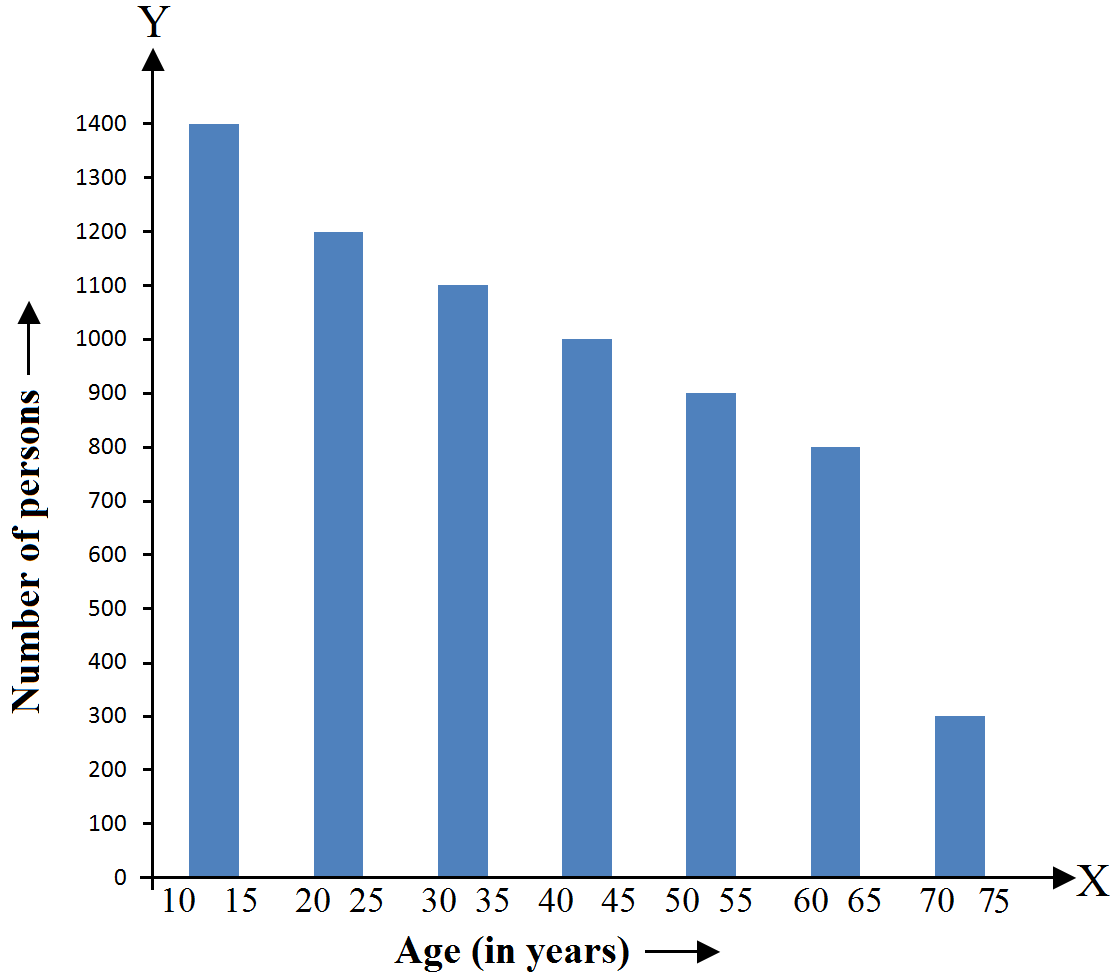
Study the bar graph representing the number of persons in various age groups in a town shown in Observe the bar graph and answer the following questions:
  1. What if the percentage of the youngest age-group persons over those in the oldest age group?
  2. What is the total population of the town?
  3. What is the number of persons in the age-group 60-65?
  4. How many persons are more in the age-group 10-15 than in the age group 30-35?
  5. What is the age-group of exactiy 1200 persons living in the town?
  6. What is the total number of persons living in the town in the age-group 50-55?
  7. What is the total muner of persons living in the town in the age-groups 10-15 and 60-65?
  8. Whether the population in general increases, decreases or remains constant with the increase in the age-group.
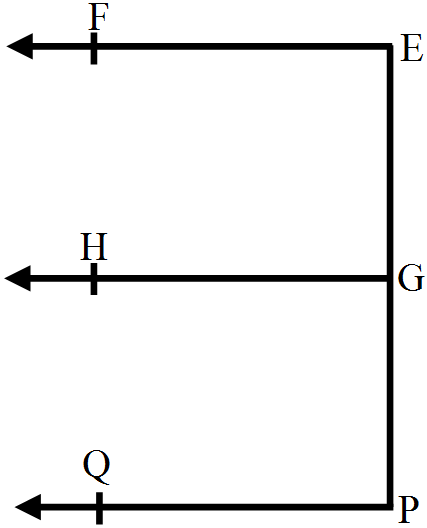
Identify and name the line segments and rays in the following figure:
Using a protractor, draw $\angle\text{BAC}$ of measure 70°. On side AC, take a point P, such that AP = 2cm. From P draw a line perpendicular to AB.
Construct an angle bisector to draw an angle of 45°.