Question 12 Marks
Find the fraction equivalent to $\frac{45}{60}$, having,Numerator 15
AnswerConsider the numerator $= 15$
$\frac{45}{60}=15$
As $45\div3=15$, we will divide both the numerator & denominator by 3.
$\Rightarrow\frac{\frac{45}{3}}{\frac{60}{3}}=\frac{15}{20}$
View full question & answer→Question 22 Marks
Find the fraction equivalent to $\frac{45}{60}$, having,Denominator 4
AnswerConsider the numerator $= 4$
$\frac{45}{60}=\frac{...}{4}$
As $60\div15=4$, we will divide both the numerator & denominator by 15
$\Rightarrow\frac{\frac{45}{15}}{\frac{60}{15}}=\frac{3}{4}$
View full question & answer→Question 32 Marks
Check whether the given fractions are equivalent:$\frac{3}{10},\frac{12}{50}$
Answer$\frac{3}{10}\times\frac{4}{4}=\frac{12}{40}$
Hence, the given fraction are not equivalent.
View full question & answer→Question 42 Marks
Solve:
$\frac{3}{22}+\frac{7}{22}$
AnswerThe given fractions are:
$\frac{3}{22}+\frac{7}{22}$
$=\frac{3+7}{22}$
$=\frac{10}{22}=\frac{5}{11}$
Hence the answer is $\frac{5}{11}$
View full question & answer→Question 52 Marks
The following fractions represent just three different numbers. Separate them in to three groups of equal fractions by changing to its simplest form:
$\frac{12}{60}$
Answer$\frac{12}{60}$
HCF of 12 & 60 is 12
Divide both the numerator & denominator by the HCF of 12 & 60
$\frac{12\div12}{60\div12}=\frac{1}{5}$
View full question & answer→Question 62 Marks
Find the fraction equivalent to $\frac{45}{60}$, having,Numerator 135
AnswerConsider the numerator $= 135$
$\frac{45}{60}=135$
As 45 × 3 = 135, we will multiply both the numerator & denominator by 3.
$\Rightarrow\frac{45\ \times\ 3}{60\ \times\ 3}=\frac{135}{180}$
View full question & answer→Question 72 Marks
Solve:
$\frac{1}{4}+\frac{0}{4}$
AnswerThe given fractions are:
$\frac{1}{4}+\frac{0}{4}$
$=\frac{1+0}{4}$
$=\frac{1}{4}$
Hence the answer is $\frac{1}{4}$
View full question & answer→Question 82 Marks
Check whether the given fractions are equivalent:$\frac{7}{13},\frac{5}{11}$
Answer$\frac{7}{13}\times\frac{5}{5}=\frac{35}{65}$
$\frac{5}{11}\times\frac{7}{7}=\frac{35}{77}$
Hence, the given fraction are not equivalent.
View full question & answer→Question 92 Marks
The following fractions represent just three different numbers. Separate them in to three groups of equal fractions by changing to its simplest form:
$\frac{15}{75}$
Answer$\frac{15}{75}$
HCF of 15 & 75 is 15
Divide both the numerator & denominator by the HCF of 15 & 75
$\frac{15\div15}{75\div15}=\frac{1}{5}$
View full question & answer→Question 102 Marks
The following fractions represent just three different numbers. Separate them in to three groups of equal fractions by changing to its simplest form:
$\frac{12}{72}$
Answer$\frac{12}{72}$
HCF of 12 & 72 is 12
Divide both the numerator & denominator by the HCF of 12 & 72
$\frac{12\div12}{72\div12}=\frac{1}{6}$
View full question & answer→Question 112 Marks
Compare the following fractions using the symbol > or <:
$\frac{6}{7}$ and $\frac{6}{11}$
Answer$\frac{6}{7}>\frac{6}{11}$ because if the numerator is the same, then the fraction with smaller denominator is greater.
View full question & answer→Question 122 Marks
Arrange in descending order of the following using the symbol >:
$\frac{8}{17},\frac{8}{9},\frac{8}{5},\frac{8}{13}$
AnswerWhen numerators are the same and denominators are different, then the fraction with greater denominator has a smaller value.
$\frac{8}{5}>\frac{8}{9}>\frac{8}{13}>\frac{8}{17}$
View full question & answer→Question 132 Marks
Write each fraction. Arrange them in ascending and descending order using correct sign '<', '=', '>' between the fractions:

AnswerAscending order:

Descending order:

View full question & answer→Question 142 Marks
Solve:$\frac{3}{15}+\frac{7}{15}$
AnswerThe given fractions are:
$\frac{3}{15}+\frac{7}{15}$
$=\frac{3+7}{15}$
$=\frac{10}{15}$
Hence the answer is $\frac{10}{15}$
View full question & answer→Question 152 Marks
Find answers to the following. Write and indicate how you solved them.
Is $\frac{1}{15}$ equal to $\frac{4}{30}?$
AnswerNumerator of the first fraction × Denominator of the second fraction = Numerator of the second fraction × Denominator of the first fraction
1 × 30 = 30
4 × 15 = 60
So,
$1\times30\ne4\times15$
$\frac{1}{15}$ is equal to $\frac{4}{30}$
View full question & answer→Question 162 Marks
The following fractions represent just three different numbers. Separate them in to three groups of equal fractions by changing to its simplest form:
$\frac{16}{100}$
Answer$\frac{16}{100}$
HCF of 16 & 100 is 4
Divide both the numerator & denominator by the HCF of 16 & 100
$\frac{16\div4}{100\div4}=\frac{4}{25}$
View full question & answer→Question 172 Marks
Solve:
$1-\frac{2}{3}+\frac{7}{3}$
AnswerThe given fractions are:
$1-\frac{2}{3}+\frac{7}{3}$
$=\frac{3-2+7}{3}$
$=\frac{8}{3}$
Hence the answer is $\frac{8}{3}$
View full question & answer→Question 182 Marks
Find the fraction equivalent of $\frac{35}{42}$, having:Numerator 30
AnswerFirstly, we will reduce $\frac{35}{42}$ into the lowest term.
Now, we will divide both the numerator & denominator by the HCFs of 35 & 42.
$\Rightarrow\frac{35\div7}{42\div7}=\frac{5}{6}$
$\frac{5}{6}=\frac{30}{}$
Consider the numerator $= 30$
As 5 × 6 = 30, we will multiply both the numerator & denominator by 6.
$\Rightarrow\frac{5\ \times\ 6}{6\ \times\ 6}=\frac{30}{36}$
View full question & answer→Question 192 Marks
Find answers to the following. Write and indicate how you solved them.Is $\frac{5}{9}$ equal to $\frac{4}{5}?$
AnswerNumerator of the first fraction × Denominator of the second fraction = Numerator of the second fraction × Denominator of the first fraction
5 × 5 = 25
4 × 9 = 36
So,
$5\times5\ne4\times9$
$\frac{5}{9}$ is not equal to $\frac{4}{5}$
View full question & answer→Question 202 Marks
Solve:
$\frac{7}{31}-\frac{4}{31}+\frac{9}{31}$
AnswerThe given fractions are:
$\frac{7}{31}-\frac{4}{31}+\frac{9}{31}$
$=\frac{7-4+9}{31}$
$=\frac{12}{31}$
Hence the answer is $\frac{12}{31}$
View full question & answer→Question 212 Marks
Write the natural numbers from 102 to 113. What fraction of them are prime numbers.
AnswerNatural numbers from 102 to 113 are 102, 103, 104, 105, 106, 107, 108, 109, 110, 111, 112 and 113
Prime numbers from 102 to 113 are 103, 107, 109 and 113
Out of 12 natural numbers, 4 are prime.
Fraction of the prime numbers $=\frac{4}{12}=\frac{1}{3}$
View full question & answer→Question 222 Marks
Find the fraction equivalent of $\frac{35}{42}$, having:Denominator 30
AnswerFirstly, we will reduce $\frac{35}{42}$ into the lowest term.
Now, we will divide both the numerator & denominator by the HCFs of 35 & 42.
$\Rightarrow\frac{35\div7}{42\div7}=\frac{5}{6}$
$\frac{5}{6}=\frac{}{30}$
Consider the denominator $= 30$
As 6 × 5 = 30, we will multiply both the numerator & denominator by 5.
$\Rightarrow\frac{5\ \times\ 5}{6\ \times\ 5}=\frac{25}{30}$
View full question & answer→Question 232 Marks
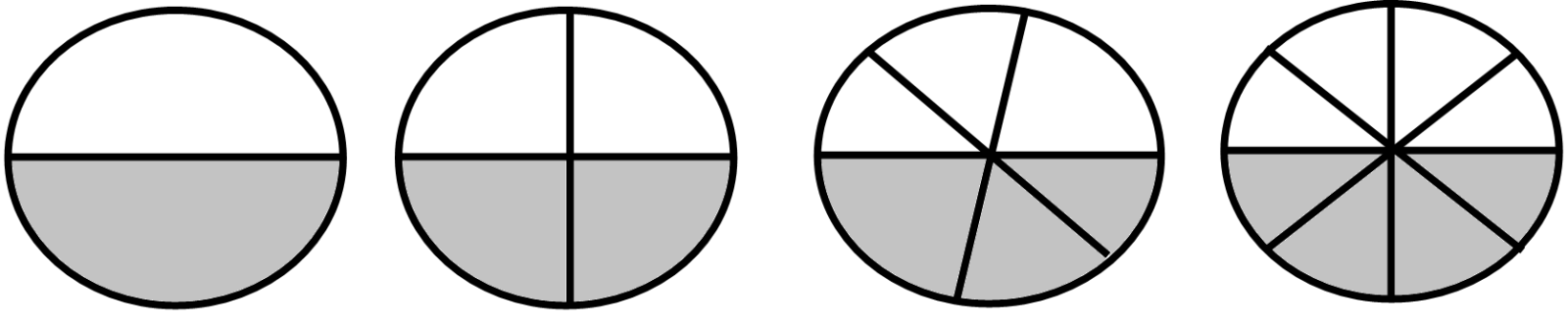
Write the fractions and check whether they are equivalent or not:
Answer
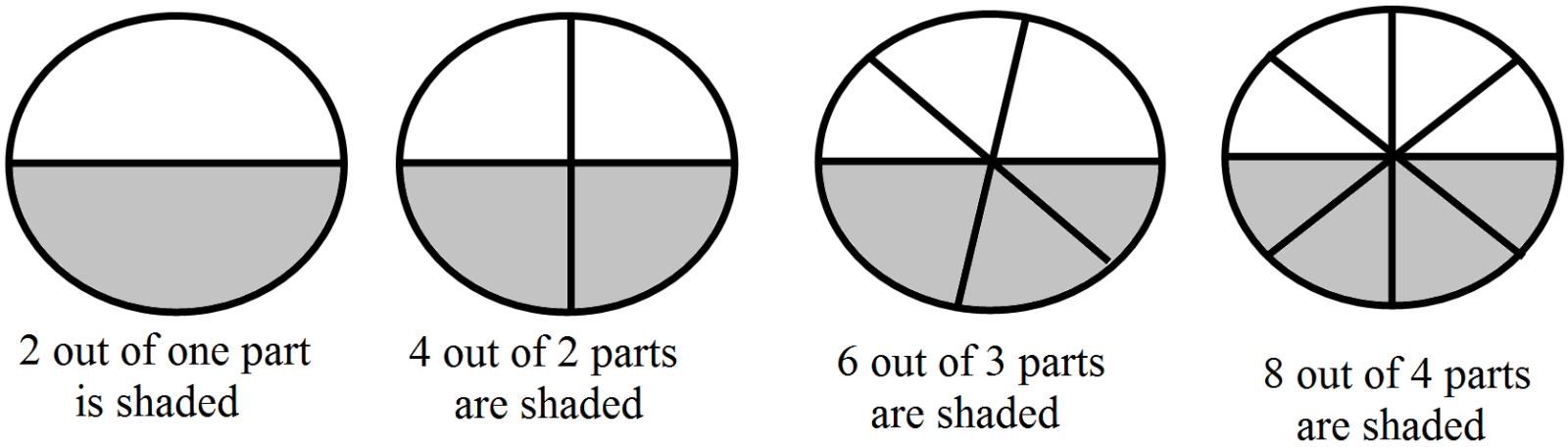 Fraction $=\frac{1}{2}$
Fraction $=\frac{2}{4}=\frac{1}{2}$
Fraction $=\frac{3}{6}=\frac{1}{2}$
Fraction $=\frac{4}{8}=\frac{1}{2}$
Yes, they are equivalent. View full question & answer→Question 242 Marks
Check whether the given fractions are equivalent:$\frac{4}{11},\frac{32}{88}$
Answer$\frac{4}{11}\times\frac{8}{8}=\frac{32}{88}$
Hence, the given fraction are equivalent.
View full question & answer→Question 252 Marks
The following fractions represent just three different numbers. Separate them in to three groups of equal fractions by changing to its simplest form:
$\frac{2}{12}$
Answer$\frac{2}{12}$
HCF of 2 & 12 is 2
Divide both the numerator & denominator by the HCF of 2 & 12
$\frac{2\div2}{12\div2}=\frac{1}{6}$
View full question & answer→Question 262 Marks
The following fractions represent just three different numbers. Separate them in to three groups of equal fractions by changing to its simplest form:
$\frac{10}{60}$
Answer$\frac{10}{60}$
HCF of 10 & 60 is 10
Divide both the numerator & denominator by the HCF of 10 & 60
$\frac{10\div10}{60\div10}=\frac{1}{6}$
View full question & answer→Question 272 Marks
Compare the following fractions using the symbol > or <:
$\frac{3}{7}$ and $\frac{5}{7}$
Answer$\frac{3}{7}<\frac{5}{7}$ because 3 < 5 and the denominator is the same.
View full question & answer→Question 282 Marks
The following fractions represent just three different numbers. Separate them in to three groups of equal fractions by changing to its simplest form:
$\frac{16}{96}$
Answer$\frac{16}{96}$
HCF of 16 & 96 is 16
Divide both the numerator & denominator by the HCF of 16 & 96
$\frac{16\div16}{96\div16}=\frac{1}{6}$
View full question & answer→Question 292 Marks
The following fractions represent just three different numbers. Separate them in to three groups of equal fractions by changing to its simplest form:
$\frac{3}{18}$
Answer$\frac{3}{18}$
HCF of 3 & 18 is 3
Divide both the numerator & denominator by the HCF of 3 & 18
$\frac{3\div3}{18\div3}=\frac{1}{6}$
View full question & answer→Question 302 Marks
The following fractions represent just three different numbers. Separate them in to three groups of equal fractions by changing to its simplest form:
$\frac{8}{50}$
Answer$\frac{8}{50}$
HCF of 8 & 50 is 2
Divide both the numerator & denominator by the HCF of 8 & 50
$\frac{8\div2}{50\div2}=\frac{4}{25}$
View full question & answer→Question 312 Marks
Find answers to the following. Write and indicate how you solved them.
Is $\frac{9}{16}$ equal to $\frac{5}{9}?$
AnswerNumerator of the first fraction × Denominator of the second fraction = Numerator of the second fraction × Denominator of the first fraction
9 × 9 = 81
5 × 16 = 80
So,
$9\times9\ne5\times16$
$\frac{9}{16}$ is not equal to $\frac{5}{9}$
View full question & answer→Question 322 Marks
Find the fraction equivalent of $\frac{35}{42}$, having:Numerator 15
AnswerFirstly, we will reduce $\frac{35}{42}$ into the lowest term.
Now, we will divide both the numerator & denominator by the HCFs of 35 & 42.
$\Rightarrow\frac{35\div7}{42\div7}=\frac{5}{6}$
$\frac{5}{6}=\frac{15}{}$
Consider the numerator $= 15$
As 5 × 3 = 15, we will multiply both the numerator & denominator by 3.
$\Rightarrow\frac{5\ \times\ 3}{6\ \times\ 3}=\frac{15}{18}$
View full question & answer→Question 332 Marks
Compare the following fractions using the symbol > or <:
$\frac{8}{3}$ and $\frac{8}{13}$
Answer$\frac{8}{3}<\frac{8}{13}$, because if the numerator is the same, then the fraction with smaller denominator is greater.
View full question & answer→Question 342 Marks
Mukesh has a box of 24 pencils. He gives half of them of Sunita. How many does sunita get? How many does Mukesh still have?
AnswerGiven,
Mukesh has 24 pencils.
Sunita gets half of mukesh’s pencils.
Sunita gets 242 pencils, that is, 12 pencils.
Number of pencils mukesh still has = 24 - 12 = 12
View full question & answer→Question 352 Marks
Check whether the given fractions are equivalent:$\frac{5}{9},\frac{30}{54}$
Answer$\frac{5}{9}\times\frac{6}{6}=\frac{30}{54}$
Hence, the given fraction are equivalent.
View full question & answer→Question 362 Marks
Check whether the given fractions are equivalent:$\frac{9}{27},\frac{25}{75}$
Answer$\frac{9}{27}=\frac{\frac{9}{9}}{\frac{27}{9}}=\frac{1}{3}$
$\frac{25}{75}=\frac{\frac{25}{25}}{\frac{75}{25}}=\frac{1}{3}$
Hence, the given fraction are equivalent.
View full question & answer→Question 372 Marks
Find the equivalent fraction of $\frac{3}{5}$, having:Denominator 30
AnswerConsider the denominator = 30
$\frac{3}{5}=\frac{....}{30}$
As 5 × 6 = 30, we will multiply both the numerator & denominator by 6, we have
$\Rightarrow\frac{3}{5}\times\frac{6}{6}=\frac{18}{30}$
View full question & answer→Question 382 Marks
Find answers to the following. Write and indicate how you solved them.
Is $\frac{4}{5}$ equal to $\frac{16}{20}?$
AnswerNumerator of the first fraction × Denominator of the second fraction = Numerator of the second fraction × Denominator of the first fraction
4 × 20 = 80
16 × 5 = 80
So,
$4\times20=16\times5$
$\frac{4}{5}$ is equal to $\frac{16}{20}$
View full question & answer→Question 392 Marks
Find the equivalent fraction of $\frac{3}{5}$, having:Numerator 21
AnswerConsider the numerator = 30
$\frac{3}{5}=21$
As 5 × 7 = 21, we will multiply both the numerator & denominator by 7, we have
$\Rightarrow\frac{3}{5}\times\frac{7}{7}=\frac{21}{35}$
View full question & answer→Question 402 Marks
Compare the following fractions using the symbol > or <:
$\frac{1}{5}$ and $\frac{4}{15}$
Answer$\frac{1}{5}=\frac{1}{5}\times\frac{3}{3}=\frac{3}{15}$ therefore, $\frac{3}{15}<\frac{4}{15}$(Because 3 < 4 and the denominator is the same)
View full question & answer→Question 412 Marks
Find the fraction equivalent to $\frac{45}{60}$, having,Denominator 240
AnswerConsider the denominator $= 240$
$\frac{45}{60}=\frac{.....}{240}$
As 60 × 4 = 240, we will multiply both the numerator & denominator by 4.
$\Rightarrow\frac{45\ \times\ 4}{60\ \times\ 4}=\frac{180}{240}$
View full question & answer→Question 422 Marks
Find the equivalent fraction of $\frac{3}{5}$, having:Numerator 9
Answer$\frac{3}{5}=9$
Consider the numerators = 9
As 3 × 3 = 9, we will multiply both the numerator & denominator by 3
$\Rightarrow\frac{3}{5}\times\frac{3}{3}=\frac{9}{15}$
View full question & answer→Question 432 Marks
The following fractions represent just three different numbers. Separate them in to three groups of equal fractions by changing to its simplest form:
$\frac{3}{15}$
Answer$\frac{3}{15}$
HCF of 3 & 15 is 3
Divide both the numerator & denominator by the HCF of 3 & 15
$\frac{3\div3}{15\div3}=\frac{1}{5}$
View full question & answer→Question 442 Marks
Arrange the following fractions in the ascending order:
$\frac{2}{7},\frac{11}{35},\frac{9}{14},\frac{13}{28}$
Answer$\frac{9}{14}>\frac{13}{28}>\frac{11}{35}>\frac{2}{7}$
View full question & answer→Question 452 Marks
Arrange the following fractions in the ascending order:
$\frac{2}{5},\frac{3}{4},\frac{1}{2},\frac{3}{5}$
AnswerLCM of 2, 4 and 5 is 20 $\frac{2}{5}=\frac{2}{5}\times\frac{4}{4}=\frac{8}{20}$ $\frac{3}{4}=\frac{3}{4}\times\frac{5}{5}=\frac{15}{20}$ $\frac{1}{2}=\frac{1}{2}\times\frac{10}{10}=\frac{10}{20}$ $\frac{3}{5}=\frac{3}{5}\times\frac{4}{4}=\frac{12}{20}$ When denominators are the same and numerators are different, then the fraction with greater numerator has a larger value. $\frac{8}{20}<\frac{10}{20}<\frac{12}{20}<\frac{15}{20}$Or, $\frac{2}{5}<\frac{1}{2}<\frac{3}{5}<\frac{3}{4}$
View full question & answer→Question 462 Marks
Solve:
$\frac{5}{12}+\frac{1}{12}$
AnswerThe given fractions are:$\frac{5}{12}+\frac{1}{12}$
$=\frac{1+2}{5}$
$=\frac{3}{5}$
Hence the answer is $\frac{3}{5}$
View full question & answer→Question 472 Marks
Solve:
$\frac{0}{15}+\frac{2}{15}+\frac{1}{15}$
AnswerThe given fractions are:
$\frac{0}{15}+\frac{2}{15}+\frac{1}{15}$
$=\frac{0+2+1}{15}$
$=\frac{3}{15}=\frac{1}{5}$
Hence the answer is $\frac{1}{5}$
View full question & answer→Question 482 Marks
Compare the following fractions using the symbol > or <:
$\frac{4}{9}$ and $\frac{15}{8}$
Answer$\frac{4}{9}=\frac{4}{9}\times\frac{8}{8}=\frac{32}{72}$ $\frac{15}{8}=\frac{15}{8}\times\frac{9}{9}=\frac{135}{72}$$\frac{32}{72}<\frac{135}{72}$, because 135 > 32 and the denominator is the same.
Therefore, $\frac{4}{9}<\frac{15}{8}$
View full question & answer→Question 492 Marks
Arrange the following fractions in the ascending order:
$\frac{5}{9},\frac{3}{12},\frac{1}{3},\frac{4}{15}$
AnswerLCM of 9, 12, 3 and 15 is 180
$\frac{5}{9}=\frac{5}{9}\times\frac{20}{20}=\frac{100}{180}$
$\frac{3}{12}=\frac{3}{12}\times\frac{15}{5}=\frac{45}{180}$
$\frac{1}{3}=\frac{1}{3}\times\frac{60}{60}=\frac{60}{180}$
$\frac{4}{15}=\frac{4}{15}\times\frac{12}{12}=\frac{48}{180}$
When denominators are the same and numerators are different, then the fraction with greater numerator has a larger value.
$\frac{5}{9}>\frac{1}{3}>\frac{4}{15}>\frac{3}{12}$
View full question & answer→Question 502 Marks
Write the natural numbers form 2 to 12. What fraction of them are prime numbers?
AnswerNatural numbers from 2 to 12 are 2, 3, 4 , 5 , 6 , 7 , 8 , 9 , 10 , 11 and 12
Prime numbers from 2 to 12 are 2, 3 , 5 , 7 and 11
Out of 11 numbers, 5 are prime.
Fraction of the prime numbers = 511
View full question & answer→Question 512 Marks
Solve:
$3\frac{2}{7}+\frac{1}{7}-2\frac{3}{7}$
AnswerThe given fractions are:
$3\frac{2}{7}+\frac{1}{7}-2\frac{3}{7}=\frac{23}{7}+\frac{1}{7}-\frac{17}{7}$
$=\frac{23+1-17}{7}$
$=\frac{7}{7}=1$
Hence the answer is 1
View full question & answer→Question 522 Marks
Shikhas has three frocks that she wears when playing. The material is good, but the colours are faded. Her mother buys some blue dye and uses it on two of the frocks. What fraction of all of the Shikha play frocks did her mother dye?
AnswerTotal frocks shikha has = 3
Number of frocks dyed by shikha’s mother = 2
Fraction of the dyed frocks = 23
Therefore, shikha’s mother dyed 23 of shikha’s frocks.
View full question & answer→Question 532 Marks
Compare the following fractions using the symbol > or <:
$\frac{2}{3}$ and $\frac{8}{12}$
Answer$\frac{8}{12}=\frac{2\times2\times2}{2\times2\times3}=\frac{2}{3}$ therefore, $\frac{2}{3}=\frac{8}{12}$
View full question & answer→Question 542 Marks
Amit was given $\frac{5}{7}$ of a bucket of oranges. What fraction of oranges was left in the basket?
AnswerFraction of oranges given to amit $=\frac{5}{7}$
Fraction of oranges left in the basket $=1-\frac{5}{7}$
$=\frac{7-5}{7}$
$=\frac{2}{7}$
Therefore, fraction of oranges left in the basket is $\frac{2}{7}$
View full question & answer→Question 552 Marks
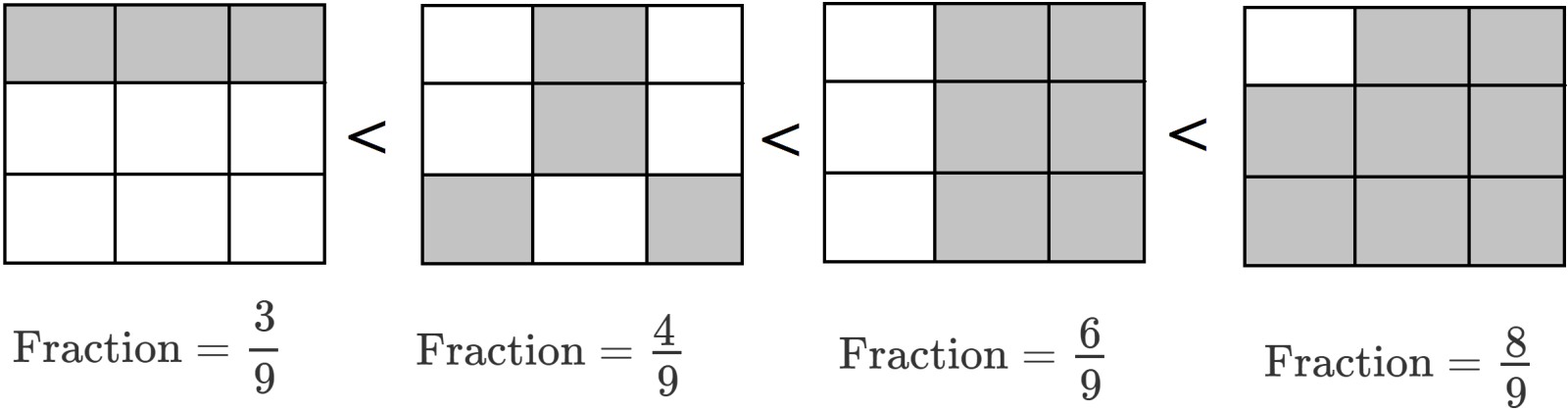
Write each fraction. Arrange them in ascending and descending order using correct sign '<', '=', '>' between the fractions:

AnswerAscending order:
Descending order:
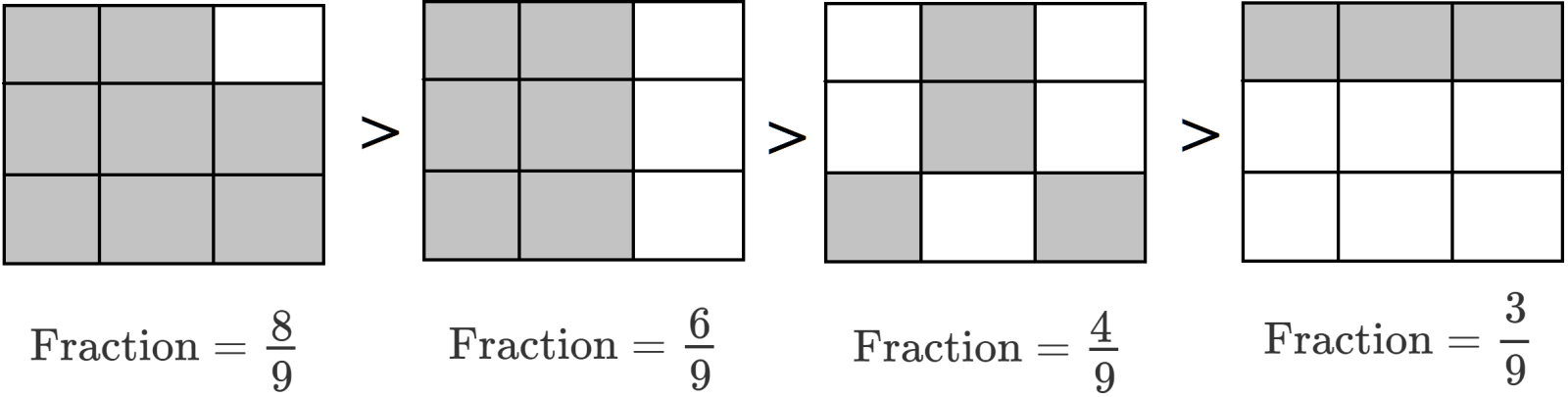
View full question & answer→Question 562 Marks
Solve:
$\frac{16}{7}-\frac{5}{7}+\frac{9}{7}$
AnswerThe given fractions are:
$\frac{16}{7}-\frac{5}{7}+\frac{9}{7}$
$=\frac{16-5+9}{7}$
$=\frac{20}{7}$
Hence the answer is $\frac{20}{7}$
View full question & answer→Question 572 Marks
Write each fraction. Arrange them in ascending and descending order using correct sign '<', '=', '>' between the fractions:

AnswerAscending order:

Descending order:

View full question & answer→Question 582 Marks
Check whether the given fractions are equivalent:$\frac{2}{7},\frac{16}{42}$
Answer$\frac{2}{7}\times\frac{8}{8}=\frac{16}{56}$
Hence, the given fraction are not equivalent.
View full question & answer→Question 592 Marks
Solve:
$\frac{4}{13}+\frac{2}{13}+\frac{1}{13}$
AnswerThe given fractions are:
$\frac{4}{13}+\frac{2}{13}+\frac{1}{13}$
$=\frac{4+2+1}{13}$
$=\frac{7}{13}$
Hence the answer is $\frac{7}{13}$
View full question & answer→Question 602 Marks
The following fractions represent just three different numbers. Separate them in to three groups of equal fractions by changing to its simplest form:
$\frac{12}{75}$
Answer$\frac{12}{75}$
HCF of 12 & 75 is 3
Divide both the numerator & denominator by the HCF of 12 & 75
$\frac{12\div3}{75\div3}=\frac{4}{25}$
View full question & answer→Question 612 Marks
Solve:
$2\frac{1}{3}-1\frac{2}{3}+4\frac{1}{3}$
AnswerThe given fractions are:
$2\frac{1}{3}-1\frac{2}{3}+4\frac{1}{3}=\frac{7}{3}-\frac{5}{3}+\frac{13}{3}$
$=\frac{7-5+13}{3}$
$=\frac{15}{3}=5$
Hence the answer is 5
View full question & answer→Question 622 Marks
Reduce $\frac{84}{98}$ to its lowest terms.
Answer$\frac{84}{98}=\frac{84\div2}{98\div2}$
$=\frac{42}{49}$
$=\frac{42\div7}{49\div7}$
$=\frac{6}{7}$
Hence, the lowest term of $\frac{84}{98}$ is $\frac{6}{7}.$
View full question & answer→Question 632 Marks
Find the equivalent fraction of $\frac{3}{5}$, having:Denominator 40
AnswerConsider the denominator = 40
$\frac{3}{5}=\frac{....}{40}$
As 5 × 8 = 40, we will multiply both the numerator & denominator by 8, we have
$\Rightarrow\frac{3}{5}\times\frac{8}{8}=\frac{24}{40}$
View full question & answer→Question 642 Marks
The following fractions represent just three different numbers. Separate them in to three groups of equal fractions by changing to its simplest form:
$\frac{4}{25}$
Answer$\frac{4}{25}$
HCF of 4 & 25 is 1
Divide both the numerator & denominator by the HCF of 4 & 25
$\frac{4\div1}{25\div1}=\frac{4}{25}$
View full question & answer→Question 652 Marks
Find the fraction equivalent of $\frac{35}{42}$, having:Denominator 18
AnswerFirstly, we will reduce $\frac{35}{42}$ into the lowest term.
Now, we will divide both the numerator & denominator by the HCFs of 35 & 42.
$\Rightarrow\frac{35\div7}{42\div7}=\frac{5}{6}$
$\frac{5}{6}=\frac{}{18}$
Consider the denominator $= 18$
As 6 × 3 = 18, we will multiply both the numerator & denominator by 3.
$\Rightarrow\frac{5\ \times\ 3}{6\ \times\ 3}=\frac{15}{18}$
View full question & answer→