Questions

Answer the following question.

🎯

Test yourself on this topic

7 questions · timed · auto-graded

Question 13 Marks
Periscope:
Answer
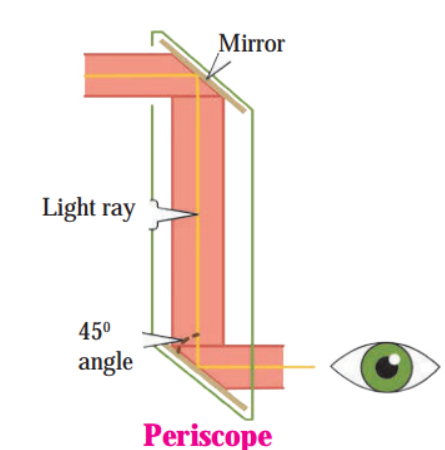
  1. Take a cardboard box. Make slits in the top and bottom sides of the box and place two mirrors so that they make an angle of 45° with the sides of the box and are parallel to each other. Fix them with a sticking tape.
  2. Make two windows of 1 inch each near the two mirrors. Now see through the bottom window.
  3. Make note of what you see.

Image
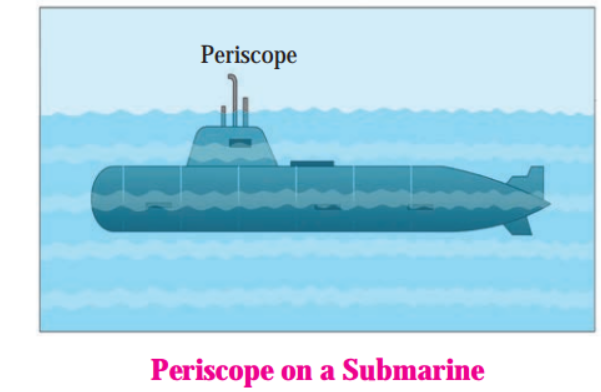
From the bottom window, one can see what is in front of the top window. This device is called a periscope. This is used in submarines to see objects above the surface of water. It is also used to observe and keep a watch on the objects or persons on the ground from an underground bunker. The kaleidoscope and periscope both use the properties of reflection of light.
Image
[Note: In a periscope, the angle of incidence is 45° and the two plane mirrors are parallel to each other. Hence, the emergent ray is parallel to the incident ray.]
View full question & answer
Question 23 Marks
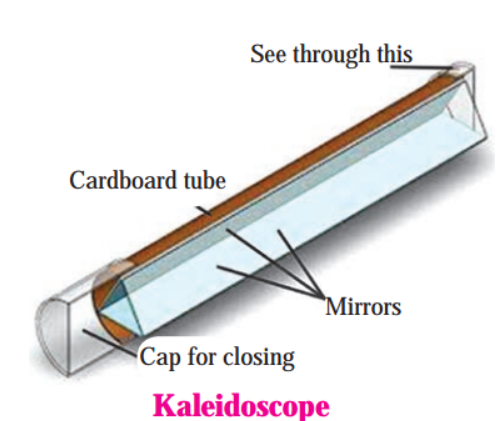
Kaleidoscope:

Image

Answer
  1. Take three rectangular mirrors of the same size.
  2. Using sticking tape, stick the mirrors together making a triangle with the reflecting surface facing inwards (see Fig.).
  3. Take a white paper of triangular shape and fix it with a tape at one end of the mirrors closing that end.
  4. Insert 4 – 5 coloured glass pieces in the hollow of the mirrors.
  5. Close the other end also with a paper and make a hole in it.
  6. Look through the hole towards light. You will see innumerable images of the glass pieces. These are formed due to reflections by the three mirrors.

You can see different designs in the kaleidoscope. The speciality of a kaleidoscope is that the designs do not easily repeat themselves. Every time the design is different. People making wall papers which are used to decorate walls and cloth designers use a kaleidoscope for making new designs.

View full question & answer
Question 33 Marks
Material:
Torch light, mirror, a stand for hanging the mirror, black paper, comb, white paper, drawing board.
Activity :
1. Fit a white paper tightly over a table or drawing board.
2. Leaving out some portion in the middle of the comb, cover the rest with black paper so that light can only pass through the open central portion.
3. Hold the comb perpendicular to the white paper and throw torch light on its central portion.
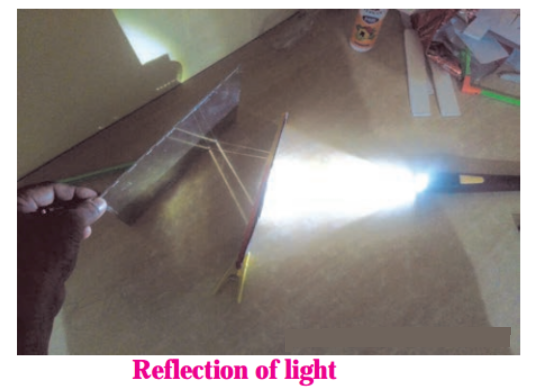
4. Adjust the comb and torch so as to get light rays on the white paper. Now keep a mirror in the path of this ray of light as shown in the figure.
5. What do you observe?

Image

Answer
Light rays which fall on the mirror get reflected and travel in a different direction.
View full question & answer
Question 43 Marks
What did you feel when it was turned on again?
Answer
We could see the objects clearly. From the above activity you can notice that there is some connection between the sense of vision and light. When we switch off the light at night, the objects in the room cannot be seen and they can be seen as before when the light is switched on again. Thus, we can see objects when the light coming from these objects enters our eyes.
View full question & answer
Question 63 Marks
If the angle between the mirror and reflected ray is 23°, what is the angle of incidence of the incident ray?
Answer
The angle between the mirror and the reflected ray is 23°. Therefore, the angle of reflection (r) = the angle made by the reflected ray with the normal to the plane mirror = 90° – 23° = 67°.
∴ The angle of incidence, i = r = 67°.
View full question & answer
Question 73 Marks
If the angle between the plane mirror and the incident ray is 40°, what are the angles of incidence and reflection?
Answer
The angle between the plane mirror and the incident ray is 40°. Therefore, the angle of incidence (i) = the angle made by the incident ray with the normal to the plane mirror = 90° – 40° = 50°. The angle of reflection, r – i – 50°.
View full question & answer
Answer the following question. - Science STD 8 Questions - Vidyadip