Questions

4 Mark Question

Take a timed test

15 questions · self-marked practice — reveal the answer and mark yourself.

Question 14 Marks
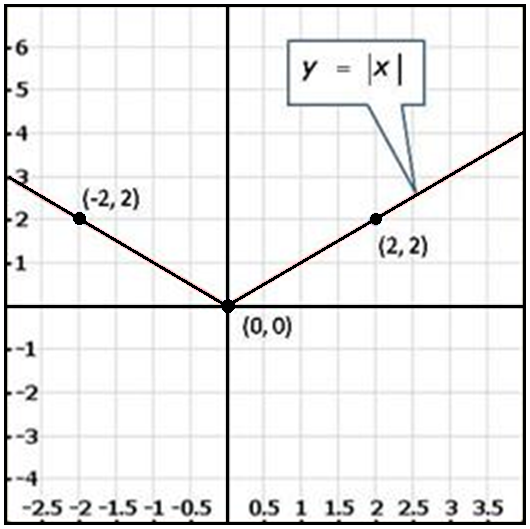
Draw the graph of y = |x|.
Answer
We have,
y = |X| ...(i)
Putting x = 0, we get y = 0
Putting x = 2, we get y = 2
Putting x = -2, we get y = 2
Thus, we have the following table for the points on graph of |x|.
x
0
2
-2
y
0
2
2
The graph of the equation y = |x|:

View full question & answer
Question 24 Marks
Draw the graph of the following linear equations in two variables:
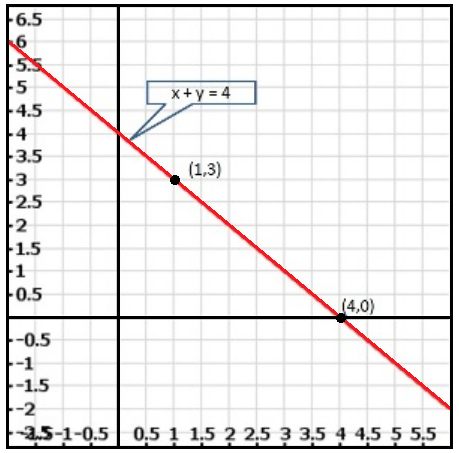
x + y = 4
Answer
We have,
x + y = 4
⇒ x = 4 - y ...(i)
Putting y = 0, we get x = 4 - 0 = 4
Putting y = 3, we get x = 4 - 3 = 1
Thus, we have the following table giving two points on the line represented by the equation x + y = 4:
Graph of the equation x + y = 4:
View full question & answer
Question 34 Marks
Draw the graph of the following linear equations in two variables:
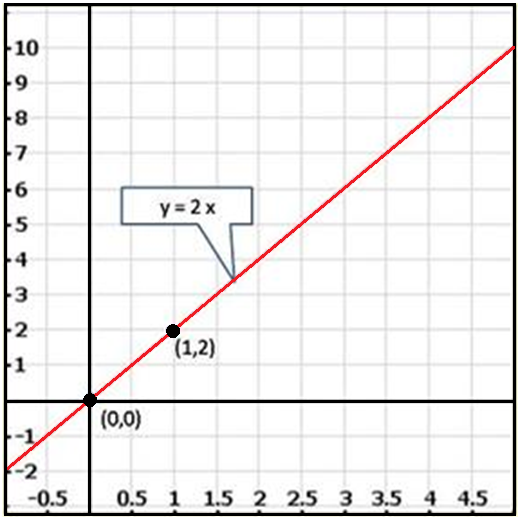
y = 2x
Answer
We have,
y = 2x ...(i)
Putting x = 0, we get y = 2 × 0 = 0
Putting x = 1, we get y = 2 × 1 = 2
Thus, we have the following table giving two points on the line represented by the equation y = 2x:
Graph of the equation y = 2x:
View full question & answer
Question 44 Marks
Draw the graph of the equations given below. Also, find the coordinates of the points where the graph cuts the coordinate axes:
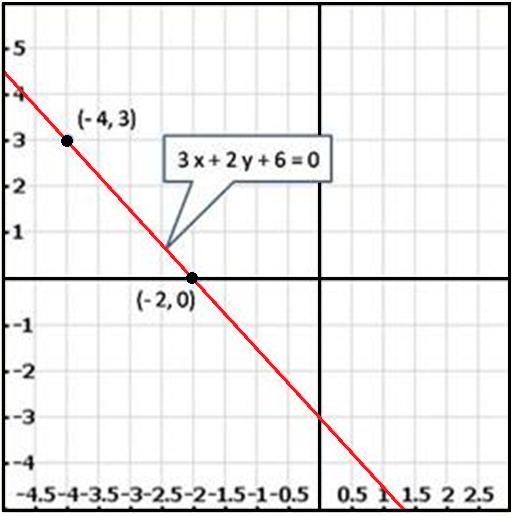
3x + 2y + 6 = 0
Answer
we have, 3x + 2y + 6 = 0 ⇒ 2y = -6 - 3x$\Rightarrow\text{y}=\frac{-6-3\text{x}}{2}\ ...(\text{i})$
Putting x = -2 in (i), we get $\text{y}=\frac{6-3(-2)}{2}=0$ Putting x = -4 in (i), we get $\text{y}=\frac{-6-3(-4)}{2}=3$ Thus, we obtain the following table giving coordinates of two points on the line represented by the equation 3x + 2y + 6 = 0. The graph of line 3x + 2y + 6 = 0: Clearly, the line intersect with the coordinate axes (-2, 0) and (0, -3).
View full question & answer
Question 54 Marks
Draw the graph of the equations given below. Also, find the coordinates of the points where the graph cuts the coordinate axes:
6x - 3y = 12
Answer
We have,
6x - 3y = 12
⇒ 3(2x - y) = 12
⇒ 2x - y = 4
⇒ 2x - 4 = y
⇒ y = 2x - 4 ...(i)
Putting x = 0 in (i), we get y = -4
Putting x = 2 in (i), we get y = 0
Thus, we obtain the following table giving coordinates of two points on the line represented by the equation 6x - 3y = 12
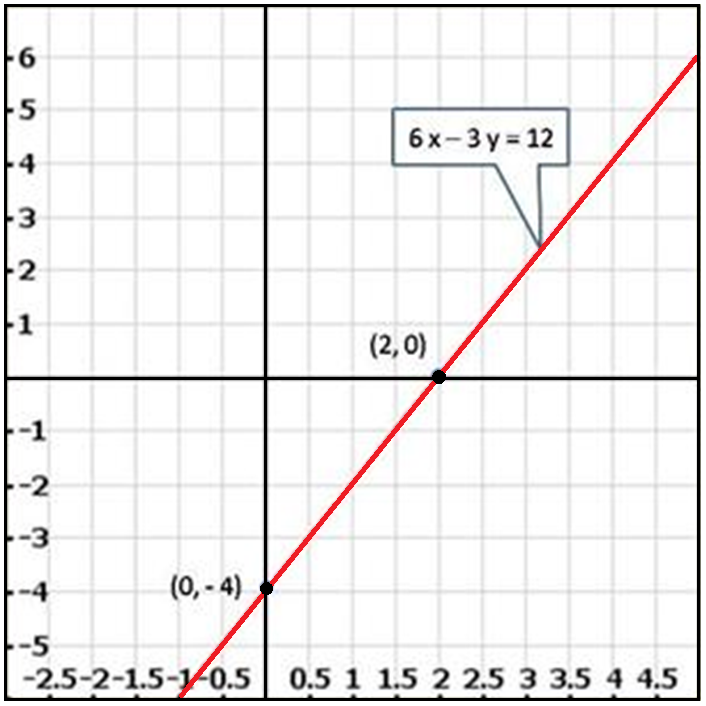
The graph of line 6x - 3y = 12:

Clearly, the line intersect with the coordinate axes (2, 0) and (0, -4).
View full question & answer
Question 64 Marks
Draw the graph of the following linear equations in two variables:
2y = -x + 1
Answer
We have, 2y = -x + 1⇒ x = 1 - 2y ...(i)
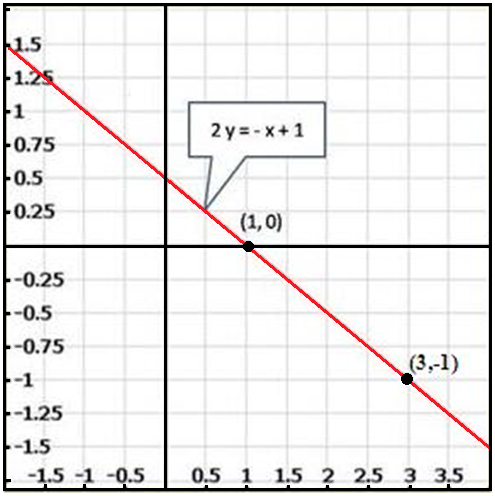
Putting y = 0, we get x = 1 - 2 × 0 = 1 Putting y = -1 we get x = 1 - 2(-1) = 3 Thus, we have the following table giving two points on the line represented by the equation 2y = -x + 1: Graph of the equation 2y = -x + 1:
View full question & answer
Question 74 Marks
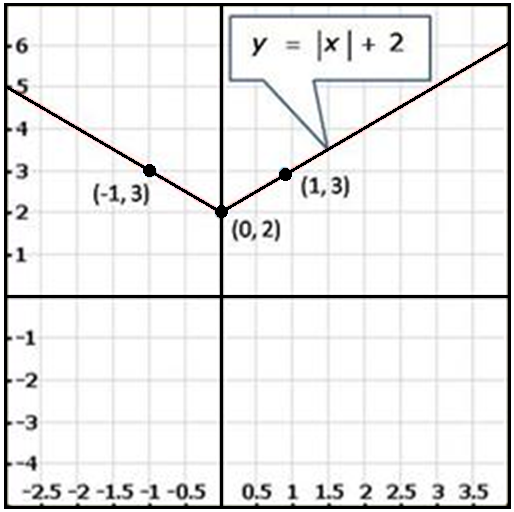
Draw the graph of y = |x| + 2.
Answer
We have,
y = |x| + 2 ...(i)
Putting x = 0, we get y = 2
Putting x = 1, we get y = 3
Putting x = -1, we get y = 3
Thus, we have the following table for the points on graph of |x| + 2:
x
0
1
-1
y
2
3
3
The graph of the equation y = |x| + 2:

View full question & answer
Question 84 Marks
Draw the graph of the following linear equations in two variables:
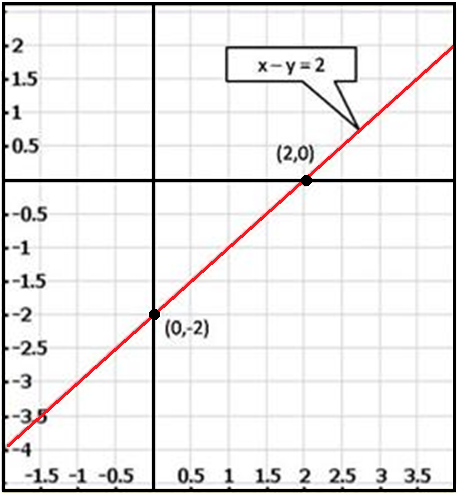
x - y = 2
Answer
We have,
x - y = 2
⇒ x = 2 + y ...(i)
Putting y = 0, we get x = 2 + 0 = 2
Putting y = -2, we get x = 2 - 2 = 0
Thus, we have the following table giving two points on the line represented by the equation x - y = 2:
Graph of the equation x - y = 2:
View full question & answer
Question 94 Marks
Draw the graph of the following linear equations in two variables:$\frac{\text{x}-2}{3}=\text{y}-3$
Answer
We have,$\frac{\text{x}-2}{3}=\text{y}-3$
⇒ x - 2 = 3(y - 3)
⇒ x - 2 = 3y - 9
⇒ x = 3y - 9 + 2
⇒ x = 3y - 7 ...(i)
Putting y = 2, we get x = 3(2) - 7 = -1 Putting y = 3, we get x = 3(3) - 7 = 2 Thus, we have the following table giving two points on the line represented by the equation $\frac{\text{x}-2}{3}=\text{y}-3:$ Graph of the equation $\frac{\text{x}-2}{3}=\text{y}-3:$
View full question & answer
Question 104 Marks
Draw the graph of the following linear equations in two variables:
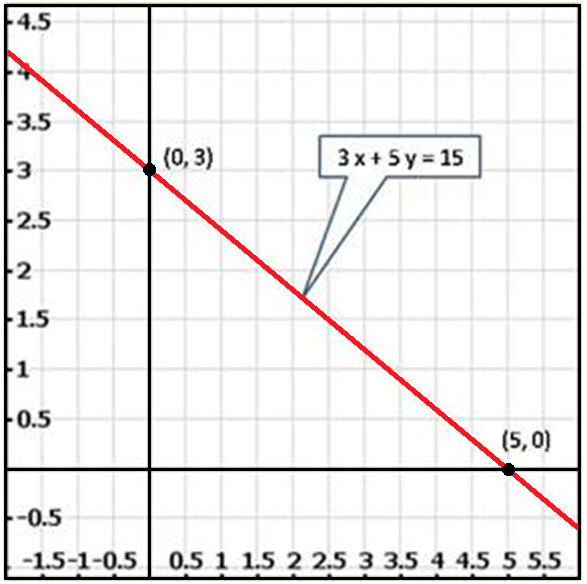
3x + 5y = 15
Answer
We have, 3x + 5y = 15 ⇒ 3x = 15 - 5y$\Rightarrow\text{x}=\frac{15-5\text{y}}{3}\ ...\text{(i)}$
Putting y = 0, we get $\text{x}=\frac{15-5\times0}{3}=5$ Putting y = 3, we get $\text{x}=\frac{15-5\times3}{3}=0$ Thus, we have the following table giving two points on the line represented by the equation 3x + 5y = 15:
View full question & answer
Question 114 Marks
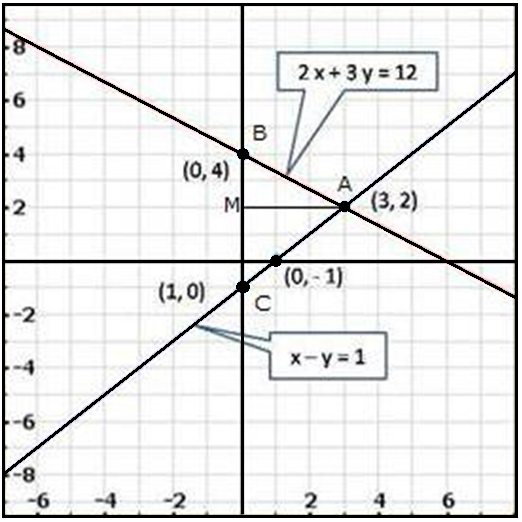
Draw the graphs of the following linear equations on the same graph paper:
2x + 3y = 12, x - y = 1
Find the coordinates of the vertices of the triangle formed by the two straight lines and the y-axis. Also, find the area of the triangle.
Answer
Graph of the equation 2x + 3y = 12:

We have,

2x + 3y = 12

⇒ 2x = 12 - 3y

$\Rightarrow\text{x}=\frac{12-3\text{y}}{2}\ ...\text{(i)}$

Putting y = 4, we get $\text{x}=\frac{12-3\times4}{2}=0$

Putting y = 2, we get $\text{x}=\frac{12-3\times2}{2}=3$

Thus, we have the following table for the points on the line 2x + 3y = 12:
x 0 3
y 4 2
Ploting points A(0, 4), B(3, 2) on the graph paper and drawing a line passing through them, we obtain graph of the equation 2x + 3y = 12.

Graph of the equation x - y = 1:

We have,

x - y = 1

⇒ x = 1 + y

Putting y = 0, we get x = 1 + 0 = 1

Putting y = -1, we get x = 1 - 1 = 0

Thus, we have the following table for the points on the line x - y = 1:
x 1 0
y 0 -1
Ploting points C(1, 0) and D(0, -1) on the same graph paper and drawing a line passing through them, we obtain the graph of the line represented by the equation x - y = 1.


Clearly, two lines intersect at A(3, 2).

The graph of line 2x + 3y = 12 intersect with y-axis at B(0, 4) and the graph of the line x - y = 1 intersect with y-axis at C(0, -1).

So, the vertices of the triangle formed by the two straight lines and y-axis are A(3, 2), B(0, 4) and C(0, -1).

Now,

$\text{Area of }\triangle\text{ABC}=\frac{1}{2}(\text{Base}\times\text{Height})$

$=\frac{1}{2}(\text{BC}\times\text{AM})$

$=\frac{1}{2}(5\times3)$

$=\frac{15}{2}\text{sq.units.}$
View full question & answer
Question 124 Marks
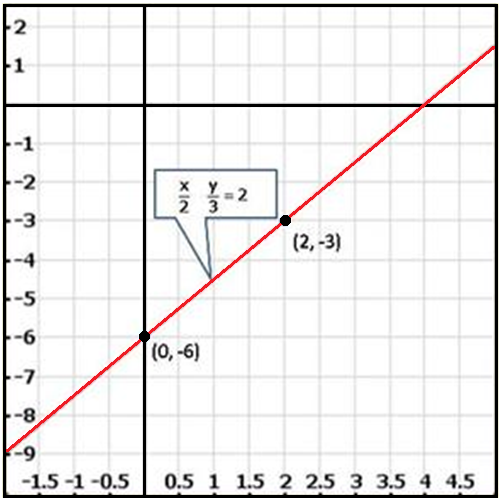
Draw the graph of the following linear equations in two variables:$\frac{\text{x}}{2}-\frac{\text{y}}{3}=2$
Answer
We have,$\frac{\text{x}}{2}-\frac{\text{y}}{3}=2$
$\Rightarrow\frac{3\text{x}-2\text{y}}{6}=2$
$\Rightarrow3\text{x}-2\text{y}=12$
$\Rightarrow3\text{x}=12+2\text{y}$
$\Rightarrow\text{x}=\frac{12+2\text{y}}{3}$
Putting y = -6, we get $\text{x}=\frac{12+2(-6)}{3}=0$ Putting y = -3, we get $\text{x}=\frac{12+2(-3)}{3}=2$ Thus, we have the following table giving two points on the line represented by the equation $\frac{\text{x}}{2}-\frac{\text{y}}{3}=2:$ Graph of the equation $\frac{\text{x}}{2}-\frac{\text{y}}{3}=2:$
View full question & answer
Question 134 Marks
Draw the graph of the equations given below. Also, find the coordinates of the points where the graph cuts the coordinate axes:
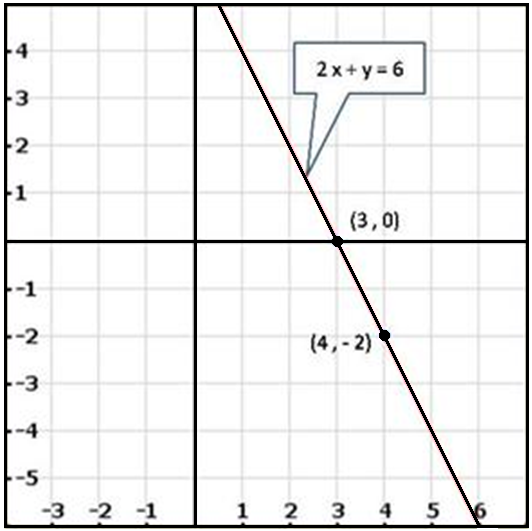
2x + y = 6
Answer
we have,
2x + y = 6
⇒ y = 6 - 2x ...(i)
Putting x = 3 in (i), we get y = 6 - 2 × 3 = 0
Putting x = 4 in (i), we get y = 6 - 2 × 4 = -2
Thus, we obtain the following table giving coordinates of two points on the line represented by the equation 2x + y = 6.
The graph of line 2x + y = 6:

Clearly, the line intersect with the coordinate axes (3, 0) and (0, 6).
View full question & answer
Question 144 Marks
Draw the graph of the following linear equations in two variables:
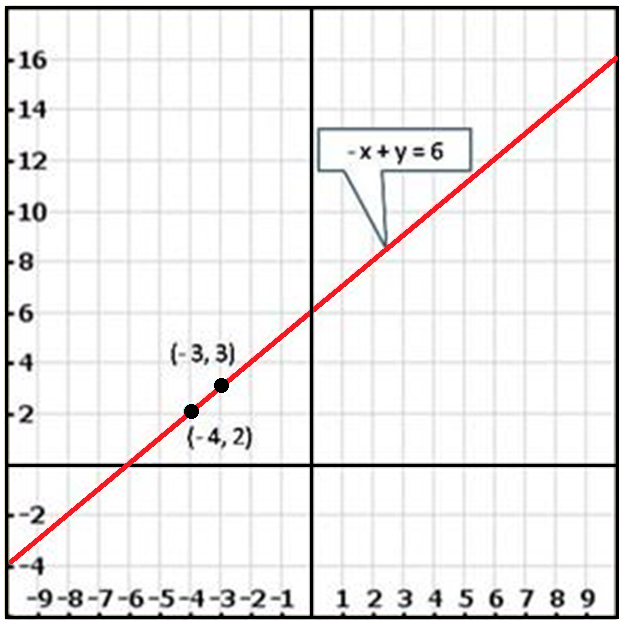
-x + y = 6
Answer
We have,
-x + y = 6
⇒ y = 6 + x ...(i)
Putting x = -4, we get y = 6 - 4 = 2
Putting x = -3, we get y = 6 - 3 = 3
Thus, we have the following table giving two points on the line represented by the equation -x + y = 6:
Graph of the equation -x + y = 6:
View full question & answer
Question 154 Marks
Draw the graph of the equations given below. Also, find the coordinates of the points where the graph cuts the coordinate axes:
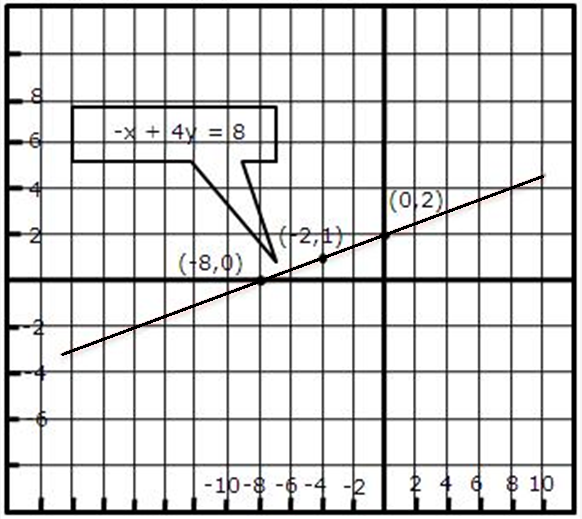
-x + 4y = 8
Answer
we have,
-x + 4y = 8
⇒ 4y - 8 = x
⇒ x = 4y - 8 ...(i)
Putting y = 1 in (i), we get x = 4 × 1 - 8 = -4
Putting y = 2 in (i), we get x = 4 × 2 - 8 = 0
Thus, we obtain the following table giving coordinates of two points on the line represented by the equation -x + 4y = 8.
The graph of line -x + 4y = 8:

Clearly, the line intersect with the coordinate axes (-8, 0) and (0, 2).
View full question & answer