Questions

3 Mark Question

Take a timed test

15 questions · self-marked practice — reveal the answer and mark yourself.

Question 13 Marks
In a parallelogram ABCD, $\angle \text{D}=135^\circ$. Determine the measures of $\angle\text{A}$ and $\angle\text{B}$.
Answer
In a parallelogram ABCD Adjacent angles are supplementary So, $\angle\text{D}+\angle\text{C}=180^\circ$$\angle\text{C}=180^\circ-135^\circ$
$\angle\text{C}=45^\circ$
In a parallelogram opposite sides are equal.$\angle\text{A}=\angle\text{C}=45^\circ$
$\angle\text{B}=\angle\text{D}=135^\circ$
View full question & answer
Question 23 Marks
If the angles of a quadrilateral are in the ratio 3 : 5 : 9 : 13, then find the measure of the smallest angle.
Answer
We have, $\angle\text{A}:\angle\text{B}:\angle\text{C}:\angle\text{D}=3:5:9:13.$ So, let $\angle\text{A}=3\text{x},$$\angle\text{B}=5\text{x},$
$\angle\text{C}=9\text{x},$
and $\angle\text{D}=13\text{x},$ By angle sum property of a quadrilateral, we get:$\angle\text{A}+\angle\text{B}+\angle\text{C}+\angle\text{D}=360$
3x + 5x + 9x + 13x = 360 30x = 360$\text{x}=\frac{360}{3}$
x = 12 smallest angle is:$\angle\text{A}=3\text{x},$
$\angle\text{A}=3(12^\circ)$
$\angle\text{A}=36^\circ$
Hence, the smallest angle measures 36º.
View full question & answer
Question 33 Marks
Find the measure of all the angles of a parallelogram, if one angle is 24° less than twice the smallest angle.
Answer
x + 2x - 24 = 180° ⇒ 3x - 24 = 180° ⇒ 3x = 108° + 24° ⇒ 3x = 204°$\Rightarrow\text{x}=\frac{204}{3}=68^\circ$
⇒ x = 68° ⇒ 2x - 24° = 2 × 68° - 24° = 112° Hence, four angles are 68°, 112°, 68°, 112°.
View full question & answer
Question 43 Marks
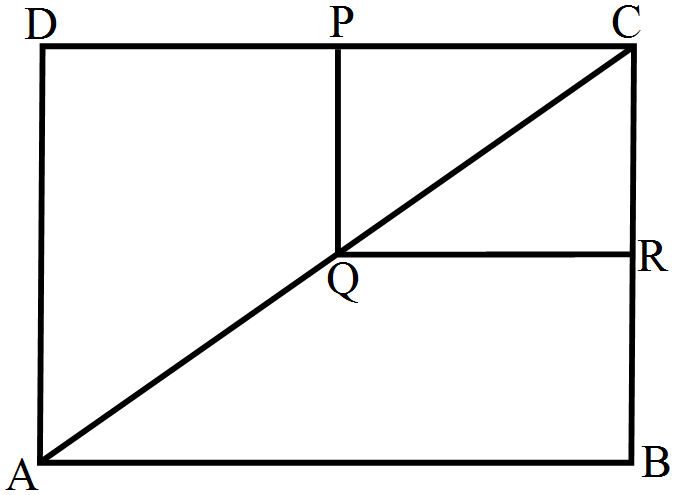
In figure, ABCD and PQRC are rectangles and Q is the mid-point of AC. Prove that
  1. DP = PC
  2. $\text{PR}=\Big(\frac{1}{2}\Big)\text{AC}$
Answer
  1. In$\triangle\text{ADC},$ Q is the mid-point of AC such that PQ∥AD
Therefore, P is the mid-point of DC.

⇒ DP = DC [Using mid-point theorem]
  1. Similarly, R is the mid-point of BC
$\therefore\text{PQ}=\Big(\frac{1}{2}\Big)\text{BD}$

$\text{PR}=\Big(\frac{1}{2}\Big)\text{AC}$ [Diagonal of rectangle are equal, BD = AC]
View full question & answer
Question 53 Marks
Three angles of a quadrilateral are respectively equal to 110°, 50° and 40°. Find its fourth angle.
Answer
Given,
Three angles are 110°, 50° and 40°
Let the fourth angle be 'x'
We have,
Sum of all angles of a quadrilateral = 360°
110° + 50° + 40° = 360°
⇒ x = 360° - 200°
⇒ x = 160°
Therefore, the required fourth angle is 160°.
View full question & answer
Question 63 Marks
The angles of a quadrilateral are in the ratio 3 : 5 : 9 : 13. Find all the angles of the quadrilateral.
Answer
Let the common ratio between the angles is 't'
So the angles will be 3t, 5t, 9t and 13t respectively.
Since the sum of all interior angles of a quadrilateral is 360°
Therefore, 3t + 5t + 9t + 13t = 360°
⇒ 30t = 360°
⇒ t = 12°
Hence, the angles are
3t = 3 × 12 = 36°
5t = 5 × 12 = 60°
9t = 9 × 12 = 108°
13t = 13 × 12 = 156°
View full question & answer
Question 73 Marks
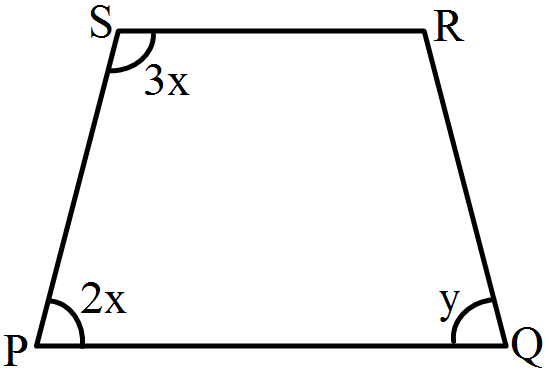
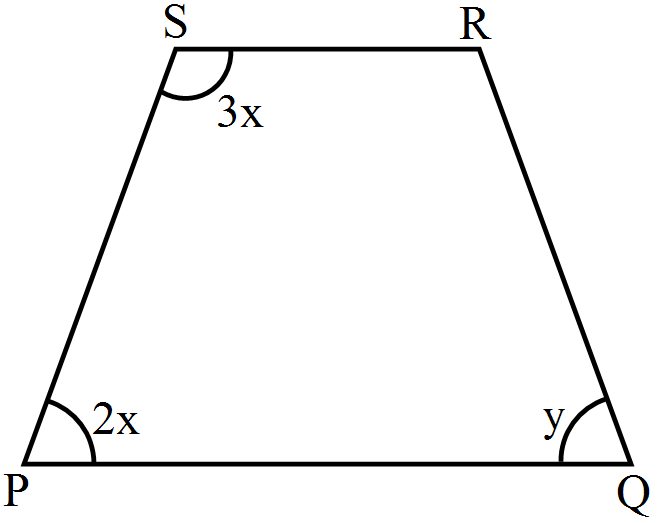
In the given figure, PQRS is an isosceles trapezium. Find x and y.
Answer
Trapezium is given as follows: We know that PQRS is a trapezium with SR || PQ Therefore,$\angle\text{P}+\angle\text{S}=180^\circ$
$2\text{x}+3\text{x}=108^\circ$
$5\text{x}=180^\circ$
$\text{x}=\frac{180^\circ}{5}$
$\text{x}=36^\circ$
Hence, the required value for x is 36º.
View full question & answer
Question 83 Marks
The perimeter of a parallelogram is 22cm. If the longer side measures 6.5cm, what is the measure of shorter side?
Answer
Let the shorter side of the parallelogram be x cm.
The longer side is given as 6.5cm.
Perimeter of the parallelogram is given as 22cm
Therefore,
2[x + 6.5] = 22
x + 6.5 = 11
x = 11 - 65
x = 4.5
Hence, the measure of the shorter side is 4.5cm.
View full question & answer
Question 93 Marks
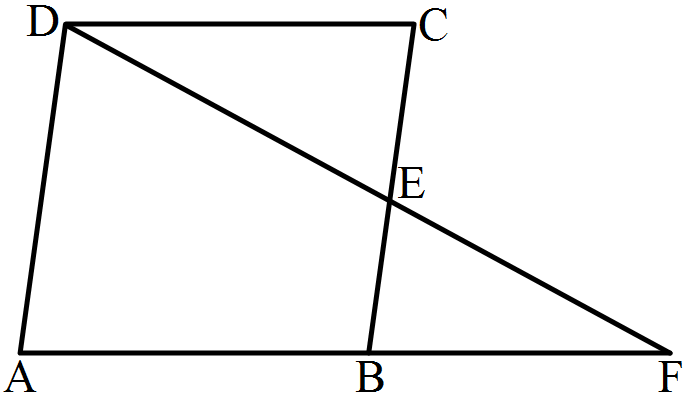
In figure, ABCD is a parallelogram and E is the mid-point of side BC. If DE and AB when produced meet at F, prove that AF = 2AB.
Answer
In $\triangle\text{BEF}$ and $\triangle\text{CED}$$\angle\text{BEF}=\angle\text{CED}$ [Verified opposite angle]
BE = CE [Since, E is the mid-point of BC]$\angle\text{EBF}=\angle\text{ECD}$ [Since, Alternate interior angles are equal]
$\therefore\triangle\text{BEF}\cong\triangle\text{CED}$ [ASA congruence]
$\therefore\text{BF}=\text{CD}\ [\text{CPCT}]$
AF = AB + AF AF = AB + AB AF = 2AB. Hence proved.
View full question & answer
Question 103 Marks
ABCD is a parallelogram in which $\angle\text{A}=70^\circ$ Compute $\angle\text{B},\angle\text{C}$ and $\angle\text{D}$.
Answer
In a parallelogram ABCD$\angle\text{A}=70^\circ$
$\angle\text{A}+\angle\text{B}=180^\circ$ [Since, adjacent angles are supplementary]
$70^\circ+\angle\text{B}=180^\circ$ $[\because\angle\text{A}=70^\circ]$
$\angle\text{B}=1800-70^\circ$
$\angle\text{B}=110^\circ$
In a parallelogram opposite sides are equal.$\angle\text{A}=\angle\text{C}=70^\circ$
$\angle\text{B}=\angle\text{D}=110^\circ$
View full question & answer
Question 113 Marks
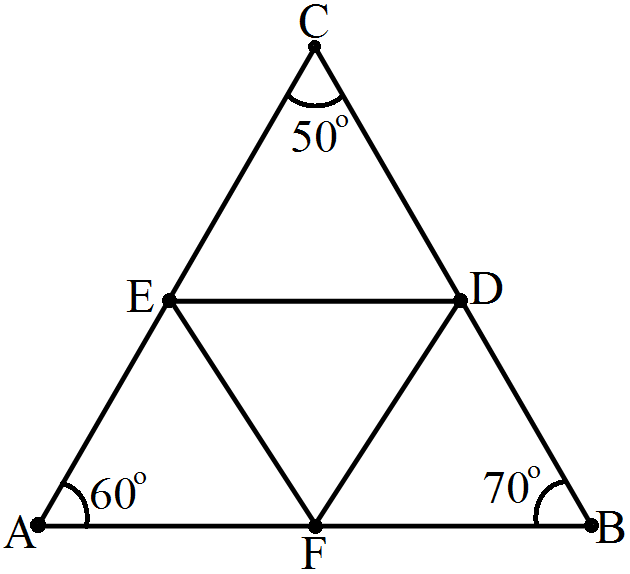
In a triangle $\angle\text{ABC},$ $\angle\text{A}=50^\circ,$ $\angle\text{B}=60^\circ$ andFind the measures of the angles of the triangle formed by joining the mid-points of the sides of this triangle.
Answer
In $\triangle\text{ABC},$ D and E are mid points of AB and BC. By Mid point theorem,$\text{DE}||\text{AC},\ \text{DE}=\frac{1}{2}\text{AC}$
F is the midpoint of AC Then, $\text{DE}=\Big(\frac{1}{2}\Big)\text{AC}=\text{CF}$ In a Quadrilateral DECF$\text{DE}||\text{AC},\ \text{DE}=\text{CF}$
Hence DECF is a parallelogram.$\therefore\angle\text{C}=\angle\text{D}=70^\circ$ [Opposite sides of a parallelogram]
Similarly BEFD is a parallelogram, $\angle\text{B}=\angle\text{F}=60^\circ$ ADEF is a parallelogram, $\angle\text{A}=\angle\text{E}=50^\circ$$\therefore$ Angles of $\triangle\text{DEP}$ are:
$\angle\text{D}=70^\circ,\angle\text{E}=50^\circ,\angle\text{F}=60^\circ$
View full question & answer
Question 123 Marks
In a quadrilateral ABCD, the angles A, B, C and D are in the ratio of  $1 : 2 : 4 : 5.$ Find the measure of each angles of the quadrilateral.
Answer
Let the angles of the quadrilaterals be $A = x, B = 2x, C = 4x$ and $D = 5x$
Then, $A + B + C + D$
$= 360^\circ \Rightarrow x + 2x + 4x + 5x$
$= 360^\circ \Rightarrow 12x = 360^\circ$
$\Rightarrow\text{x} = \frac{360^\circ}{12}$
$\Rightarrow x = 30^\circ$​​​​​​​
Therefore, $A = x = 30^\circ B = 2x = 60^\circ C = 4x = 120^\circ D = 5x = 150^\circ$
View full question & answer
Question 133 Marks
The perimeter of a parallelogram is 22cm.If the longer side measures 6.5cm what is the measure of the shorter side?
Answer
Let the shorter side be 'x'.
Therefore, perimeter = x + 6.5 + 6.5 + x [Sum of all sides]
22 = 2(x + 6.5)
11 = x + 6.5
⇒ x = 11 - 6.5 = 4.5cm
Therefore, shorter side = 4.5cm
View full question & answer
Question 143 Marks
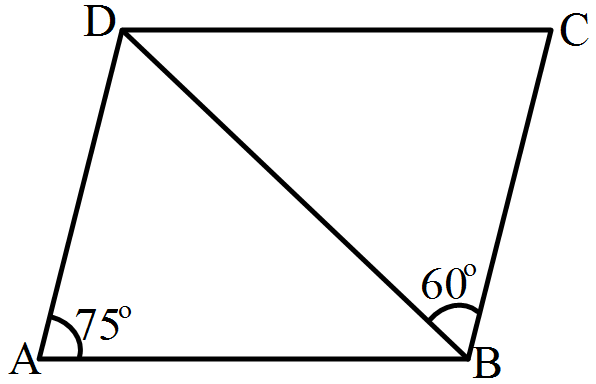
In figure, ABCD is a parallelogram in which $\angle\text{DAB}=75^\circ$ and $\angle\text{DBC}=60^\circ$. Compute $\angle\text{CDB},$ and $\angle\text{ADB}$.
Answer
To find $\angle\text{CDB}$ and $\angle\text{ADB}$$\angle\text{CBD}=\angle\text{ABD}=60^\circ$ [Alternate interior angle. AD∥ BC and BD is the transversal]
in $\angle\text{BDC}$$\angle\text{CBD}+\angle\text{C}+\angle\text{CDB}=180^\circ$ [Angle sum property]
$\Rightarrow60^\circ+75^\circ+\angle\text{CDB}=180^\circ$
$\Rightarrow\angle=180^\circ-(60^\circ+75^\circ)$
$\Rightarrow\angle\text{CDB}=45^\circ$
Hence, $\angle\text{CDB}=45^\circ,\angle\text{ADB}=60^\circ$
View full question & answer
Question 153 Marks
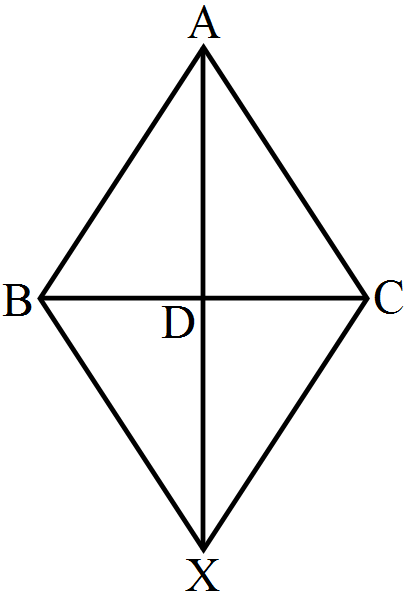
In a $\triangle\text{ABC}$ median AD is produced to x such that AD = DX. Prove that ABXC is a parallelogram.
Answer

In a quadrilateral ABXC, we have
AD = DX [Given]
BD = DC [Given]
So, diagonals AX and BC bisect each other.
Therefore, ABXC is a parallelogram.
View full question & answer
3 Mark Question - Maths STD 9 Questions - Vidyadip