Question types

Laws of Motion question types

142 questions across 14 question groups — pick any mix to generate a Science paper with step-by-step answer keys.

142
Questions
14
Question groups
5
Question types
Sample Questions

Laws of Motion questions

One sample from each question group in this chapter. Select any group above to see the full set with answer keys.

A bullet having a mass of 10 g and moving with a speed of 1.5 m/s, penetrates a thick wooden plank of mass 90 g. The plank was initially at rest. The bullet gets embedded in the plank and both move together. Determine their velocity. (Ans: 0.15 m/s)
View full solution

Image
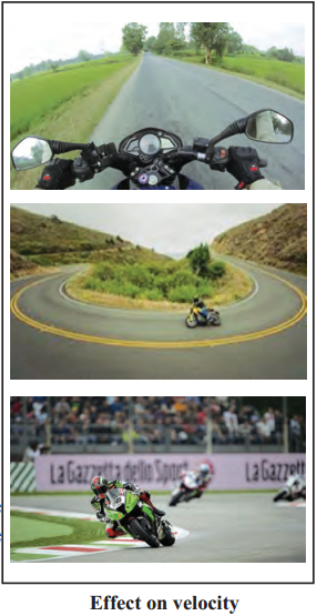
Question 1. What will be the effect on the velocity of the motorcycle if its speed increases or decreases, but its direction remains unchanged?
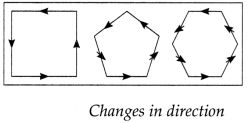
Question 2. In case of a turning on the road, will the velocity and speed be same?
Question 3. If, on a turning, we change the direction as well as the speed of the motorcycle, what will be the effect on its velocity?
View full solution
constant velocity. If that velocity is zero, then the object remains at rest. If an external force is applied, the velocity will change because of the force. The second law explains how the velocity of an object changes when it is subjected to an external force. The law defines a force to be equal to changes in momentum (mass times velocity) per change in time. Newton also developed the calculus of mathematics, and the “changes” “expressed in j the second law are most accurately defined in differential forms. (Calculus can also be used to determine the velocity and location variations experienced by an object subjected to an external force.) For an object with a constant mass the second law states that the force F is the product of an objects mass and its acceleration a:
F = m * a
For an external applied force the change in velocity depends on the mass of the object.

A force will cause in velocity; and likewise, a change in velocity will generate a force. The equation works both ways.
The third law states that for every action (force) in nature there is an equal and opposite reaction. In other words, if object A exerts a force on object B, then object B also exerts an equal force on object: A. Notice that the forces are exerted on different objects. The third law can be used to explain the generation of lift by a wing and the production of thrust by a jet engine


(i) A chalk kept on the table remains in the position of rest until moved by the teacher. Which law of motion is followed in this situation?
(ii) What will happen to momentum if the mass and acceleration both are doubled?
(iii) What will happen to momentum if the mass and acceleration both are halved?
(iv) A moving stone filled truck collides with a moving car coming from opposite direction. Why is it observed that only the car is pushed backward?
(v) What will happen to the force if the jet engines do not produce enough thrust to push the aeroplane in mid-air?
View full solution
(a) When a bat strikes a ball, the ball exerts an equal and opposite force on the bat. The force : acting on the ball projects it with high velocity, Due to the large mass of bat compared to ball, reaction force on the bat slows down the bat’s motion.
(b) When a bullet is fired from a gun, the gun exerts a force on the bullet in the forward direction. This is the action force. The bullet also exerts an equal force on the gun in the backward direction. This is the reaction force. Due to the large mass of the gun, it j moves only a little distance backward. This backward movement of the gun is called the recoil of the gun.
(c) In a rocket, burning fuel creates a push on the front of the rocket pushing it forward. This creates an equal and opposite push on the exhaust gas backwards.

(i) Which of Newton’s law examples are given here?
(ii) When a rifle is fired it is pushed back this movement is called what?
(iii) What does the ball acquire after it gets velocity?
(iv) State newton’s 1st law of motion.
(v) Which force is required to produce motion in an object?
View full solution
balls have masses of 50 gm and 100 gm and they are moving along the same line in the same direction with velocities of 3 m/s and 1.5 m/s respectively. They collide with each other and after the collision, the first ball moves with a velocity of 2.5 m/s. Calculate the velocity of the other ball after collision.
View full solution

Generate a Laws of Motion paper free

Pick question groups from the list above, set marks and difficulty, and export a branded PDF with step-by-step answer keys. First 3 chapters free — no signup.

Download App