Question 14 Marks
Prove that the line joining the mid-point of a chord to the centre of the circle passes through the mid-point of the corresponding minor arc.
Answer
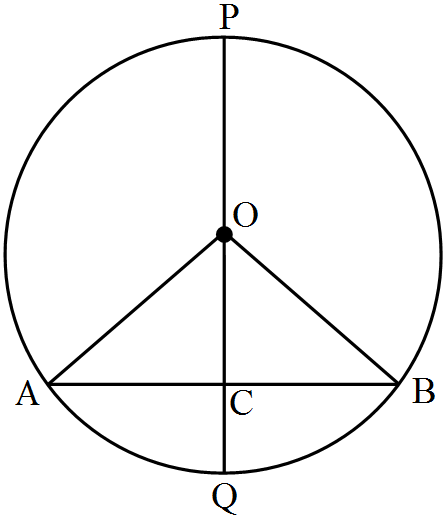
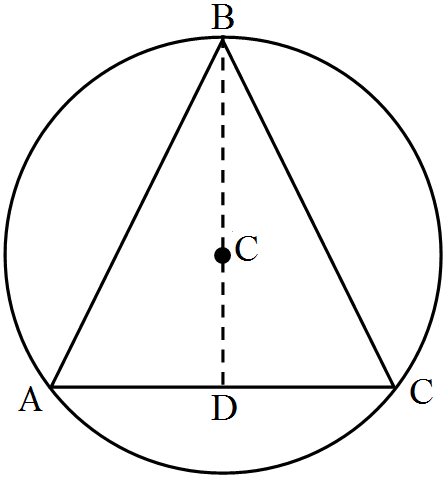
View full question & answer→Given: 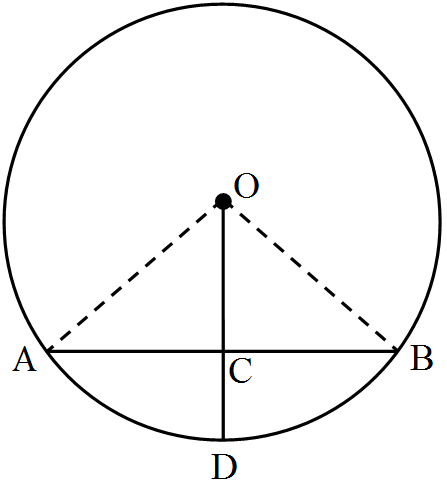 C is the mid-point of chord AB. To prove: D is the mid-point of arc AB. Proof: In $\triangle\text{OAC}$ and $\triangle\text{OBC}$ OA = OB [Radius of circle] OC = OC [Common] AC = BC [C is the mid-point of AB] Then $\triangle\text{OAC}\cong\triangle\text{OBC}$ [By SSS condition]$\therefore\angle\text{AOC}=\angle\text{BOC}$
$\Rightarrow\text{m}\overline{\text{A}}\text{D}\cong\text{m}\overline{\text{B}}\text{D}$
$\Rightarrow\overline{\text{A}}\text{D}\cong\overline{\text{B}}\text{D}$
Hence, D is the mid-point of arc AB.
C is the mid-point of chord AB. To prove: D is the mid-point of arc AB. Proof: In $\triangle\text{OAC}$ and $\triangle\text{OBC}$ OA = OB [Radius of circle] OC = OC [Common] AC = BC [C is the mid-point of AB] Then $\triangle\text{OAC}\cong\triangle\text{OBC}$ [By SSS condition]$\therefore\angle\text{AOC}=\angle\text{BOC}$$\Rightarrow\text{m}\overline{\text{A}}\text{D}\cong\text{m}\overline{\text{B}}\text{D}$
$\Rightarrow\overline{\text{A}}\text{D}\cong\overline{\text{B}}\text{D}$
Hence, D is the mid-point of arc AB.
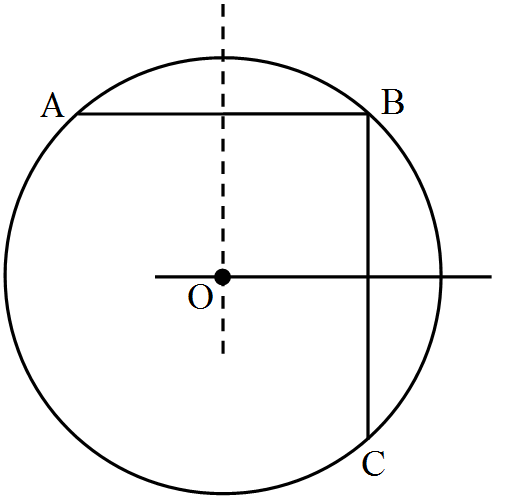 Steps of Construction:
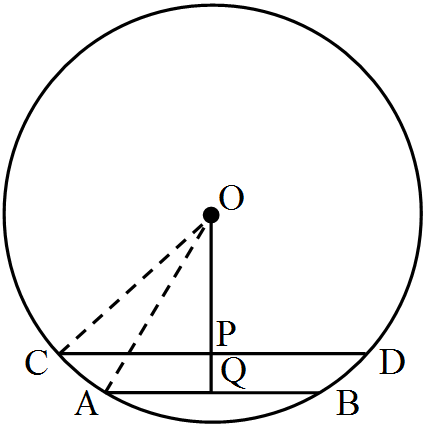 Draw $\text{OP}\perp\text{AB}$ and $\text{OQ}\perp\text{CD}$ as well as point O, Q and P are collinear. Clearly, PQ = 3cm Let OQ = x then OP = x + 3 In $\triangle\text{OAP}$ and $\triangle\text{OCQ}$ we have$\text{OA}^2=\text{OP}^2+\text{AP}^2$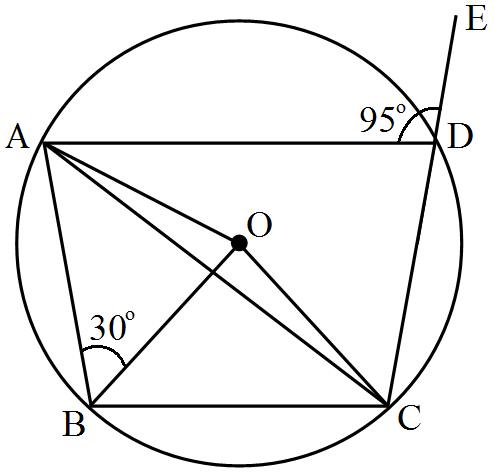
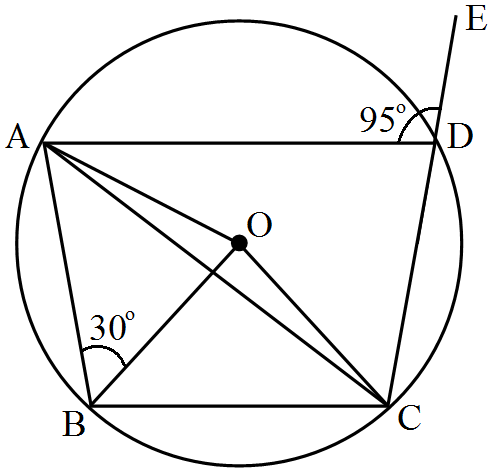 Since $\angle\text{ADE}=95^\circ$$\Rightarrow\angle\text{ADC}=180^\circ-95^\circ=85^\circ$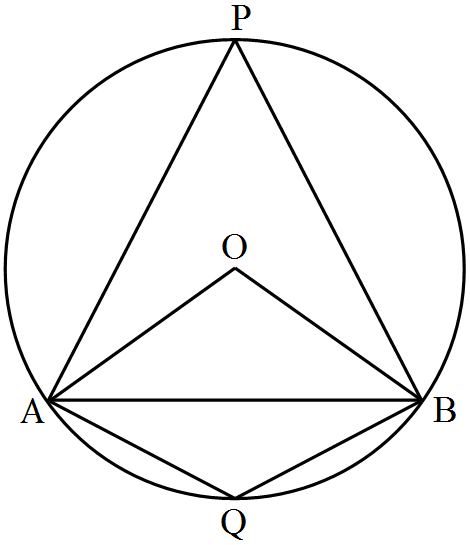
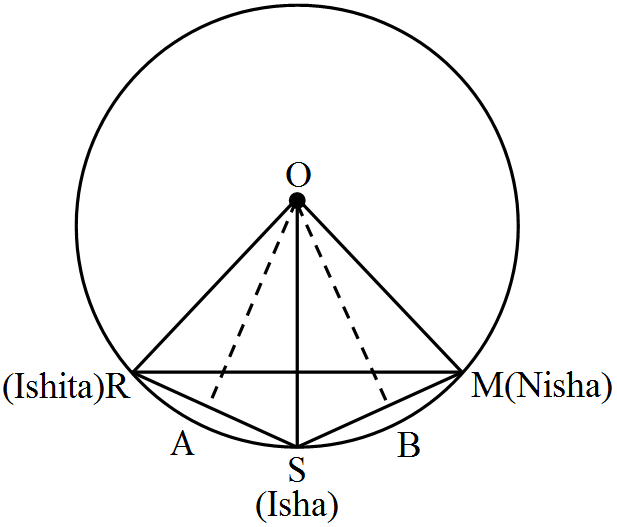
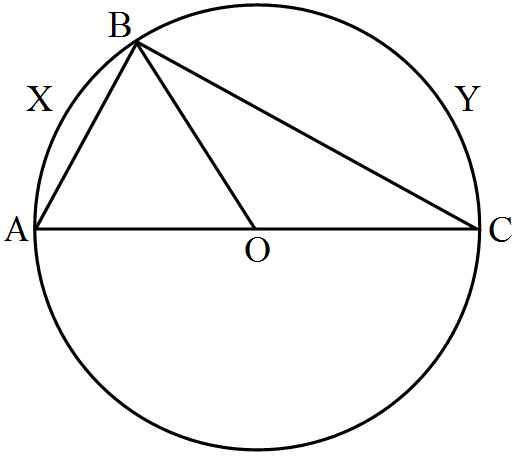
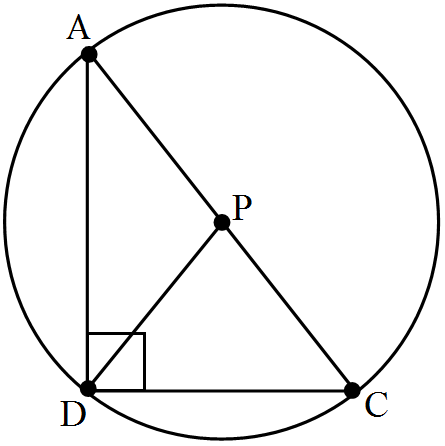 Let $\triangle\text{ABC}$ be a right triangle right angled at B. Let P be the mid-point of hypotenuse AC. Draw a circle with centre at P and AC as a diameter. Since, $\angle\text{ABC}=90^\circ.$ Therefore, the circle passes through B.$\therefore$ BP = Radius
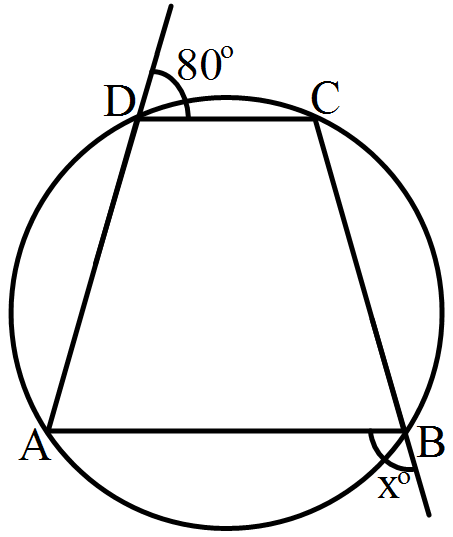
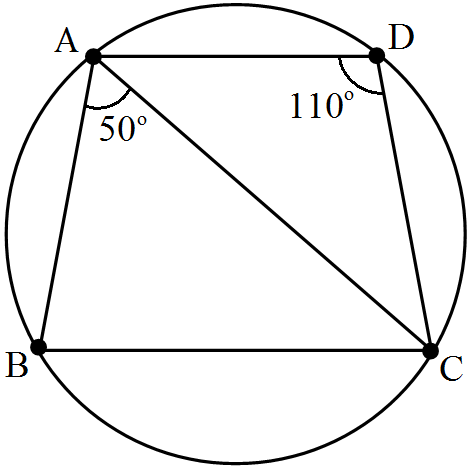 Since, ABCD is a cyclic quadrilateral.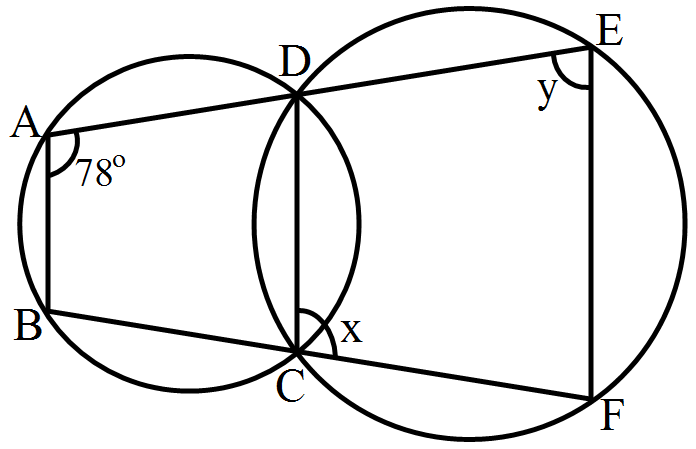
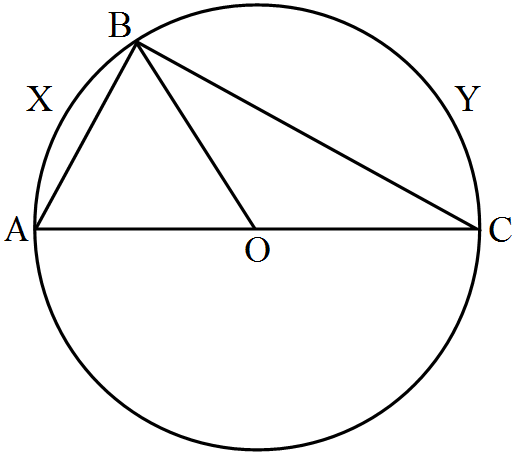
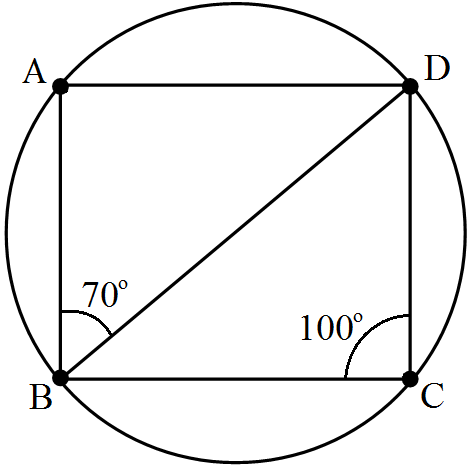 Since, ABCD is a cyclic quadrilateral.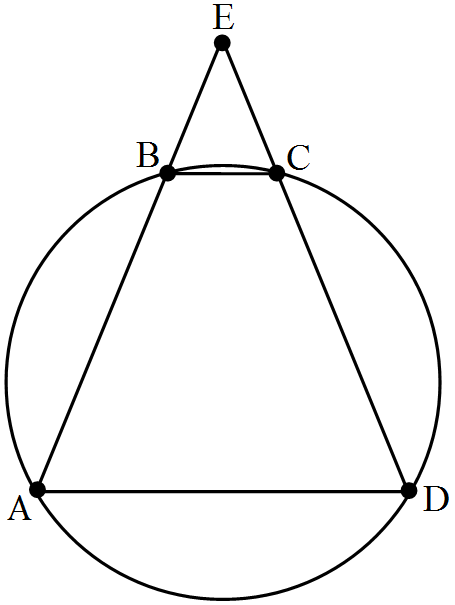
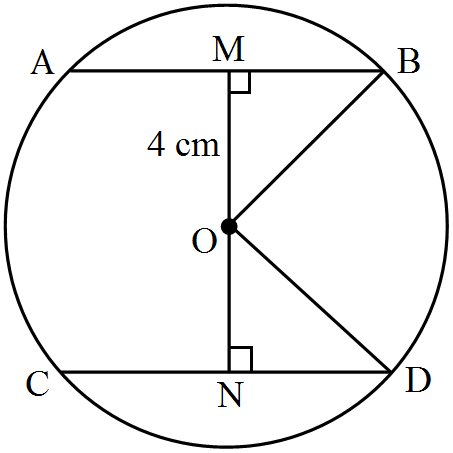
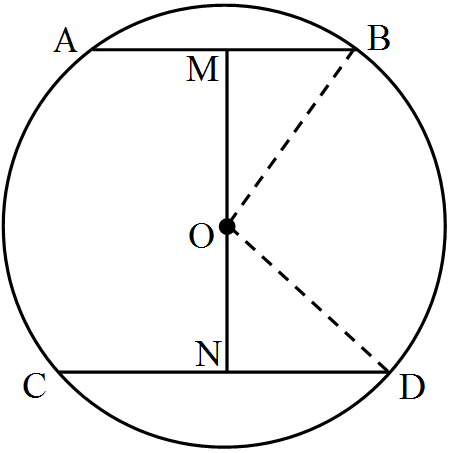 Join OB and OD.$\text{BM}=\frac{\text{AB}}{2}=\frac{5}{2}$ [Perpendicular from the centre bisects the chord]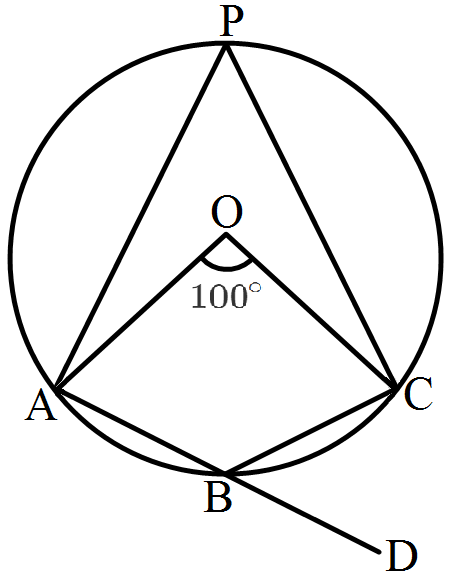
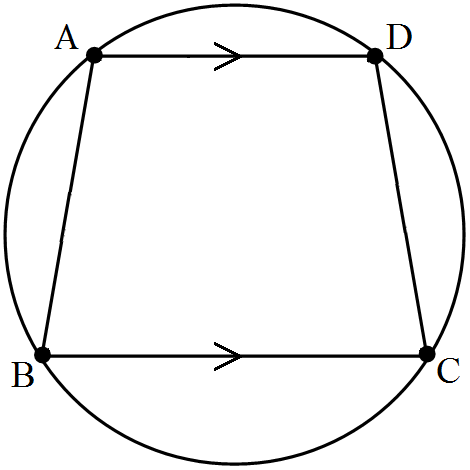 We have
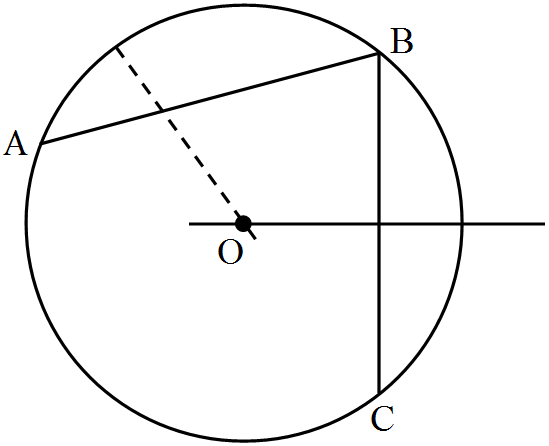 Steps of Construction:
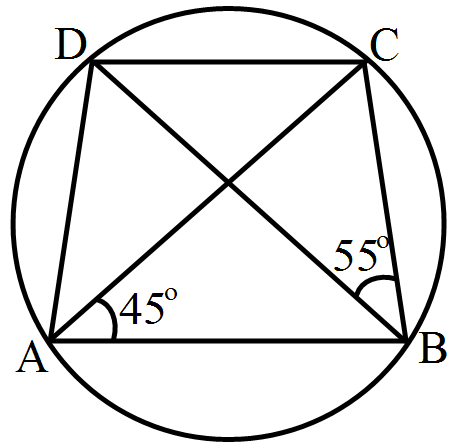
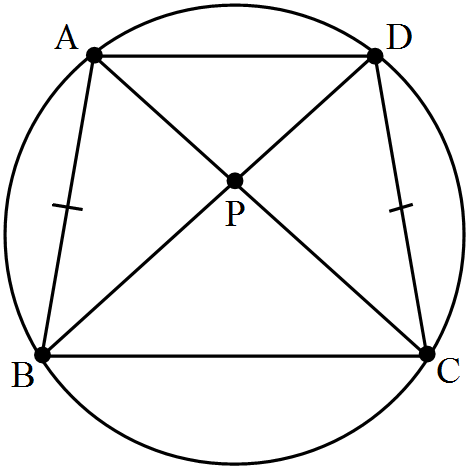 Given ABCD is a cyclic quadrilateral in which AB = DC To prove AC = BD Proof In $\triangle\text{PAB}$ and $\triangle\text{PDC}$$\text{AB}=\text{DC}$ [Given]
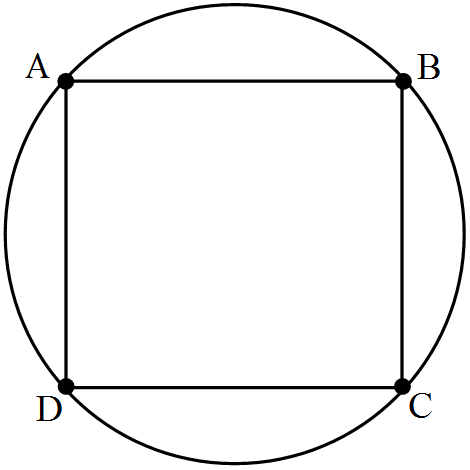 We have, $\angle\text{A}=3\angle\text{C}$
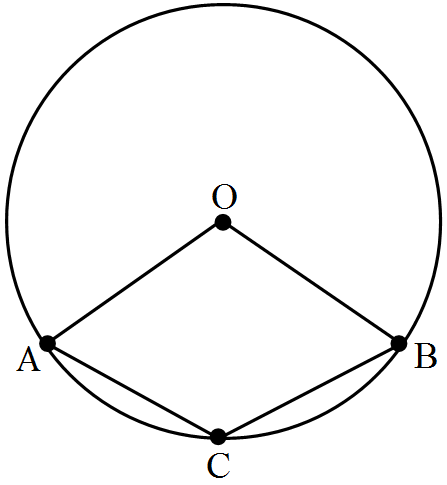 Given: $\angle\text{ACB}$ is an angle in minor segment. To prove: $\angle\text{ACB}>90^\circ$ Proof: By degree measure theorem Reflex $\angle\text{AOB}=2\angle\text{ACB}$ And reflex $\angle\text{AOB}>180^\circ$ Then, $2\angle\text{ACB}>180^\circ$$\Rightarrow\angle\text{ACB}>\frac{180^\circ}{2}$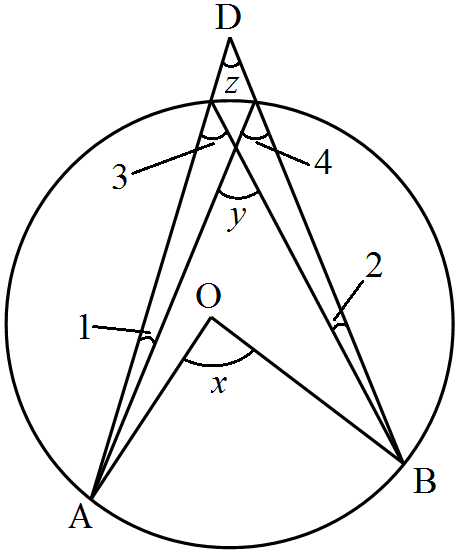
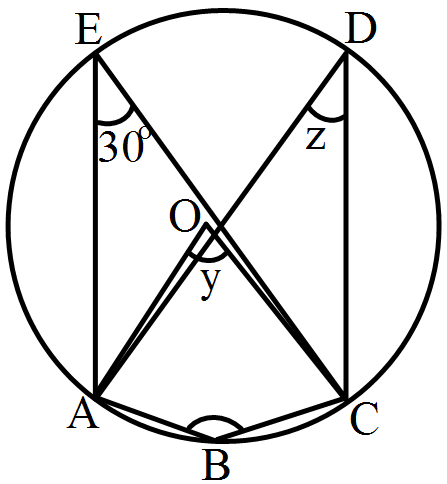
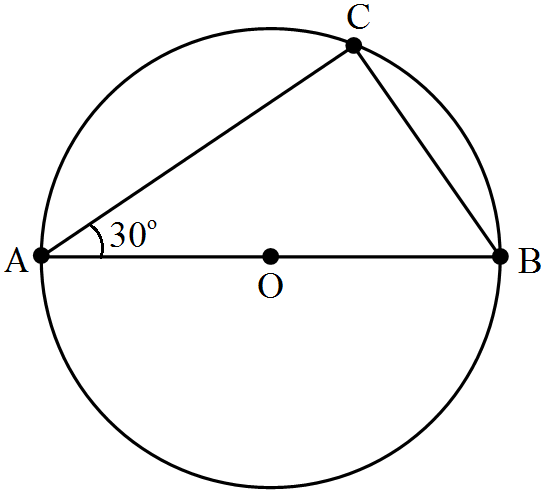 We have, $\angle\text{CAB}=30^\circ$
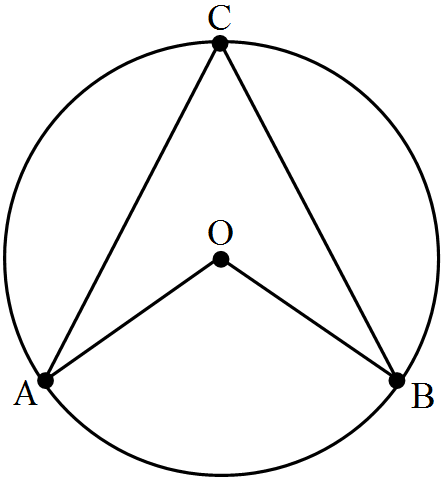 Given: $\angle\text{ACB}$ is an angle in minor segment.
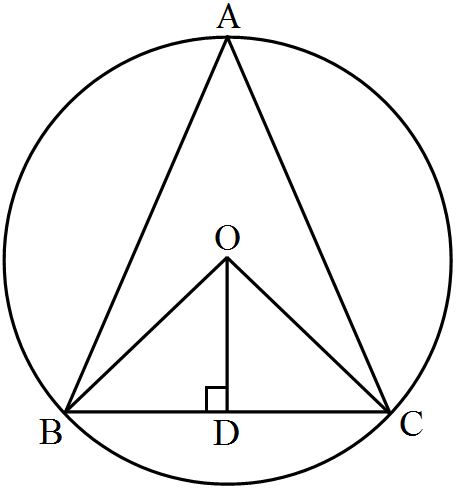
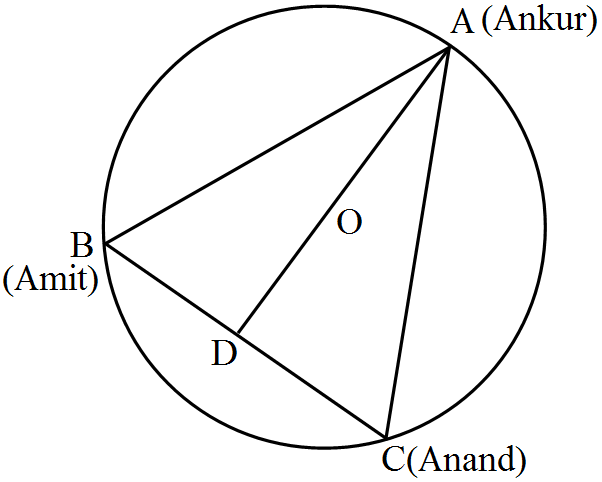 So, ABC is an equilateral triangle OA (radius) = 40m Medians of equilateral triangle pass through the circum centre (O) of the equilateral triangle ABC. We also know that median intersect each other at the ratio 2 : 1 As AD is the median of equilateral triangle ABC, we can write:$\frac{\text{OA}}{\text{OD}}=\frac{2}{1}$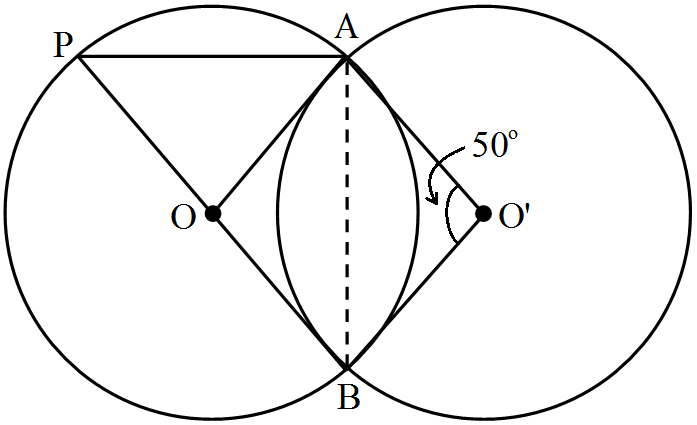
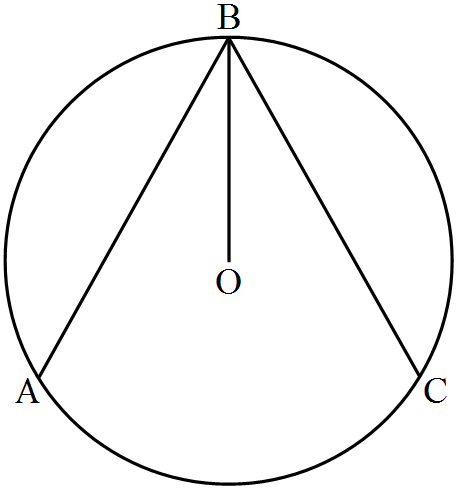
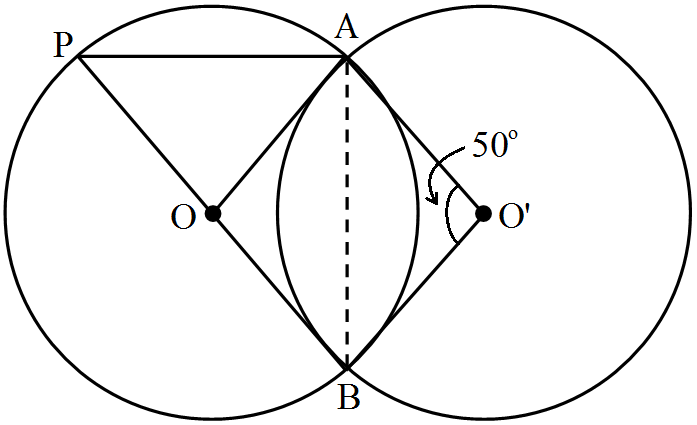 Now, since all the sides of the quadrilateral OBO’A are equal it has to be a rhombus. One of the properties of a rhombus is that the opposite angles are equal to each other. So, since it is given that $\angle\text{AO}'\text{B}=50^\circ$ we can say that the angle opposite it, that is to say that $\angle\text{AO}\text{B}$ should also have the same value. Hence we get $\angle\text{AO}\text{B}=50^\circ$ Now, consider the first circle with the centre ‘O’ alone. ‘AB’ forms a chord and it subtends an angle of 50° with its centre, that is $\angle\text{AO}\text{B}=50^\circ.$ A property of a circle is that the angle subtended by an arc at the centre of the circle is double the angle subtended by the arc in the remaining part of the circle. This means that,$\angle\text{APB}=\frac{\angle\text{AOB}}{2}$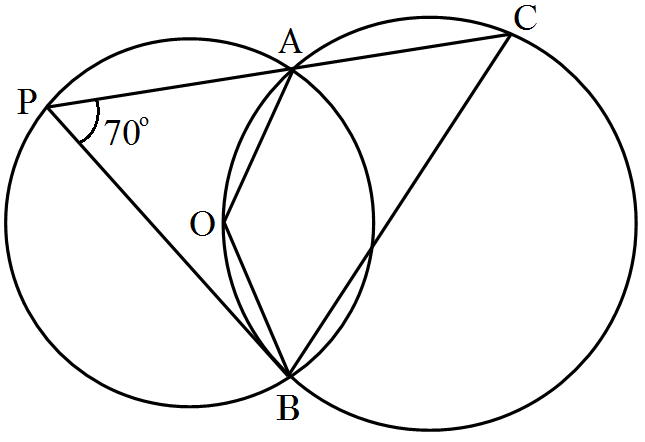
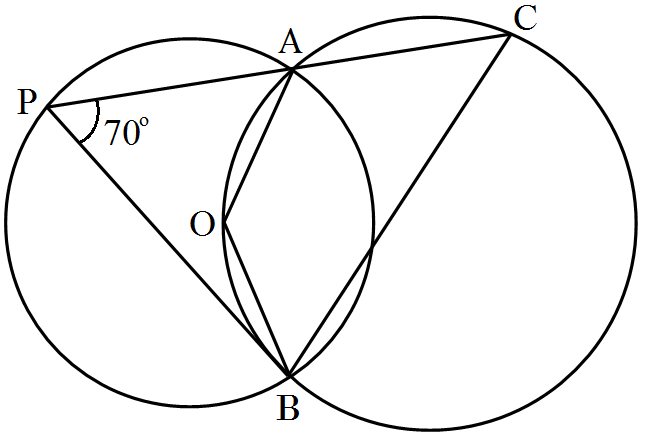 So, here we have$\angle\text{AOB}=2\angle\text{APB}$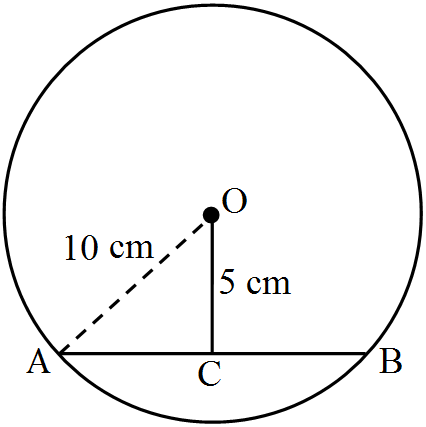
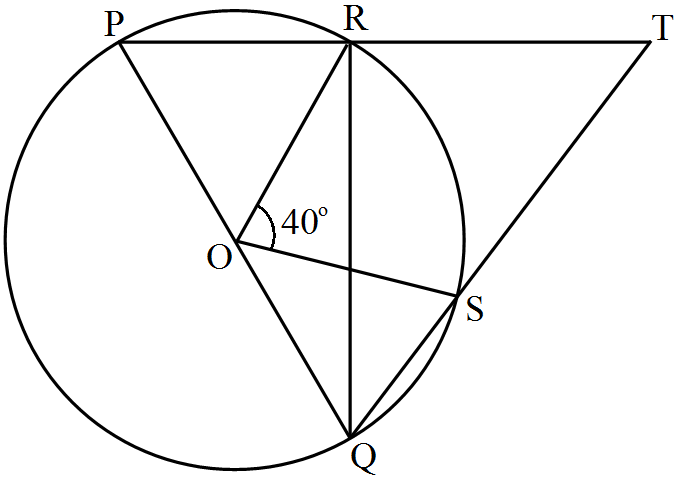
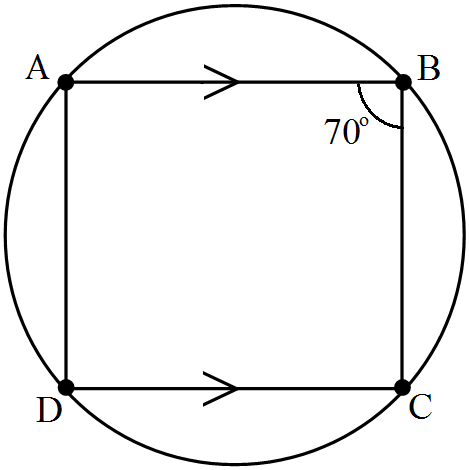 We have, $\angle\text{B}=70^\circ$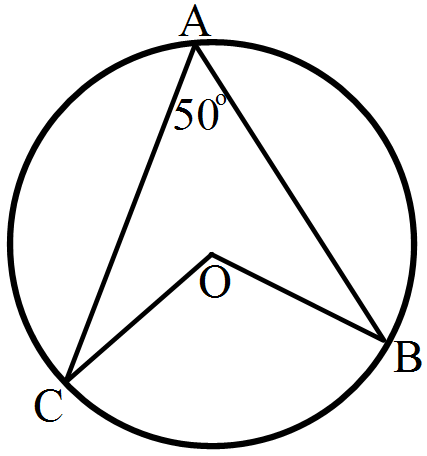
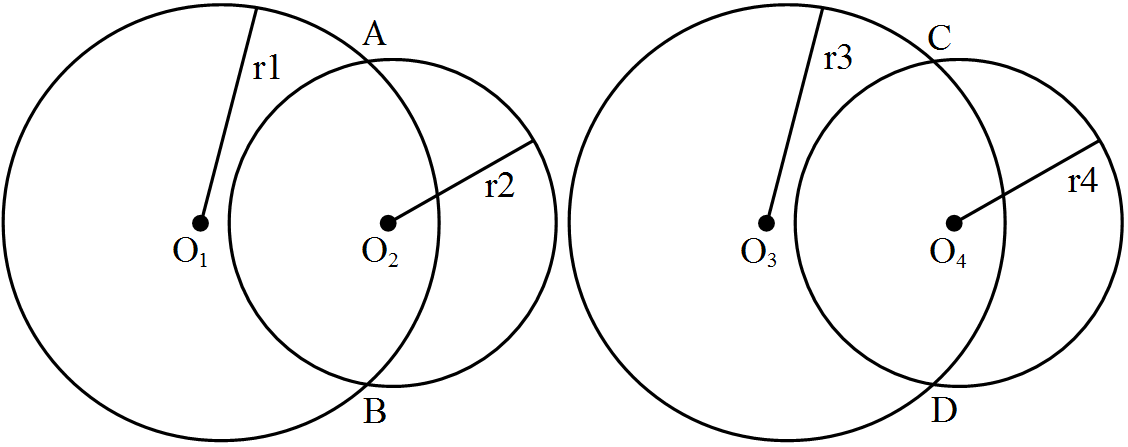
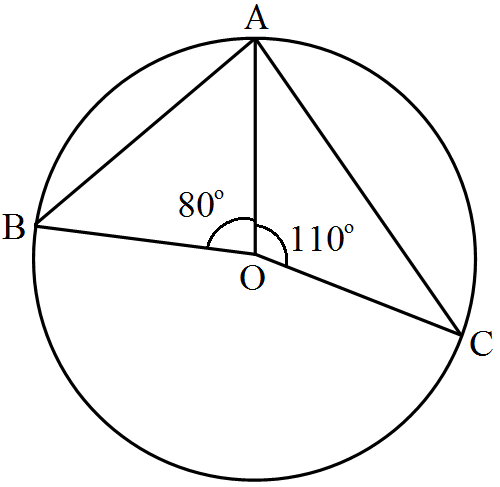
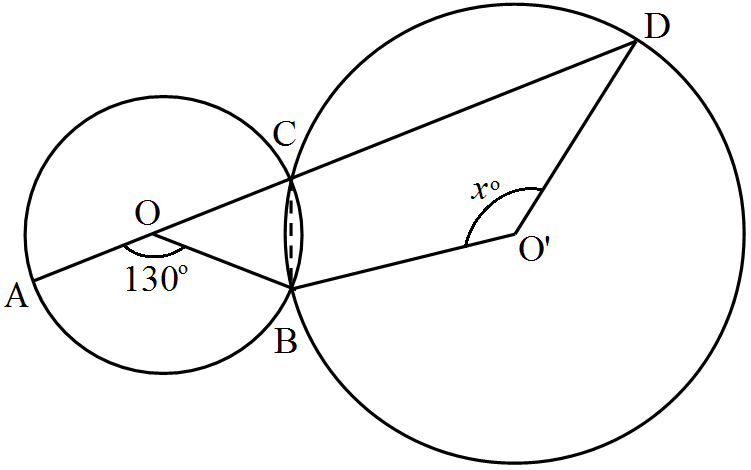
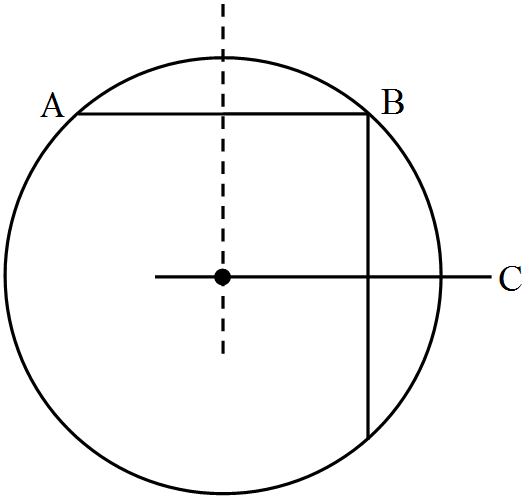 Steps of Construction:
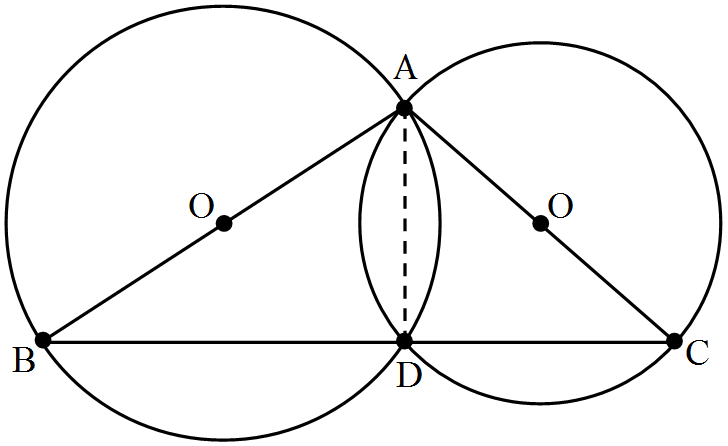 Since, AB is a diameter Then, $\angle\text{ADB}=90^\circ\dots(1)$ [Angles in semicircle] Since, AC is a diameter Then, $\angle\text{ADC}=90^\circ\dots(2)$ [Angles in semicircle] Add equations (1) and (2)$\angle\text{ADB}+\angle\text{ADC}=90^\circ+90^\circ$
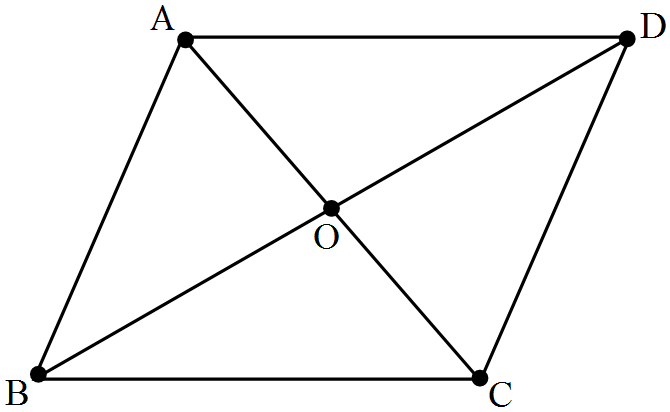 LetABCD be a rhombus such that its diagonals AC and BD intersect at O. Since, the diagonals of a rhombus intersect at right angle.$\therefore\angle\text{AOB}=\angle\text{BOC}$