Questions

4 Mark Question

Take a timed test

19 questions · self-marked practice — reveal the answer and mark yourself.

Question 14 Marks
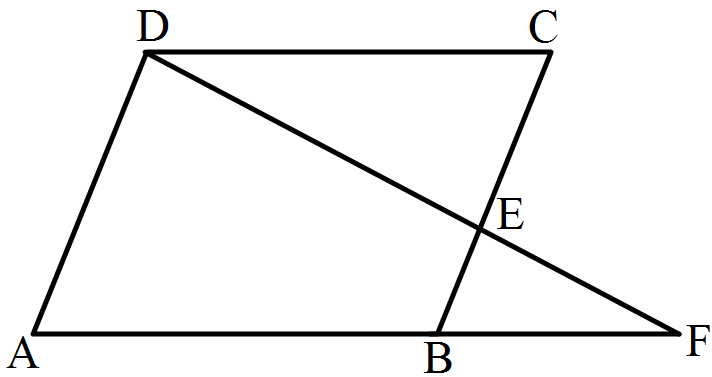
In the adjoining figure, ABCD is a parallelogram and E is the midpoint of side BC. If DEand AB when produced meet at F, prove that AF = 2AB.
Answer
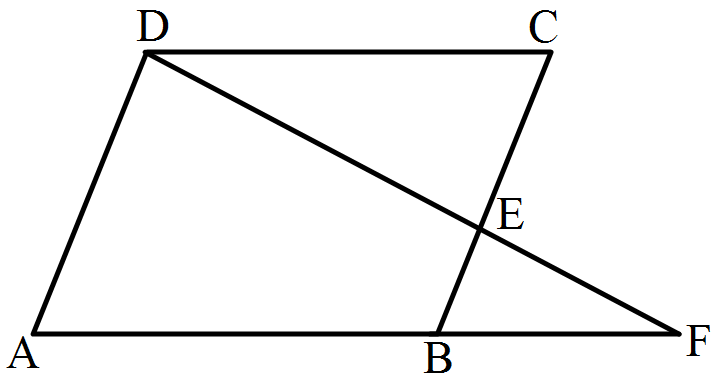
Given: A parrallelogram ABCD in which E is the mid point of side BC, DE and AB when produced meet at F.
To Prove: $\text{AF}=2\text{AB}$
Proof: In $\triangle\text{DEC}$ and $\triangle\text{FEB}$
$\angle\text{DEC}=\angle\text{FEB}$ [vertically opposite angles]
$\angle\text{DCE}=\angle\text{FBE}$ [alternate angles]
$\text{CE = EB}$ [Given]
Thus by Angle-Angle-Side criterion of congruence, we have
$\triangle\text{DEC}\cong\triangle\text{FEB}$ [By AAS]
The corresponding parts of the congruent triangle are equal.
$\therefore\text{DC = FB}$ [By C.P.C.T.]
So, $\text{AF = AB + BF}$
$=\text{AB + DC}$
$=\text{AB + AB}$
$=2\text{AB}$
$\therefore\text{AF}=2\text{AB}$
View full question & answer
Question 24 Marks
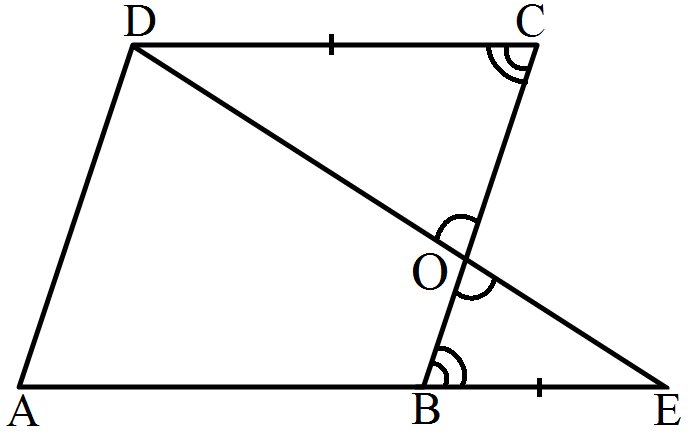
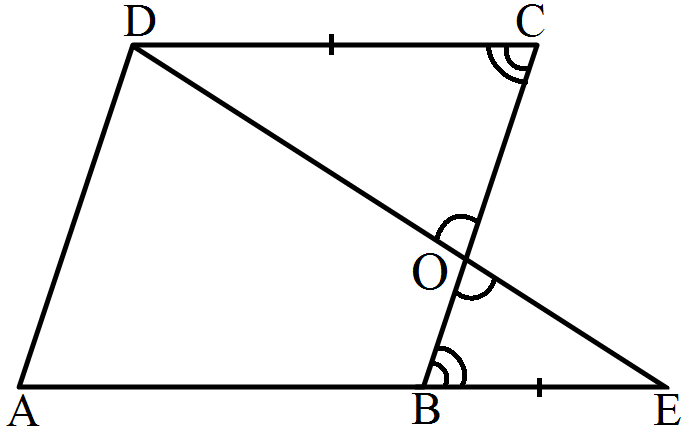
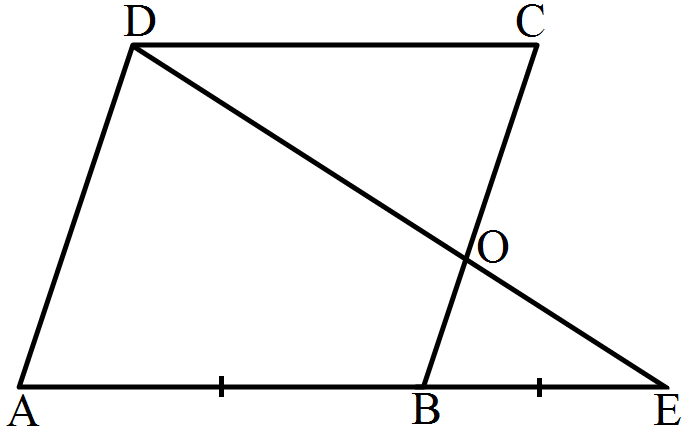
In the adjoining figure, ABCD is a parallelogram in which AB is produced to E so that BE = AB. Prove that ED bisects BC.
Answer

Given: ABCD is a parralegram in which AB is produced to E such that BE = AB. DE is joined which cuts BC at O.
To Prove: $\text{OB = OC}$
Proof: In $\triangle\text{OCD}$ and $\triangle\text{OBE},$ we have,
$\angle\text{DOC}=\angle\text{EOB}$ [vertically opposite angles are equal]
$\angle\text{OCD}=\angle\text{OBE}$ [AB || CD, BC is a transversal thus, alternate angles are equal]
$\text{DC = BE}$ [AB = CD and BE = AB]
Thus, by Angle-Angle-Side criterion of congruence, we have
$\therefore\triangle\text{OCD}\cong\triangle\text{OBE}$ [by AAS]
The corresponding parts of the congruent triangles are equal.
$\therefore\text{OC = OB}$
Hence, ED bisect BC.
View full question & answer
Question 34 Marks
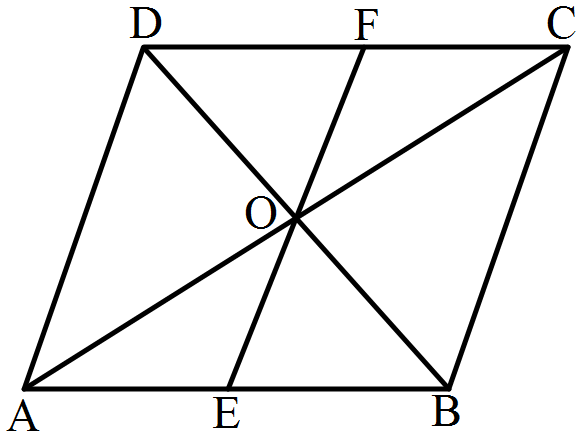
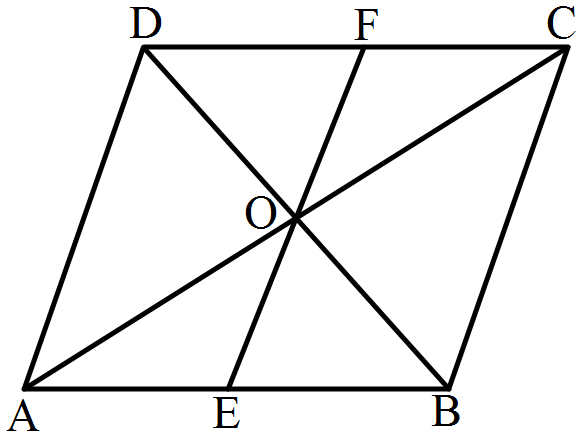
In the adjoining figure, ABCD is a parallelogram whose diagonals intersect each other at O. A line segment EOF is drawn to meet AB at E and DC at F. Prove that OE = OF.
Answer

Given: A parallelogram ABCD, in which diagonals intersect at O. E and F are the points on AB and CD
To Prove: $\text{OE = OF}$
Proof: In $\triangle\text{AOE}$ and $\triangle\text{COF},$ we have
$\angle\text{CAE}=\angle\text{DCA}$ [Alternate angles]
$\text{AO = CO}$ [diagonals are equal and bisect each other]
and, $\angle\text{AOE}=\angle\text{COF}$ [Vertically opposite angles]
Thus by Angle-Side-Angle criterion of congruence, we have,
$\therefore\triangle\text{AOE}\cong\triangle\text{COF}$ [By ASA]
The corresponding parts of the congruent triangles are equal.
$\therefore\text{OE = OF}$ [By C.P.C.T.]
View full question & answer
Question 44 Marks
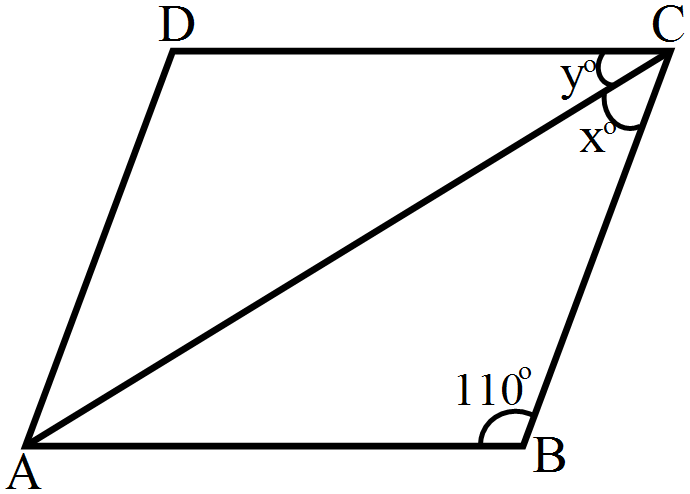
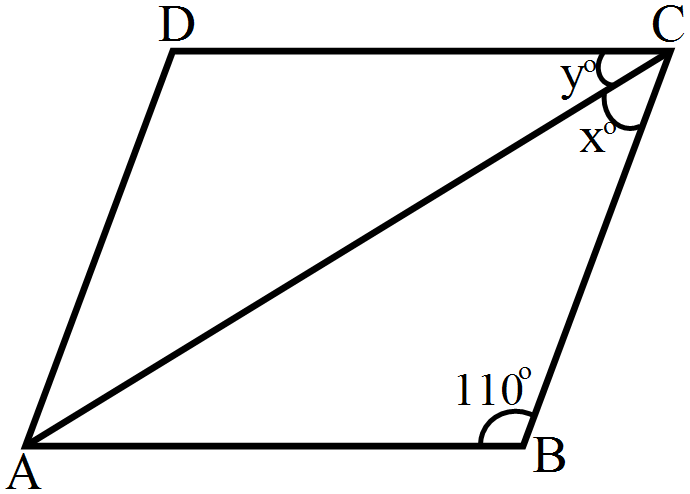
In each of the figures given below, ABCD is a rhombus. Find the value of x and y in each case.
Answer
ABCD is a rhombus, so its all sides are equal.
In $\triangle\text{ABC},$ we have$\text{AB = BC}$
$\Rightarrow\angle\text{CAB}=\angle\text{ACB}=\text{x}^{\circ}$
As, $\angle\text{CAB}+\angle\text{ABC}+\angle\text{ACB}=180^{\circ}$$\Rightarrow\text{x}+110^{\circ}+\text{x}=180^{\circ}$
$\Rightarrow2\text{x}=180^{\circ}-110^{\circ}=70^{\circ}$
$\Rightarrow\text{x}=\frac{70^{\circ}}{2}=35^{\circ}$
$\therefore\text{x}=35^{\circ}$ and $\text{y}=35^{\circ}$
View full question & answer
Question 54 Marks
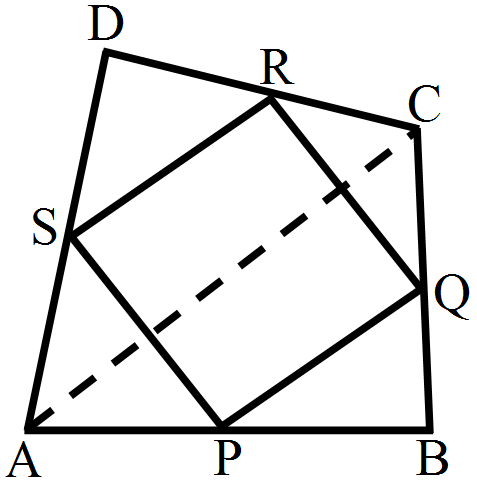
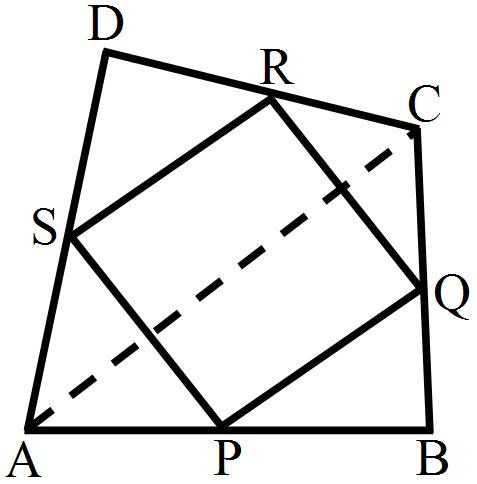
P , Q, R and S are respectively the midpoints of the sides AB, BC, CD and DA of a quadrilateral ABCD. Show that:
  1. PQ || AC and $\text{PQ}=\frac{1}{2}\text{AC}$
  2. PQ || SR
  3. PQRS is a parallelogram.
Answer
  1. In $\triangle\text{ABC,}$ P and Q are the mid-points of sides AB and BC respectively.
$\Rightarrow\text{PQ }||\text{ AC}$ and $\text{PQ}=\frac{1}{2}\text{AC}...(\text{i})$
  1. In $\triangle\text{ADC,}$ R and S are the mid-points of sides CD and AD respectively.
$\Rightarrow\text{SR || AC}$ and $\Rightarrow\text{SR}=\frac{1}{2}\text{AC}...(\text{ii})$

From (i) and (ii), we have

$\text{PQ = SR }$ and $\text{PQ ∥ SR}$
  1. Thus, in quadrilateral PQRS, one pair of opposite sides are equal and parallel.
Hence, PQRS is a parallelogram.
View full question & answer
Question 64 Marks
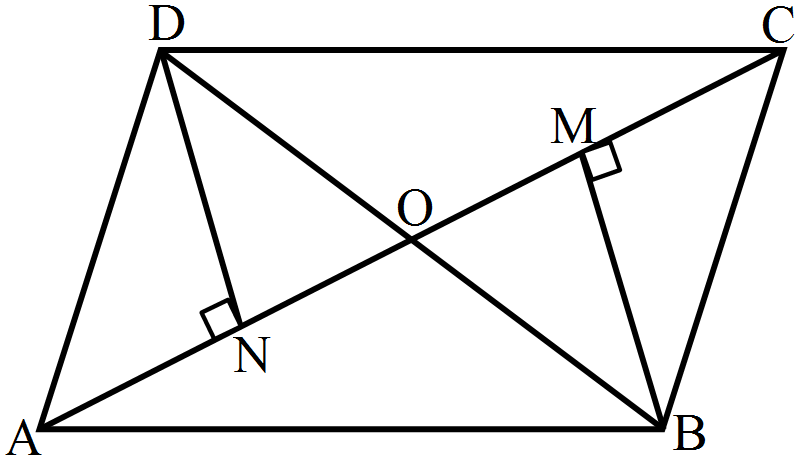
In the adjoining figure, $\text{BM}\perp\text{AC}$ and $\text{DN}\perp\text{AC}.$ If BM = DN, prove that AC bisects BD.
Answer
Given: A quadrilateral ABCD, in which $\text{BM}\perp\text{AC}$ and $\text{DN}\perp\text{AC}$ and BM = DN. To prove: AC bisects BD; or DO = BO Proof: Let AC and BD intersect at O. Now, in $\triangle\text{OND}$ and $\triangle\text{OMB},$ we have:$\angle\text{OND}=\angle\text{OMB}$ (90° each)
$\angle\text{DON}=\angle\text{BOM}$ (Vertically opposite angles)
Also, $\text{DN = BM}$ (Given) i.e., $\triangle\text{OND}\cong\triangle\text{OMB}$ (AAS congrurence rule)$\therefore\text{OD = OB}$ (C.P.C.T.)
Hence, AC bisects BD.
View full question & answer
Question 74 Marks
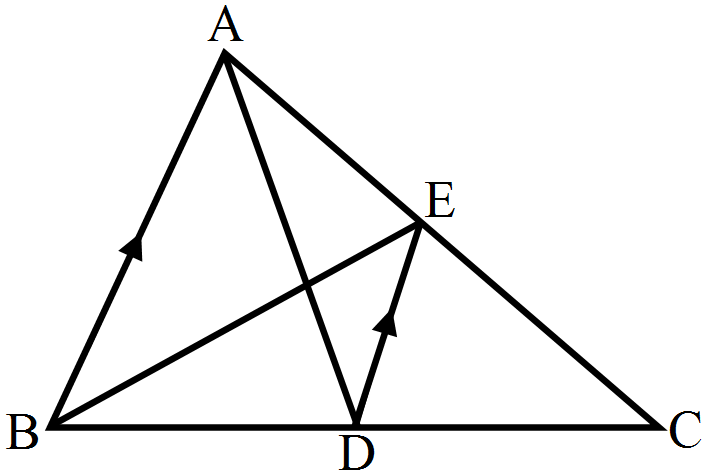
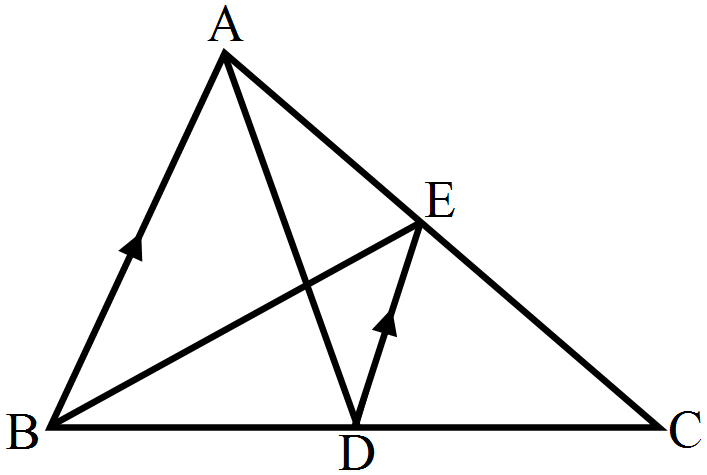
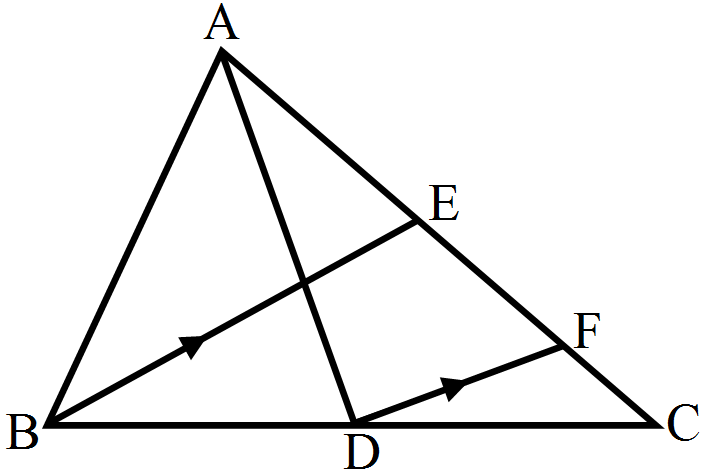
In the adjoining figure, AD is a median of $\triangle\text{ABC}$ and DE || BA. Show that BE is also a median of $\angle\text{ABC}.$
Answer
Given: A $\triangle\text{ABC}$ in which AD is its median and DE || AB
To Prove: BE is a median of $\triangle\text{ABC}.$
Proof: In $\triangle\text{ABC},$
DE || AB [Given]
D is the mid-point of BC.
The line drawn through the midpoint of one side of a triangle, parallel to another side, intersects the third side at its midpoint.
So, by Mid point Theorem, E is the mid-point of AC.
$\therefore$ BE is the median of $\triangle\text{ABC}$ drawn through B.
View full question & answer
Question 84 Marks
In the adjoining figure, ABCD is a square and $\triangle\text{EDC}$ is an equilateral triangle. Prove that:
  1. AE = BE,
  2. $\angle\text{DAE}=15^{\circ}.$
Answer
Given: ABCD is a square in which AB = BC = CD = DA. $\triangle\text{EDC}$ is an equilateral triangle in which ED = EC = DC and$\angle\text{EDC}=\angle\text{DEC}=\angle\text{DCE}=60^{\circ}.$
To prove: $\text{AE = BE}$ and $\angle\text{DAE}=15^{\circ}$ Proof: in $\triangle\text{ADE}$ and $\triangle\text{BCE},$ we have:$\text{AD = BC}$ [Sides of a square]
$\text{DE = EC}$ [Sides of an equilateral triangle]
$\angle\text{ADE}=\angle\text{BCE}=90^{\circ}+60^{\circ}=150^{\circ}$
$\therefore\triangle\text{ADE}\cong\triangle\text{BCE}$
i.e., $\text{AE = BE}$ Now, $\angle\text{ADE}=150^{\circ}$$\text{DA = DC}$ [Sides of a square]
$\text{DC = DE}$ [Sides of an equilateral triangle]
So, $\text{DA = DE}$$\triangle\text{ADE}$ and $\triangle\text{BCE}$ are isosceles triangle.
i.e., $\angle\text{DAE}=\angle\text{DEA}=\frac{1}{2}(180^{\circ}-150^{\circ})=\frac{30^{\circ}}{2}=15^{\circ}$
View full question & answer
Question 94 Marks
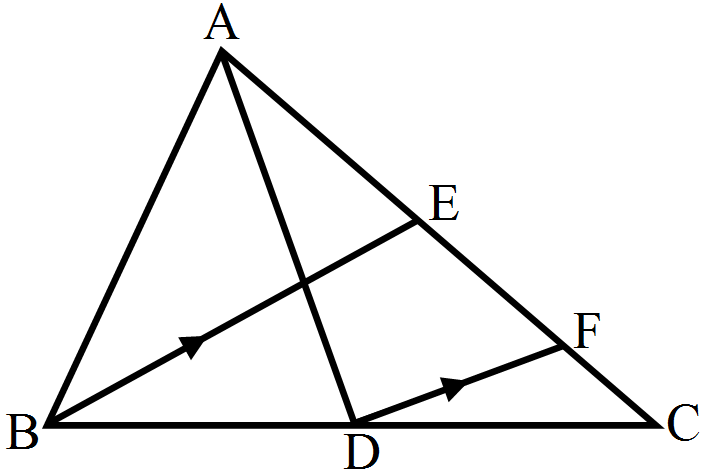
In the adjoining figure, AD and BE are the medians of $\triangle\text{ABC}$ and DF || BE. Show that $\text{CF}=\frac{1}{4}\text{AC}.$
Answer
Given: A $\triangle\text{ABC}$ in which AD and BE are the medians. DF is drawn parallel to BE.
To prove: $\text{CF =}\frac{1}{2}\text{AC}$ Proof: In $\triangle\text{CBE},$D is the mid point of BC and DF is parallel to BE.
The line drawn through the midpoint of one side of a triangle, parallel to another side, intersects the third side at its midpoint.
So,by Mid point Theorem Fis the mid point of EC.
$\therefore\text{CF}=\frac{1}{2}\text{EC}$
$=\frac{1}{2}\Big(\frac{1}{2}\text{AC}\Big)$ [BE is the median through B]
$=\frac{1}{4}\text{AC}.$
Thus, $\text{CF}=\frac{1}{4}\text{AC}.$
View full question & answer
Question 104 Marks
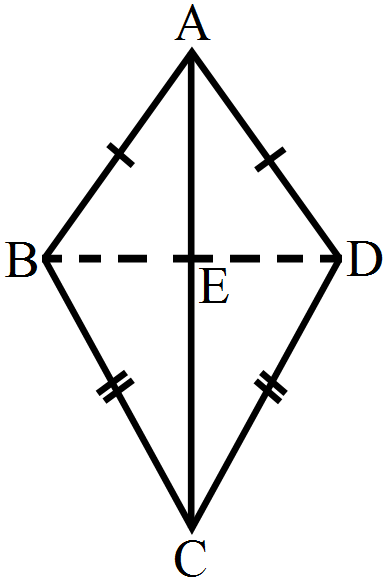
In the given figure, ABCD is a quadrilateral in which AB = AD and BC = DC. Prove that
  1. AC bisects $\angle\text{A}$ and $\angle\text{C},$
  2. BE = DE,
  3. $\angle\text{ABC}=\angle\text{ADC}.$
Answer
Given: ABCD is a quadrilateral in which AB = AD and BC = DC
  1. In $\triangle\text{ABC}$ and $\triangle\text{ADC},$ we have:
$\text{AB = AD}$ (Given)

$\text{BC = DC}$ (Given)

$\text{AC}$ is common.

i.e., $\triangle\text{ABC}\cong\triangle\text{ADC}$ (SSS congruence rule)

$\therefore\angle\text{BAC}=\angle\text{DAC}$ and $\angle\text{BCA}=\angle\text{DCA}$ (By C.P.C.T.)

Thus, AC bisects $\angle\text{A}$ and $\angle\text{C}.$
  1. Now, in $\triangle\text{ABE}$ and $\triangle\text{ADE},$ we have:
$\text{AB = AD}$ (Given)

$\angle\text{BAE}=\angle\text{DAE}$ (Proven above)

$\text{AE}$ is common.

$\therefore\triangle\text{ABE}\cong\triangle\text{ADE}$ (SAS congruence rule)

$\Rightarrow\text{BE = DE}$ (By C.P.C.T.)
  1. $\triangle\text{ABC}\cong\triangle\text{ADC}$ (Proven above)
$\therefore\angle\text{ABC}=\angle\text{ADC}$ (By C.P.C.T.)
View full question & answer
Question 114 Marks
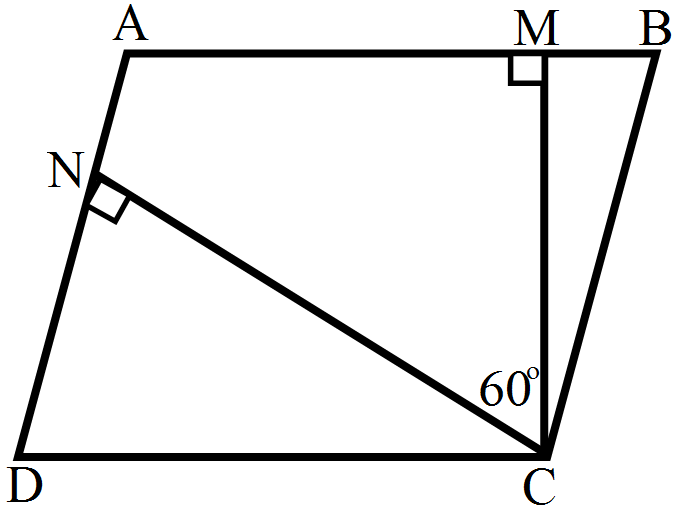
The angle between two altitudes of a parallelogram through the vertex of an obtuse angle of the parallelogram is 60°. Find the angles of the parallelogram.
Answer

$\angle\text{DCM}=\angle\text{DCN}+\angle\text{MCN}$
$\Rightarrow90^{\circ}=\angle\text{DCN}+60^{\circ}$
$\Rightarrow\angle\text{DCN}=30^{\circ}$
In $\triangle\text{DCN,}$
$\angle\text{DNC}+\angle\text{DCN}+\angle\text{D}=180^{\circ}$
$\Rightarrow90^{\circ}+30^{\circ}+\angle\text{D}=180^{\circ}$
$\Rightarrow\angle\text{D}=60^{\circ}$
$\Rightarrow\angle\text{B}=\angle\text{D}=60^{\circ}$ (opposite angles of parallelogram are equal)
$\Rightarrow\angle\text{A}=180^{\circ}-\angle\text{B}=180^{\circ}-60^{\circ}=120^{\circ}$
$\Rightarrow\angle\text{C}=\angle\text{A}=120^{\circ}$
Thus, the angles of a parallelogram are 60°, 120°, 60° and 120°.
View full question & answer
Question 124 Marks
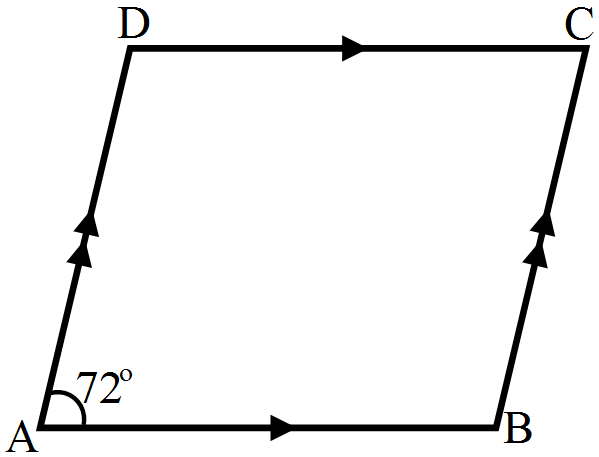
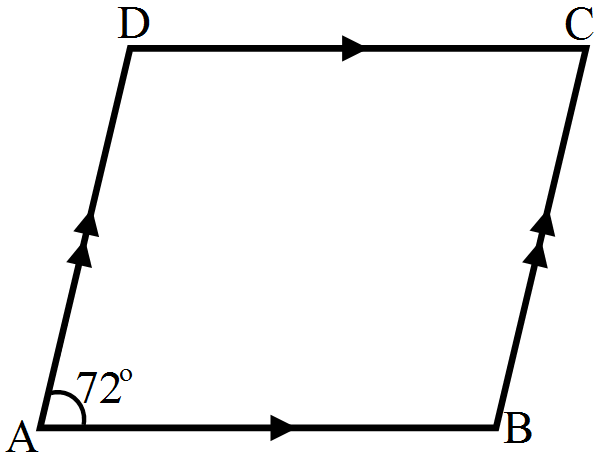
In the adjoining figure, ABCD is a parallelogram in which $\angle\text{A}=70^{\circ}.$ Calculate $\angle\text{B},\angle\text{C}$ and $\angle\text{D}.$
Answer
In a parallelogram, opposite angles are equal.$\therefore\angle\text{A}=\angle\text{C}=72^{\circ}$
The sum of all the four angles of a parallelogram is 360° So, $\angle\text{A}+\angle\text{B}+\angle\text{C}+\angle\text{D}=360^{\circ}$$\Rightarrow72^{\circ}+\angle\text{B}+72^{\circ}+\angle\text{D}=360^{\circ}$ $[\because\angle\text{A} = \angle\text{C}]$
$\Rightarrow2\angle\text{B}+144^{\circ}=360^{\circ}$ $[\because\angle\text{B}=\angle\text{D}]$
$\Rightarrow2\angle\text{B}=360^{\circ}-144^{\circ}=216{^\circ}$
$\Rightarrow\angle\text{B}=\frac{216}{2}=108^{\circ}$
$\therefore\angle\text{B}=108^{\circ},\angle\text{C}=72^{\circ}$ and $\angle\text{D}=108^{\circ}.$
View full question & answer
Question 134 Marks
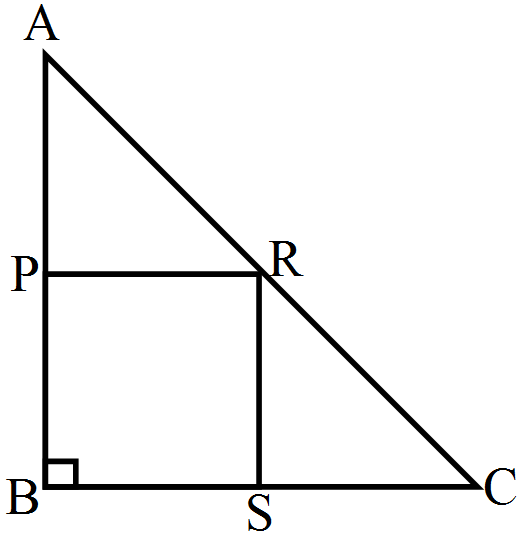
A square is inscribed in an isosceles right triangle so that the square and the triangle have one angle common. Show that the vertex of the square opposite the vertex of the common angle bisects the hypotenuse.
Answer

Let $\triangle\text{ABC}$ be an isosceles right triangle, right-angled at B.
$\Rightarrow\text{AB = BC}$
Let PBSR be a square inscribed in $\triangle\text{ABC}$ with common $\angle\text{B}.$
$\Rightarrow\text{PB = BS = SR = RP}$
Now, $\text{AB} - \text{PB = BC} -\text{BS}$
$\Rightarrow\text{AP = CS ...(i)}$
In $\triangle\text{APR}$ and $\triangle\text{CSR}$
$\text{AP = CS}$ [from (i)]
$\angle\text{APR}=\angle\text{CSR}$ (Each 90°)
$\text{PR = SR}$ (sides of a square)
$\therefore\triangle\text{APR}\cong\triangle\text{CSR}$ (by SAS congruence criterion)
$\Rightarrow\text{AR = CR}$ [C.P.C.T.]
Thus, point R bisects the hypotenuse AC.
View full question & answer
Question 144 Marks
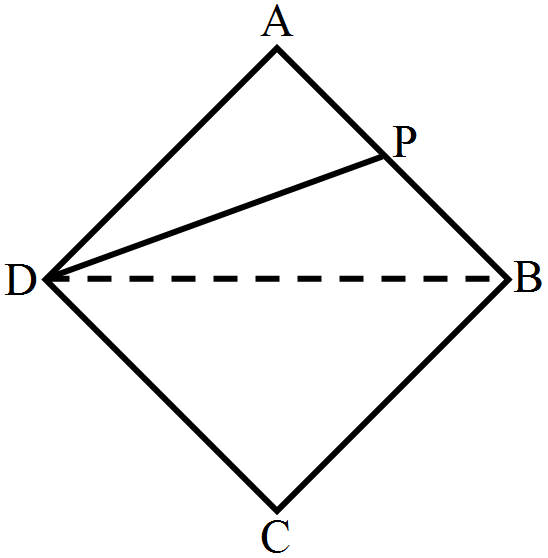
In a rhombus ABCD, the altitude from D to the side AB bisects AB. Find the angles of the rhombus.
Answer

Let the altitude from D to the side AB bisect AB at point P.
Join BD.
In $\triangle\text{AMD}$ and $\triangle\text{BMD},$
$\text{AM = BM}$ (M is the mid-point of AB)
$\angle\text{AMD}=\angle\text{BMD}$ (Each 90°)
$\text{MD = MD}$ (common)
$\therefore\triangle\text{AMD}\cong\triangle\text{BMD}$ (by SAS congruence criterion)
$\Rightarrow\text{AD = BD}$ (C.P.C.T.)
But, $\text{AD = AB}$ (sides of a rhombus)
$\Rightarrow\text{AD = AB = BD}$
$\Rightarrow\triangle\text{ADB}$ is an equilateral triangle.
$\Rightarrow\angle\text{A}=60^{\circ}$
$\Rightarrow\angle\text{C}=\angle\text{A}=60^{\circ}$ (opposite angles are equal)
$\Rightarrow\angle\text{B}=180^{\circ}-\angle\text{A}=180^{\circ}-60^{\circ}=120^{\circ}$
$\angle\text{D}=\angle\text{B}=120^{\circ}$
Hence, in rhombus ABCD, $\angle\text{A}=60^{\circ},\angle\text{B}=120^{\circ},\angle\text{C}=60^{\circ}$ and $\angle\text{D}=120^{\circ}.$
View full question & answer
Question 154 Marks
In a rhombus ABCD show that diagonal AC bisects $\angle\text{A}$ as well as $\angle\text{C}$ and diagonal BD bisects $\angle\text{B}$ as well as $\angle\text{D}.$
Answer

In $\triangle\text{ABC}$ and $\triangle\text{ADC},$
$\text{AB = AD}$ (sides of a rhombus are equal)
$\text{BC = CD}$ (sides of a rhombus are equal)
$\text{AC = AC}$ (common)
$\therefore\triangle\text{ABC}\cong\triangle\text{ADC}$ (by SSS congruence criterion)
$\Rightarrow\angle\text{BAC}=\angle\text{DAC}$ and $\angle\text{BCA}=\angle\text{DCA}$ (C.P.C.T.)
$\Rightarrow\text{AC}$ bisects $\angle\text{A}$ as well as $\angle\text{C}.$
Similarly,
In $\triangle\text{BAD}$ and $\triangle\text{BCD},$
$\text{AB = BC}$ (sides of a rhombus are equal)
$\text{AD = CD}$ (sides of a rhombus are equal)
$\text{BD = BD}$ (common)
$\therefore\triangle\text{BAD}\cong\triangle\text{BCD}$ (by SSS congruence criterion)
$\Rightarrow\angle\text{ABD}=\angle\text{CBD}$ and $\angle\text{ADB}=\angle\text{CDB}$ (C.P.C.T.)
$\Rightarrow\text{BD}$ bisects $\angle\text{B}$ as well as $\angle\text{D}.$
View full question & answer
Question 164 Marks
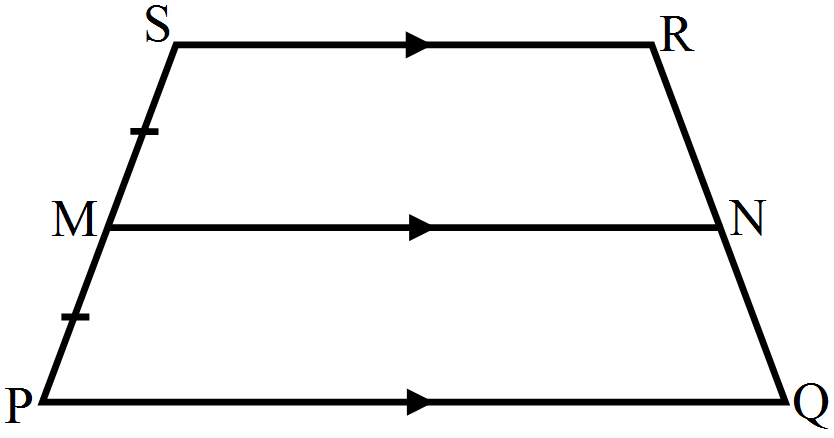
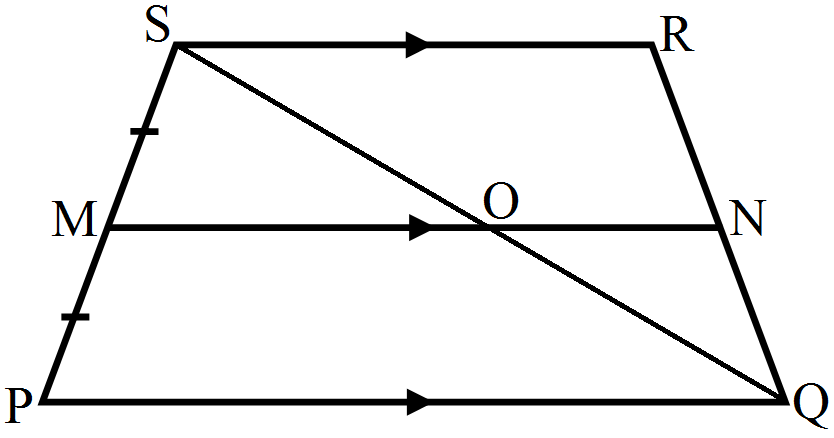
In the adjoining figure, PQRS is a trapezium in which PQ || SR and M is the midpoint of PS. A line segment MN || PQ meets QR at N. Show that N is the midpoint of QR.
Answer
Construction: Join diagonal QS. Let QS intersect MN at point O.

PQ || SR and MN || PQ
⇒ PQ || MN || SR
By converse of mid-point theorem a line drawn, through the mid-point of any side of a triangle and parallel to another side bisects the third side.
Now, in $\triangle\text{SPQ}$
MO || PQ and M is the mid-point of SP
So, this line will intersect QS at point O and O will be the mid-point of QS.
Also, MN || SR
Thus, in $\triangle\text{QRS},$ ON || SR and O is the midpoint of line QS.
So, by using converse of mid-point theorem, N is the mid-point of QR.
View full question & answer
Question 174 Marks
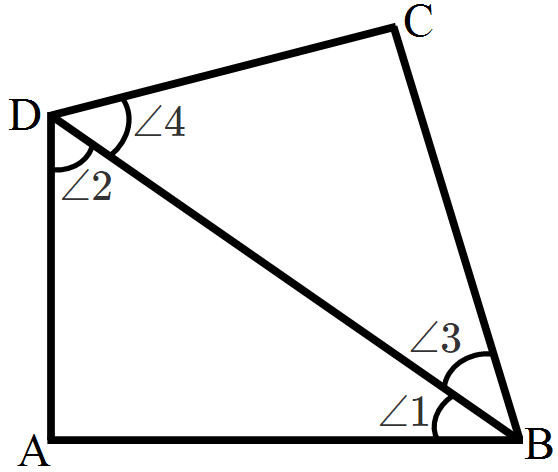
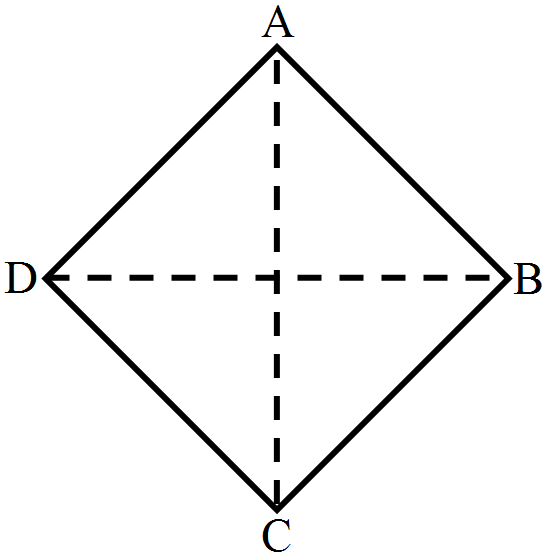
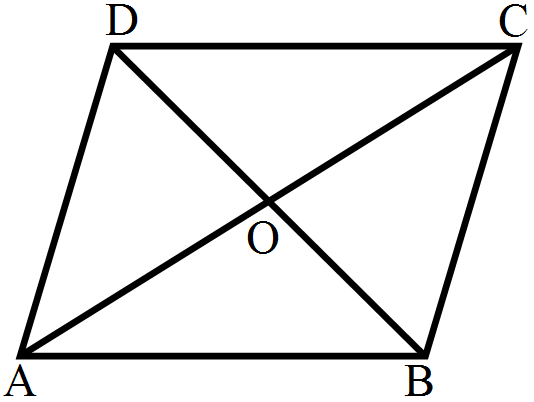
Prove that the sum of all the angles of a quadrilateral is 360°.
Answer
Let ABCD be a quadrilateral and $\angle1,\angle2,\angle3$ and $\angle4$ are its four angles as shown in the figure. Join BD which divides ABCD in two triangles, $\triangle\text{ABD}$ and $\triangle\text{BCD}.$ In $\triangle\text{ABD},$ we have:$\angle1+\angle2+\angle\text{A}=180^{\circ}..(\text{i})$
In $\triangle\text{BCD},$ we have:$\angle3+\angle4+\angle\text{C}=180^{\circ}...(\text{ii})$
On adding (i) and (ii), we get:$(\angle1+\angle3)+\angle\text{A}+\angle\text{C}+(\angle4+\angle\text{2})=360^{\circ}$
$\Rightarrow\angle\text{A}+\angle\text{C}+\angle\text{B}+\angle\text{D}=360^{\circ}$ $[\because\angle1+\angle3=\angle\text{B, }\angle4+\angle2=\angle\text{D}]$
$\therefore\angle\text{A}+\angle\text{C}+\angle\text{B}+\angle\text{D}=360^{\circ}$
View full question & answer
Question 184 Marks
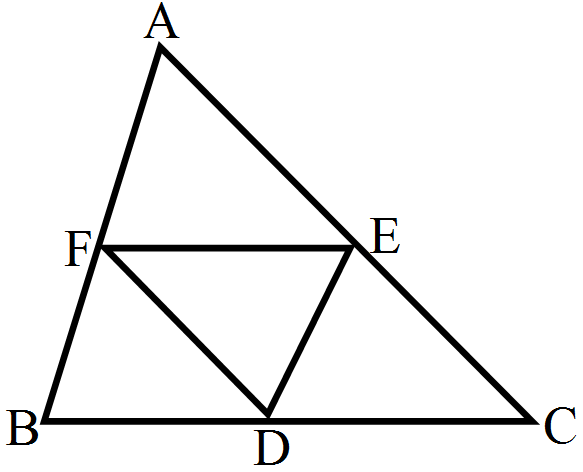
In the adjoining figure, D, E, F are the midpoints of the sides BC, CA and AB respectively, of $\triangle\text{ABC}.$ Show that $\angle\text{EDE}=\angle\text{A},\angle\text{DEF}=\angle\text{B}$ and $\angle\text{DFE}=\angle\text{C}.$
Answer
$\triangle\text{ABC}$ is shown below. D, E and F are the midpoints of sides BC, CA and AB, respectively.As F and E are the mid points of sides AD and AC of $\triangle\text{ABC}.$
$\therefore$ FE || BC (By mid point theorem)
Similarly, DE || FB and FD || AC.
Therefore, AFDE, BDEF and DCEF are all parallelograms.
In parallelogram AFDE, we have:
$\angle\text{A}=\angle\text{EDF}$ (Opposite angle are equal)
In parallelogram BDEF, we have:
$\angle\text{B}=\angle\text{DEF}$ (Opposite angles are equal)
In parallelogram DCEF, we have:
$\angle\text{C}=\angle\text{DFE}$ (Opposite angles are equal)
View full question & answer
Question 194 Marks
The lengths of the diagonals of a rhombus are 24cm and 18cm respectively. Find the length of each side of the rhombus.
Answer
ABCD is a rhombus in which diagonal AC = 24cm and BD = 18cm. We know that in a rhombus, diagonals bisect each other at right angles. So in $\triangle\text{AOB}$$\angle\text{AOB}=90^{\circ}$
$\text{AO}=\frac{1}{2}\text{AC}=\frac{1}{2}\times24=12\text{cm}$
and, $\text{BO}=\frac{1}{2}\text{BD}=\frac{1}{2}\times18=9\text{cm}$ Now, by Pythagoras Theorem, we have$\text{AB}^{2}=\text{AO}^{2}+\text{OB}^2$
$\Rightarrow\text{AB}^2=12^2+9^2$
$\Rightarrow144+81=225$
$\Rightarrow\text{AB}=\sqrt{225}=15\text{cm}$
SO the length of each side of the rhombus is 15cm.
View full question & answer