Question 15 Marks
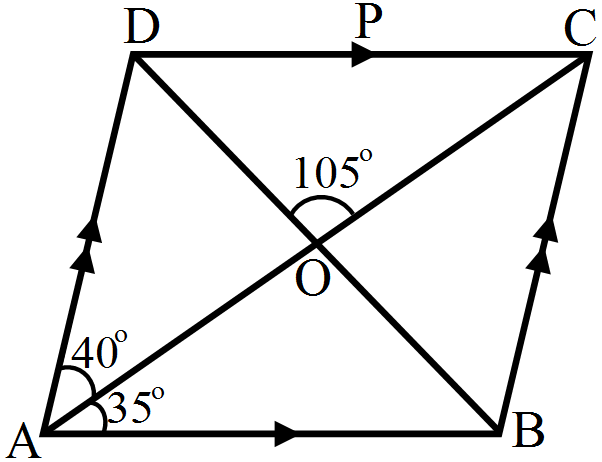
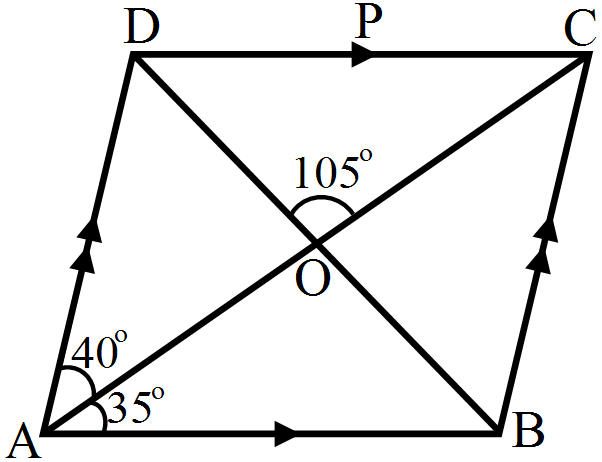
In the adjoining figure, ABCD is a parallelogram in which $\angle\text{DAB}=80^{\circ}$ and $\angle\text{DBC}=60^{\circ}.$ Calculate $\angle\text{CDB}$ and $\angle\text{ADB}.$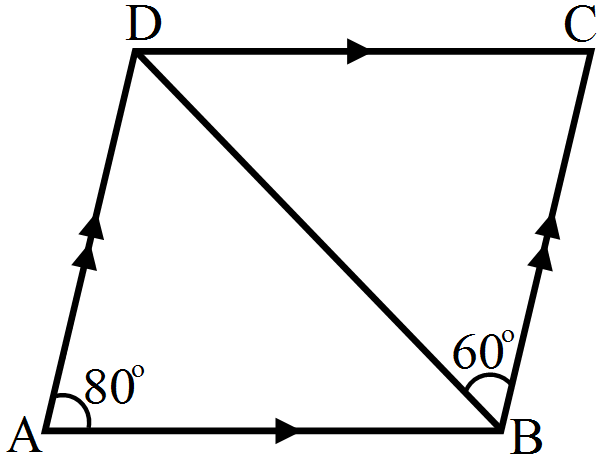
Answer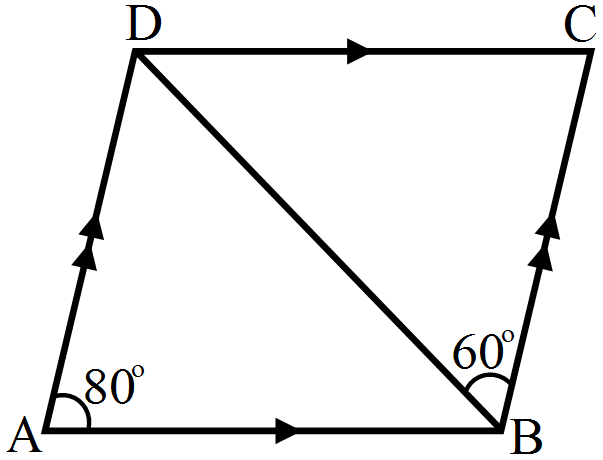 ABCD is a parallelogram, so opposite angles are equal.$\therefore\angle\text{C}=\angle\text{A}=80^{\circ}$
As AD || BC and BD is a transversal. So, $\angle\text{ADB}=\angle\text{DBC}=60^{\circ}$ [Alternate angles] In $\triangle\text{ABD}$$\angle\text{A}+\angle\text{ADB}+\angle\text{ABD}=180^{\circ}$
$\Rightarrow80^{\circ}+60^{\circ}+\angle\text{ABD}=180^{\circ}$
$\Rightarrow140^{\circ}+\angle\text{ABD}=180^{\circ}$
$\Rightarrow\angle\text{ABD}=180^{\circ}-140^{\circ}=40^{\circ}$
$\therefore\angle\text{ABC}=\angle\text{ABD}+\angle\text{DBC}$
$=40^{\circ}+60^{\circ}=100^{\circ}$
In a parallelogarm, opposite angles are equal. So, $\angle\text{ADC}=\angle\text{ABC}=\angle100^{\circ}$$\therefore\angle\text{CDB}=\angle\text{ADC}-\angle\text{ADB}$
$=100^{\circ}-60^{\circ}=40^{\circ}$
and $\angle\text{ADB}=60^{\circ}.$
View full question & answer→ ABCD is a parallelogram, so opposite angles are equal.$\therefore\angle\text{C}=\angle\text{A}=80^{\circ}$As AD || BC and BD is a transversal. So, $\angle\text{ADB}=\angle\text{DBC}=60^{\circ}$ [Alternate angles] In $\triangle\text{ABD}$$\angle\text{A}+\angle\text{ADB}+\angle\text{ABD}=180^{\circ}$
$\Rightarrow80^{\circ}+60^{\circ}+\angle\text{ABD}=180^{\circ}$
$\Rightarrow140^{\circ}+\angle\text{ABD}=180^{\circ}$
$\Rightarrow\angle\text{ABD}=180^{\circ}-140^{\circ}=40^{\circ}$
$\therefore\angle\text{ABC}=\angle\text{ABD}+\angle\text{DBC}$
$=40^{\circ}+60^{\circ}=100^{\circ}$
In a parallelogarm, opposite angles are equal. So, $\angle\text{ADC}=\angle\text{ABC}=\angle100^{\circ}$$\therefore\angle\text{CDB}=\angle\text{ADC}-\angle\text{ADB}$
$=100^{\circ}-60^{\circ}=40^{\circ}$
and $\angle\text{ADB}=60^{\circ}.$
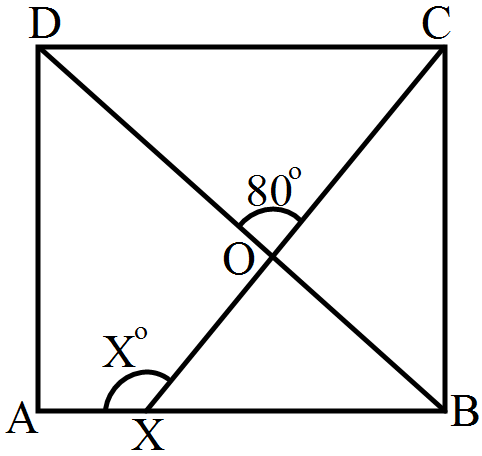 Consider the triangle $\triangle\text{ABD}$$\text{AB = AD}$ [$\therefore$ ABCD is a square]
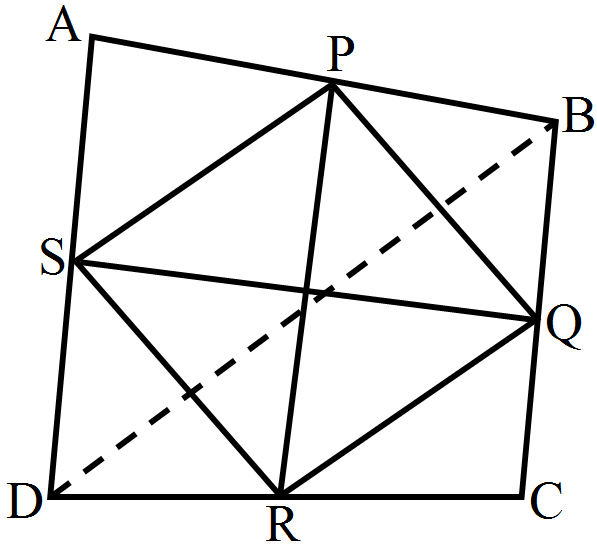 In $\triangle\text{ABD},$ S and P are the midpoints of AD and AB, respectively.$\therefore\text{SP || BD}$ and $\text{SP}=\frac{1}{2}\text{BD }...(\text{i})$ (By midpoint theorem)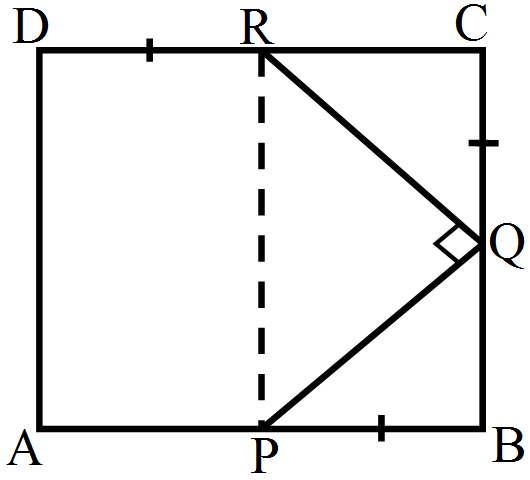
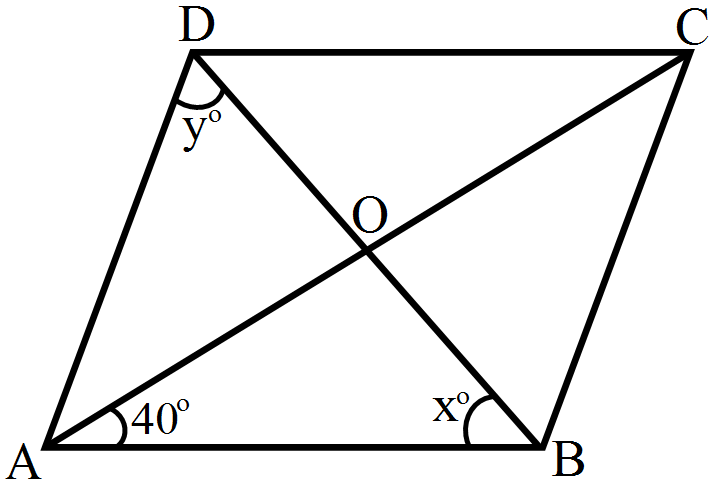
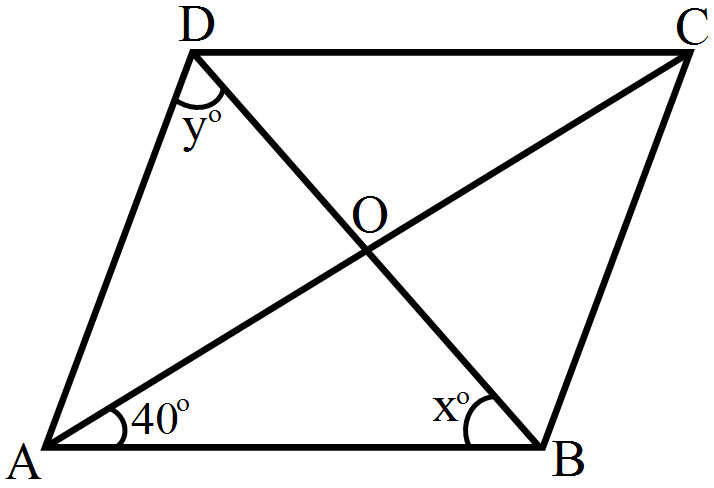 So in $\triangle\text{ABD},\text{AB = AD}$$\Rightarrow\angle\text{ABD}=\angle\text{ADB}$
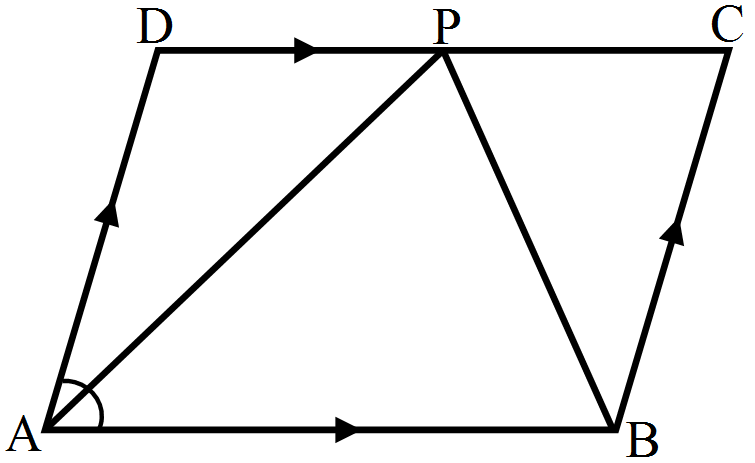
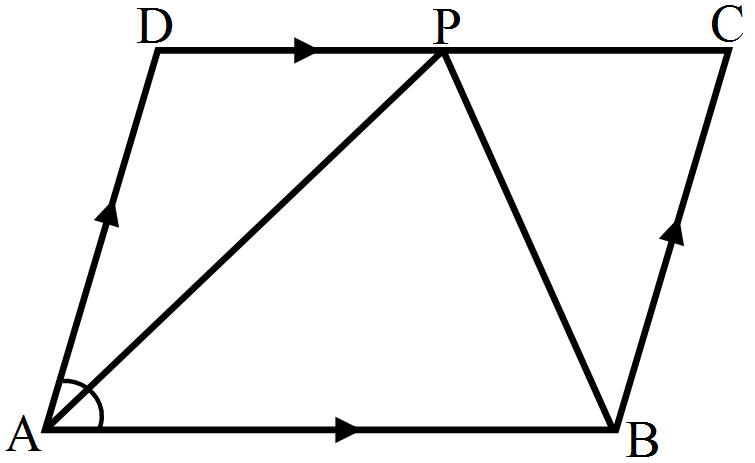
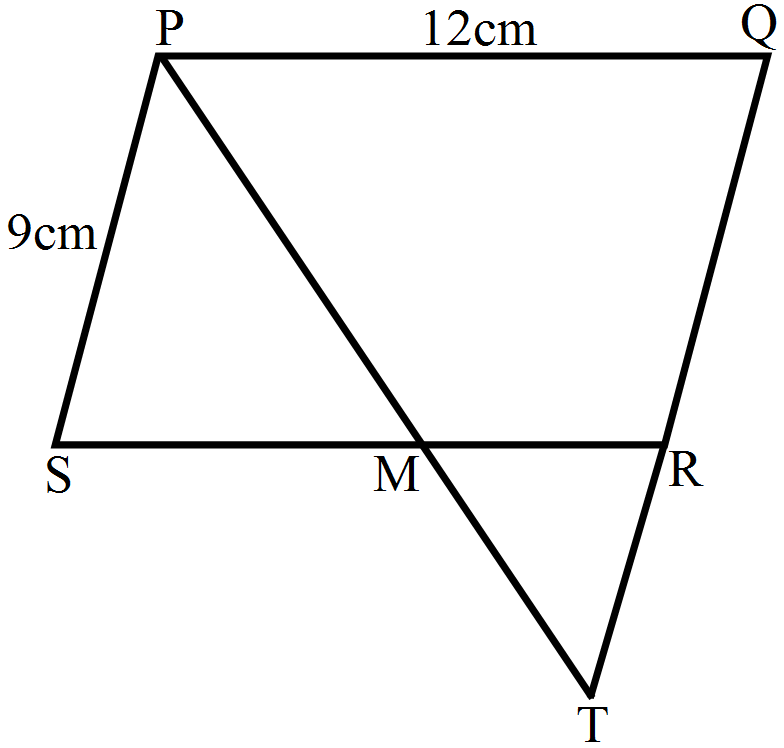 PM is the bisector of $\angle\text{P}.$
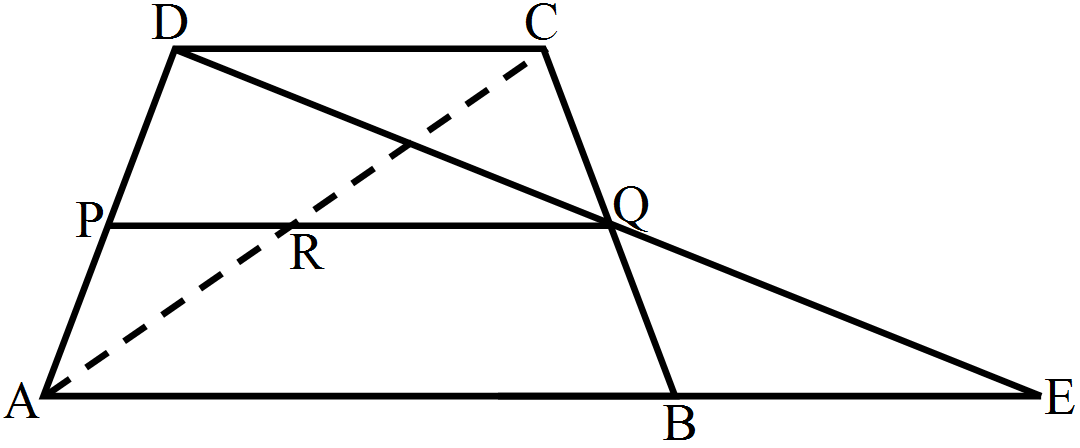
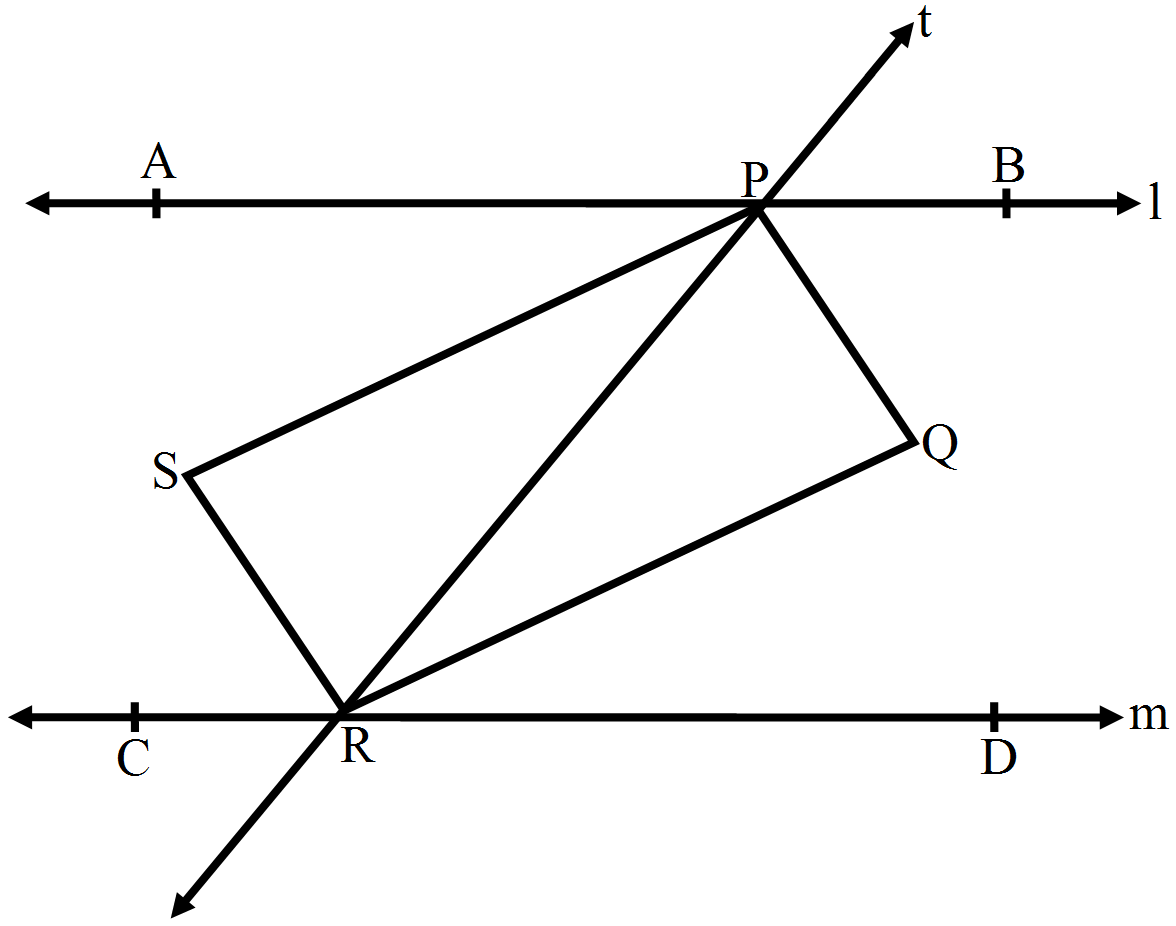 l || m and t is a transversal.$\Rightarrow\angle\text{APR}=\angle\text{PRD}$ (alternate angles)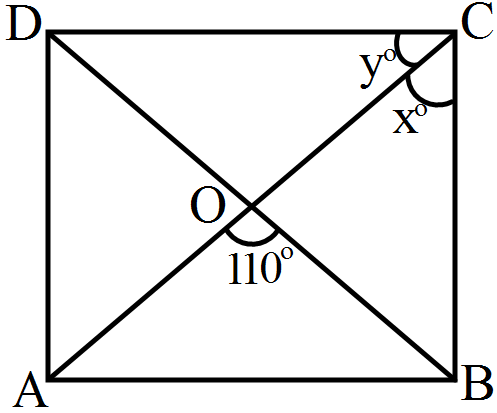
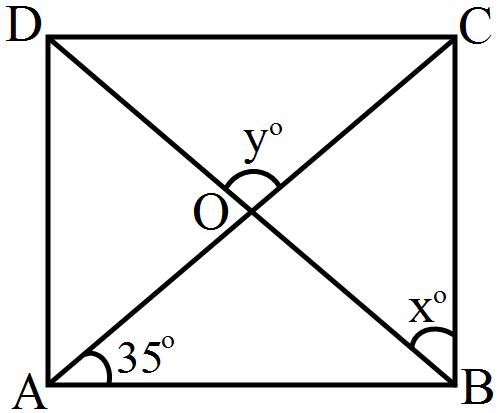
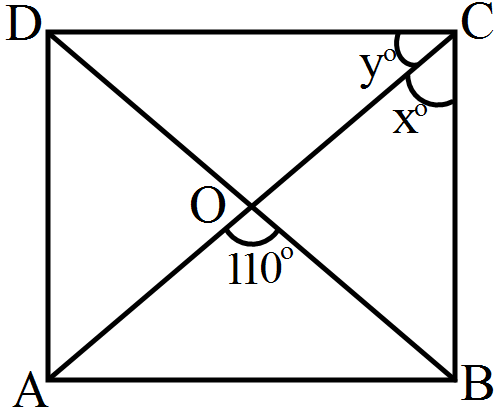 So, in $\triangle\text{AOB},\text{OA = OB}$$\Rightarrow\angle\text{OAB}=\angle\text{OBA}$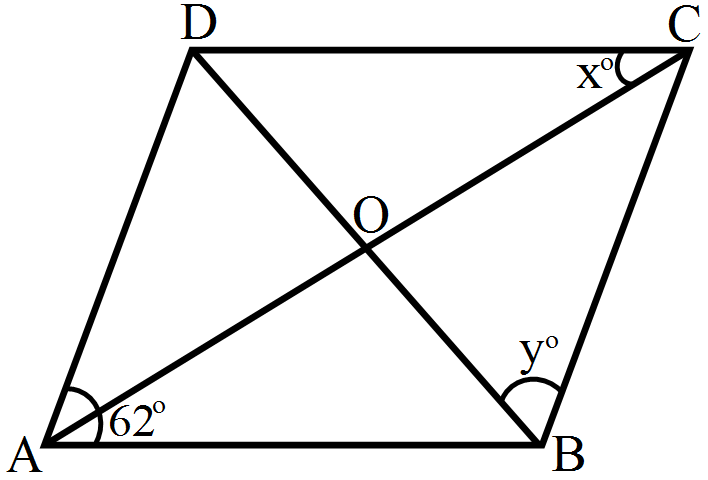
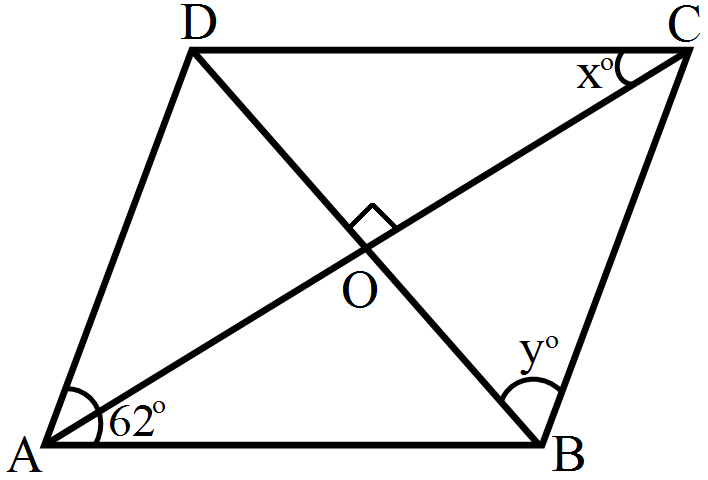 So, $\angle\text{A}=\angle\text{C},$ i.e., $\angle\text{C}=62^{\circ}$ Now in $\triangle\text{BCD},\text{BC = DC}$$\Rightarrow\angle\text{CDB}=\angle\text{DBC}=\text{y}^{\circ}$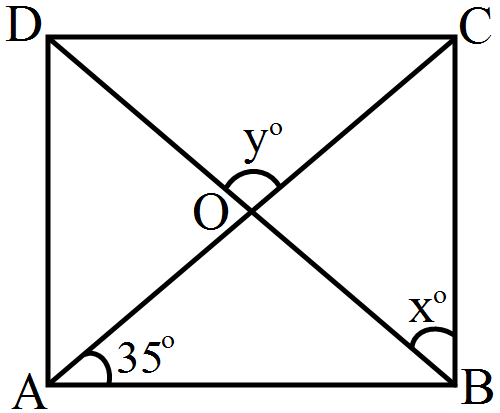
 We know that diagonals of a rectangle are equal and bisect each other.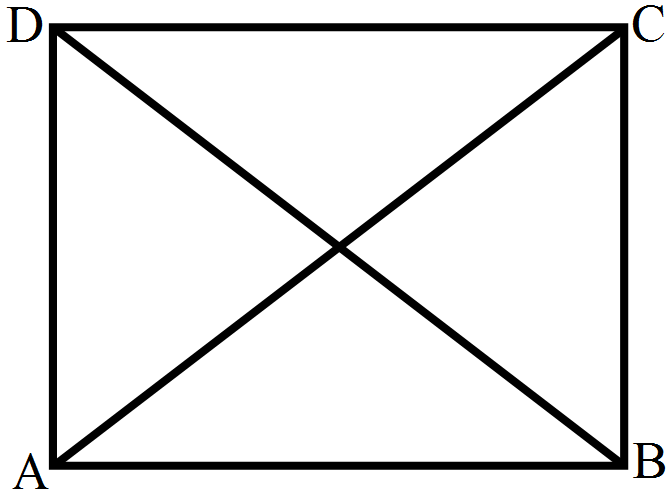
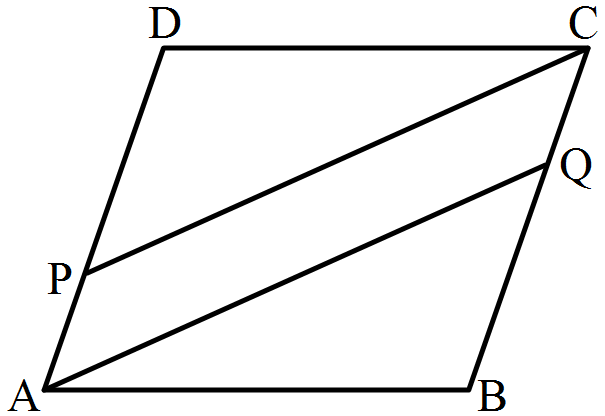
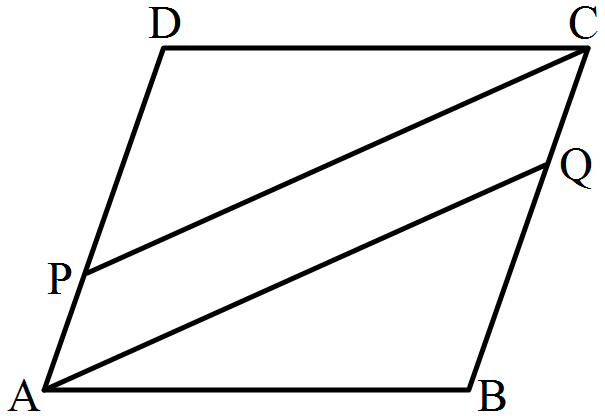
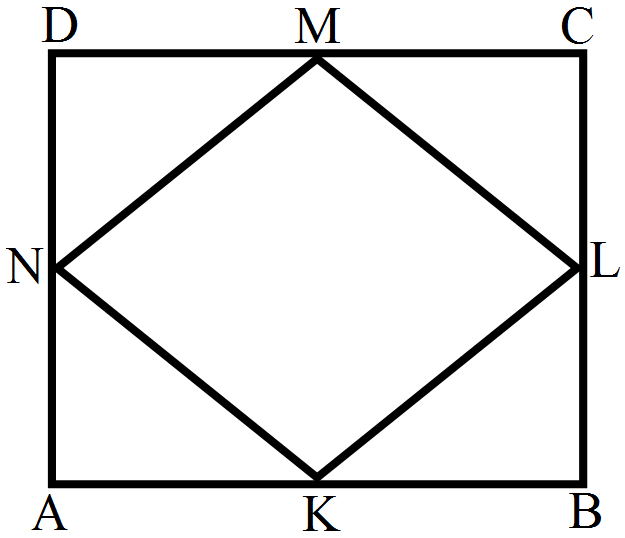 $\text{AK = BL = CM = DN}$ (given)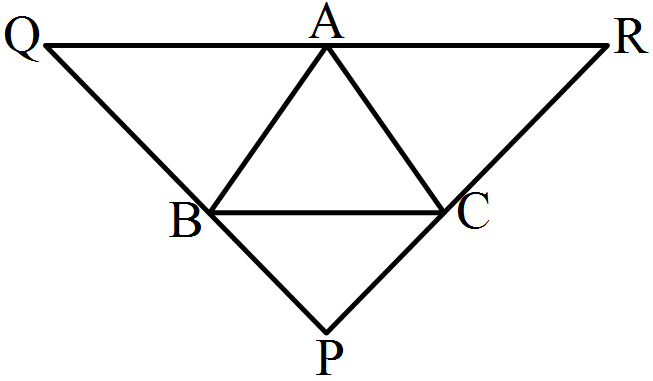
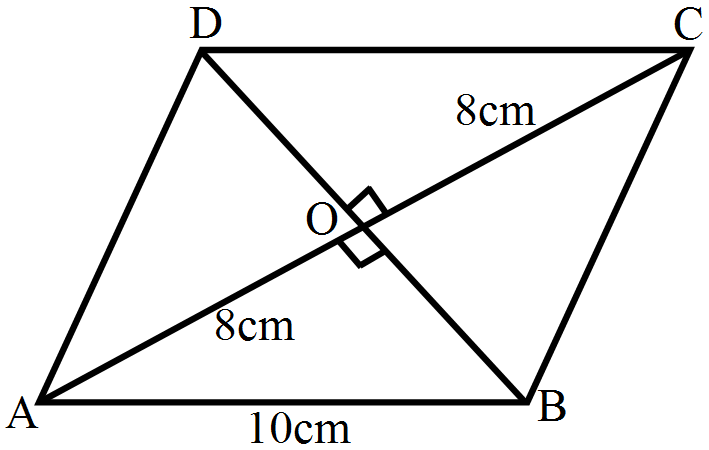 Area of $\triangle\text{ABC}=\frac{1}{2}\times\text{AC}\times\text{OB}$$=\frac{1}{2}\times16\times6=48\text{cm}^2.$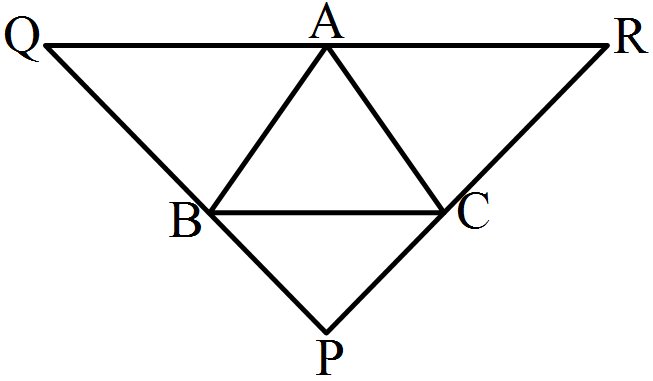
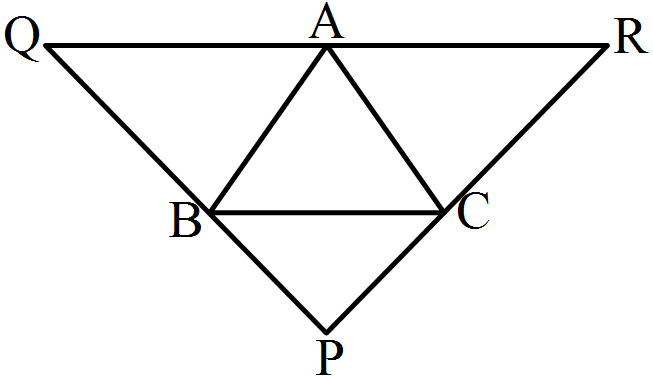
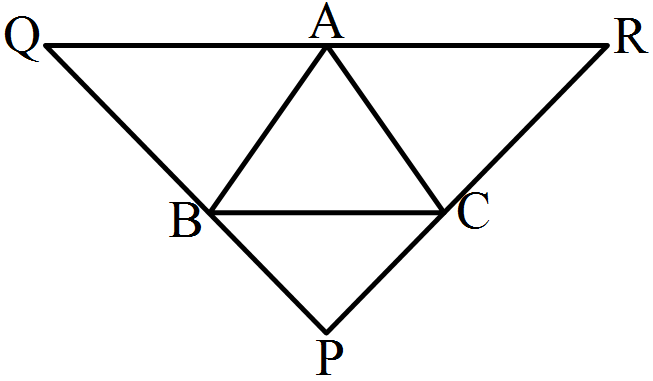 To prove: $\text{BC}=\frac{1}{2}\text{QR}$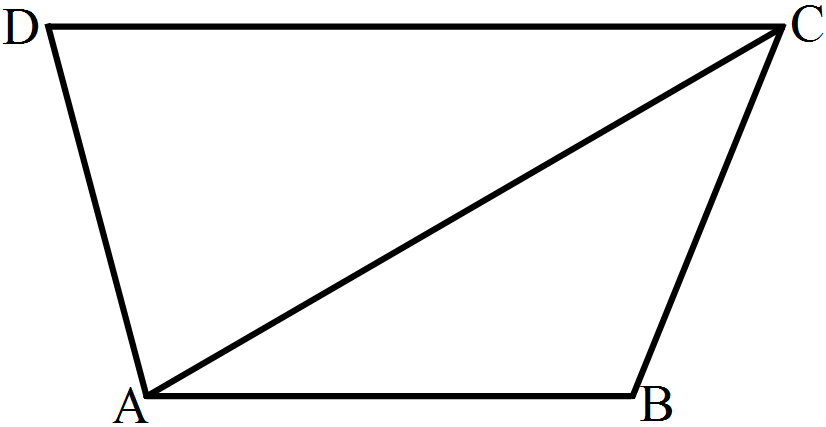
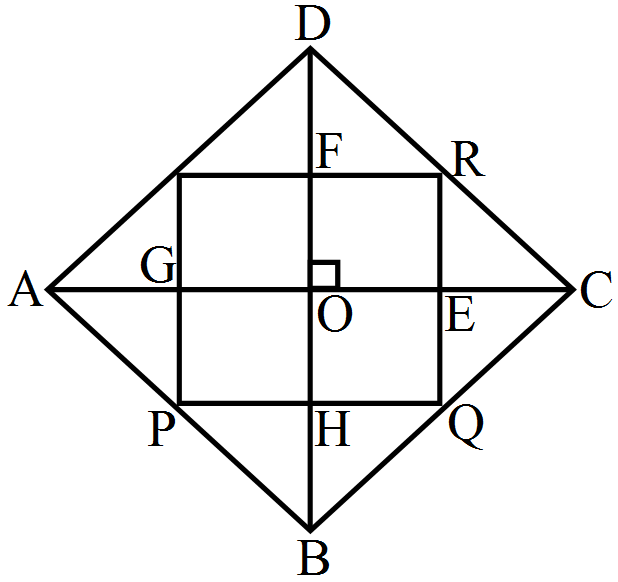
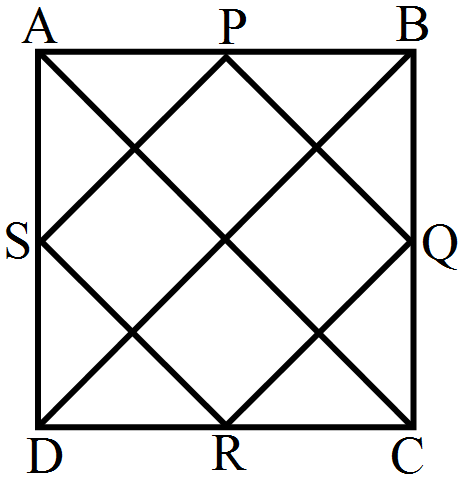 Given: In quadrilateral ABCD, AC = BD and $\text{AC}\perp\text{BD}.$ P, Q, R and S are the mid-points of AB, BC, CD and AD, respectively.
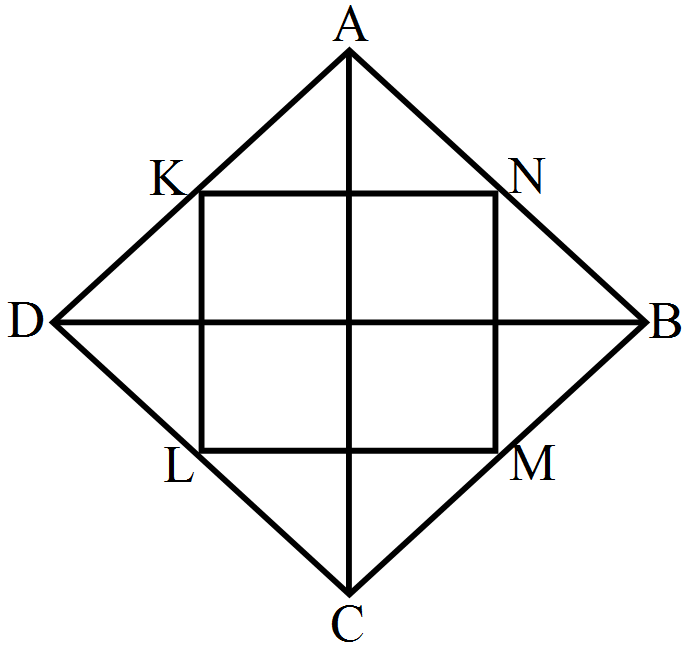 Given: In quadrilateral ABCD, BD = AC and K, L, M and N are the mid-points of AD, CD, BC and AB, respectively. To prove: KLMN is a rhombus. Proof: In $\triangle\text{ADC},$ Since, K and L are the mid-points of sides AD and CD, respectively. So, $\text{KL || AC}$ and $\text{KL}=\frac{1}{2}\text{AC}...(1)$ Similarly, in $\triangle\text{ABC,}$ Since, M and N are the mid-points of sides BC and AB, respectively. So, $\text{NM || AC}$ and $\text{NM}=\frac{1}{2}\text{AC}...(2)$ From (1) and (2), we get$\text{KL = NM}$ and $\text{KL || NM}$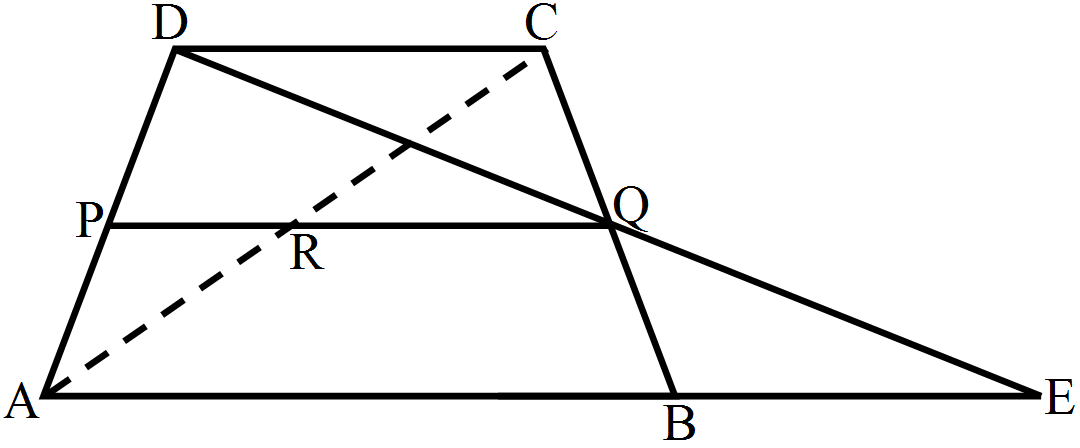
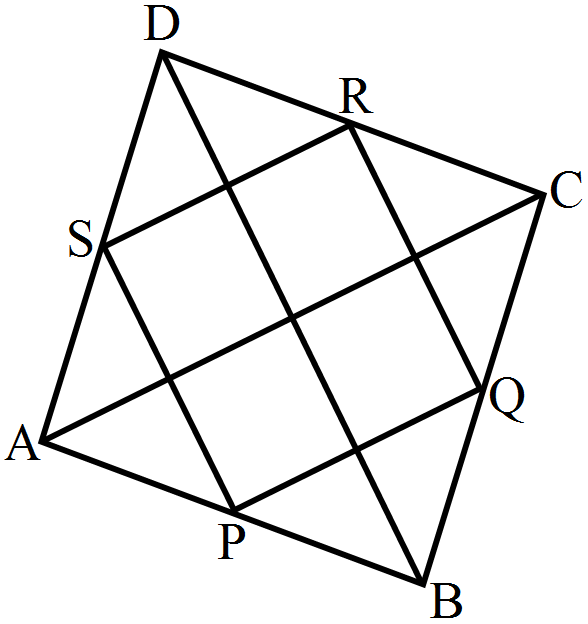 Given: In quadrilateral ABCD, $\text{AC}\perp\text{BD},$ P, Q, R and S are the mid-points of AB, BC, CD and AD, respectively.
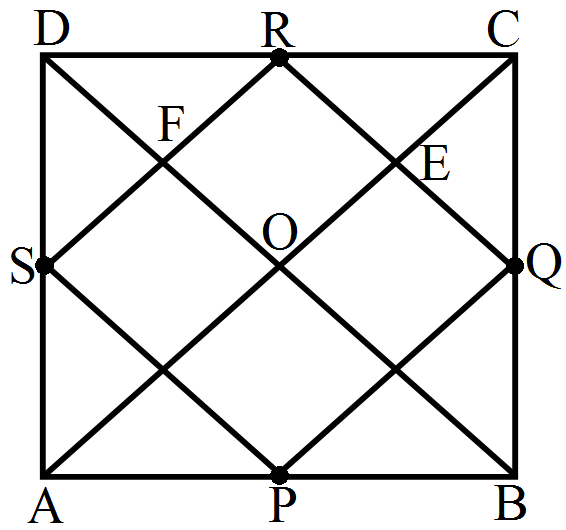 Let ABCD be a square and P, Q, R and S be the midpoints of AB, BC, CD and DA,respectively.