MCQ 1011 Mark
A ladder makes an angle of $60^\circ$ with the ground when placed against a wall. If the foot of the ladder is $2m$ away from the wall, then the length of the ladder is :
AnswerCorrect option: D. $4\text{m}$
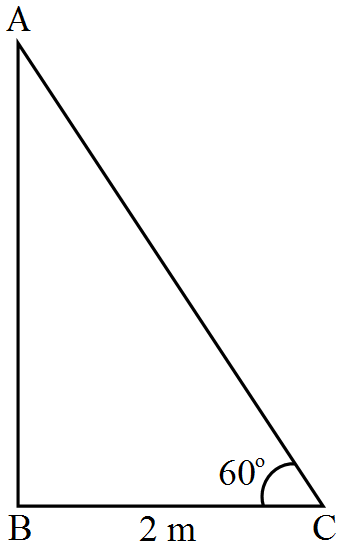
Let $AB$ be the wall and $AC$ be the ladder
We have,
$BC = 2m,$ and $\angle\text{ACB}=60^\circ$
In $\triangle\text{ABC},$
$\cos60^\circ=\frac{\text{BC}}{\text{AC}}$
$\Rightarrow\frac{1}{2}=\frac{2}{\text{AC}}$
$\therefore\ \text{AC}=4\text{m}$ View full question & answer→MCQ 1021 Mark
Two persons are a metres apart and the height of one is double that of the other. If from the middle point of the line joining their feet, an observer finds the angular elevation of their tops to be complementary, then the height of the shorter post is :
AnswerCorrect option: D. $\frac{\text{a}}{2\sqrt{2}}$
Let $AB$ and $CD$ be the two persons such that $AB < CD.$
Then, let $AB = h$ so that $CD = 2h$
Now, the given information can be represented as,
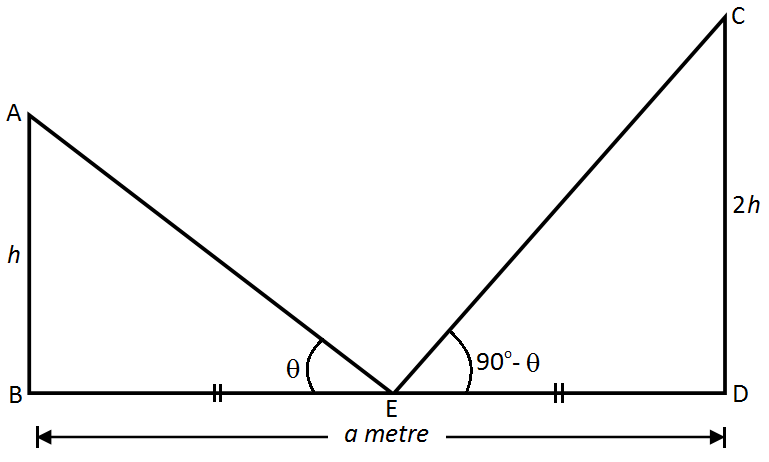
Here, $E$ is the midpoint of $BD$.
We have to find height of the shorter person.
So we use trigonometric ratios.
In triangle $\text{ECD},$
$\tan\angle\text{CED}=\frac{\text{CD}}{\text{ED}}$
$\Rightarrow\ \tan(90^\circ-\theta)=\frac{2\text{h}}{\big(\frac{\text{a}}{2}\big)}$
$\Rightarrow\ \cot\theta=\frac{4\text{h}}{\text{a}}\ ....(1)$
Again in triangle $\text{ABE},$
$\tan\angle\text{AEB}=\frac{\text{AB}}{\text{BE}}$
$\Rightarrow\ \tan\theta=\frac{\text{h}}{\big(\frac{\text{a}}{2}\big)}$
$\Rightarrow\ \frac{1}{\cot\theta}=\frac{2\text{h}}{\text{a}}$
$\Rightarrow\ \frac{\text{a}}{4\text{h}}=\frac{2\text{h}}{\text{a}}$
$\Rightarrow\ \text{a}^2=8\text{h}^2$
$\Rightarrow\ \text{h}=\frac{\text{a}}{2\sqrt{2}}$ View full question & answer→MCQ 1031 Mark
The angle of depression of a car, standing on the ground, from the top of a 75m tower, is 30°. The distance of the car from the base of the tower (in metres) is:
- ✓
$25\sqrt{3}$
- B
$50\sqrt{3}$
- C
$75\sqrt{3}$
- D
$150$
AnswerCorrect option: A. $25\sqrt{3}$
(A) $25\sqrt{3}$
View full question & answer→MCQ 1041 Mark
A pole stands vertically, inside a triangular park $\text{ABC}$. If the angle of elevation of the top of the pole from each corner of the park is same, then the foot of the pole is at the :
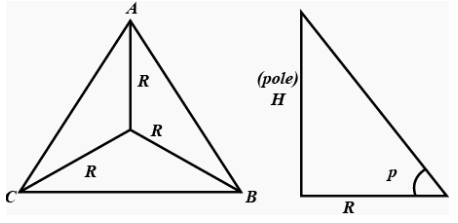
AnswerIf angle of elevation $(p)$ is same from all the vertices then the Pole must be at Equal Distance from each of the vertices which will be $= R\ ($Circumradius$)$
as $\tan\text{p}=\frac{\text{H}}{\text{R}}$
$\Rightarrow\frac{\text{H}}{\tan\text{p}}\ [$which is same from all vertices$]$
therefore, the pole must be lying on the Circumcenter
View full question & answer→MCQ 1051 Mark
The length of the shadow of a $20m$ tall pole on the ground when the sun’s elevation is $45^\circ$ is :
- A
$20\sqrt2\text{m}$
- ✓
$20\text{m}$
- C
$40\text{m}$
- D
$20\sqrt3\text{m}$
AnswerCorrect option: B. $20\text{m}$
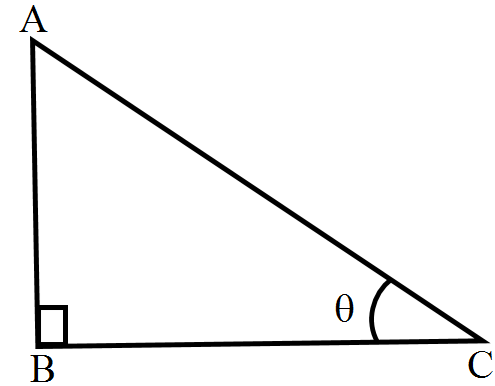
Given : Height of pole $= AB = 20$m and angle of elevation $\theta=45^\circ$
Let lenght of shadow of pole $= BC = x$ meters.
$\therefore\tan45^\circ=\frac{\text{AB}}{\text{BC}}$
$\Rightarrow1=\frac{20}{\text{x}}$
$\Rightarrow\text{x}=20\text{m}$
Therefore, the lenght of the shadow of the pole is $20m.$ View full question & answer→MCQ 1061 Mark
If two trees of height $'x\ ’$ and $'y\ ’$ standing on the two ends of a road subtend angles of $30^\circ$ and $60^\circ$ respectively at the midpoint of the road, then the ratio of $x : y$ is :
- A
$1 : 1$
- B
$1 : 2$
- C
$3 : 1$
- ✓
$1 : 3$
AnswerCorrect option: D. $1 : 3$
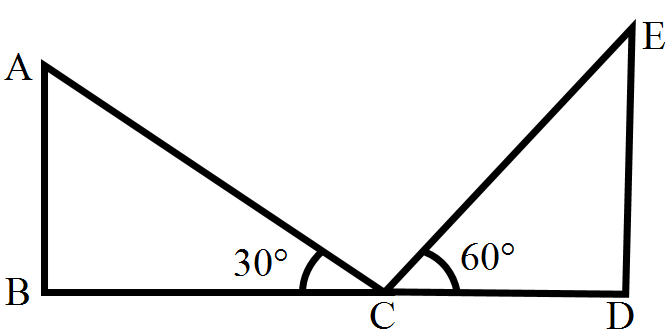
Here two trees $AB$ abd $ED$ are of height $x$ and $y$ respectively. And $BC = CD$
$\therefore\tan30^\circ=\frac{\text{x}}{\text{BC}}$
$\Rightarrow\frac{1}{\sqrt3}=\frac{\text{x}}{\text{BC}}$
$\Rightarrow\text{x}=\frac{\text{BC}}{\sqrt3}$ And $\tan60^\circ=\frac{\text{y}}{\text{CD}}$
$\Rightarrow\sqrt3=\frac{\text{y}}{\text{CD}}$
$\Rightarrow\text{y}=\text{CD}\sqrt3=\text{BC}\sqrt3 \ [BC = CD]$
Now, $\frac{\text{x}}{\text{y}}=\frac{\text{BC}}{\sqrt3\times\text{BC}\sqrt3}=\frac{1}{3}$
$\Rightarrow\text{x}:\text{y}=1:3$ View full question & answer→MCQ 1071 Mark
A man standing on a level plane observes the elevation of the top of a pole to be $\alpha$ . He then walks a distance equal to double the height of the pole and then finds that the elevation is now $2\alpha$ . Then $\alpha =$
- A
$30^\circ$
- ✓
$15^\circ$
- C
$60^\circ$
- D
$45^\circ$
AnswerCorrect option: B. $15^\circ$
$15^\circ$
View full question & answer→MCQ 1081 Mark
A ladder makes an angle of $60^\circ$ with the ground when placed against a wall. If the foot of the ladder is $2m$ away from the wall, then the length of the ladder $($in metres$)$ is :
- A
$\frac{4}{\sqrt{3}}$
- B
$4\sqrt{3}$
- C
$2\sqrt{2}$
- ✓
$4$
Answer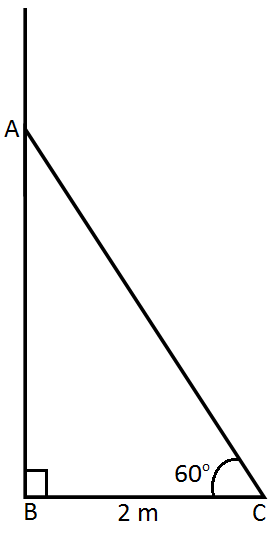
Suppose $AC$ is the ladder and $BC$ is the distance of the foot of the ladder from the wall.
It is given that $, BC = 2m$ and $\angle\text{ACB}=60^\circ.$
In right $\triangle\text{ABC,}$
$\cos60^\circ=\frac{\text{BC}}{\text{AC}}$
$\Rightarrow\ \frac{1}{2}=\frac{2}{\text{AC}}$
$\Rightarrow\ \text{AC}=4\text{m}$
Thus, the length of the ladder is $4m.$ View full question & answer→MCQ 1091 Mark
In a $\triangle\text{ABC}$ right angled at $B, \angle\text{A}=30^\circ$ and $AC = 6\ cm,$ then the lenght of $BC$ is :
- A
$3\sqrt3\text{ cm}$
- B
$2\sqrt3\text{ cm}$
- ✓
$3\text{ cm}$
- D
$4\sqrt3\text{ cm}$
AnswerCorrect option: C. $3\text{ cm}$
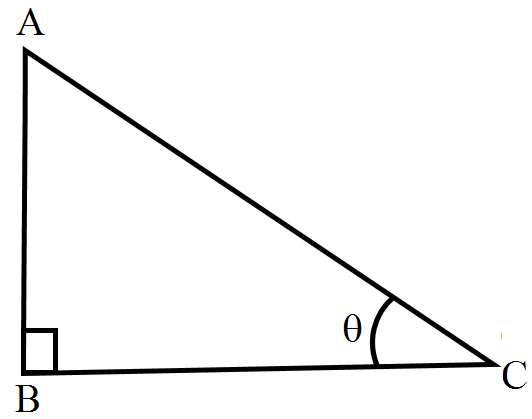
In triangle $\text{ABC}, \angle\text{A}=30^\circ,$ and $AC = 6\ cm$
Then the lenght of $BC,$
$\sin30^\circ=\frac{\text{BC}}{6}$
$\Rightarrow\frac{1}{2}=\frac{\text{BC}}{6}$
$\Rightarrow\text{BC}=\frac{6}{2}=3\text{ cm}$
$=\frac{6}{2}=3\text{ cm}$
Therefore, the length of $BC$ is $3\ cm$. View full question & answer→MCQ 1101 Mark
The angle of elevation of a cliff from a point $A$ on the ground and from the point $B 100m$ vertically above $A$ are $\alpha$ and $\beta$ respectively. The height of the cliff $($in metres$)$ is :
- A
$\frac{100\tan\beta}{\cot\beta-\cot\alpha}$
- ✓
$\frac{100\cot\beta}{\cot\beta-\cot\alpha}$
- C
$\frac{100\tan\beta}{\cot\alpha+\cot\beta}$
- D
$\frac{100\cot\beta}{\cot\alpha+\cot\beta}$
AnswerCorrect option: B. $\frac{100\cot\beta}{\cot\beta-\cot\alpha}$
$\frac{100\cot\beta}{\cot\beta-\cot\alpha}$
View full question & answer→MCQ 1111 Mark
A kite is flying at a height of $90m$ above the ground. The string attached to the kite is temporarily tied to a point on the ground. The inclination of the string with the ground is $60^\circ.$ The length of the string, assuming that there is no slack in the string is :
- ✓
$60\sqrt3\text{m}$
- B
$90\text{m}$
- C
$90\sqrt3\text{m}$
- D
$45\text{m}$
AnswerCorrect option: A. $60\sqrt3\text{m}$
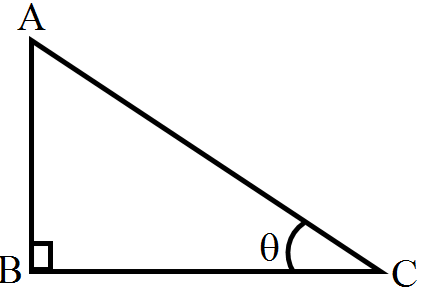
Let Height of the flying kite $= AB = 90m$
And the angle of elevation $=\theta=60^\circ$
And the length of the string $= AC$
$\therefore\sin60^\circ=\frac{\text{AB}}{\text{AC}}$
$\Rightarrow\frac{\sqrt3}{2}=\frac{90}{\text{AC}}$
$=\text{AC}=\frac{90\times2}{\sqrt3}\times\frac{\sqrt3}{\sqrt3}$
$=60\sqrt3\text{m}$ View full question & answer→MCQ 1121 Mark
If the angle of depression of an object from a $75m$ high tower is $30^\circ,$ then the distance of the object from the tower is :
- A
$25\sqrt{3}\text{m}$
- B
$50\sqrt{3}\text{m}$
- C
$100\sqrt{3}\text{m}$
- ✓
$75\sqrt{3}\text{m}$
AnswerCorrect option: D. $75\sqrt{3}\text{m}$
In triangle $\text{ABC},$
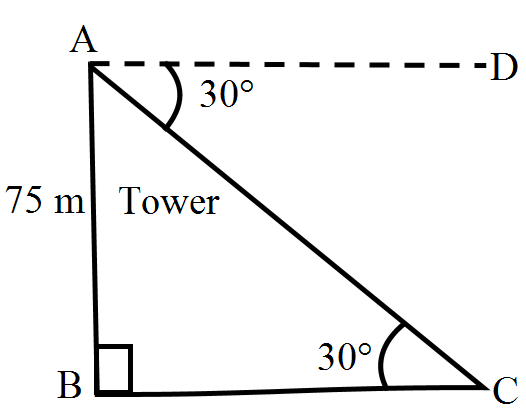
$\tan30^\circ=\frac{\text{AB}}{\text{BC}}$
$\Rightarrow\frac{1}{\sqrt3}=\frac{75}{\text{BC}}$
$\Rightarrow\text{BC}=75\sqrt3\text{m}$
Therefore, the distance between $P$ and foot of the tower is $75\sqrt{3}\text{ meters}.$ View full question & answer→MCQ 1131 Mark
The $..........$ is the line drawn from the eye of an observer to the point in the object viewed by the observer.
AnswerThe line of sight is the imaginary line drawn from the eye of an observer to the point in the object viewed by the observer.
The angle between the line of sight and the ground is called angle of elevation.
View full question & answer→MCQ 1141 Mark
If the angles of elevation of a tower from two points at distances $'m\ ’$ and $'n\ ’$ where $m > n$ from its foot and in the same line from it are $30^\circ$ and $60^\circ ,$ then the height of the tower is :
- A
$\sqrt{\text{m}+\text{n}}$
- ✓
$\sqrt{\text{m}\text{n}}$
- C
$\sqrt\frac{\text{m}}{\text{n}}$
- D
$\sqrt{\text{m}-\text{n}}$
AnswerCorrect option: B. $\sqrt{\text{m}\text{n}}$
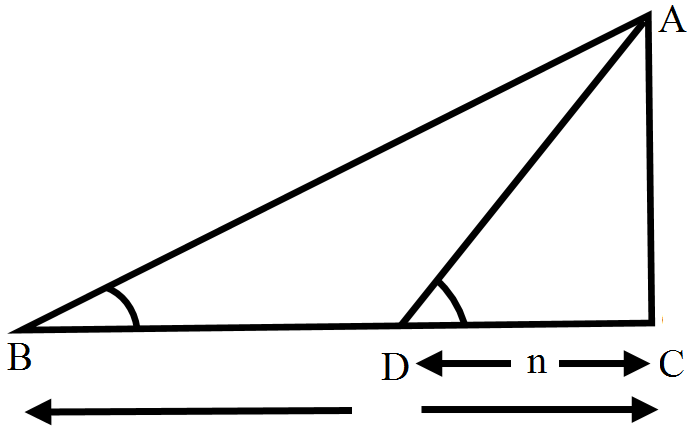
In triangle $\text{ABC}, \angle\text{ABC}=30^\circ$
$\tan30^\circ=\frac{\text{h}}{\text{m}}$
$\Rightarrow\frac{1}{\sqrt3}=\frac{\text{h}}{\text{m}}$
$\Rightarrow\text{h}=\frac{\text{m}}{\sqrt3}.....(\text{i})$
In triangle $\text{ADC}, \angle\text{ADC}=60^\circ$
$\tan60^\circ=\frac{\text{h}}{\text{n}}$
$\Rightarrow\sqrt3=\frac{\text{h}}{\text{n}}$
$\Rightarrow\text{h}=\text{n}\sqrt3.....(\text{ii})$ View full question & answer→MCQ 1151 Mark
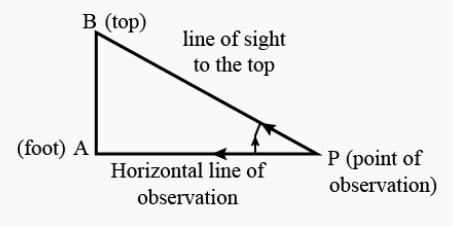
The angle of elevation of an object viewed is the angle formed by the line of sight with the horizontal when it is :
- ✓
Above the horizontal level
- B
Below the horizontal level
- C
- D
AnswerCorrect option: A. Above the horizontal level
In the figure $,AB$ is a vertical object with $A$ as foot and $B$ as top.
$P$ is the point of observation.
So $,PA$ is the line of horizontal sight and we have to raise our head if we look at $B.$
The angle, described in this case $\angle\text{PAB}$ when $PB$ is the line of sight.
But by definition, $\angle\text{APB}$ is the angle of elevation.
View full question & answer→MCQ 1161 Mark
If the height of the tower is $\sqrt{3}$ times of the length of its shadow, then the angle of elevation of the sun is :
- A
$15^\circ$
- B
$30^\circ$
- ✓
$60^\circ$
- D
$45^\circ$
AnswerCorrect option: C. $60^\circ$
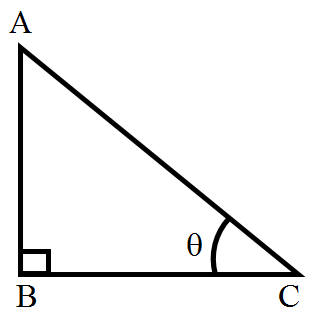
Let the length of the shadow be $x$ meters.
Then the height of the tower be $\sqrt{3}\text{x}\text{ meter}.$
$\therefore\tan\theta=\frac{\text{AB}}{\text{BC}}$
$\Rightarrow\tan\theta=\frac{\sqrt{3}\text{x}}{\text{x}}$
$\Rightarrow\tan\theta=\sqrt{3}$
$\Rightarrow\tan\theta=\tan60^\circ$
$\Rightarrow\theta=60^\circ$ View full question & answer→MCQ 1171 Mark
If the length of the shadow of a tower is $\sqrt{3}\text{ times}$ its height then the angle of elevation of the sun is :
- A
$45^\circ$
- ✓
$30^\circ$
- C
$60^\circ$
- D
$90^\circ$
AnswerCorrect option: B. $30^\circ$
Let $AB$ be the pole and $BC$ be its shadow.
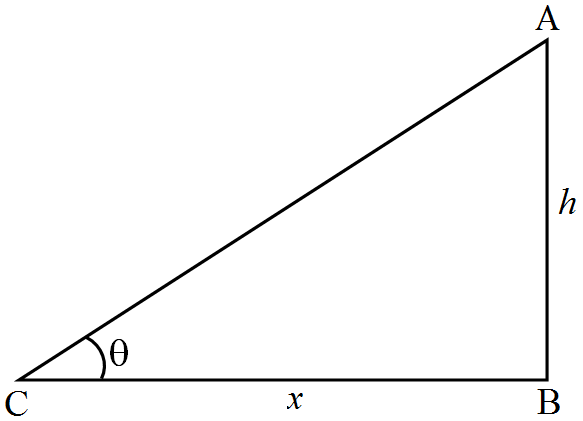
Let $AB = h$ and $BC = x$ such that $\text{x}=\sqrt{3}\text{h}\ ($given$)$ and $\theta$ be the angle of elevation.
From $\triangle\text{ABC},$ we have:
$\frac{\text{AB}}{\text{BC}}=\tan\theta$
$\Rightarrow\frac{\text{h}}{\text{x}}=\frac{\text{h}}{\sqrt{3}\text{h}}=\tan\theta$
$\Rightarrow\tan\theta=\frac{1}{\sqrt{3}\text{h}}$
$\Rightarrow\theta=30^\circ$ View full question & answer→MCQ 1181 Mark
The length of the shadow of a tower standing on level ground is found to be $2x$ metres longer when the sun's elevation is $30^\circ$ than when it was $45^\circ$ . The height of the tower in metres is :
- ✓
$(\sqrt{3}+1)\text{x}$
- B
$(\sqrt{3}-1)\text{x}$
- C
$2\sqrt{3}\text{x}$
- D
$3\sqrt{2}\text{x}$
AnswerCorrect option: A. $(\sqrt{3}+1)\text{x}$
Let $h$ be the height of tower $AB.$
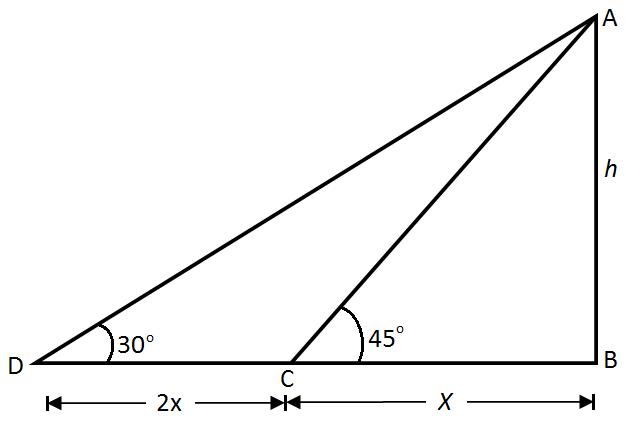
Given that : angle of elevation of sun are $\angle\text{D}=30^\circ$ and $\angle\text{C}=45^\circ.$
Then Distance $CD = 2x$ and we assume $BC = X$
Here, we have to find the height of tower.
So we use trigonometric ratios.
In a triangle $\text{ABC},$
$\Rightarrow\ \tan\text{C}=\frac{\text{AB}}{\text{BC}}$
$\Rightarrow\ \tan45^\circ=\frac{\text{AB}}{\text{BC}}$
$\Rightarrow\ 1=\frac{\text{h}}{\text{X}}$
$\Rightarrow\ \text{X}=\text{h}$
Again in a triangle $\text{ABD},$
$\Rightarrow\ \tan\text{D}=\frac{\text{AB}}{\text{BC}+\text{CD}}$
$\Rightarrow\ \tan30^\circ=\frac{\text{h}}{\text{X}+2\text{x}}$
$\Rightarrow\ \frac{1}{\sqrt{3}}=\frac{\text{h}}{\text{h}+2\text{x}} [X = h]$
$\Rightarrow\ \sqrt{3}\text{h}=\text{h}+2\text{x}$
$\text{h}(\sqrt{3}-1)=2\text{x}$
$\Rightarrow\ \text{h}=\frac{2\text{x}}{\sqrt{3}-1}$
$\Rightarrow\ \text{h}=\frac{2\text{x}}{\sqrt{3}-1}\times\frac{\sqrt{3}+1}{\sqrt{3}+1}$
$\Rightarrow\ \text{h}=\text{x}(\sqrt{3}+1)$ View full question & answer→MCQ 1191 Mark
If in a $ \triangle\text{ABC}, \angle\text{C}=90^\circ$ and $\angle\text{B}=45^\circ,$ then state which of the following is true?
AnswerCorrect option: C. Base $=$ Perpendicular
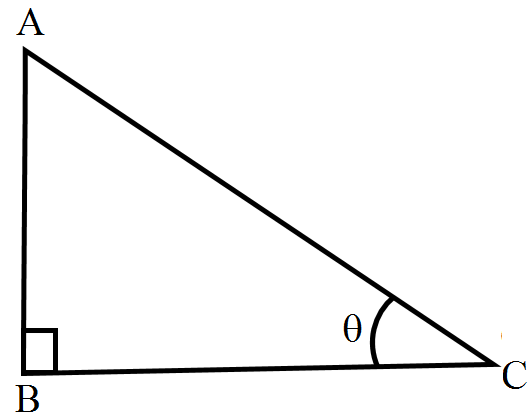
Given : in triangle $\text{ABC}, \angle\text{C}=45^\circ,$ and $\angle\text{B}=90^\circ,$
Since, $\tan\theta=\frac{\text{Perpendicular}}{\text{Base}}$
$\Rightarrow\tan45^\circ=\frac{\text{Perpendicular}}{\text{Base}}$
$1=\frac{\text{Perpendicular}}{\text{Base}}$
$\Rightarrow\text{Base}=\text{Perpendicular}.$ View full question & answer→MCQ 1201 Mark
From a point on the ground which is $15m$ away from the foot of a tower, the angle of elevation is found to be $60^{\circ}$. The height of the tower is :
- A
$10\text{m}$
- B
$10\sqrt3\text{m}$
- C
$20\sqrt3\text{m}$
- ✓
$15\sqrt3\text{m}$
AnswerCorrect option: D. $15\sqrt3\text{m}$
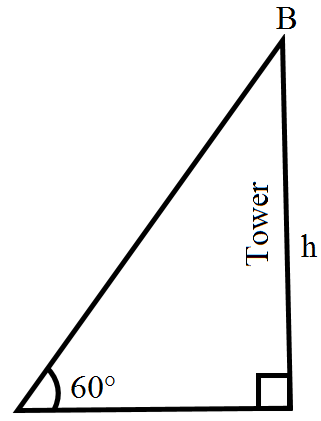
Let the height of the tower be $h$ meters.
In triangle $\text{AOB},$
$\tan60^\circ=\frac{\text{AB}}{\text{OA}}$
$\Rightarrow\tan60^\circ=\frac{\text{h}}{15}$
$\Rightarrow\sqrt3=\frac{\text{h}}{15}$
$\Rightarrow\text{h}=15\sqrt3\text{m}$
Therefore the height of the tower is $15\sqrt3\text{ meters}.$ View full question & answer→MCQ 1211 Mark
A kite is flying at a height of $200m$ above the ground. The string attached to the kite is temporarily tied to a point on the ground. The inclination of the string with the ground is $45^\circ$ . The length of the string, assuming that there is no slack in the string is :
- A
$100\text{m}$
- ✓
$200\sqrt3\text{m}$
- C
$200\text{m}$
- D
$100\sqrt2\text{m}$
AnswerCorrect option: B. $200\sqrt3\text{m}$
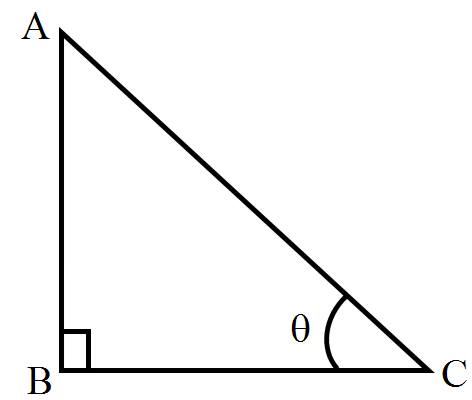
Here, in triangle $\text{ABC},$ Height of the slide $= AB = 200m$
Angle of elevation $= \theta=45^\circ$
To find : Length of string $= AC$
$\therefore\sin45^\circ=\frac{\text{AB}}{\text{AC}}$
$\Rightarrow\frac{1}{\sqrt{2}}=\frac{200}{\text{AC}}$
$\Rightarrow\text{AC}=200\sqrt2\text{m}$ View full question & answer→MCQ 1221 Mark
In a right triangle $\text{ABC}, \angle\text{C}=90^\circ.$ If $\text{AC}=\sqrt3 BC$ and $ \angle\text{B}=\phi,$ then find its value.
- ✓
$60^\circ$
- B
$30^\circ$
- C
$45^\circ$
- D
AnswerCorrect option: A. $60^\circ$
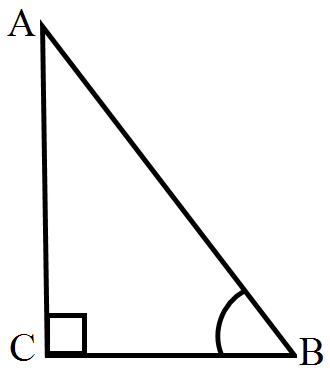
Given : $\angle\text{C}=90^\circ.$
If $\text{AC}=\sqrt3 BC$ and $ \angle\text{B}=\phi,$
$\therefore\tan\phi=\frac{\text{AC}}{\text{BC}}$
$\Rightarrow\tan\phi=\frac{\sqrt3\text{BC}}{\text{BC}}=\sqrt3$
$\Rightarrow\tan\phi=\tan60^\circ\phi$
$\Rightarrow\phi=60^\circ$ View full question & answer→MCQ 1231 Mark
A pole casts a shadow of length $2\sqrt{3}\text{m}$ on the ground when the sun's elevation is $60^\circ$ . The height of the pole is :
- A
$4\sqrt{3}\text{m}$
- ✓
$6\text{m}$
- C
$12\text{m}$
- D
$3\text{m}$
AnswerCorrect option: B. $6\text{m}$
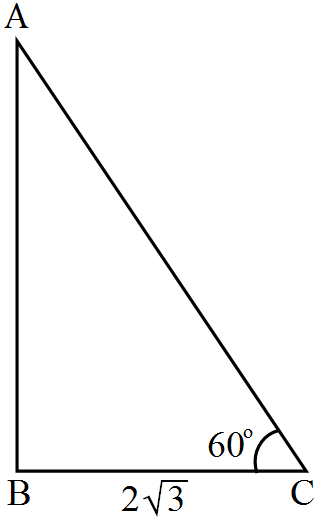
Let $AB $ be the pole and $BC$ be its shadow.
We have,
$\text{BC}=2\sqrt{3}\text{m}$ and $\angle\text{ACB}=60^\circ$
In $\triangle\text{ABC},$
$\tan60^\circ=\frac{\text{AB}}{\text{BC}}$
$\Rightarrow\sqrt{3}=\frac{\text{AB}}{2\sqrt{3}}$
$\therefore\ \text{AB}=6\text{m}$ View full question & answer→MCQ 1241 Mark
A pole $6m$ high casts a shadow $2\sqrt{3}\text{m}$ long on the ground, then the Sun's elevation is :
- ✓
$60^\circ$
- B
$45^\circ$
- C
$30^\circ$
- D
$90^\circ$
AnswerCorrect option: A. $60^\circ$
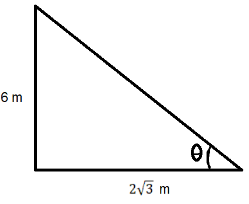
The sun's elevation angle will be opposite to the side which depicts the height of the pole, and base will be the length of the shadow.
$\text{Base}=2\sqrt{3}\text{m}$
$\text{height = 6m}$
$\tan(\theta)=\frac{6}{2\sqrt{3}}=\sqrt{3}$
$\theta=\tan^{-1}(\sqrt{3})$
$=60^\circ$
$\theta$ being the angle of elevation.
View full question & answer→MCQ 1251 Mark
A ladder $12m$ long rests against a wall. If it reaches the wall at a height of $6\sqrt3\text{m},$ then the angle of elevation is :
- A
$30^\circ$
- B
$45^\circ$
- C
$75^\circ$
- ✓
$60^\circ$
AnswerCorrect option: D. $60^\circ$
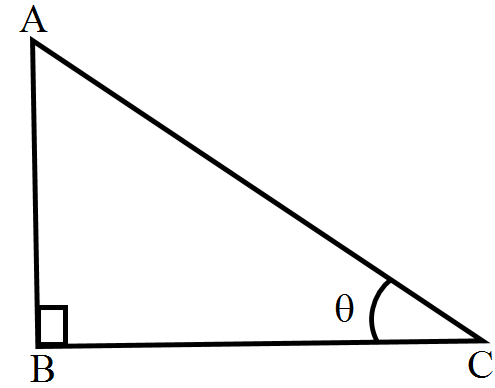
Then the height $AB$ is $6\sqrt3\text{ meter}.$
$\therefore\sin\theta=\frac{\text{AB}}{\text{AC}}$
$\Rightarrow\sin\theta=\frac{6\sqrt3}{12}$
$\Rightarrow\sin\theta=\frac{\sqrt3}{2}$
$\Rightarrow\sin\theta=\sin60^\circ$
$\Rightarrow\theta=60^\circ$ View full question & answer→MCQ 1261 Mark
If a kite is flying at a height of $10\sqrt3\text{m}$ from the level ground attached to a string inclined at $60^\circ$ to the horizontal then the length of the string is :
- A
$40\sqrt3\text{m}$
- B
$60\sqrt3\text{m}$
- C
$80\sqrt3\text{m}$
- ✓
$20\text{m}$
AnswerCorrect option: D. $20\text{m}$
Let $AB$ be the length of the string and $\text{AC}=10\sqrt3\text{m}$
And $\angle\text{ABC}=60^\circ$
In triangle $\text{ABC},$
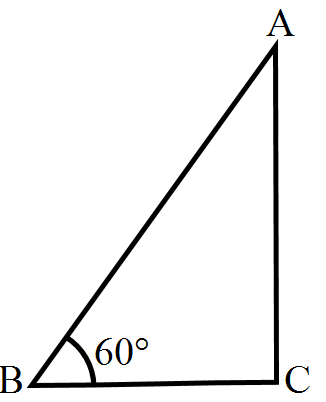
$\sin60^\circ=\frac{\text{AC}}{\text{AB}}$
$\Rightarrow\frac{\sqrt3}{2}=\frac{10\sqrt3}{\text{AB}}$
$\Rightarrow\text{AB}=\frac{10\sqrt3\times2}{\sqrt3}=20\text{ cm}$
Therefore, the lenght of the strigh is $20m$. View full question & answer→MCQ 1271 Mark
The ratio of the length of a rod and its shadow is $1:\sqrt{3}.$ The angle of elevation of the sum is :
- ✓
$30^\circ$
- B
$45^\circ$
- C
$60^\circ$
- D
$90^\circ$
AnswerCorrect option: A. $30^\circ$
Let $\theta$ be angle of elevation of sun.
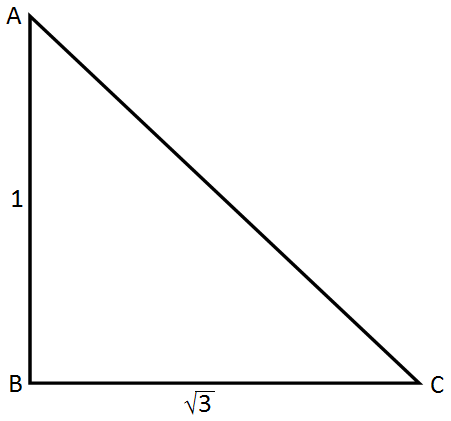
Given that : length of road $AB = 1$ and its shadow $\text{BC}=\sqrt{3}$
Here, we have to find angle of elevation of sun.
So we use trigonometric ratios.
In a triangle $\text{ABC},$
$\Rightarrow\ \tan\text{C}=\frac{\text{AB}}{\text{BC}}$
$\Rightarrow\ \tan\theta=\frac{1}{\sqrt{3}}$
$\Big[\because\ \tan30^\circ=\frac{1}{\sqrt{3}}\Big]$
$\Rightarrow\ \theta=30^\circ$ View full question & answer→MCQ 1281 Mark
A pole $10m$ high cast a shadow $10m$ long on the ground, then the sun’s elevation is :
- A
$15^\circ$
- ✓
$45^\circ$
- C
$30^\circ$
- D
$60^\circ$
AnswerCorrect option: B. $45^\circ$
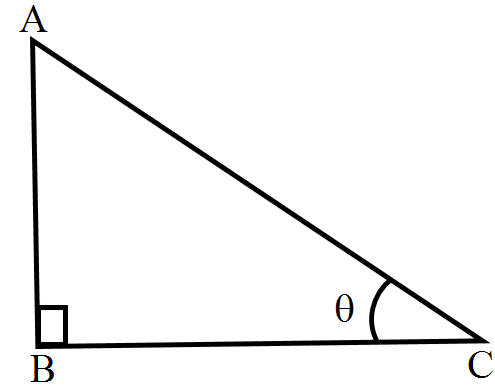
Let the lenght of the shadow $BC$ be $10$ meters.
Then the height of the pole $AB$ is $10$ meter.
$\therefore\tan\theta=\frac{\text{AB}}{\text{BC}}$
$\Rightarrow\tan\theta=\frac{10}{10}$
$\Rightarrow\tan\theta=1$
$\Rightarrow\tan\theta=\tan45^\circ$
$\Rightarrow\theta=45^\circ$ View full question & answer→MCQ 1291 Mark
A kite is flying at a height of $60m$ from the level ground, attached to a string inclined at $30^\circ$ to the horizontal. The length of the string is :
- A
$40\sqrt3\text{m}$
- B
$60\sqrt3\text{m}$
- ✓
$120\text{m}$
- D
$\text60\text{m}$
AnswerCorrect option: C. $120\text{m}$
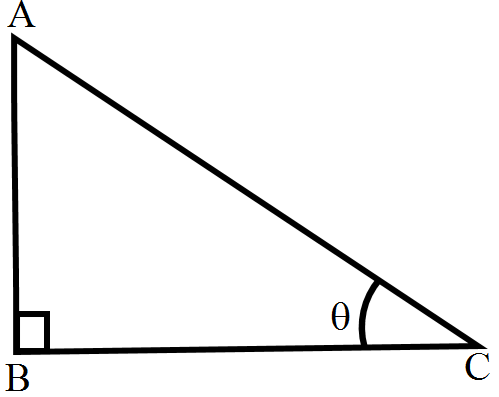
Let kite is flying at a height $AB = 60m$ and angle of elevation $= 30^\circ$
To find : Length of the the string $AC$
$\therefore\sin30^\circ=\frac{\text{AC}}{\text{AB}}$
$\Rightarrow\frac{1}{2}=\frac{6}{\text{AB}}\text{m}$
$\Rightarrow\text{AB}=120\text{m}$
Therefore, the lenght of string is $120m.$ View full question & answer→MCQ 1301 Mark
$A$ and $B$ are two stations due north and south of a tower of height $25m$. The angles of depression of the stations from the top of the towe $r$ observed to be $30^\circ$ and $45^\circ$ respectively. The distance between the two stations is :
- ✓
$25(\sqrt{3}+1)$
- B
$25(\sqrt{3}-1)\text{m}$
- C
$25\sqrt{3}\text{m}$
- D
$25(2+\sqrt{3})\text{m}$
AnswerCorrect option: A. $25(\sqrt{3}+1)$
$\tan45^\circ=\frac{25}{\text{d}_2}$
$\text{d}_2=25$
$\tan30^\circ=\frac{25}{\text{d}_1}$
$\text{d}_1=25\sqrt{3}$
$\text{d}_1+\text{d}_2=25(\sqrt{3}+1)\text{m}$
View full question & answer→MCQ 1311 Mark
If the altitude of the sum is at $60^\circ,$ then the height of the vertical tower that will cast a shadow of length $30m$ is :
AnswerCorrect option: A. $30\sqrt{3}\text{m}$
Let $h$ be the height of vertical tower $AB.$
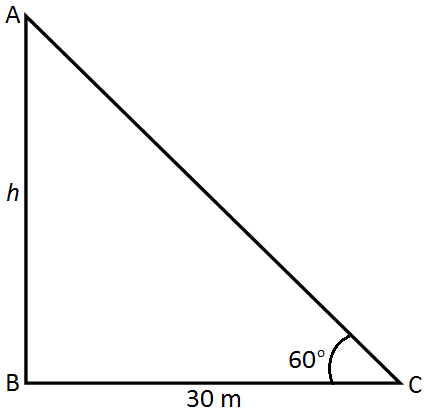
Given that : altitude of sun is $60^\circ$ and shadow of length $BC = 30$ meters.
Here, we have to find the height of tower.
So we use trigonometric ratios.
In a triangle $\text{ABC},$
$\Rightarrow\ \tan\text{C}=\frac{\text{AB}}{\text{BC}}$
$\Rightarrow\ \tan60^\circ=\frac{\text{AB}}{\text{BC}}$
$\Rightarrow\ \sqrt{3}=\frac{\text{h}}{30}$
$\Rightarrow\ \text{h}=30\sqrt{3}$ View full question & answer→MCQ 1321 Mark
A bridge across a river makes an angle of $45^\circ$ with the river bank. If the length of the bridge across the river is $200m,$ then the breadth of the river is :
- ✓
$100\sqrt2\text{m}$
- B
$200\sqrt2\text{m}$
- C
$200\text{m}$
- D
$100\text{m}$
AnswerCorrect option: A. $100\sqrt2\text{m}$
Let the breadth of the river be $h$ meters.
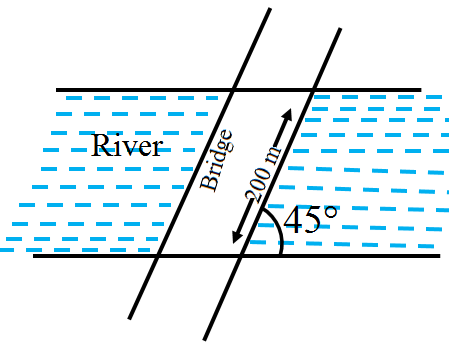
$\sin45^\circ=\frac{\text{h}}{200}$
$\Rightarrow\frac{1}{\sqrt2}=\frac{\text{h}}{200}$
$\Rightarrow\text{h}=\frac{200}{\sqrt2}$
$\Rightarrow\text{h}=\frac{200}{\sqrt2}\times\frac{\sqrt2}{\sqrt2}$
$=100\sqrt2\text{ meters}$
Therefore, the breadth of the river is $100\sqrt2\text{ meters}.$ View full question & answer→MCQ 1331 Mark
The angles of depression of two ships from the top of a light house are $45^\circ$ and $30^\circ$ towards east. If the ships are $100m$ apart. the height of the light house is :
AnswerCorrect option: C. $50(\sqrt{3}-1)\text{m}$
Let $AB$ be the light house $C$ and $D$ are two ships whose angles of depression on $A$ are $30^\circ $ and $45^\circ $ respectively.
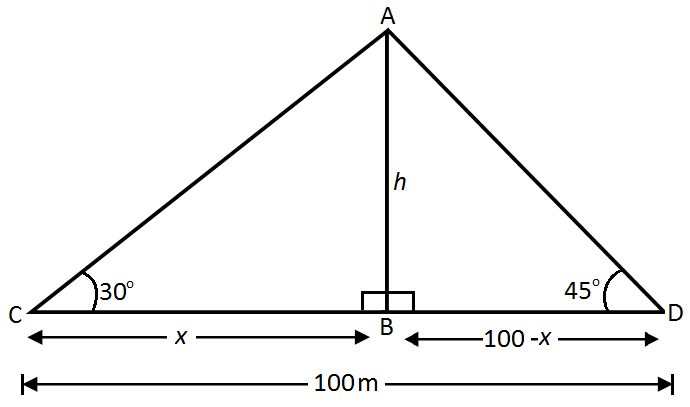
$\because \text{XAY} \| CD$
$\therefore\ \angle\text{ACB}=\angle\text{XAC}=30^\circ$
and $\angle\text{ADB}=\angle\text{YAD}=45^\circ,$
$CD = 100m$
Let $AB = h$ and $CB = x,$ then $BD = (100 - x)$
Now in right $\triangle\text{ACB,}$
$\tan\theta=\frac{\text{Perpendicular}}{\text{Base}}=\frac{\text{AB}}{\text{CB}}$
$\tan30^\circ=\frac{\text{h}}{\text{x}}$
$\Rightarrow\ \frac{1}{\sqrt{3}}=\frac{\text{h}}{\text{x}}$
$\Rightarrow\ \text{x}=\sqrt{3}\text{h}\ ......(\text{i})$
Similarly in right $\triangle\text{ADB,}$
$\tan45^\circ=\frac{\text{AB}}{\text{BD}}$
$\Rightarrow\ 1=\frac{\text{h}}{100-\text{x}}$
$\Rightarrow\ 100-\text{x}=\text{h}$
$\Rightarrow\ \text{x}=100-\text{h}\ .....(\text{ii})$
From $(i)$ and $(ii)$
$\sqrt{3}\text{h}=100-\text{h}$
$\Rightarrow\ \sqrt{3}\text{h}+\text{h}=100$
$\Rightarrow\ (\sqrt{3}+1)\text{h}=100$
$\text{h}=\frac{100}{\sqrt{3}+1}=\frac{100(\sqrt{3}-1)}{(\sqrt{3}+1)(\sqrt{3}-1)}$
$=\frac{100(\sqrt{3}-1)}{3-1}=\frac{100(\sqrt{3}-1)}{2}$
$=50(\sqrt{3}-1)$
$\therefore$ Height of light house $=50(\sqrt{3}-1)\text{m}$ View full question & answer→MCQ 1341 Mark
If the angle of depression of a car from a $100m$ high tower is $45^\circ,$ then the distance of the car from the tower is :
- ✓
$100\text{m}$
- B
$200\text{m}$
- C
$100\sqrt{3}\text{m}$
- D
$200\sqrt{3}\text{m}$
AnswerCorrect option: A. $100\text{m}$
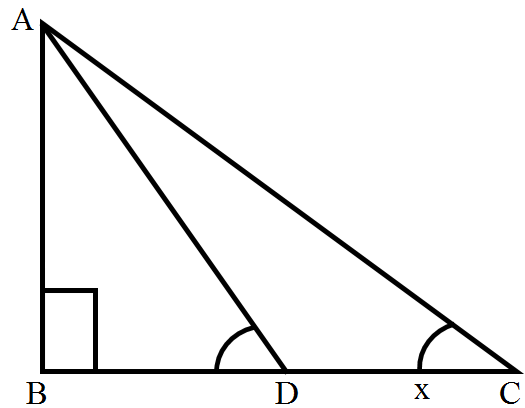
Let the distance of the car from the tower be $x$ meters.
$\therefore\tan45^\circ=\frac{\text{AC}}{\text{BC}}$
$\Rightarrow1=\frac{100}{\text{x}}\text{m}$
$\Rightarrow\text{x}=100\text{m}$
Therefore, the distance of the car from the tower is $100m.$ View full question & answer→MCQ 1351 Mark
The shadow of a $5m$ long stick is $2m$ long. At the same time, the length of the shadow of a $12.5m$ high tree is :
AnswerRatio of lengths of objects $=$ ratio of lengths of their shadows.
Let the length of shadow of the tree be $x m$.
Then $,\frac{5}{12.5}=\frac{2}{\text{x}}$
$\Rightarrow5\text{x}=2\times12.5=25$
$\Rightarrow\text{x}=5$
View full question & answer→MCQ 1361 Mark
A $1.2m$ tall boy stands at a distance of $2.4m$ from a lamp post and casts a shadow of $3.6m$ on the ground. The height of the lamp post is :
AnswerIn triangle $\text{ABC}$ and $\text{BED},$
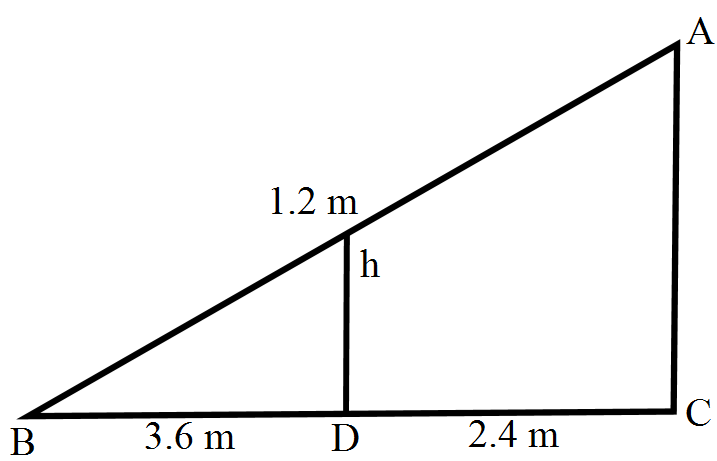
$\angle\text{C}=\angle\text{EDB} \ [$Each $90^\circ ]$
and $\angle\text{B}=\angle\text{B}\ [$Common$]$
$\therefore\triangle\text{ABC}\sim\triangle\text{BDE}$
$\therefore\frac{\text{AC}}{\text{DE}}=\frac{\text{BC}}{\text{DC}}$
$\Rightarrow\frac{\text{h}}{1.2}=\frac{6}{3.6}$
$\Rightarrow\text{h}=\frac{6\times1.2}{3.6}=2\text{m}$ View full question & answer→MCQ 1371 Mark
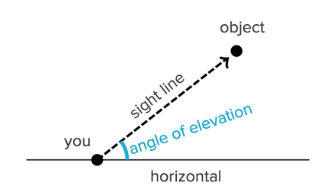
The angle formed by the line of sight with the horizontal, when the point being viewed is above the horizontal level is called :
AnswerThe angle of Elevation is the angle formed by the line of sight with the horizontal, when the point being viewed is above the horizontal level.
Hence, the answer is angle of elevation.
View full question & answer→MCQ 1381 Mark
The tops of two poles of height $20m$ and $14m$ are connected by a wire. If the wire makes an angle of $30^\circ$ with horizontal, then the length of the wire is :
AnswerLet $AB$ and $CD$ be two poles $AB = 20m, CD = 14m. $
$A$ and $C$ are joined by a wire $CE \| DB$ and angle of elevation of $A$ is $30^\circ .$
Let $CE = DB = x$ and $AC = l$
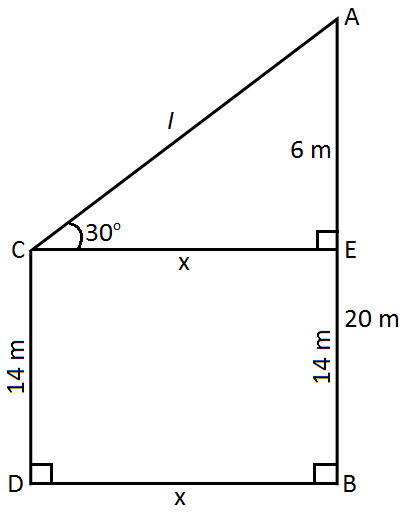
Now $, AE = AB - EB = AB - CD $
$= 20 - 14 = 6m$
Now in right $\triangle\text{ACE,}$
$\sin\theta=\frac{\text{Perpendicular}}{\text{Hypotenuse}}=\frac{\text{AE}}{\text{AC}}$
$\Rightarrow\ \sin30^\circ=\frac{6}{\text{AC}}$
$\Rightarrow\ \frac{1}{2}=\frac{6}{\text{AC}}$
$\Rightarrow\ \text{AC}=2\times6=12$
$\therefore$ Length of $AC = 12m.$ View full question & answer→MCQ 1391 Mark
A circus artist is climbing a $20m$ long rope, which is tightly stretched and tied from the top of a vertical pole to the ground. If the angle made by the rope with the ground level is $30^\circ ,$ then the height of the pole is :
- ✓
$10\text{m}$
- B
$10\sqrt3\text{m}$
- C
$20\text{m}$
- D
$20\sqrt3\text{m}$
AnswerCorrect option: A. $10\text{m}$
In right triangle $\text{ABC},$
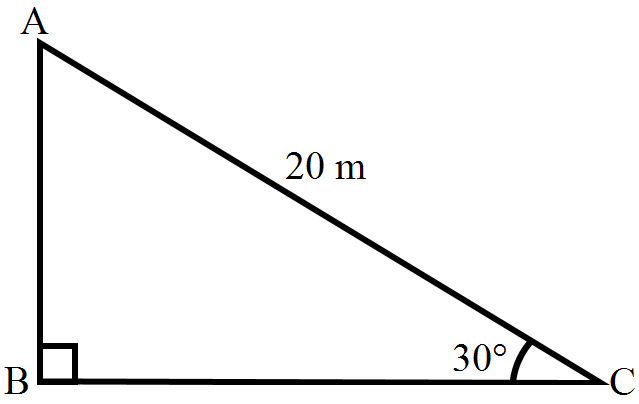
$\sin30^\circ=\frac{\text{AB}}{\text{AC}}$
$\Rightarrow\frac{1}{2}=\frac{\text{AB}}{20}$
$\Rightarrow\text{AB}=10\text{m}$
Hence, the height of the pole is $10m$. View full question & answer→MCQ 1401 Mark
$..........$ is an instrument for measuring the angles of elevation and depression.
AnswerA theodolite is an instrument for measuring the angles of elevation and depression.
A Theodolite is a more accurate instrument for measuring horizontal and vertical angles.
View full question & answer→MCQ 1411 Mark
A ladder $12m$ long just reaches the top of a vertical wall. If the ladder makes an angle of $45^\circ$ with the wall, then the height of the wall is :
- A
$12\sqrt2\text{m}$
- B
$6\text{m}$
- C
$12\text{m}$
- ✓
$6\sqrt2\text{m}$
AnswerCorrect option: D. $6\sqrt2\text{m}$
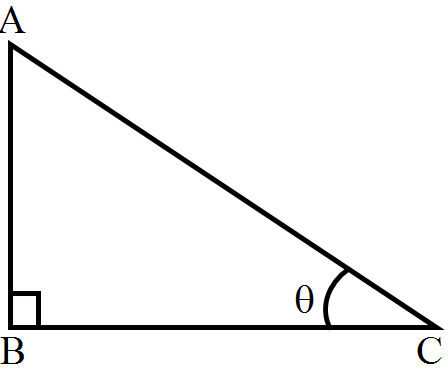
Let the height of the top of the ladder reaches to a vertical wall $= AB$
The length of the ladder $= AC = 12m$
The angle of elevation $=\theta=45^\circ$
$\therefore\sin45^\circ=\frac{\text{AB}}{\text{AC}}$
$\Rightarrow\frac{1}{\sqrt2}=\frac{\text{AB}}{12}$
$\Rightarrow\text{AB}=\frac{12}{\sqrt2}\times\frac{\sqrt2}{\sqrt2}$
$\Rightarrow\text{AB}=6\sqrt2\text{m}$ View full question & answer→MCQ 1421 Mark
A man on the top of an observation tower finds an object at an angle of depression $30^\circ$ . After the object was moved $30$ metres in a straight line towards the tower, he finds the angle of depression to be $45^\circ$ . The distance of the object now from the foot of the tower in metres is :
- A
$15\sqrt{3}$
- ✓
$15(\sqrt{3}+1)$
- C
$15(\sqrt{3}-1)$
- D
$15(2+\sqrt{3})$
AnswerCorrect option: B. $15(\sqrt{3}+1)$
$15(\sqrt{3}+1)$
View full question & answer→MCQ 1431 Mark
Two men are on opposite sides of a tower. They observe the angles of elevation of the top of the tower as $60^\circ$ and $45^\circ$ respectively. If the height of the tower is $60m,$ then the distance between them is :
- ✓
$20(\sqrt3+3)\text{m}$
- B
$20(3-\sqrt3)\text{m}$
- C
$20(\sqrt3-3)\text{m}$
- D
$\text{None of these}$
AnswerCorrect option: A. $20(\sqrt3+3)\text{m}$
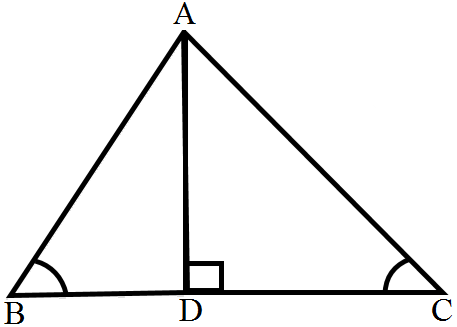
Let the height of the tower $= AD = 60m$ and angles of elevation of the top of the tower of two men are $60^\circ $ and $45^\circ $ respectively.
To find : Distance between two men $= BC$
In triangle $\text{ABD},$
$\tan60^\circ=\frac{60}{\text{BD}}$
$\Rightarrow\sqrt3=\frac{60}{\text{BD}}$
$\Rightarrow\text{BD}=\frac{60}{\sqrt3}\times\frac{\sqrt3}{\sqrt3}=20\sqrt3\text{m}$
In triangle $\text{ADC},$
$\tan45^\circ=\frac{60}{\text{DC}}$
$\Rightarrow1=\frac{60}{\text{DC}}$
$\Rightarrow\text{DC}=60\text{m}$
$\therefore\text{BC}=\text{BD}+\text{DC}=20\sqrt3+60$
$=20(\sqrt3+3)\text{m}$ View full question & answer→MCQ 1441 Mark
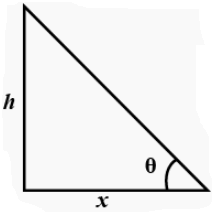
he ratio of the length of a pole and its shadow is $1: \sqrt{3}$. The angle of elevation of the sun is :
- A
$90^\circ$
- B
$60^\circ$
- ✓
$30^\circ$
- D
$45^\circ$
AnswerCorrect option: C. $30^\circ$
$\text{tan}\ \theta =\frac{\text{h}}{\text{x}}$
$\Rightarrow \text{tan}\ \theta =\frac{1}{\sqrt{3}}$
$\Rightarrow \tan\theta = \tan30^\circ$
$\Rightarrow \theta = 30^\circ$
Hence, the answer is $= 30^\circ .$
View full question & answer→MCQ 1451 Mark
The $.........$ is the angle between the horizontal and the line of sight to an object when the object is below the horizontal level.
AnswerThe angle of depression is the angle between the horizontal and line of sight to an object when the object is below the horizontal level.
The angle of depression is formed when the observer is higher than the object he is looking at.
It is the angle between the horizontal line and the line joining the observer's eye and the object.
It plays a very important role in determining the heights and distances.
View full question & answer→MCQ 1461 Mark
The angles of elevation of the top of $12m$ high tower from two points in opposite directions with it are complementary. If distance of one point from its base is $16m,$ then distance of second point from tower's base is?
Answer$\frac{\text{AB}}{\text{BC}}={\tan}\theta $
$\Rightarrow {\tan}\theta =\frac{12}{16}$
$\frac{\text{AB}}{\text{BB}}={\tan}(90−\theta )$
$\Rightarrow {\cot}\theta =\frac{12}{\text{x}} $
eq. $(1)\times$ eq. $(2)$ we get
$\frac{12}{16}\times \frac{12}{\text{x}}={\tan}\theta \times {\cot}\theta =1$
$\Rightarrow 16\text{x}=144$
$\Rightarrow \text{x}=\frac{144}{16}=9\text{m}.$
View full question & answer→MCQ 1471 Mark
From a point on the ground, $30m$ away from the foot of a tower, the angle of elevation of the top of the tower is $30^\circ .$ The height of the tower is :
- A
$30\text{m}$
- ✓
$10\sqrt{3}\text{m}$
- C
$10\text{m}$
- D
$30\sqrt{3}\text{m}$
AnswerCorrect option: B. $10\sqrt{3}\text{m}$
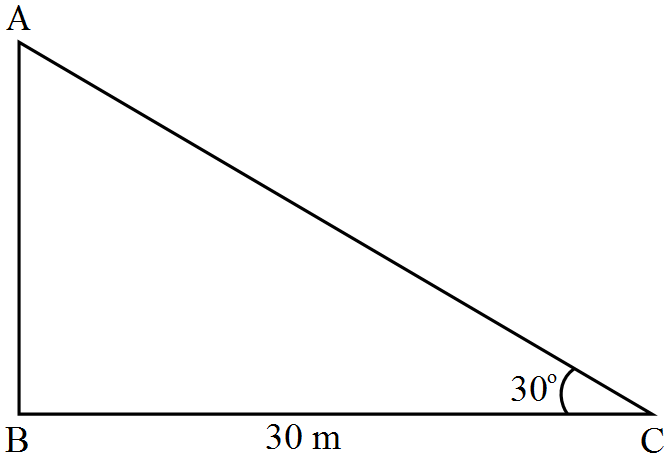
Let $AB$ be the tower and point $C$ be the point of obseevation on the ground.
We have,
$BC = 30m,$ and $\angle\text{ACB}=30^\circ$
In $\triangle\text{ABC},$
$\tan30^\circ=\frac{\text{AB}}{\text{BC}}$
$\Rightarrow\frac{1}{\sqrt{3}}=\frac{\text{AB}}{30}$
$\Rightarrow\text{AB}=\frac{30}{\sqrt{3}}$
$\Rightarrow\text{AB}=\frac{30}{\sqrt{3}}\times\frac{\sqrt{3}}{\sqrt{3}}$
$\Rightarrow\text{AB}=\frac{30\sqrt{3}}{3}$
$\therefore\ \text{AB}=10\sqrt{3}\text{m}$ View full question & answer→MCQ 1481 Mark
If the elevation of the sun changes form $30^\circ$ to $60^\circ,$ then the difference between the lengths of shadows of a pole $15m$ high, is :
- A
$7.5\text{m}$
- B
$15\text{m}$
- ✓
$10\sqrt{3}\text{m}$
- D
$5\sqrt{3}\text{m}$
AnswerCorrect option: C. $10\sqrt{3}\text{m}$
Let $AB$ be the pole and $AC$ and $AD$ be its shadows.
We have :
$\angle\text{ACB}=30^\circ,\angle\text{ADB}=60^\circ$ and $AB = 15m.$
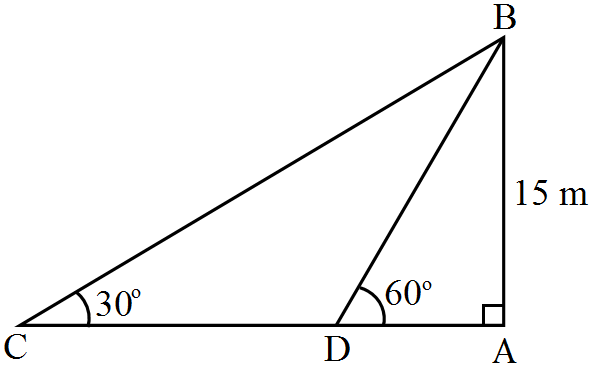
In $\triangle\text{ACB},$
We have :
$\frac{\text{AC}}{\text{AB}}=\cot30^\circ=\sqrt{3}$
$\Rightarrow\frac{\text{AC}}{15}={\sqrt{3}}$
$\Rightarrow\text{AC}=15\sqrt{3}\text{m}$
Now, in $\triangle\text{ADB},$ we have:
$\frac{\text{AD}}{\text{AB}}=\cot60^\circ=\frac{1}{\sqrt{3}}$
$\Rightarrow\frac{\text{AD}}{15}=\frac{1}{\sqrt{3}}$
$\Rightarrow\text{AD}=\frac{15}{\sqrt{3}}=\frac{15\times\sqrt{3}}{\sqrt{3}\times\sqrt{3}}$
$\Rightarrow\frac{15\sqrt{3}}{3}=5\sqrt{3}\text{m}$
$\therefore$ Difference between the lengths of the shadows
$=\text{AC}-\text{AD}=15\sqrt{3}-5\sqrt{3}=10\sqrt{3}\text{m}$ View full question & answer→MCQ 1491 Mark
If a $l.5-m-$ tall girl stands at a distance of $3m$ from a lamp post and casts a shadow of length $4.5m$ on the ground, then the height of the lamp post is :
- A
$1.5m$
- B
$2m$
- ✓
$2.5m$
- D
$2.8m.$
AnswerCorrect option: C. $2.5m$
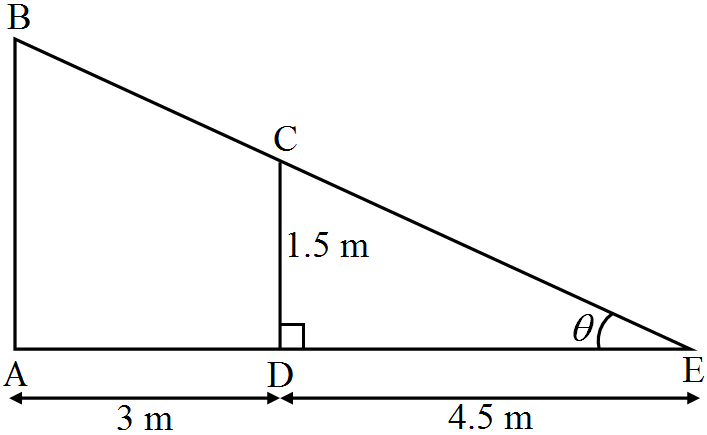
Let $AB$ be the lamp $-$ post; $CD$ be the girl and $DE$ be her shadow.
We have,
$CD = 1.5m, AD =3m, DE = 4.5m$
Let $\angle\text{E}=\theta$
In $\triangle\text{CDE},$
$\tan\theta=\frac{\text{CD}}{\text{DE}}$
$\Rightarrow\tan\theta=\frac{1.5}{4.5}$
$\Rightarrow\tan\theta=\frac{1}{3}\dots(\text{i})$
Now, in $\triangle\text{ABE},$
$\tan\theta=\frac{\text{AB}}{\text{AE}}$
$\Rightarrow\frac{1}{3}=\frac{\text{AB}}{\text{AD}+\text{DE}}\ [$Using $(i)]$
$\Rightarrow\frac{1}{3}=\frac{\text{AB}}{3+4.5}$
$\Rightarrow\text{AB}=\frac{7.5}{3}$
$\therefore\ \text{AB}=2.5\text{m}$ View full question & answer→MCQ 1501 Mark
If the altitude of the sun is $60^\circ,$ the height of a tower which casts a shadow of length $90m$ is :
- A
$60\text{m}$
- ✓
$90\sqrt3\text{m}$
- C
$90\text{m}$
- D
$60\sqrt3\text{m}$
AnswerCorrect option: B. $90\sqrt3\text{m}$
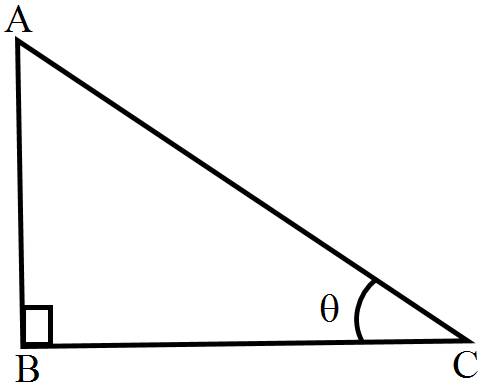
Let Height of the tower $= AB = h$ meters,
Length of the shadow $= BC = 90m$
And angle of elevation $\theta=60^\circ$
$\therefore\tan60^\circ=\frac{\text{AB}}{\text{BC}}$
$\Rightarrow\sqrt{3}=\frac{\text{h}}{90}$
$\Rightarrow\text{h}=90\sqrt{3}\text{ meters}.$ View full question & answer→