Questions · Page 1 of 2

[5 marks Questions]

🎯

Test yourself on this topic

50 questions · timed · auto-graded

Question 15 Marks
Given below are certain situations. Analyze and describe its possible impact on a person :
a) Testes of a male boy are not able to descend into scrotum during his embryonic development.
b) Vas deferens of a man is plugged.
c) Prostate and seminal vesicles are not functional.
d) Egg is not fertilised in a human female.
e) Placenta does not attach to the uterus optimally.
Answer
a) Sperm formation will be adversely affected because it requires a lower temperature than the body temperature.
b) Vas deferens is a passage for transfer of sperms, so sperms will not be transferred further.
c) When prostate and seminal vesicles are not functional, they will not add secretions for nourishment and medium for the transport of sperms.
d) When an egg is not fertilised in a human female, it lives for about one day. Then, the thickened lining of the uterus breaks leading to discharge of blood and mucus along with the unfertilised egg. This is called menstruation.
e) Nutrition and oxygen will not be provided to the growing embryo affecting its growth, which could have serious implications as well.
View full question & answer
Question 25 Marks
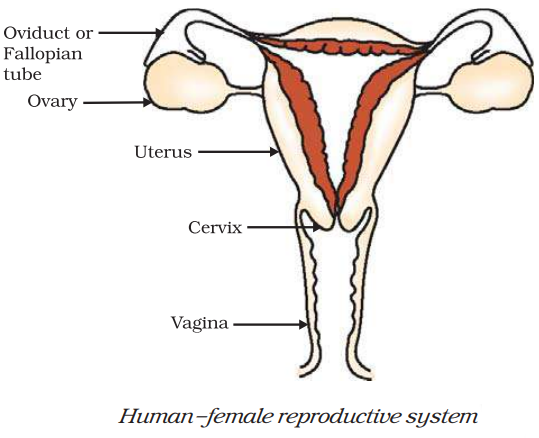
  1. Draw a sectional view of human female reproductive system and label the part where:
  1. Eggs develop.
  2. Fertilisation take place.
  3. Fertilised egg gets implanted.
  1. Describe, in brief, the changes the uterus undergoes:
  1. To receive the zygote.
  2. If zygote is not formed.
Answer
  1.  


Parts where:
  1. Eggs develop–Ovary.
  2. Fertilisation take place–Fallopian tubes.
  3. Fertilised egg gets implanted–Uterus.
  1.  
  1. The inner uterus lining (endometrium) becomes thick and soft with lots of blood capillaries before of a fertilised egg (zygote). The uterus has to keep this zygote for further development and supply it with food, oxygen, etc.
  2. If the egg is not fertilised, then the uterus lining break down along with its bloods vessels in the form of vaginal bleeding called menstrual flow.
View full question & answer
Question 35 Marks
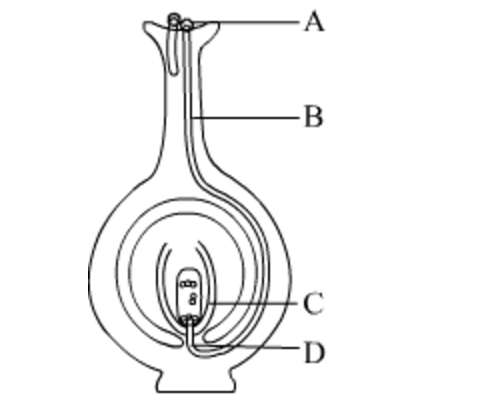
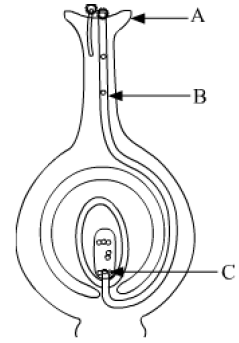
  1. Name the parts labelled as A, B, C and D in the diagram given below:
  1. What is pollination? State its significance.
  2. How does fertilisation occur in flowers? Name the parts of the flower that develop into (i) seed, and (ii) fruit after fertilisation.
Answer
  1.  
A– Pollen grains.

B– Pollen tube.

C– Ovary.
  1. The transfer of pollen grains from anther (male sexual part) of a flower to the stigma part of the pistil (female sexual part) is known as pollination.
Signification of pollination: It may be the cause of variation in a species of a plant.
  1. Fertilisation in flower: A pollen grain contains two male gametes. When a pollen grain falls on the stigma of the carpel, it grows a pollen tube downwards into the style. One of the male gametes reaches the ovary through pollen tube and fuses with female gamete present in the ovule. This fertilisation of the two germ cells style. One of the germ cells forms a zygote. The zygote is capable into new plant.
The other male gamete fuses with two polar nuclei to form endosperm nucleus. This fusion is called triple fusion. The zygote grows into an embryo and an endosperm nucleus grows into endosperm. (the food storage tissue of seed)
  1. All the eggs in the ovule present in the ovary of a flower gets fertilised by male gametes from the pollen grains and grow to become seeds.
  2. The ovary of flower develops and becomes fruit.
View full question & answer
Question 45 Marks
  1. Write the functions of each of the following parts in a human female reproductive system:
  1. Ovary.
  2. Uterus.
  3. Fallopian tube.
  1. Write the structure and functions of placenta in a human female.
Answer
  1.  
  1. Ovary: They produce eggs or the female gamete. They also produce the female hormone estrogen which brings about the development of secondary sexual characters in females.
  2. Oviduct: Carries the mature egg to the uterus. The oviduct provides the place for fertilization to occur.
  3. Uterus: It nurturing the fertilized ovum that develops into the fetus and holding and supporting it till the baby is mature enough for birth.
  1. Placenta is a disc which is embedded in the uterine wall. It contains villi on the embryo’s side of the tissue. On the mother’s side are blood spaces, which surround the villi.
The placenta provides a large surface area for glucose and oxygen to pass from the mother to the embryo. The waste substances generated by the foetus are removed by transferring them into the mother’s blood through the placenta.
View full question & answer
Question 55 Marks
What is placenta? Describe its structure. State its functions in case of a pregnant human female.
Answer
Placenta is a special tissue that forms a connection between the foetus and the mother. It is a disc embedded in the uterine wall; it contains villi on the embryo’s side of the tissue while there are blood spaces on the Mother's side, which surround the villi. Structure Placenta is a disc-like structure embedded in the Uterine wall.
  1. It contains villi on the side of the embryo.
  2. It contains blood spaces, on mother’s side, which surround the villi.
Functions:
  1. It provides a large surface, area for glucose and $O_2$ to pass from mother’s blood to the embryo.
  2. It also removes metabolic wastes from the embryo.
View full question & answer
Question 65 Marks
  1. Name the human male reproductive organ that produces sperms and also secretes a hormone. Write the functions of the secreted hormone.
  2. Name the parts of the human female reproductive system where:
  1. fertilisation takes place,
  2. implantation of the fertilised egg occurs.
Explain how the embryo gets nourishment inside the mother's body.
Answer
  1. Testes produce sperms and secrete a hormone called testosterone. The function of testosterone is to control the development of male sex organs and male features such as a deeper voice, moustache, beard and more body hair as compared to females.
  2.  
  1. Fertilisation takes place in the oviduct or fallopian tubes.
  2. Implantation of the fertilised egg occurs in the uterus.
After implantation, a disc-like special tissue called placenta develops between the uterus wall and the embryo. The placenta helps in the exchange of nutrients, oxygen and waste products between the embryo and the mother. Thus, it provides nourishment to the growing embryo.
View full question & answer
Question 75 Marks
What is pollination? How does it occur in plants? How does pollination lead to fertilisation? Explain.
Answer
The transfer of pollen grains from anthers (male sexual parts) of a flower to the stigma part of the pistil (female sexual part) is known as pollination. Pollination is done by insects, birds, wind and water. Pollination can occur in two ways:
  1. Self-pollination: When the pollen grains from the anther of a flower are transferred to the stigma of the same flower or another flower on the same plant, it is called self-pollination.
  2. Cross pollination: When the pollen grains from the anther of a flower on one plant are transferred to the stigma of a flower on another similar plan it is called cross-pollination.
When a pollen grain falls on the stigma of the carpel, it grows a pollen tube downwards through the style towards the female gamete in the ovary. A male gamete moves down the tube. When the pollen tube enters the ovule, its tip bursts open and male gamete comes out of the pollen tube and combings with the nucleus of the female gamete and forms zygote. This process is known as fertilisation.
View full question & answer
Question 85 Marks
Write the two causes of human population explosion. Explain with the help of suitable examples how this explosion can be checked.
Answer
The two causes of population explosion are:
  1. Decline in death rate (including maternal mortality rate and infant mortality rate).
  2. Increase in the number of people in the reproducible age.
Following are the ways to check population explosion:
  1. One-child norm.
  2. Increasing the marriageable age.
  3. Promoting contraceptive methods.
Contraceptive methods are of two types:
  1. Natural means of contraception.
  2. Artificial means of contraception.
Natural Methods:
  1. Avoiding the coming together of ovum and sperm.
  2. Periodic abstinence: Avoiding coitus from days 10 to 17 of the menstrual cycle.
  3. Coitus interrupts: Withdrawal of penis before ejaculation.
  4. Lactational amenorrhea: It is the absence of menstruation during lactation. So, in the lactation period, the chances of conception are almost zero.
Artificial Methods:
  1. Physically preventing the coming together of ovum and sperm.
  2. Barriers: Include condoms, diaphragms, cervical caps and vaults.
  3. Intra uterine devices (IUDs): They release hormones to cause phagocytosis of sperms, or they release copper ions to decrease sperm motility.
  4. Oral contraceptive pills: They contain hormones-either progesterone or progesterone-oestrogen combination.
  5. Surgical methods: Include vasectomy (removal of a part of the vas deferens in males) and tubectomy (removal of a part of the fallopian tubes in females).
View full question & answer
Question 95 Marks
Draw a diagram of human female reproductive system and label the part:
  1. That produces eggs.
  2. Where fusion of egg and sperm take place.
  3. Where zygote is implanted.
What happens to human egg when it is not fertilised?
Answer
In the female reproductive system, the part that:
  1. Produces egg: Ovary.
  2. Fusion of egg and sperm takes place: Fallopian tube.
  3. Zygote is implanted: Uterus.
Diagram of female reproductive system:
The ovary releases one egg every month. The uterus also prepares itself every month to receive a fertilised egg. The inner uterus lining (endometrium) becomes thick and is supplied with blood to nourish the embryo. If the egg is not fertilised, then the uterus lining is not required. Hence, it breaks down and is released in the form of blood and mucus through the vagina. This process lasts for 2-8 days and is known as menstruation.
View full question & answer
Question 105 Marks
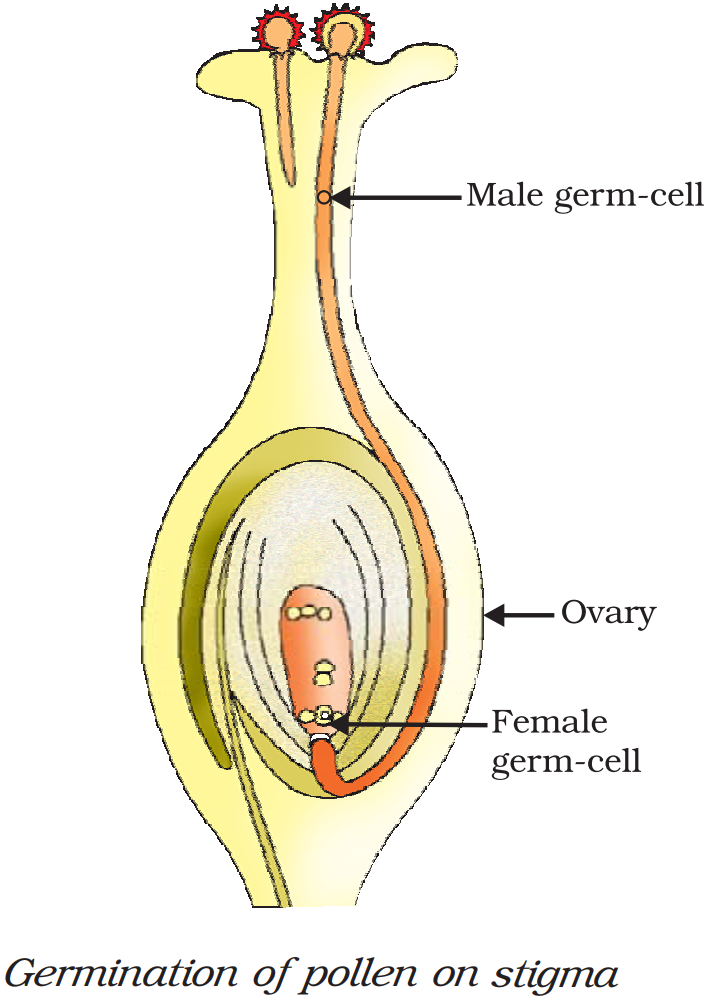
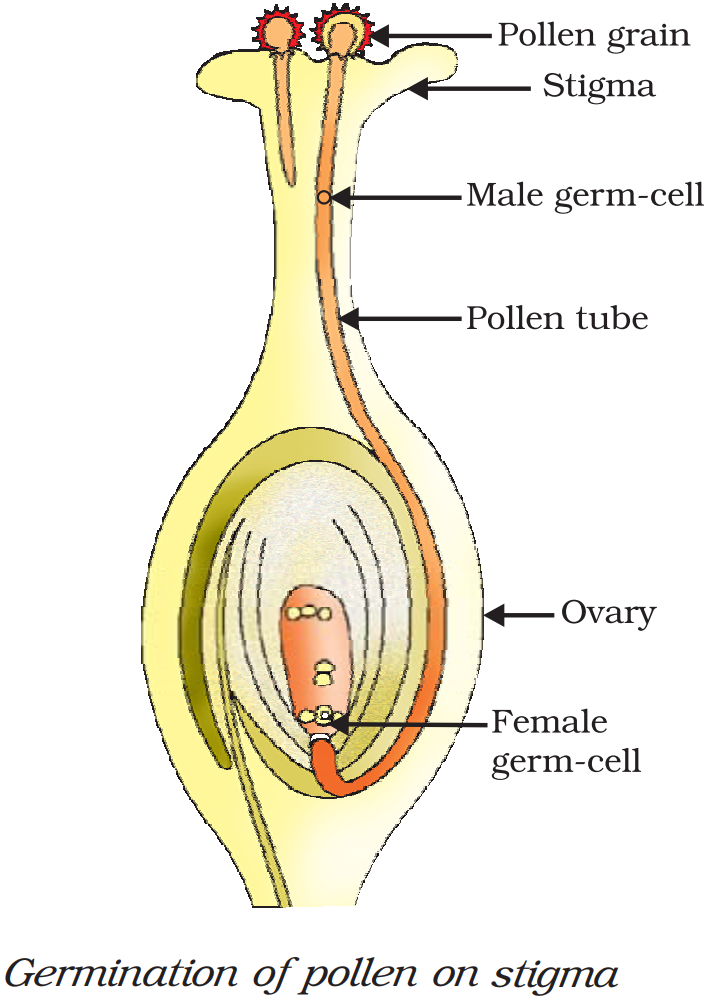
Distinguish between unisexual and bisexual flowers giving one example of each. Draw a diagram showing process of germination of pollen grains on stigma and label the following parts:
  1. Female germ cell.
  2. Male germ cell.
  3. Ovary.
Answer
Unisexual Flowers Bisexual Flowers
The flower has either male reproductive organs (stamens) or the female reproductive organs (pistil) The flower has both the male reproductive organs (stamens) and the female reproductive organs (pistil) in a single flower.
Example: Papaya. Example: Hibiscus.
Diagram showing germination of pollen grain on stigma:
View full question & answer
Question 115 Marks
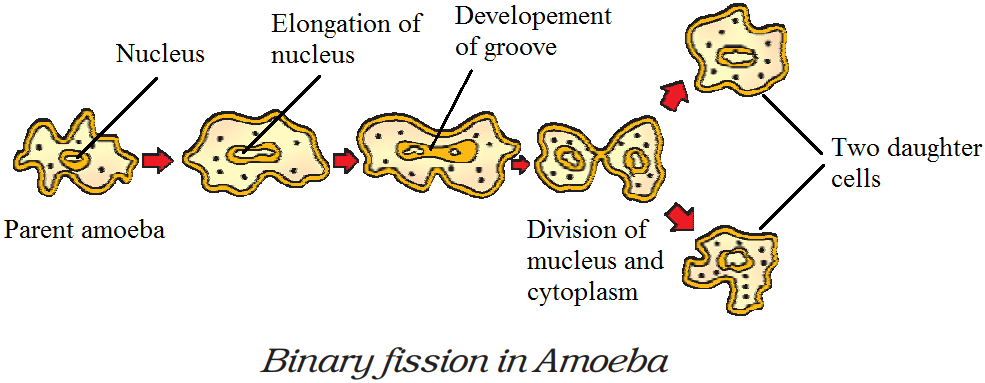
What is binary fission in organisms? With the help of suitable diagrams, describe the mode of reproduction in Amoeba.
Answer

Binary fission which means division in half. It is a kind of asexual reproduction. It is the most common form of reproduction in prokaryotes and occurs in some single-celled eukaryotes. After replicating its genetic material, the cell divides into two nearly equal sized daughter cells.
In unicellular organisms like Amoeba cell division, or fission, leads to the creation of new individuals. The parent cell simply splits into two equal halves during cell division. In organisms such as Amoeba, the splitting of the two cells during division can take place in any plane.
It takes place in the following steps:
  1. Parent cell enlarges and the nucleus develops constriction.
  2. The cytoplasm divided with the two nucleuses.
  3. The cell divides into two.
View full question & answer
Question 125 Marks
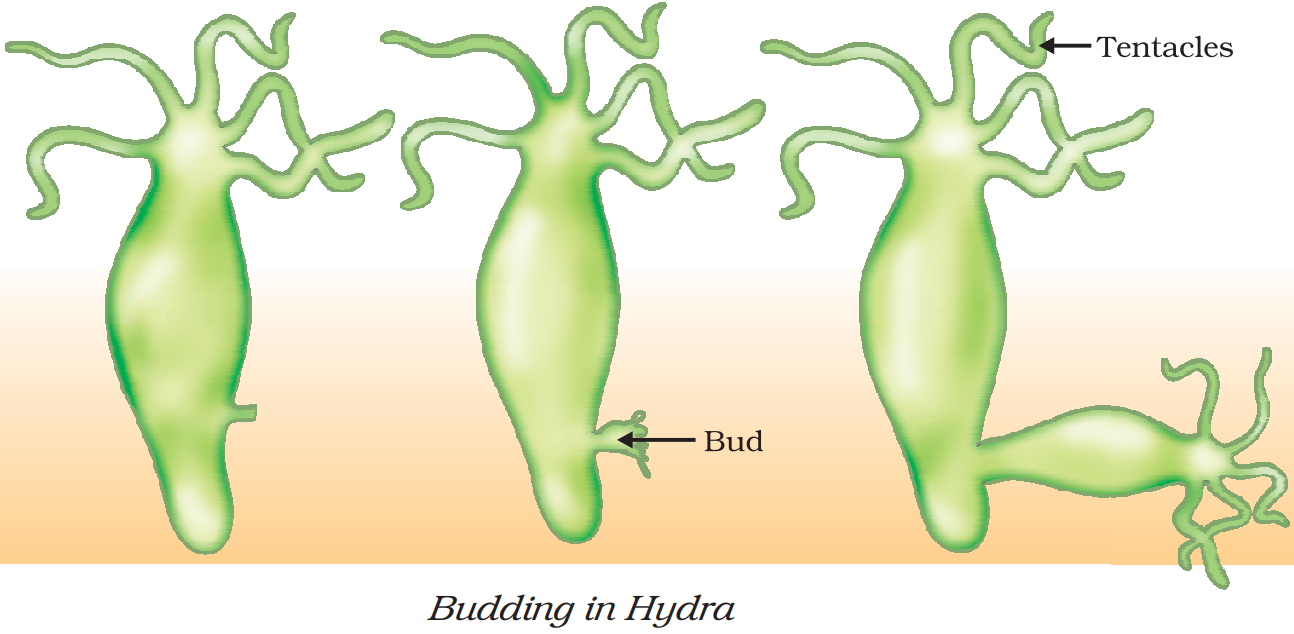
With the help of suitable diagram, explain the various steps of budding in Hydra.
Answer
The hydra reproduces by the process of budding by the use of regenerative cells. It carries out the process in the following steps:
  1. A bud develops as an outgrowth due to repeated cell division at one specific site.
  2. The buds develop into tiny individuals.
  3. When fully mature, these buds detach from the parent body and become new independent individuals.
View full question & answer
Question 135 Marks
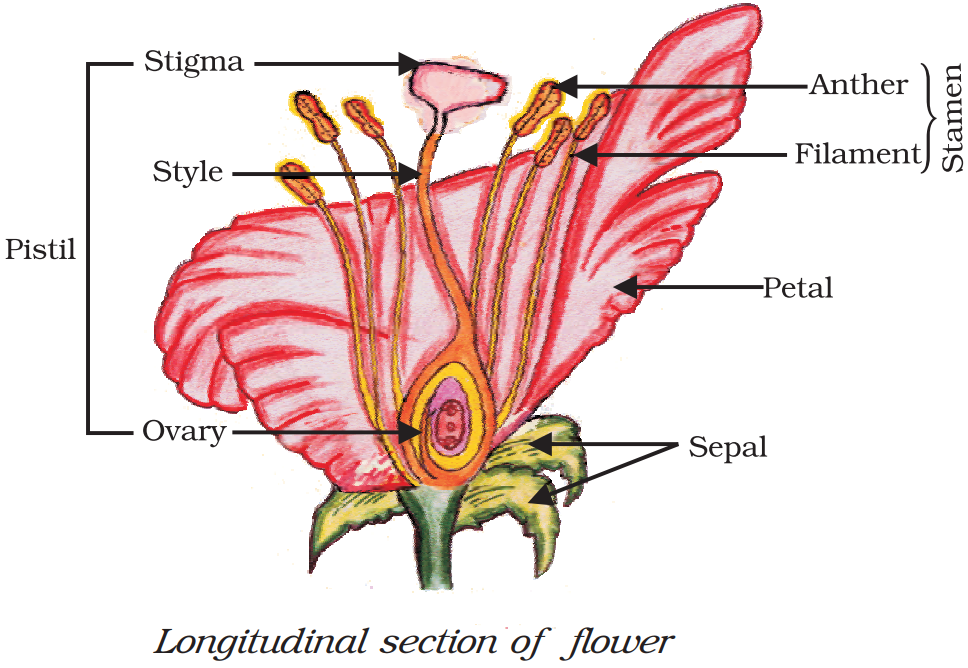
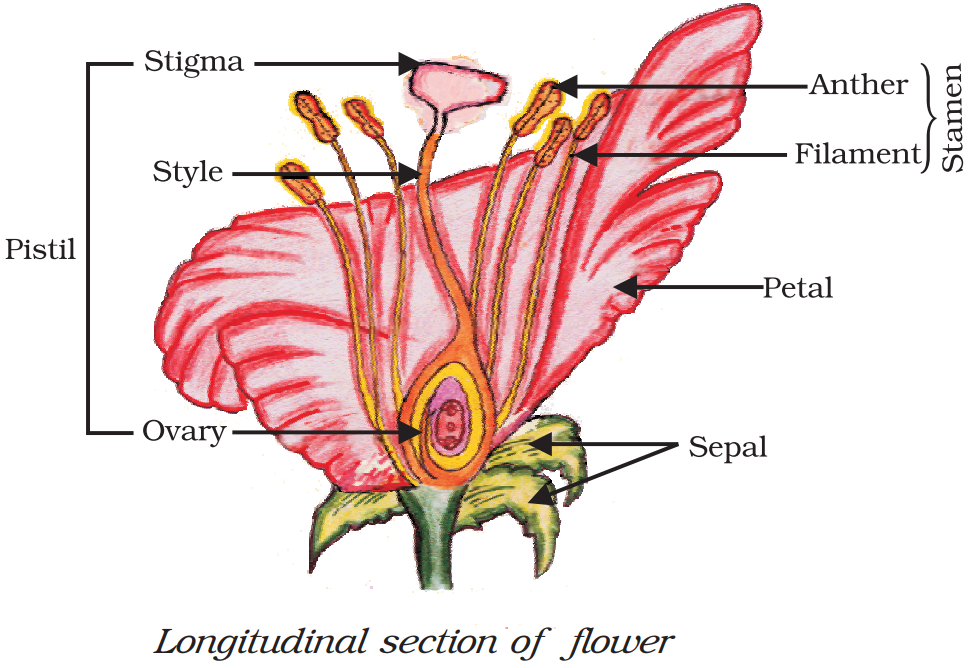
  1. Draw a longitudinal section of a flower and label the following parts:
  1. Part that produces pollen grain.
  2. Part that transfers male gametes to the female gametes.
  3. Part that is sticky to trap the pollen grain.
  4. Part that develops into a fruit.
  1. Differentiate between pollination and fertilisation.
Answer
  1.  
  1. Part that produces pollen grain: anther
  2. Part that transfers male gamete to the female gamete: style
  3. Sticky part to trap pollen grain: stigma
  4. Part that develops into fruit: Ovary
  1.  
Pollination Fertilization
Pollination is the process of transfer of pollen grains from anther to the sligma of the same or different flower. Fertilization is the process of fusion of male gamete with the female gamete.
It takes place with the help of pollinations like wind, water insects etc. It takes place by the growth of pollen tube toward the ovary.
View full question & answer
Question 145 Marks
  1. Explain the role of placenta in the development of human embryo.
  2. Give example of two bacterial and two viral sexually transmitted diseases. Name the most effective contraceptive which prevents spread of such diseases.
Answer
  1. Placenta is a temporary organ which is formed from the tissues derived from the foetus and the mother. The placenta contains villi on the embryo’s side of tissue and blood spaces on the mother side of tissue. The blood space surrounds the villi. The villi provides a large surface area for glucose and oxygen to pass from the mother to the embryo. Thus, through placenta, the maternal blood passes food (glucose, amino acids, lipids and proteins), oxygen, hormones, water, antibodies to the foetal blood and the foetal metabolic wastes (carbon dioxide, urea) pass into the maternal blood.
  2. BACTERIAL INFECTION: This includes gonorrhoea (inflammation of mucus membrane of urinogenital tract) and syphilis (lesions in the mucus membrane of urinogential tract)
VIRAL INFECTION: This includes warts, HIV-AIDS, Hepatitis-B.
Use of condoms can prevent the spread of these diseases to a great extent.
View full question & answer
Question 155 Marks
  1. State in brief the functions of the following organs in the human female reproductive system:
Ovary, Fallopian tube, Uterus
  1. What is menstruation? Why does it occur?
Answer
  1.  
Functions of Ovaries:
  1. The ovaries produce eggs (also called ova) and female hormones(These hormones control the development of female body characteristics, such as the breasts, body shape, and body hair).
  2. The ovaries also regulate the menstrual cycle and pregnancy.
Functions of Fallopian tubes:
  1. The fallopian tubes connect the ovaries to the uterus. One egg cell each month is released from the ovaries floats down the fallopian tubes, and into the uterus.
Functions of Uterus:
  1. Uterus is the place where a foetus develops.
  2. The uterus provides structural integrity and support to the bladder, bowel, pelvic bones and organs.
  3. The reproductive function of the uterus is to accept a fertilized ovum which passes through the utero-tubal junction from the fallopian tube.
  1. Menstruation (men-STRAY-shuhn) is a woman's monthly bleeding. When you menstruate, your body sheds the lining of the uterus (womb). Menstrual blood flows from the uterus through the small opening in the cervix and passes out of the body through the vagina. Most menstrual periods last from 3 to 5 days.
View full question & answer
Question 165 Marks
Give one example each of unisexual and bisexual flowers. Differentiate between the two types of pollination that occur in flowers. What happens when a pollen lands on a suitable stigma? Write about the events that occur till the seed formation in the ovary.
Answer
Unisexual Flower: Papaya/Watermelon.
Bisexual Flower: Hibiscus/Rose.
Self-pollination: The pollen grains are transferred from the anther to the stigma of the same flower or to the flower of the same plant.
Cross pollination: The pollen grains are transferred from the anther to the stigma of a flower of a different plant.
  • After pollen lands on a suitable stigma, a pollen tube grows out of pollen grain and travels through the style to reach the ovary.
  • The male germ cell fuses with the female germ cell to form a zygote.
  • Zygote divides several times to form an embryo within the ovule.
  • The ovule develops tough coat and gradually gets converted into a seed.
View full question & answer
Question 175 Marks
What is vegetative propagation? List with brief explanation three advantages of practising this process for growing some types of plants. Select two plants from the following which are grown by this process:
Banana, Wheat, Mustard, Jasmine, Gram.
Answer
Definition: It is the production of plants from vegetative parts of the plant like stem, root, leaf etc. In vegetative propagation, a portion is detached from the body of the parent plant and is grown independently.
Advantages of vegetative propagation:
  1. For propagation of plants that produce little or no viable seeds.
  2. Many fruits are cross pollinated, so to provide consistent quality without variation vegetative propagation is preferred.
  3. Most often easier, rapid and more economical method.
  4. Flowering period is short compared to seed propagated plants.
  5. Method of choice in propagating plants in unfavorable environmental condition.
Jasmine and banana are grown by this process.
View full question & answer
Question 185 Marks
  1. Write the name of the human male reproductive organ that produces sperms and secretes a hormone. Name the hormone secreted and state its function?
  2. Write the site of fertilization and the part where the zygote gets implanted in the human female.
  3. State, in brief, how an embryo gets its nourishment inside the mother's body.
Answer
  1. Testis is the male reproductive organ in humans that produces sperms and also secretes the testosterone hormone. Important functions of testosterone are as follows:
Stimulates the development, maturation and functioning of the male accessory sex organs like vas deferens and seminal vesicles Stimulates muscular growth, growth of facial hair, low pitch voice, sperm production, etc.
  1.  
  1. Fertilisation takes place in the fallopian tube (oviduct).
  2. Implantation of the fertilised egg occurs in the uterus. The embryo develops inside the mother’s body for about nine months.
  1. Inside the uterus, the outer tissue surrounding the embryo develops finger-like projections called villi. These villi are surrounded by uterine tissue and maternal blood. They provide a large surface area for the exchange of oxygen and nutrients. There is a special tissue called placenta embedded in the uterine wall. The embryo receives the oxygen and nutrients from the mother’s blood via the placenta. The waste material produced by the embryo is removed through the placenta.
View full question & answer
Question 195 Marks
Write the functions of the following in human female reproductive system:
Ovary, oviduct, uterus.
How does the embryo get nourishment inside the mother's body? Explain in brief.
Answer
  1.  
  1. Ovaries are primary reproductive organs in a woman. Functions:
  1. To make mature female sex cells called 'ova' or eggs.
  2. To produce the female sex hormones called estrogen and progesterone.
  1. Oviduct also known as fallopian tubes. Functions:
  1. To transfer the female gametes (egg) from ovary to uterus.
  2. The fertilization of egg (or ovum) by a sperm takes place in the oviduct.
  1. Uterus: two oviducts are connected to bag like organ called uterus (womb) Functions:
  1. The growth and development of a fertilized ovum into a baby takes place in the uterus.
  1. The embryo gets nourishment inside the mother's body through placenta that is a disc like special tissue that develops between the uterus wall and the embryo. It is through the placenta that all the other requirements of the developing foetus also like respiration, excretion etc., are met from mother's body.
View full question & answer
Question 205 Marks
  1. Name the respective part of human female reproductive system:
  1. That produces eggs.
  2. Where fusion of egg and sperm takes place.
  3. Where zygote gets implanted.
  1. Describe in brief what happens to the zygote after it gets implanted.
Answer
  1. Part of human female reproductive system:
  1. Ovary produces egg in females.
  2. Fusion of eggs and sperm takes place in the fallopian tube.
  3. Zygote gets implanted in the uterus of the female reproductive system.
The diagram below shows Female reproductive system.

  1. The zygote formed after fertilization in the fallopian tube is implanted in the uterus. It divides repeatedly to form a mass of cells known as embryo. This embryo gets attached to the inner layer of the uterine cavity, i.e., endometrium. It thickens every month and is supplied with blood to nourish the embryo. Soon it gets covered by rapidly dividing uterine cells. This leads to pregnancy. Within a span of some months, the embryo starts developing limbs and begins to resemble a miniature being. When all parts of the embryo can be recognized, it becomes a foetus. The mother gives birth to the baby when the foetus fully develops.
View full question & answer
Question 215 Marks
  1. Give one example each of a unisexual and a bisexual flower.
  2. Mention the changes a flower undergoes after fertilisation.
  3. How does the amount of DNA remain constant though each new generation is a combination of DNA copies of two individuals?
Answer
  1.  
Unisexual Flower – Papaya.

Bisexual Flower – Hibiscus.
  1. After fertilisation, the fertilised egg divides several times to from an embryo within the ovule. The ovule develops a tough coat around it and is gradually converted into a seed (containing the baby plant along with food).The ovary of flower develops and becomes a fruit (with seeds inside it). The other parts of flower like sepals, petals, stamens, stigma and style dry up and fall off. Only the ovary is left behind.
  2. In sexual reproduction, though the genetic material DNA from two gametes, male and female gametes, combine together to from a new cell ‘zygote’ but the amount of DNA in zygote does not get doubled. This is because the gametes are special type of cells which contain only half the amount of DNA as compared to the normal body cells of an organism. So the new cell zygote formed by tow gametes cells will have the normal amount of DNA.
View full question & answer
Question 225 Marks
  1. Name the organ that produces sperms as well as secretes a hormone in human males. Name the hormone it secretes and write its functions.
  2. Name the parts of the human female reproductive system where fertilisation occurs.
  3. Explain how the developing embryo gets nourishment inside the mother’s body.
Answer
  1. Testis is the male reproductive organ in humans that produces sperms and also secretes the testosterone hormone.
Important functions of testosterone are as follows:

Stimulates the development, maturation and functioning of the male accessory sex organs like vas deferens and seminal vesicles Stimulates muscular growth, growth of facial hair, low pitch voice, sperm production, etc.
  1.  
  1. Fertilization takes place in the fallopian tube (oviduct).
  2. Implantation of the fertilized egg occurs in the uterus.
  1. The embryo develops inside the mother's body for about nine months. Inside the uterus, the outer tissue surrounding the embryo develops finger-like projections called villi. These villi are surrounded by uterine tissue and maternal blood. They provide a large surface area for the exchange of oxygen and nutrients. There is a special tissue called placenta embedded in the uterine wall. The embryo receives the oxygen and nutrients from the mother’s blood via the placenta. The waste material produced by the embryo is removed through the placenta.
View full question & answer
Question 235 Marks
  1. Write the functions of the following parts in human female reproductive system:
  1. Ovary.
  2. Oviduct.
  3. Uterus.
  1. Describe the structure and function of placenta.
Answer
  1.  
  1. Ovaries are primary reproductive organs in a woman. Functions:
  1. To make mature female sex cells called 'ova' or eggs.
  2. To produce the female sex hormones called estrogen and progesterone.
  1. Oviduct also known as fallopian tubes. Functions:
  1. To transfer the female gametes (egg) from ovary to uterus.
  2. The fertilization of egg (or ovum) by a sperm takes place in the oviduct.
  1. Uterus - two oviducts are connected to bag like organ called uterus (womb) Functions:
  1. The growth and development of a fertilized ovum into a baby takes place in the uterus.
  1. Placenta is a disc like special tissue that develops between the uterus wall and the embryo. It is through the placenta that all the requirements of the developing foetus like nutrition, respiration, excretion etc., are met from mother's body. It can be said that the exchange of nutrients, oxygen, waste products between the embryo and the mother takes place through the placenta.
View full question & answer
Question 245 Marks
  1. List three distinguishing features between sexual and asexual types of reproduction.
  2. Explain why variations are observed in the off spring’s of sexually reproducing organisms?
Answer
  1.  
Sr. no Sexual Reproduction Asexual Reproduction
1. It involves both the parent. It involves only a single parent.
2. It involves fusion of male and female gametes. It does not involves fusion of gametes The gametes of single parent undergoes divison and gives rise to new a individual.
3. It results in the introduction of variation in a population as newly formed organisms are not the exact copies of the parent. It does not bring variation in a population as the newly formed organisms are identical to the parents.
  1. In case of sexual reproduction, there is marked variation between the parent and offspring due to the following reasons:
  1. The male and female gametes are formed by meiotic division which allows crossing over and recombination. This generates variation in the genes of offspring.
  2. Two parents are involved who are different from each other. The fusion of their gamete would produce a distinct individual.
View full question & answer
Question 255 Marks
  1. Identify A, B and C in the given diagram and write their functions.
  2. Mention the role of gamete and zygote in sexually reproducing organisms.
Answer
  1.  
A – Stigma, Function – The stigma is a sticky surface where the pollen lands and later germinates.

B – Pollen tube, Function – It carries the pollen to the egg cell for fertilisation.

C – Egg cell, Function – It fuses with the male gamete and leads to the formation of zygote.
  1. Role of gametes – The gametes play an important role in the sexually reproducing organisms as they carry the entire genetic information of the organism. These gametes upon fusion result in the formation of zygote, which develops into a new individual. Any deformation in the gametes will lead to the deformity in the newly formed offspring.
Role of zygote – Zygote is the diploid cell formed by the fusion of male and female gametes during fertilisation in sexual reproduction. Zygote is the first stage in the development process of an organism and it contains all the genetic information of both the parents, essential for the growth of the new organism.
View full question & answer
Question 265 Marks
Define the terms pollination and fertilisation. Draw a diagram of a pistil showing pollen tube growth into the ovule and label the following:
pollen grain, male gamete, female gamete, ovary.
Answer
Pollination: It is a type of asexual reproduction in which the pollen grains are transferred from the anther of a stamen to stigma of a carpel. Pollination is of two types:
  1. Self-pollination
  2. Cross pollination
Fertilization: it is a mode of sexual reproduction in which the male gamete is fused with the female gamete to form zygote. This process occurs in both plants and animals. There are two types of fertilization which are as follows:
  1. External fertilization.
  2. Internal fertilization.
The diagram of a pistil showing pollen tube growth into the ovule is as follows:
View full question & answer
Question 275 Marks
Describe in brief the role or,
  1. Testis.
  2. Seminal vesicle.
  3. Vas deference.
  4. Ureter.
  5. Prostate gland in human male reproductive system.
Answer
  1. Testes: The testes are the male reproductive organs that are located outside the abdominal cavity within a pouch called scrotum. It produces sperms and also produces a hormone called testosterone, which brings about secondary sexual characters in boys.
  2. Seminal vesicles: The seminal vesicles secretion makes the transport of the sperm easier and the fluid also provides nutrition.
  3. Vas deferens: It carries sperm from the vasa efferentia to the urethra.
  4. Ureter: When blood is filtered by the kidney, the waste material (urine) is passed on to urinary bladder via the ureters. The function of ureter is to carry urine from the kidney to the urinary bladder.
  5. Prostate glands: It produces an alkaline fluid (prostatic fluid), which is a constituent of the semen. The prostatic fluid provides motility, longer survival period (neutralizes the acidic environment of the female reproductive tract) and protection to sperms.
View full question & answer
Question 285 Marks
  1. Draw a diagram of the longitudinal section of flower and label on it sepal, petal, ovary and stigma.
  2. Write the names of male and female reproductive parts of a flower.
Answer
  1. The diagram of the longitudinal section of a flower is as follows:
  1. Stamen is the male reproductive part of a flower. Carpel is the female reproductive part of flower.
View full question & answer
Question 295 Marks
  1. What is fragmentation in organisms? Name a multicellular organism which reproduces by this method.
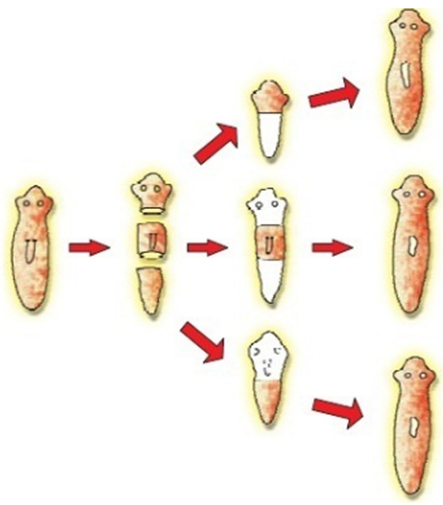
  2. What is regeneration in organism? Describe regeneration in Planaria with the help of a suitable diagram.
Answer
  1. Fragmentation: It is a mode of asexual reproduction when a organisms simply break down into several parts or fragments in order to reproduce a new individual.
Ex: Spirogyra
  1. Regeneration: The process by which some organism replace or restore lost or amputated body parts that have been cut/ damaged by external factors. It is also a mode of asexual reproduction as these organisms regrowth its parts separately sometimes when they have been removed into 2 or more.
Ex: Planaria

View full question & answer
Question 305 Marks
  1. Write the function of following parts in human female reproductive system:
  1. Ovary.
  2. Oviduct.
  3. Uterus.
  1. Describe in brief the structure and function of placenta.
Answer
  1. Functions:
  1. Ovary:
  • Produces ova or female gametes.
  • Secretes the female hormones oestrogen and progesterone which are responsible for changes in the female body at the time of puberty.
  1. Oviduct:
  • Acts as the site for the fertilisation of male and female gametes.
  • After fertilisation, the ovum travels down to the uterus through the oviduct.
  1. Uterus:
  • Protects and nourishes the developing embryo with the help of placenta.
  1. Structure and function of placenta:
  • Placenta is embedded in the uterine wall and serves as a connecting link between the mother’s body and the baby.
  • It is a disc of specialised tissue which provides food and oxygen to the foetus.
  • It contains blood spaces on the mother’s side and small projections called villi on the foetal side. Here, the mother’s blood and foetal blood come in contact with each other.
  • It provides a large surface area for the exchange of nutrients and oxygen between the mother and the foetus.
  • The foetus gives away waste products and carbon dioxide to the mother’s blood for excretion.
  • It also functions as an endocrine gland and secretes the hormones necessary to maintain pregnancy.
View full question & answer
Question 315 Marks
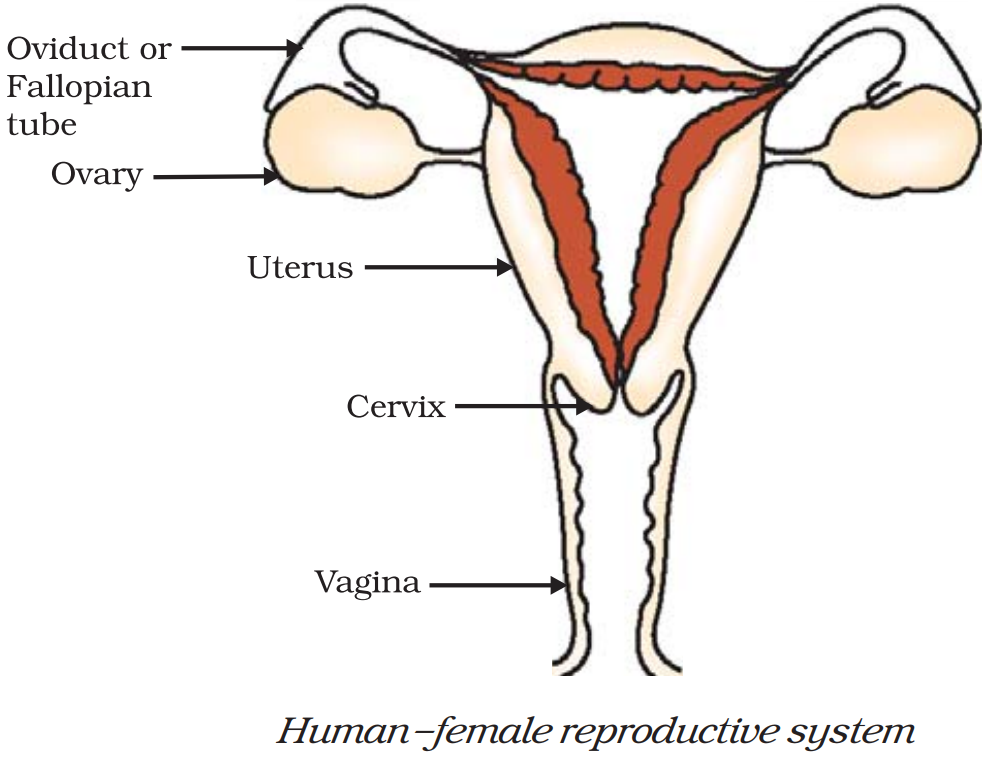
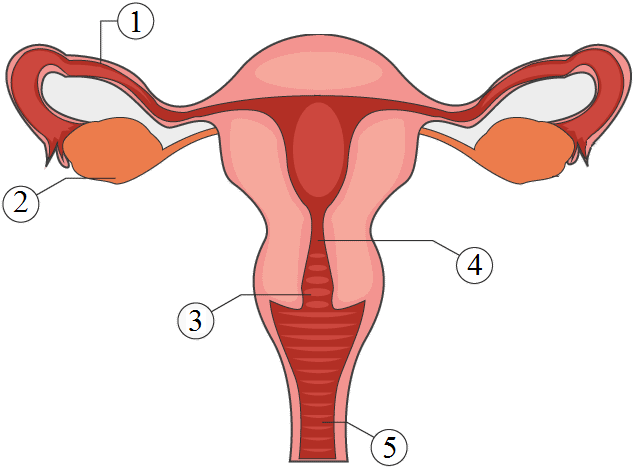
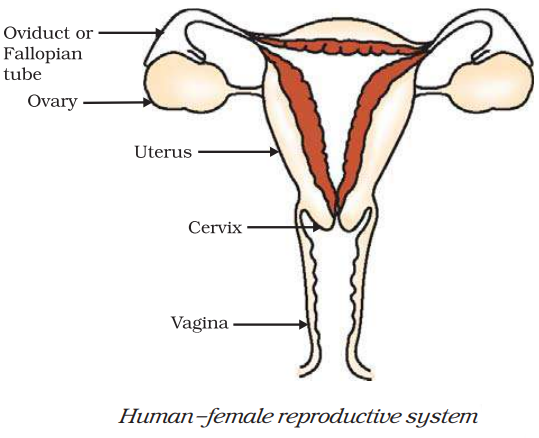
  1. Identify the given diagram. Name the parts 1 to 5.
  1. What is contraception? List three advantages of adopting contraceptive measures.
Answer
  1. The labelled parts of the female reproductive system are as follows:
  1. Oviduct or Fallopian Tube
  2. Ovary
  3. Uterus
  4. Cervix
  5. Vagina
  1. Contraception includes methods or ways to prevent fertilisation and pregnancy in a fertile female as a result of successful copulation between a fertile male and female.
Some of the major advantages of adopting various contraceptive methods include:
  1. Prevention of unwanted pregnancies.
  2. Help in family planning and population control.
  3. Some contraceptive devices like condoms and female diaphragm prevent spread of STDs like AIDS and Hepatitis B.
View full question & answer
Question 325 Marks
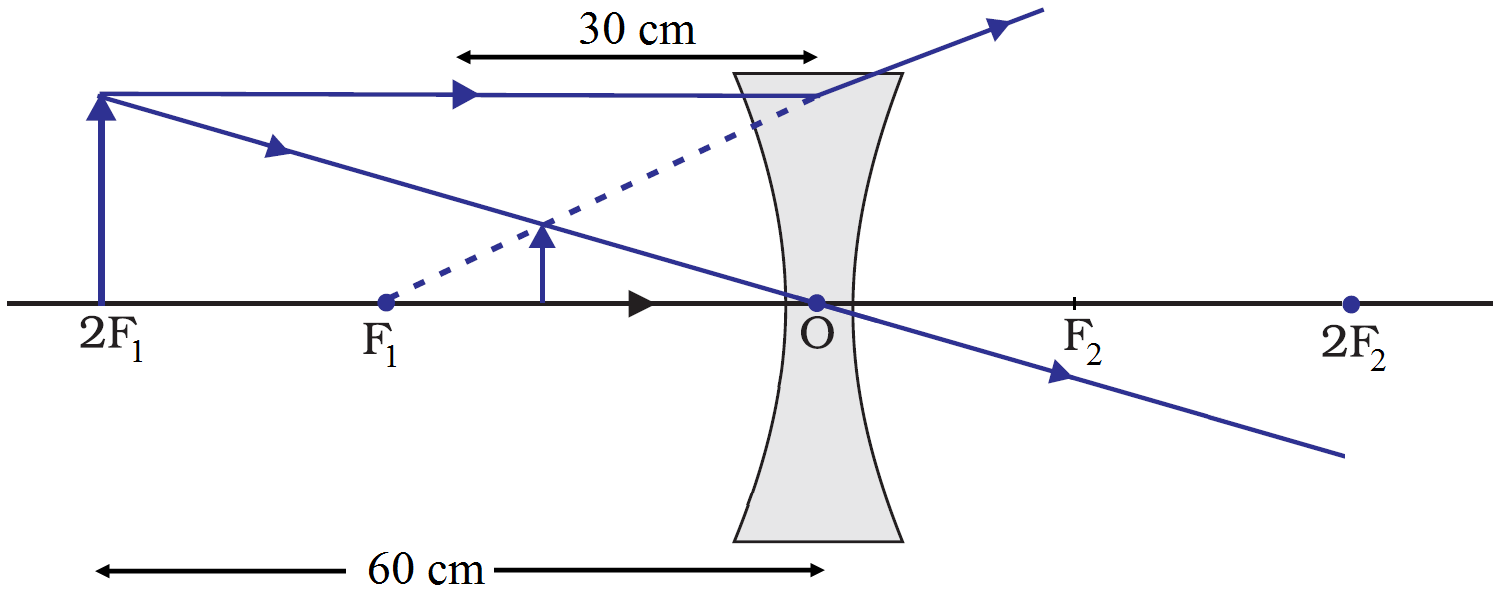
An object is placed at a distance of 60cm from a concave lens of focal length 30cm.
  1. Use lens formula to find the distance of the image from the lens.
  2. List four characteristics of the image (nature, position, size, erect/ inverted) formed by the lens in this case.
  3. Draw ray diagram to justify your answer of part (ii).
Answer

We have,
  1. Object distance, u = -60cm
Focal length of the concave lens, f = -30cm
Using lens formula,
$\frac{1}{\text{v}}-\frac{1}{\text{u}}=\frac{1}{\text{f}}$
$\frac{1}{\text{v}}-\frac{1}{(-60)}=\frac{1}{(-30)}$
$\frac{1}{\text{v}}=\frac{-1}{30}-\frac{1}{60}$
$\frac{1}{\text{v}}=\frac{-3}{60}$
$\text{v}=-20\text{cm}$
The image will be formed at a distance of 20cm in front of the lens.
  1. Nature of the image is virtual. The position of the image is between $F_1$ and optical center O.
Size of the image is diminished. The image is Erect.
  1.  
View full question & answer
Question 335 Marks
Define pollination. Explain the different types of pollination. List two agents of pollination? How does suitable pollination lead to fertilization?
Answer
Transfer of pollen grain from the anther of a flower to stigma is termed as pollination.
Based on the transfer of pollen grains between plants, pollination can be of two types:
  1. Self Pollination: When pollen of a plant is transferred to the stigma of a flower on the same parent plant then it is termed as self-pollination.
  2. Cross Pollination: When pollen of a plant is transferred to the stigma of a flower of a plant different from the one from which pollen is obtained then it is termed as cross-pollination.
Some of the most common agents of pollination that helps in carrying the pollen from the anther to the stigma of a flower are insects and wind.
As the pollen of the right type is deposited on to the stigma of the flower of the same species, quite often it leads to germination of pollen grain as a result of a chemical cross-talk between the pollen and the carpel. Germination leads to the growth and extension of the pollen tube through the style of the flower to its ovary. The pollen tube carries the male gametes all the way to the ovule inside the ovary, leading to fertilisation of male gamete with the female gamete inside the ovule,
View full question & answer
Question 345 Marks
Sperms are produced in testis, how do they reach the urethra for further passage into the female reproductive tract?
Answer
The testes are composed of coiled structures called seminiferous tubules, which are the sites of sperm production. The structure on top of the seminiferous tubules in the testes is the epididymis. The sperm migrate from of the seminiferous tubules to the epididymis. Within the epididymis, the sperm mature while they are stored in this structure.
The ejaculation process begins as the penis fills with blood and becomes erect. With sufficient stimulation, mature sperm travel from the epididymis through the vas deferens, a muscular tube, which propels sperm forward through smooth muscle contractions. The sperm arrive first at the ampulla, where secretions from the seminal vesicle are added.
From the ampulla, seminal fluid is propelled forward through the ejaculatory ducts toward the urethra, passing first by the prostate gland, where a milky fluid is added to form semen. Finally, the semen is ejaculated through the far end of the urethra.
View full question & answer
Question 355 Marks
What is done in the contraception method known as:
  1. Vasectomy.
  2. Tubectomy?
Answer
  1. Vasectomy: In males, a small portion of the sperm duct (Vasdeferens) is removed by surgical operation and both the cut ends are ligated properly. This prevents the sperms from coming out.
  2. Tubectomy: In females, a small portion of the oviducts is removed by surgical operation and the cut ends are ligated. This prevents the ovum from entering into the oviducts.
View full question & answer
Question 365 Marks
The human males use a device X made of a very thin rubber sheet as a covering on the male organ to prevent pregnancy. This device traps the gametes Y in it. In order to prevent pregnancy, the human females use a device Z which is a circle of rubber with a metal spring around it. The device Z is put inside the vagina to cover the cervix. It stops Y from going into the uterus.
  1. What is device X?
  2. What are Y?
  3. Name the device Z.
  4. What is the general name of these methods of birth control (or preventing pregnancy)?
  5. The use of which contraceptive device, X or Z, can protect the persons from sexually transmitted diseases?
Answer
  1. The device X is condom.
  2. Y represents sperms.
  3. The device Z is copper-T.
  4. The general name of these methods of birth control is called barrier method or IUCD (Intrauterine Contraceptive Device).
  5. Using condoms (X) during sexual intercourse can protect a person from sexually transmitted disease.
View full question & answer
Question 375 Marks
When an insect sits on the flower of a plant then some particles A present in the top of little stalks in the flower attach to its body hair. When this insect now sits on the flower of another similar plant, then particles A attached to the hair of insect are put on the top of a flask-shaped organ at the centre of flower. The particle A grows a long tube b from the top of flask-shaped organ through which C moves down and reaches the bottom part of flask-shaped organ. Here C fuses with the nucleus of d contained in structure E. the fusion of C and D forms a new cell f which grows and develops into a seed of the plant.
  1. What are particles A? What is the process of transferring A from one flower to another flower of similar plant by the insect known as?
  2. What is the name of tube B?
  3. What is C which moves down through the tube B?
  4. Name D and E.
  5. What is F?
Answer
  1. Represents pollen grains. The process of transferring pollen grains from one flower to another flower of the similar plant by insects is known as cross pollination.
  2. B represents the pollen tube.
  3. C is the male gamete which moves down through the pollen tube (B).
  4. D is the female gamete (or egg). The structure E represents the ovule.
  5. F is the zygote.
View full question & answer
Question 385 Marks
In the surgical method of birth control available for males, the structures A in the reproductive system are cut and ligated (tied up) at both ends. This prevents the reproductive cells B from coming out from the organs C where they are made in the male body. Since B cannot come out from the male body, they cannot fuse with cell D in the body of a female and hence pregnancy is prevented.
  1. What are structures A?
  2. What are cells B?
  3. Name the organs C.
  4. What is cell D?
  5. What is the name of this surgical procedure for birth control available to males?
Answer
  1. A represents the vas deferens.
  2. B represents sperms.
  3. C represents the testes.
  4. The cell D is the egg or ova.
  5. The surgical method of birth control available to males is called vasectomy.
View full question & answer
Question 395 Marks
A worm X found in freshwater and slow-moving streams has been accidently cut into three pieces. It was observed that in due course of time, each cut piece of the worm develops to become a complete worm by growing all the missing parts.
  1. Name the worm X which can exhibit this phenomenon of making complete worm from its cut body parts.
  2. Name another organism Y which possesses the same characteristic of growing fully from its cut body parts.
  3. What is the name of this process in which a complete organism is formed from its cut body part.
  4. State whether X and Y are unicellular and/or multicellular organisms.
  5. Can a dog be produced completely form its cut body part (say, a cut tail) just like organisms X and Y? Why?
Answer
  1. The worm X is Planaria.
  2. The organism Y which posses the same characteristic as of X is Hydra.
  3. The process in which a complete organism is formed from a lost body part of its parent is regeneration.
  4. X and Y are multicellular organisms.
  5. A dog cannot be produced from a lost body part like its tail, as this animal has a high degree of organisation in its body.
View full question & answer
Question 405 Marks
What is placenta? Mention its role during pregnancy?
Answer
Followed by fertilization, placenta is developed which serve to provide nutrition and oxygen to developing embryo from the mother's blood. It is a disc embedded in the uterine wall and contains villi on the embryo's side of the tissue while blood spaces surrounding the villi are present on mother’s side. The embryo is connected to the placenta by umbilical cord, a tube like structure.Placenta serves to fulfill all nutritional requirements of developing embryo by supplying food and oxygen from mother’s blood to the embryo. Waste products of developing embryo are removed by transferring them into the mother's blood through the placenta. Functions of placenta are facilitated by villi that provide large surface areas for passage of nutrition and oxygen to embryo from mother through blood.
View full question & answer
Question 415 Marks
A, B and C are three common STDs. A and C are caused by bacteria whereas B is caused by a virus D. The virus D reduces the immunity of the infected person to such a low level that the person can die of even very mild diseases.
  1. What could A and C be?
  2. What is B?
  3. Name the virus D?
  4. How can A, B and C be caused?
  5. Out of A, B and C, which one does not have a definite cure as yet?
Answer
  1. A is gonorrhoea and C is syphilis.
  2. B is AIDS.
  3. The virus D is Human Immunodeficiency Virus (HIV).
  4. A, B and C can be caused by sexual contact with an infected person.
  5. AIDS (B) does not have a definite cure as yet.
View full question & answer
Question 425 Marks
Name two bacterial diseases which are sexually transmitted. Name their causal organisms, symptoms and preventive measures.
Answer
Two bacterial, sexually transmitted diseases are gonorrhoea and syphilis:
  1. Gonorrhoea: It is caused by Neisseria gonorrhoeae. Symptoms, if produced include burning with passage of urine, discharge from penis or vagina, pain in the pelvic region. The disease can be prevented by the use of condoms during sex or having sex with only one, uninfected partner.
  2. Syphilis: It is caused by Treponema pallidum species. Symptoms include the presence of a firm skin ulcer, without pain or itching. This disease can be prevented by use of condoms.
View full question & answer
Question 435 Marks
A filamentous alga X is found in ponds, lakes and slow-moving streams. The filament of this alga simply breaks into two (or more) pieces on maturing and each piece then grows to become a complete new alga.
  1. Name an alga which X is likely to be.
  2. What is the colour of X?
  3. What is the method of forming new algae by the breaking of parent alga known as?
  4. An Amoeba also breaks up to form two daughter Amoebae. What is the difference in the splitting of Amoeba and splitting of this alga as a method of reproduction?
  5. Name one marine animal which reproduces in the same way as alga X.
Answer
  1. The alga X is likely to be Spirogyra.
  2. The alga is green in colour.
  3. This mode of forming new alga from the breaking-up of the parent alga is termed as fragmentation.
  4. The splitting of Amoeba is termed as fission, which occurs only in unicellular organisms. The splitting of alga is termed as fragmentation, which occurs only in multicellular organisms.
  5. Sea anemone reproduces in the same way as the alga X.
View full question & answer
Question 445 Marks
What are various ways to avoid pregnancy? Elaborate any one method.
Answer
Methods to avoid undesired pregnancy are called contraceptive methods. It includes:
  1. Mechanical barrier that prevent arrival of sperm to the egg, e.g., condom.
  2. Chemical Drugs or contraceptive pills-Small dosage of female hormones that prevent released of egg.
  3. Loop or copper-T-physical devices to prevent pregnancy.
  4. Surgical method-permanent contraception by vasectomy and tubectomy.
Surgical methods: Vasectomy refers to surgical method in which vasa deferentia in human males are cut and sealed to prevent pregnancy by making seminal fluid devoid of sperms. Tubectomy refers to surgical process in which oviducts in human females are cut and sealed to prevent pregnancy by inhibiting released of egg.
View full question & answer
Question 455 Marks
Two very small organisms X and Y both reproduce by the method of budding. Organism X is industrially very important because it is used in making alcohol from sugar. It is also used in making bread. Organism Y Lives in freshwater. If organism Y gets cut into a number of parts accidently, each cut part can grow to form complete organism.
  1. What are organisms X and Y?
  2. What is the name of the process in which X converts sugar into alcohol?
  3. To which class of organisms does X belong?
  4. Name an important body feature of organism Y.
  5. Which organism is multicellular and which one is unicellular?
Answer
  1. The organism X is yeast and organism Y is Hydra.
  2. The process by which the organism X converts sugar into alcohol is fermentation.
  3. Organism X is a fungus; hence, it belongs to the category of non-green plants.
  4. Organism Y is a multicellular organism and comprises tentacles at one end.
  5. Organism X is unicellular, and the organism Y is multicellular.
View full question & answer
Question 465 Marks
When a fertilised egg E formed in the oviduct of a human female divides repeatedly to form an embryo, the embryo gets implanted in the thick and soft lining of the uterus. After this a disc-like special tissue T develops between the uterus wall and embryo through which all the requirements of the developing embryo (and foetus) are met from the mother's body, The embryo is connected to the tissue T through a string like structure S.
  1. What is the other name of fertilised egg cell E?
  2. What is the name of tissue T?
  3. Name the string-like structure S.
  4. Name two substances which pass from mother's blood to embryo through tissue T and, one type of substance which passes from embryo to mother's blood.
  5. What happens to S when the baby is born? Why?
Answer
  1. The fertilised egg cell E is also called the zygote.
  2. The tissue T is the placenta.
  3. The string-like structure S is the umbilical cord.
  4. Oxygen and nutrients pass from the mother's blood to the embryo and carbon dioxide passes from the embryo to the mother's blood through the placenta (T).
  5. When a baby is born, the umbilical cord is still attached to the baby. It is cut and tied to separate the baby from the mother.
View full question & answer
Question 475 Marks
The germ cell A produced by a person X is round in shape and it fuses with another germ cell B having a long tail and produced by a person Y. The fusion of A and B produces a new cell C. The cell C divides repeatedly and grows inside the organ D of person X to form E in which the body features of the unborn baby are not much developed. E grows further to form F in which the various body features of the unborn baby (like hands, legs, head, eyes, and ears, etc.) can be identified. F grows further and ultimately forms a baby. What are A, B, C, D, E and F? Out of the two persons X and Y, which one is male and which one female?
Answer
  • A is the ovum.
  • B is sperm.
  • C is the zygote.
  • D is the uterus.
  • E is the embryo.
  • F is the foetus.
The person X is a female and Y is a male.
 
View full question & answer
Question 485 Marks
A scientist removed some cells from the growing point of a plant and placed it in a suitable medium leading to the formation of a shapeless lump of mass X. X is then transferred to another medium which stimulates it to develop roots. When X with developed roots is placed in a yet another medium, then it develops shoots to form tiny plantlets. These plantlets can then be transplanted in pots or soil where they can grow to form mature plants.
  1. What is the shapeless lump of mass X known as?
  2. What name is given to this method of producing new plants?
  3. The growth medium used in this method contains plant nutrients in the form of a 'jelly'. Name this jelly.
  4. What is the general name of chemicals used to stimulate the growth of plant cells and development of roots and shoots?
  5. Name any two plants which are produced by this method.
  6. State any two advantages of this method of producing plants.
  7. What is the other name of this method [other then that given in (b) above]?
Answer
  1. The shapeless lump of mass X is known as callus.
  2. This method of producing new plants is known as tissue culture.
  3. The jelly is called agar.
  4. The chemicals used to stimulate the growth of plant cells and fasten the development of roots and shoots are called plant hormones.
  5. Orchids and dahlia are two flowering plants that are propagated by this method.
  6. The main advantage of this technique is that it is extremely fast, and the plantlets are obtained in a few weeks. Secondly, this method produces disease-free plantlets.
  7. The other name of this technique is micropropagation.
View full question & answer
Question 495 Marks
DNA copies generated will be similar, but may not be completely identical to the original.’ Explain the statement concerning asexually reproducing organisms.’
Answer
DNA copies generated during reproduction will be similar but may not be identical to the original. This statement is correct because copying of DNA also accompanies the creation of an additional cellular apparatus. When the DNA copies are separated from each other, each copy have its own cellular apparatus and from one cell, there is production of two cells due to which copying of DNA brings variation every time. Survival cells are similar to each other but also they have variations from each other too.
View full question & answer