Questions

[5 marks Questions]

🎯

Test yourself on this topic

36 questions · timed · auto-graded

Question 15 Marks
  1. List the parts of the human eye that control the amount of light entering into it. Explain how they perform this function.
  2. Write the function of retina in human eye.
  3. Do you know that the corneal-impairment can be cured by replacing the defective cornea with the cornea of the donated eye? How and why should we organise groups to motivate the community members to donate their eyes after death?
Answer
  1. The iris and pupil control the amount of light entering the eyes. If the amount of light received by the eye is large (as during the day time), then the iris contracts the pupil (makes the pupil small) and reduces the amount of light entering the eye.
If the amount of light received by the eyes is small (as in a dark room or during night), the iris expands the pupil (makes the pupil large) so that more enter the eyes.
  1. The screen on which the image is formed in the eye is called retina. Retina is a delicate membrane having a large number of light sensitive cells called ‘rods’ and ‘cones’ which respond to the ‘intensity of light’ and ‘colours of object’ respectively.
  2. Eyes of a dead person can be donated to a person having corneal blindness. It will help him/her see the world. We can also register ourselves to donate our eyes. The organisations that put up eye donation camps preserve our eyes after our death and donate them to the needy.
View full question & answer
Question 25 Marks
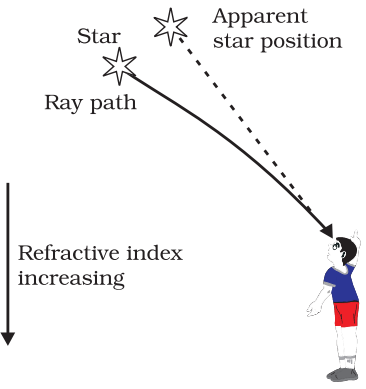
What is atmospheric refraction? Use this phenomenon to explain the following natural events.
  1. Twinkling of stars.
  2. Advanced sun-rise and delayed sun-set.
Draw diagrams to illustrate your answers.
Answer
Atmospheric refraction is the refraction of light caused by the earth's atmosphere due to change in the refractive indices of different layers of the atmosphere.
  1. Twinkling of stars: Stars are distant point sourced sources of light. The path of the rays of light coming from the distant star goes on varying due to atmospheric refraction slightly. Thus, apparent position of the star fluctuates and the amount of star light entering the eye flickers giving the twinkling effect.
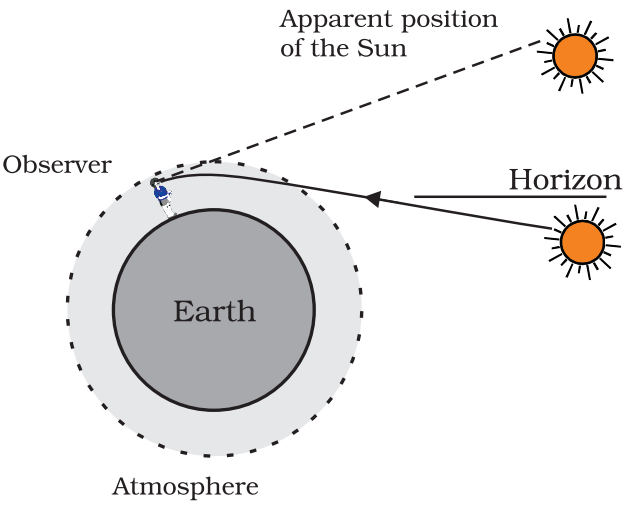
  1. Advanced sunrise: When the sun is slightly below the horizon, light rays coming from the sun travel from rarer to denser layers of air. As a result of the atmospheric refraction of light appears to come from a higher position above the horizon. Therefore, the sun appears earlier than actual sunrise.
Delayed sunset: During sunset, the apparent position of the sun is visible to us and not the actual position due to the same bending of light rays effect. Therefore, because of refraction, we see the sunset afterwards although it has actually moved from its position.

View full question & answer
Question 35 Marks
Write the importance of ciliary muscles in the human eye. Name the defect of vision that arises due to gradual weakening of the ciliary muscles in old age. What type of lenses are required by the persons suffering from this defect to see the objects clearly?
Akshay, sitting in the last row in his class, could not see clearly the words written on the blackboard. When the teacher noticed it, he announced if any student sitting in the front row could volunteer to exchange his seat with Akshay. Salman immediately agreed to exchange his seat with Akshay. He could now see the words written on the blackboard clearly. The teacher thought it fit to send the message to Akshay’s parents advising them to get his eyesight checked.
In the context of the above event, answer the following questions:
  1. Which defect of vision is Akshay suffering from? Which type of lens is used to correct this defect?
  2. State the values displayed by the teacher and Salman.
  3. In your opinion, in what way can Akshay express his gratitude towards the teacher and Salman?
Answer
Ciliary muscles are important because they help in modifying the curvature of eye lens so that eye can focus objects which are at varying distances. The focal length is changed by contraction and relaxation of ciliary muscles. We are able to see nearby and also the distant object clearly by using bifocal lenses which consists of both concave and convex lens. The upper part of lens is Concave lens which is used for distant vision and the lower part of lens is convex lens which is for nearby objects. Bifocal lens are used in Presbyopia condition when the person can't see distant as well as nearby objects.
  1. Akshay is suffering from Myopia defect in which the person can't see distant objects clearly. Concave lens of suitable power is used to correct it.
  2. The teacher showed concerned and care towards the health of Akshay. Moreover, Salman has also showed helping and caring nature.
  3. Akshay should thank his teacher as well as Salman for the caring nature they showed towards him.
View full question & answer
Question 45 Marks
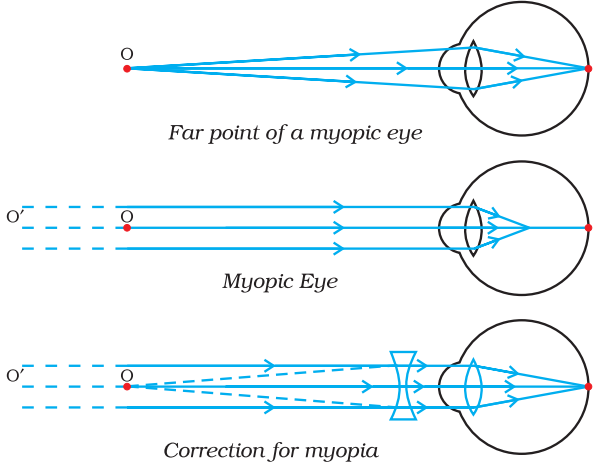
  1. A student suffering from myopia is not able to see distinctly the objects placed beyond 5 m. List two possible reasons due to which this defect of vision may have arisen. With the help of ray diagrams, explain.
  1. Why the student is unable to see distinctly the objects placed beyond 5 m from his eyes.
  2. The type of the corrective lens used to restore proper vision and how this defect is corrected by the use of this lens.
  1. If, in this case, the numerical value of the focal length of the corrective lens is 5 m, find the power of the lens as per the new Cartesian sign convention.
Answer
Two possible reasons due to which this defect of vision may have arisen are:
  1. Increase in curvature of the lens.
  2. Increase in length of the eyeball.
  1.  
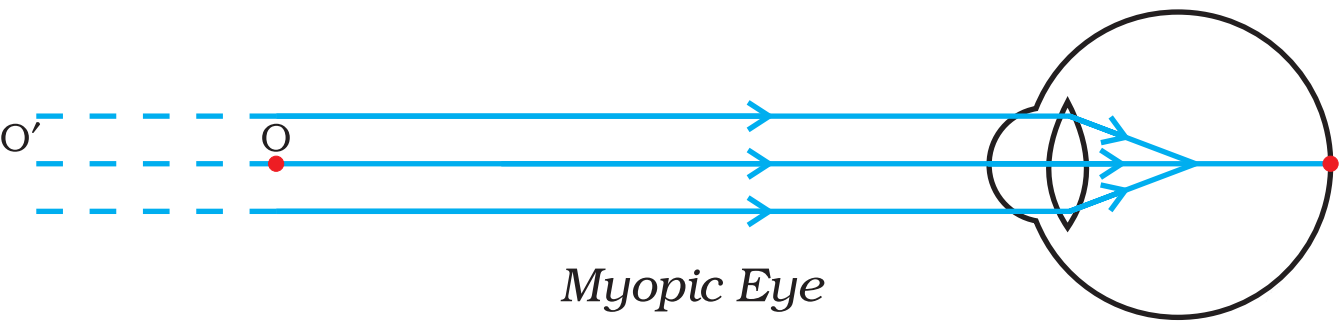
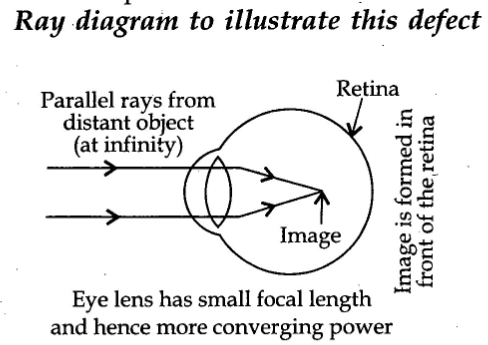
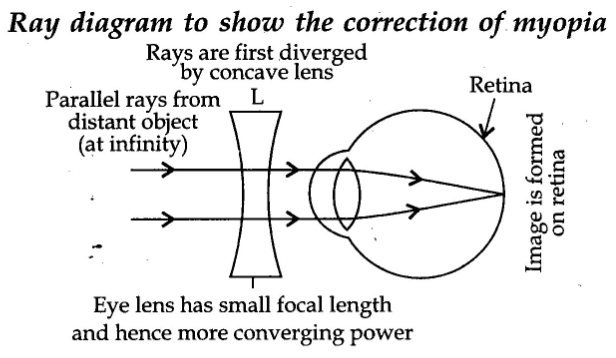
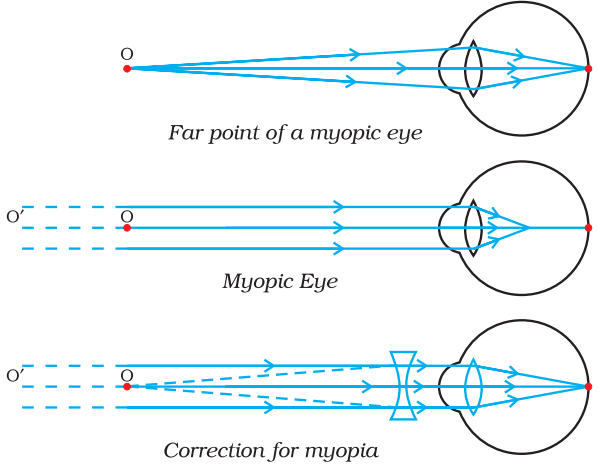
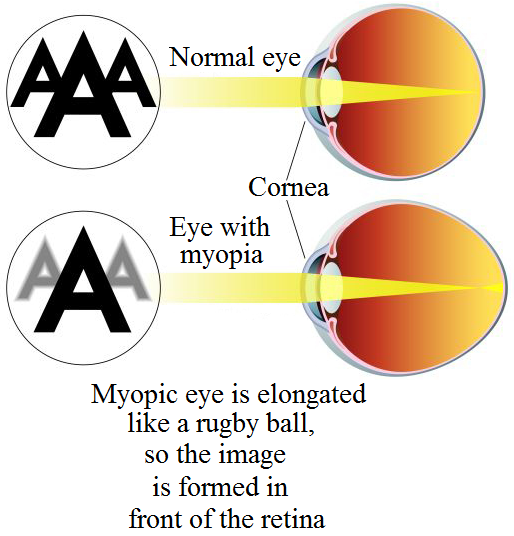
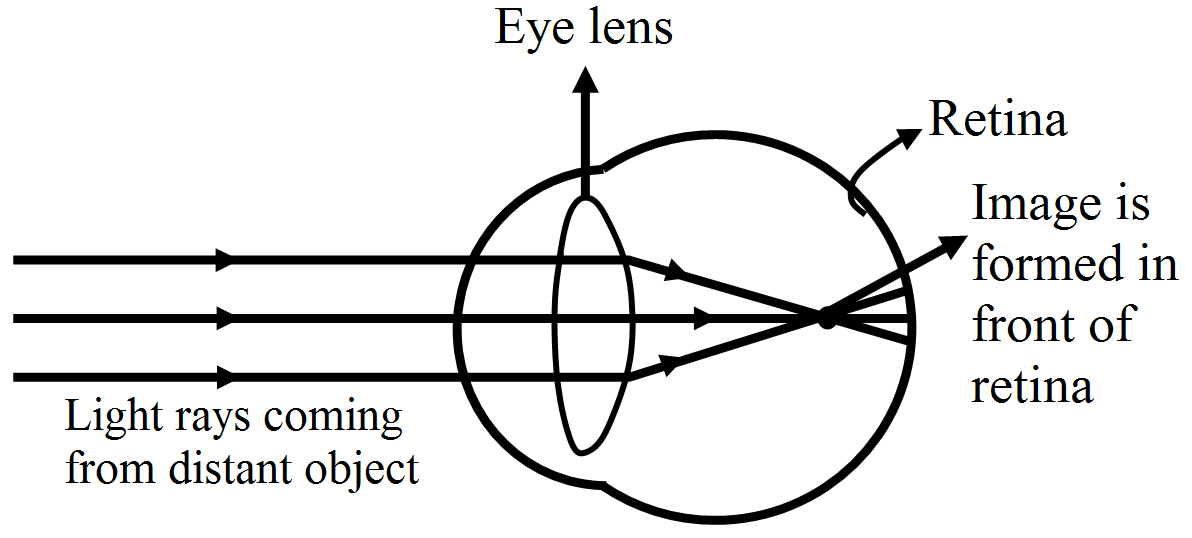
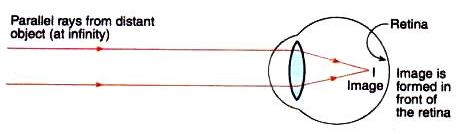
  1. A myopic eye has its far point nearer than infinity. It forms the image of a distant object in front of its retina as shown in the figure given below. In the given case student's far point is 5 m. So, image of the object placed beyond 5 m from his eyes is formed in front of the retina and hence appears blurred. That is why the student is unable to see distinctly the objects placed beyond 5 m from his eyes.
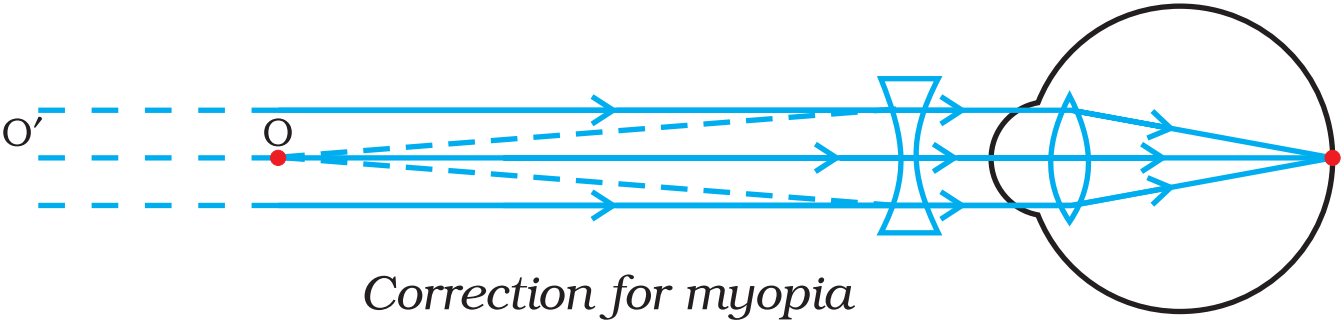
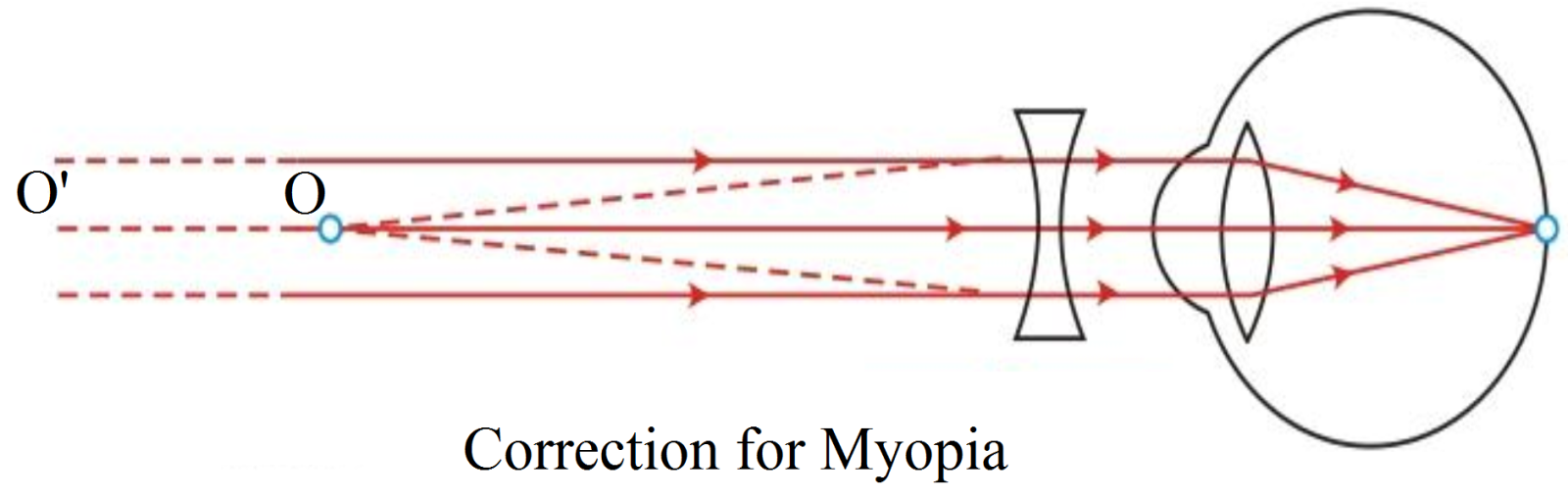
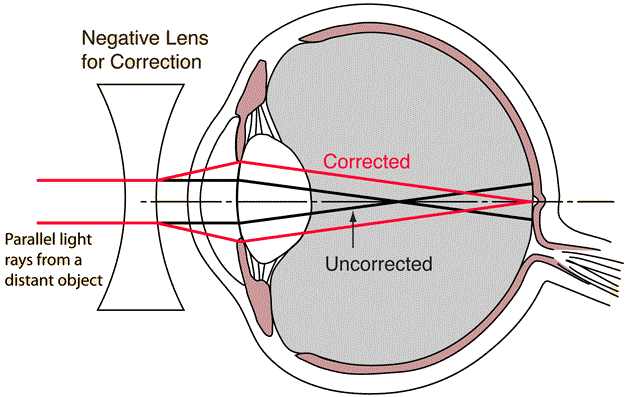
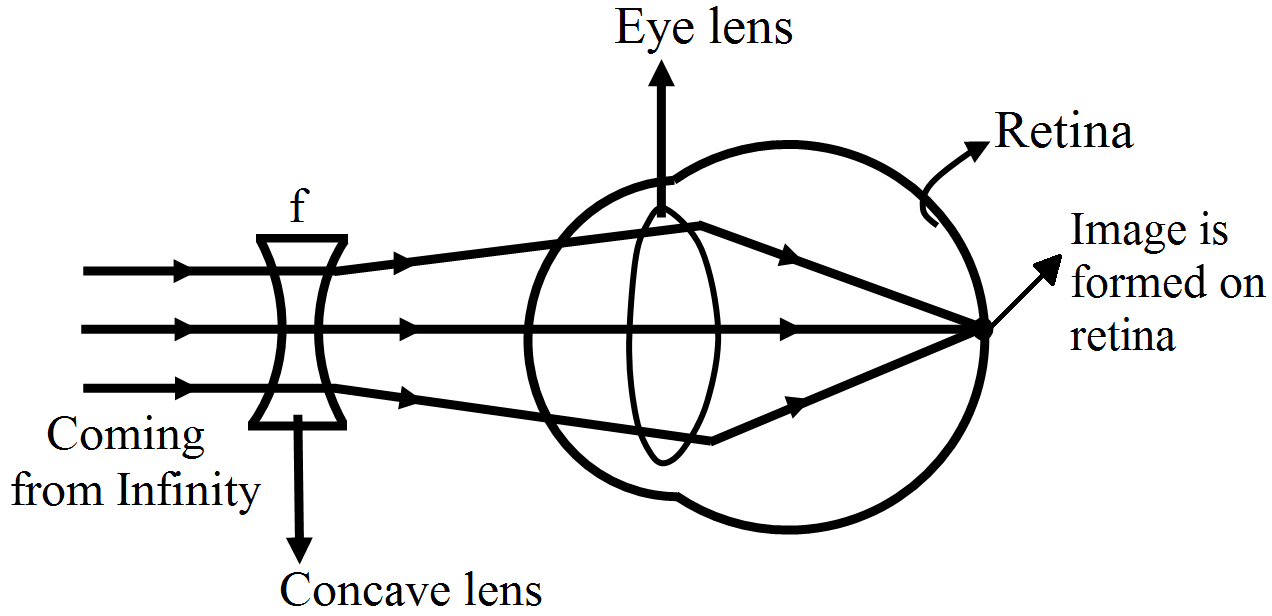
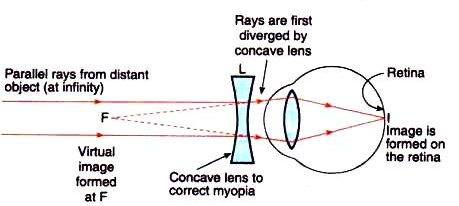
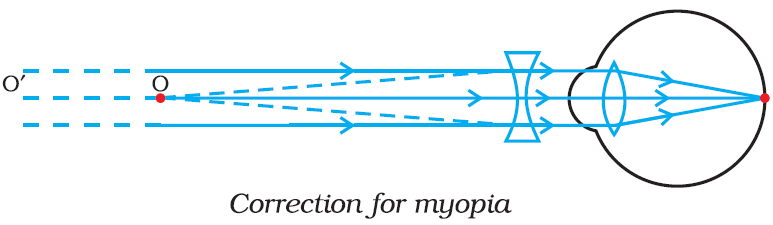
  1. Since a concave lens has an ability to diverge incoming rays, it is used to correct this defect of vision. The image is allowed to form at the retina by using a concave lens of suitable power as shown in the given figure.
  1. Power of the required corrective lens $(\text{P})=\frac{1}{\text{f}\text{(in m)}}$
$\text{P}=-\frac{1}{5}$

$\text{P} = -0.2\text{D}$

Hence, the power of corrective lens is -0.2D.
View full question & answer
Question 55 Marks
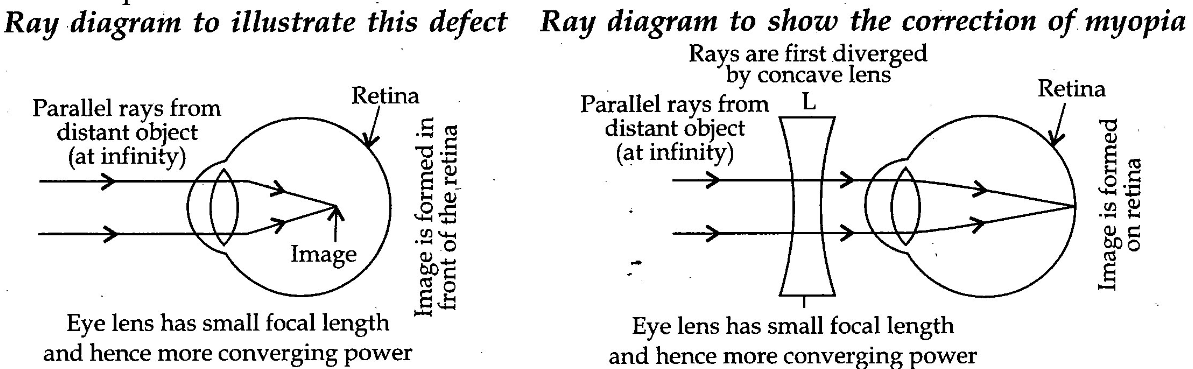
  1. A student cannot see clearly a chart hanging on a wall placed at a distance of 3 m from his eyes. Name the defect of vision he is suffering from. Draw a ray diagram to illustrate this defect. List its two possible causes.
  2. Draw a ray diagram to show how this defect may be corrected using a lens of apropriate focal length.
  3. An eye donation camp is being organised by social workers in your locality. How and why would you help in this cause?
Answer
  1. Myopia is the defect of the eye vision due to which a person can see the near objects clearly, but he cannot see the far objects clearly.
Causes of myopia: myopia is caused:
  • Due to the elongation of the eye ball.
  1. Due to decrease in the focal length of the eye lens becomes more convergent. Myopia can be corrected by using a concave lens of suitable focal length in the spectacles of such a person.
  1.  
  1. There are millions of blind people in our country who cannot see at all. The eyesight of most of these blind people can be restored if they are given the eyes donated by other persons after their death. Our two eyes can give eyesight to two blind persons.
In the eye donation camps, we can even today, make a pledge in writing, i.e., whenever we die, our eyes should be removed and given to the blind persons to light up their dark world. We should be greatful to God that he has given us the gift of vision to see this wonderful world.
We must try and pass on this priceless gift of vision to our less fortunate blind brothers and sisters by registering our name for eye donation.
View full question & answer
Question 65 Marks
  1. What is meant by 'power of a lens'?
  2. State and define the S.I. unit of power of a lens.
  3. A convex lens of focal length 25 cm and a concave lens of focal length 10 cm are placed in close contact with each other. Calculate the lens power of this combination.
Answer
  1. The ability of a lens to converge or diverge a beam of the light ray is known as the Power (P) of the lens.
Power is equal to the reciprocal of the focal length.

That is, $\text{P}=\frac{1}{\text{f}}$
  1. SI unit of the power of a lens is Dioptre.
$1\text{diopter}=\frac{1}{(1\text{m})}=1\text{m}^{-1}$

1m is the focal lenght of the lens.
  1. Given,
Focal length, f = +25cm

$=+\Big(\frac{25}{100}\Big)\text{m}$

$\text{P}_1=\frac{1}{\text{f}_1}$

$=\frac{100}{25}$

$\Rightarrow\text{P}_1=+4\text{D}$

Focal length, $\text{f}_2=-10\text{cm}=-\Big(\frac{10}{100}\Big)\text{m}$

Power, $\text{P}_2=\frac{1}{\text{f}_2}=-\Big(\frac{100}{10}\Big)\text{m}=-10\text{D}$

Power of the combination of lens, $P=P_1+P_2$

P = 4D - 10D = -6D.
View full question & answer
Question 75 Marks
  1. What is myopia? State the two causes of myopia. With the help of labelled ray diagrams show.
  1. The eye defect myopia.
  2. Correction of myopia using a lens.
  1. Why is the normal eye unable to focus on an object placed within 10 cm from the eye?
Answer
  1. Myopia: Myopia is the defect of the eye vision due to which a person can see the nearby objects clearly but cannot see the far objects so distinctly.
Causes of myopia:
  1. The eyeball gets elongated along its axis so that the distance between the eyelens and the retina becomes larger.
  2. Due to excessive curvature of the cornea, the focal length of the eyelens becomes too small.
Myopia can be corrected by using a concave lens of suitable focal length in the spectacles of such a person.
  1. The ability of the eye lens to adjust its focal length is called automatic accommodation. However, the focal length of the eye lens cannot be decreased below a certain limit. The maximum accommodation of a normal eye is reached when the object is at a distance of 25cm from the eyes. Thus, the normal eye is unable to focus an object placed within 10cm from the eye because all the power of accommodation has already taken place.
View full question & answer
Question 85 Marks
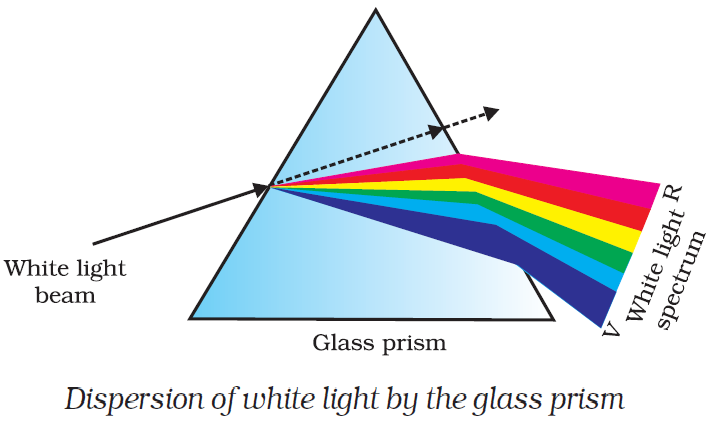
  1. What is dispersion of white light? What is the cause of such dispersion? Draw a diagram to show the dispersion of white light by a glass prism.
  2. A glass prism is able to produce a spectrum when white light passes through it but a glass slab does not produce any spectrum. Explain why it is so.
Answer
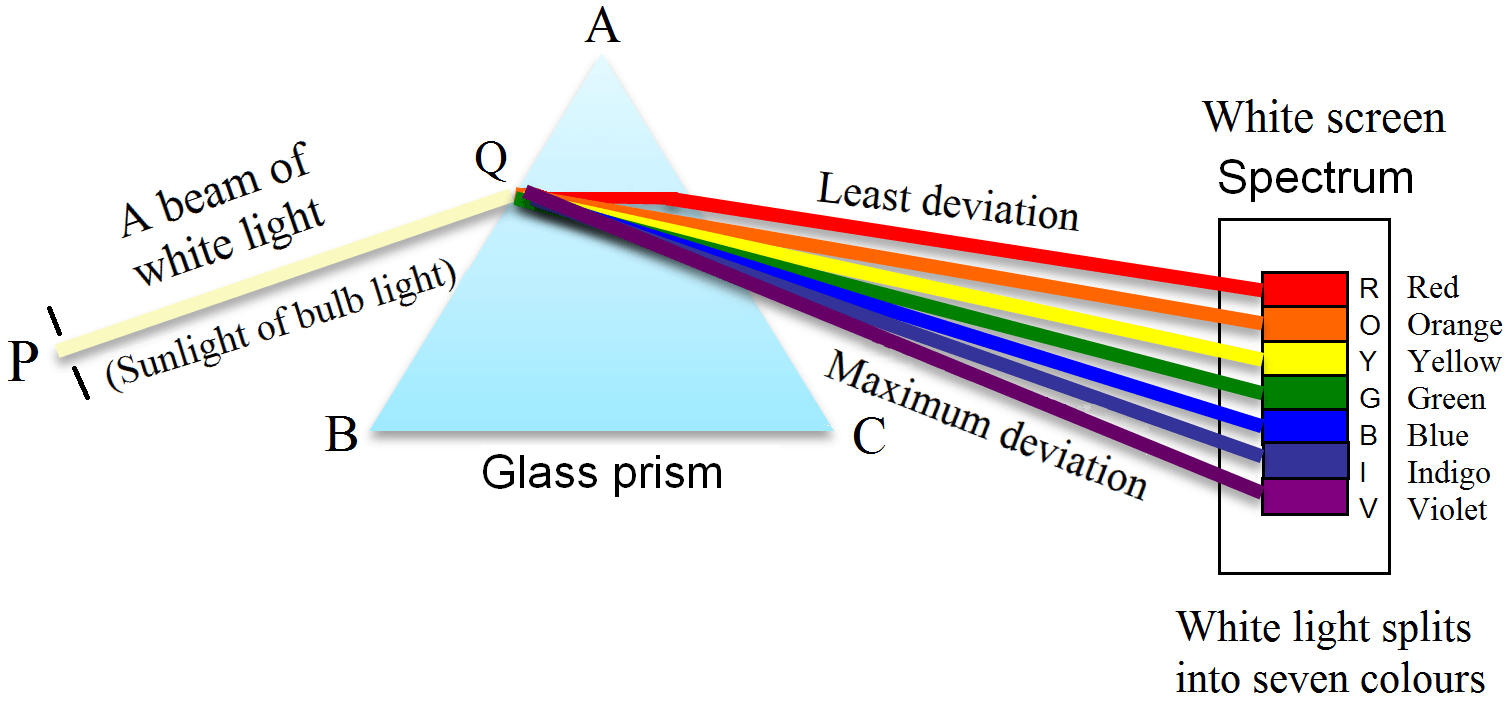
  1. The splitting up of white light into seven colours on passing through a transparent medium like a glass prism is called disperision of light.
    The dispersion of white light occurs because different colors of light bend through different angles with respect to the incident ray, as they pass through a prism. The red light bends the least while the violet the most as shown below.
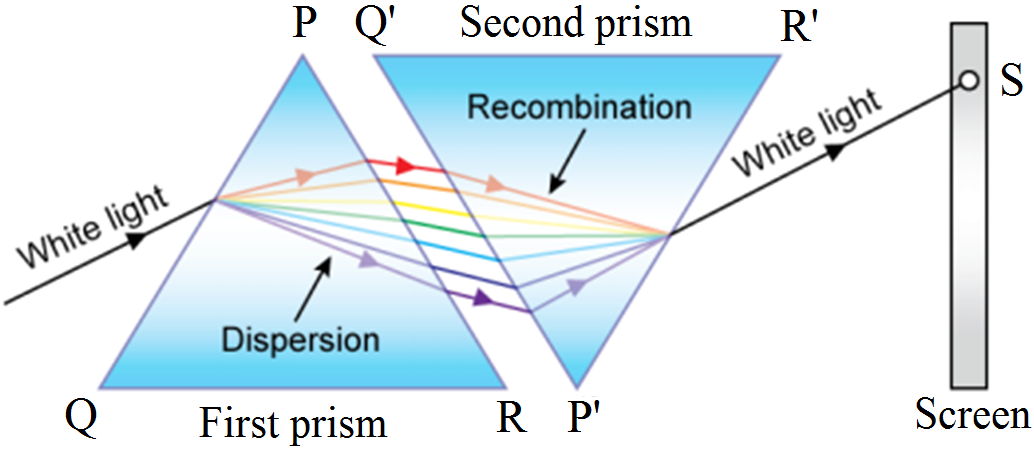
  1. A glass slab acts as a combination of two identical glass prisms. The second prism can be considered to be placed in an inverted position with respect to the first. The first prism splits the white light into its seven colour components. When these colour components fall on the second prism, it recombines them to form white light.
View full question & answer
Question 95 Marks
  1. Give reasons for the following:
  1. Colour of the clear sky is blue.
  2. The sun can be seen about two minutes before the actual sunrise.
  3. We cannot see an object clearly if it is placed very close to the eyes.
  1. What is Presbyopia? Write two causes of this defect.
Answer
  1.  
  1. The blue colour of the sky is due to the scattering of the sunlight by the molecules present in the atmosphere. Blue light of shorter wavelength is scattered more strongly than red light of longer wavelength. This scattered light contains blue light in a larger proportion and it enters our eyes. That is why the sky appears blue.
  2. When the sun is slightly below the horizon, then the sun's light coming from less dense air to more dense air is refracted downwards as it passes through the atmosphere. Because of the atmospheric refraction the sun appears to be raised above the horizon. Hence we can see the sun about two minutes before the actual sun rise.
  3. If the object is too close to the eye the distance bteween the object and retina is less and hence the image of the object is not formed on the retina so we cannot see the object properly. The minimum distance for seeing an object clearly is 25cm.
  1. Presbyopia: Presbyopia is a defect of the eye because of which a person cannot see nearby objects clearly. This defect occurs because of the loss of the power of accommodation of the eye.
The causes of this defect are as follows:
  • Weakening of the ciliary muscles in old age.
  • Reduction in the flexibility of the eye lens.
View full question & answer
Question 105 Marks
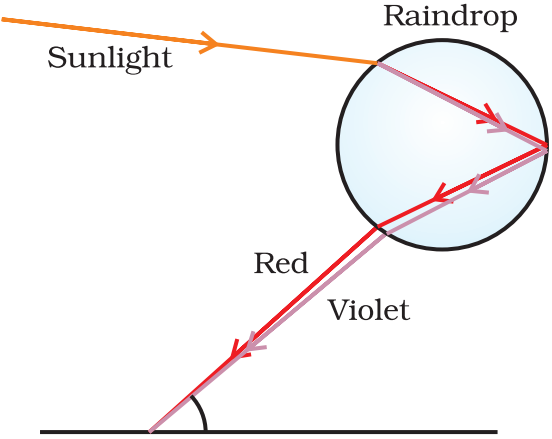
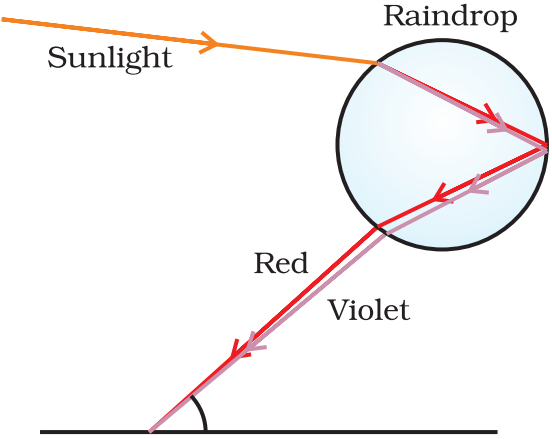
  1. What is meant by dispersion of whlte light? Describe the formation of rainbow in the sky with the help of a diagram.
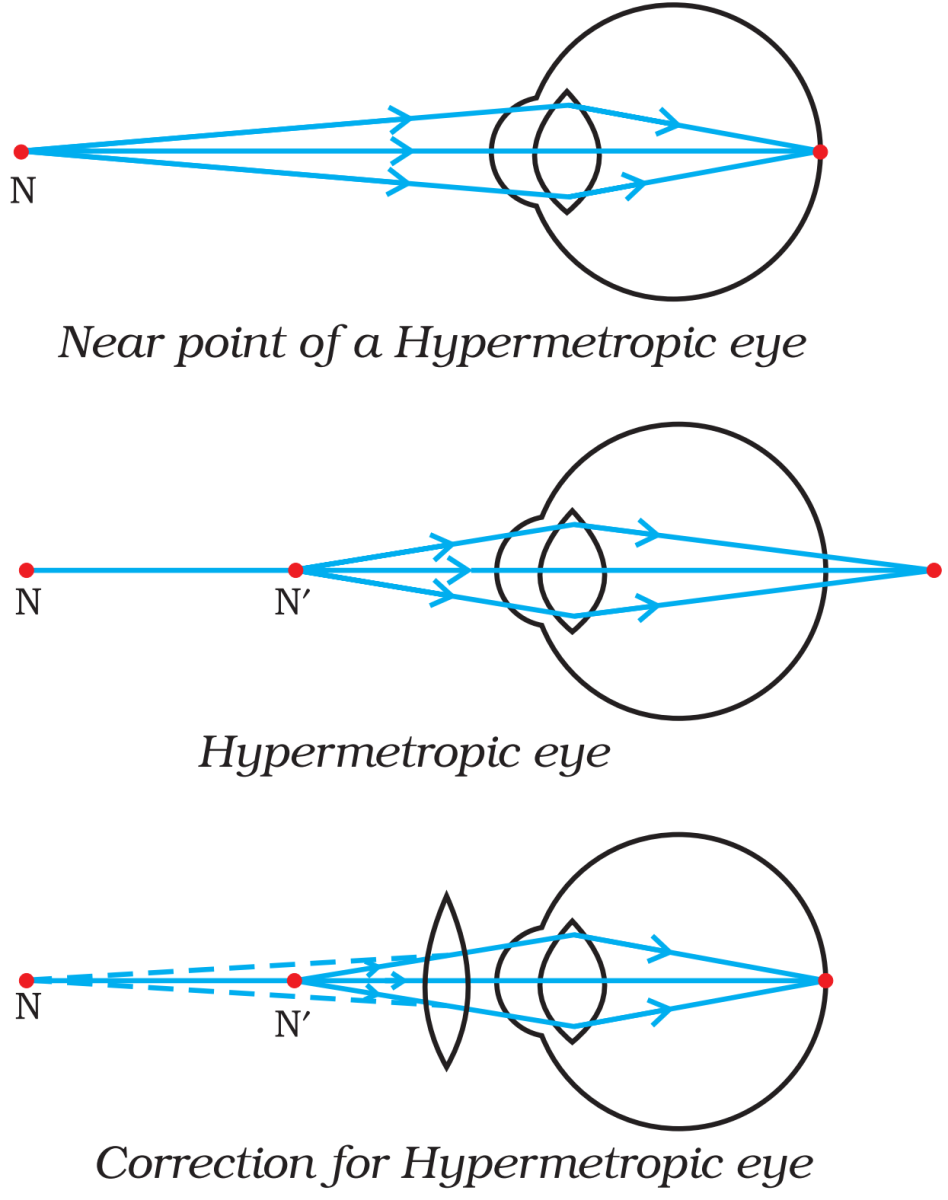
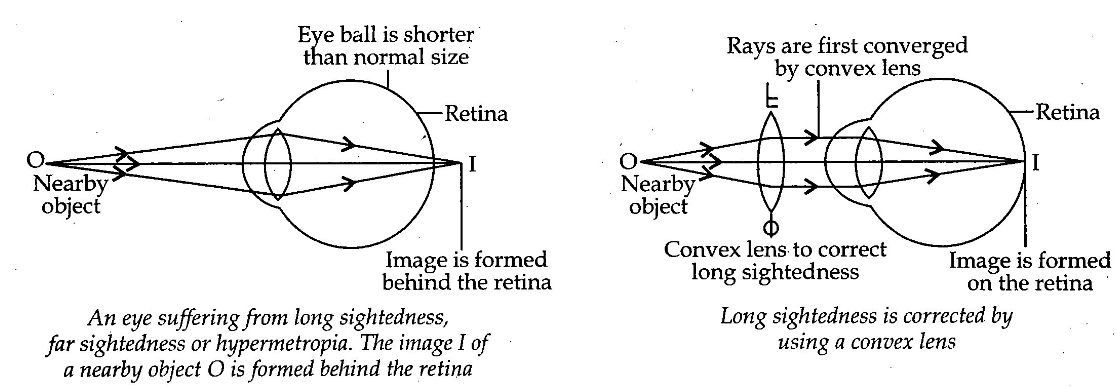
  2. What is hypermetropia? Draw ray diagrams to show the image formation of an object by:
  1. Hypermetropic eye.
  2. Correction made with a suitable lens for hypermetropic eye.
Answer
  1. The splitting up of white light into seven colours on passing through a transparent medium like a glass prism is called disperision of light.

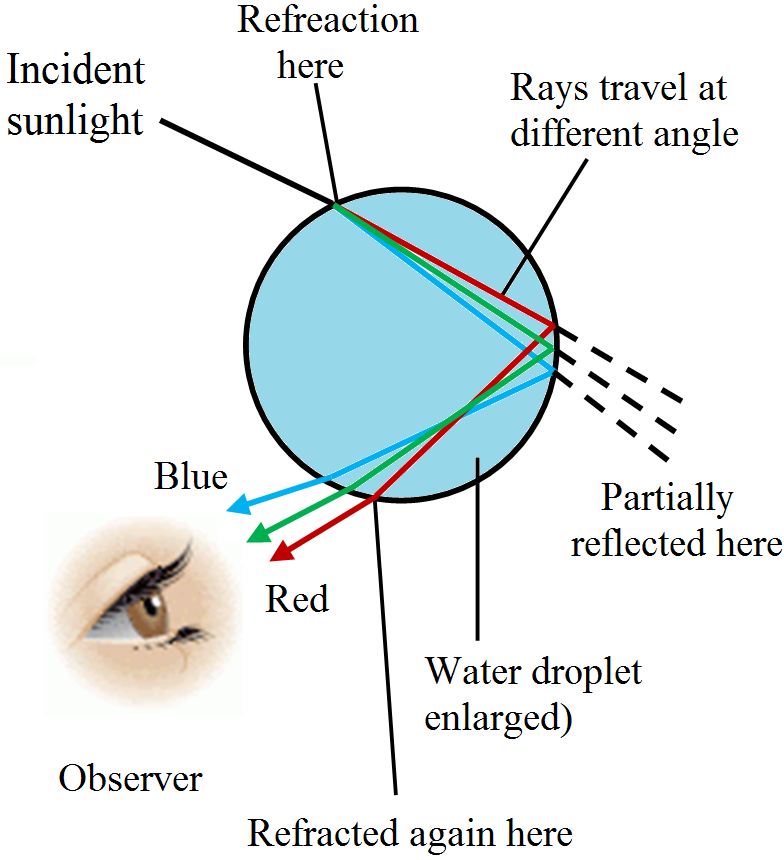
The raindrops act like small prisms. When sunlight enters and leaves these randrops, the various coulured rays in white light are refracted by different amounts dur to which an arc of seven coulurs called ranbow is formed.
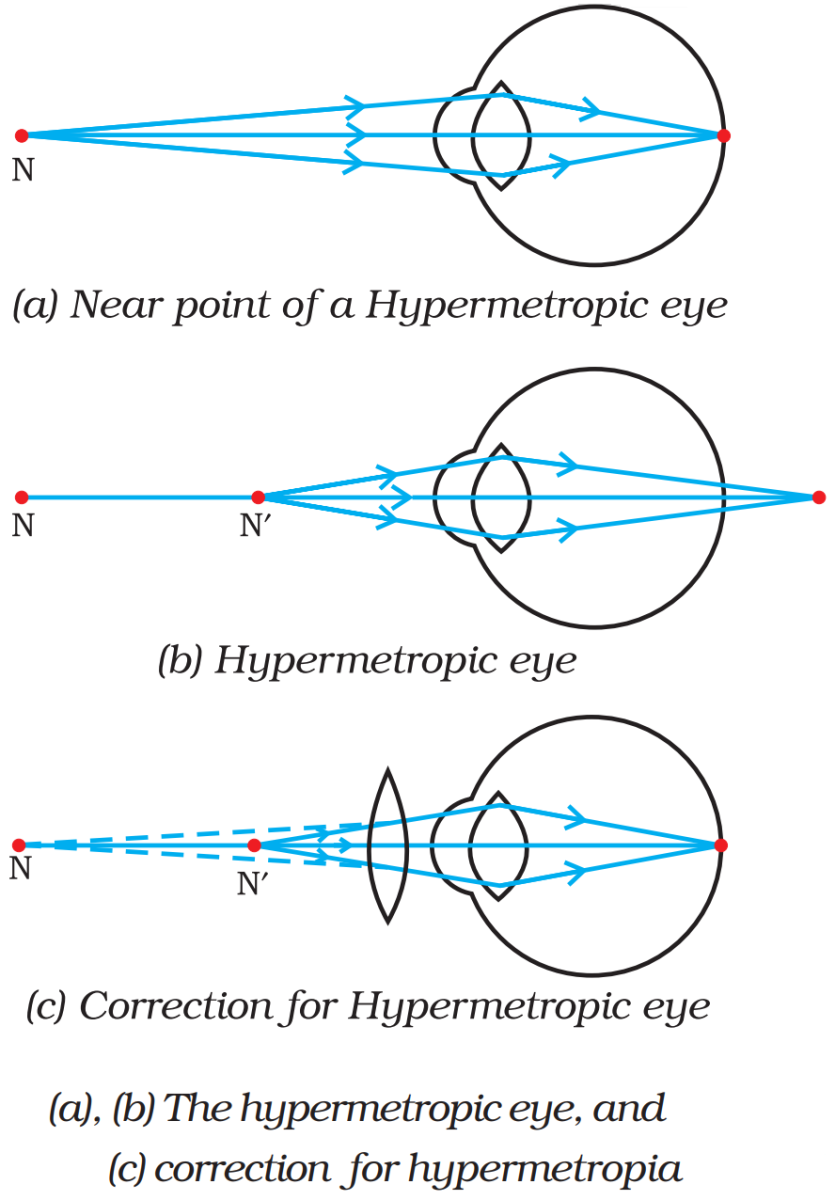
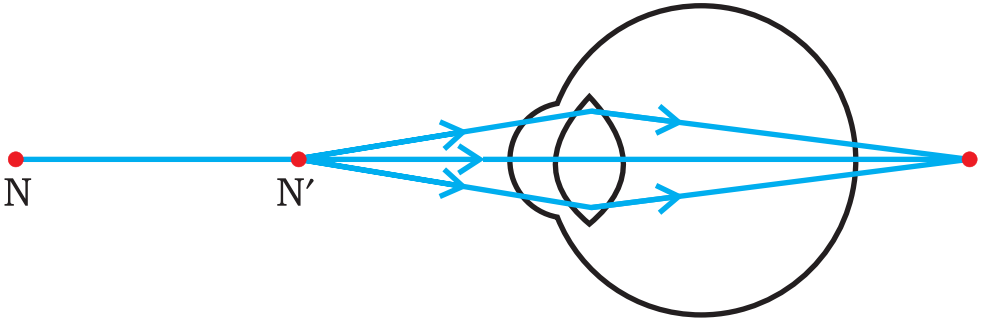
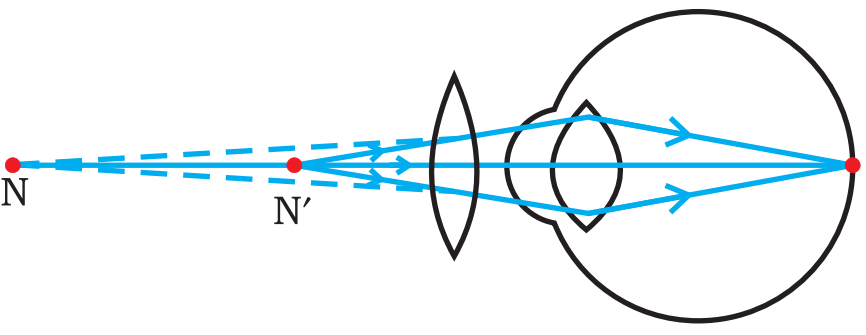
  1. Hypermetropia: defect of vision due to which a person clearly sees distant objects but cannot clearly see nearby objects.
  1. Figure
  1. Figure
View full question & answer
Question 115 Marks
  1. Write the functions of each of the following parts of the human eye:
  1. Cornea.
  2. Iris.
  3. Crystalline (Eye) lens.
  4. Ciliary muscles.
  5. Retina.
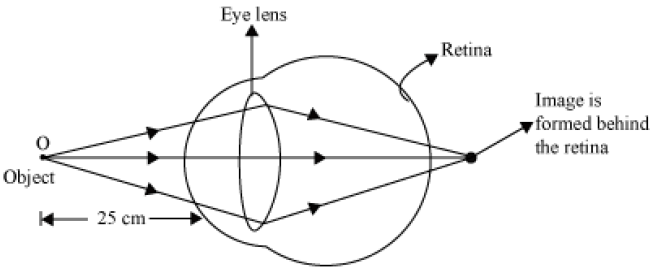
  1. A person is unable to see distinctly the objects closer than 1 m. Name the defect of vision he is suffering from. Draw ray diagrams to illustrate the cause of the defect and its correction by suitable lens.
Answer
  1.  
  1. Cornea is the colorful part of the eye. It helps in entering of light.
  2. Iris is the part which regulates the entering of light by contrasting and expanding.
  3. Crystalline lens is the eye lens which is convex lens it helps to see the object and form the image.
  4. Ciliary muscle helps to adjust the focal length of the eye to see the image.
  5. Retina is the part of the eye where image is formed.
  1. A person is unable to see distinctly the objects closer than 1m, he is suffering of Hypermetropia or Long-sightedness.
The ray diagrams to illustrate the cause of the defect and its correction by suitable lens are as follow.
View full question & answer
Question 125 Marks
  1. What is dispersion of white light? Stae its cause.
  2. “Rainbow is an example of dispersion of sunlight.” Justify this statement by explaining, with the help of a labelled diagram, the formation of a rainbow in the sky. List two essential conditions for observing a rainbow.
Answer
  1. DISPERSION OF WHITE LIGHT: The splitting of white light into seven constituent colors (VIBGYOR). When passed through a glass prism is called dispersion.
  2. Rainbow forms when sunlight hits the water droplets suspended in the atmosphere and undergoes total internal reflection. When the sunlight comes out of the drop it disperses, where the drop acts like a small prism. This dispersion or breaking up of light into several colors is what forms the Rainbow. Hence, rainbow is an example of dispersion of sunlight.
Conditions for rainbow formation are:
  1. A rain shower must have occurred so that there is enough moisture in atmosphere.
  2. The sun should be in the opposite direction.
View full question & answer
Question 135 Marks
  1. Write the function of each of the following parts of human eye:
CORNEA; IRIS; CRYSTALLINE LENS; CILIARY MUSCLES.
  1. Millions of people of the developing countries of world are suffering from corneal blindness. These persons can be cured by replacing the defective cornea with the cornea of a donated eye. A charitable society of your city has organised a campaign in your neighbourhood in order to create awareness about this fact. If you are asked to participate in this mission how would you contribute in this noble cause?
  1. State the objective of organising such campaigns.
  2. List two arguments which you would give to motivate the people to donate their eyes after death.
  3. List two values which are developed in the persons who actively participate and contribute in such programmes.
Answer
  1. Functions of the following parts of human eye:
  1. Cornea: The front part of the eye is called cornea. Most of the refraction for the light rays entering the eye occurs at the surface of the cornea.
  2. Iris: This is a flat, colored, ring-shaped membrane behind the cornea. It controls the size of the pupil.
  3. Crystalline lens: Eye lens is a convex lens which focuses the image of the on the retina.
  4. Ciliary muscles: Ciliary muscles hold the eye lens and change the eye-lens while focusing. When these muscles are relaxed the lens becomes thin. Thus, its focal length increases. This enables us to see distant objects clearly. While looking at the closer objects these muscles contract. This increases the curvature of the eye lens, it becomes thick. With this focal length decreases and we see nearby objects clearly.
  1.  
  1. Objective of such campaigns: To make people aware of corneal blindness make them realize their duties towards the society by taking pledge of donation.
  2. One pair of eyes can give eyesight to two corneal blind persons (each one eye), and make them see this beautiful world.
  3. Values developed in persons who actively participate in such programmes are social welfare and awareness.
View full question & answer
Question 145 Marks
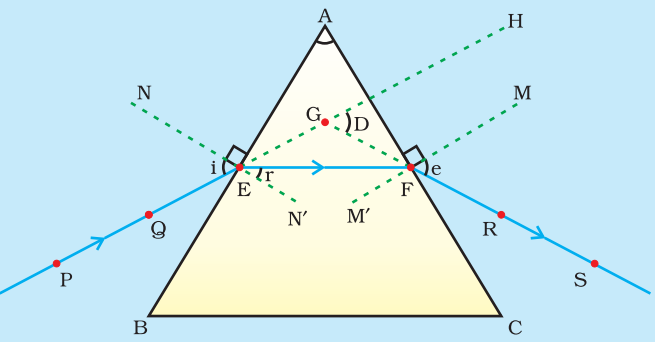
  1. Draw a ray diagram to explain the term angle of deviation.
  2. Why do the component colours of incident white light split into a spectrum while passing through a glass prism, explain.
  3. Draw a labelled ray diagram to show the formation of a rainbow.
Answer
  1. Emergent ray bends at an angle to the direction of the incident ray and the angle between them is known as angle of deviation.
  1. When a beam of light enters a prism, it gets refracted and splits into its seven constituent colors. This splitting of the light ray occurs because of the different angles of bending of each colour. Hence, each colour passing through the prism bends at different angles with the respect to the incident beam. This gives rise to the formation of the colour spectrum.
​​​​​​​
View full question & answer
Question 155 Marks
A student is unable to see clearly the words written on the blackboard placed at a distance of approximately 4 m from him. Name the defect of vision the boy is suffering from. Explain the method of correcting this defect. Draw ray diagram for the:
  1. Defect of vision and also.
  2. For its correction.
Answer
Since the student is not able to see distinctly the words written on the blackboard which is at a distance of approximately 4m from him, the student is suffering from myopia or near sightedness. A myopic eye has its far point nearer than infinity. It forms the image of a distant object in front of its retina. To correct a myopic eye, the concave lens of a suitable focal length is used. Using a concave lens of suitable power, the image is allowed to form at the retina.
  1. Myopic eye.
  2. Correction of myopia using concave lens.
View full question & answer
Question 165 Marks
  1. List three common refractive defects of vision. Suggest the way of correcting these defects.
  2. About 45 lac people in the developing countries are suffering from corneal blindness. About 30 lac children below the age of 12 years suffering from this defect can be cured by replacing the defective cornea with the cornea of a donated eye. How and why can students of your age involve themselves to create awareness about this fact among people?
Answer
  1. The three defects of vision:
  1. Myopia: Myopia is the defect of the eye vision due to which a person can see the near objects clearly, but he can not see the far objects clearly. Causes of myopia. Myopia is caused due the elongation of the eye ball and due to decrease in the focal length of the eye lens. The eye lens become more convergent. Myopia can corrected by using a concave lens of suitable focal length in the spectacles of such a person.
  1. Long-sightedness or hypermetropia: Due to defect, a person is not able to see the nearby objects clearly but can see the distant objects clearly.
Cause of hypermetropia. It is caused due to the following reasons:
  • Normal increase in the focal length of the eye lens. The lens becomes less convergent.
  • Shortening of the eyeball size.
correction. Long sightedness can be corrected by using a convex lens of suitable focal length in the spectacles of such a person.
When a convex lens of suitable power is placed in front of the hypermetropic eye then diverging rays of light coming from the nearby object are the first converged by this convex lens. Due to this, the convex lens from a virtual image of the nearby object at a point near to the hypermetropic eye. Then the hypermetropic eye can easily focus the image formed by convex lens on the retina.
  1. Presbyopia: The power of accommodation of the eye decreases with ageing. It occurs due to the gradual weakening of the ciliary muscles and decreasing flexibility of the crystalline lens. The near point of the eye increases with age. It may reach even 2 metres. This defect is called presbyopia.
Causes of presbyopia. It is mainly caused due to the weakening of the ciliary muscles of the eyes. Such a person may suffer from myopia and hypermetropia. This defect is then corrected by using bifocal lenses of suitable focal lengths. The upper part of the lens is a concave lens for correcting myopia to see the distant objects clearly, while the lower part of the lens has a convex lens to correct the hypermitropia to see the nearby objects clearly.
  1. We have seen advertisements in media persuading people for eye donation. If cornea of the eyes are removed within 6 hours of the death of a person, it can be transplanted to a person suffering from corneal blindness. There are more than 45 lakh cases of corneal blindness and unfortunately out of these a major portion is that of children aged below 12 years. If a person comes forward for eye donation, he can save two corneal blind persons by donating one eye to each.
How exciting it feels to think that after one’s death, he/she can make two blind persons see this wonderful world Therefore it is a must to promote such advertisements to encourage people and make them aware of this noble cause.
View full question & answer
Question 175 Marks
A student is unable to see clearly the words written on the blackboard placed at a distance of approximately 4m from him. Name the defect of vision the boy is suffering from. Explain the method of correcting this defect. Draw ray diagram for the:
  1. Defect of vision and also.
  2. For its correction.
Answer

Since the student is not able to see distinctly the words written on the blackboard which is at a distance of approximately 4m from him, the student is suffering from myopia or near sightedness. A myopic eye has its far point nearer than infinity. It forms the image of a distant object in front of its retina. To correct a myopic eye, the concave lens of a suitable focal length is used. Using a concave lens of suitable power, the image is allowed to form at the retina.
  1. Myopic eye.
  2. Correction of myopia using concave lens.
View full question & answer
Question 185 Marks
  1. A person cannot read newspaper placed nearer than 50 cm from his eyes. Name the defect of vision he is suffering from. Draw a ray diagram to illustrate this defect. List its two possible causes. Draw a ray diagram to show how this defect may be corrected using a lens of appropriate focal length.
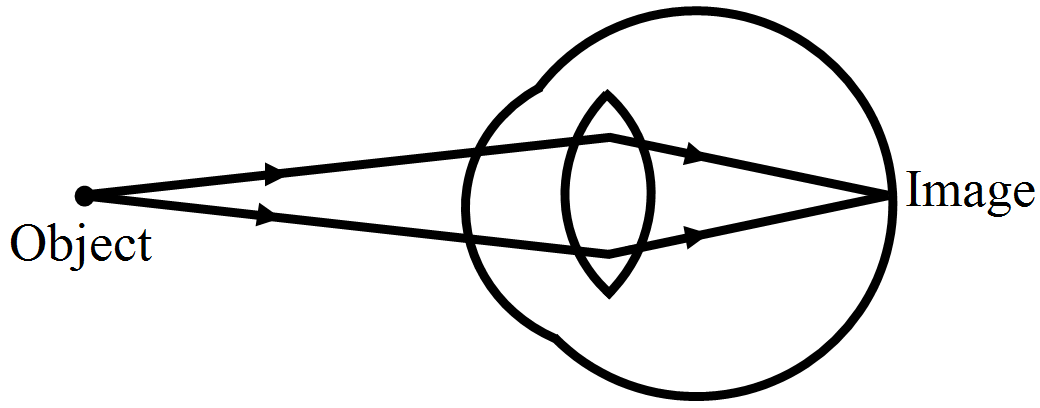
  2. We see advertisements for eye donation on television or in newspapers. Write the importance of such advertisements.
Answer
  1. The person is suffering from Hypermetropia i.e. Far-sightedness.

Hypermetropia is caused due to:
  1. The focal length of the eye lens is too long.
  2. Decrease in the length of the eyeball.
This defect can be corrected using convex lens of appropriate focal length.
  1. Eye donation:
Our eye can live even after our death, so by donating our eyes, we can give vision to any blind person and make him see. By giving such advertisement in newspaper we can aware more people for this noble cause and raise the number of donations for blind people.
View full question & answer
Question 195 Marks
  1. Write the function of each of the following parts of human eye:
  1. Cornea.
  2. Iris.
  3. Crystalline lens.
  4. Ciliary muscles.
  1. Why does the sun appear reddish early in the morning? Will this phenomenon be observed by an astronaut on the Moon? Give reason to justify your answer.
Answer
  1.  
  1. Cornea: Protective layer of the eye; refraction of light rays entering the eye.
  2. Iris: Controls the size of the pupil.
  3. Crystalline lens: Adjusts the focal length and forms an inverted image of the object on the retina.
  4. Ciliary muscles: Adjust the thickness of the lens.
  1.  
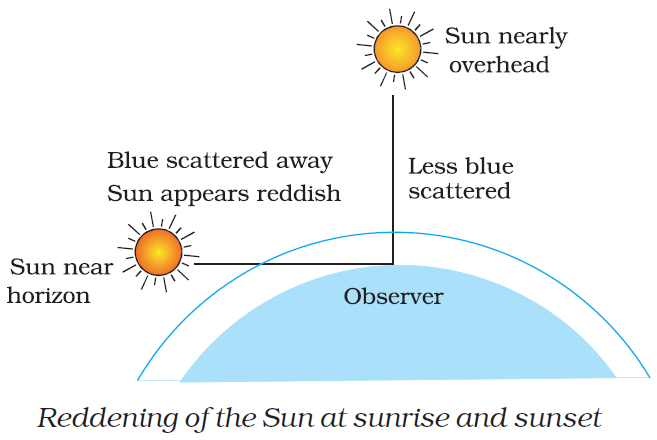
  1. During sunrise and sunset, sunlight travels a greater distance through the atmosphere.
  2. Because of this, blue light is scattered more than red light and it directly enters our eyes.
  3. Hence, the sky and Sun appear red during sunrise and sunset.
  4. Atmospheric refraction is the phenomenon of bending of light on passing through the Earth’s atmosphere. The reason for this occurrence is that the upper layers of the Earth’s atmosphere are rarer compared to the lower layers.
The astronaut who is on the Moon cannot see the Sun reddish during sunrise because the sunlight going towards the Moon does not undergo refraction.
View full question & answer
Question 205 Marks
  1. A student is unable to see clearly the words written on the black board placed at a distance of approximately 3m from him. Name the defect of vision the boy is suffering from. State the possible causes of this defect and explain the method of correcting it.
  2. Why do stars twinkle? Explain.
Answer
  1. The boy is unable to see the board which is 3m away from him.
So, the boy is unable to see distant objects.
This means he is suffering from myopia or near-sightedness.
Causes of myopia:
  1. Due to a high converging power of lens.
  2. Due to an eyeball being too long.
Methods of correcting myopia:
  1. Myopia is corrected by using a concave lens.
  2. The concave lens used to correct myopia is of such a power that it produces a virtual image of the distant objects on the far point of the myopic eye.
  1.  
  1. Stars are luminous objects, and hence, they shine in the night sky.
  2. If we observe stars in the clear night sky, they appear to change their intensity continuously.
  3. This change in the intensity occurs due to atmospheric refraction.
  4. When the light coming from a star enters the earth’s atmosphere, it undergoes refraction due to the varying optical densities of air at different altitudes.
  5. So, the intensity of star light entering our eyes increases and decreases.
  6. Thus, stars twinkle.
View full question & answer
Question 215 Marks
How does refraction take place in the atmosphere? Why do stars twinkle but not the planets?
Answer
Atmosphere is made up of several layers. The layer at the top is optically rare, while the layer at the bottom is optically denser. Due to this, when light travels through different layers of the atmosphere, refraction takes place. Since light passes through denser and denser layer as it moves through atmosphere, it tends to bend towards the normal. Stars are very far from us; compared to planet. Due to this, stars serve as point source of light. As a result, even a slightest change in their apparent position in the sky is clearly perceived by us. Hence, stars appear to twinkle. Planets on the other hand, are near to us. Hence, they do not serve as point source of light. Hence, minor changes in their apparent position are not perceived by us. Hence, planets do not appear to twinkle.
View full question & answer
Question 225 Marks
Explain the functions of the following parts of the eye:
  1. Iris.
  2. Pupil.
  3. Ciliary.
  4. Muscles.
  5. Eye-lens.
  6. Retina.
  7. Optic nerve.
Answer
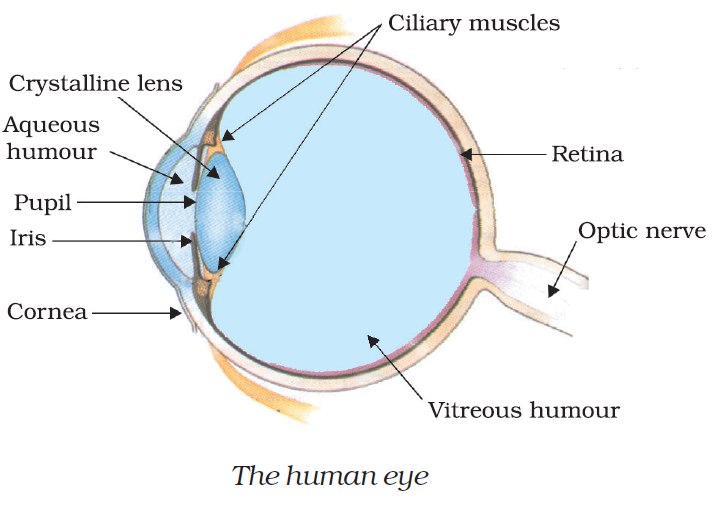
  1. Cornea: It is the front part of the eye. The light coming from objects enters the eye through cornea.
  2. Iris: It controls the amount of light entering the eye.
  3. Pupil: It controls the illumination in the eye.
  4. Ciliary muscles: The focal length of the eye-lens can be changed by changing its shape by the action of ciliary muscles.
  5. Eye-lens: It focuses light on to the retina.
  6. Retina: It is a delicate membrane having a large number of light sensitive cells called ‘rods’ and ‘cones’ which respond to the intensity of light and colour of objects respectively.
  7. Optic nerve: It conveyes the image formed on the retina to the brain.
View full question & answer
Question 235 Marks
Draw a diagram to show why distant objects cannot be seen distinctly by a myopic eye. List two reasons due to which this defect of vision may be caused. A person with a myopic eye
cannot see objects clearly beyond a distance of 2 m. Name the type of corrective lens that would be needed to correct the defect of vision and draw a ray diagram to show how the defect
gets corrected.
Answer
In order to see objects by the eye the image of the object should form on the retina, exactly on the retina. When a person is suffering from Myopia or near sightedness, the near point
of distinct vision gets Increases and an object placed at a distance less than this new near point has its image formed in front of retina.

If a person can’t see the object clearly beyond 2m then he should use concave or diverging lens in order to correct his defect.
View full question & answer
Question 245 Marks
A student finds the writing on the blackboard as blurred and unclear when sitting on the last desk of the classroom. He, however, sees clearly when sitting on the front desk at an approximate distance 2m from the blackboard.
  1. Draw the ray diagram to illustrate the formation of image of the blackboard writing by his eye lens when he sits at the (a) last desk, (b) front desk.
  2. Name the defect of vision the student is suffering from. Also, list two causes of this defect.
  3. Name the kind of lens would enable him to see clearly when he is seated at the last desk. Draw the ray diagram to illustrate how this helps him to see clearly.
Answer
  1. when the student is sitting in front, a focussed image is formed.

when the student is sitting further away, a blurred image is formed.
  1. The student is suffering from short-sightedness or Myopia which makes it difficult to see distant objects clearly but nearer objects are viewed fine.
The far point of an eye suffering from myopia is less than infinity. It is caused:
  • Due to high converging power of the eye lens(because of its short focal length)
  • Due to ye ball being too long.
  1. The concave lens would help him to see clearly when he is seated at the last desk.
View full question & answer
Question 255 Marks
Explain the structure and functioning of Human eye. How are we able to see nearby as well as distant objects?
Answer

The human eye has following main parts:

Cornea: Human eye is spherical in shape. It has tough white coat which protects the interior of the eye. The front portion of this coat is transparent and is called cornea.
Iris: This is a dark muscular structure behind the cornea. Unique colour of a person’s eye is because of colour of iris.
Pupil: The small opening in the iris is called pupil. Iris controls the size of the pupil and thus controls the amount of light entering the eye. Light enters the eye through pupil.
Lens: Lens is thicker at the middle and is made of transparent material. Lens focuses the light on the back of the eye; called retina.
Retina: The back of the eye is called retina. It works like a screen; on which image is formed. Rods and cones function as photoreceptors in the retina of the eye, turning visible light into neuronal signals, which are sent to the brain. This process is called transduction. These nerve cells are connected to optic nerve.
Formation of Image in Eye: Light rays enter the eye through pupil and pass through lens. Lens focuses light rays on retina. Real, inverted and smaller image is formed on retina. Optic nerve carries the message to the brain. The brain interprets the message and we get the sense of vision.
View full question & answer
Question 265 Marks
The descriptions of five kinds of images are given below:
  1. Diminished and virtual.
  2. Enlarged and real.
  3. Enlarged and erect.
  4. Real and inverted.
  5. Virtual and the same size.
Which one of these describes the image formed:
  1. On the retina of the eye?
  2. By a magnifying glass?
  3. By a convex driving mirror on a car?
  4. By a plane mirror?
  5. on the screen of a slide projector?
Answer
Sl. no.
Image formed
kind of image
i.
On the retina of the eye.
Real and inverted.
ii.
By a magnifying glass.
Enlarged and erect.
iii.
By a convex driving mirror on a car.
Diminished and virtual.
iv.
By a plane mirror.
virtual and same sized.
v.
On the screen of a slide projector.
Enlarged and real.
View full question & answer
Question 275 Marks
How can we explain the reddish appearance of sun at sunrise or sunset? Why does it not appear red at noon?
Answer
It is caused by Rayleigh scattering of sunlight. The molecules in the air scatter blue light more than red light as blue light has shortest wavelength as compared to that of red light which has about 1.8 times greater than blue light. Sky appears blue. During sunrise/ sunset, the sun looks reddish because at this stage, Sun rays travel longer distance in atmosphere and blue and green light (having shortest wavelength) of visible spectrum is scattered away fully while the red light having largest wavelength is scattered the least.Sun is directly over head and sunlight travel relatively shorter distance causing only little of the blue and violet colors to be scattered.
View full question & answer
Question 285 Marks
What is short-sightedness? State the two causes of short-sightedness (or myopia). With the help of ray diagrams, show:
  1. The eye-defect short-sightedness.
  2. Correction of short-sightedness by using a lens.
Answer

Short Sightedness is that defect of vision due to which a person can see nearby objects clearly but cannot see distant objects clearly Causes:
  1. Excessive curvature of the eye lens.
  2. Elongation of the eyeball
Ray diagram for:
  1. Eye-defect short sightedness

In a myopic eye, image of distant object is formed in front of the retina (and not on the retina).

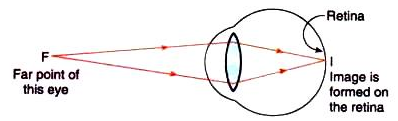
The far point (F)of a myopic eye is less than infinity
  1. Correction of short- sightedness by using a lens

Correction of myopia.the concave lens placed in front of the eye forms a virtual image of distant object at far point (F) of the myopic eye.​​​​
View full question & answer
Question 295 Marks
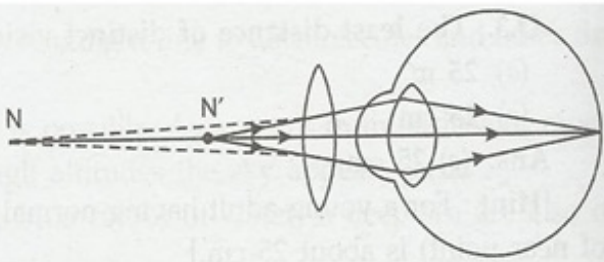
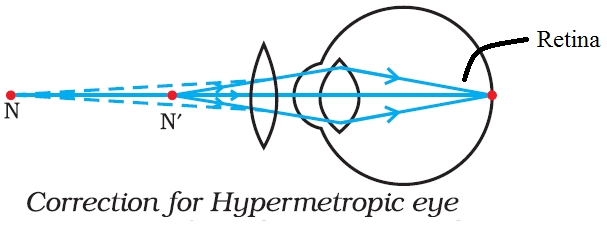
Make a diagram to show how hypermetropia is corrected. The near point of a hypermetropic eye is 1 m. What is the power of the lens required to correct this defect? Assume that the near point of the normal eye is 25 cm.
Answer
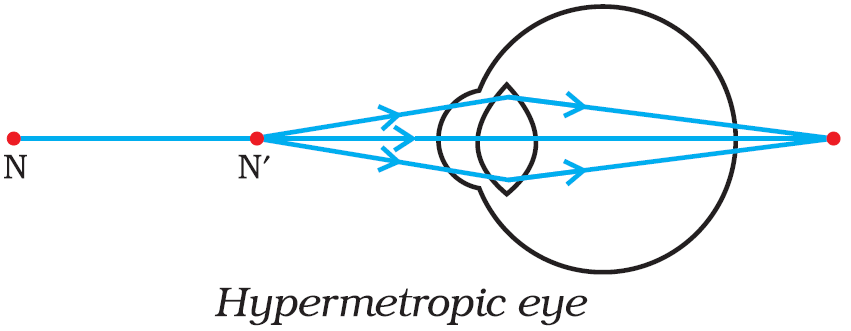
Diagram representing the correction of hypermetropia is a follows: Near point of defective eye is 1 m and that of normal eye is 25 cm. Here, u = -25 cm, v = -1m = 100 cm. Using lens formula$\frac{1}{\text{f}}=\frac{1}{\text{v}}-\frac{1}{\text{u}}$
$\frac{1}{\text{f}}=\frac{1}{-100}+\frac{1}{25}=\frac{3}{100}$
$\text{f}=\frac{100}{3} \ \text{cm}=\frac{1}{3} \ \text{m}$
$\text{P}=\frac{1}{\text{f}} \ (\text{m})=\frac{1}{0.33}= +3.0\ \text{D}$.
View full question & answer
Question 305 Marks
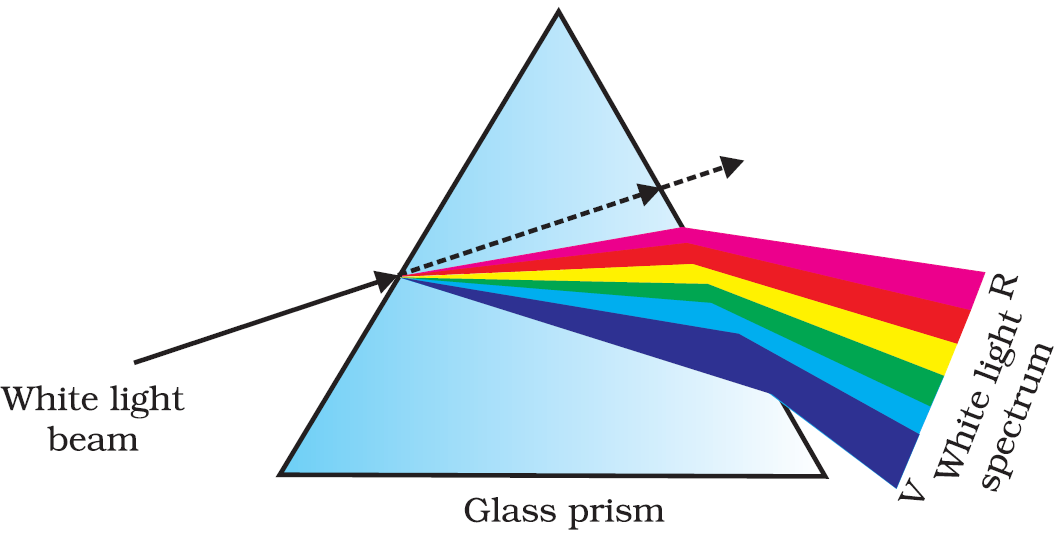
Explain the phenomenon of dispersion of white light through a glass prism, using suitable ray diagram.
Answer
Splitting of light into its constituent colors is referred to as dispersion. When a narrow beam of white light falls on a triangular glass prism, light of different colors have different refractive indices in glass. However, the speed of light is same irrespective of its colors. Different refractive indices of different colors of light lead to their different bending pattern. This causes splitting of white light into light of seven colors called as VIBGYOR. V = violet, I = indigo, B = blue, G = green, Y = yellow, O = orange, R = red.
The light of red colour bends the least on passing through the prism and appears at the top while violet colour bends through maximum angle and appears at bottom.
View full question & answer
Question 315 Marks
What is long-sightedness? State the two causes of long-sightedness (or hypermetropia). With the help of ray diagrams, show:
  1. The eye-defect long-sightedness.
  2. Correction of long-sightedness by using a lens.
Answer
Long-sightedness is that defect of vision due to which a person cannot see the nearby objects clearly but he can see the distant objects clearly. Causes:
  • Focal length of the eye lens is too long.
  • The eyeball has become too small.
Ray diagram for:
  • Eye-defect long-sightedness.
View full question & answer
Question 325 Marks
When do we consider a person to be myopic or hypermetropic? Explain using diagrams how the defects associated with myopic and hypermetropic eye can be corrected?
Answer
When a person is unable to clearly see distant objects, he is considered a myopic person. Such a person is suffering from myopia. This happens when image is formed in front of the retina. When a person is unable to clearly see a nearby object, he is considered a hypermetropic person. Such a person is suffering from hypermetropia. This happen when image is formed behind the retina.
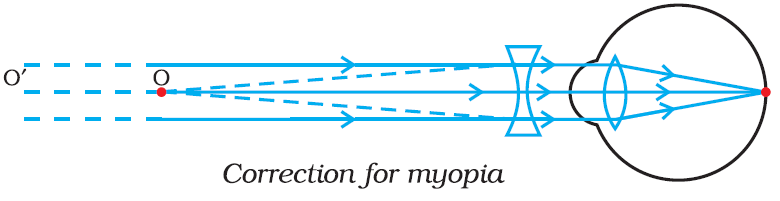
Correction of Myopia: A person suffering from myopia needs to use a concave lens of suitable focal length. The concave lens diverges the rays coming from infinity. After refraction from the concave lens, the rays appear to be coming from the far point of this person’s eye. Due to this, a clear image of distant object is made on the retina of that person. That is how a myopic person is able to clearly see distant objects; with the help of suitable concave lens.

Correction of Hypermetropia: A hypermetropic person needs to use a convex lens of suitable focal length. The convex lens converges the light rays coming from a nearby object. As a result, these light rays appear to be coming from the near point of this person’s eyes. Due to this, a clear image of nearby object is made on the retina of that person. That is how a hypermetropic person is able to clearly see nearby objects; with the help of suitable convex lens.
View full question & answer
Question 335 Marks
List the parts of the human eye that control the amount of light entering into it. Explain, how they perform this function?
Answer
The parts are iris and pupil. Between the cornea and the lens we have a muscular coloured diaphragm called iris, which has a small hole in it, called the pupil. Iris is the coloured part that we see in the eye. The size of the pupil varies with the help of iris. In dim light, the size of the pupil increases with the help of iris to allow more light to enter the eye. In bright light,-the pupil contracts to allow less light to enter into the eye. In other words, the iris regulates the amount of light entering the eye by dilating the pupil in light of low intensity and contracting the pupil in high-intensity light.
View full question & answer
Question 345 Marks
Differentiate between myopia and hypermetropia. What type of spectacles should be worn by a person having the defects of myopia as well as hypermetropia? How does it help?
Answer
In myopia, a person can see nearby objects clearly but cannot see distant object clearly. In hypermetropia, a person can see distant objects clearly but cannot see nearby objects clearly. A person having the defects of myopia as well as hypermetropia should wear spectacles having bifocal lenses in which upper part consists of concave lens and lower part consists of convex lens. The upper part corrects myopia and the lower part corrects hypermetropia.
View full question & answer
Question 355 Marks
Define the term dispersion of white light. Name the colour of light which bends (i) the most, (ii) the least, while passing through a glass prism Draw a ray diagram to Justify your answer.
Answer
  1. The most is red.
  2. Violet
The phenomenon of splitting of white light into its components colors while passing through a prism is known as Dispersion of light. The cause of the dispersion of light through

the prism is because the angle of refraction of light of different is different and since white light is a mixture of seven colors and they get refracted at different angles resulting in

the phenomenon of dispersion.

View full question & answer
Question 365 Marks
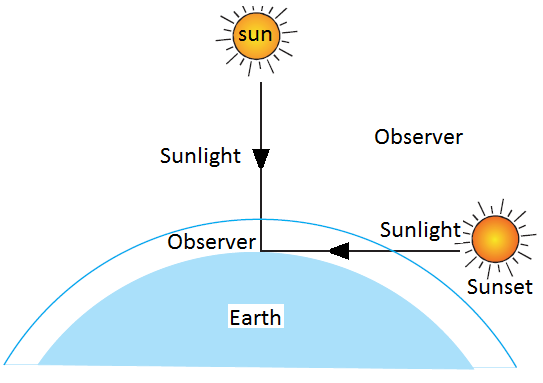
What is the difference in colours of the Sun observed during sunrise/ sunset and noon? Give explanation for each.
Answer
At the time of sunrise or sunset, the position of the sun is very far away from us (Figure). The sunlight travels longer distance through the atmosphere of the earth before reaching our eyes. Scattering of blue light is more than the scattering of red light. As a result of this, more red light reaches our eyes than any other colour. Hence sunset and sunrise appear red.
During noon, the sun is overhead and sunlight travels less distance through the earth’s atmosphere to reach our eyes. In this case, the scattering of almost all colours is very small. Hence, the sun appears white.
View full question & answer