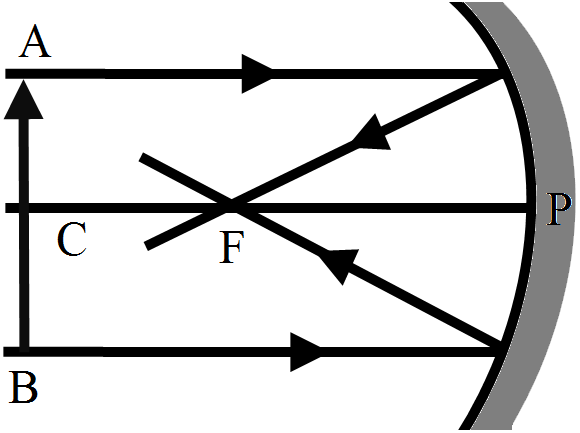
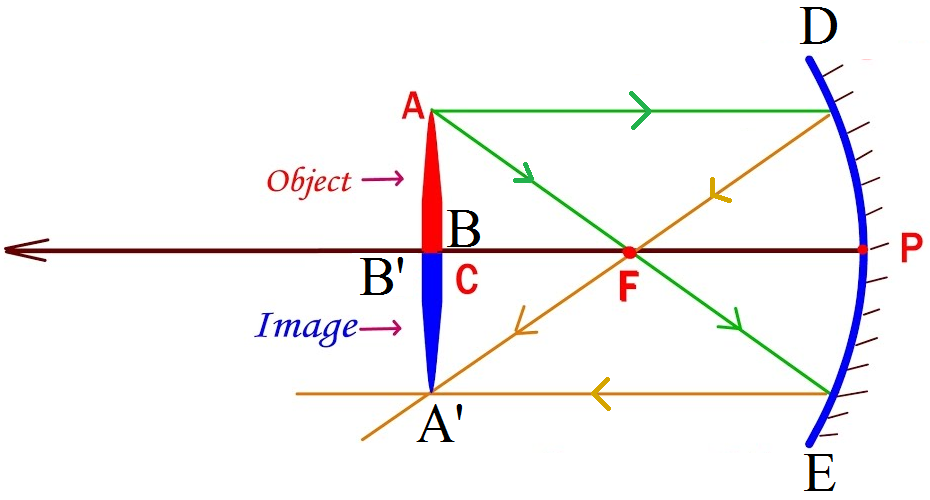
Questions · Page 2 of 2

[5 marks Questions]

Question 515 Marks
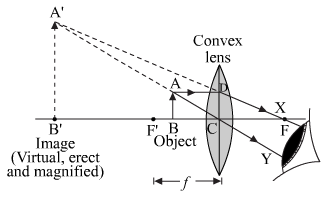
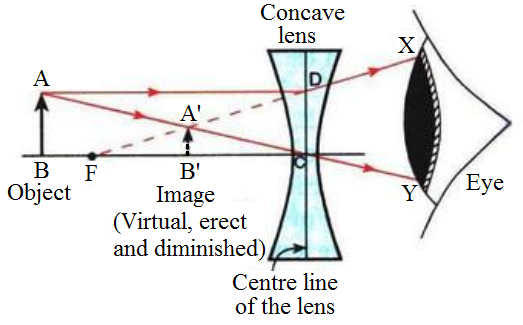
Construct ray diagrams to illustrate the formation of a virtual image using:
  1. A converging lens, and.
  2. A diverging lens.
Answer
  1.  
  1.  
View full question & answer
Question 525 Marks
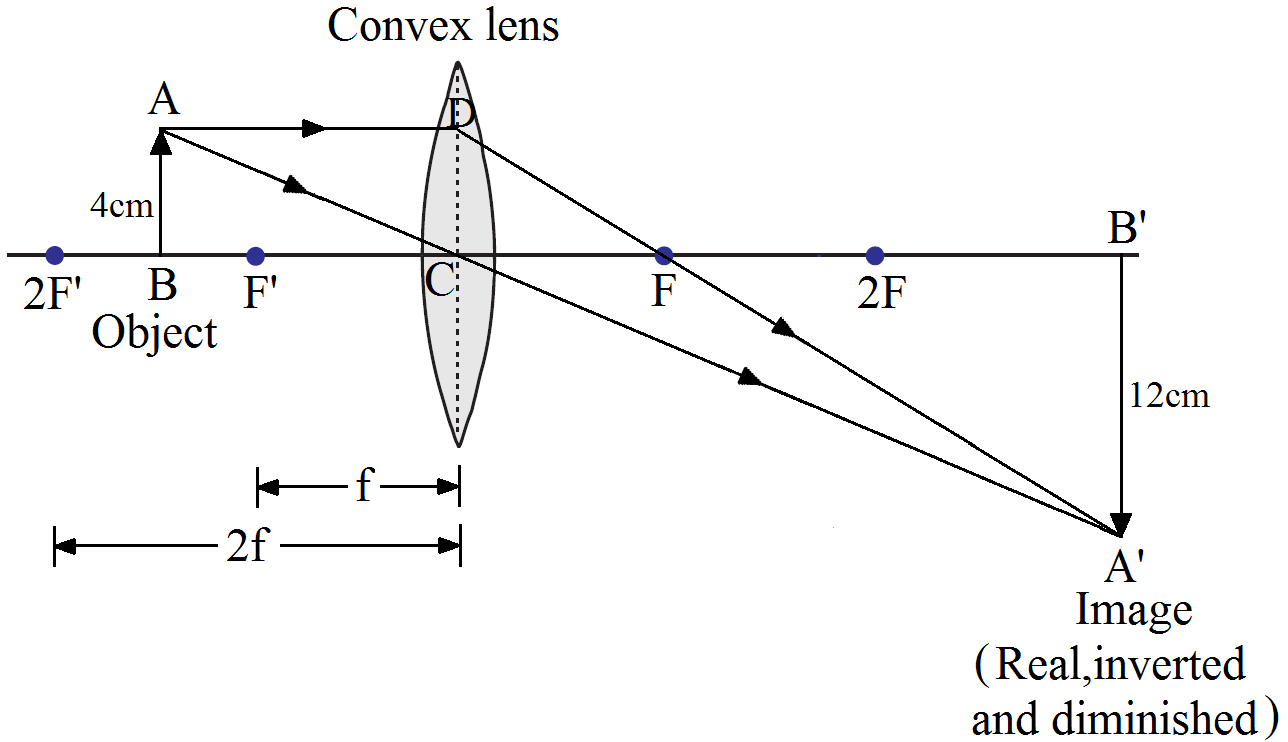
An object placed 4cm in front of a converging lens produces a real image 12cm from the lens.
  1. What is the magnification of the image?
  2. What is the focal length of the lens?
  3. Draw a ray diagram to show the formation of image. Mark clearly F and 2F in the diagram.
Answer
u = -4cm
v = 12cm (Real image)
  1. $\text{m}=\frac{\text{v}}{\text{u}}=\frac{12}{-4}=-3$
  2. Lens fromula, $\frac{1}{\text{v}}-\frac{1}{\text{u}}=\frac{1}{\text{f}}$
$\frac{1}{12}-\frac{1}{-4}=\frac{1}{\text{f}}$

$\frac{1+3}{12}=\frac{1}{\text{f}}$

$\text{f}=3\text{cm}$

View full question & answer
Question 535 Marks
The speed of light in air is $3 \times 10^8 m / s$. In medium $X$ its speed is $2 \times 10^8 m / s$ and in medium $Y$ the speed of light is $2.5 \times 10^8 m / s$. Calculate:
a. air ${ }^n x$
b. air ${ }^n y$
c. $X^n y$
Answer
Given,
Speed of light in air $=3 \times 10^8 m / s$.
Speed of light in medium $X=2.0 \times 10^8 m / s$.
Speed of light in medium $Y=2.50 \times 10^8 m / s$
  1. $_\text{air}\text{n}_\text{x}=\ ?$
$_\text{air}\text{n}_\text{x}=\frac{\text{Speed of light in air}}{\text{Speed of light in medium X}}$

$_\text{air}\text{n}_\text{x}=\frac{3.0\times10^8\text{m}/\text{ s}}{2.0\times10^8\text{m}/ \text{s}}$

$_\text{air}\text{n}_\text{x}=1.5$
  1. $_\text{air}\text{n}_\text{y}=\ ?$
$_\text{air}\text{n}_\text{y}=\frac{\text{Speed of light in air}}{\text{Speed of light in medium y}}$

$_\text{air}\text{n}_\text{y}=\frac{3.0\times10^8\text{m}/\text{ s}}{2.50\times10^8\text{m}/\text{ s}}$

$_\text{air}\text{n}_\text{y}=1.2$
  1. $_\text{x}\text{n}_\text{y}=\ ?$
$_\text{x}\text{n}_\text{y}=\frac{\text{Speed of light in medium X}}{\text{Speed of light in medium Y}}$

$_\text{x}\text{n}_\text{y}=0.8$
View full question & answer
Question 545 Marks
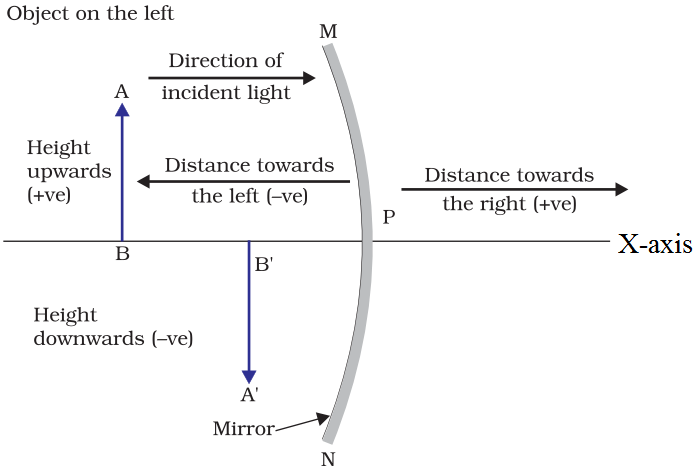
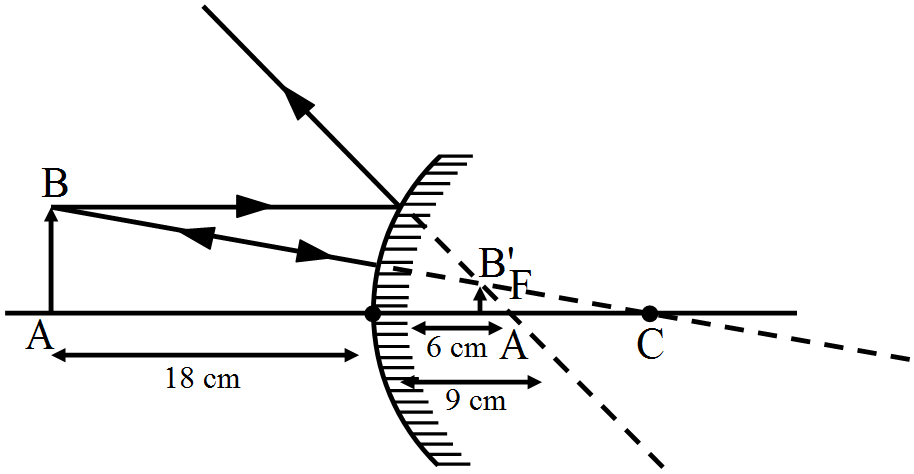
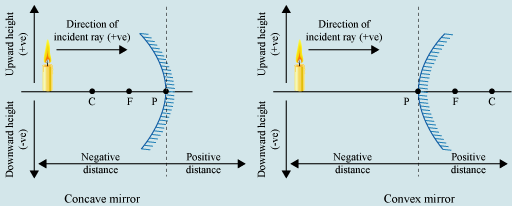
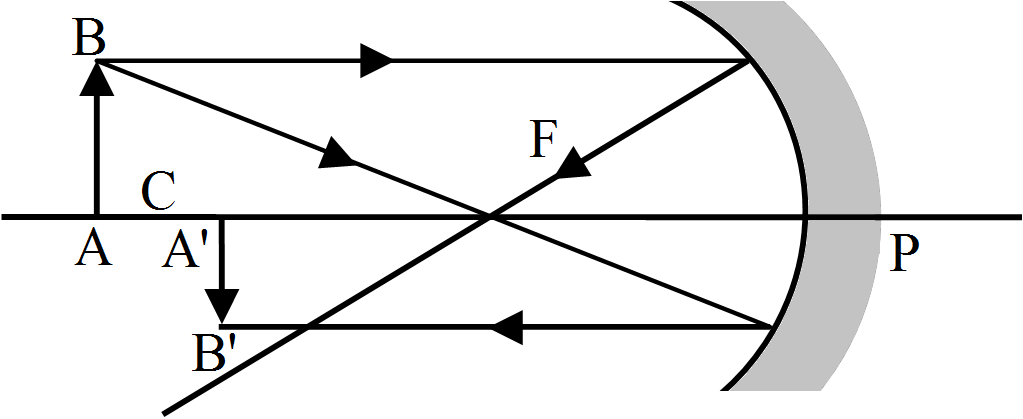
List the new Cartesian sign convention for reflection of light by spherical mirrors. Draw a diagram and apply these conventions for calculating the focal length and nature of a spherical mirror which forms $\frac{1}{3}$ times magnified virtual image of an object placed 18cm if front of it.
Answer
New Cartesian Sign Conventions for reflection of light by spherical mirrors are given
below:
  1. The object is always placed to the left of the mirror. This implies that the light from the object falls on the mirror from the left-hand side.
  2. All distances parallel to the principal axis are measured from the pole of the mirror.
  3. All the distances measured to the right of the origin (along + x-axis) are taken as positive while those measured to the left of the origin (along - x-axis) are taken as negative.
  4. Distances measured perpendicular to and above the principal axis (along + y-axis) are taken as positive.
  5. Distances measured perpendicular to and below the principal axis (along - y-axis) are taken as negative.
$\text{m}=\frac{1}{3}$
$\Rightarrow\text{u}=-18\text{cm}$
$\Rightarrow\text{f}=?$
$\Rightarrow\text{v}=?$
$\Rightarrow\text{m}=-\frac{\text{v}}{\text{u}}=\frac{1}{3}$
$\Rightarrow\text{v}=-\frac{\text{u}}{3}=-\frac{(-18)}{3}=-6\text{cm.}$
Now, according to mirror formula.
$\frac{1}{\text{v}}+\frac{1}{\text{u}}=\frac{1}{\text{f}}$
$\Rightarrow\frac{1}{6}+\frac{1}{(-18)}=\frac{1}{\text{f}}$
$\Rightarrow\frac{1}{\text{f}}=\frac{3-1}{18}$
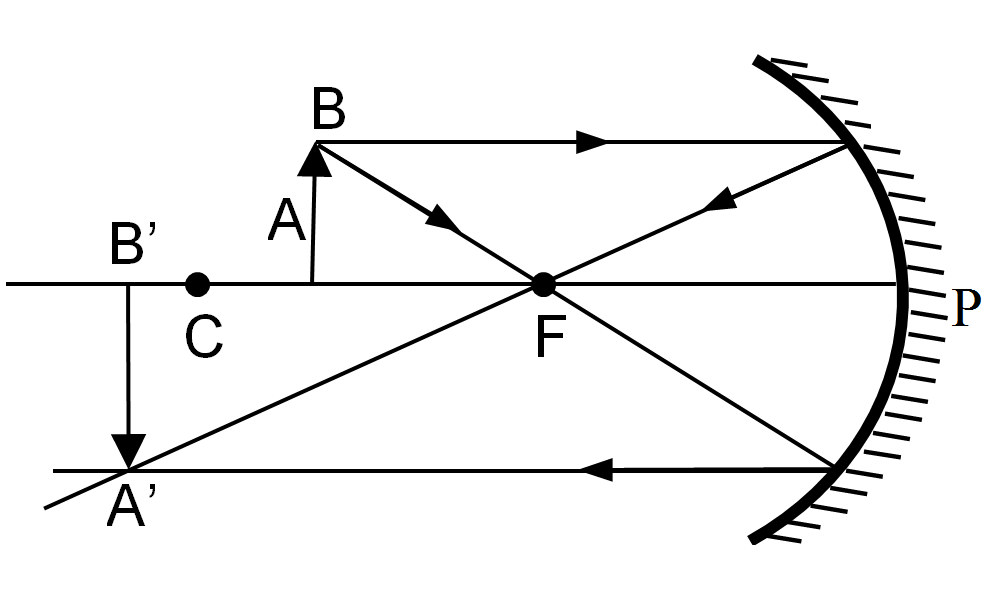
$\Rightarrow\frac{1}{\text{f}}=\frac{2}{18}$
$\text{f}=9\text{cm}$
Since, the focal length is positive so, it is a convex mirror. Ray diagram: ​​​​​​​
View full question & answer
Question 555 Marks
An object is kept at a distance of 100 cm from each of the above lenses. Calculate the
  1. Image distance and
  2. Magnification in each of two cases.
Answer
  1. Given,
Object distance (u) = -100cm

Focal length (f) = 50cm

Image distance = v

By lens formula;

$\frac{1}{\text{v}}-\frac{1}{\text{u}}=\frac{1}{\text{f}}$

$\Rightarrow\frac{1}{\text{v}}-\frac{1}{-100}=\frac{1}{50}$

$\Rightarrow\frac{1}{\text{v}}=\frac{1}{50}-\frac{1}{100}$

$\Rightarrow\frac{1}{\text{v}}=\frac{2-1}{100}=\frac{1}{100}$

$\Rightarrow\text{v}=100\text{cm}$

Hence the image is formed at 100 cm behind the lens.

Object distance (u) = -100cm

Focal length (f) = -25cm

Image distance = v

By lens formula;

$\frac{1}{\text{v}}-\frac{1}{\text{u}}=\frac{1}{\text{f}}$

$\Rightarrow\frac{1}{\text{v}}-\frac{1}{-100}=\frac{-1}{25}$

$\Rightarrow\frac{1}{\text{v}}=\frac{-1}{25}-\frac{1}{100}$

$\Rightarrow\frac{1}{\text{v}}=\frac{-4-1}{100}=\frac{-5}{100}$

$\Rightarrow\text{v}=-\frac{100}{5}$

$\Rightarrow\text{v}=-20\text{cm}$

Hence the image is formed at 20cm in front of the lens.
  1.  
For 1st case:

Object distance (u) = -100cm

Image distance (v) = 100cm.

By Magnification Formula

Magnification (m) $=\frac{\text{v}}{\text{u}}$

⇒ Magnification $=\frac{100}{-100}$

Therefore, Magnification for the 1st case is -1. The negative sign means the image is real and inverted.

For 2nd case:

Object distance (u) = -100cm

Image distance (v) = -20cm.

By Magnification Formula

Magnification (m) $=\frac{\text{v}}{\text{u}}$

⇒ Magnification $=\frac{-20}{-100}=\frac{1}{5}=0.2$

Therefore, Magnification for 2nd case is 0.2. The positive sign means the image is erect and virtual.
View full question & answer
Question 565 Marks
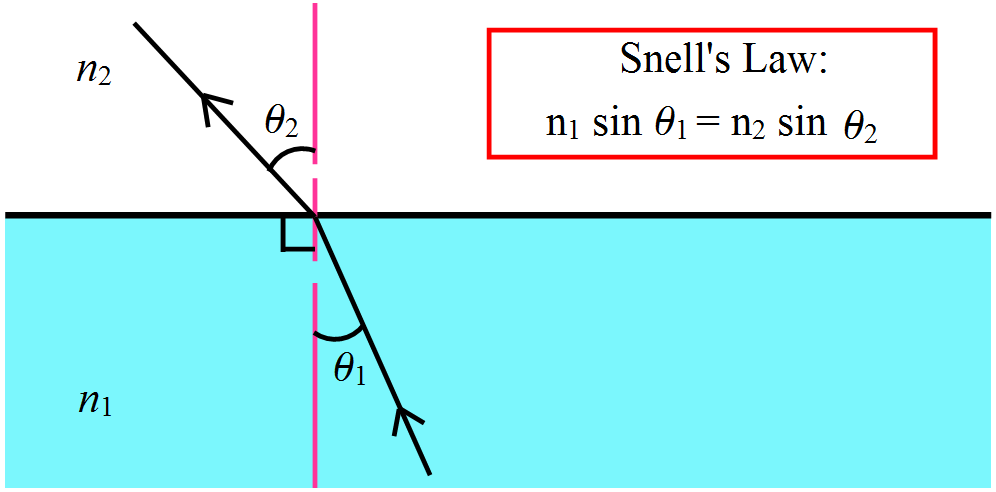
State the laws of refraction of light. Write an expression to relate absolute refractive index of a medium with speed of light in vacuum.
The refractive index of a medium x with respect to y is $\frac{2}{3}$ and the refractive index of medium y with respect to z is $\frac{4}{3}$ Calculate the refractive index of medium z with respect to medium x
Answer
Laws of Refraction
  1. The incident ray, the refracted ray and the normal to the transparent surface at the point of incidence all lie in the same plane.
  2. The ratio of the sine of the angle of incidence in the first medium to the sine of the angle of refraction in the second medium is a constant for a given pair of medium and for a given wavelength of light.
$\text{n}=\frac{\text{sin i}}{\text{sin r}}$
Absolute refractive index of a medium is defined as the ratio of the speed of light in vacuum or air to the speed of light in the medium. It is denoted by n.$\text{n}=\frac{\text{speed of light in air (c)}}{\text{speed of light in medium (v)}}$

The refractive index of x with respect to $\text{y},\text{n}_{\text{xy}}=\frac{2}{3}$
The refractive index of x with respect to $\text{z,}\text{n}_{\text{yz}}=\frac{4}{3}$
The refractive index of x with respect to $\text{x},\text{n}_{\text{zx}}=\frac{\text{n}_\text{z}}{\text{n}_\text{x}}=\frac{\text{n}_\text{z}}{\text{n}_\text{y}}\times\frac{\text{n}_\text{y}}{\text{n}_\text{x}}$
$\text{n}_{\text{zx}}=\frac{1}{\text{n}_{\text{yz}}}\times\frac{1}{\text{n}_{\text{xy}}}$
$=\frac{3}{4}\times\frac{3}{2}=\frac{9}{8}$
View full question & answer
Question 575 Marks
When a spherical mirror is held towards the sun and its sharp image is formed on a piece of a carbon paper for some time, a hole is burnt in the carbon paper.
  1. What is the nature of spherical mirror?
  2. Why is a hole burnt in the carbon paper?
  3. At which point of the spherical mirror the carbon paper is placed?
  4. What name is given to the distance between spherical mirror and carbon paper?
  5. What is the advantage of using a carbon paper rather than a white paper?
Answer
  1. The spherical mirror is concave.
  2. A concave mirror converges light rays, and in this case it will converge the incoming parallel rays of the sun at its focus. Since the carbon paper was kept at the focus of the concave mirror, the hole was burnt into it.
  3. The carbon paper was kept at the focus of the spherical mirror.
  4. The distance between the mirror and the carbon paper is the focal length.
  5. A carbon paper is a good absorber of sunlight; hence, it burnt quickly.​
View full question & answer
Question 585 Marks
Write all the capital letters of the alphabet which look the same in a plane mirror.
Answer
A, H, I, M, O.
View full question & answer
Question 595 Marks
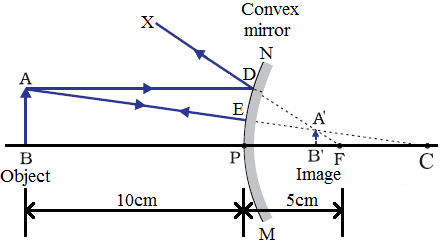
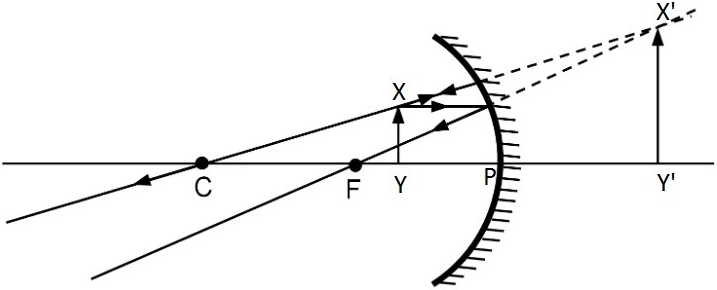
An object is placed at a distance of 10cm from a convex mirror of focal length 5cm.
  1. Draw a ray-diagram showing the formation of image.
  2. State two characteristics of the image formed.
  3. Calculate the distance of the image from mirror.
Answer
  1.  
  1. The image formed is diminished and erect.
  2. u = 10cm, f = 5cm
$\frac{1}{\text{v}}+\frac{1}{\text{u}}=\frac{1}{\text{f}}$

$\Rightarrow \frac{1}{\text{v}}+\frac{1}{-10}=\frac{1}{5}$

$\Rightarrow \frac{1}{\text{v}}=\frac{1}{10}+\frac{1}{5}=\frac{3}{10}$

$\therefore \frac{1}{\text{v}}=\frac{3}{10}\text{cm}=3.33\text{cm}$
View full question & answer
Question 605 Marks
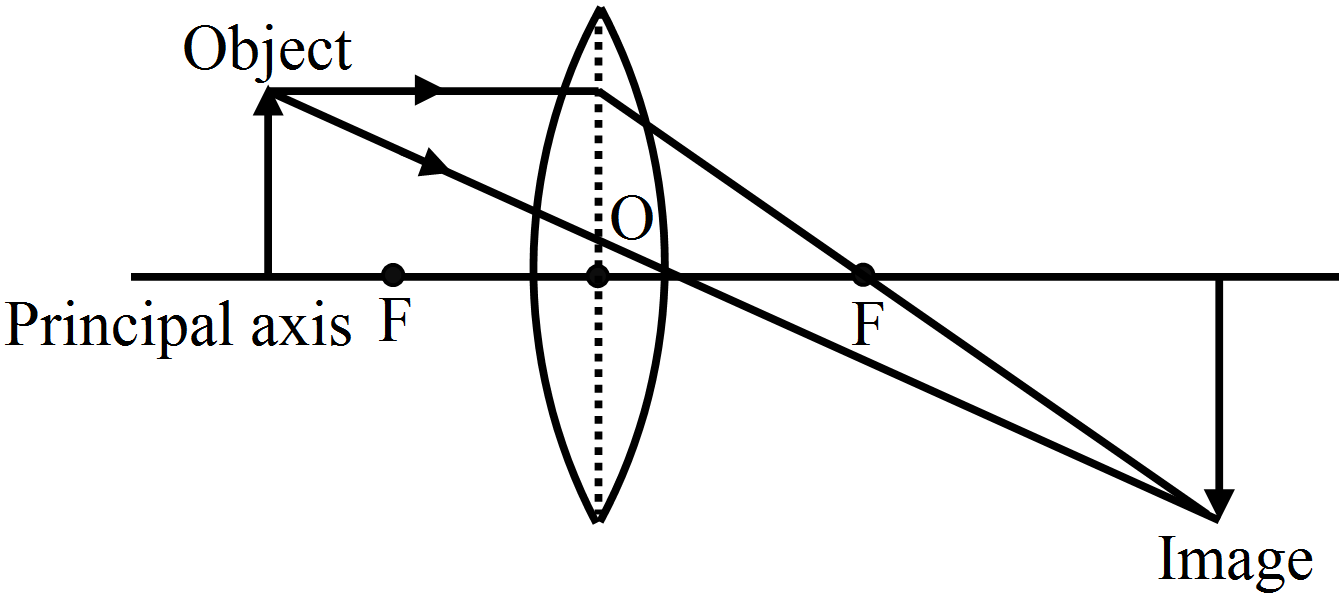
List the sign conventions that are followed in case of refraction of light through spherical lenses. Draw a diagram and apply these conventions in determining the nature and focal length of a spherical lens which forms three times magnified real image of an object placed 16 cm from the lens.
Answer
The sign conventions that are followed in case of refraction of light through spherical lenses are as follows:
All the distances are measured from the optical centre of the lens. All the distances which are measured in the same direction of the incident light ray will be taken as positive. All the distance which are measured against the direction of incident light are taken as negative. The perpendicular distances to principal axis in upward direction will be positive and those in downward direction will be taken as negative.
Given, $h_2-4 h_1$ (image formed in downward direction)
Object distance u = -20cm
Magnification = +4
Magnification is given by $\frac{\text{h}_2}{\text{h}_1}=\frac{\text{v}}{\text{u}}$
Putting the values $\frac{-4\text{h}_1}{\text{h}_1}=\frac{\text{v}}{-20}$
Therefore,
V = -4 × -20
V = +80cm
Since image distance is positive, so it will form on the right side of the convex lens.
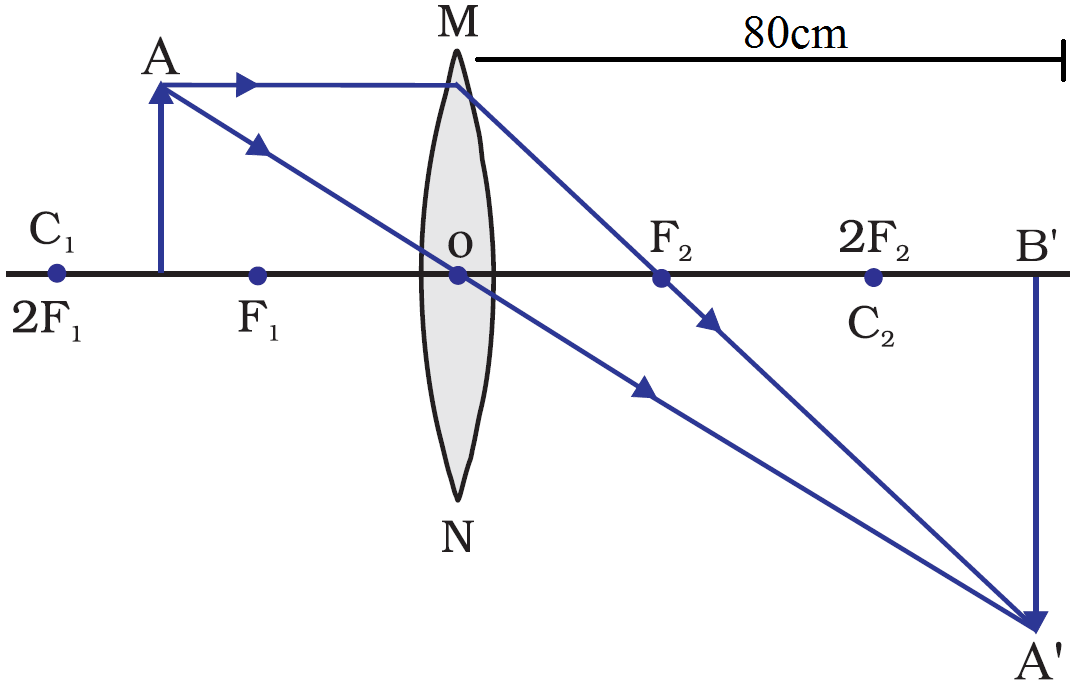
The ray diagram will be as follows:
Image is formed 80cm from the lens on the opposite side of the object, i.e. on the right side of the lens.
View full question & answer
Question 615 Marks
One-half of a convex lens of focal length 10cm is covered with a black paper. Can such a lens produce an image of a complete object placed at a distance of 30cm from the lens? Draw a ray diagram to justify your answer. A 4cm tall object is placed perpendicular to the principal axis of a convex lens of focal length 20cm. The distance of the object from the lens is 15cm. Find the nature, position and size of the image.
Answer
A convex lens can produce the complete image of the object even though half of the lens is covered. Because light rays coming from the object can be refracted from the other part of the lens. Given, height of object = 4cm focal length, f = 20cm u = -15cm after sign conventions Applying the lens formula $\frac{1}{\text{f}}=\frac{1}{\text{v}}-\frac{1}{\text{u}}$$\frac{1}{\text{v}}=\frac{1}{\text{f}}+\frac{1}{\text{u}}$
$\frac{1}{\text{v}}=\frac{1}{20}+\frac{1}{-15}$
$\text{v}=-60\text{cm}$
To find the height of image, using to formula,$\frac{\text{h}_2}{\text{h}_1}=\frac{\text{v}}{\text{u}}$
$\frac{-60}{-15}=\frac{\text{h}_2}{\text{h}_1}$
$\text{h}_2=-\frac{60}{-15}\times4$
$\text{h}_2=+16\text{cm}$
Therefore, the image formed will be virtual, erect and magnified.$\therefore$ Position of image is 60cm in front of lens
size of image is 8cm nature of image is virtual and erect.
View full question & answer
Question 625 Marks
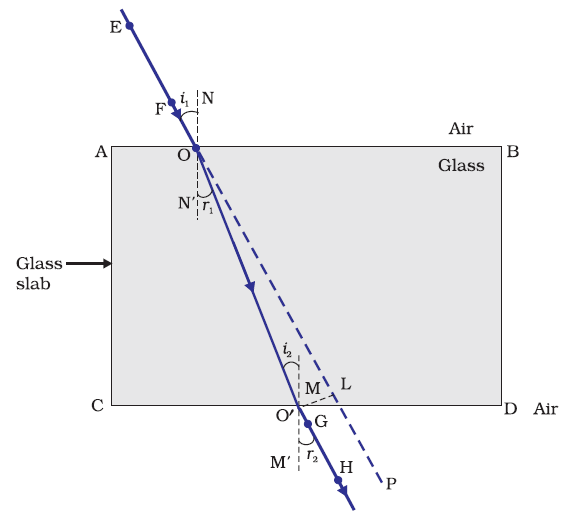
Why does a light ray incident on a rectangular glass slab immersed in any medium emerges parallel to itself? Explain using a diagram.
Answer
Perform an experiment to demonstrate that light bends from its path, when it falls obliquely on the surface of a glass slab. Also show that angle of incidence is about equal to the emergent angle.
  1. Take a glass slab and place it on a white sheet of paper fixed on a drawing board.
  2. Mark the boundary ABCD of the glass slab.
  3. Fix two pins $P_1$ and $P_2$, vertically on the drawing board such that line joining the pins is inclined to the edge $A B$ of the glass slab (Figure).

4. Now, look through the glass slab from opposite side so that the images of pins $P _1$ and $P _2$ are seen exactly in line. Fix two pins $P_3$ and $P_4$, vertically on the drawing board such that pins $P_3, P_4$ and image of $P_1$ and $P_2$ are exactly in one line.
5. Remove the glass slab and all pins. Join the points $P_1$ and $P_2$ with a line and extend this line to touch the edge $A B$ at $P$. Similarly join the points $P_3$ and $P_4$ with a line and extend the line to touch the edge $D C$ at $Q$.
6. Join points $P$ and $Q$ with a straight line.
7. Draw normal $N N^{\prime}$ at $P$ on the edge $A B$ and a normal $N_1 N_1{ }^{\prime}$ at $Q$ on the edge $D C$.
8. Measure $\angle P _2 PN$ and $\angle P _3 QN _1^{\prime}$ using a protractor or dee.

This experiment shows that when light falls obliquely on a glass slab, it bends along PQ from its original path along PL . Also $\angle P _2 PN \approx \angle P _3 QN _1^{\prime}$. That is, angle of incidence is about equal to the emergent angle.Note: Distance between pins $P_1$ and $P_2$, and between $P_3$ and $P_4$ must be large.
View full question & answer
Question 635 Marks
List the sign conventions for reflection of light by spherical mirror. Draw a diagram and apply these conventions in the determination of focal length of a spherical mirror which forms a $\frac{1}{3}$ times magnified real image of an object placed 16cm in front of it.
Answer
Rules of sign convention:
  1. Objects are always placed to the left of the mirror i.e. light must fall on the mirror from left to right.eights measured perpendicular to and below the principal axis are taken as negative.
  2. All distances are measured from the pole of the mirror.
  3. Distances along the direction of the incident ray are taken as positive, while distances along the direction of the reflected ray are taken as negative.
  4. Heights measured perpendicular to and above the principal axis are taken as positive.
  5. Heights measured perpendicular to and below the principal axis are taken as negative.
These sign conventions can also represented in the following diagram.
Numerical part: Given; Magnification (m) = -3 (real image is inverted always). Object distance (u) = -16cm. By Magnification Formula; Magnification, $\text{m}=-\frac{\text{v}}{\text{u}}$ Where, v is the image distance u is the object distance$\Rightarrow-3=-\frac{\text{v}}{-16}$
$\Rightarrow\text{v}=-3\times16=-48\text{cm}$
$\therefore$ Image distance (v) = -48cm.
By mirror formula;$\frac{1}{\text{v}}+\frac{1}{\text{u}}=\frac{1}{\text{f}}$
$\Rightarrow\frac{1}{-48}+\frac{1}{-16}=\frac{1}{\text{f}}$
$\Rightarrow\frac{1}{\text{f}}=\frac{-1-3}{48}=-\frac{4}{48}$
$\Rightarrow\text{f}=\frac{-48}{4}=-12$
Therefore the focal length is -12cm. Since the focal length is negative, therefore the mirror is concave mirror.
View full question & answer
Question 645 Marks
Analyse the following observation table showing variation of image distance (v) with object distance (u) in case of a convex lens and answer the questions that follow, without doing any calculations:
S. No.
Object distance u (cm)
Image distance v (cm)
1
-90
+18
2
-60
+20
3
-30
+30
4
-20
+60
5
-18
+90
6
-10
+100
  1. What is the focal length of the convex lens? Give reason in support of your answer.
  2. Write the serial number of that observation which is not correct. How did you arrive at this conclusion?
  3. Take an appropriate scale to draw ray diagram for the observation at S. No. 4 and find the approximate value of magnification.
Answer
  1. From S. No. 3 we can say that the radius of curvature of the lens is 20 cm because when an object is placed at the centre of curvature of a convex lens its image is formed on the other side of the lens at the same distance from the lens. And, we also know that focal length is half of the radius of curvature. Thus, focal length of the lens is +15 cm.
  2. S. No. 6 is not correct as for this observation the object distance is between focus and pole so for such cases the image formed is always virtual but in this case a real image is forming as the image distance is positive.
  3. $\text{m}=\frac{\text{V}}{\text{U}}$
$\text{m}=\frac{+60}{-20}$
$\text{m}=-3$
View full question & answer
Question 655 Marks
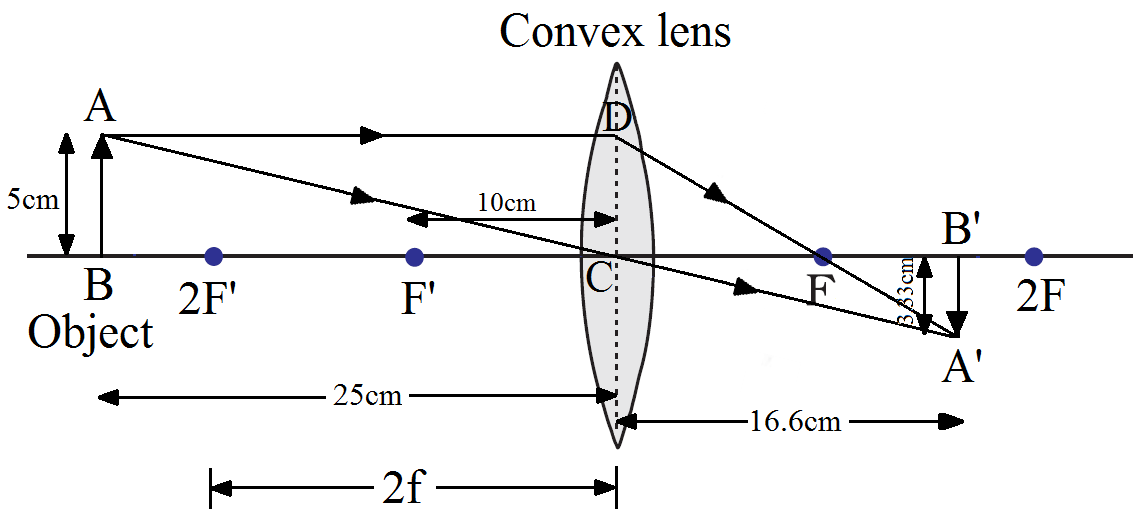
An object 5cm high is held 25cm away from a converging lens of focal length 10cm. Find the position, size and nature of the image formed. Also draw the ray diagram.
Answer
$u =5 cm h _1=-25 cm f =10 cm$ Lens formula, $\frac{1}{ v }-\frac{1}{ u }=\frac{1}{ f } \frac{1}{ v }-\frac{1}{-25}=\frac{1}{10}$
$\frac{1}{\text{v}}=\frac{1}{10}-\frac{1}{25}$
$\frac{1}{\text{v}}=\frac{5-2}{50}=\frac{3}{50}$
$\text{v}=16.6$
Image is 16.6cm behind the convex lens.$\text{m}=\frac{\text{v}}{\text{u}}=\frac{\frac{50}{3}}{-25}=-\frac{2}{3}$ (image is real and inverted)
$\text{m}=\frac{\text{h}_2}{\text{h}_1}$
$-\frac{2}{3}=\frac{\text{h}_2}{5}$
$\text{h}_2=\frac{-10}{3}=-3.33\text{cm}$
Image is 3.33cm in size and is real and inverted.
View full question & answer
Question 665 Marks
Draw the ray diagram in each case to show the position and nature of the image formed when the object is placed:
  1. At the centre of curvature of a concave mirror.
  2. Between the pole P and focus F of a concave mirror.
  3. In front of a convex mirror.
  4. At 2f of a convex lens.
  5. In front of a concave lens.
Answer

The table givenbelow illustrates the ray diagram along with the position and nature of image, formed various positions of the object.
Formation of image by Concave Mirror for Difference Positions of Object.
S. No. Position of Object Ray Diagram Position of image Nayure and Size of image
1. At infinity At focus or in the focal plane Real, inverted, extremely diminished in size
2. Beyond the centre of curvature but at finite distance from mirror Between focus and the centre of curvature Real, inverted and diminished
3. At the centre of curvature At the centre of curvature Real, inverted and same size as the of object
4. Between focus and centre of curvature Beyond centre of curvature Real, inverted and magnifed
5. At the focus At infity Real, inverted and extremely magnified
6. Between the pole and focus Behind the mirror Virtual, erect and magnified
View full question & answer
Question 675 Marks
What is meant by ‘reflection of light’? Define the following terms used in the study of reflection of light by drawing a labelled ray-diagram :
  1. Incident ray.
  2. Point of incidence.
  3. Normal.
  4. Reflected ray.
  5. Angle of incidence.
  6. Angle of reflection.
Answer
The process of sending back the light rays which fall on the surface of an object is called reflection of light.
  1. Incident ray: The ray of light that falls on the mirror surface is called the incident ray.
  2. Point of incidence: The point at which the incident ray falls on the mirror is called the point of incidence.
  3. Normal: The normal is a line at right angle to the mirror surface at the point of incidence.
  4. Reflected ray: The ray of light which is sent back by the mirror is called the reflected rays.
  5. Angle of incidence: The angle of incidence is the angle made by the incident ray with the normal at the point of incidence.
  6. Angle of reflection: The angle of reflection is the angle made by the reflected ray with the normal at the point of incidence.
View full question & answer
Question 685 Marks
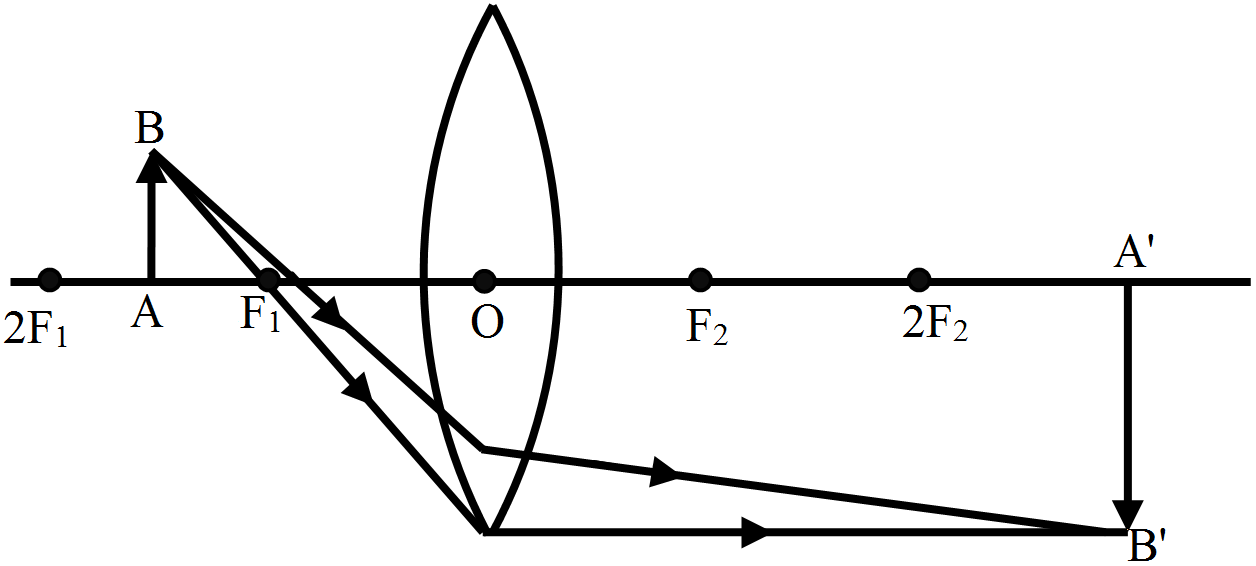
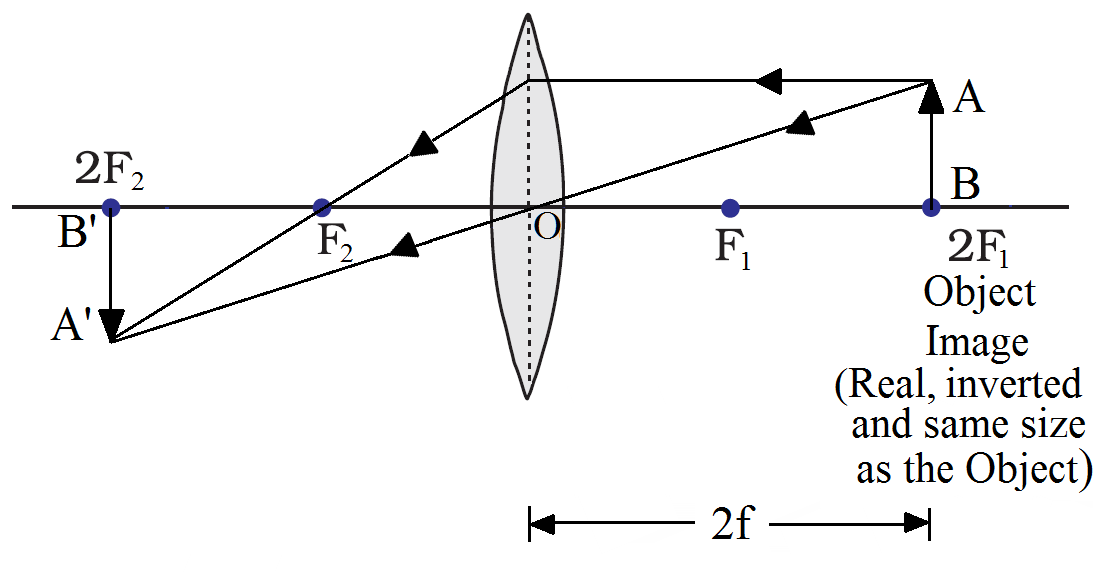
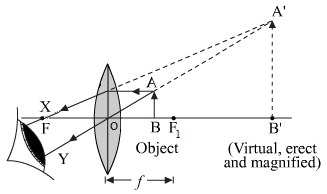
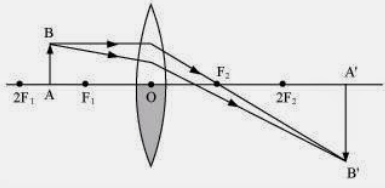
Draw ray diagrams to represent the nature, position and relative size of the image formed by a convex lens for the object placed:
  1. At $2 F_1$
  2. between F and the optical centre O of the lens.
Which of the above two cases shows the use of convex lens as a magnifying glass ? Give reasons for your choice.
Answer
  1. Object at $2F_1$:
  1. Object between F1 and the optical centre O of the lens:


The Case when object is between $F_1$ and the optical $O$ of the lens shows the use of convex lens as a magnifying glass. This is becasue here the image formed is erect and magnified.
View full question & answer
Question 695 Marks
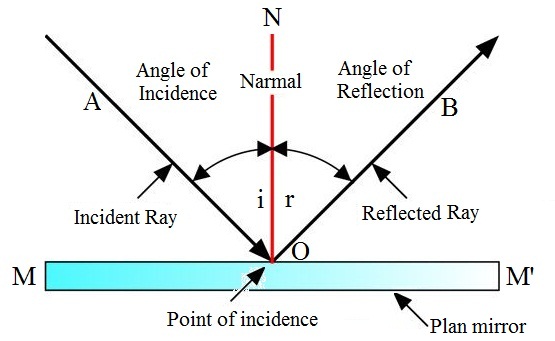
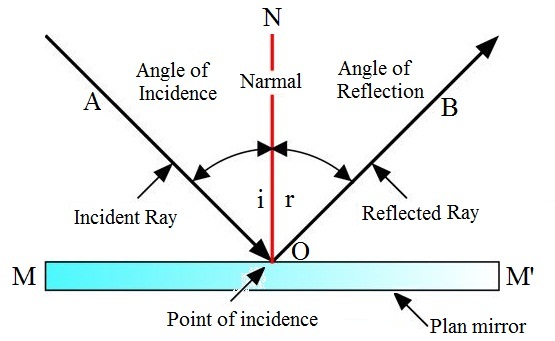
State and explain the laws of reflection of light at a plane surface (like a plane mirror), with the help of a labelled ray-diagram. Mark the angles of ‘incidence’ and ‘reflection’ clearly on the diagram. If the angle of reflection is 47.5°, what will be the angle of incidence?
Answer
Laws of reflection of light:

First law of reflection: According to the first law of reflection, the incidence ray, the reflected ray and the normal (at the point of incidence), all lie in the same plane.For e.g., in the figure, the incident ray AO, the reflected ray OB and the normal ON, all lie in the same plane, the plane of paper.
Second law of reflection: According to the second law of reflection, the angle of reflection is always equal to the angle of incidence. For e.g., if we measure the angle of reflection NOB in the figure, we will find that it is exactly equal to the angle of incidence AON. If the angle of reflection is 47.50, the angle of incidence will also be 47.50 in accordance with the second law of reflection.
View full question & answer
Question 705 Marks
A camera fitted with a lens of focal length 50mm is being used to photograph a flower that is 5cm in diameter. The flower is placed 20cm in front of the camera lens.
  1. At what distance from the film should the lens be adjusted to obtain a sharp image of the flower?
  2. What would be the diameter of the image of the flower on the film?
  3. What is the nature of camera lens?
Answer
  1. Focal length, f = 50mm = 5cm
Object distance, u = -20cm

Image distance, v = ?

Putting these values in lens formula, we get,

$\frac{1}{\text{v}}-\frac{1}{\text{u}}=\frac{1}{\text{f}}$

$\Rightarrow\frac{1}{\text{v}}-\frac{1}{-20}=\frac{1}{5}$

$\Rightarrow\frac{1}{\text{v}}+\frac{1}{20}=\frac{1}{5}$

$\Rightarrow\frac{1}{\text{v}}=\frac{1}{5}-\frac{1}{20}$

$\Rightarrow\frac{1}{\text{v}}=\frac{20-5}{100}$

$\Rightarrow\frac{1}{\text{v}}=\frac{15}{100}$

$\Rightarrow{\text{v}}=6.66\text{cm}$

Film should be adjusted at a distance of 6.66 cm behind the lens.
  1. Given,
Diameter of object, h = 5cm

Diameter of image, h' = ?

$\text{Magnification},\text{ m}=\frac{\text{h}'}{\text{h}}=\frac{\text{v}}{\text{u}}$

Therefore,

$\text{h}'=\frac{\text{v}}{\text{u}}\times\text{h}$

$\text{h}'=\frac{6.66}{20}\times5=1.66\text{cm}$
  1. It is a convex lens.
View full question & answer
Question 715 Marks
Explain why, though both a plane mirror and a sheet of paper reflect light but we can see the image of our face in a plane mirror but not in a sheet of paper.
Answer
We can see the image of our face in a plane mirror but not in a sheet of paper because images are formed by regular reflection of light and in case of a plane mirror, regular reflection takes place; while in case of a sheet of paper, diffuse reflection takes place.
View full question & answer
Question 725 Marks
An object is placed at a distance of 30cm from a concave lens of focal length 15cm. List four characteristics (nature, position, etc.) of the image formed by the lens.
Answer
Here, object distance, u = -15 cm and focal length, f = -30 cm Using lens formula,$\frac{1}{\text{f}}=\frac{1}{\text{v}}-\frac{1}{\text{u}}$
$\frac{1}{-30}=\frac{1}{\text{v}}-\frac{1}{-15}$
$\frac{1}{\text{v}}=-\frac{1}{30}-\frac{1}{15}$
${\text{v}}=100{\text{cm}}$
${\text{m}}=\frac{\text{v}}{\text{u}}=\frac{-10}{-15}=+23$
Four characteristics of the image formed by the concave lens are:
  1. Image formed is virtual.
  2. Image is erect.
  3. Image is formed on the same side of the lens as the object.
  4. Image is smaller than the object.
View full question & answer
Question 735 Marks
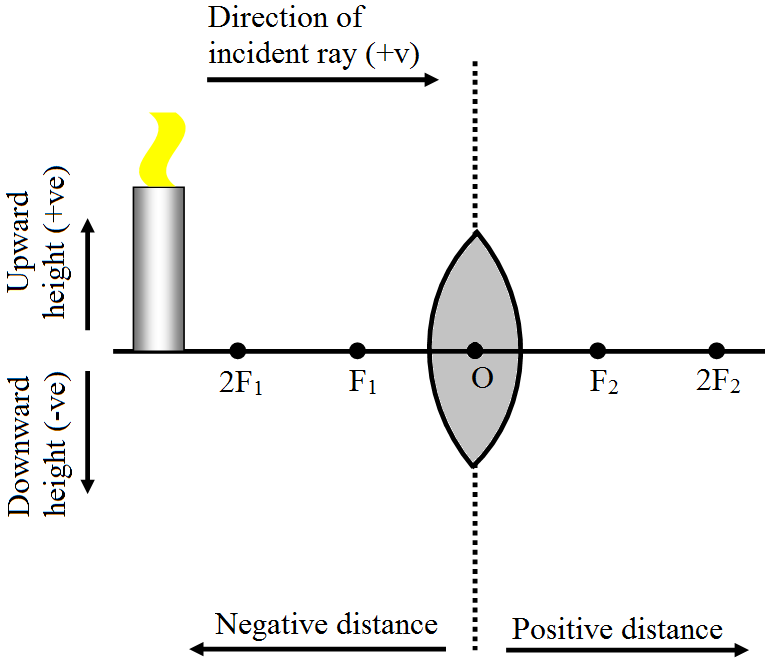
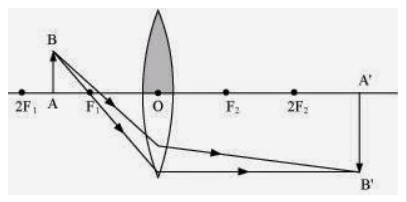
List the sign conventions that are followed in case of refraction of light through spherical lenses. Draw a diagram and apply these conventions in determining the nature and focal length of a spherical lens which forms three times magnified real image of an object placed 16cm from the lens.
Answer
Sign Convention for Lenses
  1. Object is always placed to the left of the lens i.e., the light must fall on the lens from left to right.
  2. All distances parallel to the principal axis are measured from the optical centre of the lens.
  3. Distances along the direction of incident rays (along positive x-axis) are taken as positive, while distances opposite to the direction of incident rays (along negative x-axis) are taken as negative.
  4. Distances measured above the principal axis (along positive y-axis) are taken as positive.
  5. Distances measured below the principal axis (along negative y-axis) are taken as negative.
These sign conventions are represented in the following diagram: According to the question. Magnification (m) = -3 (real image is always inverted). Object distance (u) = -16cm. By Magnification Formula; Magnification, $\text{m}=\frac{\text{v}}{\text{u}}$ v is the image distance, u is the object distance$\Rightarrow-3=\frac{\text{v}}{-16}$
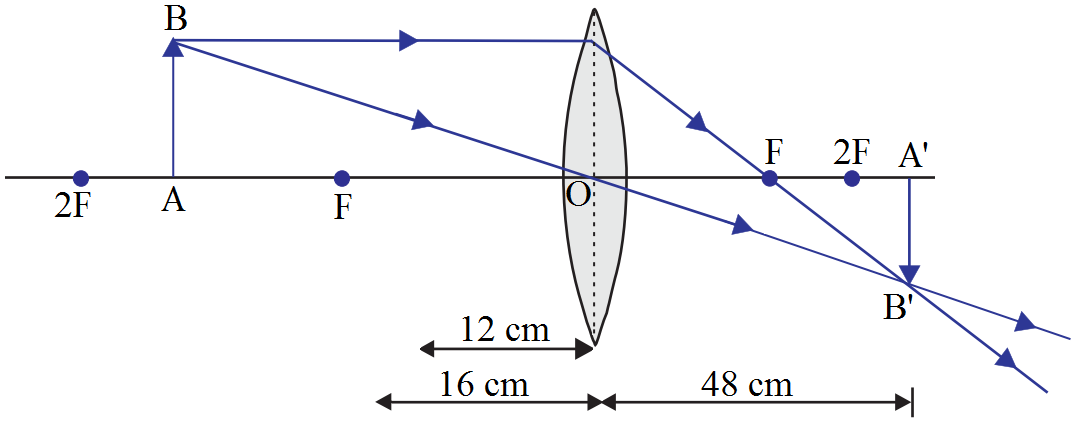
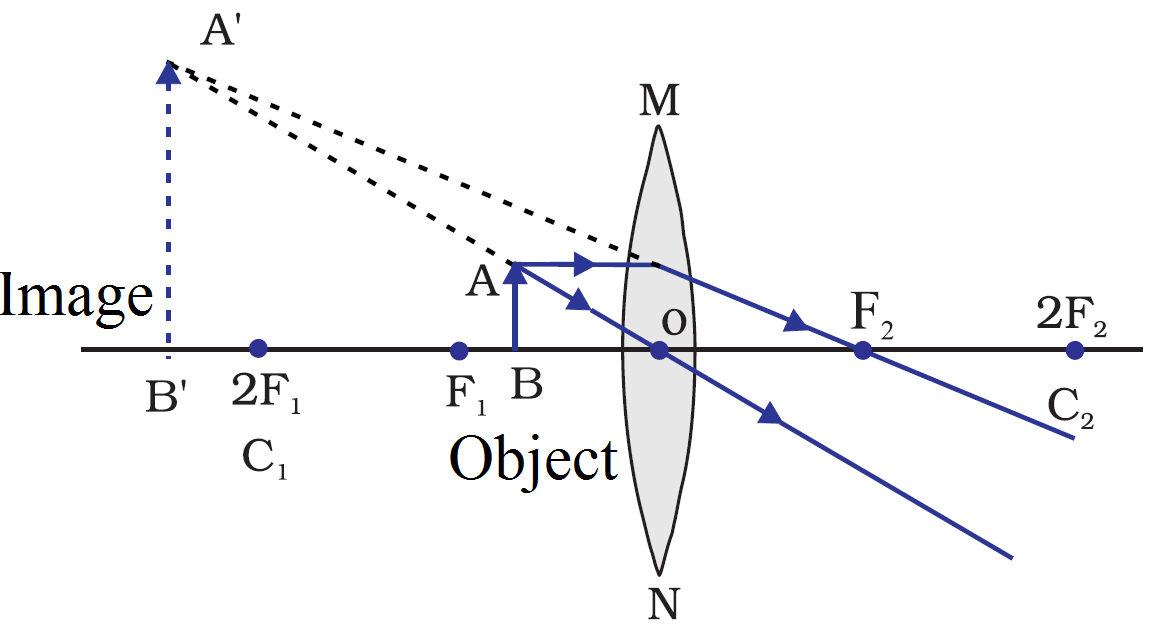
$\rightarrow\text{v}=-16\times-3$
$\Rightarrow\text{v}=48\text{cm.}$
$\therefore$ Image distance (v) = 48cm.
By lens formula;$\frac{1}{\text{v}}-\frac{1}{\text{u}}=\frac{1}{\text{f}}$
$\Rightarrow\frac{1}{48}-\frac{1}{-16}=\frac{1}{\text{f}}$
$\Rightarrow\frac{1}{\text{f}}=\frac{1+3}{48}=\frac{4}{48}$
$\Rightarrow\text{f}=\frac{48}{4}=12$
Therefore the focal length is 12 cm. Since the focal length is positive, therefore the lens is convex lens. Figure below shows the ray diagram for the same.
View full question & answer
Question 745 Marks
A student focussed the image of a candle flame on a white screen using a convex lens. He noted down the position of the candle screen and the lens as under,
Position of candle = 12.0cm
Position of convex lens = 50.0cm
Position of the screen = 88.0cm
  1. What is the focal length of the convex lens?
  2. Where will the image be formed if he shifts the candle towards the lens at a position of 31.0cm?
  3. What will be the nature of the image formed if he further shifts the candle towards the lens?
  4. Draw a ray diagram to show the formation of the image in case (iii) as said above.
Answer
Let f be the focal length of the convex lens.The distance of object should be measured from pole of the lens.
Distance of candle (or object) = Position of convex lens - Position of candle = 50 - 12 = 38cm.Now, by sign convention, distance of candle (or object) = u = -38cm
Similarly, distance of candle’s image = position of the screen - position of convex lens = 88 - 50 = 38cmBy sign convention, distance of candle’s image = v = +38cm
  1. Using lens formula, $\frac{1}{\text{v}}-\frac{1}{\text{u}}=\frac{1}{\text{f}}$
$\frac{1}{\text{f}}=\frac{1}{38}-\frac{1}{-38}=\frac{1}{19}$
$\Rightarrow\ \text{f}=19\text{cm}$
The focal length of the convex lens is 19cm.
  1. When the candle is shifted towards the lens at a position of 31.0cm.
Then, new object distance = position of convex lens c position of candle = 50 – 31 = 19
By sign convention, u = -19cm.
Now, focal length of the convex lens = 19cm. It means, the candle lays at the focus of lens, hence its image is formed at infinity.
  1. When he further shifts the candle towards the lens. This means candle lies between optical centre and focus of convex lens, so, magnified, virtual and erect image of the candle will be formed.
  2. The ray diagram of image formation is given below:
View full question & answer
Question 755 Marks
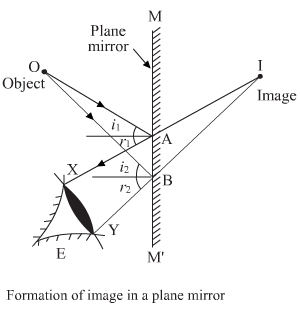
With the help of a labelled ray-diagram, describe how a plane mirror forms an image of a point source of light placed in front of it. State the characteristics of the image formed in a plane mirror.
Answer

Cosider a point source of light O placed in front of a plane mirror MM’. a ray of light OA coming from O in incident at point A on the mirror and gets reflected in the direction AX according to the laws of reflection of light. Another ray of light OB coming from O strikes the mirror ar point B and gets reflected in the direction BY. Rays AX and BY, on producing backwards, meet at point I behind the mirror; which is the image of point source O.
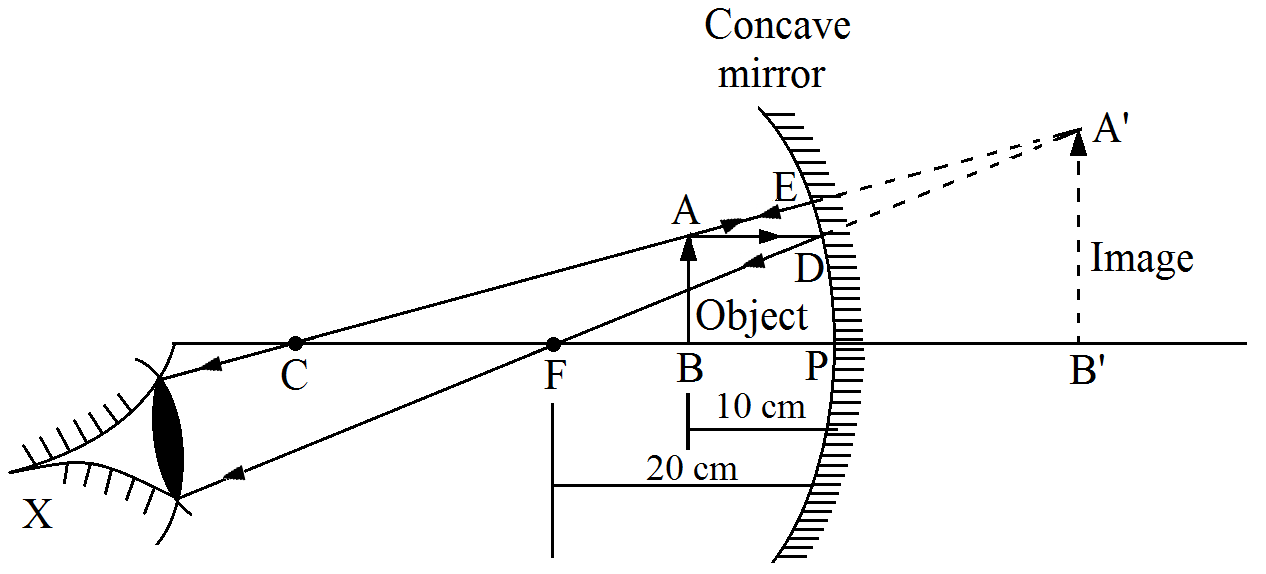
Characteristics of image formed in a plane mirror:
  1. The image formed in a plane mirror is virtual. It cannot be received on a screen.
  2. The image formed in a plane mirror is erect. It is the same side up as the object.
  3. The image in a plane mirror is of the same size as the object.
  4. The image formed by a plane mirror is at the same distance behind the mirror as the object is in front of the mirror.
  5. The image formed by a plane mirror is laterally inverted.
View full question & answer
Question 765 Marks
What is meant by power of a lens? Name and define its S.I. unit. One student uses a lens of focal length +50cm and another of -50cm. State the nature and find the power of each lens. Which of the two lenses will always give a virtual, erect and diminished image irrespective of the position of the object?
Answer
The ability of a lens to converge/ diverge a beam of light rays is expressed in terms of its Power(P).$\text{P}=\frac{1}{\text{f}}$
The SI unit of power of lens is Dioptre.It is denoted by the letter "D" SI unit of length is metre (m) Therefore, $1\text{D}=\frac{1}{\text{m}}\text{ or }1\text{D}=1\text{m}-1$$\text{f}_1=50\text{cm}=0.5\text{m}$
$\text{P}_1=\frac{1}{\text{f}_1}$
$\text{P}_1=\frac{1}{0.5}$
$\text{P}_1=2\text{D}$
Since Power is +ve therefore the lens with focal lenght 50cm is convex lens.$\text{f}_2=-50\text{cm}=-0.5\text{m}$
$\text{P}_2=\frac{1}{\text{f}_1}$
$\text{P}_2=\frac{1}{-0.5}$
$\text{P}_2=-2\text{D}$
Since Power is -ve therefore the lens with focal lenght -50cm is concave lens. The image formed by the concave lens is virtual, erect and diminished irrespective of the position of the object.
View full question & answer
Question 775 Marks
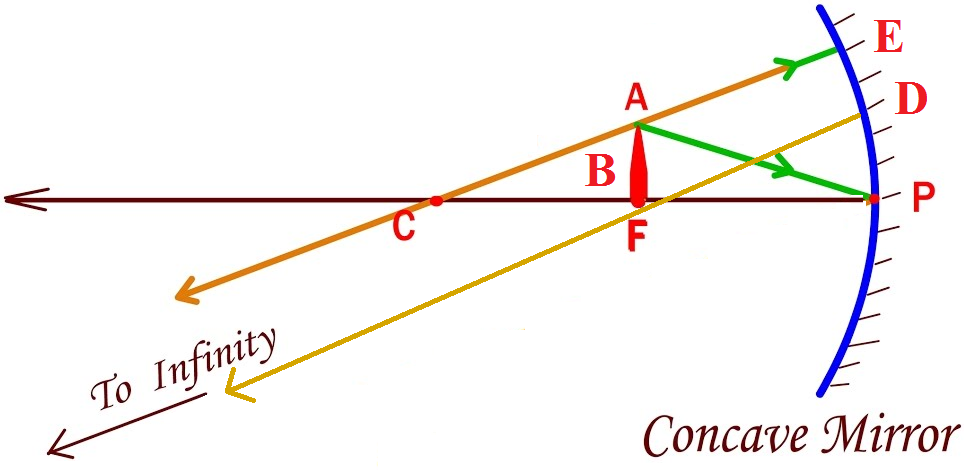
An object is placed at a distance of 10cm from a concave mirror of focal length 20cm.
  1. Draw a ray diagram for the formation of image.
  2. Calculate the image distance.
  3. State two characteristics of the image formed.
Answer
  1.  


Fig. Formation of image by the concave mirror when the object is palced between its pole and focus.
  1. f = -20cm, u = -10cm, v = ?
We know that

$\frac{1}{\text{v}}+\frac{1}{\text{u}}=\frac{1}{\text{f}}$

$\Rightarrow\frac{1}{\text{v}}+\frac{1}{(-10)}=\frac{1}{(-20)}$

$\Rightarrow\frac{1}{\text{v}}=\frac{1}{20}+\frac{1}{10}=\frac{1}{20}$

$\therefore \text{v}=20\text{cm}$
  1. Characteristics of image formed
  1. Image is virtual.
  2. Image is erect.
View full question & answer
Question 785 Marks
One-half of a convex lens is covered with a black paper. Will this lens produce a complete image of the object? Verify your answer experimentally. Explain your observations.
Answer
The convex lens will form complete image of an object, even if its one half is covered with black paper It can be understood by the following two cases.
Case I:

When the upper half of the lens is covered.
In this case, a ray of light coming from the object will be refracted by the lower half of the lens. These rays meet at the other side of the lens to form the image of the given object, as shown in the above figure.
Case II:

When the lower half of the lens is covered.
In this case, a ray of light coming from the object is refracted by the upper half of the lens. These rays meet at the other side of the lens to form the image of the given object, as shown in the above figure.
View full question & answer
Question 795 Marks
A student did an experiment with a convex lens. He put an object at different distances 25cm, 30cm, 40cm, 60cm and 120cm from the lens. In each case he measured the distance of the image from the lens. His results were 100cm, 24cm, 60cm, 30cm and 40cm, respectively. Unfortunately his results are written in wrong order:
  1. Rewrite the image distances in the correct order.
  2. What would be the image distance if the object distance was 90cm?
  3. Which of the object distances gives the biggest image?
  4. What is the focal length of this lens?
Answer
  1. Since the focal length is a constant quantity, we have to pair the object distance (u) and the image distance (v) such that the focal length always comes out to be the same. From the above argument, we get the correct order of the image distance as 100, 60, 40, 30 and 24. The reason being, as the object is carried far from a convex lens, the image is formed closer to the lens.
  2. Lens formula is given by,
$\frac{1}{\text{f}}=\frac{1}{\text{v}}-\frac{1}{\text{u}}$

$\Rightarrow\frac{1}{20}=\frac{1}{\text{v}}-\frac{1}{-90}$

$\Rightarrow\frac{1}{20}=\frac{1}{\text{v}}+\frac{1}{90}$

$\Rightarrow\frac{1}{\text{v}}=\frac{1}{20}-\frac{1}{90}$

$\Rightarrow\frac{1}{\text{v}}=\frac{9-2}{180}$

$\Rightarrow\frac{1}{\text{v}}=\frac{7}{180}$

$\Rightarrow{\text{u}}=\frac{180}{7}$

$\Rightarrow{\text{u}}=25.7\text{cm}$

The image distance will be 25.7cm if the object distance is 90cm.
  1. The object distance of 25 gives the biggest image because at this position, the object is between f and 2f. We know that when an object is placed between f and 2f of a convex lens, we get a real, inverted and magnified image.
  2. The image of an object at 2f is formed at 2f. This means that the pair of u and v that is equal in value gives us the value of 2f, which is 40. Hence, the value of f (focal length) is $\frac{40}{2}$
$\therefore\ \text{f}=20\text{cm}$
View full question & answer
Question 805 Marks
The image in a plane mirror is virtual and laterally inverted. What does this statement mean?
Answer
The image is virtual and laterally inverted means it cannot be obtained on a screen and is reversed sideways.
View full question & answer
Question 815 Marks
Write laws of refraction. Explain the same with the help of ray diagram, when a ray of light passes through a rectangular glass slab.
Answer
Laws of refraction of light are:
  • The incident ray, the refracted ray and the normal to the interface of two transparent media at the point of incidence, all lie in the same plane.
  • The ratio of sine of angle of incidence to the sine of angle of refraction is constant, for the light of a given wavelength and for the given pair of media. This law is also known as Snell’s law of refraction. The constant is also known as refractive index.
The ray diagram is as shown below:

In the glass slab, the emergent rays are parallel to the incident ray because the extant of bending of the ray of light at the opposite parallel faced of rectangular glass slab are equal and opposite, so that emergent ray is parallel to incident ray.
View full question & answer
Question 825 Marks
  1. What is scattering of light? Explain how the colour of the scattered light depends on the size of the scattering particles.
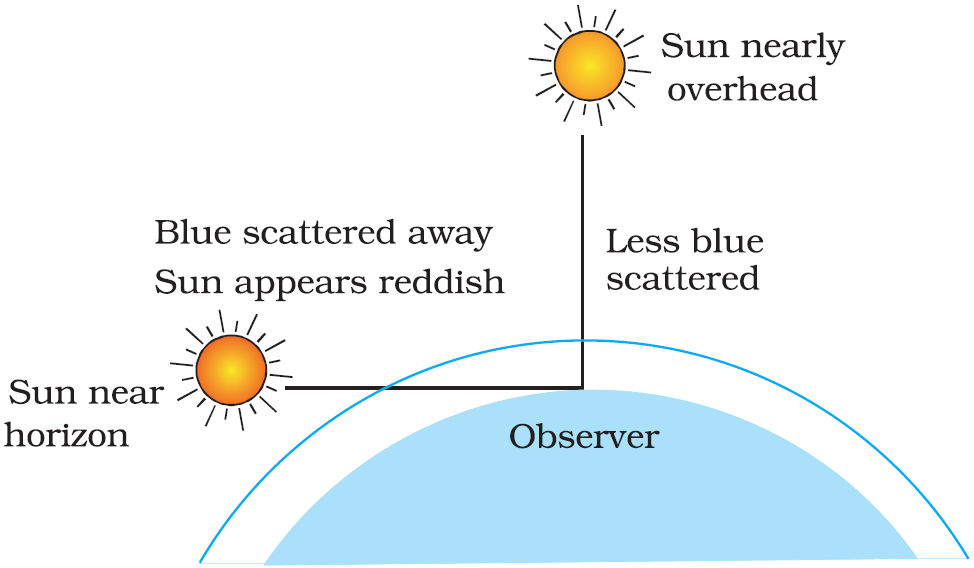
  2. Explain the reddish appearance of the Sun at sunrise or sunset. Why does it not appear red at noon?
Answer
  1. Scattering: Direction of ray of light changes when it collides with particles of comparable size.
  • Fine particle scatter shorter wavelengths like blue light.
  • Particles of larger size scatter longer wavelengths like red light.
  • If particle size is large enough scattered light may appear white.
  1.  
  • During sunrise and sunset, sun is near horizon. Sunlight travels longer distance. Most of blue light scatters away by particles. Light of longer wavelength reaches our eye so sun appears reddish.
  • At noon, sun is directly overhead so sunlight travels lesser distance. Less amount of blue light is scattered giving white appearance to sun.
View full question & answer