Question
A student did an experiment with a convex lens. He put an object at different distances 25cm, 30cm, 40cm, 60cm and 120cm from the lens. In each case he measured the distance of the image from the lens. His results were 100cm, 24cm, 60cm, 30cm and 40cm, respectively. Unfortunately his results are written in wrong order:
  1. Rewrite the image distances in the correct order.
  2. What would be the image distance if the object distance was 90cm?
  3. Which of the object distances gives the biggest image?
  4. What is the focal length of this lens?
Answer

  1. Since the focal length is a constant quantity, we have to pair the object distance (u) and the image distance (v) such that the focal length always comes out to be the same. From the above argument, we get the correct order of the image distance as 100, 60, 40, 30 and 24. The reason being, as the object is carried far from a convex lens, the image is formed closer to the lens.
  2. Lens formula is given by,
$\frac{1}{\text{f}}=\frac{1}{\text{v}}-\frac{1}{\text{u}}$

$\Rightarrow\frac{1}{20}=\frac{1}{\text{v}}-\frac{1}{-90}$

$\Rightarrow\frac{1}{20}=\frac{1}{\text{v}}+\frac{1}{90}$

$\Rightarrow\frac{1}{\text{v}}=\frac{1}{20}-\frac{1}{90}$

$\Rightarrow\frac{1}{\text{v}}=\frac{9-2}{180}$

$\Rightarrow\frac{1}{\text{v}}=\frac{7}{180}$

$\Rightarrow{\text{u}}=\frac{180}{7}$

$\Rightarrow{\text{u}}=25.7\text{cm}$

The image distance will be 25.7cm if the object distance is 90cm.
  1. The object distance of 25 gives the biggest image because at this position, the object is between f and 2f. We know that when an object is placed between f and 2f of a convex lens, we get a real, inverted and magnified image.
  2. The image of an object at 2f is formed at 2f. This means that the pair of u and v that is equal in value gives us the value of 2f, which is 40. Hence, the value of f (focal length) is $\frac{40}{2}$
$\therefore\ \text{f}=20\text{cm}$

Need a full question paper?

Generate a complete, print-ready paper with questions like this in minutes — across 16+ boards, with answer keys.

Start Generating Free

Similar questions

When water is added gradually to a white solid X, a hissing sound is heard and a lot of heat is produced forming a product Y. A suspension of Y in water is applied to the walls of a house during white washing. A clear solution of Y is also used for testing carbon dioxide gas in the laboratory.
  1. What could be solid X? Write its chemical formula.
  2. What could be product Y? Write its chemical formula.
  3. What is the common name of the solution of Y which is used for testing carbon dioxide gas?
  4. Write chemical equation of the reaction which takes place on adding water to slid X.
  5. Which characteristic of chemical reactions is illustrated by this example?
A p.d. of 4V is applied to two resistors of $6 Ω$ and $2 Ω$ connected in series. Calculate:
  1. The combined resistance.
  2. The current flowing.
  3. The p.d. across the $6 Ω$ resistor.
An object $4.0 \ cm$ in size, is placed $25.0 \ cm$ in front of a concave mirror of focal length $15.0 \ cm.$
$i.$ At what distance from the mirror should a screen be placed in order to obtain a sharp image?
$ii.$ Find the size of the image.
$iii.$ Draw a ray diagram to show the formation of image in this case.
How would you distinguish between baking powder and washing soda by heating?
Write the chemical formula and name of the compound which is the active ingredient of all alcoholic drinks. List its two uses. Write chemical equation and name of the product formed when this compound reacts with-
  1. Sodium metal.
  2. Hot concentrated sulphuric acid.
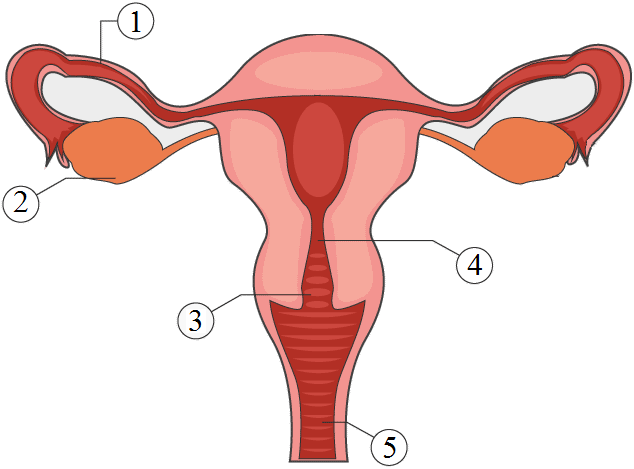
  1. Identify the given diagram. Name the parts 1 to 5.
  1. What is contraception? List three advantages of adopting contraceptive measures.
In the surgical method of birth control available for human females, the structures P in the reproductive system are cut and ligated (tied up) properly at both ends. This prevents the reproductive cell Q released by an organ R from entering the structures P so that Q is not available to fuse with another reproductive cell S coming from the male reproductive system. In this way, pregnancy is prevented.
  1. What are structures P?
  2. What is cell Q?
  3. Name the organ R.
  4. What is the reproductive cell S?
  5. What is the name of this surgical method of birth control available to females?
On heating blue coloured powder of copper (II) nitrate in a boiling tube, copper oxide (black), oxygen gas and a brown gas X is formed.
  1. Write a balanced chemical equation of the reaction.
  2. Identity the brown gas X evolved.
  3. Identity the type of reaction.
  4. What could be the pH range of aqueous solution of the gas X?
When a person puts food in his mouth, then teeth cut it into small pieces, chew and grind it. The glands A in the mouth secrete a substance B which is mixed with the food by tongue. The substance B contains an enzyme C which starts the digestion of food in the mouth. The slightly digested food from the mouth goes down a tube D. The special type of movements E in the walls of tube D push the food into stomach for further digestion. The stomach wall secretes gastric juice containing three substance F, G and H. One of the functions of F is to kill bacteria which may enter the stomach with food. The substance G protects the inside layer of stomach from the damaging effect of substance F whereas substance H is and enzyme for digestion. The partially digested food then enters into small intestine for further digestion.
  1. What is Gland A, Substance B and Enzyme C?
  2. Name the tube D.
  3. What is the movement E known as?
  4. What are F, G and H?
State five uses of metals and five of non-metals.