Questions

5 Marks Questions

🎯

Test yourself on this topic

27 questions · timed · auto-graded

Question 15 Marks
Define a cardiac cycle and the cardiac output.
Answer
The sequential events in the heart which are repeated cyclically is called cardiac cycle and it consists of systole (contraction) and diastole (relaxation) of both the atria and ventricles. The duration of a cardiac cycle is 0.8 seconds. Periods of cardiac cycle are atrial systole (0.1 second), ventricular systole (0.3 second) and complete cardiac diastole (0.4 second). The amount of blood pumped by heart per minute is called cardiac output. It is calculated by multiplying stroke volume (volume of blood pumped by each ventricle per minute) with heart rate (number of beats per minute). The heart of normal person beats 72 times per minute and pumps out about 70mL of blood per beat. Therefore, cardiac output averages 5000mL or 5 litres.
View full question & answer
Question 25 Marks
Write the differences between: P-wave and T-wave.
Answer
 
P-wave
 
T-wave
1.
In an electrocardiogram (ECG), the P-wave indicates the activation of the SA node.
1.
In an electrocardiogram (ECG), the T-wave represents ventricular relaxation.
2.
During this phase, the impulse of contraction is generated by the SA node, causing atrial depolarisation.
2.
During this phase, the ventricles relax and return to their normal state.
3.
It is of atrial origin.
3.
It is of ventricular origin.
View full question & answer
Question 35 Marks
What is the significance of atrio-ventricular node and atrio-ventricular bundle in the functioning of heart?
Answer
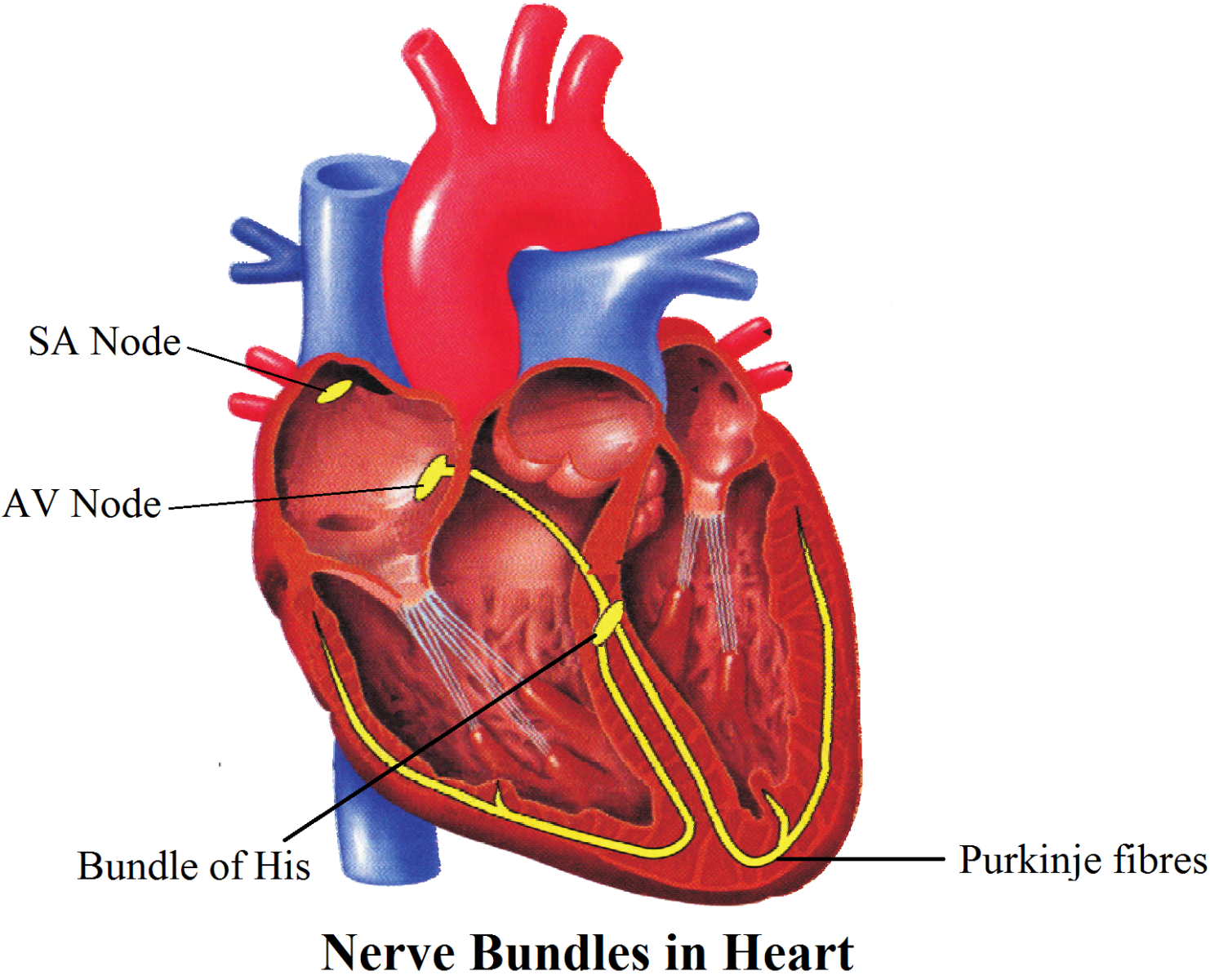
The atrioventricular (AV) node is present in the right atrium, near the base of the inter-auricular septum that separates the right auricle from the ventricle. It gives rise to the bundle of His that conducts the cardiac impulses from the auricles to the ventricles. As the bundle of His passes the ventricle along the inter-ventricular septum, it divides into two branches – the right ventricle and the left ventricle. The end branches of this conducting system then forms a network of Purkinje fibres that penetrate into the myocardium. The auricular contraction initiated by the wave of excitation from the sino-atrial node (SA node) stimulates the atrio-ventricular node, thereby leading to the contraction of ventricles through the bundle of His and Purkinje fibres. Hence, the atrio-ventricular node and the atrioventricular bundle play a role in the contraction of ventricles.
View full question & answer
Question 45 Marks
Write the differences between: Open and Closed system of circulation.
Answer
 
Open system of circulation
 
Closed system of circulation
1.
In this system, blood is pumped by the heart, through large vessels, into body cavities called sinuses.
1.
In this system, blood is pumped by the heart, through a closed network of vessels.
2.
The body tissues are in direct contact with blood.
2.
The body tissues are not in direct contact with blood.
3.
Blood flows at low pressure. Hence, it is a slower and less efficient system of circulation.
3.
Blood flows at high pressure. Hence, it is a faster and more efficient system of circulation.
4.
The flow of blood is not regulated through the tissues and organs.
4.
The flow of blood can be regulated by valves.
5.
This system is present in arthropods and mollusks.
5.
This system is present in annelids, echinoderms, and vertebrates.
View full question & answer
Question 55 Marks
Draw a standard ECG and explain the different segments in it.
Answer
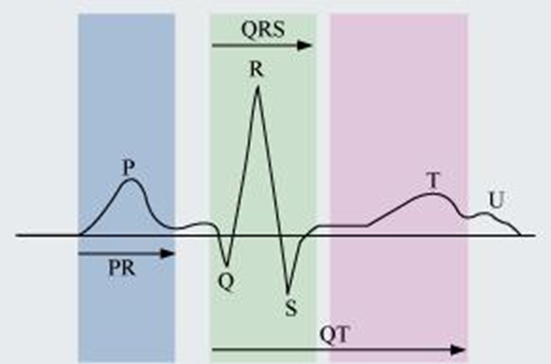
Electrocardiogram is a graphical representation of the cardiac cycle produced by an electrograph. The diagrammatic representation of a standard ECG is shown below. A typical human electrocardiogram has five waves – P, Q, R, S, and T. The P, R, and T-waves are above the base line and are known as positive waves. The Q and S-waves are below the base line and are known as negative waves. The P-wave is of atrial origin, while the Q, R, S, and T-waves are of ventricular origin.
  1. The P-wave indicates atrial depolarisation. During this wave, the impulse of contraction is generated by the SA node. The PQ-wave represents atrial contraction.
  2. The QR-wave is preceded by ventricular contraction. It represents the spread of the impulse of contraction from the AV node to the wall of the ventricle. It leads to ventricular depolarisation.
  3. The RS-wave represents ventricular contraction of about 0.3 sec.
  4. The ST-wave represents ventricular relaxation of about 0.4 sec. During this phase, the ventricles relax and return to their normal state.
  5. The T-wave represents ventricular relaxation.
View full question & answer
Question 65 Marks
Match Column I with Column II
 
Column I
 
Column II
a.
Eosinophils
i.
Coagulation
b.
RBC
ii.
Universal Recipient
c.
AB Group
iii.
Resist Infections
d.
Platelets
iv.
Contraction of Heart
e.
Systole
v.
Gas transport
Answer
 
Column I
 
Column II
a.
Eosinophils
iii.
Resist Infections
b.
RBC
v. Gas transport
c.
AB Group
ii. Universal Recipient
d.
Platelets
i.
Coagulation
e.
Systole
iv.
Contraction of heart
View full question & answer
Question 75 Marks
What is meant by double circulation? What is its significance?
Answer
Double circulation is a process during which blood passes twice through the heart during one complete cycle. This type of circulation is found in amphibians, reptiles, birds, and mammals. However, it is more prominent in birds and mammals as in them the heart is completely divided into four chambers – the right atrium, the right ventricle, the left atrium, and the left ventricle. The movement of blood in an organism is divided into two parts:
  1. Systemic circulation
  2. Pulmonary circulation
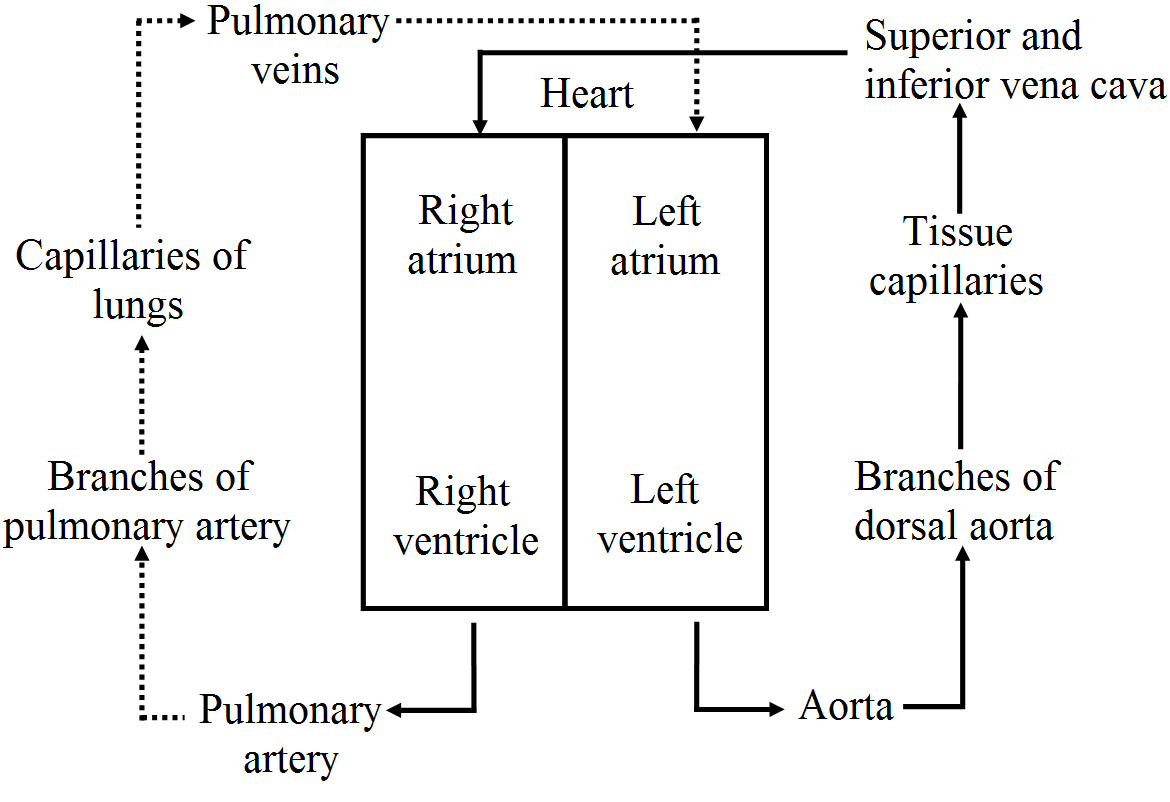
Systemic circulation involves the movement of oxygenated blood from the left ventricle of the heart to the aorta. It is then carried by blood through a network of arteries, arterioles, and capillaries to the tissues. From the tissues, the deoxygenated blood is collected by the venules, veins, and vena cava, and is emptied into the left auricle. Pulmonary circulation involves the movement of deoxygenated blood from the right ventricle to the pulmonary artery, which then carries blood to the lungs for oxygenation. From the lungs, the oxygenated blood is carried by the pulmonary veins into the left atrium. Hence, in double circulation, blood has to pass alternately through the lungs and the tissues.Significance of double circulation:
The separation of oxygenated and deoxygenated blood allows a more efficient supply of oxygen to the body cells. Blood is circulated to the body tissues through systemic circulation and to the lungs through pulmonary circulation.
View full question & answer
Question 85 Marks
Describe the evolutionary change in the pattern of heart among the vertebrates.
Answer
  • The vertebrate heart has evolved from a two-chambered heart of a fish to a four-chambered heart of mammals and birds.
  • The heart of fish is two-chambered. The heart pumps deoxygenated blood to the gills where it is oxygenated and sent to the body. The deoxygenated blood is carried to the heart.
  • In amphibians, there are three chambers—the left atrium, the right atrium and a ventricle. The left atrium receives the oxygenated blood from the gills, the lungs or the skin. The right atrium receives deoxygenated blood from the body organs. However, eventually, both types of blood are mixed in the ventricle and the body is supplied with the mixed blood.
  • In case of reptiles, there is half septum which divides the ventricle incompletely. Here, oxygenated and deoxygenated blood do not mix.
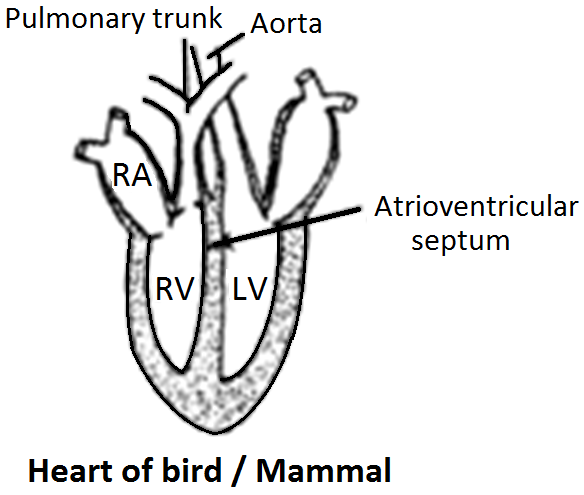
  • In crocodiles, birds and mammals, the heart is completely divided into halves which keep the oxygenated and deoxygenated blood separate.
  • There is a structural modification in the heart from fish to mammals, which ensures the supply of oxygenated blood to the body. At the same time, the four-chambered structure makes sure that the flow of blood is regulated.
  • The types of circulation also change from single to double as the structure of the heart is modified.
View full question & answer
Question 95 Marks
What is the significance of hepatic portal system in the circulatory system?
Answer
Hepatic Portal System There is special vascular connection that exists between the digestive tract and liver in all chordates and is called as hepatic portal system. This system carries blood from intestine to the liver before it is delivered to the systemic circulation. Significance of hepatic portal system in circulatory system
  1. Blood that comes from alimentary canal contains glucose, amino acids and other nutrients. The liver absorbs excess of fats and glucose to be used at the time of starvation when blood passes through given.
  2. Harmful nitrogenous wastes like ammonia is converted into urea which is later removed by kidney
  3. Liver produces proteins which are transported through blood circulation (e.g., fibrinogen for blood clotting).
View full question & answer
Question 105 Marks
  1. What is lymph? Write its two functions.
  2. Where are Bicuspid and Tricuspid valves located in human heart.
  3. Name the blood vessels that bring oxygenated blood from lungs to heart.
Answer
  1. Lymph: When blood flows through the capillaries, som water and water-soluble small molecules seer into the tissue spaces to form tissue/ interstitia fluid; the part of the interstitial fluid that enter: the lymphatic system, is called lymph.
Functions:
  1. Fats are absorbed from the alimentary canal through lymph in the lacteals of intestinal villi.
  2. The lymphocytes present in the lymph are responsible for the immune response of the body.
  3. It also carries nutrients, hormones and other metabolites for circulation.
  4. It collects and drains the fluid that seeped out of blood, back into circulation.
  1.  
  • Bicuspid valve guards the opening in the AV septum between the left atrium and left ventricle.
  • Tricuspid valve guards the opening in the AV septum between the right atrium and right ventricle.
  1. Pulmonary veins:
View full question & answer
Question 115 Marks
Explain the advantage of the complete partition of ventricle among birds and mammals and hence leading to double circulation.
Answer
The birds and mammals have evolutionary advancement as far as structure of heart is concerned. They need more oxygen to live in terrestrial habitat. In these animals, the blood received by left and right auricles is oxygenated and deoxygenated respectively. It passes towards the left and right ventricles and thus no oxygenated and deoxygenated blood is mixed. The ventricles pump oxygenated deoxygenated blood without mixing. Thus, two separate circulatory pathways are found thus this type of blood circulation is called as double circulation, which include systemic and pulmonary circulation.
View full question & answer
Question 125 Marks
What physiological circumstances lead to erythroblastosis foetalis?
Answer
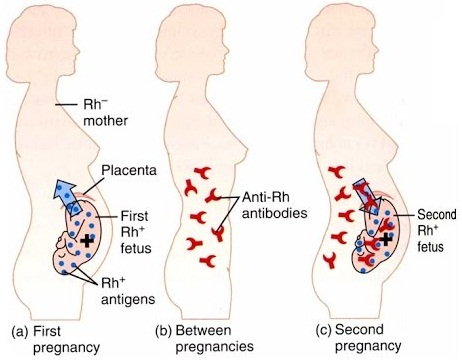
A protein named as rhesus antigen, is present on the surface of red blood corpuscles. The population having this protein is called Rh positive $\left(\mathrm{Rh}^{+}\right)$while others who do not have this protein are known as Rh negative (PIT) (dominant). Erythroblastosis Foetalis occurs due to Rh incompatibility between the foetus and mother during pregnancy. Rh antigen of the foetus does not get exposed to the $\mathrm{Rh}^{-}$blood of the mother in the first pregnancy. However, during the delivery of the first child, there is a possibility, of exposure of the maternal blood to small amounts of the Rh'^ blood from the foetus. In such cases, the mother starts preparing antibodies against Rh antigen in her blood and during her subsequent pregnancies the Rh antibodies from the mother ( $R h^{-} \mathrm{ve}$ ) leak into the blood of the foetus ( $\mathrm{Rh}^{+}$ve) resulting in the destruction of foetal RBCs. This could be fatal to the foetus or could cause severe anemia and jaundice, even may lead to the death of the foetus.
View full question & answer
Question 135 Marks
Thrombocytes are essential for coagulation of blood. Comment.
Answer
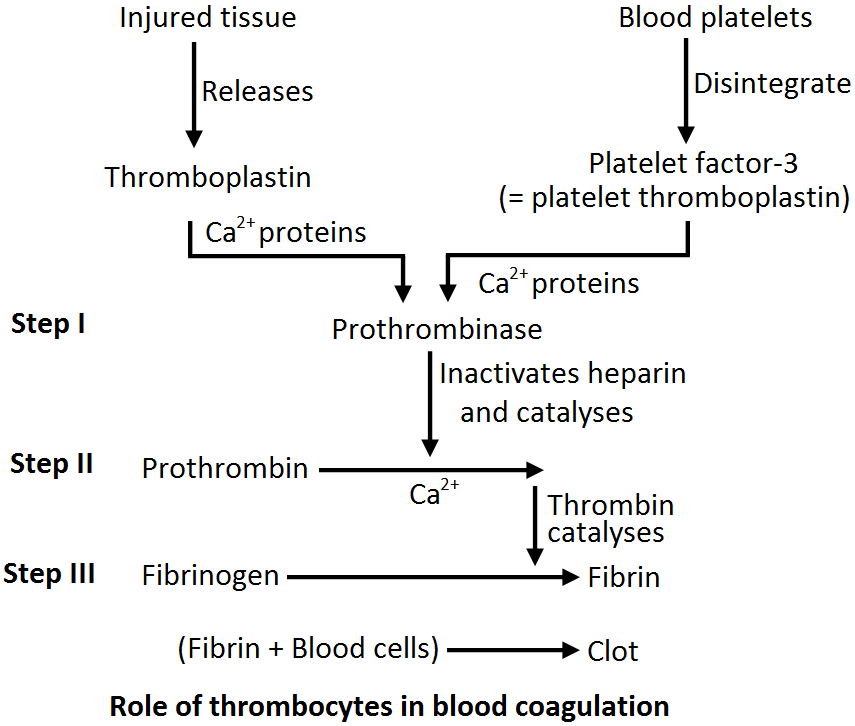
Blood is a connective tissue. It has many cellular components. Thrombocytes or platelets are one of them. Thrombocytes or platelets are found in blood. There number in the blood is 250,000/cubic mL of blood. They are formed in bone marrow and their life span is one week. When an injury is caused in the blood vessel, bleeding starts, and the platelets are disintegrated to release the clotting factor 3 called thromboplastin. This in presence of $\mathrm{Ca}^{2+}$ ions activate prothrombokinase. A series of reactions ultimately occurs which causes blood to clot and plug the injured blood vessel thus preventing further loss of blood.
View full question & answer
Question 145 Marks
Lalit, an engineer in a mechanical field used to skip his meals and used to eat junk food in hurry. Few days back Lalit complained about the frequent chest pain to his friends. One of his friend advised him to immediately visit a doctor as this might have been related to some heart disorder. Lalit visited doctor who told him to go for an ECG (Electrocardiogram). Lalit asked the
doctor about the utility of this test.
  1. What is electrocardiography?
  2. What does a human electrocardiogram indicate?
  3. What is the utility of an ECG?
  4. What values are reflected from Lalit's behaviour?
Answer
  1. It is the technique of graphic tracing of the electric impulse generated by the heart muscles during a heartbeat. This tracing is recorded with an electro-cardiograph and provides information on the condition and performance of the heart functioning.
  2. A typical human electrocardiogram, shows five different waves (i.e., P, Q, R, S and T.) The P, R and T waves are above the base line and are known as positive waves. The Q and S waves are below the baseline and are termed as negative waves.
  3. ECG is valuable in diagnosing abnormal cardiac rhythms and conducting pattern and abnormalities in heart for heart block, heart attack and coronary thrombosis.
  4. Lalit showed concern for his health so he was aware of general health problems and wanted to know the importance of the electrocardiogram procedures. He has inquisitive mind.
View full question & answer
Question 165 Marks
Differentiate between arteries and veins.
Answer
S. No
Arteries
Veins
(a)
Arteries carry blood from the heart to different parts of the body.
Veins bring blood from different parts of the body to the heart.
(b)
Arteries have thick walls to withstand the pressure of the blood.
Veins are thin walled and blood flows with very little pressure.
(c)
They do not have valves.
They possess valves to prevent back flow of blood.
(d)
Blood flow in arteries is due to pumping action of heart.
Blood flows due to contraction of muscles.
View full question & answer
Question 175 Marks
Describe (a) pulmonary circulation and (b) systemic circulation. Mention their significance/ importantce.
Answer
  1. Pulmonary circulation:
  • It starts with the right ventricle pumping the deoxygenated blood into the pulmonary artery.
  • When the blood reaches the lungs, it is oxygenated.
  • The oxygenated blood is carried by the pulmonary veins to the left atrium.
Significance: This pathway serves for the oxygenation of the deoxygenated blood.
  1. Systemic circulation
  • It starts with the left ventricle pumping the oxygenated blood into the aorta.
  • The blood is carried by a network of arteries, arterioles and capillaries to all parts of the body.
  • The deoxygenated blood from all parts of the body is collected by a system of venules, veins and ultimately poured into the right atrium by the superior vena cava and inferior vena cava.
Significance:
  • This pathway provides nutrients, oxygen and other essential substances to all parts of the body and removes the metabolic wastes and other harmful substances for elimination (excretion) from the body.
  • The coronary system of blood vessels is meant for circulation of blood to the cardiac muscles.
  • The hepatic portal system supplies the nutrients from the intestine to the liver.
View full question & answer
Question 185 Marks
  1. Where is sino-atrial node (SAN) located in human heart? Why is SAN called pacemaker of the heart?
  2. What is electrocardiogram? What represents P-wave, QRS complex and T-wave in a standard ECG?
  3. What are the causes of Angina and Coronary Artery Disease?
Answer
  1.  
  • SAN is located in the right upper corner of the right atrium.
  • Since, it is responsible for initiation and maintenance of the rhythmic contractile activity of the heart, it is called pacemaker of the heart.
  1.  
  • Electrocardiogram is the graphical representation of the electrical activity of the heart during a cardiac cycle.
  • QRS complex represents ventricular depolarisation (ventricular systole).
  • P Wave represents atrial depolarisation (systole of atria).
  • T-wave represents ventricular repolarisation (ventricular diastole).
  1.  
  • Angina is caused due to insufficient supply of oxygen to heart muscles. CAD is caused by deposits of cholesterol, fats and fibrous tissues in the coronary arteries.
View full question & answer
Question 195 Marks
Describe circulatory pathways in animals.
Answer
The circulatory patterns are of two types - open or closed. Open Circulatory System: In open circulatory system blood pumped by the heart passes through large vessels into open spaces or body cavities called sinuses. Arthropodas and Molluscs have this type of circulatory system. Closed Circulatory System: In closed circulatory system blood pumped by the heart is always circulated through a closed network of blood vessels. This pattern is considered to be more advantageous as the flow of fluid can be more precisely regulated. Annelids and chordates have this type of system. Chambered Heart: All vertebrates possess a muscular chambered heart. Fishes have a 2-chambered heart with an atrium and a ventricle. Amphibians and the reptiles (except crocodiles) have a 3-chambered heart with two atria and a single ventricle, whereas crocodiles, birds and mammals possess a 4-chambered heart with two atria and two ventricles. Single Circulation: In fishes the heart pumps out deoxygenated blood which is oxygenated by the gills and supplied to the body parts from where deoxygenated blood is returned to the heart. Incomplete Double Circulation: In amphibians and reptiles, the left atrium receives oxygenated blood from the gills/ lungs / skin and the right atrium gets the deoxygenated blood from other body parts. However, they get mixed up in the single ventricle which pumps out mixed blood. Complete Double Circulation: In birds and mammals, oxygenated and deoxygenated blood received by the left and right atria respectively passes on to the ventricles of the same sides. The ventricles pump it out without any mixing up, i.e., two separate circulatory pathways are present in these organisms, hence, these animals have double circulation.
View full question & answer
Question 205 Marks
Describe conduction of heart beat with the help of suitable diagram.
Answer
Conduction of Heart Beat: The entire heart is made of cardiac muscles. The walls of ventricles are much thicker than that of the atria. A specialised cardiac musculature called the nodal tissue is also distributed in the heart. SA Node: A patch of nodal tissue is present in the right upper corner of the right atrium called the sino-atrial node (SAN). AV Node: Another mass of nodal tissue is seen in the lower left corner of the right atrium close to the atrio-ventricular septum called the atrioventricular node (AVN) Bundle of His: A bundle of nodal fibres, atrioventricular bundle (AV bundle) continues from the AVN which passes through the atrio ventricular septa to emerge on the top of the interventricular septum and immediately divides into a right and left bundle. These branches give rise to minute fibres throughout the ventricular musculature of the respective sides and are called purkinje fibres. These fibres alongwith right and left bundles are known as bundle of HIS Generation of Heart Beat: The nodal musculature has the ability to generate action potentials without any external stimuli, le, it is autoexcitable. However, the number of action potentials that could be generated in a minute vary at different parts of the nodal system. The SA Node can generate the maximum number of action potentials, i.e., 70-75 min, and is responsible for initiating and maintaining the rhythmic contractile activity or beating of the heart. Therefore, it is called the pacemaker. Our heart normally beats 70-75 times in a minute (average 72 beats per minute).
View full question & answer
Question 215 Marks
Explain Rh-incompatibility in humans.
Answer
Rh antigen is observed on the surface of RBCs of majority (nearly 80\%) of humans. Such individuals are called Rh positive ( $\mathrm{Rh}^{+}$and those individuals where this antigen is absent are called Rh negative ( $\mathrm{Rh}^{-}$). (a) Both $\mathrm{Rh}^{+}$and $\mathrm{Rh}^{-}$ individuals are phenotypically normal. The problem in them arises during blood transfusion and pregnancy.(i) Incompatibility During Blood Transfusion The first blood transfusion of $\mathrm{Rh}^{+}$blood to the person with RI-T blood causes no harm because the Rh- person develops anti Rh factors or antibodies in his/ her blood. In second blood transfusion of $\mathrm{Rh}^{+}$blood to the $\mathrm{Rh}^{-}$person, the already formed anti Rh factors attack and destroy the red blood corpuscles of the donor. Incompatibility During Pregnancy If father's blood is $\mathrm{Rh}^{+}$, mother blood is $\mathrm{Rh}^{-}$and the foetus blood is $\mathrm{Rh}^{+}$. it will lead to a serious problem. Rh antigens of the foetus do not get exposed to the $\mathrm{Rh}^{+}$blood of the mother in the first pregnancy as the two bloods are well separated by the placenta. But in the subsequent $\mathrm{Rh}^{+}$ foetus, the anti Rh factors (antibodies) of the mother destroy the foetal red blood corpuscles due to mixing of blood. This result in the Haemolytic Disease of the New Born (HDN), called as erythroblastosis foetalis. In some cases new born may survive but will be anaemic and may also suffer with jaundice.

This condition can be avoided by administering anti-Rh antibodies to the mother immediately after the delivery of the first child.
View full question & answer
Question 225 Marks
With the help of suitable diagram describe the structure of human heart.
Answer
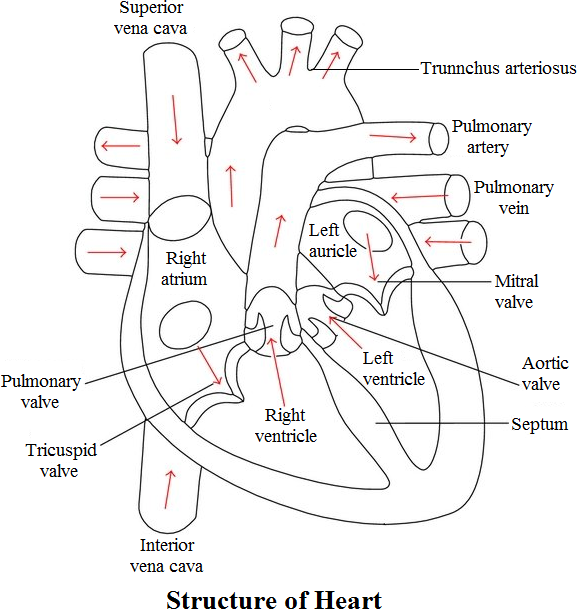
Heart: Location and Size. Heart, the mesodermally derived organ, is situated in the thoracic cavity, in between the two lungs, slightly tilted to the left. It has the size of a clenched fist. Structure: The heart is protected by a double walled membranous bar pericardium, enclosing the pericardial fluid. Heart has four chambers:
  1. Two relatively small upper chambers called atria.
  2. Two larger lower chambers called ventricles.
Septum: A thin, muscular wall called the interatrial septum separates the right and the left atria, whereas a thick-walled, the inter-ventricular septum, separates the left and the right ventricles The atrium and the ventricle of the same side are also separated by a thick fibrous tissue called the atrioventricular septum. However, each of these septa are provided with an opening through which the two chambers of the same side are connected. Valves: The opening between the right atrium and the right ventricle is guarded by a valve formed of three muscular flaps or cusps, the tricuspid valve, whereas a bicuspid or mitral valve guards the opening between the left atrium and the left ventricle. The openings of the right and the left ventricles into the pulmonary artery and the aorta respectively are provided with the semilunar valves. The valves in the heart allows the flow of blood only in one direction, i.e., from the atria to the ventricles and from the ventricles to the pulmonary artery or aorta These valves prevent any backward flow.
View full question & answer
Question 235 Marks
Describe the sequence of events which occur in the cardiac cycle. Where and how are the sounds of ‘lub' and 'dub’ produced in the heart during this cycle?
Answer
Cardiac cycle: A cardiac cycle refers to the sequential events in the heart that are cyclically repeated and consists of diastole and systole of both the atria and both the ventricles.The events are as follows:
  1. Joint diastole:
  • During this phase, both atria and ventricles are in the relaxed state.
  • Blood from pulmonary veins flows into the left atrium and from superior and inferior vena cava into right atrium.
  • Since AV valves are open, blood also flows into the respective ventricles from the atria.
  • Semilunar valves are closed.
  1. Atrial systole:
  • Atrial muscles contract and blood flow into ventricles increases by about 30%.
  • The ventricles continue to remain in their diastole.
  1. Ventricular systole:
  • As the action potential is conducted to the ventricles, they start their systole and the atria start their diastole.
  • As the pressure inside ventricles increases, the AV valves close to prevent backflow of blood into atria.
  • Further increase in ventricular pressure causes the opening of semilunar valves and blood from the left ventricle enters the aorta and that from the right ventricle enters the pulmonaryartery.
  1. Ventricular diastole:
  • The ventricles start relaxing and the atria also continue their diastole.
  • As the ventricular pressure decreases, the semilunar valves close to prevent the backflow of blood into the ventricles.
View full question & answer
Question 245 Marks
Explain different types of blood groups and donor compatibility by making a table.
Answer
ABO blood groups in human beings were reported for first time by Karl Landsteiner. ABO blood groups are determined by the gene/ (isoagglutinin). There are three alleles, IA, IB and 7° of this gene. Proteins produced by the/ A and/ ll alleles are called A antigen and B antigen respectively. People with blood group A have the A antigen on the surface of their RBCs, and antibodies to antigen B in their plasma. Persons with blood group B have B antigen on their RBCs, and antibodies against A antigen in their plasma. Individuals with AB blood group have both antigen A and antigen B on their RBCs, and no antibodies for either of the antigens in their plasma. Type O individuals are without A and B antigens on their RBCs, but have antibodies for both these antigens in their plasma. Individuals with blood group AB can receive blood of A, B or O group, while those with blood group O can donate blood to anyone. This is the most important blood group for transfusion. Thus person with blood group AB is called universal recipient and person with blood group O is called universal donor. If a blood transfusion is made between an incompatible donor and recipient, reaction of antigens on the cells and antibodies in the plasma produces clots and clog capillaries, Table: Human ABO blood groups and their compatibility.
Blood Group Genotype Antigens on red blood corpuscles Antibodies in blood plasma Can give blood to Can get blood from
A $|^A|^A Or |^A|^O$ A b A, AB A, O
B $|^B|^B Or |^B|^O​​​​​​​$ B a B, A B, O
AB $|^A|^B$ AB None AB AB, A, B, O
O $|^O|^O​​​​​​​$​​​​​​​ None a, b AB, A, B, O O
View full question & answer
Question 255 Marks
Define blood. Give detail of various formed elements of blood.
Answer
Blood is a special connective tissue consisting of a fluid matrix, plasma, and formed elements. Formed Elements: Erythrocytes, leucocytes and platelets are collectively called formed elements and they constitute nearly 45 percent of the blood.
  1. Erythrocytes. They are also known as Red Blood Cells (RBC). They are the most abundant of all the cells in blood. A healthy adult man has, on an average, 5 millions to 5.5 millions of RBCs $mm^{-3}$​​​​​​​ of blood. RBCs are formed in the red bone marrow in the adults. RBCs are devoid of nucleus in most of the mammals and are biconcave in shape. They have a red coloured, iron containing complex protein called haemoglobin, hence the colour and name of these cells. A healthy individual has 12-16gms of haemoglobin in every 100ml of blood These molecules play a significant role in transport of respiratory gases. RBCs have an average life span of 120 days after which they are destroyed in the spleen. Hence, spleen is also known as the graveyard of RBCs.
  2. Leucocytes. They are also known as White Blood Cells (WBC) as they are colourless due to the lack of haemoglobin. They are nucleated and are relatively lesser in number which averages 6000-8000 mm of blood Leucocytes are generally short lived.
There are two main categories of WBCs:
  1. Granulocytes, e.g., neutrophils, eosinophils and basophils.
  2. Agranulocytes. e.g., Lymphocytes and monocytes.
  • Neutrophils are the most abundant cells (60-65 percent) of the total WBCS and basophils are the least (0.5-1 pe cent) among them. Neutrophils and monocytes (6-8 percent) are phagocytic cells which destroy foreign organisms entering the body.
  • Basophils secrete histamine, serotonin, heparin, etc., and are involved in inflammatory reactions.
  • Eosinophils (2-3 percent resist infections and are also associated with allergic reactions.
  • Lymphocytes (20-25 percent) are of two major types - 'B' and T forms. Both B and T lymphocytes are responsible for immune responses of the body.
View full question & answer
Question 265 Marks
Describe the events in cardiac cycle. Explain “double circulation”.
Answer
The cardiac cycle consists of one heart beat or one cycle of contraction and relaxation of the cardiac muscle. During a heart beat there is contraction and relaxation of atria and ventricles. The contraction phase is called the systole while the relaxation phase is called the diastole. When both the atria and ventricles are in diastole or relaxed phase, this is referred to as a joint diastole. During this phase, the blood flows from the superior and inferior venae cavae into the atria and from the atria to the respective ventricles through auriculo-ventricular valves. But there is no flow of blood from the ventricles to the aorta and pulmonary trunk as the semilunar valves remain closed. The successive stages of the cardiac cycle are briefly described below:
  1. Atrial systole: The atria contract due to a wave of contraction, stimulated by the SA node. The blood is forced into the ventricles as the bicuspid and tricuspid valves are open.
  2. Beginning of ventricular systole: The ventricles begin to contract due to a wave of contraction, stimulated by the AV node. The bicuspid and tricuspid valves close immediately producing part of the first heart sound.
  3. Complete ventricular systole: When the ventricles complete their contraction, the blood flows into the pulmonary trunk and aorta as the semilunar valves open.
  4. Beginning of ventricular diastole: The ventricles relax and the semilunar valves are closed. This causes the second heart sound.
  5. Complete ventricular diastole: The tricuspid and bicuspid valves open when the pressure in the ventricles falls and blood flows from the atria into the ventricles. Contraction of the heart does not cause this blood flow; it is due to the fact that the pressure within the relaxed ventricles is less than that in the atria and veins.
The duration of a cardiac cycle is 0.8 sec. Double circulation: The heart of birds and mammals is four chambered, it comprises of 2 atria and 2 ventricles. Right and left atria are separated by inter-atrial septum and right and left ventricles are separated by inter-ventricular septum, thus, preventing the mixing of oxygenated and deoxygenated blood. It results in double circulation which includes systemic and pulmonary circulation. Systemic circulation is the flow of oxygenated blood from the left ventricle to all parts of the body and deoxygenated blood from various body parts to the right atrium. All systemic arteries arise from the aorta. All the veins of the systemic circulation bring deoxygenated blood into the superior vena cava, the inferior vena cava or the coronary sinus, which open into the right atrium. The purpose of systemic circulation is to carry oxygen and nutrients to body tissues and to remove carbon dioxide and other wastes from the tissues. Pulmonary circulation is flow of deoxygenated blood from the right ventricle to the lungs and the return of oxygenated blood from the lungs to the left atrium. The pulmonary trunk arises from the right ventricle and then divides into the right pulmonary artery and left pulmonary artery which supply deoxygenated blood to the right and left lungs respectively. Exchange of gases takes place in the lungs.
View full question & answer
Question 275 Marks
Blood flow in the heart during a cardiac cycle.
Answer
  1. Joint diastole:
  • Deoxygenated blood flows into the right atrium through vena cavae and oxygenated blood into the left atrium through pulmonary veins.
  • As the AV valves are open, blood from the atria flows into the respective ventricles.
  1. Atrial systole:
  • As the atria contract, blood flow to the ventricles increases by about 30 percent.
  1. Ventricular systole:
  • As the ventricles start contracting, the atria enter the diastole.
  • The ventricular pressure increases and hence, the AV valves close, (producing the first heart sound) to prevent back flow of blood.
  • As the ventricular pressure increase further, the semilunar valves are forced open and blood from the right ventricle enters the pulmonary artery and from the left ventricle into the aorta.
  1. Ventricular diastole:
  • As the ventricular pressure decreases, the semilunar valves close (producing the second heart sound) to prevent back flow of blood into ventricles.
  • For a brief period the ventricular diastole coincides with the atrial diastole, i.e., joint diastole.
  • The AV valves open and blood starts flowing from the atria into the respective ventricles.
View full question & answer
5 Marks Questions - BIOLOGY STD 11 Science Questions - Vidyadip