Questions · Page 1 of 4

M.C.Q (1 Marks)

🎯

Test yourself on this topic

50 questions · timed · auto-graded

MCQ 11 Mark
Which of the following angle corresponds to $\ce{sp2}$ hybridisation?
  • A
    $90^\circ $
  • $120^\circ$
  • C
    $180^\circ$
  • D
    $109^\circ$
Answer
Correct option: B.
$120^\circ$
$\ce{sp^2}$ hybridisation gives three $\ce{sp^2}$ hybrid orbitals which are planar triangular forming an angle of $120^\circ $ with each other.
The electronic configurations of three elements $\ce{A, B}$ and $\ce{C}$ are given below.
View full question & answer
MCQ 21 Mark
Which of the following molecule has net dipole moment zero?
  • A
    $\ce{HF}$
  • B
    $\ce{H_2O}$
  • $\ce{BF_3}$
  • D
    $\ce{CHCl_3}$
Answer
Correct option: C.
$\ce{BF_3}$
View full question & answer
MCQ 31 Mark
Diagonal hybridisation is the another name of :
  • A
    $\ce{sp^3}\ -$ hybridization.
  • B
    $\ce{sp^2}\ -$ hybridisation.
  • $\ce{sp}\ -$ hybridisation.
  • D
    All of the above.
Answer
Correct option: C.
$\ce{sp}\ -$ hybridisation.
The $\ce{sp}\ -$ hybridisation is also called diagonal hybridisation.
View full question & answer
MCQ 41 Mark
In the following questions two or more options may be correct : Which of the following have identical bond order?
  • $\text{CN}^-$
  • B
    $\text{NO}^+$
  • C
    $\text{O}^-_2$
  • D
    $\text{O}^{2-}_2$
Answer
Correct option: A.
$\text{CN}^-$
$\text{CN}^-(6+7+1=14)\text{B.O.}=3,$
 
View full question & answer
MCQ 51 Mark
Predict the correct order : $($where bp is bonded paper and $\ce{lp}$ is lone pair of electrons$)$
  • A
    $\ce{bp - bp > lp - bp > lp - bp} $
  • B
    $\ce{lp - bp > bp - bp > lp - lp}$
  • $\ce{lp - lp > lp - bp > bp - bp}$
  • D
    $\ce{lp - lp > bp - bp > lp - bp}$
Answer
Correct option: C.
$\ce{lp - lp > lp - bp > bp - bp}$
Lone pair have maximum repulsion with lone pair, followed by $\ce{lp - bp},$ minimum $\ce{bp - bp}.$
View full question & answer
MCQ 61 Mark
Which of the following species has four lone pairs of electrons in its outer shell?
  • $\ce{I}$
  • B
    $\ce{O}^-$
  • C
    $\ce{Cl}^-$
  • D
    $\ce{He}$
Answer
Correct option: A.
$\ce{I}$
Consider the electronic configuration of each of these options:
$\ce{I - [Kr]4d^{10}5s^25p^5 \rightarrow 3}$ lone pairs.
$\ce{O^- - 1s^22s^22p^5\rightarrow 3}$ lone pairs.
$\ce{Cl^- - 1s^22s^22p^63s^23p^6 \rightarrow 4}$ lone pairs.
$\ce{He - 1s^2 \rightarrow 1}$ lone pair.
View full question & answer
MCQ 71 Mark
Lewis postulated that atoms achieve the stable octet when they are linked by :
  • A
    Ionic bonds.
  • B
    Covalent bonds.
  • C
    Coordinate bonds.
  • Chemical bonds.
Answer
Correct option: D.
Chemical bonds.
The atoms can achieve the stable octet when they are linked by chemical bonds. It was postulated by Lewis.
View full question & answer
MCQ 81 Mark
The correct order of dipole moment is :
  • $\text{CH}_4<\text{NF}_3<\text{NH}_3<\text{H}_2\text{O}$
  • B
    $\text{NF}_3<\text{CH}_4<\text{NH}_3<\text{H}_2\text{O}$
  • C
    $\text{CH}_4<\text{NH}_3<\text{NF}_3<\text{H}_2\text{O}$
  • D
    $<\text{H}_2\text{O}<\text{NH}_3<\text{NF}_3<\text{CH}_4$
Answer
Correct option: A.
$\text{CH}_4<\text{NF}_3<\text{NH}_3<\text{H}_2\text{O}$
Greater the polarity, more will be dipole moment. In $\ce{< NF_3}$ nitrogen is less electronegative then $'F\ '$ so dipole moment decrease as dipole are towards fluorine.
View full question & answer
MCQ 91 Mark
Which of the following statements is correct?
  • In the formation of dioxygen from oxygen atoms $10$ molecular orbitals will be formed.
  • B
     All the molecular orbitals in the dioxygen will be completely filled.
  • C
     Total number of bonding molecular orbitals will not be same as total number of anti bonding orbitals in dioxygen.
  • D
    Number of filled bonding orbitals will be same as number of filled anti bonding orbitals.
Answer
Correct option: A.
In the formation of dioxygen from oxygen atoms $10$ molecular orbitals will be formed.
$\ce{O_2 = (8 + 8) = 16.}$
$\sigma1\text{s}^{2} < \sigma^{*}1\text{s}^{2} < \sigma2\text{s}^{2} < \sigma\text{s}^{2} < \sigma2\text{s}$
View full question & answer
MCQ 101 Mark
In case of $\ce{Na}$ metal if the number of $\ce{Na}$ atom increases, the difference in energy between successive $\ce{MOs}$ in $\ce{Na(Na)_n}$ molecules :
  • A
    Increases
  • Decreases
  • C
    May increase or decrease
  • D
    No change
Answer
Correct option: B.
Decreases
In case of $\ce{Na}$ metal if the number of $\ce{Na}$ atom increases, the difference in energy between successive $\ce{MOs}$ in $\ce{Na (Na)_n}$ molecules decreases.
When very large number of $\ce{Na}$ atoms is present, the discrete energy levels merge to form a continuous band.
View full question & answer
MCQ 111 Mark
In $\ce{OF_2},$​ number of bond pairs and lone pairs of electrons are respectively :
  • A
    $2, 6$
  • $2, 8$
  • C
    $2, 10$
  • D
    $2, 9$
Answer
Correct option: B.
$2, 8$
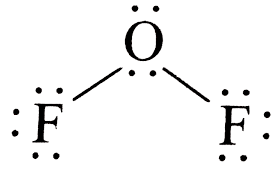
For number of bond pair and lone pair identification we need to draw the structure of $\ce{OF_2},$​ which is as follows :

It is clear from the structure that : There are two bond pairs of electrons which forms two $\ce{O − F}$ bond pairs.
$O$ atom has two lone pairs of electron. Each $F$ atom has $3$ lone pairs of electrons.
Thus in total there are $8$ lone pairs of electrons.
View full question & answer
MCQ 121 Mark
Canonical forms :
  • A
    Have real existence.
  • Have no real existence.
  • C
    Are present in equilibrium.
  • D
    Exist in one form for certain fraction of time and to other in remaining time.
Answer
Correct option: B.
Have no real existence.
The canonical forms have no real existence.
View full question & answer
MCQ 131 Mark
In which of the following pairs, the two species are isostructural :
  • $\text{BrO}^-_3$ and $\text{XeO}_3$
  • B
    $\text{SF}_4$ and $\text{XeF}_4$
  • C
    $\text{SO}^{2-}_3$ and $\text{NO}^-_3$
  • D
    $\text{BF}_3$ and $\text{NF}_3$
Answer
Correct option: A.
$\text{BrO}^-_3$ and $\text{XeO}_3$
View full question & answer
MCQ 141 Mark
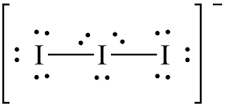
The number of bonding pairs electron $\text{(X)}$ and lone pairs electron $\text{(Y)}$ around the central atom in the $\text{I}_3^-$ion are $\text{X} + \text{Y}$ :
  • $22$
  • B
    $23$
  • C
    $32$
  • D
    $43$
Answer
Correct option: A.
$22$
The number of bonding pairs electron $(X) = 2 \times 2 = 4$
Total no. of lone pairs electron $Y = 3 \times 3 \times 2 = 18$
$X + Y = 4 + 18 = 22$​​​​​​​
View full question & answer
MCQ 151 Mark
Which of the following molecules represents resonance?
  • A
    $\ce{O_3}$
  • B
    $\text{CO}^{2-}_3$
  • C
    $\ce{CO_2}$
  • All of these.
Answer
Correct option: D.
All of these.
View full question & answer
MCQ 161 Mark
The number of electron bond pairs involved in the formation of hydrogen cyanide molecule are :
  • A
    Two
  • B
    Eight
  • C
    Three
  • Four
Answer
Correct option: D.
Four
$\ce{HCN}$ contains $4$ bonds $\ce{(1C − H}$ single bond and $1$ triple bond between $\ce{C}$ and $\ce{N})$. Thus, total bond pairs are $4.$
View full question & answer
MCQ 171 Mark
Amongst the following elements, whose electronic configurations are given below, the one having the highest ionization enthalpy is :
  • A
    $\ce{[Ne]3s^23p^1}$
  • B
    $\ce{[Ne]3s^23p^3}$
  • C
    $\ce{[Ne]3s^23p^2}$
  • $\ce{[Ar]3d^{10}4s^24p^3}$
Answer
Correct option: D.
$\ce{[Ar]3d^{10}4s^24p^3}$
Have exactly half filled $p-$ orbitals but $(b)$ is smaller in size than Hence, $(b)$ has highest ionization enthalpy.
View full question & answer
MCQ 181 Mark
The boiling point of a substance increases with increase in :
  • A
    Intermolecular hydrogen bonding.
  • B
    Intramolecular hydrogen bonding.
  • C
    Molecular mass.
  • Both $(a)$ and $(c).$
Answer
Correct option: D.
Both $(a)$ and $(c).$
View full question & answer
MCQ 191 Mark
Why do the deviations occur from idealized shape of $\ce{H_2O}$ and $\ce{NH_3}$ molecules?
  • A
    Same hybridisation.
  • Different hybridisation.
  • C
    Repulsive effect.
  • D
    None of these.
Answer
Correct option: B.
Different hybridisation.
Greater repulsion between lone pairs of electrons as compared to the lone pair $-$ bond pair and bond pair $-$ bond pair repulsions. These repulsive effects result in deviations from idealised shapes and alterations in bond angles in the molecules.
View full question & answer
MCQ 201 Mark
In a triple bond, there is sharing of :
  • A
    $3$ electrons
  • B
    $4$ electrons
  • $6$ electrons
  • D
    None of these
Answer
Correct option: C.
$6$ electrons
A triple bond is formed by sharing of $6$ electrons.
View full question & answer
MCQ 211 Mark
Select the correct statement about chemical bond.
  • A
    It is attraction between atoms
  • B
    It is caused by the electrostatic force of attraction.
  • C
    The strength of chemical bonds varies considerably.
  • All of the above
Answer
Correct option: D.
All of the above
A chemical bond is an attraction between atoms that allows the formation of chemical substances that contain two or more atoms.
The bond is caused by the electrostatic force of attraction between opposite charges, either between electrons and nuclei, or as the result of a dipole attraction.
View full question & answer
MCQ 221 Mark
The bond between $B$ and $C$ will be :
  • A
    Ionic
  • Covalent
  • C
    Hydrogen
  • D
    Coordinate
Answer
Correct option: B.
Covalent
Both $B$ and $C$ are non $-$ metals so, the bond formed between them will be covalent.
View full question & answer
MCQ 231 Mark
$\text{H}-\text{O}-\text{H}$ bond angle in water is :
  • $104.5^\circ$
  • B
    $109.5^\circ$
  • C
    $105.5^\circ$
  • D
    $108.5^\circ$
Answer
Correct option: A.
$104.5^\circ$
View full question & answer
MCQ 241 Mark
Sidgwick and Powell proposed the $\ce{VSEPR}$ theory which was further developed and refined by :
  • A
    Johann Dobereiner.
  • B
    Werner Heisenberg.
  • Nyholm and Gillespie.
  • D
    Neils Bohr.
Answer
Correct option: C.
Nyholm and Gillespie.
Nyholym and Gillespie further developed and refined the $\ce{VSEPR}$ theory.
View full question & answer
MCQ 251 Mark
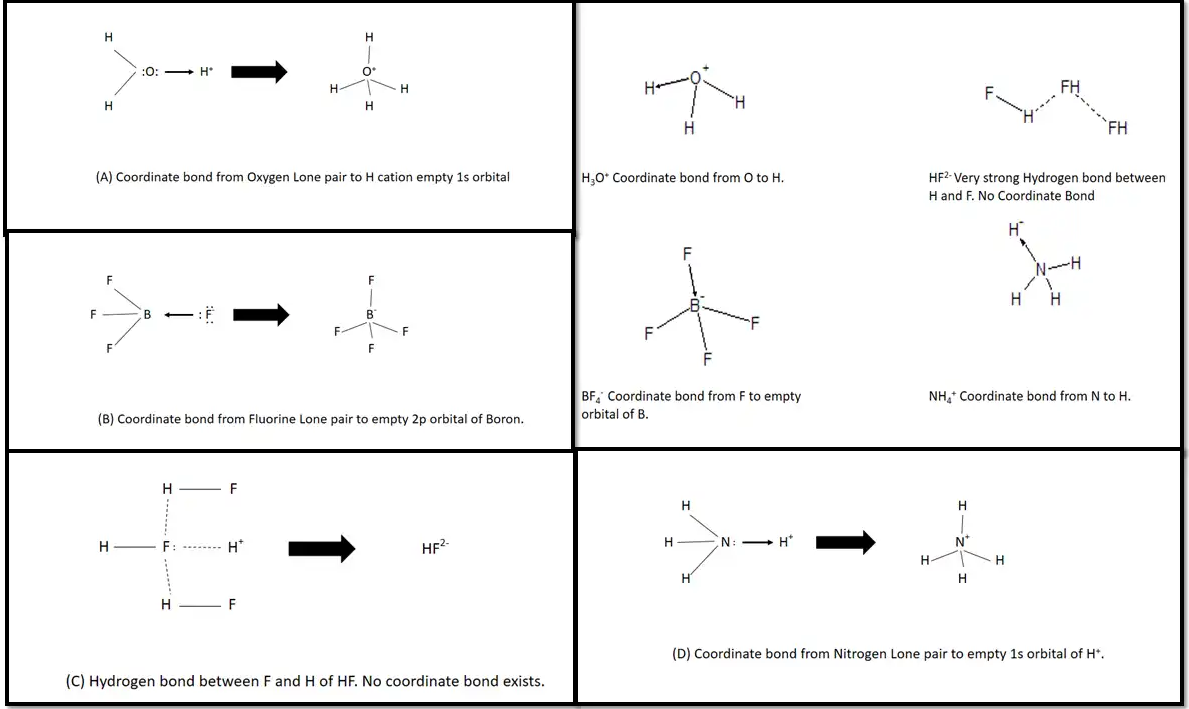
Which of the following does not contain any co $-$ ordinate bond?
  • A
    $\text{H}_3​\text{O}^+$
  • B
    $\text{BF}_4^−​$
  • ​$\text{HF}_2^−​$
  • D
    ​$\text{NH}_4^+​$
Answer
Correct option: C.
​$\text{HF}_2^−​$
In option $A,$ coordinate/dative bond is formed between lone pair of Oxygen atom and empty $s$ orbital of $H$ ion.
In option $B,$ Boron atom has empty $2p$ orbital after formation of $\ce{BF_3}$, so it can accept lone pair of fluorine atom $(F$ atom has $3$ lone pairs$)$ and form $\text{BF}_4^−​$
In option $C,$ there is no coordinate bonding but very strong Hydrogen bonding due to high electronegativity of Fluorine. $(C)$ is the correct answer.
In option $D,$ Nitrogen has one lone pair left after forming $3$ covalent bonds with hydrogen, it forms coordinate bond by sharing that lone pair with $H$ ion.
View full question & answer
MCQ 261 Mark
Decreasing order of stability :
  • A
    $\text{O}_2 > \text{O}^+_2 > \text{O}^{2-}_2 > \text{O}^-_2$
  • B
    $\text{O}_2^- > \text{O}^{2-}_2 > \text{O}_3^+ > \text{O}_2$
  • $\text{O}_2^+ > \text{O}_2>\text{O}^-_2 > \text{O}^{2-}_2$
  • D
    $\text{O}_2^{2-} > \text{O}^-_2 > \text{O}_2 > \text{O}_2^+$
Answer
Correct option: C.
$\text{O}_2^+ > \text{O}_2>\text{O}^-_2 > \text{O}^{2-}_2$
Greater the bond order, more will be stability.
View full question & answer
MCQ 271 Mark
Which of the following options represents the correct bond order?
  • A
    $\text{O}_{2} > \text{O}_{2} > \text{O}^{+}_{2}$
  • $\text{O}^{-}_{2} > \text{O}_{2} > \text{O}^{+}_{2}$
  • C
    $\text{O}_{2} > \text{O}_{2} < \text{O}_{2}$
  • D
    $\text{O}^{-}_{2} < \text{O}_{2} > \text{O}^{+}_{2}$
Answer
Correct option: B.
$\text{O}^{-}_{2} > \text{O}_{2} > \text{O}^{+}_{2}$
Bond order $,\text{O}^{2}=\frac{8-4}{2}=2.0$
Bond order $,\text{O}^{-}_{2}=\frac{8-5}{2}=1.5$
Bond order $,\text{O}^{+}_{2}=\frac{8-3}{2}=2.5$
View full question & answer
MCQ 281 Mark
The electronic configuration of the outermost shell of the most electronegative element is :
  • $\ce{2s^22p^5}$
  • B
    $\ce{3s^23p^5}$
  • C
    $\ce{4s^24p^5}$
  • D
    $\ce{5s^25p^5}$
Answer
Correct option: A.
$\ce{2s^22p^5}$
The electronic configuration represents.
$\ce{2s^22p^5} =$ fluorine $=$ most electronegative element.
$\ce{3s^23p^5} =$ chlorine.
$\ce{4s^24p^5} = $ bromine.
$\ce{5s^25p^5} =$ iodine.
View full question & answer
MCQ 291 Mark
What is the value of $\text{1D}$  in $\ce{SI}$ units?
  • $3.336 \times 10^{-30}\ cm$
  • B
    $33.36 \times 10^{-30}\ cm$
  • C
    $333.6 \times 10^{-30}\ cm$
  • D
    None of these
Answer
Correct option: A.
$3.336 \times 10^{-30}\ cm$
The debye is a $\ce{CGS}$ unit of electric dipole moment.
It is defined as $1\times 10^{-18}$ statcoulomb $-$ centimetre and $3.33564\times 10^{-30}\ cm.$
View full question & answer
MCQ 301 Mark
$\text{VSEPR}$ theory helps in predicting the shape of :
  • A
    Ionic molecules.
  • Covalent molecules.
  • C
    Noble gases.
  • D
    All of these.
Answer
Correct option: B.
Covalent molecules.
$\text{VSEPR}$ provides a simple procedure to predict the shapes of covalent molecules.
View full question & answer
MCQ 311 Mark
Which of the following species has tetrahedral geometry?
  • $\text{BH}_{4}^{-}$
  • B
    $\text{NH}_{2}^{-}$
  • C
    $\text{CO}_{3}^{2-}$
  • D
    $\text{H}_{3}\text{O}^{+}$
Answer
Correct option: A.
$\text{BH}_{4}^{-}$
$\text{BH}_{4}^{-}$ has a tetrahedral geometry.
Boron atom undergoes $\ce{sp^3}$ hybridisation.
The molecule has $4$ bond pairs and no lone pairs and so, $\text{VSEPR}$ type is $\ce{AB_4}$.
The geometry in both cases is tetrahedral.
View full question & answer
MCQ 321 Mark
Which of the following molecules all bonds not equal?
  • $\text{PCl}_5$
  • B
    $\text{SF}_6$
  • C
    $\text{BF}_3$
  • D
    $\text{AIF}_3$
Answer
Correct option: A.
$\text{PCl}_5$
$\because$ Three bonds are in horizontal plane at $120^\circ ,$ two are in vertical plane $90^\circ ,$ axial bonds are longer and weaker than equatorial bond.
View full question & answer
MCQ 331 Mark
Molecule which contains $4$ bonded pairs and $2$ lone pairs of electrons on the central atom is :
  • A
    $\ce{XeF_2}$
  • B
    $\ce{CO_2}$
  • $\ce{XeF_4}$
  • D
    $\ce{SF_6}$
Answer
Correct option: C.
$\ce{XeF_4}$
$\ce{Xe}$ is a noble gas. It has $8$ electrons in its valence shell.
Now, it is bonded to $\ce{4F}$ atoms.
So, $4$ of its electrons are involved in bonding.
Hence, bond pairs $= 4$. Remaining $4$ are unbonded electrons. So, lone pairs $= \frac{4}{2} = 2$.
Molecule which contains $4$ bonded pairs and $2$ lone pairs of electrons on the central atom is :
 
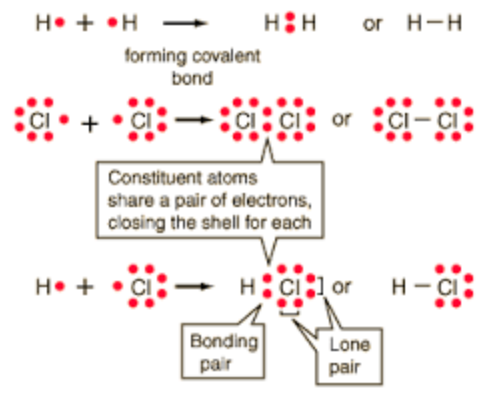
View full question & answer
MCQ 341 Mark
In which of the following molecule, the central atom has three lone pairs of electrons?
  • A
    Ammonia
  • Xenon difluoride
  • C
    Chlorine trifluoride
  • D
    Hydrogen sulphide
Answer
Correct option: B.
Xenon difluoride
Xenon difluoride is $\ce{XeF_2}. \ce{Xe}$​ is a noble gas.
So, it has $8$ electrons in the valence shell.
Out of which, $2$ are involved in formation of covalent bond with the $\ce{2F}$ atoms.
So, $6$ electrons are left as unbonded.
Therefore, lone pairs $=$ half of $6 = 3.$
View full question & answer
MCQ 351 Mark
In which of the following compounds, $H-$ bonding is strongest in the liquid phase?
  • $\ce{HF}$
  • B
    $\ce{CH_4}$​
  • C
    $\ce{HI}$
  • D
    $\ce{PH_3}$
Answer
Correct option: A.
$\ce{HF}$
As fluorine has small size and high electronegativity compared to others, it forms stronger $H-$ bonds.
View full question & answer
MCQ 361 Mark
Which of the following pair consist of only paramagnetic species?
  • $\text{O}_2,\text{NO}$
  • B
    $\text{O}^+_2,\text{O}^{2-}_2$
  • C
    $\text{CO},\text{NO}$
  • D
    $\text{O}^{2-}_2,\text{N}^-_2$
Answer
Correct option: A.
$\text{O}_2,\text{NO}$
Both are paramagnetic due to presence of unpaired electrons.
View full question & answer
MCQ 371 Mark
When a chemical bond is formed, there is decrease in :
  • A
    Kinetic energy
  • Potential energy
  • C
    Repulsive force
  • D
    Attractive force
Answer
Correct option: B.
Potential energy
When chemical bond is formed, the potential energy decreases.
The distance between two atoms at which the potential energy is minimum is known as bond length.
View full question & answer
MCQ 381 Mark
The number of electron pairs in $\ce{XeF_4}$ at the corners of the square are $ .........$
  • A
    $2$
  • B
    $3$
  • $4$
  • D
    $6$
Answer
Correct option: C.
$4$
From its structure it can be seen that, number of electron pairs in $\ce{XeF_4}$​ at the corners of the square are four The number of electron pairs in $\ce{XeF4}$ at the corners of the square are .
View full question & answer
MCQ 391 Mark
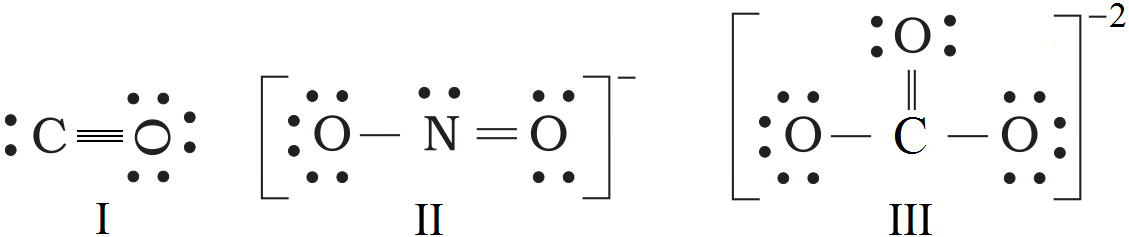
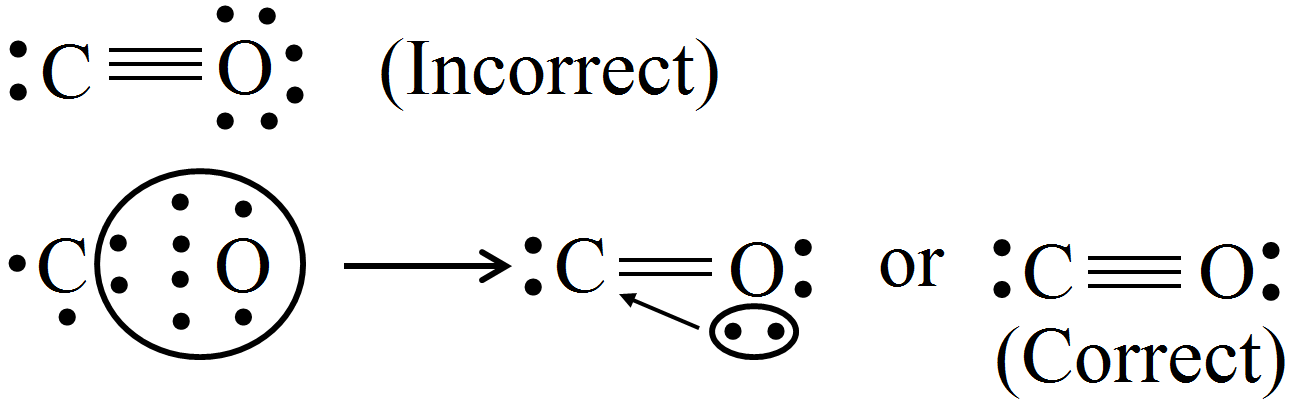
Lewis dot structure of $\ce{CO_2} \text{NO}_2^-$ and $\text{CO}^{2-}_3$ are $\ce{I, II}$ and $\ce{III}$ respectively : Which of the above structure $(s)$ is/ are wrong?
  • Only $\ce{I}$
  • B
    Only $\ce{II}$
  • C
    Only $\ce{III}$
  • D
    All of these.
Answer
Correct option: A.
Only $\ce{I}$
$\ce{I}$ may be correctly represented as :
View full question & answer
MCQ 401 Mark
Molecule which contains only bonded pairs of electrons on the central atom is :
  • A
    $\ce{H_2​O}$
  • B
    $\ce{NH_3}$
  • $\ce{BeCl_2}$
  • D
    $\ce{BF_3}$
Answer
Correct option: C.
$\ce{BeCl_2}$
Be has $2$ electrons in the valence shell $($it belongs to group $2$ of the periodic table$).$
Now both the electrons are involved in bond formation with both the $\ce{Cl}$ atoms. It comprises only bonded pair of electrons.
So, there are no lone pairs in the $\ce{Be}$ atom.
View full question & answer
MCQ 411 Mark
$\ce{N_2}$​ molecule contains $ ........ o$ and $ .........\pi^-$ bonds.
  • A
    One, four
  • B
    Three, two
  • One, two
  • D
    None
Answer
Correct option: C.
One, two
Sigma bond always between $\ce{S-S}$ and $\ce{Px-Px}$ overlap.
While $\pi$ bond is formed between $\ce{Py-Py}$ and $\ce{Pz-Pz}$ overlap.
So according to above diagram it is clear that there two pi bonds and one sigma bond in $\ce{N_2}$.
View full question & answer
MCQ 421 Mark
In which of the following substances will hydrogen bond be strongest?
  • A
    $\ce{HCl}$
  • $\ce{H_2O}$
  • C
    $\ce{HI}$
  • D
    $\ce{H_2S}$
Answer
Correct option: B.
$\ce{H_2O}$
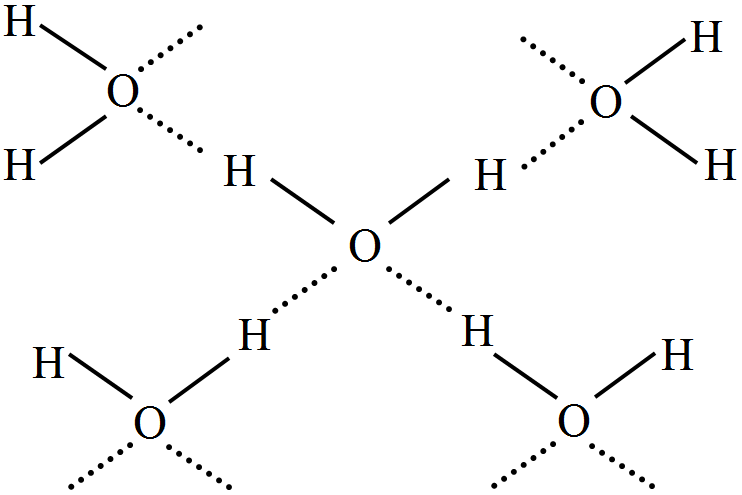
$\ce{HCl, HI}$ and $\ce{H_2S}$ do not from $H-$ bonds. Only $\ce{H_2O}$ forms hydrogen bonds. One $\ce{H_O}$ molecule forms four $H-$ bonds.
View full question & answer
MCQ 431 Mark
$\ce{Cl + Cl \rightarrow Cl_2}​,$ this is an example for $ ..........$
  • A
    Endothermic reaction
  • Exothermic reaction
  • C
    Either exothermic or endothermic
  • D
    Neither exothermic nor endothermic
Answer
Correct option: B.
Exothermic reaction
$\ce{Cl^. + Cl^. \rightarrow Cl : Cl}$
As two Chlorine atoms come together their electrostatic energy decreases.
According to the law of conservation of energy, this energy will be transformed into heat energy.
So, $\ce{Cl + Cl \rightarrow Cl_2}$​ is exothermic reaction.
View full question & answer
MCQ 441 Mark
The types of hybrid orbitals of nitrogen in $\ce{NO_2, NO_3}$ and $\ce{NH_4}$ respectively are expected to be :
  • A
    $sp , sp ^3$ and $sp ^2$
  • $sp , sp ^2$ and $sp ^3$
  • C
    $sp ^2, sp$ and $sp ^3$
  • D
    $sp ^2, sp ^3$ and $sp ^3$
Answer
Correct option: B.
$sp , sp ^2$ and $sp ^3$
The number of orbitals involved in hybridization can be determined by the application of formula :
$\text{H}=\frac{1}{2}\big[\text{V}+\text{M}-\text{C}+\text{A}\big]$
where $H =$ number of orbitals involved in hybridization.
$V =$ valence electrons of central atom.
$M =$ number of monovalent atoms linked with central atom.
$C =$ charge on the cation.
$A =$ charge on the anion.
View full question & answer
MCQ 451 Mark
The molecular orbitals like atomic orbitals are filled in accordance with the :
  • A
    Aufbau principle.
  • B
    Pauli's exclusion principle.
  • C
    Hund's rule.
  • All of the above.
Answer
Correct option: D.
All of the above.
The molecular orbitals like atomic orbitals are filled in accordance with the Aufbau principle, Pauli's exclusion principle and Hund's rule.
View full question & answer
MCQ 461 Mark
When two atomic orbitals combine, they form :
  • A
    One molecular orbital
  • Two molecular orbitals
  • C
    Three molecular orbitals
  • D
    Four molecular orbitals
Answer
Correct option: B.
Two molecular orbitals
Equal number of atomic orbitals combine to give equal number of molecular orbitals.
So, two atomic orbitals combine to give two molecular orbitals.
View full question & answer
MCQ 471 Mark
In the number of bond pairs and lone pairs of electrons on nitrogen atom are :
  • A
    $2, 2$
  • B
    $3, 1$
  • C
    $1, 3$
  • $4, 0$
Answer
Correct option: D.
$4, 0$
In $N-$ atom, number of valence electrons $= 5$.
Due to the presence of one negative charge, number of valence electrons $= 5 + 1 = 6.$
One atom forms two bonds $(=$ bond$)$ and two atom are shared with two electrons of $N-$ atom.
Thus, $3$ atoms are shared with $8$ electrons of $N-$ atom.
Number of bond pairs $($or shared pairs$) = 4.$
Number of lone pairs $= 0.$
View full question & answer
MCQ 481 Mark
The shape of $\ce{ClF_3}$ molecule is :
  • $T-$ shape.
  • B
    Trigonal planar.
  • C
    Bent shape.
  • D
    None of these.
Answer
Correct option: A.
$T-$ shape.
View full question & answer
MCQ 491 Mark
Which theory can be best understood by considering the formation of the chlorine molecule, $\ce{Cl_2}\ ?$
  • A
    Lewis theory.
  • B
    Langmuir theory.
  • Lewis $-$ Langmuir theory.
  • D
    Kossel $-$ Lewis theory.
Answer
Correct option: C.
Lewis $-$ Langmuir theory.
View full question & answer
MCQ 501 Mark
In which of the following molecule/ ion all the bonds are not equal?
  • A
    $\ce{XeF _4}$
  • B
    $\ce{BF^{-}{ }_4}$
  • $\ce{C_2 H_4}$
  • D
    $\ce{SiF_4}$
Answer
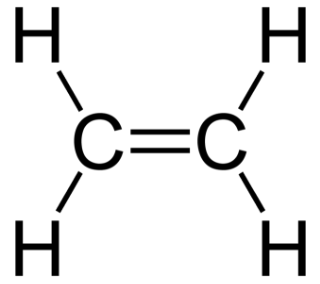
Correct option: C.
$\ce{C_2 H_4}$
Each atom is surrounded by,
View full question & answer