Questions · Page 2 of 2

1 Marks Question

Question 511 Mark
What is the nature of $\mathrm{H}_2 \mathrm{O}_2$? Give chemical reaction to show its nature.
Answer
$\mathrm{H}_2 \mathrm{O}_2$ is acidic in nature.
$\text{H}_2\text{O}_2+2\text{NaOH}\xrightarrow{\ \ \ \ }\text{Na}_2\text{O}_2+2\text{H}_2\text{O}$
View full question & answer
Question 521 Mark
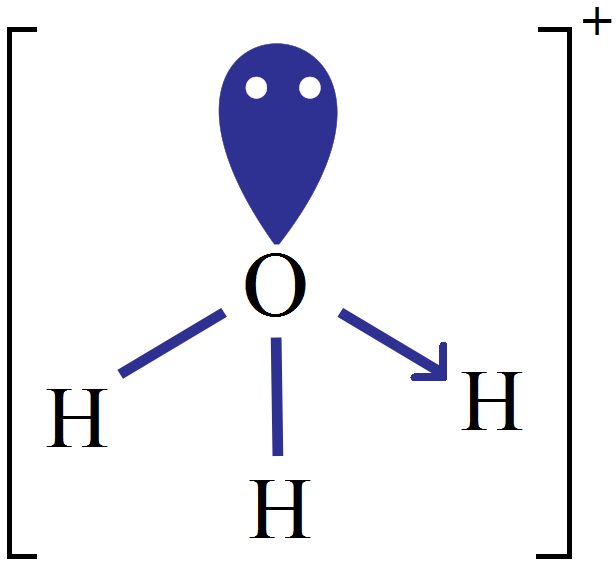
What is the hybrid orbital of oxygen atom and shape of $\mathrm{H}_3 \mathrm{O}$ ?
Answer

$\mathrm{Sp}^3$, Pyramidal shape There is coordinate bond in which lone pair of oxygen is shared by $\mathrm{H}^{+}$ion. It is denoted by $\rightarrow$.
View full question & answer
Question 531 Mark
In reaction of $\mathrm{F}_2$ and $\mathrm{H}_2 \mathrm{O}$, what is the role of water?
Answer
$2\text{F}_2+2\text{H}_2\text{O}\xrightarrow{\ \ \ \ }4\text{H}^++4\text{F}^-+\text{O}_2.$
Water is acting as reducing agent because $\mathrm{F}_2$ is best oxidising agent.
View full question & answer
Question 541 Mark
What is the molar mass of heavy water?
Answer
Molar mass of heavy water is $20\text{g}{~mol}^{-1}$,
$[\because\text{D}_2\text{O}=2\text{D}+10\\=2\times2+1\times16=4+16=20]$
View full question & answer
Question 551 Mark
Name the isotope of hydrogen which is commonly used as a tracer in organic reactions.
Answer
Most commonly deuterium is used as tracers in organic reactions. (Tritium can be used as tracers but it is radioactive in nature and least abundant hydrogen isotope, therefore deuterium is commonly used).
View full question & answer
Question 561 Mark
What do you mean by 15 volume $\mathrm{H}_2 \mathrm{O}_2$ solution?
Answer
15 volume $\mathrm{H}_2 \mathrm{O}_2$' means 1ml of a 15 volume $\mathrm{H}_2 \mathrm{O}_2$​​​​​​​ solution gives 15ml of $\mathrm{O}_2$ at NTP.
View full question & answer
Question 571 Mark
  1. Name the constituents of water gas.
  2. Which gaseous compound on treatment with dihydrogen produces methanol?
  3. Name one industrial method for the preparation of dihydrogen.
Answer
  1. Carbon monoxide and hydrogen.
  2. Carbon monoxide.
  3. Bosch process.
View full question & answer
Question 581 Mark
Acetanilide prevents the decomposition of $\mathrm{H}_2 \mathrm{O}_2$. What is this compound called?
Answer
Acetanilide is a neutral compound which suppresses the decomposition of $\mathrm{H}_2 \mathrm{O}_2$ into $\mathrm{H}_2 \mathrm{O}$ and $\mathrm{O}_2$. Thus, it is called stabiliser (or negative catalyst).
View full question & answer
Question 591 Mark
Give reasons:
Ice floats on water.
Answer
Density of ice is less than water due to presence of empty spaces created because of H-bonding between $\text{H}_2\text{O}$ molecules. Hence, ice floats on water.
View full question & answer
Question 601 Mark
When sodium hydride is electrolysed, hydrogen is liberated at which electrode?
Answer
$\text{NaH}\xrightarrow{\text{electrolysis}\ \ }\text{Na}^++\text{H}^-,$
At anode: $\text{2}\text{H}^--2\text{e}^-\xrightarrow{\ \ \ \ }\text{H}_2(\text{g})$ [Loss electrons, oxidation]
View full question & answer
Question 611 Mark
Name the compound each in which hydrogen exists in :
  1. negative oxidation state.
  2. positive oxidation state.
Answer
  1. Nah, here oxidation state of hydrogen is $- 1.$
  2. $\text{HCI}$, here oxidation state of hydrogen is $+1.$
View full question & answer
Question 621 Mark
Why is water molecules polar?
Answer
It is bent molecule, has high dipole moment due to difference in electronegativity of 'H' and oxygen, it is polar molecule.
View full question & answer
Question 631 Mark
What happens when $\mathrm{O}_3$, is passed through $\mathrm{H}_2 \mathrm{O}_2$? $\mathrm{H}_2 \mathrm{O}_2$ is oxidising or reducing agent in the reaction.
Answer
$\mathrm{H}_2 \mathrm{O}$ and $\mathrm{O}_2$ is formed. $\mathrm{H}_2 \mathrm{O}_2$ acts as reducing agent.
$\text{H}_2\text{O}_2+\text{O}_3\xrightarrow{\ \ \ \ \ \ \ \ \ \ } \text{H}_2\text{O}+2\text{O}_2$
View full question & answer
Question 641 Mark
Suggest a method to show the electronegative nature of hydrogen.
Answer
When sodium hydride is electrolysed, hydrogen is evolved at anode, which shows its electronegative nature.
View full question & answer
Question 651 Mark
Describe the bulk preparation of hydrogen by electrolytic method. What is the role of an electrolyte in this process?
Answer
Electrolysis of acidified water using platinum electrodes gives hydrogen.
$2\text{H}_2\text{O}(\text{l})\xrightarrow[\text{Traces of acide/ base}]{\text{Electrolysis}}2\text{H}_2(\text{g})+\text{O}_2(\text{g})$
Here, the role of an electrolyte is to make water conducting.
View full question & answer
Question 661 Mark
Which gas is evolved when $\mathrm{Mg}_3 \mathrm{N}_2$ (magnesium nitride) is treated with $\mathrm{H}_2 \mathrm{O}$ ? Give chemical reaction.
Answer
$\text{NH}_3$ gas is evolved.
$\text{Mg}_3\text{N}_2+6\text{H}_2\text{O}\xrightarrow{\ \ \ \ }3\text{Mg}(\text{OH})_2+2\text{NH}_2$
View full question & answer
Question 671 Mark
Name one metal which liberates $\text{H}_2$ when treated with NaOH.
Answer
Al (Aluminium) and Be (Beryllium)
$2\text{Al}+2\text{NaOH}+2\text{H}_2\text{O}\xrightarrow{\ \ \ \ }2\text{NaAlO}_2+\text{H}_2$
$\text{Be}+\text{2NaOH}\xrightarrow{\ \ \ \ \ \ \ \ \ \ \ \ }\text{Na}_2\text{BeO}_2+\text{H}_2$
View full question & answer
Question 681 Mark
What is the trade name of sodium hexa metaphosphate? Give its use.
Answer
Calgon. It is used to remove hardness of water.
View full question & answer
Question 691 Mark
Dihydrogen forms interstitial hydrides with which type of elements?
Answer
Transition metals form interstitial hydrides due to presence of voids in which hydrogen can fit into.
View full question & answer
Question 701 Mark
Why does chlorine water loses its colour if kept for long time?
Answer
$\text{Cl}_2+\text{H}_2\text{O}\xrightarrow{\ \ \ \ }\text{HCl}+\text{HOCl}$
$\text{HOCl}\xrightarrow{\ \ \ \ }\text{HCl}+[\text{O}]$
HCl is colourless, therefore, chlorine water loses its colour.
View full question & answer
Question 711 Mark
What type of bonds are broken when water evaporates.
Answer
Intermolecular hydrogen bonds are broken when water evaporates.
View full question & answer
Question 721 Mark
Explain why beryllium forms a covalent hydride while calcium forms an ionic hydride.
Answer
Because of higher electronegativity, Be (EN = 1.5) forms a covalent hydride while due to lower electronegativity Ca (EN = 1.0 ) forms an ionic hydride.
View full question & answer
Question 731 Mark
Write redox reaction between fluorine and water.
Answer
$2\text{F}_2(\text{g})+2\text{H}_2\text{O}\xrightarrow{\ \ \ \ }4\text{H}^+(\text{aq})+4\text{F}^-(\text{aq})+\text{O}_2(\text{g})$
View full question & answer
Question 741 Mark
Which out of nascent hydrogen and dihydrogen, is more reactive?
Answer
Nascent hydrogen (newly born hydrogen) [H] is more reactive
than molecular hydrogen because energy is needed to break bond in $\text{H}_2$.
View full question & answer
Question 751 Mark
Why does elemental hydrogen react with other substances slowly at room temperature?
Answer
It is because it has high bond dissociation energy $\left(436 \mathrm{~kJ} \mathrm{~mol}^{-1}\right)$ due to smaller bond length.
View full question & answer
Question 761 Mark
How does heavy water react with $\text{Al}_4\text{C}_3$?
Answer
$\text{Al}_4\text{C}_3+12\text{D}_2\text{O}\xrightarrow{\ \ \ \ }4\text{Al}(\text{OD})_3+3\text{CD}_4$
View full question & answer
Question 771 Mark
How does $\text{CaC}_2$ react with heavy water?
Answer
$\text{CaC}_2+2\text{D}_2\text{O}\xrightarrow{\ \ \ \ \ }\text{Ca}(\text{OD})_2+\text{C}_2\text{D}_2$
View full question & answer
Question 781 Mark
Complete the following reaction.
$\text{CO}(\text{g})+2\text{H}_2()\text{g}\xrightarrow[\text{CAtalyst}]{\text{Cobalt}}$
Answer
$\text{CO}(\text{g})+2\text{H}_2(\text{g})\xrightarrow[\text{Cataiyst}]{\text{Cobalt}}\text{CH}_3\text{OH}_2(\text{l})$
View full question & answer
Question 801 Mark
S. No.
Column I
S. No.
Column II
a.
Synthesis gas
i.
$Na_2[Na_4(PO_3)_6]$
b.
Dihydrogen
ii.
Oxidising agent
c.
Heavy water
iii.
Softening of water
d.
Calgon
iv.
Reducing agent
e.
Hydrogen peroxide
v.
Stoichiometric compounds of s-block elements
f.
Salt like hydrides
vi.
Prolonged electrolysis of water
 
 
vii.
$Zn + NaOH$
 
 
viii.
$Zn + dil. H_2SO_4$
 
 
ix.
Synthesis of methanol
 
 
x.
Mixture of CO and $H_2$
Answer
S. No.
Column I
S. No.
Column II
a.
Synthesis gas
(ix)
Synthesis of methanol
(x)
Mixture of CO and $H_2$
b.
Dihydrogen
(iv)
Reducing agent
(v)
Stoichiometric compounds of s-block elements
(vii)
$Zn + NaOH$
(viii)
Zn + dil. $H_2SO_4​​​​​​​$
(ix)
Synthesis of methanol
c.
Heavy water
(vi)
Prolonged electrolysis of water
d.
Calgon
(i)
$Na_2[Na_4(PO_3)_6]$
(iii)
Softening of water
e.
Hydrogen peroxide
(ii)
Oxidising agent
(iv)
Reducing agent
f.
Salt like hydrides
(v)
Stoichiometric compounds of s-block elements
View full question & answer
Question 811 Mark
Give an example of reaction in which $\text{H}_2$ acts as oxidising agent.
Answer
$2\text{Na}+\text{H}_2\xrightarrow{\ \ \ \ }2\text{NaH}$ (sodium hydride)
In this reaction, $\text{H}_2$ acts as oxidising agent because it can gain electron to form $\text{H}^-$ ion.
View full question & answer
Question 821 Mark
Classify the following as covalent, ionic or interstitial hydrides.
$\mathrm{CaH}_2, \mathrm{LaH}_2, \mathrm{RbH}, \mathrm{GeH}_2, \mathrm{TiH}_2, \mathrm{NaH}, \mathrm{NH}_3$.
Answer
Covalent hydrides $\mathrm{GeH}_2, \mathrm{NH}_3$.
Ionic hydrides $\mathrm{CaH}_2, \mathrm{RbH}, \mathrm{NaH}$.
Interstitial hydrides $\mathrm{TiH}_2, \mathrm{LaH}_2$.
View full question & answer
Question 831 Mark
Why is dihydrogen not preferred in balloons these days?
Answer
Dihydrogen is highly combustible and hence, is likely to catch fire in the presence of excess of air. That's why it is not preferred in balloons now a days.
View full question & answer
Question 841 Mark
Sodium forms a crystalline ionic solid with dihydrogen. The solid is non-volatile and non-conducting in nature. It reacts violently with water to produce dihydrogen gas. Write the formula of this compound and its reaction with water. What will happen on electrolysis of the melt of this solid?
Answer
The compound is NaH (sodium hydride)
$2\text{Na}+\text{H}_2\xrightarrow{\ \ \ \ \ \ \ \ \ }2\text{NaH} $
$\text{NaH}+\text{H}_2\text{O}\xrightarrow{\ \ \ \ \ \ \ \ }\text{NaOH}+\text{H}_2\text{(g)}$
When molten sodium hydride is electrolysed, Na will be formed at cathode and dihydrogen will be liberated at anode.
$2\text{NaH}\xrightarrow{\text{electrolysis}}2\text{Na}\ \ \ +\ \ \ \ \ \text{H}_2(\text{g})\\ \ \ \ \ \ \ \ \ \ \ \ \ \ \ \ \ \ \ \ \ \ \ \ \ \ ^\text{At cathode}\ \ \ \ \ \ \ \ \ ^\text{At anode}$
View full question & answer
1 Marks Question - Page 2 - Chemistry STD 11 Science Questions - Vidyadip