Questions · Page 2 of 4

M.C.Q (1 Marks)

MCQ 511 Mark
The presence of carbon in an organic compound is detected by heating it with :
  • A
    Sodium metal to convert it to $\text{NaCN}.$
  • B
    $\text{CaO}$ to convert it into $\text{CO}$ which burns with a blue flame.
  • $\text{CuO}$ to convert it into $\mathrm{CO}_2$ which turns lime water milky.
  • D
    $\text{Cu}$ wire to give a bluish $-$ green flame.
Answer
Correct option: C.
$\text{CuO}$ to convert it into $\mathrm{CO}_2$ which turns lime water milky.
The given organic compound is mixed with dry copper oxide $\text{(CuO)}$ and heated in a hard glass tube. The products of the reaction are passed over $($white$)$ anhydrous copper sulphate and then bubbled through lime water.
If copper sulphate turns blue due to the formation of $\mathrm{CuSO}_4 \cdot 5 \mathrm{H}_2 \mathrm{O}$
$($by water vapor$)$ then the compound contains hydrogen. If lime water is turned milky by $\mathrm{CO}_2$, then the compound contains carbon.
View full question & answer
MCQ 521 Mark
The order of $-I$ effect of orbitals is :
  • A
    $ s p^3 > s p^2 > s p $
  • $ s p > s p^2 > s p^3 $
  • C
    $ s p^2 > s p^3 > s p $
  • D
    $ s p^2 > s p > s p^3 $
Answer
Correct option: B.
$ s p > s p^2 > s p^3 $
As $\%s$ character increases, electronegativity of orbitals increases which means its tendency to pull electron towards itself also increases hence $-I$ effect increases.
View full question & answer
MCQ 531 Mark
Linear combination of two hybridised orbitals belonging to two atoms and each having one electron leads to the formation of :
  • Sigma bond
  • B
    Double bond
  • C
    Co $-$ ordinate covalent bond
  • D
    pi bond
Answer
Correct option: A.
Sigma bond
A sigma bond is a single bond formed by linear combination of hybridised orbitals.
View full question & answer
MCQ 541 Mark
Calculate the amount of $\text{NaOH}$ required to neutralise $\text{100 mL 0.1M} \ \  \mathrm{H}_2 \mathrm{SO}_4$ :
  • $0.8$
  • B
    $0.5$
  • C
    $0.6$
  • D
    $0.7$
Answer
Correct option: A.
$0.8$
View full question & answer
MCQ 551 Mark
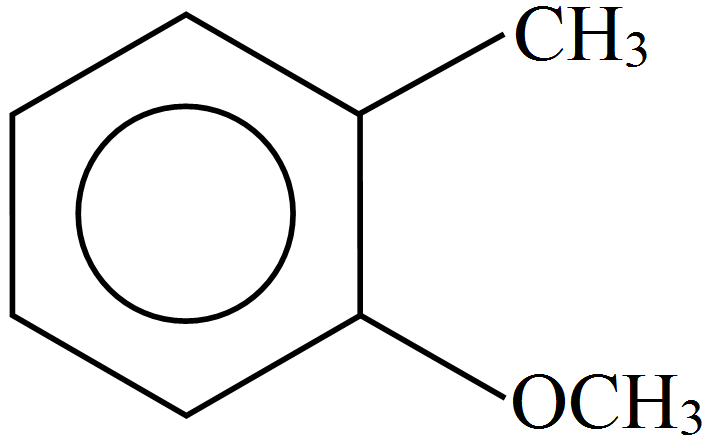
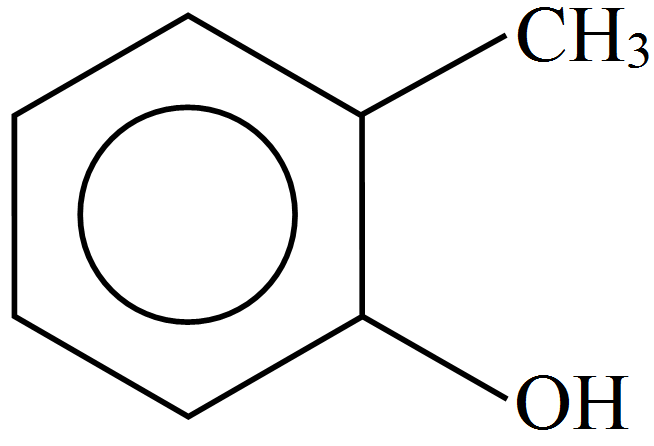
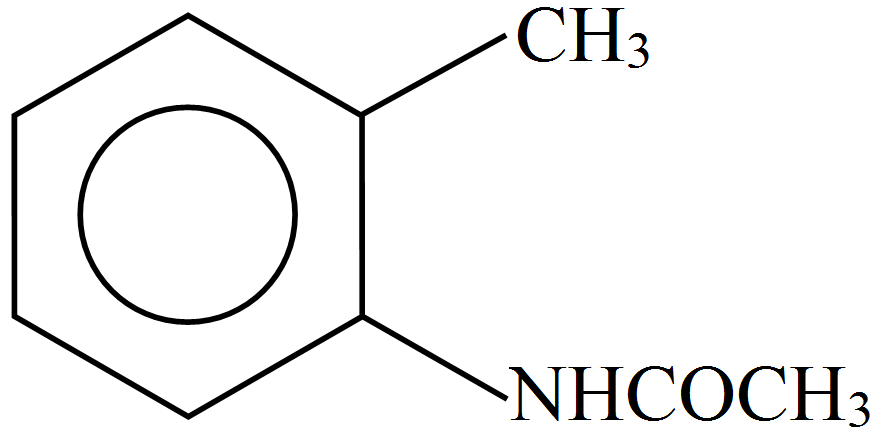
Which of the following is the most reactive towards electrophilic reagent?
  • A
  • B
  • D
Answer
Correct option: C.
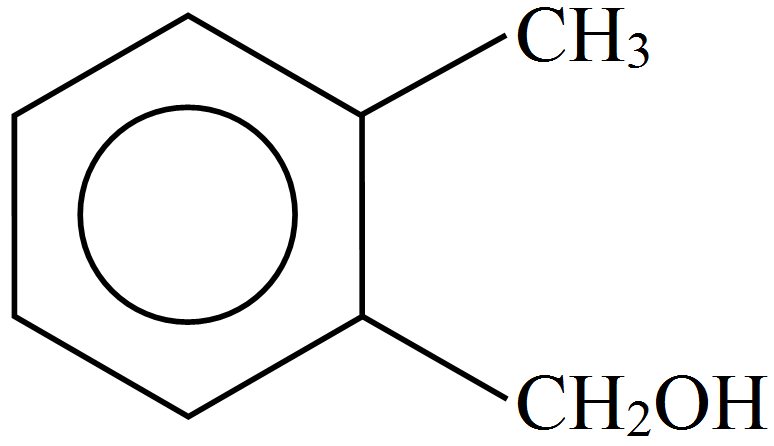
$+R-$ effect of $\mathrm{OH} > -\mathrm{CH}_3$
Hence $, 2-$ methyl phenol is more reattive towards electrophilic reagent.
View full question & answer
MCQ 561 Mark
Correct IUPAC name for $\text{H}_3\text{C}-\text{CH}-\text{CH}-\text{CH}_3\\\ \ \ \ \ \ \ \ \ \ \ \ \ \ | \ \ \ \ \ \ \ \ \ |\\\ \ \ \ \ \ \ \ \ \ \ \ \ \text{C}_2\text{H}_5\ \text{C}_2\text{H}_5$ ___________.
  • A
    2- Ethyl-3-methylpentane.
  • B
    3, 4- Dimethylhexane.
  • C
    2-Sec-butylbutane.
  • 2, 3-Dimethylbutane.
Answer
Correct option: D.
2, 3-Dimethylbutane.
View full question & answer
MCQ 571 Mark
Among the following which has greatest $-I$ effect?
  • A
    $−\text{OH}$
  • B
    $ -\mathrm{NH}_2$
  • $ -\mathrm{NO}_2 $
  • D
    $ -\mathrm{F} $
Answer
Correct option: C.
$ -\mathrm{NO}_2 $
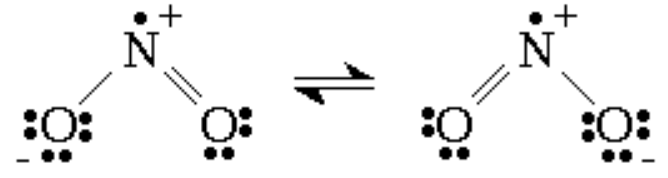
$ -\mathrm{NO}_2 $ is the strongest $-I $ group among all the neutral group because of the presence of $+$ charge on $N$ atom as shown in structure.
View full question & answer
MCQ 581 Mark
Marsh gas is :
  • A
    $ \mathrm{C}_6 \mathrm{H}_6 $
  • $ \mathrm{CH}_4 $
  • C
    $ \mathrm{C}_2 \mathrm{H}_2 $
  • D
    $ \mathrm{CO} $
Answer
Correct option: B.
$ \mathrm{CH}_4 $
Marsh gas is methane, $ \mathrm{CH}_4 $.
It is called so because it is often obtained from marshy places.
View full question & answer
MCQ 591 Mark
The first three members of a homologous series are $\mathrm{CH}_4, \mathrm{C}_2 \mathrm{H}_6, \mathrm{C}_3 \mathrm{H}_8$. The fifth member of this series will be :
  • A
    $\mathrm{C}_5 \mathrm{H}_{10}$
  • B
    $\mathrm{C}_5 \mathrm{H}_{14}$
  • $\mathrm{C}_5 \mathrm{H}_{12}$
  • D
    $\mathrm{C}_5 \mathrm{H}_8$​
Answer
Correct option: C.
$\mathrm{C}_5 \mathrm{H}_{12}$
General formula of homologous series is $\mathrm{C}_n \mathrm{H}_\text{2 n+2}$.
First member is methane i.e. $\mathrm{CH}_4$
Second member is ethane i.e. $\mathrm{C}_2 \mathrm{H}_6$
Third member is propane i.e. $\mathrm{C}_3 \mathrm{H}_8$
Forth member is butane i.e. $\mathrm{C}_4 \mathrm{H}_{10}$
Similarly, fifth member is pentane i.e
View full question & answer
MCQ 601 Mark
What is a homologation reaction?
  • A
    Conversion of one member of a homologous series to the other compounds.
  • B
    Breakdown of compounds in a homologous series.
  • Conversion of one member of a homologous series to the next member of homologous series.
  • D
    None of above
Answer
Correct option: C.
Conversion of one member of a homologous series to the next member of homologous series.
A homologation reaction is a chemical process that converts one member of a homologous series to the next member of the homologous series.
View full question & answer
MCQ 611 Mark
The following compounds show :
  • A
    Configuration isomerism.
  • B
    Conformationat isomerism.
  • Structural isomerism.
  • D
    Stereo isomerism.
Answer
Correct option: C.
Structural isomerism.
View full question & answer
MCQ 621 Mark
Compounds belonging to a homologous series have the same :
  • A
    Number of carbon atoms
  • Functional group
  • C
    Number of hydrogen atoms
  • D
    None of above
Answer
Correct option: B.
Functional group
Compounds within a homologous series typically have a fixed set of functional groups that gives them similar chemical and physical properties.
View full question & answer
MCQ 631 Mark
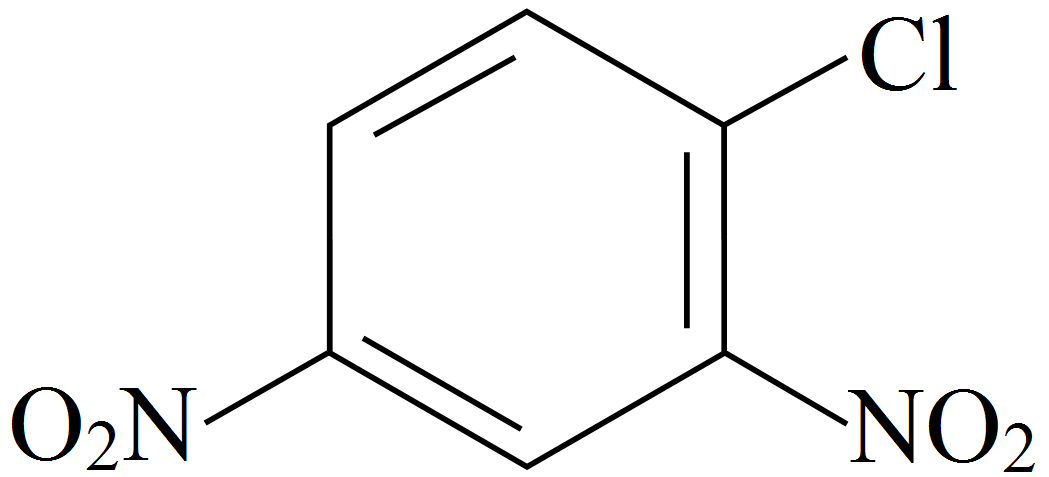
Write the correct $\text{IUPAC}$ name of the following.
  • $1-$ chloro $-2, 4-$ dinitrobenzene.
  • B
    $6-$ chloro $-1, 3-$ dinitrobenzene.
  • C
    $1-$ chloro $-4, 6-$ dinitrobenzene.
  • D
    $2-$ chloro $-1, 5-$ dinitrobenzene.
Answer
Correct option: A.
$1-$ chloro $-2, 4-$ dinitrobenzene.
View full question & answer
MCQ 641 Mark
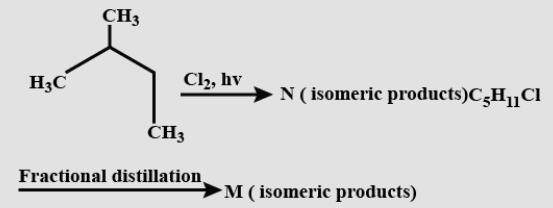
What are the values of $N$ and $M\ ?$
  • A
    $6, 6$
  • B
    $6, 4$
  • $4, 4$
  • D
    $3, 3$
Answer
Correct option: C.
$4, 4$
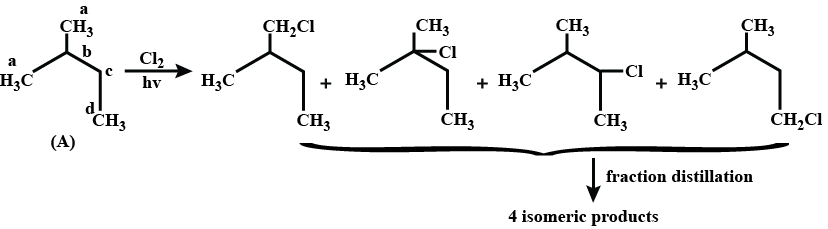
Since $A$ has four different types of $H$ atoms, so it on chlorinatives gives $4$ isomeric products.
Again as four products are chemically different, on fractional distillation they give $4$ isomeric products.
So $N = 4$ and $M = 4.$​​​​​​​​​​​​​​
View full question & answer
MCQ 651 Mark
During hearing of a court case, the judge suspected that some changes in the documents had been carried out. He asked the forensic department to check the ink used at two different places. According to you which technique can give the best results?
  • A
    Column chromatography.
  • B
    Solvent extraction.
  • C
    Distillation.
  • Thin layer chromatography.
Answer
Correct option: D.
Thin layer chromatography.
Thin layer Chomatography $\text{(TLC)}$ : itis a method for analyzing mixtures by separating the components of the mixture. $\text{TLC}$ can be used to determune the number of components in the mixture, the identity of compounds and the purity of compounds by observing the apperance of a product or the disppearance of areactant. it can also be used to monitor the progress of a reaction. $\text{TLC}$ is a sensitive technique $-$ microgram $(0.000001)g$ quantities can be analyzwd by $\text{TLC},$
View full question & answer
MCQ 661 Mark
Amongst the following elements present in an organic compound, the one which has no direct test for detection is :
  • A
    $\text{Cl}$
  • B
    $\text{N}$
  • C
    $\text{S}$
  • $\text{O}$
Answer
Correct option: D.
$\text{O}$
There is no test that can directly indicate the presence of oxygen in an organic compound. The presence of oxygen is indicated indirectly by the presence of groups containing oxygen.
View full question & answer
MCQ 671 Mark
The correct order of electronegativity of carbon in ethane, ethene and ethyne is :
  • Ethane ethene $ < $ ethyne.
  • B
    Ethyne $ < $ ethene $ < $ ethane.
  • C
    Ethene $ < $ ethyne $ < $ ethane.
  • D
    Ethene
Answer
Correct option: A.
Ethane ethene $ < $ ethyne.
As we know that, electronegativity $\propto \% S-$ character $\propto$acidic character Hence, correct order is, ethane $ < $ ethene $ < $ ethyne.
Hydrocarbons
Molecular formula
$\% S-$Character
Ethane
$\ce{CH_3-CH_3}$
$25\%$
Ethene
$\ce{CH_2 = CH_2}$
$33\%$
Ethyne
$\text{CH}\equiv\text{CH}$
$50\%$
View full question & answer
MCQ 681 Mark
Which of the following ion is most resonance stabilized?
  • A
    $\text{C}_2\text{H}_5\text{O}^\ominus$
  • $\text{C}_6\text{H}_5\text{O}^\ominus$
  • C
    $(\text{CH}_3)_3\text{CO}^\ominus$
  • D
    $(\text{CH}_3)_2\text{CHO}^\ominus$
Answer
Correct option: B.
$\text{C}_6\text{H}_5\text{O}^\ominus$
Phenoxide is stabilized by resonance.
View full question & answer
MCQ 691 Mark
Formation of which of the following complex indicates presence of sulphur in the organic compound when sodium nitroprusside is added to sodium extract of the compound?
  • A
    $\text{Fe}_{4}[\text{Fe}(\text{CN})_{6}]_{3}$
  • B
    $\text{Na}_{2} [\text{Fe}(\text{NO})(\text{CN})_{5}]$
  • C
    $\text{Fe}(\text{CNS)}$
  • $\text{Na}_{4} [\text{Fe}(\text{CN})_{5}\text{NOS}]$
Answer
Correct option: D.
$\text{Na}_{4} [\text{Fe}(\text{CN})_{5}\text{NOS}]$
Formation of sodium thionitroprusside (purple) shows the presence of sulphur in organic compound.
$\text{Na}_{2}\text{S} \ \ \ \ + \ \ \ \ \ \text{Na}_{2}[\text{Fe}(\text{NO})(\text{CN})_{5}] \xrightarrow{\ \ \ \ \ \ }\text{Na}_{4}[\text{Fe}(\text{CN})_{5}\text{NOS}]$
$\text{Sodium extract}$
View full question & answer
MCQ 701 Mark
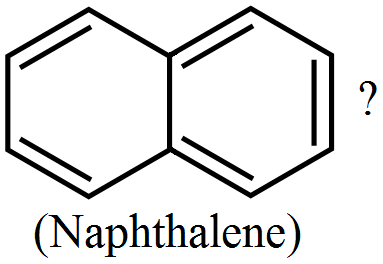
Which type of compound is shown by the following structure :
  • A
    Alicyclic compound.
  • Benzenoid aromatic compound.
  • C
    Non $-$ benzenoid aromatic compound.
  • D
    Acyclic compound.
Answer
Correct option: B.
Benzenoid aromatic compound.
Since, the given compounds contain benzene nucleus so, naphthalene is a benzenoid aromatic compound.
View full question & answer
MCQ 711 Mark
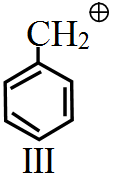
The order if stability of carbocations is :
$\text{CH}_2=\text{CH}-\text{CH}^{\oplus}_2\\ \ \ \ \ \ \ \ \ \ \ \ \ \ \ \ \text{I}$
$\text{CH}_3-\text{CH}_2-\text{CH}^{\oplus}_2\\ \ \ \ \ \ \ \ \ \ \ \ \ \ \ \ \text{II}$
  • $\text{III > I > II}$
  • B
    $\text{III > II > I}$
  • C
    $\text{II > III > I}$
  • D
    $\text{I > II > III}$
Answer
Correct option: A.
$\text{III > I > II}$
Benzyl Carbocation is most stable due to five resonating structures, $\text{I }\ ($Allyl carbocation is more stable than $\text{II (n}-$ propyl carbocation$)$ due to resonance.
View full question & answer
MCQ 721 Mark
Which one of the following can show $+\text{I}$ effect?
  • A
    $\text{CBr}_3$
  • $\text{CH}_3$
  • C
    $\text{CCl}_3$
  • D
    $\text{CHO}$
Answer
Correct option: B.
$\text{CH}_3$
Only $\text{CH}_3$ shows $+\text{I}$ effect rest of them shows $-\text{I}$ effect, since other groups contain electronegative atom which will pull electrons towards it causing $-\text{I}$ effect.
View full question & answer
MCQ 731 Mark
Which of the following is the correct $\text{IUPAC}$ name?
  • $3-$ Ethyl $-4, 4-$ dimethylheptane.
  • B
    $4, 4-$ Dimethyl $-3-$ ethylheptane.
  • C
    $5-$ Ethyl $-4, 4-$ dimethylheptane.
  • D
    $4, 4-$ Bis $($methyl$)-3-$ ethylheptane.
Answer
Correct option: A.
$3-$ Ethyl $-4, 4-$ dimethylheptane.
While writing $\text{IUPAC}$ name, the alkyl groups are written in alphabetical order. Thus lower locant $3$ is assigned to ethyl. Prefix, di, tri, and tetra are not included in alphabetical order.
The structure is $\ \ \ \ \ \ \ \ \ \ \ \ \ \ \ \ \ \ \ \ \ \ \ \ \ \ \ \ \ \ \ \ \ \ \ \text{CH}_3\\ \ \ \ \ \ \ \ \ \ \ \ \ \ \ \ \ \ \ \ \ \ \ \ \ \ \ \ \ \ \ \ \ \ \ \ \ \ \ |\\\text{CH}_3-\text{CH}_2-\text{CH}_2-\text{C}-\text{CH}-\text{CH}_2-\text{CH_3}\\ \ \ \ \ \ \ \ \ \ \ \ \ \ \ \ \ \ \ \ \ \ \ \ \ \ \ \ \ \ \ \ \ \ \ \ \ \ \ |\ \ \ \ \ \ \ |\\ \ \ \ \ \ \ \ \ \ \ \ \ \ \ \ \ \ \ \ \ \ \ \ \ \ \ \ \ \ \ \ \ \ \ \ \ \ \text{CH}\ \ \text{C}_2\text{H}_5$
View full question & answer
MCQ 741 Mark
All members of a homologous series have the same :
  • A
    Chemical formula.
  • Empirical formula.
  • C
    Boiling point.
  • D
    Melting point.
Answer
Correct option: B.
Empirical formula.
Homologous series differ by a $\ce{CH_2}$​ group. It has a mass of $14$ units.
They can be represented by a common general formula for alkanes, alkenes, alkynes, and other functional groups. They can thus, be represented by a common empirical formula.
For example alkanes has empirical formula $\mathrm{C}_n \mathrm{H}_\text{2 n+2}$ and for alkenes it is $\mathrm{C}_n \mathrm{H}_\text{2 n}$ etc.
View full question & answer
MCQ 751 Mark
In Lassaigne's test, the organic compound is fused with a piece of sodium metal in order to :
  • A
    Increase the ionisation of the compound.
  • B
    Decrease the melting point of the compound.
  • C
    Increase the reactivity of the compound.
  • Convert the covalent compound into a mixture of ionic compounds.
Answer
Correct option: D.
Convert the covalent compound into a mixture of ionic compounds.
Lassaigne's test is a general test for the detection of halogens, nitrogen and sulphur in an organic compound. These elements are covalently bonded to the organic compounds.
In order to detect them, these have to be converted into their ionic forms. This is done by fusing the organic compound with sodium metal.
The ionic compounds formed during the fusion are extracted in aqueous solution and can be detected by simple chemical tests. The extract is called sodium fusion extract or Lassaigne's extract.
View full question & answer
MCQ 761 Mark
Which of the following elements in an organic compound cannot be detected by Lassaigne's test?
  • A
    Nitrogen
  • B
    Sulphur
  • C
    Chlorine
  • Hydrogen
Answer
Correct option: D.
Hydrogen
Lassaigne's test is the most reliable test for the detection of nitrogen, halogens and sulphur in an organic compound.
The compound is heated with sodium metal to convert the elements present in the organic compound into the water $-$ soluble salts of sodium.
View full question & answer
MCQ 771 Mark
Note : Consider the following four compounds for answering questions :
  1. $\ \ \ \ \ \ \ \ \ \ \ \ \ \ \ \ \ \ \ \ \ \ \ \ \ \ \ \ \ \ \ \ \ \ \ \ \ \ \ \ \ \ \ \ \ \ \ \ \ \ \text{O}\\\ \ \ \ \ \ \ \ \ \ \ \ \ \ \ \ \ \ \ \ \ \ \ \ \ \ \ \ \ \ \ \ \ \ \ \ \ \ \ \ \ \ \ \ \ \ \ \ \ \ ||\\\text{CH}_3-\text{CH}_2-\text{CH}_2-\text{CH}_2-\text{C}-\text{H}$
  2. $\ \ \ \ \ \ \ \ \ \ \ \ \ \ \ \ \ \ \ \ \ \ \ \ \ \ \ \ \ \ \ \ \ \ \ \ \ \ \ \ \ \ \ \ \ \text{O}\\\ \ \ \ \ \ \ \ \ \ \ \ \ \ \ \ \ \ \ \ \ \ \ \ \ \ \ \ \ \ \ \ \ \ \ \ \ \ \ \ \ \ \ \ \ ||\\\text{CH}_3-\text{CH}_2-\text{CH}_2\text{CH}_2-\text{C}-\text{CH}_3$
  3. $\text{CH}_3-\text{CH}_2-\text{C}-\text{CH}_2-\text{CH}_3\\\ \ \ \ \ \ \ \ \ \ \ \ \ \ \ \ \ \ \ \ \ \ \ \ \ ||\\\ \ \ \ \ \ \ \ \ \ \ \ \ \ \ \ \ \ \ \ \ \ \ \ \ \text{O}$
  4. $\text{CH}_3-\text{CH}-\text{CH}_2-\text{C}-\text{H}\\\ \ \ \ \ \ \ \ \ \ \ \ \ \ \ \ \ \ \ \ \ \ \ \ |\ \ \ \ \ \ \ \ \ \ \ ||\\\ \ \ \ \ \ \ \ \ \ \ \ \ \ \ \ \ \ \ \ \ \ \ \text{CH}_3\ \ \ \ \ \text{O}$
Which of the following pairs are position isomers?
  • A
    $\text{I}$ and $\text{II}$
  • $\text{II}$ and $\text{III}$
  • C
    $\text{II}$ and $\text{IV}$
  • D
    $\text{III}$ and $\text{IV}$
Answer
Correct option: B.
$\text{II}$ and $\text{III}$
In position isomerism, two or more compounds differ in the position of substituent, functional group or multiple bonds but molecular formula is same. In pentanone $-2$ and pentanone $-3,$ position of ketonic group is different. $\mathrm{CH}_3-\mathrm{CH}_2 \mathrm{CH}_2-\mathrm{CO}-\mathrm{CH}_3$ and $\mathrm{CH}_3-\mathrm{CH}_2-\mathrm{CO}-\mathrm{CH}_2-\mathrm{CH}_3$
View full question & answer
MCQ 781 Mark
The number of sigma and pi bonds in a molecule of cyanogen are :
  • A
    $4, 3$
  • $3, 4$
  • C
    $5, 2$
  • D
    $3, 5$
Answer
Correct option: B.
$3, 4$
Cyanogen, $\text{N}\equiv\text{C}-\text{C}\equiv\text{N}$ has three sigma and four $'\pi\ '$ bonds.
View full question & answer
MCQ 791 Mark
In the detection of carbon, lime water turns milky due to the formation of :
  • A
    $ \mathrm{CaO} $
  • B
    $ \mathrm{Ca}(\mathrm{OH})_2 $
  • $ \mathrm{CaCO}_3 $
  • D
    $ \mathrm{Ca}\left(\mathrm{HCO}_3\right)_2$
Answer
Correct option: C.
$ \mathrm{CaCO}_3 $
Carbon dioxide passes through limewater, giving a milky solution.
This is due to the insoluble suspension of calcium carbonate formed :
$\mathrm{Ca}(\mathrm{OH})_2(\mathrm{aq})+\mathrm{CO}_2(\mathrm{~g}) \rightarrow \mathrm{CaCO}_3(\mathrm{~s})+\mathrm{H}_2 \mathrm{O}(\mathrm{l})$
View full question & answer
MCQ 801 Mark
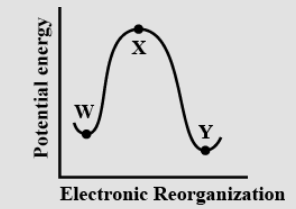
In the given potential energy diagram, the point $X$ represents :
  • A transition state
  • B
    A reaction intermediate
  • C
    A resonance hybrid
  • D
    A reactant
Answer
Correct option: A.
A transition state
In the given potential energy diagram, the point $\text{XX}$ represents the transition state.
It is the maximum energy state and below which reaction will not occur.
View full question & answer
MCQ 811 Mark
Groups that can show both $+\ M$ and $-\ M$ effect :
  • A
    vinyl
  • B
    phenyl
  • C
    $-\text{NO}$
  • All of these
Answer
Correct option: D.
All of these
$\mathrm{CH}_2 = \text{CH}− $ and phenyl both contain double bonds, Since we know $-\text{NO, C}=\text{C}$ both can show $+\ M$ and $-\ M$ effect both hence all of the above options are correct.
View full question & answer
MCQ 821 Mark
Which of the following represents ketones?
  • $> \text{C = O}$
  • B
    $- \text{OH}$
  • C
    $- \text{CHO}$
  • D
    $- \text{COOH}$
Answer
Correct option: A.
$> \text{C = O}$
$\text{COOH} =$ carboxylic acid, $−\text{CHO} =$ aldehydes $> \text{C = O} =$ ketones, $\text{OH} =$ alcohol.
View full question & answer
MCQ 831 Mark
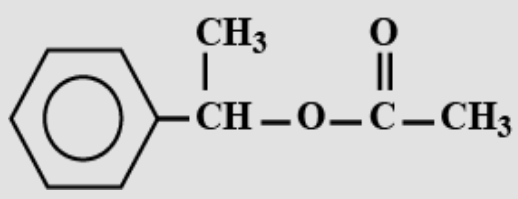
The $\text{IUPAC}$ name is :
  • A
    $1-$ phenyl $-1-$ acetyloxyethane
  • B
    $1-$ acetoxyeihylbenzene
  • $1-$ phenylethyl ethanoate
  • D
    $1-$ methylbenzyl acetate
Answer
Correct option: C.
$1-$ phenylethyl ethanoate
In the outside ring functional group present is an ester of ethyl ethonate at benzene ring position $1$ so by taking out one hydrogen it becomes $1-$ Phenyl ethylethanoate.
View full question & answer
MCQ 841 Mark
Acidified sodium fusion extract on addition of ferric chloride solution gives blood red colouration. This confirms the presence of which of the following element $(s)\ ?$
  • A
    Both $S$ and $cl.$
  • Both $N$ and $S.$
  • C
    Only $N$.
  • D
    Only $S.$
Answer
Correct option: B.
Both $N$ and $S.$
Acidified sodium fusion extract on addition of ferric chloride solution gives blood red colouration, which confirms the presence of $N$ and $S$ both.
$\text{Na} + \text{C} + \text{N} + \text{S} \xrightarrow{\ \ \ \ \ \ } \text{NaSCN}$
$\text{Fe}^{+3} + \text{SCN}^{-} \xrightarrow{\ \ \ \ \ \ } [\text{Fe}(\text{SCN})]^{2+}\\ \ \ \ \ \ \ \ \ \ \ \ \ \ \ \ \ \ \ \ \ \ \ \ \ \ \ \ \ \ \ \ \ \ \ \ \text{Blood red}$
View full question & answer
MCQ 851 Mark
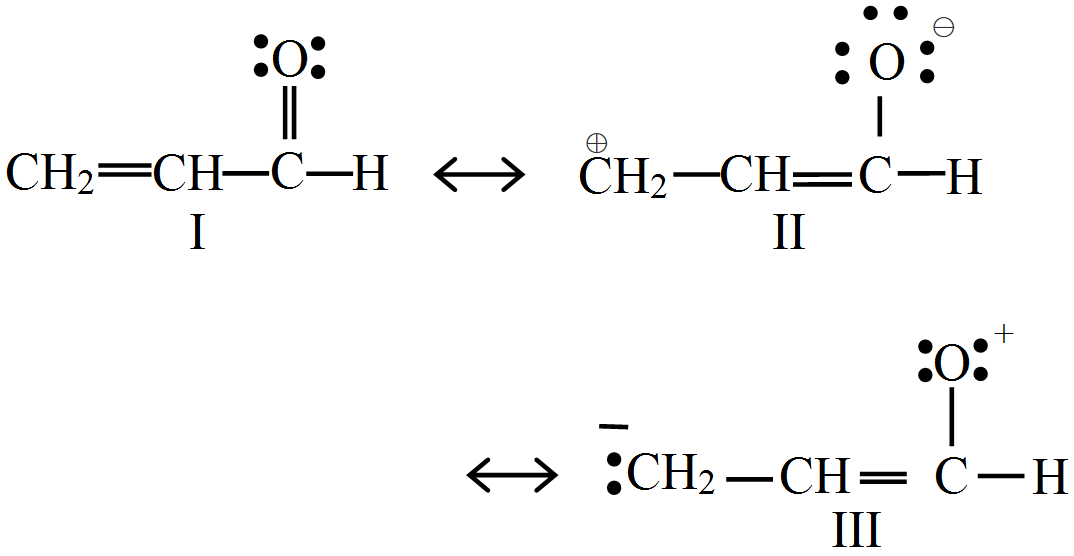
The order of relative stability of the contributing structures is :
  • A
    $\text{II > I > III}$
  • $\text{I > II > III}$
  • C
    $\text{III > II > I}$
  • D
    $\text{I = II = III}$
Answer
Correct option: B.
$\text{I > II > III}$
View full question & answer
MCQ 861 Mark
Which of the following does not belong to the same homologous series?
  • A
    $\mathrm{CH}_4$
  • B
    $\mathrm{C}_2 \mathrm{H}_6$
  • C
    $\mathrm{C}_3 \mathrm{H}_8$
  • $\mathrm{C}_4 \mathrm{H}_6$
Answer
Correct option: D.
$\mathrm{C}_4 \mathrm{H}_6$
Methane, ethane, and propane $-\mathrm{CH}_4, \mathrm{C}_2 \mathrm{H}_6, \mathrm{C}_3 \mathrm{H}_8-\mathrm{C}_n \mathrm{H}_{2 \mathrm{n}+2}$ belong to alkane family with same general formula except $\mathrm{C}_4 \mathrm{H}_6$
View full question & answer
MCQ 871 Mark
The most common characteristics of homologous series is increase in the number of :
  • A
    Propyl units
  • B
    Methyl units
  • Methylene units
  • D
    Butyl units
Answer
Correct option: C.
Methylene units
The most common characteristic of homologous series is increase in the number of methylene $(-\mathrm{CH}_2-)$ units in saturated chain within the molecule.
View full question & answer
MCQ 881 Mark
In which of the following compounds the carbon marked with asterisk is expected to have greatest positive charge?
  • ${ }^*\mathrm{CH}_3-\mathrm{CH}_2-\mathrm{Cl} $
  • B
    $ { }^* \mathrm{CH}_3-\mathrm{CH}_2-\mathrm{Mg}^{+} \mathrm{Cl}^{-} $
  • C
    $ { }^* \mathrm{CH}_3-\mathrm{CH}_2-\mathrm{Br} $
  • D
    $ { }^* \mathrm{CH}_3-\mathrm{CH}_2-\mathrm{CH}_3 $
Answer
Correct option: A.
${ }^*\mathrm{CH}_3-\mathrm{CH}_2-\mathrm{Cl} $
In $\mathrm{CH}_3-\mathrm{CH}_2-\mathrm{Cl},$ the carbon marked with asterisk has the greatest positive charge due to high electronegativity of $\text{Cl}.$
View full question & answer
MCQ 891 Mark
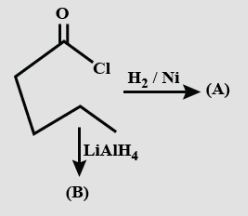
The product $(s)$ is / are :
  • A
    $(A)$ is an alcohol; $(B)$ is an aldehyde
  • B
    $(A)$ is an aldehyde; $(B)$ is an alcohol
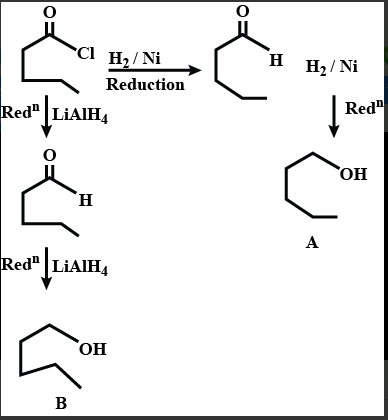
  • $(A)$ and $(B)$ both are alcohols
  • D
    $(A)$ and $(B)$ both are aldehydes
Answer
Correct option: C.
$(A)$ and $(B)$ both are alcohols
A reagent used for both reactions is reducing, it will reduce the carbonyl $-$ chloride to the alcohol group.
View full question & answer
MCQ 901 Mark
The chief source of aromatic compounds is :
  • A
    Fruits
  • B
    Oil of winter green
  • Petroleum
  • D
    Ants
Answer
Correct option: C.
Petroleum
The hydrocarbons in crude oil are mostly alkanes, cycloalkanes and various aromatic hydrocarbons. Fruits contain fructose and glucose derivatives.
Oil of wintergreen is an organic ester with fragrance. Ants have formic acid.
View full question & answer
MCQ 911 Mark
Define homologous series.
  • A
    Compound with same melting point.
  • B
    Compound with same molecular mass.
  • C
    Compounds with different general formula.
  • Compounds with same functional group substitutes for hydrogen in a carbon chain.
Answer
Correct option: D.
Compounds with same functional group substitutes for hydrogen in a carbon chain.
A homologous series is a series of compounds with the same general formula.
But they have different melting points $($physical properties$)$ and different molecular masses.
However, they have the same functional group substitutes for hydrogen in a carbon chain.
Example : $\mathrm{CH}_3 \mathrm{OH}, \mathrm{C}_2 \mathrm{H}_5 \mathrm{OH}, \mathrm{C}_3 \mathrm{H}_7 \mathrm{OH}$.
View full question & answer
MCQ 921 Mark
$\text{IUPAC}$ name of $\mathrm{CH}_3 \mathrm{OC}_2 \mathrm{H}_5$​ is :
  • A
    Ethoxy methane
  • Methoxy ethane
  • C
    Both $(a)$ and $(b)$
  • D
    None of these
Answer
Correct option: B.
Methoxy ethane
According to $\text{IUPAC}$ nomenclature system, ethers are known as alkoxy alkane.
The ether oxygen is taken with a smaller alkyl group and creates the alkoxy group while larger alkyl group is considered as a alkyl group.
So the name will be methoxy ethane.
View full question & answer
MCQ 931 Mark
The absorption of hydrogen by platinum is known as :
  • A
    Hydrogenation
  • B
    Reduction
  • C
    Dehydrogenation
  • Occlusion
Answer
Correct option: D.
Occlusion
A huge amount hydrogen gas generally loosely bounds with the surface of the platinum metal.
This is known as occlusion and the hydrogen is known as occluded hydrogen.
View full question & answer
MCQ 941 Mark
During the fusion of an organic compound with sodium metal, nitrogen of the organic compound is converted into :
  • A
    $\text{NaNO}_2$
  • B
    $\text{NaNH}_2$
  • $\text{NaCN}$
  • D
    $\text{NaNC}$
Answer
Correct option: C.
$\text{NaCN}$
View full question & answer
MCQ 951 Mark
Which of the following would be expected to be most highly ionised in water?
  • A
    $ \mathrm{CH}_3 \mathrm{CH}_2 \mathrm{CH}_2 \mathrm{COOH} $
  • B
    $ \mathrm{CH}_3 \mathrm{CHClCH}_2 \mathrm{COOH} $
  • $ \mathrm{CH}_3 \mathrm{CH}_2 \mathrm{CCl}_2 \mathrm{COOH} $
  • D
    $ \mathrm{CH}_3 \mathrm{CH}_2 \mathrm{CHClCOOH}$
Answer
Correct option: C.
$ \mathrm{CH}_3 \mathrm{CH}_2 \mathrm{CCl}_2 \mathrm{COOH} $
Fast ionization is shown by strong acids. Chlorine atom has high $-I $ effect so when attached to nearly carbon, it increases acidity thus is more acidic.
View full question & answer
MCQ 961 Mark
Identify the correct statement.
  • A
    Reaction mechanisms are studied using isotopic labelling.
  • B
    Isolation of reactive intermediates is a method to establish reaction mechanism.
  • Both $a$ and $b$ are correct.
  • D
    Neither $a$ nor $b$ is correct.
Answer
Correct option: C.
Both $a$ and $b$ are correct.
  1. Reaction mechanisms are studied using isotopic labeling. One of the atoms of one reactant/ reagent is replaced with its isotope. Then, the product in which this labelled atom is present is determined. From this information, we can decide which atom of reactant goes to which product.
$\ce{CH_3​−CO−O*H + CH_3​−OH \xrightarrow{\text{H}^+} ​CH_3​−COO−CH_3​ + H_2O}*$​
In the above reaction, O atom of $−\ce{OH}$ group of acetic acid is labelled. It is then observed that labelled $O$ atom is found in water. Hence, we can conclude that
$−\ce{OH}$ group of acetic acid combines with $H$ atom of methanol.
  1. Isolation of reactive intermediates is a method to establish reaction mechanism.
Consider the conversion $A \rightarrow D.$
It can proceed through following two different mechanisms.
$A \rightarrow B \rightarrow D.$
$A \rightarrow C \rightarrow D.$
Suppose that we are able to isolate intermediate $B$ but we cannot isolate intermediate $C$.
​​​​​​​Hence, we can say that the reaction mechanism is $A \rightarrow B \rightarrow D.$
View full question & answer
MCQ 971 Mark
Choose the correct order of stability of carbocation using the concept of hyperconjugation.
$\begin{matrix}{\ \ \ \ \ \ \ \ \ \ \ \ \text{CH}_3\\ \ \ \ \ \ \ \ \ \ \ \ \ \ |\\\text{CH}_3-\text{C}^\oplus\\ \ \ \ \ \ \ \ \ \ \ \ \ \ |\\\ \ \ \ \ \ \ \ \ \ \ \ \text{CH}_3} & { \ \ \ \ \ \ \ \ \ \ \ \ \text{CH}_3\\ \ \ \ \ \ \ \ \ \ \ \ \ \ |\\\text{CH}_3-\text{C}^\oplus\\ \ \ \ \ \ \ \ \ \ \ \ \ \ |\\ \ \ \ \ \ \ \ \ \ \ \ \ \text{H} } & {\text{CH}_3\stackrel{{\oplus} }{\hbox{CH}_2}} & \stackrel{{\oplus} }{\hbox{CH}_3} \\ \ \ \ \ \ \ \ \ \text{I} & \ \ \ \ \ \ \ \text{II} & \ \ \text{III} & \text{IV} \end{matrix}$
  • A
    $\text{I < II < III < IV}$
  • $\text{IV < III < II < I}$
  • C
    $\text{III < IV < II < I}$
  • D
    None of these.
Answer
Correct option: B.
$\text{IV < III < II < I}$
Greater the number of alkyl groups attached to a positively charged carbon atom, the greater is the hyperconjugation interaction and stabilisation of the cation.
Thus, we have the following relative stability of carbocation :
$ \ \ \ \ \ \ \ \ \ \ \ \ \text{CH}_3\\ \ \ \ \ \ \ \ \ \ \ \ \ \ | \\\text{CH}_3-\stackrel{{+} }{\hbox{C}} > (\text{CH}_3)_2\stackrel{{+ \ \ \ \ } }{\hbox{CH}} > \text{CH}_3\stackrel{{+ \ \ \ \ \ \ } }{\hbox{CH}_2} > \stackrel{{+ \ \ \ \ \ } }{\hbox{CH}}_3\\ \ \ \ \ \ \ \ \ \ \ \ \ \ |\\ \ \ \ \ \ \ \ \ \ \ \ \ \text{CH}_3$
View full question & answer
MCQ 981 Mark
Which functional group is present in a molecule of $\mathrm{CH}_3 \mathrm{Cl}\ ?$
  • A
    Amine
  • Halide
  • C
    Ether
  • D
    Ketone
Answer
Correct option: B.
Halide
Methyl chloride, $\mathrm{CH}_3 \mathrm{Cl}$ is an alkyl chloride. The functional group present is chlorine atom $−\text{Cl}.$
Note: In general we can write alkyl halides as $\text{R-X}$ where $X$ is halogen atom $\ce{Cl, Br, I}$ or $F).$
View full question & answer
MCQ 991 Mark
Dumas method is used for estimation of :
  • A
    Carbon
  • Nitrogen
  • C
    Oxygen
  • D
    Sulphur
Answer
Correct option: B.
Nitrogen
The Dumas method in analytical chemistry is a method for the quantitative determination of nitrogen in chemical substances based on a method first described by Jean $-$ Baptiste Dumas in $1826.$
View full question & answer
MCQ 1001 Mark
The elements always present in organic compounds are $C$ and $H$. In addition to these, name the other elements that may be present in it :
  • A
    Oxygen and nitrogen.
  • B
    Sulphur and halogens.
  • C
    Phosphorus.
  • All of these.
Answer
Correct option: D.
All of these.
The elements present in organic compounds are $C$ and $H,$ other elements are $\text{O, NS, X}\ ($halogen$).$
View full question & answer
M.C.Q (1 Marks) - Page 2 - Chemistry STD 11 Science Questions - Vidyadip