Question 513 Marks
What is the experimental evidence in support of the idea that electronic energies in an atom are quantized?
Answer The bright line spectrum shows that the energy levels in an atom are quantized. These lines corresponds to definite wavelength sand are obtained as a result of electronic transitions between the energy levels. Hence, the electrons in these levels have quantized values.
View full question & answer→Question 523 Marks
- Define principal quantum number(n).
- Write the electronic configuration of $Cr^+$ [Atomic number of Cr = 24].
- Define Pauli's exclusion principle.
Answer
- Principal quantum number tells the principal energy level or shell to which the electron belongs. It gives the information about the distance and the energy of the electron.
- $Cr^+ = 1s^2 2s^2 2p^6 3s^2 3p^6 3d^5$
- Pauli's exclusion principle states that no two electrons in an atom can have the same set of four quantum numbers.
View full question & answer→Question 533 Marks
Find out the number of wave made by a Bohr electron in one complete revolution in its 3rd orbit.
Answer In general, number of waves in any orbit is,
Number of wayes $=\frac{\text{Circumference of orbit}}{\text{Wavelength}}=\frac{2\pi\text{r}}{\lambda}$
But $\lambda=\frac{\text{h}}{\text{mc}}$
Number of waves $=\frac{2\pi\text{r}}{\frac{\text{h}}{\text{mv}}}=\frac{2\pi\text{r}.\text{mv}}{\text{h}}=\frac{2\pi(\text{mvr})}{\text{h}}$
The angular momentum of Bohr's 3rd orbit is,
$\text{mvr}=\frac{3\text{h}}{2\pi}$
$\therefore$ Number of wayes $=\frac{2\pi}{\text{h}}\times\frac{3\text{h}}{2\pi}=3$
Number of waves in Bohr,s 3rd orbit = 3.
View full question & answer→Question 543 Marks
The radius of first Bohr orbit of hydrogen atom is $0.529\mathring{\text{A}}.$ Calculate the radii of:
- The third orbit of $He^+$ ion,
- The second orbit of $Li^2+$ ion.
AnswerRadius of nth Bohr orbit, $\text{r}_\text{n}=\frac{\text{n}^2\text{h}^2}{4\pi^2\text{m}.\text{Ze}^2}$
For hydrogen atom $Z = 1$, first orbit $n = 1$
$\text{r}_1=\frac{\text{h}^2}{4\pi^2\text{me}^2}=0.529\mathring{\text{A}}$
- For $He^+$ ion, $Z = 2,$ third orbit, $n = 3$
$\text{r}_3(\text{He}^+)=\frac{3^2\text{h}^2}{4\pi^2\text{m}\times2\times\text{e}^2}$
$=\frac{9}{2}\Big[\frac{\text{h}^2}{4\pi^2\text{me}^2}\Big]=\frac{9}{2}\times0.529=2.380\mathring{\text{A}}$
- For $Li^{2+}$ ion, $Z = 3$, second orbit, $n = 2$
$\text{r}_2(\text{Li}^{2+})=\frac{2^2\text{h}^2}{4\pi^2\text{m}\times3\times\text{e}^2}=\frac{4}{3}\Big[\frac{\text{h}^2}{4\pi^2\text{me}^2}\Big]$
$=\frac{4}{3}\times0.529=0.7053\mathring{\text{A}}$ View full question & answer→Question 553 Marks
Calculate the uncertainty in the position of a dust particle with mass equal to 1 mg if the uncertainty in velocity is 5.5 $\times 10^{-20} \mathrm{~ms}^{-1} .\left(\mathrm{h}=6.626 \times 10^{-34} \mathrm{~Js}\right)$
Answer$\Delta \mathrm{v}=$ uncertainty in position = ?
$\Delta \mathrm{v}=$ Uncertainty in velocity $=5.5 \times 10^{-20} \mathrm{~ms}^{-1}$
$\text{m}=1\text{mg}=10^{-6}\text{kg}$ $[\because1\text{ms}=10^{-6}\text{kg}]$
Applying Heisenberg's uncertainity principle,
$\Delta\text{x},\Delta\text{v}=\frac{\text{h}}{4\text{m}\pi}$
Uncretainity in position, $\Delta\text{x}=\frac{ \text{h}}{4\text{m}\pi\times\Delta\text{v}}$
$=\frac{6.626106^{-34}\text{Js}}{4\times10^{-6}\text{kg}\times3.14\times5.5\times10^{-20}\text{ms}^{-1}}\text{m}$
$\Delta\text{x}=\frac{6.626}{69.08}\times10^{-8}\text{m}$
$\Delta\text{x}=\frac{66.26}{69.08}\times10^{-9}\text{m}=0.959\times10^{-9} \ \text{m}$
$\Delta\text{r}=9.59\times10^{-10}\text{m}$
View full question & answer→Question 563 Marks
- What is the main difference between electro magnetic waves theory and Planck's quantum theory.
- Which rule is violated in the following orbital diagram:

Answer
- Electromagnetic Waves Theory: Energy is radiated or absorbed continuously.
Planck's Quantum Theory: Energy is radiated or absorbed not continuously but discontinuously in the form of small packets called quantas or photons.
- Hund's rule is being violated: Because orbitals having equal energy should be singly filled first and then pairing of electron should take place.
View full question & answer→Question 573 Marks
Calculate the wavelength of tennis ball of mass 60 gram moving with a velocity of $10 \mathrm{~ms}^{-1} .\left(\mathrm{h}=6.626 \times 10^{-34} \mathrm{Js}\right)$
AnswerAccording to de Broglie equation,
$\text{m}=60\text{g}=\frac{60}{1000}\text{kg}$
$\text{c}=10\text{ms}^{-1}$
$\text{h}=6.626\times10^{-34}\text{Js}$
$\lambda=\frac{\text{h}}{\text{mc}}$
$\lambda=\frac{6.626\times10^{-34}\text{Js}}{6\times10^{-2}\text{kg}\times10\text{ms}^{-1}}$
$\lambda=\frac{6.626}{6}\times10^{-33}\text{m}$
$\lambda=1.104\times10^{-33}\text{m}$
View full question & answer→Question 583 Marks
Correct the following electronic configuration of the elements in the ground state.
- $1\text{s}^2\ 2\text{s}^1,2\text{p}^2_\text{x},2\text{p}^2_\text{y},2\text{p}^2_\text{z},3\text{s}62,2\text{p}^1_\text{x}$
- $1\text{s}^2\ 2\text{s}^1,2\text{p}^1_\text{x},2\text{p}^1_\text{y},2\text{p}^1_\text{z}$
- $1\text{s}^2\ 2\text{s}^1,2\text{p}^6,3\text{s}^2,3\text{p}^6,3\text{d}^5$
- $1\text{s}^2\ 2\text{s}^2,2\text{p}^6,3\text{p}^6,3\text{d}^4,4\text{s}^2$
Answer
- $1\text{s}^2\ 2\text{s}^2,2\text{p}^2_\text{x},2\text{p}^2_\text{y},2\text{p}^2_\text{z},3\text{s}^2$
- $1\text{s}^2\ 2\text{s}^2,2\text{p}^1_\text{x},2\text{p}^1_\text{y},2\text{p}^1_\text{y},2\text{p}^1_\text{z}$
- $1\text{s}^2\ 2\text{s}^2,2\text{p}^6,3\text{s}^2,3 \text{p}^6,4\text{s}^2,3\text{d}^2$
- $1\text{s}^2\ 2\text{s}^2,2\text{p}^6,3\text{s} ^2,3\text{p}^6,3\text{d}^5,4\text{s}^1$
View full question & answer→Question 593 Marks
Chlorophyll present in green leaves of plants absorbs light at $4.620 \times 10^{14}Hz$. Calculate the wavelength of radiation in nanometer. Which part of the electromagnetic spectrum does it belong to?
AnswerFrequency and wavelength are related by the following equation:
$\mathrm{f}=\frac{\mathrm{c}}{\lambda}$ Where f is the frequency $=4.620 \times 10^{14} \mathrm{~Hz}$
$\mathrm{c}=$ speed of light $=3 \times 10^8 \mathrm{~m} / \mathrm{s}$
Therefore, $\lambda=\frac{\mathrm{c}}{\mathrm{f}}$
$=\frac{3 \times 10^8}{4.620 \times 10^{14}}$
$=6.49 \times 10^{-7} \mathrm{~m}=649 \mathrm{~nm}$
It belongs to the visible light of the spectrum.
View full question & answer→Question 603 Marks
Calculate the energy required for the process,
$\text{He}^+(\text{g})\rightarrow\text{He}^{2+}\text{(g)}+\text{e}^-$
The ionization energy for the H atom in the ground state is $2.18 \times 10^{-18} \mathrm{~J}\mathrm{~atom}^{-1}$
AnswerEnergy associated with hydrogen-like species is given by,
$\text{E}_{\text{n}}=-2.18\times10^{-18}\Big(\frac{\text{Z}^2}{\text{n}^2}\Big)\text{J}$
For ground state of hydrogen atom,
$\triangle\text{E = E}_{\infty}-\text{E}_1$
$=0-\bigg[-2.18\times10^{-18}\bigg\{\frac{(1)^2}{(1)^2}\bigg\}\bigg]\text{J}$
$\triangle\text{E}=2.18\times10^{-18}\text{J}$
For the given process,
$\text{He}^+(\text{g})\rightarrow\text{He}^{2+}\text{(g)}+\text{e}^-$
An electron is removed from $\text{n}=1\text{ to}\text{ n}=\infty.$
$\triangle\text{E = E}_{\infty}-\text{E}_1$
$=0-\bigg[-2.18\times10^{-18}\bigg\{\frac{(2)^2}{(1)^2}\bigg\}\bigg]$
$\triangle\text{E}=8.27\times10^{-18}\text{J}$
$\therefore$ The energy required for the process $8.27\times10^{-18}\text{J}.$
View full question & answer→Question 613 Marks
Calculate the wavenumber for the longest wavelength transition in the Balmer series of atomic hydrogen.
AnswerFor the Balmer series, $\mathrm{n}_{\mathrm{i}}=2$. Thus, the expression of wave number $(\overline{\mathrm{v}})$ is given by,
$\overline{\mathrm{v}}=\left[\frac{1}{(2)^2}-\frac{1}{\mathrm{n}_{\mathrm{r}}^2}\right]\left(1.097 \times 10^7 \mathrm{~m}^{-1}\right)$
Wave number $(\overline{\mathbf{v}})$ is inversely proportional to wavelength of transition. Hence, for the longest wavelength transition, $\overline{\mathbf{v}}$ has to be the smallest.
For $\bar{v}$ to be minimum, $n_f$ should be minimum. For the Balmer series, a transition from $n_i=2$ to $n_f=3$ is allowed. Hence, taking $\mathrm{n}_{\mathrm{f}}=3$, we get:
$\bar{\text{v}}=(1.097\times10^7)\Big[\frac{1}{2^2}-\frac{1}{3^2}\Big]$
$\bar{\text{v}}=(1.097\times10^7)\Big[\frac{1}{4}-\frac{1}{9}\Big]$
$=(1.097\times10^7)\Big(\frac{9-4}{36}\Big)$
$=(1.097\times10^7)\Big(\frac{5}{36}\Big)$
$\bar{\text{v}}=1.5236\times10^6\text{ m}^{-1}$
View full question & answer→Question 623 Marks
The diameter of zinc atom is 2.6 $\mathring{\text{A}}$.Calculate,
- Radius of zinc atom in pm
- Number of atoms present in a length of 1.6cm if the zinc atoms are arranged side by side lengthwise.
Answer
- $\text{Radius of zinc atom }=\frac{\text{Diameter}}{2}$
$=\frac{2.6\mathring{\text{A}}}{2}$
$=1.3\times10^{-10}\text{m}$
$=130\times10^{-12}\text{m}=130\text{pm}$
- Length of the arrangement = 1.6cm
$=1.6 \times 10^{-2} \mathrm{~m}$
Diameter of zinc atom $=2.6 \times 10^{-10} \mathrm{~m}$
$\therefore$ Number of zinc atoms present in the arrangement
$=\frac{1.6\times10^{-2}\text{m}}{2.6\times10^{-10}\text{m}}$
$=0.6153\times10^8\text{m}$
$=6.153\times10^7$ View full question & answer→Question 633 Marks
Show that the circumference of the Bohr orbit for the hydrogen atom is an integral multiple of the de Broglie wavelength associated with the electron revolving around the orbit.
Answer Since a hydrogen atom has only one electron, according to Bohr’s postulate, the angular momentum of that electron is given by:
$\text{mvr}=\text{n}\frac{\text{h}}{2\pi}...(1)$
Where,
n = 1, 2, 3, …
According to de Broglie’s equation:
$\lambda=\frac{\text{h}}{\text{mv}}$
or $\text{mv}=\frac{\text{h}}{\lambda}...(2)$
Substituting the value of ‘mv’ from expression (2) in expression (1):
$\frac{\text{hr}}{\lambda}=\text{n}\frac{\text{h}}{2\pi}$
or $2\pi\text{r}=\text{n}\lambda...(3)$
Since $'2\pi\text{r}'$ represents the circumference of the Bohr orbit (r), it is proved by equation (3) that the circumference of the Bohr orbit of the hydrogen atom is an integral multiple of de Broglie’s wavelength associated with the electron revolving around the orbit.
View full question & answer→Question 643 Marks
How many neutrons and protons are there in the following nuclei?
$\text{ }^{13}_{06}\text{C},\text{ }^{16}_{08}\text{O},\text{ }^{24}_{12}\text{Mg},\text{ }^{56}_{26}\text{Fe},\text{ }^{88}_{38}\text{Sr}$
Answer$\text{ }^{13}_{06}\text{C}:$
Atomic mass = 13
Atomic number = Number of protons = 6
Number of neutrons = (Atomic mass) – (Atomic number)
= 13 – 6 = 7
$\text{ }^{16}_{08}\text{O}:$
Atomic mass = 16
Atomic number = 8
Number of protons = 8
Number of neutrons = (Atomic mass) – (Atomic number)
= 16 – 8 = 8
$\text{ }^{24}_{12}\text{Mg}:$
Atomic mass = 24
Atomic number = Number of protons = 12
Number of neutrons = (Atomic mass) – (Atomic number)
= 24 – 12 = 12
$\text{ }^{56}_{26}\text{Fe}:$
Atomic mass = 56
Atomic number = Number of protons = 26
Number of neutrons = (Atomic mass) – (Atomic number)
= 56 – 26 = 30
$\text{ }^{88}_{38}\text{Sr}:$
Atomic mass = 88
Atomic number = Number of protons = 38
Number of neutrons = (Atomic mass) – (Atomic number)
= 88 – 38 = 50
View full question & answer→Question 653 Marks
An element with mass number 81 contains 31.7% more neutrons as compared to protons. Assign the atomic symbol.
Answer Let the number of protons in the element be x.
$\therefore$ Number of neutrons in the element
= x + 31.7% of x
= x + 0.317 x
= 1.317 x
According to the question,
Mass number of the element = 81
$\therefore$ (Number of protons + number of neutrons) = 81
$\Rightarrow\text{x}+1.317\text{x}=81$
$2.317\text{x}=81$
$\text{x}=\frac{81}{2.317}$
$=34 .95$
$\therefore\text{x}=35$
Hence, the number of protons in the element i.e., x is 35.
Since the atomic number of an atom is defined as the number of protons present in its nucleus, the atomic number of the given element is 35.
$\therefore$ The atomic symbol of the element is $\text{ }^{81}_{35}\text{Br}.$
View full question & answer→Question 663 Marks
How much energy is required to ionise a H atom if the electron occupies n = 5 orbit? Compare your answer with the ionization enthalpy of H atom (energy required to remove the electron from n = 1 orbit).
Answer $\text{E}_{\text{n}}=\frac{-21.8\times10^{-19}}{\text{n}^2\text{Jatom}^{-1}}$
For ionization from 5th orbit, $\text{n}_{1}=5,\text{n}_2=\infty$
$\therefore\triangle\text{E = E}_2-\text{E}_1=-21.8\times10^{-19}\times\Big(\frac{1}{\text{n}2^2}-\frac{1}{\text{n}1^2}\Big)$
$=21.8\times10^{-19}\times\Big(\frac{1}{\text{n}1^2}-\frac{1}{\text{n}2^2}\Big)$
$=21.8\times10^{-19}\times\Big(\frac{1}{5^2}-\frac{1}{\infty}\Big)$
$=8.72\times10^{-20}\text{J}$
For ionization from 1st orbit, $\text{n}_1=1,\text{n}_2=\infty$
$\therefore\triangle\text{E}'=21.8\times10^{-19}\times\Big(\frac{1}{1^2}-\frac{1}{\infty}\Big)=21.8\times10^{-19}\text{J}$
$\frac{\triangle\text{E}'}{\triangle\text{E}}=\frac{21.8\times10^{-19}}{8.72\times10^{-20}}=25$
Hence, 25 times less energy is required to ionize an electron in the 5th orbital of hydrogen atom as compared to that in the ground state.
View full question & answer→Question 673 Marks
Which of the following are isoelectronic species i.e., those having the same number of electrons?
$\text{Na}^+,\text{K}^+,\text{Mg}^{2+},\text{Ca}^{2+},\text{S}^{2-},\text{Ar}.$
AnswerNotes:Isoelectronic are the species having same number of electrons.
A positive charge means the shortage of an electron.
A negative charge means gain of electron.
Number of electrons in $\mathrm{Na}^{+}=11-1=10$
Number of electrons in $\mathrm{K}^{+}=19-1=18$
Number of electrons in $\mathrm{Mg}^{2+}=12-2=10$
Number of electrons in $\mathrm{Ca}^{2+}=20-2=18$
Number of electrons in $\mathrm{S}^{2-}=16+2=18$
Number of electrons in $\mathrm{Ar}=18$
Hence, the following are isoelectronic species:
1. $\mathrm{Na}^{+}$and $\mathrm{Mg}^{2+}$ (10 electrons each)
2. $\mathrm{K}^{+}, \mathrm{Ca}^{2+}, \mathrm{S}^{2-}$ and Ar (18 electrons each)
$\lambda=\frac{6.626 \times 10^{-34} \mathrm{Js}}{\left(9.10939 \times 10^{-31} \mathrm{~kg}\right)\left(811.579 \mathrm{~ms}^{-1}\right)}$
$\lambda=8.9625 \times 10^{-7} \mathrm{~m}$
Hence, the wavelength of the electron is $8.9625 \times 10^{-7} \mathrm{~m}$.
View full question & answer→Question 683 Marks
What transition in the hydrogen spectrum would have the same wavelength as the Balmer transition $n = 4 to n = 2 of He^+$ spectrum?
AnswerFor $He^+$ ion, the wave number $(\bar{\text{v}})$ associated with the Balmer transition, n = 4 to n = 2 is given by:$\bar{\text{v}}=\frac{1}{\lambda}=\text{RZ}^2\Big(\frac{1}{\text{n}^2_1}-\frac{1}{\text{n}^2_2}\Big)$
Where,
$n_1 = 2$
$n_2 = 4$
Z = atomic number of helium
$\bar{\text{v}}=\frac{1}{\lambda}=\text{R}(2)^2\Big(\frac{1}{4}-\frac{1}{16}\Big)$
$=4\text{R}\Big(\frac{4-1}{16}\Big)$
$\bar{\text{v}}=\frac{1}{\lambda}=\frac{3\text{R}}{4}$
$\Rightarrow\lambda=\frac{4}{3\text{R}}$
According to the question, the desired transition for hydrogen will have the same wavelength as that of $He^+$.
$\Rightarrow\text{R}(1)^2\bigg[\frac{1}{\text{n}^2_1}-\frac{1}{\text{n}_2^2}\bigg]=\frac{3\text{R}}{4}$
$\bigg[\frac{1}{\text{n}_1^2}-\frac{1}{\text{n}^2_2}\bigg]=\frac{3}{4}...(1)$
By hit and trail method, the equality given by equation (1) is true only when
$n_1 = 1$ and $n_2 = 2.$
$\therefore$ The transition for $n_2 = 2 to n = 1$ in hydrogen spectrum would have the same wavelength as Balmer transition n = 4 to n = 2 of $He^+$ spectrum.
View full question & answer→Question 693 Marks
Lifetimes of the molecules in the excited states are often measured by using pulsed radiation source of duration nearly in the nano second range. If the radiation source has the duration of 2 ns and the number of photons emitted during the pulse source is $2.5 \times 10^{15}$, calculate the energy of the source.
AnswerFrequency of radiation ( $v$ ),
$\mathrm{v}=\frac{1}{2.0 \times 10^{-9} \mathrm{~s}}$
$v=5.0 \times 10^8 \mathrm{~s}^{-1}$
Energy $(E)$ of source $=\mathrm{Nh} v$
Where,
$\mathrm{N}=$ number of photons emitted
$\mathrm{h}=$ Planck's constant
$v=$ frequency of radiation
Substituting the values in the given expression of (E):
$\mathrm{E}=\left(2.5 \times 10^{15}\right)\left(6.626 \times 10^{-34} \mathrm{~J}\right)\left(5.0 \times 10^8 \mathrm{~s}^{-1}\right)$
$E=8.282 \times 10^{-10} \mathrm{~J}$
Hence, the energy of the source $(\mathrm{E})$ is $8.282 \times 10^{-10} \mathrm{~J}$.
View full question & answer→Question 703 Marks
Threshold frequency, $v_0$ is the minimum frequency which a photon must possess to eject an electron from a metal. It is different for different metals. When a photon of frequency $1.0 \times 10^{15} \mathrm{~s}^{-1}$ was allowed to hit a metal surface, an electron having $1.988 \times 10^{-19}$ J of kinetic energy was emitted. Calculate the threshold frequency of this metal. Show that an electron will not be emitted if a photon with a wavelength equal to 600 nm hits the metal surface.
Answer$\text{hv}=\text{h}_0+\text{K.E}.$
$\text{hv}_0=\text{hv}-\text{K.E.}$
$\text{v}_0=\text{v}-\frac{\text{K.E.}}{\text{h}}\ ...(\text{i})$
$\text{v}=1.0\times10^{15}\text{s}^{-1}$
$\text{K.E.}=1.988\times^{-19}\text{J},\text{ h}=6.626\times10^{-34}\text{Js}$
From (i) we have,
$\text{v}_0=1.0\times10^{15}\text{s}^{-1}-\frac{1.988\times10^{-19}\text{J}}{6.626\times10^{-34}\text{Js}}$
$=(1.0\times10^{15}-0.30\times10^{15})\text{s}^{-1}$
$=0.7\times10^{15}\text{s}^{-1}=7\times10^{14}\text{s}^{-1}$
$\lambda=600\text{nm}=600\times10^{-9}\text{m}=6.0\times^{-7}\text{m}$
$\text{v}=\frac{\text{v}}{\lambda}=\frac{3.0\times10^8\text{ms}^{-1}}{6.0\times10^{-1}\text{m}}=5\times10^{14}\text{s}^{-1}$
Thus $\text{v}$ < $\text{v}_0$, Hence, no electron will be emitted.
View full question & answer→Question 713 Marks
Out of electron and proton which one will have, a higher velocity to produce matter waves of the same wavelength? Explain it.
AnswerThe de-broglie relationship is given by,
$\lambda=\frac{\text{h}}{\text{mv}}$
Where $\lambda$ is wavelength, m is mass and v is velocity.
We can also write the relation as,
$\text{v}=\frac{\text{h}}{\text{m}\lambda}$
So, velocity is inversely proportional to the mass.
$\text { Mass of electron }=9.1 \times 10^{-31} \mathrm{~kg}$
$\text { mass of proton }=1.6 \times 10^{-27} \mathrm{~kg}$
Mass of proton is more than mass of electron therefore the velocity of electron is more than that of proton.
View full question & answer→Question 723 Marks
If the velocity of the electron in Bohr’s first orbit is $2.19 \times 106 \mathrm{~ms}^{-1}$, calculate the de Broglie wavelength associated with it.
AnswerAccording to de Broglie’s equation,
$\lambda=\frac{\text{h}}{\text{mv}}$
Where,
$\lambda$ = wavelength associated with the electron
h = Planck’s constant
m = mass of electron
v = velocity of electron
Substituting the values in the expression of $\lambda:$
$\lambda=\frac{6.626\times10^{-34}\text{Js}}{(9.10939\times10^{-31}\text{kg})(2.19\times10^6\text{ms}^{-1})}$
$=3.32\times10^{-10}\text{m}=3.32\times10^{-10}\text{m}\times\frac{100}{100}$
$=332\times10^{-12}\text{m}$
$\lambda=332\text{pm}$
$\therefore$ Wavelength associated with the electron = 332pm
View full question & answer→Question 733 Marks
What is the maximum number of emission lines when the excited electron of a H atom in n = 6 drops to the ground state?
Answer
When the excited electron of an H atom in n = 6 drops to the ground state, the following transitions are possible:
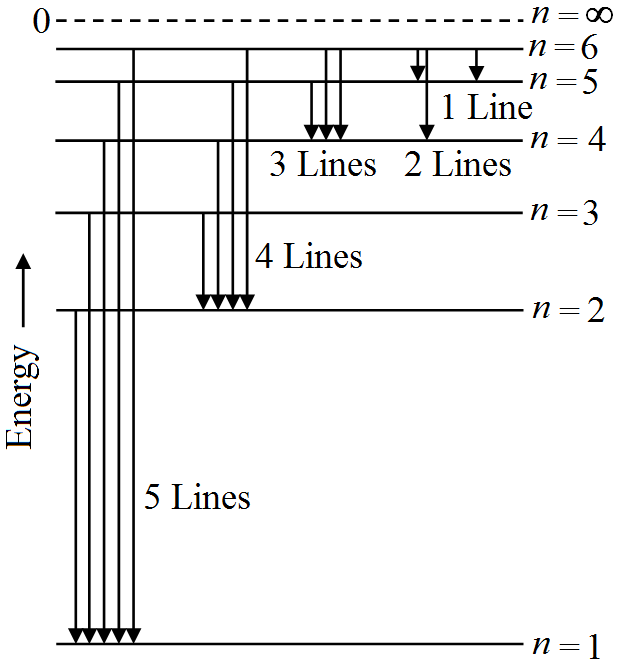
Hence, a total number of (5 + 4 + 3 + 2 + 1) 15 lines will be obtained in the emission spectrum.
The number of spectral lines produced when an electron in the $\text{n}^{th}$ level drops down to the ground state is given by $\frac{\text{n(n}-1)}{2}$
Given,
n = 2
Number of spectral lines $=\frac{6(6-1)}{2}=15$ View full question & answer→Question 743 Marks
The electron energy in hydrogen atom is given by $\text{E}_{\text{n}}=\frac{ (–2.18 \times 10–18 )}{\text{n}^2}\text{J}.$ Calculate the energy required to remove an electron completely from the n = 2 orbit. What is the longest wavelength of light in cm that can be used to cause this transition?
Answer $\text{E}_{\text{n}}=\frac{ (–2.18 \times 10–18 )}{\text{n}^2}\text{J}$
Energy required for ionization from n = 2 is given by,
$\triangle\text{E = E}_{\infty}-\text{E}_2$
$=\Big[\Big(\frac{-2.18\times10^{-18}}{(\infty)^2}\Big)-\Big(\frac{-2.18\times10^{-18}}{(2)^2}\Big)\Big]\text{J}$
$=\Big[\frac{2.18\times10^{-18}}{4}-0\Big]\text{J}$
$=0.545\times10^{-18}\text{J}$
$\triangle\text{E}=5.45\times10^{-19}\text{J}$
$\lambda=\frac{\text{hc}}{\triangle\text{E}}$
Here, $\lambda$ is the longest wavelength causing the transition.
$\lambda=\frac{(6.626\times10^{-34})(3\times10^8)}{5.45\times10^{-19}}=3.647\times10^{-7}\text{m}$
$=3647\times10^{-19}\text{m}$
$=3647\mathring{\text{A}}$
View full question & answer→Question 753 Marks
What is the energy in joules, required to shift the electron of the hydrogen atom from the first Bohr orbit to the fifth Bohr orbit and what is the wavelength of the light emitted when the electron returns to the ground state? The ground state electron energy is $=–2.18\times10^{-11}\text{ ergs}$.
Answer1erg $=10^{-7} \mathrm{~J}$
As ground state electronic energy is $–2.18\times10^{-11}\text{ ergs}$, this means that $\text{E}_{\text{n}}\frac{-21.8\times10^{-11}}{\text{n}^2}\text{ergs}.$
$\triangle\text{E = E}_5-\text{E}_1=2.18\times10^{-11}\Big(\frac{1}{1^2}-\frac{1}{5^2}\Big)$
$=2.18\times10^{-11}\Big(\frac{24}{25}\Big)$
$=2.09\times10^{-1}\text{ ergs}$
$=2.09\times10^{-18}\text{J}$
When electron returns to ground state (n = 1), energy emitted $=2.09\times10^{-11}\text{ ergs}$.
As, $\text{E = hv}=\frac{\text{hc}}{\lambda}$
$\Rightarrow\lambda=\frac{\text{hc}}{\text{E}}=\frac{(6.626\times10^{-27}\text{ erg sec})(3.0\times10^{10}\text{cm s}^{-1})}{2.09\times10^{-11}\text{ergs}}$
$=9.51\times10^{-6}\text{cm}$
$=951\times10^{-8}\text{cm}$
$=951\mathring{\text{A}}$
View full question & answer→Question 763 Marks
Write the electronic configurations of the following ions :
- $H^–$
- $Na^+$
- $O^{2–}$
- $F^–$
Answer
- $H^– $
The electronic configuration of $H$ atom is $1s^1.$
A negative charge on the species indicates the gain of an electron by it.
$\therefore$ Electronic configuration of $H^– = 1s^2$
- $Na^+$
The electronic configuration of $Na$ atom is $1s^2 2s^2 2p^6 3s^1.$
A positive charge on the species indicates the loss of an electron by it.
$\therefore$ Electronic configuration of $Na^+ = 1s^2 2s^2 2p^6 3s^0$ or $1s^2 2s^2 2p^6$
- $O^{2–} $
The electronic configuration of $O$ atom is $1s^2 2s^2 2p^4.$
A dinegative charge on the species indicates that two electrons are gained by it.
$\therefore$ Electronic configuration of $O^{2–}$ ion $= 1s^2 2s^2 p^6$
- $F^–$
The electronic configuration of $F$ atom is $1s^2 2s^2 2p^5.$
A negative charge on the species indicates the gain of an electron by it.
$\therefore$ Electron configuration of $F^–$ ion $= 1s^2 2s^2 2p^6$ View full question & answer→Question 773 Marks
Yellow light emitted from a sodium lamp has a wavelength $(\lambda)$ of $580 nm$. Calculate the frequency (ν) and wavenumber $(\bar{\text{v}})$ of the yellow light.
AnswerFrom the expression,
$\lambda=\frac{\text{c}}{\text{v}}$
We get,
$\text{v}=\frac{\text{c}}{\lambda} \ ...(1)$
Where,
$v=$ frequency of yellow light
$\mathrm{c}=$ velocity of light in vacuum $=3 \times 10^8 \mathrm{~m} / \mathrm{s}$
$\lambda=$ wavelength of yellow light $=580 \mathrm{~nm}=580 \times 10^{-9} \mathrm{~m}$
Substituting the values in expression (i)
$\mathrm{v}=\frac{3 \times 10^8}{580 \times 10^{-9}}=5.17 \times 10^{14} \mathrm{~s}^{-1}$
Thus, frequency of yellow light emitted from the sodium lamp
$=5.17 \times 10^{14} \mathrm{~s}^{-1}$
Wave number of yellow light, $\bar{\text{v}}=\frac{1}{\lambda}$
$=\frac{1}{580\times10^{-9}}=1.72\times10^{6}\text{ m}^{-1}$
View full question & answer→