MCQ 11 Mark
Two lines are said to be perpendicular if the product of their slope is equal to:
- ✓
$-1$
- B
$0$
- C
$1$
- D
$\frac{1}{2}$
AnswerWhen two lines are perpendicular, then the product of their slope is equal to $-1.$
If two lines are perpendicular with slope $m_1$ and $m_2$, then $m_1.m_2 = -1.$
View full question & answer→MCQ 21 Mark
If slope of a line is $4$ and $y-$intercept made by the line is $2$ then the equation of line will be:
- A
$y = 4x - 2$
- ✓
$y = 4x + 2$
- C
$y = 2x + 4$
- D
$y = 2x - 4$
AnswerCorrect option: B. $y = 4x + 2$
Let general equation of line be $y = m \times x + c.$
Given, $m = 4$ and $c = 2.$
$\Rightarrow y = 4x + 2$
View full question & answer→MCQ 31 Mark
Given the three straight lines with equations $5x + 4y = 0, x + 2y - 10 = 0$ and $2x + y + 5 = 0,$ then these lines are:
- A
- B
The sides of a right angled triangle
- ✓
- D
The sides of an equilateral triangle
View full question & answer→MCQ 41 Mark
Choose the correct answer.
A point equidistant from the lines $4x + 3y + 10 = 0, 5x – 12y + 26 = 0$ and $7x + 24y – 50 = 0$ is:
- A
$(1, -1)$
- B
$(1, 1)$
- ✓
$(0, 0)$
- D
$(0, 1)$
AnswerCorrect option: C. $(0, 0)$
Given equation are
$4x + 3y + 10 = 0 .....(i)$
$5x - 12y + 26 = 0 .....(ii)$
and $7x + 27y - 50 = 0 .....(iii)$
Let $(x_1, y_1)$ be any point equidistant from eq. $(i),$ eq. $(ii)$ and eq. $(iii).$
Distance of $(x_1, y_1)$ from eq. $(i)$
$=\Big|\frac{4\text{x}_1+3\text{y}_1+10}{\sqrt{16+9}}\Big|=\Big|\frac{4\text{x}_1+3\text{y}_1+10}{5}\Big|$
Distance of $(x_1, y_1)$ from eq. $(iii)$
$=\Big|\frac{5\text{x}_1-12\text{y}_1+26}{\sqrt{25+144}}\Big|=\Big|\frac{5\text{x}_1-12\text{y}_1+26}{13}\Big|$
Distance of $(x_1, y_1)$ from eq. $(iii)$
$=\Big|\frac{7\text{x}_1+24\text{y}_1-50}{\sqrt{49+576}}\Big|=\Big|\frac{7\text{x}_1+24\text{y}_1-50}{25}\Big|$
If the point $(x_1, y_1)$ is equidistant from the given lines, then
$\Big|\frac{4\text{x}_1+3\text{y}_1+10}{5}\Big|=\Big|\frac{5\text{x}_1-12\text{y}_!+26}{13}\Big|=\Big|\frac{7\text{x}_1+24\text{y}_1-50}{25}\Big|$
We see that putting $x_1 = 0$ and $y_1= 0$, the above relation is satisfied i.e.,
$=\frac{10}{5}=\frac{26}{13}=\frac{50}{25}=2$
Hence, the correct option is $(c).$
View full question & answer→MCQ 51 Mark
Find the equation of line parallel to $4x + y = 2$ and pass through $(2, 5):$
- ✓
$4x + y - 13 = 0$
- B
$4x + y + 13 = 0$
- C
$4x - y - 13 = 0$
- D
$4x - y + 13 = 0$
AnswerCorrect option: A. $4x + y - 13 = 0$
Line $4x + y = 2$ has
slope $-4$ Line parallel to it has
slope $-4$ and pass through $(2, 5)$
so equation will be $y - 5 = (-4) (x - 2)$
$\Rightarrow 4x + y - 13 = 0$
View full question & answer→MCQ 61 Mark
If slope of a line is positive then its inclination is:
AnswerIf inclination is $\alpha$ slope is given by $\tan\alpha$ Given that slope of line is positive which means $\tan\alpha$ is positive.
We know, $\tan\alpha$ is positive in $1^{st}$ quadrant
i.e. $\alpha$ should be acute angle.
View full question & answer→MCQ 71 Mark
What is the distance of $(5, 12)$ from origin?
- A
$6$ units.
- B
$8$ units.
- C
$10$ units.
- ✓
$13$ units.
AnswerCorrect option: D. $13$ units.
We know, distance between two points $(x_1, y_1)$ and $(x_2, y_2)$ is $\sqrt{({\text{x}}_{1}-{\text{x}}_{2})^{2}+({\text{y}}_{1}-{\text{y}}_{2})^{2}}$
So, distance between $(5, 12)$ from origin $(0, 0)$ is
$\sqrt{({5-0})^{2}+({12-0})^{2}}$
$= \sqrt{({5})^{2}+({12})^{2}}$
$=13\text{ unit}.$
View full question & answer→MCQ 81 Mark
Three vertices of a parallelogram taken in order are $(-1, -6), (2, -5)$ and $(7, 2).$ The fourth vertex is:
- A
$(1, 4)$
- ✓
$(4, 1)$
- C
$(1, 1)$
- D
$(4, 4)$
AnswerCorrect option: B. $(4, 1)$
Let $A(-1, -6), B(2, -5)$ and $C(7, 2)$ be the given vertex.
Let $D(h, k)$ be the fourth vertex.
The midpoints of $AC$ and $BD$ are $(3, -2)$ and $\Big(\frac{2+\text{h}}{2},\frac{-5+\text{k}}{2}\Big)$ respectively.
We know that the diagonals of a parallelogram bisect each other.
$\therefore3=\frac{2+\text{h}}{2}$ and $-2=\frac{-5+\text{k}}{2}$
$\Rightarrow\text{h}=4$ and $\text{k}=1$
View full question & answer→MCQ 91 Mark
If slope of a line is $\frac{2}{3}$ then find the slope of line perpendicular to it:
- ✓
$\frac{-3}{2}$
- B
$\frac{3}{2}$
- C
$\frac{2}{3}$
- D
$\frac{-2}{3}$
AnswerCorrect option: A. $\frac{-3}{2}$
If lines with slopes $m_1$ and $m_2$ are perpendicular then $m_1 \times m_2 = -1$.
If $\text{m}_{1} = \frac{2}{3}$ then $\text{m}_{2} = \frac{-3}{2} $
View full question & answer→MCQ 101 Mark
The point which divides the join of $(1, 2)$ and $(3, 4)$ externally in the ratio $1 : 1:$
- A
Lies in the $III$ quadrant.
- B
Lies in the $II$ quadrant.
- C
Lies in the $I$ quadrant.
- ✓
AnswerThe point which divides the join of $(1, 2)$ and $(3, 4)$ externally in the ratio $1 : 1$ is
$\Big(\frac{1\times3-1\times1}{1-1},\frac{1\times4-1\times2}{1-1}\Big)$
which is not defined.
Therefore, it is not possible to externally divide the line joining two points in the ratio $1 : 1$
View full question & answer→MCQ 111 Mark
Find the equation of line parallel to $y-$axis and passing through $(3, 4):$
- ✓
$x = 3$
- B
$x = 4$
- C
$y = 4$
- D
$y = 3$
AnswerCorrect option: A. $x = 3$
Let general equation of line be $y = m (x - d)$
$\Rightarrow\text{x} = \frac{\text{y}}{\text{m + d}}$
Since line is parallel to $y-$axis
so, $\text{m}=\frac{1}{0}$ or $\frac{1}{\text{m}} =0$
$\Rightarrow x = d$
$\Rightarrow x = 3$ by substituting the point $(3, 4).$
View full question & answer→MCQ 121 Mark
Choose the correct answer. Equation of the line passing through $(1, 2)$ and parallel to the line $y = 3x - 1$ is:
- A
$y + 2 = x + 1$
- B
$y + 2 = 3 (x + 1)$
- ✓
$y - 2 = 3 (x - 1)$
- D
$y - 2 = x - 1$
AnswerCorrect option: C. $y - 2 = 3 (x - 1)$
Given equation is $y = 3x - 1$
Slope $= 3$
Slope of the line passing through the given point $(1, 2)$ and parallel to the given line $= 3$
So, the equation of the required line is
$y - 2 = 3(x - 1)$
Hence, the correct option is $(c).$
View full question & answer→MCQ 131 Mark
Choose the correct answer. The tangent of angle between the lines whose intercepts on the axes are $a, -b$ and $b, -a,$ respectively, is
- A
$\frac{\text{a}^2-\text{b}^2}{\text{ab}}$
- B
$\frac{\text{b}^2-\text{a}^2}{2}$
- ✓
$\frac{\text{b}^2-\text{a}^2}{2\text{ab}}$
- D
AnswerCorrect option: C. $\frac{\text{b}^2-\text{a}^2}{2\text{ab}}$
Intercepts of line are $a$ and $-b;$
i.e., line passes through the points $(a, 0), (0, -b).$
$\therefore$ Slope of line, $\text{m}_1=\frac{-\text{b}-0}{0-\text{a}}=\frac{\text{b}}{\text{a}}$
Intercepts of line are $b, -a;$
i.e., line passes through the points $(b, 0), (0, -a).$
$\therefore$ Slope of line, $\text{m}_2=\frac{-\text{a}-0}{0-\text{b}}=\frac{\text{a}}{\text{b}}$
If $\theta$ is the angle between the lines, then
$\tan=\theta=\frac{\frac{\text{b}}{\text{a}}-\frac{\text{a}}{\text{b}}}{1+\frac{\text{a}}{\text{b}}\times\frac{\text{b}}{\text{a}}}=\frac{\frac{\text{b}^2-\text{a}^2}{\text{ab}}}{2}=\frac{\text{b}^2-\text{a}^2}{2\text{ab}}$
View full question & answer→MCQ 141 Mark
Find slope of line passing through origin and $(3, 6):$
- ✓
$2$
- B
$3$
- C
$\frac{1}{3}$
- D
$\frac{1}{2}$
AnswerWe know, slope of line joining two points $(x_1, y_1)$ and $(x_2, y_2)$ is given by $\frac{(\text{y}_{2}-\text{y}_{1})}{(\text{x}_{2}-\text{x}_{1})}$
So, slope of line joining $(0, 0)$ and $(3, 6)$ is $\frac{(6-0)}{(3-0)} = \frac{6}{3} = 2$
View full question & answer→MCQ 151 Mark
A triangle $\text{ABC}$ is right angled at $A$ has points $A$ and $B$ as $(2, 3)$ and $(0, -1)$ respectively. If $BC = 5,$ then point $C$ may be:
- A
$(-4, 2)$
- B
$(4, -2)$
- ✓
$(0, 4)$
- D
$(0, -4)$
AnswerCorrect option: C. $(0, 4)$
View full question & answer→MCQ 161 Mark
$L$ is a variable line such that the algebraic sum of the distances of the points $(1, 1), (2, 0)$ and $(0, 2)$ from the line is equal to zero. The line $L$ will always pass through:
- ✓
$(1, 1)$
- B
$(2, 1)$
- C
$(1, 2)$
- D
AnswerCorrect option: A. $(1, 1)$
Let $ax + by + c = 0$ be the variable line.
It is given that the algebraic sum of the distances of the points $(1, 1), (2, 0)$ and $(0, 2)$ from the line is equal to zero
$\therefore \ \frac{\text{a}+\text{b}+\text{c}}{\sqrt{\text{a}^2+\text{b}^2}}+\frac{2\text{a}+0+\text{c}}{\sqrt{\text{a}^2+\text{b}^2}}+\frac{0+2\text{b}+\text{c}}{\sqrt{\text{a}^2+\text{b}^2}}=0$
$\Rightarrow3\text{a}+3\text{b}+3\text{c}=0$
$\Rightarrow\text{a}+\text{b}+\text{c}=0$
Substituting $c = -a - b$ in $ax + by + c = 0,$ we get:
$\text{ax}+\text{by}-\text{a}-\text{b}=0$
$\Rightarrow\text{a}(\text{x}-1)+\text{b}(\text{y}-1)=0$
$\Rightarrow(\text{x}-1)+\frac{\text{a}}{\text{b}}(\text{y}-1)=0$
This line is of the form $\text{L}_1+\lambda\text{L}_2=0$
which passes through the intersection of $L_1 =0$ and $L_2=0$,
i.e. $x - 1 = 0$ and $y - 1 = 0.$
$\Rightarrow x = 1, y = 1$
View full question & answer→MCQ 171 Mark
Equation of horizontal line below $x-$axis at $5$ units from $x-$axis is:
- A
$x = 5$
- B
$x = -5$
- C
$y = 5$
- ✓
$y = -5$
AnswerCorrect option: D. $y = -5$
Equation of $x-$axis is $y = 0.$ Horizontal line is parallel to $x-$axis and below it by $5$ units
so, equation of line is $y = -5.$
View full question & answer→MCQ 181 Mark
Choose the correct answer. The equation of the line passing through the point $(1, 2)$ and perpendicular to the line $x + y + 1 = 0$ is:
- A
$y - x + 1 = 0$
- ✓
$y - x - 1 = 0$
- C
$y - x + 2 = 0$
- D
$y - x - 2 = 0$
AnswerCorrect option: B. $y - x - 1 = 0$
Slope of the given line $+1 = 0$ is $-1.$
So, slope of line perpendicular to above line is $1.$
Line passes through the point $(1, 2).$
Therefore, equation of the required linens:
$\Rightarrow y - 2 = 1(x - 1)$
$\Rightarrow y - x - 1 = 0.$
View full question & answer→MCQ 191 Mark
Choose the correct answer. The equations of the lines passing through the point $(1, 0)$ and at a distance $\frac{\sqrt{3}}{2}$ from the origin, are
- ✓
$\sqrt{3}{x}+{y}-\sqrt{3}=0,\sqrt{3}{x}-{y}-\sqrt{3}=0$
- B
$\sqrt{3}{x}+{y}+\sqrt{3}=0,\sqrt{3}{x}-{y}+\sqrt{3}=0$
- C
${x}+\sqrt{3}{y}-\sqrt{3}=0,{x}-\sqrt{3}{y}-\sqrt{3}=0$
- D
AnswerCorrect option: A. $\sqrt{3}{x}+{y}-\sqrt{3}=0,\sqrt{3}{x}-{y}-\sqrt{3}=0$
Equation of any line passing through $(1, 0)$ is
$\Rightarrow y - 0 = m(x - 1)$
$\Rightarrow mx - y - m = 0$
Distance of the line from origin is $\frac{\sqrt{3}}{2}$
$\therefore \frac{\sqrt{3}}{2} =\Big|\frac{\text{m}\times0-0-\text{m}}{\sqrt{1+\text{m}^2}}\Big|$
$\Rightarrow \frac{\sqrt{3}}{2}=\Big|\frac{-\text{m}}{\sqrt{1+\text{m}^2}}\Big|$
Squaring both sides, we get
$\frac{3}{4}=\frac{\text{m}^2}{1+\text{m}^2}$
$\Rightarrow 4\text{m}^2=3+3\text{m}^2$
$\Rightarrow 4\text{m}^2-3\text{m}^2=3$
$\Rightarrow \text{m}^2=3$
$\therefore \text{m}=\pm\sqrt{3}$
$\therefore$ Required equations are
$\pm\sqrt{3}\text{x}-\text{y}\mp\sqrt{3}=0$
i.e., $\sqrt{3}\text{x}-\text{y}-\sqrt{3}=0=0$ and $-\sqrt{3}\text{x}-\text{y}+\sqrt{3}=0=0$
$\Rightarrow \sqrt{3}\text{x}+\text{y}-\sqrt{3}=0$
Hence, the correct option is $(a).$
View full question & answer→MCQ 201 Mark
If the points $A (1, 2), B (2, 4)$ and $C (3, a)$ are collinear, what is the length $BC?$
- A
$2$ unit
- B
$3$ unit
- ✓
$5$ unit
- D
$5$ unit
AnswerCorrect option: C. $5$ unit
View full question & answer→MCQ 211 Mark
If the two lines with slope $m_1$ and $m_2$ are perpendicular then their slopes has relation:
- A
$ m_1+m_2=1 $
- B
$ m_1 \times m_2=1 $
- ✓
$ m_1 \times m_2=-1 $
- D
$ m_1+m_2=-1 $
AnswerCorrect option: C. $ m_1 \times m_2=-1 $
If the two lines are perpendicular then if one line form angle $\alpha$ with positive $x-$axis then the other line form angle $90^\circ + \alpha$
If $\text{m}_{1} = \tan \alpha$ then $m_2$ will be $\tan (90^\circ + \alpha) = -\cot\alpha = \frac{-1}{\tan\alpha}$
$\Rightarrow m_1 \times m_2=-1 $
View full question & answer→MCQ 221 Mark
If $P (1, 2), Q (3, 5), R (7, 9)$ form a triangle then find the equation of median through $P:$
- ✓
$5x - 4y + 3 = 0$
- B
$5x + 4y + 3 = 0$
- C
$5x - 4y - 3 = 0$
- D
$5x + 4y - 3 = 0$
AnswerCorrect option: A. $5x - 4y + 3 = 0$
Midpoint of $QR$ line is $\Big(\frac{3+7}{2},\frac{5+9}{2}\Big) = (5, 7)$
Equation of line joining $(1, 2)$ and $(5, 7)$ is $\frac{\text{y - 2}}{7 - 2} = \frac{\text{x - 1}}{5-1}$
$\Rightarrow\frac{\text{y}-2}{5} = \frac{\text{x}-1}{4}$
$\Rightarrow 4y - 8 = 5x - 5$
$\Rightarrow 5x - 4y + 3 = 0.$
View full question & answer→MCQ 231 Mark
A line passes through $(2, 2)$ and is perpendicular to the line $3x + y = 3.$ Its $y-$intercept is:
- A
$\frac{1}{3}$
- B
$\frac{2}{3}$
- C
$1$
- ✓
$\frac{4}{3}$
AnswerCorrect option: D. $\frac{4}{3}$
View full question & answer→MCQ 241 Mark
The acute angle between the medians drawn from the acute angles of a right angled isosceles triangle is:
- A
$\cos^{-1}\big(\frac{2}{3}\big)$
- B
$\cos^{-1}\big(\frac{3}{4}\big)$
- ✓
$\cos^{-1}\big(\frac{4}{5}\big)$
- D
$\cos^{-1}\big(\frac{5}{6}\big)$
AnswerCorrect option: C. $\cos^{-1}\big(\frac{4}{5}\big)$
Let the coordinates of the right$-$angled isosceles triangle be $O(0, 0), A(a, 0)$ and $B(0, a).$
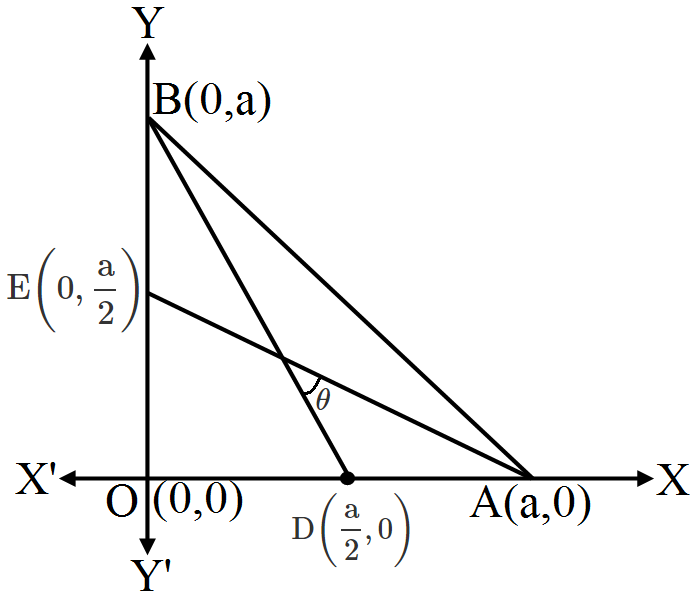
Here, $BD$ and $AE$ are the medians drawn from the acute angles $B$ and $A$, respectively.
$\therefore$ Slope of $BD = m_1$
$=\frac{0-\text{a}}{\frac{\text{a}}{2}-0}$
$=-\frac{1}{2}$
Let $\theta$ be the angle between $BD$ and $AE.$
$\tan\theta=\Big|\frac{-2+\frac{1}{2}}{1+1}\Big|$
$=\frac{3}{4}$
$\Rightarrow\cos\theta=\frac{4}{\sqrt{3^2+4^2}}$
$\Rightarrow\cos\theta=\frac{4}{5}$
$\Rightarrow\theta=\cos^{-1}\Big(\frac{4}{5}\Big)$
Hence, the acute angle between the medians is $\cos^{-1}\Big(\frac{4}{5}\Big).$ View full question & answer→MCQ 251 Mark
$.....$ is the midpoint of $(1, 2)$ and $(5, 8):$
- A
$(2, 5)$
- ✓
$(3, 5)$
- C
$(5, 2)$
- D
$(5, 3)$
AnswerCorrect option: B. $(3, 5)$
We know, midpoint of $(x_1, y_1)$ and $(x_2, y_2)$ is $\Big(\frac{{\text{x}}_{1}+{\text{x}}_{2}}{2}, \frac{{\text{y}}_{1}+{\text{y}}_{2}}{2}\Big)$
So, midpoint of $(1, 2)$ and $(5, 8)$ is $\Big(\frac{1+5}{2}, \frac{2+8}{2}\Big)$ is $(3, 5)$
View full question & answer→MCQ 261 Mark
If line joining $(1, 2)$ and $(5, 7)$ is parallel to line joining $(3, 4)$ and $(11, x):$
AnswerWe know, slope of line joining two points $(x_1, y_1)$ and $(x_2, y_2)$ is given by $\frac{(\text{y}_{2}-\text{y}_{1})}{(\text{x}_{2}-\text{x}_{1})}$
Lines are parallel means slope is equal.
$\Rightarrow\frac{(\text{x}-4)}{(11-3)} =\frac {(7-2)}{(5-1)}$
$\text{x}-4 = 5\times\frac{8}{4} = 10$
$\Rightarrow x = 14$
View full question & answer→MCQ 271 Mark
If $(-4, 5)$ is one vertex and $7x - y + 8 = 0$ is onediagonal of a square, then the equation of second diagonal is:
- A
$x + 3y = 21$
- B
$2x - 3y = 7$
- ✓
$x + 7y = 31$
- D
$2x + 3y = 21$
AnswerCorrect option: C. $x + 7y = 31$
View full question & answer→MCQ 281 Mark
Slope of a line is given by if inclination of line is $\alpha$:
- A
$\sin\alpha$
- B
$\cos\alpha$
- ✓
$\tan\alpha$
- D
$\cot\alpha$
AnswerCorrect option: C. $\tan\alpha$
Slope of a line is given by $\tan\alpha$ if inclination of line is $\alpha$. Slope is denoted by tangent of the inclination angle.
View full question & answer→MCQ 291 Mark
Equation of vertical line to the right of $y-$axis at $5$ units from $y-$axis is:
- ✓
$x = 5$
- B
$x = -5$
- C
$y = 5$
- D
$y = -5$
AnswerCorrect option: A. $x = 5$
Equation of $y-$axis is $x = 0.$ Vertical line is parallel to $y-$axis and to the right by $5$ units.
so, equation of line is $x = 5.$
View full question & answer→MCQ 301 Mark
In what ratio does the line $y - x + 2 = 0$ cut the line joining $(3, -1)$ and $( 8, 9)?$
- ✓
$2 : 3$
- B
$3 : 2$
- C
$3 : -2$
- D
$1 : 2$
AnswerCorrect option: A. $2 : 3$
View full question & answer→MCQ 311 Mark
The medians $AD$ and $BE$ of a triangle with vertices $A(0, b), B(0, 0)$ and $C(a, 0)$ are perpendicular to each other, if
- A
$\text{a}=\frac{\text{b}}{2}$
- B
$\text{b}=\frac{\text{a}}{2}$
- C
$\text{ab}=1$
- ✓
$\text{a}=\pm\sqrt{2}\text{b}$
AnswerCorrect option: D. $\text{a}=\pm\sqrt{2}\text{b}$
The midpoints of $BC$ and $AC$ are $\text{D}\Big(\frac{\text{a}}{2},0\Big)$ and $\text{E}\Big(\frac{\text{a}}{2},\frac{\text{b}}{2}\Big)$
Slope of $\text{AD}=\frac{0-\text{b}}{\frac{\text{a}}{2}-0}$
Slope of $\text{BE}=\frac{-\frac{\text{b}}{2}}{\frac{\text{-a}}{2}}$
It is given that the medians are perpendicular to each other.
$\frac{0-\text{b}}{\frac{\text{a}}{2}-0}\times\frac{-\frac{\text{b}}{2}}{-\frac{\text{a}}{2}}=-1$
$\Rightarrow\text{a}=\pm\sqrt{2}\text{b}$
View full question & answer→MCQ 321 Mark
Choose the correct answer. Slope of a line which cuts off intercepts of equal lengths on the axes is:
- ✓
$-1$
- B
$-0$
- C
$2$
- D
$\sqrt{3}$
AnswerIntercept form of a line is
$\frac{\text{x}}{\text{a}}+\frac{\text{y}}{\text{b}}=1$
$\Rightarrow \frac{\text{x}}{\text{a}}+\frac{\text{y}}{\text{a}}=1(\because \text{a}=\text{b})$
$\Rightarrow x + y = a$
$\Rightarrow y =- -x + a$
$\therefore$ Slope is $-1$
Hence, the correct option is $(a).$
View full question & answer→MCQ 331 Mark
If the two lines are perpendicular then difference of their inclination angle is:
- A
$45^\circ$
- B
$60^\circ$
- ✓
$90^\circ$
- D
$180^\circ$
AnswerCorrect option: C. $90^\circ$
If the two lines are perpendicular then if one line form angle $\alpha$ with positive $x-$axis then the other line form angle $90^\circ+\alpha$
View full question & answer→MCQ 341 Mark
If the area of the triangle with vertices $(x, 0), (1, 1)$ and $(0, 2)$ is $4$ square unit, then the value of $x$ is:
View full question & answer→MCQ 351 Mark
What is the inclination of a line which is parallel to $x-$axis?
- ✓
$0^\circ$
- B
$180^\circ$
- C
$45^\circ$
- D
$90^\circ$
AnswerCorrect option: A. $0^\circ$
If a line is parallel to $x-$axis then angle formed by it with $x-$axis is zero.
So, its inclination is zero.
View full question & answer→MCQ 361 Mark
The line segment joining the points $(-3, -4)$ and $(1, -2)$ is divided by $y-$axis in the ratio:
- A
$1 : 3$
- B
$2 : 3$
- ✓
$3 : 1$
- D
$3 : 2$
AnswerCorrect option: C. $3 : 1$
Let the points $(-3, -4)$ and $(1, -2)$ be divided by $y-$axis at $(0, t)$ in the ratio $m : n.$
$\therefore\Big(\frac{\text{m}-3\text{n}}{\text{m}+\text{n}},\frac{-2\text{m}-4\text{n}}{\text{m}+\text{n}}\Big)=(0,\text{t})$
$\Rightarrow0=\frac{\text{m}-3\text{n}}{\text{m}+\text{n}}$
$\Rightarrow\text{m}:\text{n}=3:1$
View full question & answer→MCQ 371 Mark
If a line with slope $m$ makes $x-$intercept $d$. Then equation of the line is:
- A
$y = m(d - x)$
- ✓
$y = m(x - d)$
- C
$y = m(x + d)$
- D
$y = mx + d$
AnswerCorrect option: B. $y = m(x - d)$
View full question & answer→MCQ 381 Mark
The condition for the points $(x, y), (-2, 2)$ and $(3, 1)$ to be collinear is:
- ✓
$x + 5y = 8$
- B
$x + 5y = 6$
- C
$5x + y = 8$
- D
$5x + y = 6$
AnswerCorrect option: A. $x + 5y = 8$
$x (2 - 1) -1(1 - y) + 3 (y - 2) = 0$ or $x + 5y = 8$
View full question & answer→MCQ 391 Mark
If equation of a line is $y = 3x - 4$ then find the slope of line:
AnswerComparing the above equation with general equation $y = m × x + c,$
$m = 3$ which is the slope of line.
View full question & answer→MCQ 401 Mark
The equation of a line that passes through the points $(1, 5)$ and $(2, 3)$ is:
- ✓
$2x + y - 7 = 0$
- B
$2x - y - 7 = 0$
- C
$x + 2y - 7 = 0$
- D
$2x + y + 7 = 0$
AnswerCorrect option: A. $2x + y - 7 = 0$
We know that the equation of a line passes through two points $(x_1, y_1)$ and $(x_2, y_2)$ is
$\frac{(\text{y}-\text{y}_{1})}{(\text{x}\text{-x}_{1})} = \frac{(\text{y}_{2}-\text{y}_{1})}{(\text{x}_{2}-\text{x}_{1})}$
$(x_1, y_1) = (1, 5)$
$(x_2, y_2) = (2, 3)$
Now, substitute the values in the formula, we get
$\frac{(\text{y}-5)}{(\text{x}-1)} = \frac{(3-5)}{(2-1)}$
$\frac{(\text{y}-5)}{(\text{x}-1)} = \frac{(-2)}{(1)}$
$y - 5 = -2(x - 1)$
$y - 5 = -2x + 2$
$2x + y - 5 - 2 = 0$
$2x + y - 7 = 0$
$\therefore$ The equation of a line that passes through the points $(1, 5)$ and $(2, 3)$ is $2x + y - 7 = 0.$
View full question & answer→MCQ 411 Mark
The locus of a point, whose abscissa and ordinate are always equal is:
- ✓
$x - y = 0$
- B
$x + y = 1$
- C
$x + y + 1 = 0$
- D
AnswerCorrect option: A. $x - y = 0$
Let the abscissa and ordinate of a point $“P”$ be $(x, y)$
Given condition: Abscissa $=$ Ordinate
$\text{(i.e) x = y}$
The locus of a point is $x - y = 0.$
View full question & answer→MCQ 421 Mark
Find the equation of line parallel to $4x + y = 2$ and pass through $(2, 5):$
- ✓
$4x + y - 13 = 0$
- B
$4x + y + 13 = 0$
- C
$4x - y - 13 = 0$
- D
$4x - y + 13 = 0$
AnswerCorrect option: A. $4x + y - 13 = 0$
Line $4x + y = 2$ has slope $-4.$ Line parallel to it has slope $-4$ and pass through $(2, 5)$
so equation will be $y - 5 = (-4) (x - 2)$
$\Rightarrow 4x + y - 13 = 0$
View full question & answer→MCQ 431 Mark
Choose the correct answer.
A line cutting off intercept $-3$ from the $y-$axis and the tengent at angle to the xaxis is $\frac{3}{5}$, its equation is:
- ✓
$5y - 3x + 15 = 0$
- B
$3y - 5x + 15 = 0$
- C
$5y - 3x - 15 = 0$
- D
AnswerCorrect option: A. $5y - 3x + 15 = 0$
Since the lines cut off intercepts $-3$ on $y-$axis then the line is passing through the point $(0, -3).$
Given that: $\tan\theta=\frac{3}{5}$
$\Rightarrow$ Slope of the line $\text{m}=\frac{3}{5}$
So, the equation of the line is
$y - y_1 = m(x - x_1)$
$\Rightarrow \text{y}+ 3 = \frac{3}{5}(\text{x} -0)$
$\Rightarrow 5y + 15 = 3x$
$\Rightarrow 3x - 5y - 15 = 0$
$\Rightarrow 5y - 3x + 15 = 0$
Hence, the correct option is $(a).$
View full question & answer→MCQ 441 Mark
The number of real values of $\lambda$ for which the lines $\text{x} - 2\text{y} + 3 = 0, \lambda\text{x} + 3\text{y} + 1 = 0$ and $4\text{x} - \lambda\text{y} + 2 = 0$ are concurrent is:
Answer$\text{x} - 2\text{y} + 3 = 0 \ ...(\text{i})$
$\lambda\text{x} + 3\text{y} + 1 = 0 \ ...(\text{ii})$
$4\text{x} - \lambda\text{y} + 2 = 0 \ ...(\text{iii})$
It is given that $(1), (2)$ and $(3)$ are concurrent.
$\therefore\begin{vmatrix} 1&-2&3\\\lambda&3&1\\4&-\lambda&2\end{vmatrix}=0$
$\Rightarrow(6+\lambda)+2(2\lambda-4)+3(-\lambda^2-12)=0$
$\Rightarrow6+\lambda+4\lambda-8-3\lambda^2-36=0$
$\Rightarrow5\lambda-3\lambda^2-38=0$
$\Rightarrow3\lambda^2-5\lambda+38=0$
The discriminant of this equation is $25 - 4 \times 3 \times 38 = -431$
Hence, there is no real value of $\lambda$ for which the lines $\text{x} - 2\text{y} + 3 = 0, \lambda\text{x} + 3\text{y} + 1 = 0$ and $4\text{x} - \lambda\text{y} + 2 = 0$ are concurrent.
View full question & answer→MCQ 451 Mark
Find slope of line if inclination made by the line is 60°.
- A
$\frac{1}{2}$
- B
$\frac{1}{\sqrt{3}}$
- ✓
$\sqrt{3}$
- D
$1$
AnswerCorrect option: C. $\sqrt{3}$
Slope of a line is given by $\tan\alpha$ if inclination of line is $\alpha$ If inclination is $60^\circ$ the slope is $\tan 60^\circ = \sqrt{3}$
View full question & answer→MCQ 461 Mark
If the point $(5, 2)$ bisects the intercept of a line between the axes, then its equation is:
- A
$5x + 2y = 20$
- ✓
$2x + 5y = 20$
- C
$5x - 2y = 20$
- D
$2x - 5y = 20$
AnswerCorrect option: B. $2x + 5y = 20$
Let the equation of the line be $\frac{\text{x}}{\text{a}}+\frac{\text{y}}{\text{b}}=1$
The coordinates of the intersection of this line with the coordinate axes are $(a, 0)$ and $(0, b).$
The midpoint of $(a, 0)$ and $(0, b)$ is $\Big(\frac{\text{a}}{2},\frac{\text{b}}{2}\Big)$
According to the question:
$\Big(\frac{\text{a}}{2},\frac{\text{b}}{2}\Big)=(5,2)$
$\Rightarrow\frac{\text{a}}{2}=5,\frac{\text{b}}{2}=2$
$\Rightarrow\text{a}=10,\text{b}=4$
The equation of the required line is given below:
$\frac{\text{x}}{10}+\frac{\text{y}}{4}=1$
$\Rightarrow2\text{x}+5\text{y}=20$
View full question & answer→MCQ 471 Mark
Choose the correct answer.
One vertex of the equilateral triangle with centroid at the origin and one side as $x + y - 2 = 0$ is:
- A
$(-1, -1)$
- B
$(2, 2)$
- ✓
$(-2, -2)$
- D
$(2, -2)$
AnswerCorrect option: C. $(-2, -2)$
Let $\text{ABC}$ be the equilateral triangle with vertex $A(h, k).$
Also, centroid is $G(0, 0).$
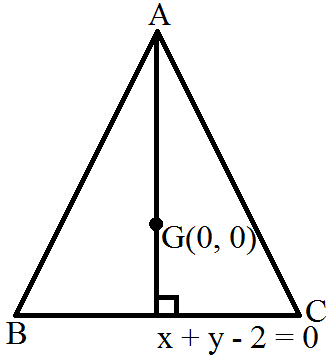
Now, $\text{AG}\bot\text{BC}$
Slope of line $BC$ or $x + y - 2 = 0$ is $-1.$
$\therefore$ Slope of $\text{AG},\frac{\text{k}}{\text{h}}=1$ or $h = k.$
Now distance of origin from $\text{BC}=\frac{|0+0-2}{\sqrt{1^2+1^2}|}=\sqrt{2}$
$\therefore$ Distance of $A$ form $\text{BC}=3\sqrt{2}=\frac{|\text{h}+\text{k}-2|}{\sqrt{1^2+1^2}}$
$\therefore |h + k - 2| = 6$
$\Rightarrow h + k - 8 = 0$ or $h + k + 4 = 0$
$\Rightarrow h + k - 8 = 0$ or $h + k + 4 = 0$
$\Rightarrow h = 4$ or $h = -2$
$\therefore$ Vertex is $(-2, -2).$ View full question & answer→MCQ 481 Mark
What is the distance between $(1, 3)$ and $(5, 6):$
- A
$3$ units
- B
$4$ units
- ✓
$5$ units
- D
$25$ units
AnswerCorrect option: C. $5$ units
We know, distance between two points $(x_1, y_1)$ and $(x_2, y_2)$ is $\sqrt{(\text{x}_{1}−\text{x}_{2})^2+(\text{y}_{1}−\text{y}_{2})^2.}$
So, distance between $(1, 3)$ and $(5, 6)$ is $\sqrt{{(1-5)}^2+{(3-6)}^2}$
$= (4)^2+ (3)^2$
$= 5$ units
View full question & answer→MCQ 491 Mark
Choose the correct answer.
If the line $\frac{\text{x}}{\text{a}} + \frac{\text{y}}{\text{b}} =1$ passes through the points $(2, -3)$ and $(4, -5),$ then $(a, b)$ is:
- A
$(1, 1)$
- B
$(-1, 1)$
- C
$(1, -1)$
- ✓
$(-1, -1)$
AnswerCorrect option: D. $(-1, -1)$
Equation of line passing through the points $(2, -3)$ and $(4, -5)$ is
$\text{y}+3=\frac{-5+3}{4-2}(\text{x}-2)$
$\Rightarrow \text{y}+3=\frac{-2}{2}(\text{x}-2)$
$\Rightarrow \text{y}+3=-(\text{x}-2)$
$\Rightarrow \text{y}+3=-\text{x}+2$
$\Rightarrow \text{x}+\text{y}=-1$
$\Rightarrow \frac{\text{x}}{-1}+\frac{\text{y}}{-1}=1 ($intercept from$)$
$\therefore \text{a}=-1,\text{b}=-1$
Hence, the correct option is $(d).$
View full question & answer→MCQ 501 Mark
The points $(-a, -b), (0 , 0), (a, b)$ and $(a^2, ab)$ are:
- A
- B
Vertices of a parallelogram
- ✓
- D
View full question & answer→