MCQ 511 Mark
Distance between the lines $5x + 3y - 7 = 0$ and $15x + 9y + 14 = 0$ is:
- A
$\frac{35}{\sqrt{34}}$
- B
$\frac{1}{3\sqrt{34}}$
- ✓
$\frac{35}{3\sqrt{34}}$
- D
$\frac{35}{2\sqrt{34}}$
AnswerCorrect option: C. $\frac{35}{3\sqrt{34}}$
The given lines can be written as
$5\text{x}+3\text{y}-7=0 \ ...(1)$
$5\text{x}+3\text{y}+\frac{14}{3}=0 \ ...(2)$
Let $d$ be the distance between the lines $5x + 3y - 7 = 0$ and $15x + 9y + 14 = 0$
Then, $\text{d}=\Bigg|\frac{-7-\frac{14}{3}}{\sqrt{5^2+3^2}}\Bigg|$
$\Rightarrow\text{d}=\frac{35}{3\sqrt{34}}$
View full question & answer→MCQ 521 Mark
Choose the correct answer. For specifying a straight line, how many geometrical parameters should be known?
AnswerDifferent form of equation of straight line are slope intercept form, $y = mx + c,$ Paramerer $= 2$
Intercept form, $\frac{\text{x}}{\text{a}}+\frac{\text{y}}{\text{b}}=1,$ parameter $= 2$
One-point from, $y - y_1 = m(x - x_1)$, parameter = 2
Normal form, $\text{x}\cos \text{w}+\text{y}\sin\text{w}=\text{P},$ Parameter $= 2$
Hence, the correct option is $(b).$
View full question & answer→MCQ 531 Mark
A line passes through $P (1, 2)$ such that its intercept between the axes is bisected at $P.$ The equation of the line is:
- A
$x + 2y = 5$
- B
$x - y + 1 = 0$
- C
$x + y - 3 = 0$
- ✓
$2x + y - 4 = 0$
AnswerCorrect option: D. $2x + y - 4 = 0$
View full question & answer→MCQ 541 Mark
Find the equation of line parallel to $x-$axis and passing through $(3, 4):$
- A
$x = 3$
- B
$x = 4$
- ✓
$y = 4$
- D
$y = 3$
AnswerCorrect option: C. $y = 4$
Let general equation of line be $y = m \times x + c.$
Since line is parallel to $x-$axis so, $m = 0.$
$\Rightarrow y = c$
$\Rightarrow y = 4$ by substituting the point $(3, 4).$
View full question & answer→MCQ 551 Mark
If $-40^\circ F$ is equal to $-40^\circ C$ and $0^\circ C$ is equal to $32^\circ F$ then find the value of $40^\circ C:$
- ✓
$104^\circ F$
- B
$112^\circ F$
- C
$86^\circ F$
- D
$92^\circ F$
AnswerCorrect option: A. $104^\circ F$
Let general equation be $F = m \times c + k$
$-40 = -40m + k$
and $32 = 0 + k$
$\Rightarrow -40 = -40m + 32$
$\text{ m}=\frac{72}{40} = \frac{18}{10}$
$\text{F}=\frac{18}{10} \times 40 + 32$
$= 72 + 32$
$= 104.$
View full question & answer→MCQ 561 Mark
The area of a triangle with vertices at $(-4, -1), (1, 2)$ and $(4, -3)$ is:
AnswerLet $A$ be the area of the triangle formed by the points $(-4, -1), (1, 2)$ and $(4, -3).$
$\therefore\text{A}=\frac{1}{2}\big|\{\text{x}_1(\text{y}_2-\text{y}_3)+\text{x}_2(\text{y}_3-\text{y}_1)+\text{x}_3(\text{y}_1-\text{y}_2)\}\big|$
$\Rightarrow\text{A}=\frac{1}{2}\big|\{-4(2+3)+1(-3+1)+4(-1-2)\}\big|$
$\Rightarrow\text{A}=17$
View full question & answer→MCQ 571 Mark
If equation of line is $y = 5x + 10$ then find the value of $x-$intercept made by the line:
- A
$2$
- B
$\frac{1}{2}$
- C
$\frac{-1}{2}$
- ✓
$-2$
AnswerGiven, equation is $y = 5x + 10.$
$X-$intercept means value of $x$ when $y$ is zero $0 = 5x + 10$
$\Rightarrow x = -2$
View full question & answer→MCQ 581 Mark
The distance between $M (-1, 5)$ and $N (x, 5)$ is $8$ units. The value of $x$ is:
- A
$-9$ or $9$
- B
$-7$ or $9$
- ✓
$-9$ or $7$
- D
$-7$ or $-9$
AnswerCorrect option: C. $-9$ or $7$
$\sqrt{[\text{x}-(-1)^{2}] + (5-5)^{2}} = 8$
$\Rightarrow(\text{x+1})^2=8^2$
$\Rightarrow\text{x}+1=\underline{+}8$
$\therefore\text{x}=-9,7$
View full question & answer→MCQ 591 Mark
The equation of the straight line which passes through the point $(-4, 3)$ such that the portion of the line between the axes is divided internally by the point in the ratio $5 : 3$ is:
- ✓
$9x - 20y + 96 = 0$
- B
$9x + 20y = 24$
- C
$20x + 9y + 53 = 0$
- D
AnswerCorrect option: A. $9x - 20y + 96 = 0$
Let the required line intersects the coordinate axis at $(a, 0)$ and $(0, b).$
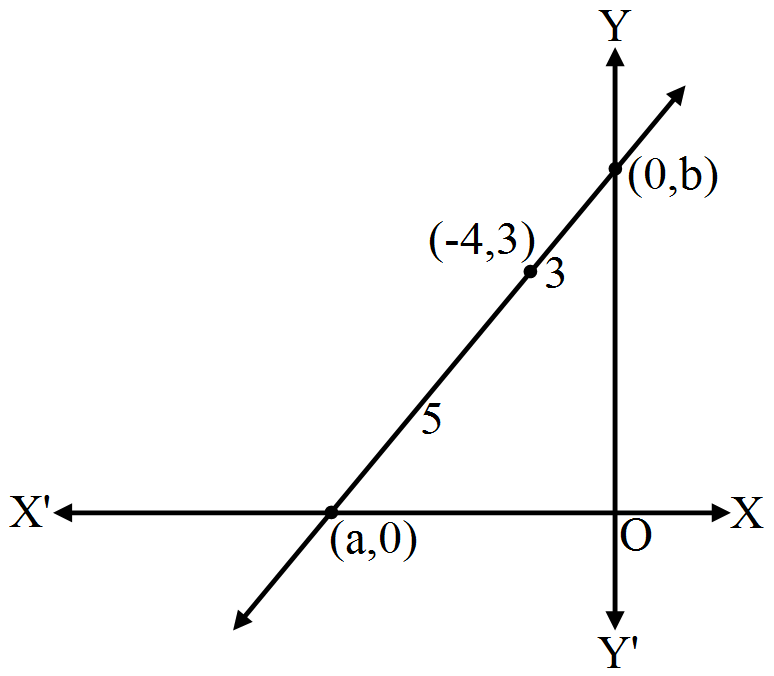
The point $(−4, 3)$ divides the required line in the ratio $5 : 3$
$\therefore \ -4=\frac{5\times0+3\times\text{a}}{5+3}$ and $3=\frac{5\times\text{b}+3\times0}{5+3}$
$\Rightarrow\text{a}=\frac{ -32}{3}$ and $\text{b}=\frac{ 24}{5}$
Hence, The equation of the required line is given below:
$\frac{\text{x}}{\frac{-32}{3}}+\frac{\text{y}}{\frac{24}{5}}=1$
$\Rightarrow\frac{-3\text{x}}{32}+\frac{5\text{y}}{24}=1$
$\Rightarrow-9\text{x}+20\text{y}=96$
$\Rightarrow9\text{x}-20\text{y}+96=0$ View full question & answer→MCQ 601 Mark
The slope of a line $ax + by + c = 0$ is:
- A
$\frac{\text{a}}{\text{b}}$
- ✓
$\frac{\text{-a}}{\text{b}}$
- C
$\frac{\text{c}}{\text{b}}$
- D
$\frac{\text{-c}}{\text{b}}$
AnswerCorrect option: B. $\frac{\text{-a}}{\text{b}}$
We know that the general equation of a line is $ax + by + c = 0.$
Rearranging the equation, we get
$\Rightarrow by = -ax - c$
$\Rightarrow\text{y} =\big(\frac{\text{-a}}{\text{b}})\text{ x}-\big(\frac{\text{-c}}{\text{b}}) ...(1)$
This is of the form, $y = mx + c … (2)$
By comparing $(1)$ and $(2),$ we get
Slope, $\text{m} = \frac{\text{-a}}{\text{b}}$
View full question & answer→MCQ 611 Mark
Two vertices of a triangle are $(-2, -1)$ and $(3, 2)$ and third vertex lies on the line $x + y = 5.$ If the area of the triangle is $4$ square units, then the third vertex is:
- A
$(0, 5)$ or, $(4, 1)$
- ✓
$(5, 0)$ or, $(1, 4)$
- C
$(5, 0)$ or, $(4, 1)$
- D
$(0, 5)$ or, $(1, 4)$
AnswerCorrect option: B. $(5, 0)$ or, $(1, 4)$
Let $(h, k)$ be the third vertex of the triangle.
It is given that the area of the triangle with vertices $(h, k), (-2, -1)$ and $(3, 2)$ is $4$ square units.
$\frac{1}{2}\big|\text{h}(-1-2)-3(-1-\text{K})-2(2-\text{K})\big|=4$
$\Rightarrow3\text{h}-5\text{k}+1=\pm 8$
Taking positive sign, we get,
$3h - 5k + 1 = 8$
$3h - 5k - 7 = 0 ...(1)$
Taking negative sign, we get,
$3h - 5k + 9 = 0 ...(2)$
The vertex $(h, k)$ lies on the line $x + y = 5.$
$h + k - 5 = 0 ...(3)$
On solving $(1)$ and $(3)$, we find $(4, 1)$ to be the coordinates of the third vertex.
Similarly, on solving $(2)$ and $(3),$ we find $(2, 3)$ to be the coordinates of the third vertex.
View full question & answer→MCQ 621 Mark
If $x-$intercept of a line is $4$ and its $y-$intercept is $2$ then find the equation of line:
- A
$2x + y - 4 = 0.$
- ✓
$x + 2y - 4 = 0.$
- C
$2x + y + 4 = 0.$
- D
$x + 2y + 4 = 0.$
AnswerCorrect option: B. $x + 2y - 4 = 0.$
If $x-$intercept of a line is a and $y-$intercept of line is b so, equation of line is $\frac{\text{x}}{\text{a}}+\frac{\text{y}}{\text{b}} = 1$
Equation of line is $\frac{\text{x}}{4}+\frac{\text{y}}{2} = 1$
$\Rightarrow x + 2y - 4 = 0.$
View full question & answer→MCQ 631 Mark
Find the distance between $2x + y + 4 = 0$ and $2x + y + 8 = 0:$
- ✓
$\frac{4}{\sqrt5}$
- B
$\frac{3}{\sqrt5}$
- C
$\frac{9}{\sqrt5}$
- D
$\frac{3}{\sqrt5}$
AnswerCorrect option: A. $\frac{4}{\sqrt5}$
Distance between parallel lines $ax + by + c_1 = 0$ and $ax + by + c_2 = 0$ is $\mid\frac{\text{c}_{1}-\text{c}_{2}}{\sqrt{\text{a}^2+\text{b}^2}}\mid$
So, distance $2x + y + 4 = 0$ and $2x + y + 8 = 0$ is $\mid\frac{8-4}{\sqrt2^2+1^2}\mid=\frac{4}{\sqrt5}$
View full question & answer→MCQ 641 Mark
If equation of a line is $y = 3x - 4$ then find the slope of line:
AnswerComparing the above equation with general equation $y = m × x + c,$
$m = 3$ which is the slope of line.
View full question & answer→MCQ 651 Mark
Choose the correct answer. The distance between the lines $y = mx + c_1$ and $y = mx + c_2$ is:
- A
$\frac{\text{c}_1-\text{c}_2}{\sqrt{\text{m}^2+1}}$
- ✓
$\frac{|\text{c}_1-\text{c}_2|}{\sqrt{1+\text{m}^2}}$
- C
$\frac{\text{c}_2-\text{c}_1}{\sqrt{1+\text{m}^2}}$
- D
$0$
AnswerCorrect option: B. $\frac{|\text{c}_1-\text{c}_2|}{\sqrt{1+\text{m}^2}}$
Let any point on the line $y=m x+c_1$ be $P\left(x_1, y_1\right)$.
The equation of the other line is : $y=m x+c_2$
$\Rightarrow m x-y+c_2=0$
Distance of point $P$ from this line, $\text{d}=\frac{|\text{mx}_1-\text{y}_1+\text{c}_2|}{\sqrt{\text{m}^2+1}}$
Since $P$ line on the first line, we get
$ \Rightarrow y_1=m x_1+c_1$
$ \Rightarrow m x_1-y_1=-c_1 $
$\therefore \text{d}=\frac{|\text{c}_1-\text{c}_2|}{\sqrt{\text{m}^2+1}}$
View full question & answer→MCQ 661 Mark
Angle made by line with measured anticlockwise is called inclination of the line:
- ✓
Positive $x-$axis
- B
Negative $x-$axis
- C
Positive $y-$axis
- D
Negative $y-$axis
AnswerCorrect option: A. Positive $x-$axis
We know, inclination of line is always measured with positive $x-$axis in anticlockwise direction.
View full question & answer→MCQ 671 Mark
Choose the correct answer.
If the coordinates of the middle point of the portion of a line intercepted between the coordinate axes is $(3, 2),$ then the equation of the line will be:
- ✓
$2x + 3y = 12$
- B
$3x + 2y = 12$
- C
$4x - 3y = 6$
- D
$5x - 2y = 10$
AnswerCorrect option: A. $2x + 3y = 12$
Let the given the line meets the axes at $A(a, 0)$ and $B(0, b).$
Given that $C(3, 2)$ is the mid$-$point of $AB$
$\therefore 3=\frac{\text{a}+0}{2}\Rightarrow \text{a}=6$
and $2=\frac{0+\text{b}}{2}\Rightarrow \text{b}=4$
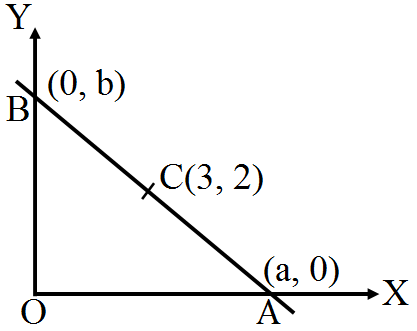
Intercept form of the line $AB$
$\Rightarrow \frac{\text{x}}{6}+\frac{\text{y}}{4}=1$
$\Rightarrow 2\text{x}+3\text{y}=12$
Hence, the correct option is $(a).$ View full question & answer→MCQ 681 Mark
If slope of a line is negative then its inclination is:
AnswerIf inclination is $\alpha$ slope is given by $\tan\alpha$ Given that slope of line is negative which means $\tan\alpha$ is negative. We know, $\tan\alpha$ is negative in $2^{nd}$ quadrant
i.e. $\alpha$ should be obtuse angle.
View full question & answer→MCQ 691 Mark
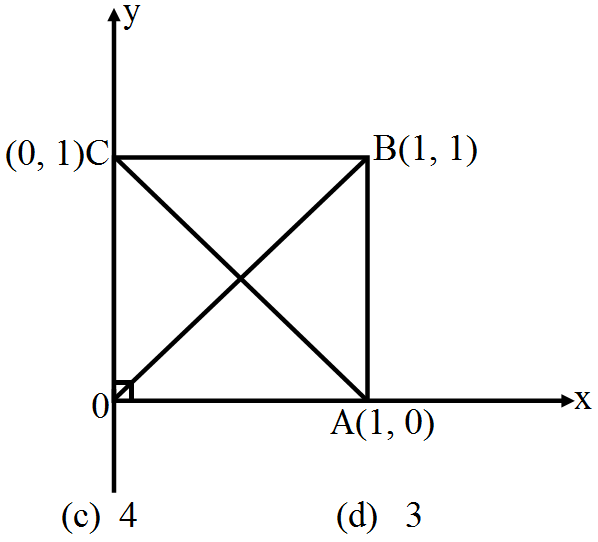
Choose the correct answer. Equations of diagonals of the square formed by the lines $x = 0, y = 0, x = 1$ and $y = 1$ are:
AnswerCorrect option: A. $y = x, y + x = 1$
Given lines are plotted on coordinate plane as shown in the adjacent figure.
From the figure, equation of diagonal $OB$ is $y = x.$
Equation of the diagonal $AC$ is $x + y = 1 ($using intercept form$).$
View full question & answer→MCQ 701 Mark
If $p$ be the length of the perpendicular from the origin on the line $\frac{\text{x}}{\text{a}}+\frac{\text{y}}{\text{b}}=1,$ then:
- A
$\text{p}^2=\text{a}^2+\text{b}^2$
- B
$\text{p}^2=\frac{1}{\text{a}^2}+\frac{1}{\text{b}^2}$
- ✓
$\frac{1}{\text{p}^2}=\frac{1}{\text{a}^2}+\frac{1}{\text{b}^2}$
- D
AnswerCorrect option: C. $\frac{1}{\text{p}^2}=\frac{1}{\text{a}^2}+\frac{1}{\text{b}^2}$
It is given that $p$ is the length of the perpendicular from the origin on the line
$\frac{\text{x}}{\text{a}}+\frac{\text{y}}{\text{b}}=1$
$\frac{1}{\text{a}}\text{x}+\frac{1}{\text{b}}\text{y}-1=0$
$\therefore\text{p}=\begin{vmatrix}\frac{0+0+1}{\sqrt{\frac{1}{\text{a}^2}+\frac{1}{\text{b}^2}}} \end{vmatrix}$
Squaring both sides,
$\Rightarrow\frac{1}{\text{p}^2}=\frac{1}{\text{a}^2}+\frac{1}{\text{b}^2}$
View full question & answer→MCQ 711 Mark
If equation of line is $y = 5x + 10$ then find the value of $x-$intercept made by the line:
- A
$2$
- B
$\frac{1}{2}$
- C
$\frac{-1}{2}$
- ✓
$-2$
AnswerGiven, equation is $y = 5x + 10.$
$X-$intercept means value of $x$ when $y$ is zero.
$0 = 5x + 10$
$\Rightarrow x = -2$
View full question & answer→MCQ 721 Mark
Slope of a line is given by if inclination of line is $\alpha$:
- A
$\sin\alpha$
- B
$\cos\alpha$
- ✓
$\tan\alpha$
- D
$\cot\alpha$
AnswerCorrect option: C. $\tan\alpha$
Slope of a line is given by $\tan\alpha$ if inclination of line is $\alpha$ Slope is denoted by tangent of the inclination angle.
View full question & answer→MCQ 731 Mark
The ratio in which the line $3x + 4y + 2 = 0$ divides the distance between the line $3x + 4y + 5 = 0$ and $3x + 4y - 5 = 0$ is:
- A
$1 : 2$
- ✓
$3 : 7$
- C
$2 : 3$
- D
$2 : 5$
AnswerCorrect option: B. $3 : 7$
Here, in all equations the coefficient of $x$ is same.
It means all the lines have same slope
So, all the lines are parallel.
Now, the distance between the line $3x + 4y + 2 = 0$ and $3x + 4y + 5 = 0$ is given by
$\frac{|2-5|}{\sqrt{3^2+4^2}}$
$=\frac{3}{\sqrt{25}}=\frac{3}{5}$
Hence, the ratio is given by
$\frac{3}{5}:\frac{7}{5}$
$=3:7$
View full question & answer→MCQ 741 Mark
If a line makes an angle a with the positive direction of $x-$axis, then the slope of the line is given by:
- A
$\text{m} = \sin\text{a}$
- B
$\text{m} = \cos\text{a}$
- ✓
$\text{m} = \tan\text{a}$
- D
$\text{m} = \sec\text{a}$
AnswerCorrect option: C. $\text{m} = \tan\text{a}$
View full question & answer→MCQ 751 Mark
The equation of a straight line that passes through the point $(3, 4)$ and perpendicular to the line $3x + 2y + 5 = 0$ is:
- ✓
$2x - 3y + 6 = 0$
- B
$2x + 3y + 6 = 0$
- C
$2x - 3y - 6 = 0$
- D
$2x + 3y - 6 = 0$
AnswerCorrect option: A. $2x - 3y + 6 = 0$
The equation of a straight line perpendicular to $3x + 2y + 5 = 0$ is $2\text{x}-3\text{y}+\lambda=0 …(1)$
This passes through the point $(3, 4).$
Now, substitute in equation $(1),$ we get
$2(2) - 3(4) +\lambda = 0$
$4-12+\lambda =0$
$-6+\lambda =0$
$\lambda=6$
Substituting $\lambda=6 $ in $(1),$ we get $2x - 3y + 6 = 0,$ which is the required equation.
View full question & answer→MCQ 761 Mark
The inclination of the straight line passing through the point $(-3, 6)$ and the mid$-$point of the line joining the point $(4, -5)$ and $(-2, 9)$ is:
- A
$\frac{\pi}{4}$
- B
$\frac{\pi}{6}$
- C
$\frac{\pi}{3}$
- ✓
$\frac{3\pi}{4}$
AnswerCorrect option: D. $\frac{3\pi}{4}$
The midpoint of the line joining the points $(4, -5)$ and $(-2, 9)$ is $(1, 2).$
Let $\theta$ be the inclination of the straight line passing through the points $(-3, 6)$ and $(1, 2).$
Then, $\tan\theta=\frac{ 2-6}{1+3}=-1$
$\Rightarrow\theta=\frac{3\pi}{4}$
View full question & answer→MCQ 771 Mark
If slope of a line is $4$ and $x-$intercept made by the line is $2$ then the equation of line will be:
- ✓
$y = 4x - 8$
- B
$y = 4x + 8$
- C
$y = 2x + 4$
- D
$y = 2x - 4$
AnswerCorrect option: A. $y = 4x - 8$
Let general equation of line be $y = m \times x + c.$
Given, $m = 4$ and value of $x$ when $y = 0$ is $2.$
$C = -m \times 2 = -4 \times 2 = -8.$
$\Rightarrow y = 4x - 8$
View full question & answer→MCQ 781 Mark
The angle between the lines $2x - y + 3 = 0$ and $x + 2y + 3 = 0$ is:
- ✓
$90^\circ$
- B
$60^\circ$
- C
$45^\circ$
- D
$30^\circ$
AnswerCorrect option: A. $90^\circ$
Let $m_1$ and $m_2$ be the slope of the lines $2x - y + 3 = 0$ and $x + 2y + 3 = 0,$ respectively.
Let $\theta$ be the angle between them.
Here, $m_1= 2$ and $\text{m}_2=-\frac{1}{2}$
$\because\text{m}_1\text{m}_2=-1$
Therefore, the angle between the given lines is $90^\circ .$
View full question & answer→MCQ 791 Mark
If $A (6, 4)$ and $B (2, 12)$ are the two points, then the slope of a line perpendicular to line $AB$ is:
- A
$-2$
- B
$2$
- ✓
$\frac{1}{2}$
- D
$\frac{-1}{2}$
AnswerCorrect option: C. $\frac{1}{2}$
Given points: $A (6, 4) =(x_1, y_1)$
$B (2, 12) =(x_2, y_2)$
We know that the slope of a line passing through two points $(x_1, y_1)$ and $(x_2, y_2)$ is $\frac{(\text{y}_{2}\text{-y}_{1})}{(\text{x}_{2}-\text{x}_{1})}$
$\text{m} = \frac{(12-4)}{(2-6)} = \frac{8}{-4} = -2.$
We know that the slope of two perpendicular lines $m_1.m_2 =-1.$
The slope of a line perpendicular to line $AB$ is $\frac{-1}{\text{m}} = \frac{-1}{-2} = \frac{1}{2}$
View full question & answer→MCQ 801 Mark
$A(6, 3), B(-3, 5), C(4, -2)$ and $D(x, 3x)$ are four points. If $\triangle\text{DBC} : \triangle\text{ABC}= 1 : 2,$ then $x$ is equal to:
- ✓
$\frac{11}{8}$
- B
$\frac{8}{11}$
- C
$3$
- D
AnswerCorrect option: A. $\frac{11}{8}$
The area of a triangle with vertices $D(x, 3x), B(-3, 5)$ and $C(4, -2)$ is given below:
Area of $\triangle\text{DBC}=\frac{1}{2}\{\text{x}(5+2)-3(-2-3\text{x})+4(3\text{x}-5)\}$
$\Rightarrow$ Area of $\triangle\text{DBC}=(14\text{x}-7)\text{sq units}$
Similarly, the area of a triangle with vertices $A(6, 3), B(-3, 5)$ and $C(4, -2)$ is given below:
$\triangle\text{ABC}=\frac{1}{2}\{6(5+2)-3(-2-3)+4(3-5)\}$
$\triangle\text{ABC}=\frac{49}{2}\text{sq units}$
Given:
$\triangle\text{DBC}:\triangle\text{ABC}=1:2$
$\frac{2(14\text{x}-7)}{49}=\frac{1}{2}$
$\Rightarrow8\text{x}-4=7$
$\Rightarrow\text{x}=\frac{11}{8}$
View full question & answer→MCQ 811 Mark
The equation $\frac{(2 \text{x})}{2} - \frac{(\text{y}{ 2})}{2} = -3,$ if $x = -2,$ then $y$ is equal to:
View full question & answer→MCQ 821 Mark
Equation of vertical line to the left of $y-$axis at $5$ units from $y-$axis is:
- A
$x = 5$
- ✓
$x = -5$
- C
$y = 5$
- D
$y = -5$
AnswerCorrect option: B. $x = -5$
Equation of $y-$axis is $x = 0.$ Vertical line is parallel to $y-$axis and to the left by $5$ units
so, equation of line is $x = -5.$
View full question & answer→MCQ 831 Mark
Find the equation perpendicular to $2x - y = 4$ and pass through $(2, 4):$
- A
$2x + y - 10 = 0$
- B
$x + 2y + 10 = 0$
- ✓
$x + 2y - 10 = 0$
- D
$x + y - 10 = 0$
AnswerCorrect option: C. $x + 2y - 10 = 0$
Line $2x - y = 4$ has slope $2$.
Line perpendicular to given line has slope $\frac{-1}{2}$
equation is $(\text{y}-4) = \big(\frac{-1}{2}\big) (\text{x}-2)$
$2y - 8 = -x + 2$
$\Rightarrow x + 2y - 10 = 0$
View full question & answer→MCQ 841 Mark
Which of the following lines is farthest from the origin?
- A
$x - y + 1 = 0$
- B
$2x - y + 3 = 0$
- C
$x + 2y - 2 = 0$
- ✓
$x + y - 2 = 0$
AnswerCorrect option: D. $x + y - 2 = 0$
View full question & answer→MCQ 851 Mark
Equation of horizontal line above $x-$axis at $5$ units from $x-$axis is:
- A
$x = 5$
- B
$x = -5$
- ✓
$y = 5$
- D
$y = -5$
AnswerCorrect option: C. $y = 5$
Equation of $x-$axis is $y = 0.$ Horizontal line is parallel to $x-$axis and above it by $5$ units
so, equation of line is $y = 5.$
View full question & answer→MCQ 861 Mark
The inclination of the line $x - y + 3 = 0$ with the positive direction of $x-$axis is:
- ✓
$45^\circ$
- B
$135^\circ$
- C
$-45^\circ$
- D
$-135^\circ$
AnswerCorrect option: A. $45^\circ$
View full question & answer→MCQ 871 Mark
What is the inclination of a line which is parallel to $y-$axis?
- A
$0^\circ$
- B
$180^\circ$
- C
$45^\circ$
- ✓
$90^\circ$
AnswerCorrect option: D. $90^\circ$
If a line is parallel to $y-$axis then angle formed by it with $x-$axis is $90^\circ .$
So, its inclination is $90^\circ .$
View full question & answer→MCQ 881 Mark
Find the equation of line parallel to $x-$axis and passing through $(3, 4):$
- A
$x = 3$
- B
$x = 4$
- ✓
$y = 4$
- D
$y = 3$
AnswerCorrect option: C. $y = 4$
Let general equation of line be $y = m \times x + c.$
Since line is parallel to $x-$axis so, $m = 0.$
$\Rightarrow y = c$
$\Rightarrow y = 4$ by substituting the point $(3, 4).$
View full question & answer→MCQ 891 Mark
Equation of horizontal line above $x-$axis at $5$ units from $x-$axis is:
- A
$x = 5$
- B
$x = -5$
- ✓
$y = 5$
- D
$y = -5$
AnswerCorrect option: C. $y = 5$
Equation of $x-$axis is $y = 0.$ Horizontal line is parallel to $x-$axis and above it by $5$ units
so, equation of line is $y = 5$
View full question & answer→MCQ 901 Mark
The equations of the sides $\text{AB, BC}$ and $\text{CA}$ of $\triangle \text{ABC}$ are $y - x = 2, x + 2y = 1$ and $3x + y + 5 = 0$ respectively. The equation of the altitude through $B$ is:
- A
$x - 3y + 1 = 0$
- ✓
$x - 3y + 4 = 0$
- C
$3x - y + 2 = 0$
- D
AnswerCorrect option: B. $x - 3y + 4 = 0$
The equation of the sides $\text{AB, BC}$ and $\text{CA}$ of $\triangle \text{ABC}$ are $y - x = 2, x + 2y = 1$ and $3x + y + 5 = 0,$ respectively.
Solving the equations of $\text{AB}$ and $\text{BC,}$
i.e. $y - x = 2$ and $x + 2y = 1,$ we get:
$x = -1, y = 1$
So, the coordinates of $B$ are $(-1, 1).$
The altitude through $B$ is perpendicular to $AC.$
$\therefore$ Slope of $AC = -3$
Thus, slope of the altitude through $B$ is $13.$
Thus, slope of the altitude through $B$ is $\frac{1}{3}.$
Equation of the required altitude is given below:
$\text{y}-1+\frac{1}{3}(\text{x}+1)$
$\Rightarrow\text{x}-3\text{y}+4=0$
View full question & answer→MCQ 911 Mark
For specifying a straight line, how many geometrical parameters should be known:
MCQ 921 Mark
Two lines are said to be parallel if the difference of their slope is:
AnswerWe know that two lines are said to be parallel if their slope is equal. If $m_1$ and $m_2$ are the slopes of two parallel lines, then it is represented as $m_1= m_2$.
The difference of their slope should be $m_1- m_2= 0.$
View full question & answer→MCQ 931 Mark
The distance between the lines $3x + 4y = 9$ and $6x + 8y = 15$ is:
- A
$\frac{3}{2}$
- ✓
$\frac{3}{10}$
- C
$6$
- D
$\frac{9}{4}$
AnswerCorrect option: B. $\frac{3}{10}$
View full question & answer→MCQ 941 Mark
If equation of line is $x + y = 2$ then find the angle made by line with $x-$axis:
- ✓
$45^\circ$
- B
$60^\circ$
- C
$30^\circ$
- D
$75^\circ$
AnswerCorrect option: A. $45^\circ$
Given, equation is $x + y = 2.$ Reducing the above equation to normal form
$\frac{(\text{x + y})}{\sqrt2} ={\sqrt2}.$
$\text{x} \cos45^\circ + \text{y} \sin 45^\circ = {\sqrt2}$
Angle made with $x-$axis is $45^\circ .$
View full question & answer→MCQ 951 Mark
Angle made by line with measured anticlockwise is called inclination of the line:
- ✓
Positive $x-$axis.
- B
Negative $x-$axis.
- C
Positive $y-$axis.
- D
Negative $y-$axis.
AnswerCorrect option: A. Positive $x-$axis.
We know, inclination of line is always measured with positive $x-$axis in anticlockwise direction.
View full question & answer→MCQ 961 Mark
If $a + b + c = 0,$ then the family of lines $3ax + by + 2c = 0$ pass through fixed point:
- A
$\Big(2,\frac{2}{3}\Big)$
- ✓
$\Big(\frac{2}{3},2\Big).$
- C
$\Big(-2,\frac{2}{3}\Big)$
- D
AnswerCorrect option: B. $\Big(\frac{2}{3},2\Big).$
Given:
$a + b + c = 0$
Substituting $c = -a - b$ in $3ax + by + 2c = 0,$ we get:
$3\text{ax}+\text{by}-2\text{a}-2\text{b}=0$
$\Rightarrow\text{a}(3\text{x}-2)+\text{b}(\text{y}-2)=0$
$\Rightarrow(3\text{x}-2)+\frac{\text{b}}{\text{a}}(\text{y}-2)=0$
This line is of the form $\text{L}_1+\lambda\text{L}_2=0,$ which passes through the intersection of the lines $L_1$ and $L_2$
i.e. $3x - 2 = 0$ and $y - 2 = 0.$
Solving $3x - 2 = 0$ and $y - 2 = 0,$ we get
$\text{x}=\frac{2}{3},\text{y}=2$
Hence, the required fixed point is $\Big(\frac{2}{3},2\Big).$
View full question & answer→MCQ 971 Mark
Equation of the straight line making equal intercepts on the axes and passing through the point $(2, 4)$ is:
- A
$4x - y - 4 = 0$
- B
$2x + y - 8 = 0$
- ✓
$x + y - 6 = 0$
- D
$x + 2y - 10 = 0$
AnswerCorrect option: C. $x + y - 6 = 0$
View full question & answer→MCQ 981 Mark
Equation of vertical line to the right of $y-$axis at $5$ units from $y-$axis is:
- ✓
$x = 5$
- B
$x = -5$
- C
$y = 5$
- D
$y = -5$
AnswerCorrect option: A. $x = 5$
Equation of $y-$axis is $x = 0.$ Vertical line is parallel to $y-$axis and to the right by $5$ units
so, equation of line is $x = 5.$
View full question & answer→MCQ 991 Mark
What can be said regarding a line if its slope is negative?
- A
$\theta$ is an acute angle
- ✓
$\theta$ is an obtuse angle
- C
Either the line is $x-$axis or it is parallel to the $x-$axis
- D
AnswerCorrect option: B. $\theta$ is an obtuse angle
The line with a negative slope makes an obtuse angle with a positive $x-$axis when measured in the anti$-$clockwise direction.
View full question & answer→MCQ 1001 Mark
The centroid of the triangle with vertices $(2, 6), (-5, 6)$ and $(9,3)$ is:
- A
$(2, -3)$
- ✓
$(2, 5)$
- C
$(-2, 3)$
- D
$(-2, -3)$
AnswerCorrect option: B. $(2, 5)$
$\text{G}=\Big(\frac{\text{x}_{1}+\text{x}_{2}+\text{x}_{3}}{3},\frac{\text{y}_{1}+\text{y}_{2}+\text{y}_{3}}{3}\Big)$
$=\Big(\frac{2 - 5 + 9}{3},\frac{6 + 6 + 6}{3}\Big)$
$= (2,5)$
View full question & answer→