MCQ 1011 Mark
If a line has slope $3$ and pass through point $(1, 2)$ then the equation of line is:
- A
$x = 3y - 1$
- B
$x = 3y + 1$
- C
$y = 3x + 1$
- ✓
$y = 3x - 1$
AnswerCorrect option: D. $y = 3x - 1$
Let general equation of line be $y = m \times x + c.$
Given $m = 3$
$\Rightarrow y = 3x + c$
Substituting the point $(1, 2)$ in above equation we get $2 = 3 \times 1 + c$
$\Rightarrow c = -1$
So, equation of line will be $y = 3x - 1.$
View full question & answer→MCQ 1021 Mark
The inclination of the line $5x - 5y + 8 = 0$ is:
- A
$30^\circ$
- ✓
$45^\circ$
- C
$60^\circ$
- D
$90^\circ$
AnswerCorrect option: B. $45^\circ$
View full question & answer→MCQ 1031 Mark
The equation of the line through the points $(1, 5)$ and $(2, 3)$ is:
- A
$2x - y - 7 = 0$
- B
$2x + y + 7 = 0$
- ✓
$2x + y - 7 = 0$
- D
$x + 2y - 7 = 0$
AnswerCorrect option: C. $2x + y - 7 = 0$
View full question & answer→MCQ 1041 Mark
The centroid of the triangle with vertices $(2, 6), (-5, 6)$ and $(9, 3)$ is:
- A
$(2, -3)$
- ✓
$(2, 5)$
- C
$(-2, 3)$
- D
$(-2, -3)$
AnswerCorrect option: B. $(2, 5)$
$\text{G} =\Big(\frac{ {\text{x}_{1}+\text{x}_{2}+\text{x}_{3}}}{3},\frac{ {\text{y}_{1}+\text{y}_{2}+\text{y}_{3}}}{3}\Big)$
$=\Big(\frac {2-5+9}{3}, \frac{6+6+6}{3}\Big)$
$= (2,5)$
View full question & answer→MCQ 1051 Mark
If the lines $x + q = 0, y - 2 = 0$ and $3x + 2y + 5 = 0$ are concurrent, then the value of $q$ will be:
AnswerThe lines $x + q = 0, y - 2 = 0$ and $3x + 2y + 5 = 0$ are concurrent.
$\therefore\begin{vmatrix}1&0&\text{q}\\0&1&-2\\3&2&5 \end{vmatrix}=0$
$\Rightarrow1(5+4)-0+\text{q}(0-3)=0$
$\Rightarrow3\text{q}=9$
$\Rightarrow\text{q}=3$
View full question & answer→MCQ 1061 Mark
The distance of the point $(x_1, y_1)$ from the origin:
- A
$\text{x}\frac{2}{1}+\text{y}\frac{2}{1}$
- ✓
$\sqrt{\text{x}\frac{2}{1}+\text{y}\frac{2}{1}}$
- C
$\frac{1}{\sqrt{\text{x}\frac{2}{1}+\text{y}\frac{2}{1}}}$
- D
$\frac{1}{\text{x}\frac{2}{1}+\text{y}\frac{2}{1}}$
AnswerCorrect option: B. $\sqrt{\text{x}\frac{2}{1}+\text{y}\frac{2}{1}}$
We can use the distance formula to find the length of the line.
Distance between points $\sqrt{(\text{x}_{2}-\text{x}_{1}+(\text{y}_{2}-\text{y}_{1})}$
But given that one of the co$-$ordinates is $(0, 0)$
Distance from $(0, 0)$ is $=\sqrt{(\text{x}_{1})^{2}+(\text{y}_{1})^{2}}$
View full question & answer→MCQ 1071 Mark
A point equidistant from the line $4x + 3y + 10 = 0, 5x - 12y + 26 = 0$ and $7x + 24y - 50 = 0$ is:
- A
$(1, -1)$
- B
$(1, 1)$
- ✓
$(0, 0)$
- D
$(0, 1)$
AnswerCorrect option: C. $(0, 0)$
Let the coordiantes of the point be $(a, b)$
Now, the distance of the point $(a, b)$ from $4x + 3y + 10 = 0$ is given by
$\Bigg|\frac{4\text{a}+3\text{b}+10}{\sqrt{4^2+3^2}}\Bigg|$
$=\Bigg|\frac{4\text{a}+3\text{b}+10}{5}\Bigg|$
Again, the distance of the point $(a, b)$ from $5x - 12y + 26 = 0$ is given by
$\Bigg|\frac{5\text{a}-12\text{b}+26}{\sqrt{5^2+(-12)^2}}\Bigg|$
$=\Bigg|\frac{5\text{a}-12\text{b}+26}{13}\Bigg|$
Again, the distance of the point $(a, b)$ from $7x + 24y - 50 = 0$ is is given by
$\Bigg|\frac{7\text{a}+24\text{b}-50}{\sqrt{7^2+(24)^2}}\Bigg|$
$=\Bigg|\frac{7\text{a}+24\text{b}-50}{25}\Bigg|$
Now,
$\Bigg|\frac{4\text{a}+3\text{b}+10}{5}\Bigg|=\Bigg|\frac{5\text{a}-12\text{b}+26}{13}\Bigg|=\Bigg|\frac{7\text{a}+24\text{b}-50}{25}\Bigg|$
Only $a = 0$ and $b = 0$ is satisfying the above equation
Hence, the correct answer is option $(c).$
View full question & answer→MCQ 1081 Mark
Equation of the line passing through $(0, 0)$ and slope $m$ is:
- A
$y = mx + c$
- B
$x = my + c$
- ✓
$y = mx$
- D
$x = my$
AnswerCorrect option: C. $y = mx$
View full question & answer→MCQ 1091 Mark
Area of the triangle formed by the points $((a + 3)(a + 4), a + 3), ((a + 2)(a + 3), (a + 2))$ and $((a + 1)(a + 2), (a + 1))$ is:
AnswerThe given points are $\{(a + 3)(a + 4), a + 3), ((a + 2)(a + 3), (a + 2))$ and $((a + 1)(a + 2), (a + 1)\}$
Let $A$ be the area of the triangle formed by these points.
Then, $\text{A}=\frac{1}{2}[\text{x}_1(\text{y}_2-\text{y}_3)+\text{x}_2(\text{y}_3-\text{y}_1)+\text{x}_3(\text{y}_1-\text{y}_2)]$
$\Rightarrow\text{A}=\frac{1}{2}[(\text{a}+3)(\text{a}+4)(\text{a}+2-\text{a}-1)+(\text{a}+2)(\text{a}+3)\text{a}+1-\text{a}-3)+(\text{a}+1)(\text{a}+2)(\text{a}+3-\text{a}-2)]$
$\Rightarrow\text{A}=\frac{1}{2}[(\text{a}+3)(\text{a}+4)-2(\text{a}+2)(\text{a}+3)+(\text{a}+1)(\text{a}+2)]$
$\Rightarrow\text{A}=\frac{1}{2}[\text{a}^2+7\text{a}+12-2\text{a}^2-10\text{a}-12+\text{a}^2+3\text{a}+2]$
$\Rightarrow\text{A}=1$
View full question & answer→MCQ 1101 Mark
If slope of a line is negative then its inclination is:
AnswerIf inclination is α slope is given by $\tan\alpha$ Given that slope of line is negative which means $\tan\alpha$ is negative.
We know, $\tan\alpha$ is negative in $2^{nd}$ quadrant
i.e. $\alpha$ should be obtuse angle
View full question & answer→MCQ 1111 Mark
Choose the correct answer. The ratio in which the line $3x + 4y + 2 = 0$ divides the distance between the lines $3x + 4y + 5 = 0$ and $3x + 4y - 5 = 0$ is:
- A
$1 : 2$
- ✓
$3 : 7$
- C
$2 : 3$
- D
$2 : 5$
AnswerCorrect option: B. $3 : 7$
Given lines are:
$3x + 4y + 5 = 0 .....(i)$
$3x + 4y - 5 = 0 .....(ii)$
The third line is : $3x + 4y + 2 = 0$
Distance between the line $(i)$ and $(iii) =\frac{|5-2|}{\sqrt{9+16}}=\frac{3}{5}$
Distance between the lines $(ii)$ and $(iii) =\frac{|-5-2|}{\sqrt{9+16}}=\frac{7}{5}$
Hence, the required ratio is $\frac{3}{5}:\frac{7}{5}$ or $3 : 7.$
View full question & answer→MCQ 1121 Mark
The area of the triangle formed by the points $(a, b + c), (b, c + a)$ and $(c, a + b)$ is:
- A
$1$
- B
$a + b + c$
- C
$abc$
- ✓
$0$
AnswerArea $=\frac{1}{2}[\text{a}(\text{c + a - a - b})+\text{b }(\text{a + b - b - c})+\text{c }(\text{b + c - c - a})]=0$
View full question & answer→MCQ 1131 Mark
If two vertices of a triangle are $(3, -2)$ and $(-2, 3)$ and its orthocenter is $(-6, 1)$ then its third vertex is:
- A
$(5, 3)$
- B
$(-5, 3)$
- C
$(5, -3)$
- ✓
$(-5, -3)$
AnswerCorrect option: D. $(-5, -3)$
View full question & answer→MCQ 1141 Mark
The equation of the line with slope $-\frac{3}{2}$ and which is concurrent with the lines $4x + 3y - 7 = 0$ and $8x + 5y - 1 = 0$ is:
- A
$3x + 2y - 63 = 0$
- ✓
$3x + 2y - 2 = 0$
- C
$2y - 3x - 2 = 0$
- D
AnswerCorrect option: B. $3x + 2y - 2 = 0$
Given:
$4x + 3y - 7 = 0 ...(1)$
$8x + 5y - 1 = 0 ...(2)$
The equation of the line with slope $-\frac{3}{2}$ is given below:
$\text{y}=-\frac{3}{2}\text{x}+\text{c}$
$\Rightarrow\frac{3}{2}\text{x}+\text{y}-\text{C}=0 \ ...(3)$
The lines $(1), (2)$ and $(3)$ are concurrent.
$\therefore\begin{vmatrix}4&3&-7\\8&5&-1\\\frac{3}{2}&1&\text{-c} \end{vmatrix}=0$
$\Rightarrow4(-5\text{c}+1)-3\Big(-8\text{c}+\frac{3}{2}\Big)-7\Big(8-\frac{15}{2}\Big)=0$
$\Rightarrow-20\text{c}+4+24\text{c}-\frac{9}{2}-56+\frac{105}{2}=0$
$\Rightarrow\frac{-40\text{c}+8+48\text{c}-9-112+105}{2}=0$
$\Rightarrow8\text{c}=8$
$\Rightarrow\text{c}=1$
On substituting $c = 1$ in $\text{y}=-\frac{3}{2}\text{x}+\text{c},$ we get:
$\text{y}=-\frac{3}{2}\text{x}+1,$
$\Rightarrow3\text{x}+2\text{y}-2=0$
View full question & answer→MCQ 1151 Mark
Choose the correct answer. The point $(4, 1)$ undergoes the following two successive transformations:
AnswerCorrect option: B. $(3, 4)$
Reflection of $A(4, 1)$ in $y = x$ is $5(1, 4).$
Now translation of point $B$ through a distance $'2\ '$ units along the positive $x-$axis shifts $B$ to $C(1 + 2, 4)$ or $C(3, 4).$
View full question & answer→MCQ 1161 Mark
Choose the correct answer. The distance of the point of intersection of the lines $2x - 3y + 5 = 0$ and $3x + 4y = 0$ from the line $5x - 2y = 0$ is:
AnswerCorrect option: A. $\frac{130}{17\sqrt{29}}$
Given lines are:
$2x - 3y + 5 = 0 .....(i)$
and $3x + 4y = 0 .....(ii)$
Solving these lines, we get point of intersection as $\Big(\frac{-20}{17},\frac{15}{17}\Big).$
$\therefore$ Distance of this point from the line $'5x - 2y = 0'$
$=\frac{\Big|5\times\Big(-\frac{20}{17}\Big)-2\Big(\frac{15}{17}\Big)\Big|}{\sqrt{25+4}}$
$=\frac{\Big|\frac{-100}{17}-\frac{30}{17}\Big|}{\sqrt{25}}$
$=\frac{130}{17\sqrt{29}}$
View full question & answer→MCQ 1171 Mark
If line joining $(1, 2)$ and $(5, 7)$ is parallel to line joining $(3, 4)$ and $(11, x):$
AnswerWe know, slope of line joining two points $(x_1, y_1)$ and $(x_2, y_2)$ is given by $\frac{(\text{y}_{2}- \text{y}_{1})}{(\text{x}_{2}-\text{x}_{1})}$
Lines are parallel means slope is equal
$\Rightarrow\frac{(\text{x}-4)}{(11-3)} = \frac{(7-2)}{(5-1)}$
$\Rightarrow \text{x}-4 = \frac{5\times8}{4} = 10$
$\Rightarrow x = 14$
View full question & answer→MCQ 1181 Mark
The distance between $(6, 5)$ and $(-3, 4)$ is:
- ✓
$\sqrt{82}$
- B
$\sqrt{83}$
- C
$\sqrt{84}$
- D
AnswerCorrect option: A. $\sqrt{82}$
The given points are $(6, 5)$ and $(-3, 4)$
The distance is given as $=\sqrt {(\text{x}_2-\text{x}_1)^2+(\text{y}_2-\text{y}_1)^2}$
$=\sqrt {(6+3)^2+(4-5)^2}$
$=\sqrt {9^2+1^2}$
$=\sqrt {81+1}$
$=\sqrt {82}$
View full question & answer→MCQ 1191 Mark
Choose the correct answer. The coordinates of the foot of perpendiculars from the point $(2, 3)$ on the line $y = 3x + 4$ is given by
- A
$\frac{37}{10},\frac{-1}{10}$
- ✓
$\frac{-1}{10},\frac{37}{10}$
- C
$\frac{10}{37},-10$
- D
$\frac{2}{3},-\frac{1}{3}$
AnswerCorrect option: B. $\frac{-1}{10},\frac{37}{10}$
Let the foot of perpendicular from the point $P(2, 3)$ on the line $3x - y + 4 = 0$ be $M(h, k).$
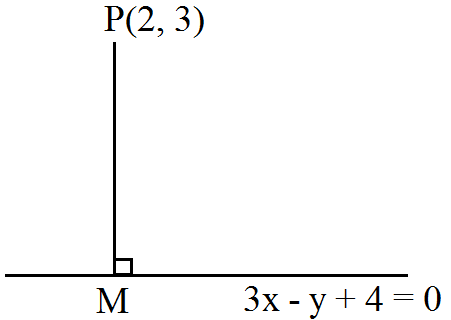
$M(h, k)$ lies on the given line,
$\therefore 3h - k + 4 = 0 .....(i)$
Also, slopw of the given line is $3.$
$\therefore$ Slope of $\text{PM}=-\frac{1}{3}=\frac{\text{k}-3}{\text{h}-2}$ or $h + 3k - 11 = 0 .....(ii)$
Solving $(1)$ and $(ii),$ we get $(\text{h},\text{k})\equiv\Big(-\frac{1}{10},\frac{37}{10}\Big)$ View full question & answer→MCQ 1201 Mark
If the coordinates of the middle point of the portion of a line intercepted between the coordinate axes is $(3, 2)$ then the equation of the line will be:
- ✓
$2x + 3y = 12$
- B
$3x + 2y = 12$
- C
$4x - 3y = 6$
- D
$5x - 2y = 10$
AnswerCorrect option: A. $2x + 3y = 12$
View full question & answer→MCQ 1211 Mark
The tangent of angle between the lines whose intercepts on the axes are $a, -b$ and $b, -a$ respectively, is:
- A
$\frac{\text{a}^2-\text{b}^2}{\text{ab}}$
- B
$\frac{\text{b}^2-\text{a}^2}{\text{ab}}$
- ✓
$\frac{\text{b}^2-\text{a}^2}{\text{2ab}}$
- D
AnswerCorrect option: C. $\frac{\text{b}^2-\text{a}^2}{\text{2ab}}$
View full question & answer→MCQ 1221 Mark
Line through the points $(-2, 6)$ and $(4, 8)$ is perpendicular to the line through the points $(8, 12)$ and $(x, 24)$. Find the value of $x:$
View full question & answer→MCQ 1231 Mark
Find the distance between the following pair of points. $(5, 7)$ and the origin:
- ✓
$\sqrt{74}$
- B
$\sqrt{64}$
- C
$\sqrt{34}$
- D
AnswerCorrect option: A. $\sqrt{74}$
Take points $A (5, 7)$ and $B (0, 0)$
To find the distance between two point $A (x_1, y_1)$ and $B(x_2, y_2)$, distance formula is used which is given by:
$\text{AB} =\sqrt{ (\text{x}_{1}-\text{x}_{2})^2+(\text{y}_{1}-\text{y}_{2})^2}$
so, $\text{AB} =\sqrt{ (5-0)^{2}+(7-0)^{2}}$
$= \sqrt{(25+49)}$
$= \sqrt{(74)}$
View full question & answer→MCQ 1241 Mark
If $p_1$ and $p_2$ are the lengths of the perpendiculars from the origin upon the lines $\text{x} \sec \theta + \text{y}\ \text{cosec}\ \theta = \text{a}$ and $\text{x} \cos \theta - \text{y} \sin \theta = \text{a} \cos 2 \theta$ respectively, then:
- ✓
$4\text{p}_1^2 + \text{p}_2^2 = \text{a}^2$
- B
$\text{p}_1^2 + 4\text{p}_2^2 = \text{a}^2$
- C
$\text{p}_1^2 + 4\text{p}_2^2 = \text{a}^2$
- D
AnswerCorrect option: A. $4\text{p}_1^2 + \text{p}_2^2 = \text{a}^2$
The given lines are
$\text{x} \sec \theta + \text{y} \text{cosec}\theta = \text{a} \ ...(1)$
$\text{x} \cos \theta - \text{y} \sin \theta = \text{a} \cos 2 \theta \ ...(2)$
$p_1$ and $p_2$ are the perpendiculars from the origin upon the lines $(1)$ and $(2)$, respectively.
$\text{p}_1=\Big|\frac{-\text{a}}{\sqrt{\sec^2\theta+\text{cosec}^2}\theta}\Big|$ and $\text{p}_2=\Big|\frac{-\text{a}\cos2\theta}{\sqrt{\cos^2\theta+\sin^2}\theta}\Big|$
$\Rightarrow\text{p}_1=\Big|\frac{-\text{a}\sin\theta\cos\theta}{\sqrt{\sin^2\theta+\cos^2}\theta}\Big|$ and $\text{p}_2=\big|-\text{a}\cos2\theta\big|$
$\Rightarrow\text{p}_1=\frac{1}{2}\big|-\text{a}\times2\sin\theta\cos\theta\big|$ and $\text{p}_2=\big|-\text{a}\cos2\theta\big|$
$\Rightarrow\text{p}_1=\frac{1}{2}\big|-\text{a}\times\sin2\theta\big|$ and $\text{p}_2=\big|-\text{a}\cos2\theta\big|$
$\Rightarrow4\text{p}_1^2+\text{p}_2^2=\text{a}^2(\sin^22\theta+\cos^22\theta)$
$=\text{a}^2$
View full question & answer→MCQ 1251 Mark
If slope of a line is positive then its inclination is:
AnswerIf inclination is $\alpha$ slope is given by $\tan\alpha$ Given that slope of line is positive which means $\tan\alpha$ is positive.
We know, $\tan\alpha$ is positive in $1^{st}$ quadrant
i.e. $\alpha$ should be acute angle
View full question & answer→MCQ 1261 Mark
If equation of line is $x + y = 2$ then find the perpendicular distance of line from origin:
- ✓
$\sqrt{2}$
- B
$\sqrt{3}$
- C
$\frac{1}{\sqrt2}$
- D
$\frac{1}{\sqrt3}$
AnswerCorrect option: A. $\sqrt{2}$
Given, equation is $x + y = 2.$ Reducing the above equation to normal form
$\frac{(\text{x + y})}{\sqrt2} =\sqrt{2}$
$\text{x} \cos45^\circ + \text{y} \sin 45^\circ = \sqrt{2}$
Perpendicular distance from origin is $\sqrt{2}$
View full question & answer→MCQ 1271 Mark
Two lines are perpendicular if the product of their slopes is:
MCQ 1281 Mark
The figure formed by the lines $\text{ax} \pm \text{by} \pm \text{c} = 0$ is:
AnswerThe given lines can be written separately in the following manner:
$ax + by + c = 0 ...(1)$
$ax + by - c = 0 ...(2)$
$ax - by - c = 0 ...(3)$
$ax - by - c = 0 ...(4)$
Graph of the given lines is given below:
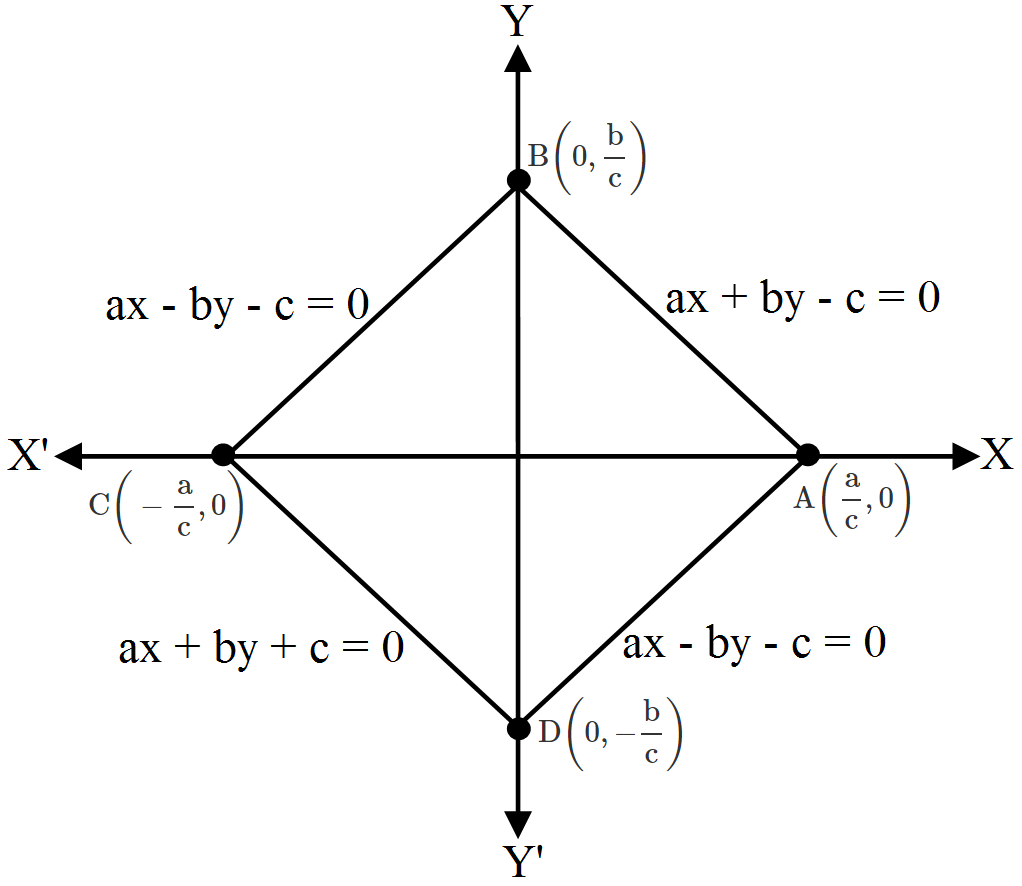
Clearly, $\text{AB}=\text{BC}=\text{CD}=\text{DA}=\sqrt{\frac{\text{a}^2}{\text{c}^2}+\frac{\text{b}^2}{\text{c}^2}}=\frac{\sqrt{\text{a}^2+\text{b}^2}}{|\text{c}|}$
Thus, the region formed by the given lines is $\text{ABCD,}$ which is a rhombus. View full question & answer→MCQ 1291 Mark
The line segment joining the points $(1, 2)$ and $(-2, 1)$ is divided by the line $3x + 4y = 7$ in the ratio:
- A
$3 : 4$
- B
$4 : 3$
- C
$9 : 4$
- ✓
$4 : 9$
AnswerCorrect option: D. $4 : 9$
Let the line segment joining the points $(1, 2)$ and $(−2, 1)$ be divided by the line $3x + 4y = 7$ in the ratio $m:n.$
Then, the coordinates of this point will be $\Big(\frac{-2\text{m}+\text{n}}{\text{m}+\text{n}},\frac{\text{m}+2\text{n}}{\text{m}+\text{n}}\Big)$ that lie on the line.
$3\text{x}+4\text{y}=7$
$3\times\frac{-2\text{m}+\text{n}}{\text{m}+\text{n}}+4\times\frac{\text{m}+2\text{n}}{\text{m}+\text{n}}=7$
$\Rightarrow-2\text{m}+11\text{n}=7\text{m}+7\text{n}$
$\Rightarrow-9\text{m}=-4\text{n}$
$\Rightarrow\text{m}:\text{n}=4:9$
View full question & answer→MCQ 1301 Mark
Equation of horizontal line above $x-$axis at $5$ units from $x-$axis is:
- A
$x = 5$
- B
$x = -5$
- ✓
$y = 5$
- D
$y = -5$
AnswerCorrect option: C. $y = 5$
Equation of $x-$axis is $y = 0.$ Horizontal line is parallel to $x-$axis and above it by $5$ units.
so, equation of line is $y = 5$
View full question & answer→MCQ 1311 Mark
The line $x + y = 4$ divides the line joining the points $(-1, 1)$ and $(5, 7)$ in the ratio:
- A
$2 : 1$
- ✓
$1 : 2$ internally
- C
$1 : 2$ externally
- D
AnswerCorrect option: B. $1 : 2$ internally
View full question & answer→MCQ 1321 Mark
The perpendicular distance of a line $4x + 3y + 5 = 0$ from the point $(-1, 2)$ is:
View full question & answer→MCQ 1331 Mark
A line passes through the point $(2, 2)$ and is perpendicular to the line $3x + y = 3.$ Its $y-$intercept is:
- A
$\frac{1}{3}$
- B
$\frac{2}{3}$
- C
- ✓
$\frac{4}{3}$
AnswerCorrect option: D. $\frac{4}{3}$
The equation of the line perpendicular to $3x + y = 3$ is given below:
$\text{x}-3\text{y}+\lambda=0$
This line passes through $(2, 2).$
$2-6+\lambda=0$
$\Rightarrow\lambda=4$
So, the equation of the line will be
$x - 3y + 4 = 0$
$\Rightarrow\text{y}=\frac{1}{3}\text{x}+\frac{4}{3}$
Hence, the $y-$intercept is $\frac{4}{3}.$
View full question & answer→MCQ 1341 Mark
If slope of a line is $4$ and $y-$intercept made by the line is $2$ then the equation of line will be:
- A
$y = 4x - 2$
- ✓
$y = 4x + 2$
- C
$y = 2x + 4$
- D
$y = 2x - 4$
AnswerCorrect option: B. $y = 4x + 2$
Let general equation of line be $y = m \times x + c.$
Given, $m = 4$ and $c = 2$
View full question & answer→MCQ 1351 Mark
Which of the following points are $10$ units from the origin:
- A
$(6, 4)$
- ✓
$(-6, 8)$
- C
$(6, -8)$
- D
$(-6, -8)$
AnswerCorrect option: B. $(-6, 8)$
$\text{A} =\sqrt{ (6-0)^{2}+(4-0)^{2}} = \sqrt{52}$
$\text{B} =\sqrt{ (6-0)^{2}+(8-0)^{2}} =10$
$\text{C} =\sqrt{ (6-0)^{2}+(-8-0)^{2}} =10$
$\text{D} =\sqrt{ (-6-0)^{2}+(-8-0)^{2}} =10$
View full question & answer→MCQ 1361 Mark
If equation of a line is $3x + 2y - 6 = 0$ then $x-$intercept is and $y-$intercept is:
- A
$3, 2$
- ✓
$2, 3$
- C
$2, 6$
- D
$3, 6$
AnswerCorrect option: B. $2, 3$
Reducing the above equation to intercept form $\frac{\text{x}}{\text{a}} +\frac{\text{y}}{\text{b}} =1,$
we get $\frac{\text{x}}{2} +\frac{\text{y}}{3} =1$
$a = 2$ which is $x-$intercept and $b = 3$ which is $y-$intercept.
View full question & answer→MCQ 1371 Mark
What is the slope of a line which is parallel to $y-$axis?
AnswerIf a line is parallel to $y-$axis then angle formed by it with $x-$axis is zero.
So, its inclination is $90^\circ .$
$\text{slope} = \tan 90^\circ$ which is not defined.
View full question & answer→MCQ 1381 Mark
If line joining $(1, 2)$ and $(7, 6)$ is perpendicular to line joining $(3, 4)$ and $(11, x):$
AnswerWe know, slope of line joining two points $(x_1, y_1)$ and $(x_2, y_2)$ is given by $\frac{(\text{y}_{2}-\text{y}_{1})}{(\text{x}_{2}-\text{x}_{1})}$
Lines are perpendicular means $m_1\times m_2= -1$
$\Rightarrow\big(\frac{\text{x}-4}{11-3}\big), \big(\frac{6-2}{7-1}\big) = -1$
$\Rightarrow (x - 4) (4) = (-1) (8) (6)$
$\Rightarrow x - 4 = -12$
$\Rightarrow x = -16.$
View full question & answer→MCQ 1391 Mark
Equation of vertical line to the left of $y-$axis at $5$ units from $y-$axis is:
- A
$x = 5$
- ✓
$x = -5$
- C
$y = 5$
- D
$y = -5$
AnswerCorrect option: B. $x = -5$
Equation of $y-$axis is $x = 0.$ Vertical line is parallel to $y-$axis and to the left by $5$ units
so, equation of line is $x = -5$
View full question & answer→MCQ 1401 Mark
What is the distance of $(5, 12)$ from the origin?
- A
$5$ units
- B
$8$ units
- C
$12$ units
- ✓
$13$ units
AnswerCorrect option: D. $13$ units
Let the points be $A (0, 0)$ and $B (5, 12).$
$A (0, 0) = (x_1, y_1)$
$B (5, 12) = (x_2, y_2)$
The distance between two points, $\text{AB} = [(\text{x}_{2}-\text{x}_{1})^2+(\text{y}_{2}-\text{y}_{1})^2]$
$\text{AB} = [(5-0)^{2}+(12-0)^2]$
$\text{AB}=\sqrt{(25+144)}$
$\text{AB}=\sqrt{(169)}$
$\text{AB}=13$
The distance of $(5, 12)$ from the origin is $13$ units.
View full question & answer→MCQ 1411 Mark
If $p$ be the length of the perpendicular from the origin on the straight line $x + 2by = 2p,$ then what is the value of $b:$
- A
$\frac{1}{\text{p}}$
- B
$\text{p}$
- C
$\frac{1}{2}$
- ✓
$\frac{3}{2}$
AnswerCorrect option: D. $\frac{3}{2}$
View full question & answer→MCQ 1421 Mark
If the lines $ax + 12y + 1 = 0, bx + 13y + 1 = 0$ and $cx + 14y + 1 = 0$ are concurrent, then $a, b, c$ are in:
AnswerCorrect option: C. $A.P.$
The given lines are
$ax + 12y + 1 = 0 ...(1)$
$bx + 13y + 1 = 0 ...(2)$
$cx + 14y + 1 = 0 ...(3)$
It is given that $(1), (2)$ and $(3)$ are concurrent.
$\begin{vmatrix} \text{a}&12&1\\\text{b}&13&1\\\text{c}&14&1\end{vmatrix}=0$
$\Rightarrow\text{a}(13-14)-12(\text{b}-\text{c})+14\text{b}-13\text{c}=0$
$\Rightarrow-\text{a}-12\text{b}+12\text{c}+14\text{b}-13\text{c}=0$
$\Rightarrow-\text{a}+2\text{b}-\text{c}=0$
$\Rightarrow2\text{b}=\text{a}+\text{c}$
Hence, $a, b$ and $c$ are in $AP.$
View full question & answer→MCQ 1431 Mark
The relation between $a, b, a’$ and $b’$ such that the two lines $ax + by = c$ and $a’x + b’y = c’$ are perpendicular is:
- A
$aa¢ – bb¢ = 0$
- ✓
$aa¢ + bb¢ = 0$
- C
$ab + a¢b¢ = 0$
- D
$ab - a¢b¢ = 0$
AnswerCorrect option: B. $aa¢ + bb¢ = 0$
View full question & answer→MCQ 1441 Mark
Choose the correct answer. The equations of the lines which pass through the point $(3, -2)$ and are inclined at $60^\circ$ to the line $\sqrt{3} \text{x} + \text{y} = 1$ is:
- ✓
$\sqrt{3}\text{x}+\text{y}-\sqrt{3}=0,\sqrt{3}\text{x}-\text{y}-\sqrt{3}=0$
- B
$\sqrt{3}\text{x}+\text{y}+\sqrt{3}=0,\sqrt{3}\text{x}-\text{y}+\sqrt{3}=0$
- C
$\text{x}+\sqrt{3}\text{y}-\sqrt{3}=0,\text{x}-\sqrt{3}\text{y}-\sqrt{3}=0$
- D
AnswerCorrect option: A. $\sqrt{3}\text{x}+\text{y}-\sqrt{3}=0,\sqrt{3}\text{x}-\text{y}-\sqrt{3}=0$
Slope of the given line $\sqrt{3}\text{x}+\text{y}=1$ is, $\text{m}=-\sqrt{3}.$
Let the slope of the required line which makes an angle of $60^\circ$ with the above line is $m.$
$\therefore \tan 60^\circ=\bigg|\frac{-\sqrt{3}-\text{m}}{1-\sqrt{3}\text{m}}\bigg|$
$\Rightarrow \bigg|\frac{-\sqrt{3}-\text{m}}{1-\sqrt{3}\text{m}}\bigg|=\sqrt{3}$
$\Rightarrow -\sqrt{3}-\text{m}=\sqrt{3}-3\text{m}$ or $-\sqrt{3}-\text{m}=-\sqrt{3}+3\text{m}$
$\Rightarrow \text{m}=\sqrt{3}$ or $m = 0$
Line is passing throught the point $(3, -2).$
Thus, the equation of the required line is : $\text{y}+2=\sqrt{3}(\text{x}-3)$ or $y + 2 = 0$
$\Rightarrow \sqrt{3}\text{x}-\text{y}-2-3\sqrt{3}=0$ and $y + 2 = 0$
View full question & answer→MCQ 1451 Mark
The lines $x + 2y - 5 = 0, 2x - 3y + 4 = 0, 6x + 4y - 13 = 0:$
- A
- ✓
Form a right angled triangle
- C
Form an isosceles triangle
- D
Form an equilateral triangle
AnswerCorrect option: B. Form a right angled triangle
View full question & answer→MCQ 1461 Mark
The vertices of a triangle are $(6, 0), (0, 6)$ and $(6, 6)$. The distance between its circumcentre and centroid is:
- A
$2\sqrt{2}$
- B
$2$
- ✓
$\sqrt{2}$
- D
$1$
AnswerCorrect option: C. $\sqrt{2}$
Let $A(0, 6), B(6, 0)$ and $C(6, 6)$ be the vertices of the given triangle.
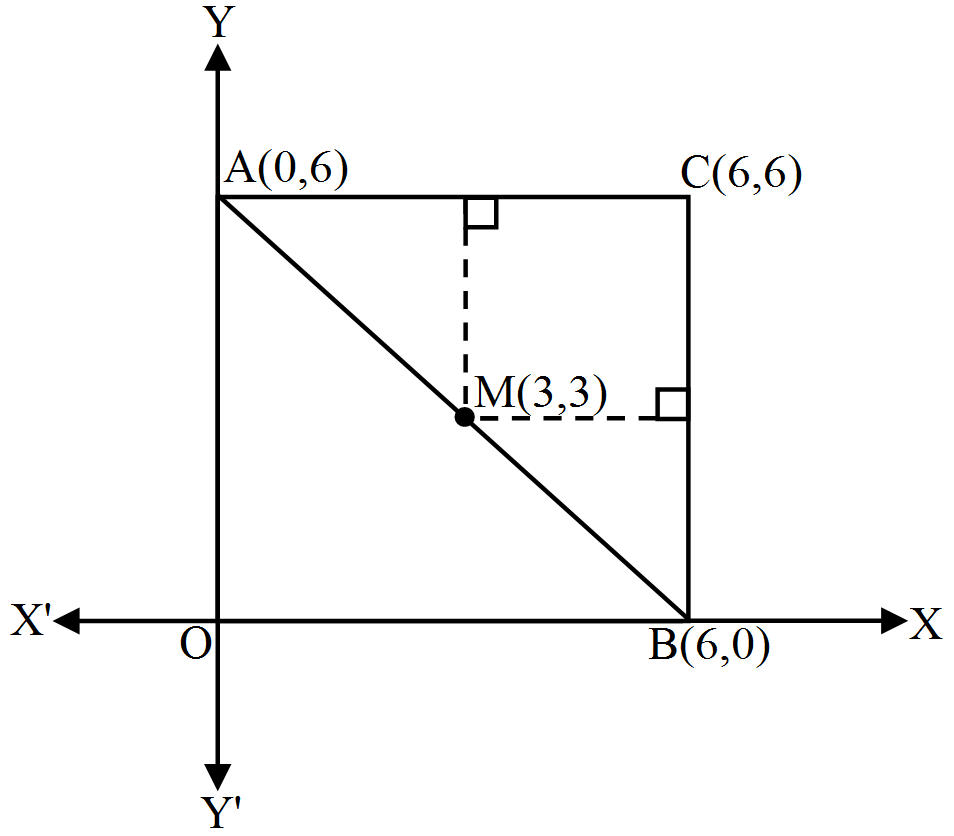
Centroid of $\triangle\text{ABC}=\Big(\frac{0+6+6}{3},\frac{6+0+6}{3}\Big)$
$=(4,4)$
Coordinates of $\text{N}=\Big(\frac{6+6}{2},\frac{6+0}{2}\Big)$
$=(6,3)$
Coordinates of $\text{P}=\Big(\frac{0+6}{2},\frac{6+6}{2}\Big)$
$=(3,6)$
Equation of $MN$ is $y = 3$
Equation of $MP$ is $x = 3$
As, we know that circumcentre of a triangle is the intersection of the perpendicular bisectors of any two sides.
Therefore, coordinates of circumcentre is $(3, 3)$
Thus, the coordinates of the circumcentre are $(3, 3)$ and the centroid of the triangle is $(4, 4).$
Let $d$ be the distance between the circumcentre and the centroid.
$\therefore\text{d}\sqrt{(4-3)^2+(4-3)^2}=\sqrt{2}$ View full question & answer→MCQ 1471 Mark
What is the distance between $(1, 3)$ and $(5, 6)?$
- A
$3$ units.
- B
$4$ units.
- ✓
$5$ units.
- D
$25$ units.
AnswerCorrect option: C. $5$ units.
We know, distance between two points $(x_1, y_1)$ and $(x_2, y_2)$ is $\sqrt{(\text{x}_{1}-\text{x}_{2}) ^{2}+{(\text{y}_{1}-\text{y}_{2})} ^{2}}$
So, distance between $(1, 3)$ and $(5, 6)$ is
$\sqrt{{(1-5)}^{2}+(3-6)^{2}}$
$= \sqrt{{(4)}^{2}+(3)^{2}}$
$= 5\text{ units}.$
View full question & answer→MCQ 1481 Mark
The equation of the line passing through $(1, 5)$ and perpendicular to the line $3x - 5y + 7 = 0$ is:
- ✓
$5x + 3y - 20 = 0$
- B
$3x - 5y + 7 = 0$
- C
$3x - 5y + 6 = 0$
- D
$5x + 3y + 7 = 0$
AnswerCorrect option: A. $5x + 3y - 20 = 0$
A line perpendicular to $3x - 5y + 7 = 0$ is given by
$5\text{x}+3\text{y}+\lambda=0$
This line passes through $(1, 5)$
$5+15+\lambda=0$
$\Rightarrow\lambda=-20$
Therefore, the equation of the required line is $5x + 3y - 20 = 0.$
View full question & answer→MCQ 1491 Mark
The reflection of the point $(4, -13)$ about the line $5x + y + 6 = 0$ is:
- ✓
$(-1, -14)$
- B
$(3, 4)$
- C
$(0, 0)$
- D
$(1, 2)$
AnswerCorrect option: A. $(-1, -14)$
Let the reflection point be $A(h, k)$
Now, the mid point of line joining $(h, k)$ and $(4, -13)$ will lie on the line $5x + y + 6 = 0$
$\therefore5\Big(\frac{\text{h}+4}{2}\Big)+\frac{\text{k}-13}{2}+6=0$
$\Rightarrow5\text{h}+20+\text{k}-13+12=0$
$\Rightarrow5\text{h}+\text{k}+19=0 \ ...(1)$
Now, the slope of the line joining points $(h, k)$ and $(4, -13)$ are perpendicular to the line $5x + y + 6 = 0.$
slope of the line $= -5$
slope of line joining by points $(h, k)$ and $(4, -13)$
$\frac{\text{k}+13}{\text{h}-4}$
$\therefore\frac{\text{k}+13}{\text{h}-4}(-5)=-1$
$\Rightarrow5\text{k}-\text{h}+60=0 \ ...(2)$
Solving $(1)$ and $(2),$ we get
$h = -1$ and $k = -14$
View full question & answer→MCQ 1501 Mark
The equation of the locus of a point equidistant from the point $A (1, 3)$ and $B (-2, 1)$ is:
- A
$6x - 4y = 5$
- ✓
$6x + 4y = 5$
- C
$6x + 4y = 7$
- D
$6x - 4y = 7$
AnswerCorrect option: B. $6x + 4y = 5$
View full question & answer→