Questions · Page 2 of 2

3 Marks Question

Question 513 Marks
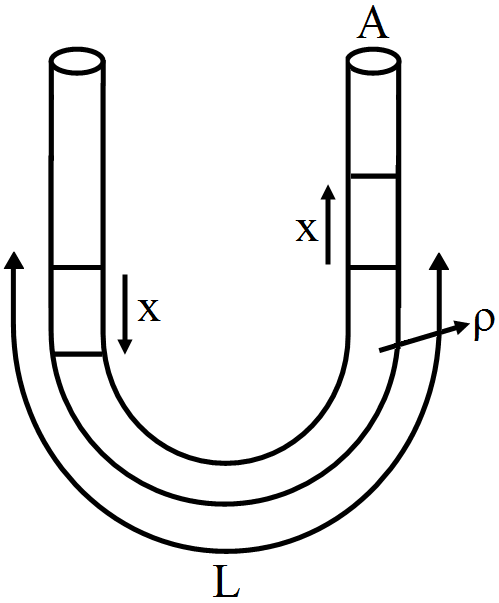
Prove that if a liquid taken in a U-tube is disturbed from the state of equilibrium, it will oscillate simple harmonically. Find expressions for the angular frequency and time period.
Answer
The restoring force, F = weight of liquid column of the height 2y$\Rightarrow\text{F}=-(\text{volume})\times\text{density}\times\text{g}$
$=-(\text{A}\times-2\text{y}.\rho\text{g})$
$\Rightarrow\text{F}=-2\text{A}\rho\text{g.y} \ ...(\text{i})$
where A = Area of cross-section of the tube $\rho$ = density of mercury
$\text{k}=-\frac{\text{F}}{\text{y}}=2\text{A}\rho.\text{g}$
Time period$\text{T}=2\pi\sqrt{\frac{\text{m}}{\text{k}}}$
$=2\pi\sqrt{\frac{\text{m}}{2\text{A}\rho.\text{g}}}$
Let L = length of the whole mercury column therefore, mass of mercury$\text{m}=\text{volume}\times\text{density}=\text{A.L.}\rho.$
$\text{T}=2\pi\sqrt{\frac{\text{m}}{\text{k}}}=2\pi\sqrt{\frac{\text{A.L.}\rho}{2\text{A}\rho\text{g}}}=2\pi\sqrt{\frac{\text{L}}{2\text{g}}}$ where L is the totat length of mercury column of L = 2h.
Where h is the height of mercury column in U-tube. It shows that mercury column executes S.H.M. Frequency, $\text{v}=\frac{1}{\text{T}}=\frac{1}{2\pi}\sqrt{\frac{2\text{g}}{\text{L}}}$ So, angular frequency$\omega=2\pi\text{v}=2\pi\times\frac{1}{2\pi}\sqrt{\frac{2\text{g}}{\text{L}}}=\sqrt{\frac{2\text{g}}{\text{L}}}$

View full question & answer
Question 523 Marks
Aman stands on a weighing machine placed on a horizontal platform. The machine reads $50kg$. By means of a suitable mechanism, the platform is made to execute harmonic vibrations up and down with a frequency of two vibrations per second. What will be the effect on the reading of the weighing machine? The amplitude of vibrations of platform is $5cm$. Take, $g = 10ms^{-2}$.
Answer
Here. $m = 50kg. v = 2s^{-1} A = 5cm = 0.05m$ Maximum acceleration$\text{a}_\text{max}=\omega^2\text{A}$
$=(2\pi\text{v}^2)\text{A}=4\pi^2\text{v}^2\text{A}$
$=4\times\Big(\frac{22}{7}\Big)^2\times(2)^2\times0.05$
$=7.9\text{cm}^{-2}$
$\therefore$ Maximum force felt by the man $=\text{m}(\text{g}+\text{a}_\text{max})$
$=50(10+7.9)$
$=895.0\text{N}$
$=89.5\text{kgf}$
Minimum force felt by the man $=\text{m}(\text{g}-\text{a}_\text{max})$$=50(10-7.9)$
$=105.0\text{N}$
$=10.5\text{kgf}$
Hence, the reading of the weighing machine varies between 10.5kgf and 69.5kgf.
View full question & answer
Question 533 Marks
A particle is performing simple harmonic motion along x-axis with amplitude 4.0cm and time period 1.2s. What is the minimum time taken by the particle to move from x = +2cm to x = +4cm and back again?
Answer
As $\text{x = a}\sin\omega\text{t}=\text{a}\sin\frac{2\pi\text{t}}{\text{T}}$ So, $\text{t}=\frac{\text{T}}{2\pi}\sin^{-1}\Big(\frac{\text{x}}{\text{a}}\Big),$ where a = 4cm At $\text{x}=2,\text{t}=\frac{\text{T}}{2\pi}\sin^{-1}\Big(\frac{2}{4}\Big)$$=\frac{\text{T}}{2\pi}\times\frac{\pi}{6}=\frac{\text{T}}{12}=\frac{1.2}{12}=\frac{1}{10}$
At $\text{x}=4,\text{t}=\frac{\text{T}}{2\pi}\sin^{-1}\Big(\frac{4}{4}\Big)$$=\frac{\text{T}}{2\pi}\times\frac{\pi}{2}=\frac{\text{T}}{4}=\frac{1.2}{4}=\frac{3}{10}$
Total Time taken $=\frac{3}{10}-\frac{1}{10}=\frac{2}{5}$
View full question & answer
Question 543 Marks
At a time when the displacement is half the amplitude, what fraction of the total energy is kinetic and what fraction is the potential in S.H.M?
Answer
When $\text{x}=\frac{\text{A}}{2},$ Fraction of energy as potential is$=\frac{\frac{1}{2}\text{m}\omega^2\Big(\text{A}^2-\frac{\text{A}^2}{4}\Big)}{\frac{1}{2}\text{m}\omega^2\text{A}^2}=\frac{3}{4}\text{ or }75\%$
So, fraction of energy as kinetic is$=\frac{\frac{1}{2}\text{m}\omega^2\frac{\text{A}^2}{4}}{\frac{1}{2}\text{m}\omega^2\text{A}^2}=\frac{1}{2}\text{ or }25\%$
View full question & answer
Question 553 Marks
A spring of force constant k has a mass M suspended from it. If the spring is cut into two halves, and the same mass is attached to one of the pieces, what will be the frequencies of oscillation of the mass?
Answer
When the spring is cut into two equal halves, the force constant of each part will be doubled. Therefore, the original frequency, $\text{v}=\frac{1}{2\pi}\sqrt{\frac{\text{k}}{\text{M}}}$ will become $\text{v}'=\frac{1}{2\pi}\sqrt{\frac{2\text{k}}{\text{M}}}=\sqrt{2\text{v}}$
View full question & answer
Question 563 Marks
Calculate the percentage change in time period of a simple pendulum if its length is increased by 8%.
Answer
As $\text{T}\propto\sqrt{\text{l}}$$\frac{\Delta\text{T}}{\text{T}}\times100=\frac{1}2{}\frac{\Delta\text{l}}{\text{l}}\times100$
$\therefore\%\text{ change in T}=\frac{1}{2}\times8=4\%$
View full question & answer
Question 573 Marks
A particle of mass $0.1kg$ is held between two rigid supports by two springs of force constants $8N/ m$ and $2N/ m$. If the particle is displaced along the direction of the length of the springs, calculate its frequency of vibration.
Answer
The situation is shown in the fig.

When the mass is displaced along the direction of the length of the spring, one spring is compressed while the other is extended but the force due to both the springs is in the same direction. Hence the effective force constant $k = k_1 + k_2 = 8N/ m + 2N/ m = 10N/ m$ The frequency of vibration is given by$\text{v}=\frac{1}{2\pi}\sqrt{\frac{\text{k}}{\text{m}}}$
$=\frac{1}{2\pi}\sqrt{\frac{10}{0.1}}$
$\text{v}=\frac{10}{2\pi}$
$=\frac{5}{\pi}\text{s}^{-1}$
View full question & answer
Question 583 Marks
Show that when a particle is moving in S.H.M. its velocity at a distance $\frac{\sqrt{3}}{2}$ of its amplitude from the central position is half its velocity in central position.
Answer
In a S.H.M. velocity is given by $\text{v}=\omega\sqrt{\text{A}^2-\text{x}^2}$ where x is the displacement from mean position. Velocity at $\text{x}=\frac{\sqrt{3}\text{A}}{2}$ is,$\text{v}_1=\omega\sqrt{\text{A}^2-\frac{3}{4}\text{A}^2}=\omega\text{A}\sqrt{\frac{1}{4}}$
$=\frac{\omega\text{A}}{2}$
Velocity at central position$=\omega\sqrt{\text{A}^2-0^2}=\omega\text{A}$
$\therefore$ Velocity at $\frac{\sqrt{3}\text{A}}{2}=\frac{1}{2}$ (velocity at central position)
View full question & answer
Question 593 Marks
A simple pendulum in a stationary lift has time period T. What would be the effect on the time period when the left
  1. Moves up with uniform velocity v.
  2. Moves down with uniform velocity v.
  3. Moves up with uniform acceleration a.
  4. Moves down with uniform acceleration a.
  5. Beings to fall freely under gravity?
Answer
  1. And
  2. Since acceleration of the lift is zero therefore there will be no effect on time period.
  3. When the lift moves up with uniform acceleration a, the effective value of acceleration due to gravity is g + a
$\therefore\text{T}'=2\pi\sqrt{\frac{\text{l}}{\text{g}+\text{a}}}$

Clearly, $\text{T}'<\text{T}$.
  1. When the lift moves down with uniform acceleration a, then the effective value of g is g - a.
$\text{T}'=2\pi\sqrt{\frac{\text{l}}{\text{g}+\text{a}}}$

Clearly,$\text{T}'<\text{T}$.
  1. When the lift begins to fall freely under gravity, the effective value of g becomes zero. So, T is infinite i.e., the simple pendulum shall not oscillate.
View full question & answer
Question 603 Marks
Show that for a particle in linear SHM, the average kinetic energy over a period of oscillation is equal to average potential energy over the same period.
Answer
K.E. $=\frac{1}{2}\text{m}\omega^2\text{A}^2\cos^2\omega\text{t}$ P.E. $=\frac{1}{2}\text{m}\omega^2\text{A}^2\sin^2\omega\text{t}$ Average K.E. over a one time period:$(\text{K.E.)}_{\text{avg}}=\frac{1}{\text{T}}\int\limits^{\text{T}}_0(\text{K.E.)dt}$
$=\frac{1}{\text{T}}\int\limits^{\text{T}}_{0}\frac{1}{2}\text{m}\omega^2\text{A}^2\cos^2\omega\text{t dt}$
$=\frac{1}{2\text{T}}\text{m}\omega^2\text{A}^2\int\limits^\text{T}_0\cos^2\omega\text{t dt}$
$=\frac{\text{m}\omega^2\text{A}^2}{2\text{T}}.\frac{\text{T}}{2}=\frac{1}{4}\text{m}\omega^2\text{A}^2$
Similarly, $\text{P.E.}=\frac{1}{2}\text{m}\omega^2\text{A}^2$
View full question & answer
Question 613 Marks
Derive an expression for the potential energy of an elastic stretched spring.
Answer
Consider a spring attached with a mass m stretching by a length y after t sec. Restoring force F = mass × acceleration$=-\text{}\omega^2\text{y}=-\text{ky}$
where, $\text{k = spring constant = m}\omega^2$ Work done for an additional displacement dy against restoring force is$\text{dW}=-\text{F dy}$
$=-(-\text{ky})\text{dy = ky dy}$
Total work done$\text{W}=\int\limits^{\text{y}}_0\text{ky dy}=\frac{1}{2}\text{ky}^2$
This work done appears as a PE. 'U' of the particle.$\text{U}=\frac{1}2{}\text{ky}^2=\frac{1}{2}\text{m}\omega^2\text{y}^2$
$=\frac{1}{2}\text{m}\omega^2\text{a}^2\sin^2\omega\text{t}$
View full question & answer
Question 623 Marks
What is a second's pendulum? How much is its length on the surface of moon?
Answer
A second's pendulum is one whose time period of e. oscillation is 2 seconds. On the surface of moon,$\text{a}=\frac{\text{g}}{6}.$
$\therefore\text{Using}\text{ T}=2\pi\sqrt{\frac{\text{l}}{\text{g}}},$
We have $\text{l}=\frac{4\text{g}}{6\times4\pi^2}=\frac{1}{6}\text{m}$
View full question & answer
Question 633 Marks
A particle is executing S.H.M. If $v_1$ and $v_2$ are the speeds of the particle at distance $x_1$ and $x_2$ from the equilibrium position, show that the frequency of oscillations is$\text{f}=-\frac{1}{2\pi}\bigg(\frac{\text{v}^2_1-\text{v}^2_2}{\text{x}^2_2-\text{x}^2_1}\bigg)^{\frac{1}{2}}$
Answer
The displacement of a particle executing S.H.M. is given by$\text{x = a}\cos\omega\text{t}$
$\frac{\text{dx}}{\text{dt}}=\omega\text{a}\sin\omega\text{t}$
$\therefore\text{Velocity},\text{v}=\frac{\text{dx}}{\text{dt}}$ or $\text{v}^2=\text{a}^2\omega^2\sin^2\omega\text{t}.$
$=\text{a}^2\omega^2(1-\cos^2)\omega\text{t}$
$=\omega^2(\text{a}^2-\text{x}^2)$
Hence, $\text{v}^2_1=\omega^2(\text{a}^2-\text{x}^2_1)$ And $\text{v}^2_2=\omega^2(\text{a}^2-\text{x}^2_2)$ Subtracting the two,$\text{v}^2_1-\text{v}^2_2=\omega^2(\text{x}^2_2-\text{x}^2_1)$
$\omega^2=\frac{\text{v}^2_1-\text{v}^2_2}{\text{x}^2_2-\text{x}^2_1}$
$\omega=\bigg(\frac{\text{v}^2_1-\text{v}^2_2}{\text{x}^2_2-\text{x}^2_1}\bigg)^{\frac{1}{2}}$
But $\omega=2\pi\text{f}$$\therefore\text{f}=\frac{1}{2\pi}=\bigg(\frac{\text{v}^2_1-\text{v}^2_2}{\text{x}^2_2-\text{x}^2_1}\bigg)^{\frac{1}{2}}$
View full question & answer
Question 643 Marks
For an oscillating pendulum, establish the relation, $\frac{\text{d}^2\theta}{\text{dr}^2}+\omega^2=\theta=0,$ Where $\omega^2=\frac{\text{g}}{\text{l}}$ and $\theta$ is small angular displacement.
Answer
Restoring force is provided by the portion $\text{mg}\sin\theta$ of gravitational force. Since, it acts perpendicular to length l, the restoring torque $=-\text{mg}\sin\theta\text{l}$ Also, $\tau=\text{l}\alpha=\text{m}\text{l}^2\alpha$$\therefore\text{ml}^2\alpha=-\text{mg}\sin\theta.\text{l}$
$\alpha=-\frac{\text{g}\sin\theta}{\text{l}}$
For small angles ofoscillation, $\sin\theta\cong\theta.$$\therefore\alpha=-\frac{\text{g}}{\text{l}}.\theta$
$\frac{\text{d}^2\theta}{\text{dt}^2}=-\frac{\text{g}}{\text{l}}.\theta$
i.e. $\frac{\text{d}^2\theta}{\text{dt}^2}+\omega^2\theta=0.$ giving $\omega=\sqrt{\frac{\text{g}}{\text{l}}}$ and $\text{T}=2\pi\sqrt{\frac{\text{l}}{\text{g}}}$
View full question & answer
Question 653 Marks
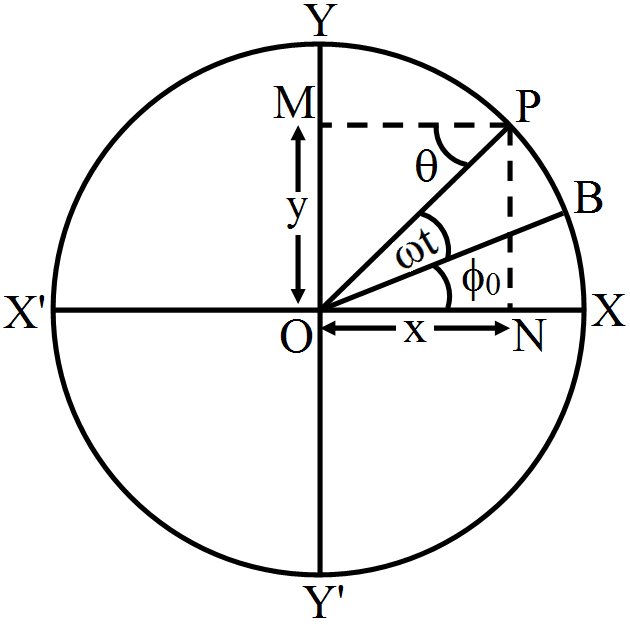
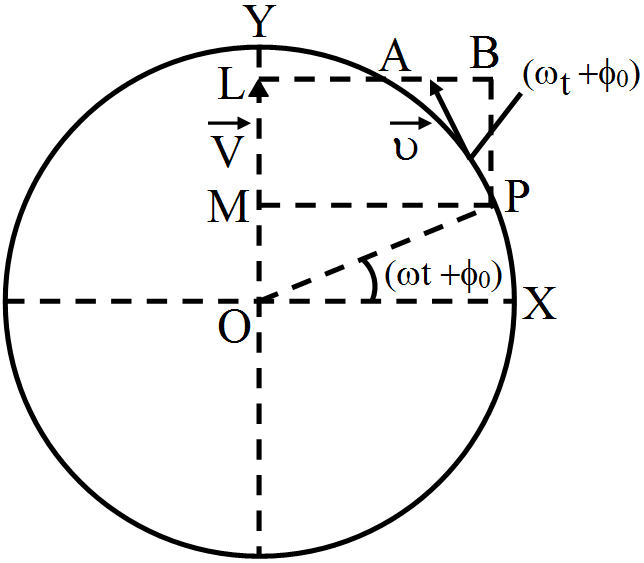
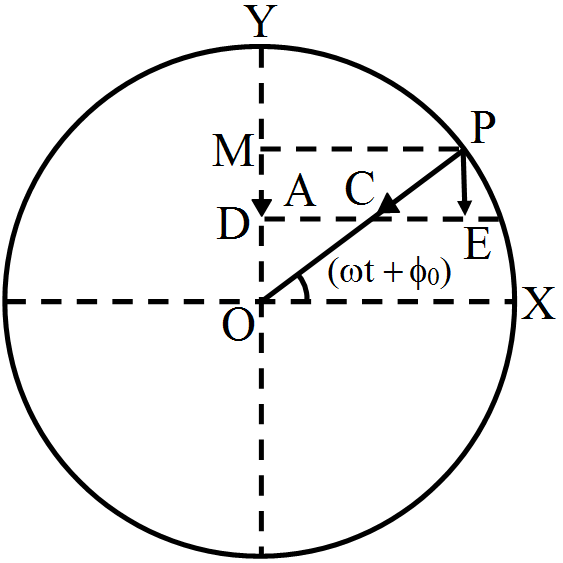
Explain the relation in phase between displacement, velocity and acceleration in S.H.M., graphically as well as theoretically.
Answer
If displacement:$\text{y = A}\sin(\omega\text{t}+\phi_0)$
velocity $\text{v}=\omega\text{A}\cos(\omega\text{t}+\phi_0)$ acceleration $\text{a}=-\omega^2\text{A}\sin(\omega\text{t}+\phi_0)$ x and v differ in phase by $\frac{\pi}{2}.$ v and a differ in phase by $\frac{\pi}{2}.$
View full question & answer
Question 663 Marks
For a particle in S.H.M., the displacement x of the particle as a function of time t is given as $\text{x = A}\sin(2\pi\text{t}).$ Here x is in cm and t is in seconds.
Let the time taken by the particle to travel from x = 0 to $\text{x}=\frac{\text{A}}{2}$ be $T_1$ and the time taken to travel from $\text{x}=\frac{\text{A}}{2}$ to x = A be $T_2$​​​​​​​. Find $\frac{\text{T}_1}{\text{T}_2}.$
Answer
x = 0 at t = 0, t = 1s Let $\text{x}=\frac{\text{A}}{2}\text{ at }\text{t = T}_1$ then $\frac{\text{A}}{2}=\text{A}\sin(2\pi\text{T}_1)$$\text{A}.\sin\Big(\frac{\pi}{6}\Big)=\text{A}\sin(2\pi\text{T}_1)$
$\Rightarrow\frac{\pi}{6}=2\pi\text{T}_1$
$\text{T}_1=\frac{1}{12}\text{s}$
Time taken from x = 0 to x = A is $\frac{\text{T}}{4}$$\Rightarrow\text{at}\text{ x}=\text{A}$ and $\text{t = T}$
$\text{A = A}\sin2\pi\text{T}$
$\sin\frac{\pi}{2}=\sin2\pi\text{T}$
$\text{T}=\frac{1}{4}\sec$
$\text{T}_1+\text{T}_2=\frac{1}{4}$
$\text{T}_2=\frac{1}{4}-\frac{1}{12}=\frac{1}{6}\text{s}$
So, $\frac{\text{T}_1}{\text{T}_{2}}=\frac{\frac{1}{12}}{\frac{1}{6}}=\frac{1}{2}$
View full question & answer
Question 673 Marks
If $\text{x = a}\cos\omega\text{t + b}\sin\omega\text{t},$ show that it represents S.H.M.
Answer
$\text{x = a}\cos\omega\text{t + b}\sin\omega\text{t}$$\frac{\text{dx}}{\text{dt}}=-\text{a}\omega\sin\omega\text{t}+\text{b}\omega\cos\omega\text{t}$
$\frac{\text{d}^2\text{x}}{\text{dt}^2}=-\omega^2\text{a}\cos\omega\text{t}-\text{b}\omega^2\sin\omega\text{t}$
$=-\omega^2(\text{a}\cos\omega\text{t}+\text{b}\sin\omega\text{t})$
$\frac{\text{d}^2\text{x}}{\text{dt}^2}=-\omega^2\text{x}$
$\therefore$ It represents a S. H. M.
View full question & answer
Question 683 Marks
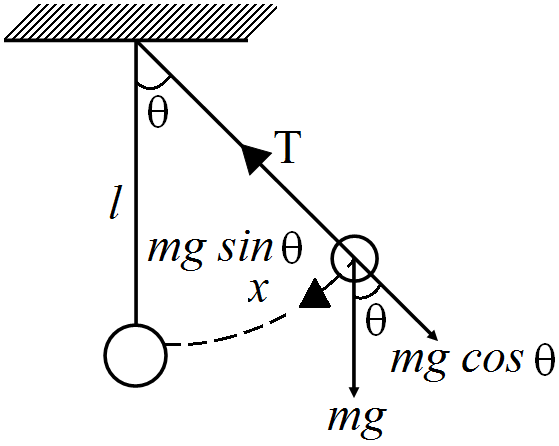
When will the motion of a simple pendulum be simple harmonic?
Answer
Consider a pendulum of length l and mass of bob m is displaced by angle $\theta$ as shown in fig. The restoring force = F $=\text{mg}\sin\theta$ If $\theta$ is small then $\sin\theta=\theta=\frac{\text{arc}}{\text{radius}}=\frac{\text{x}}{\text{l}}$$\therefore\text{F}=-\text{mg}\frac{\text{x}}{1}\ \text{or}\ \text{F}\propto(-\text{x})$
$(\because\text{m}_2\text{g},1\text{are constant})$
Hence, the motion of simple pendulam will be smile harmonic for small angle $\theta.$
View full question & answer
Question 693 Marks
  1. What is echo?
  2. If a reflector is situated at a distance of $860m$ from a sound source, what is the time of echo? Speed of sound in air at a room temperature can be taken as $344m/ s.$
Answer
  1. The sound heard by an observer$/$ listner after the reflection from a surface is called echo.
  2. Total distance travelled by sound to come back $= 2 \times 860 = 1720m$ speed of sound is $344m/ s.$
$\therefore\text{Time}=\frac{\text{Distance}}{\text{Speed}}$
$=\frac{1720}{344}=5\text{sec}$
View full question & answer
Question 703 Marks
A block with a mass of $3.0\ kg$ is suspended from an ideal spring having negligible mass and stretches the spring by $0.2m$.
  1. What is the force constant of the spring?
  2. What is the period of oscillation of the block if it is pulled down and released?
Answer
  1. Force constant $\text{k}=\frac{\text{F}}{\text{l}}=\frac{\text{mg}}{\text{l}}$
Here $m = 3.0\ kg$ and elongation in length of spring $l = 0.2m$
$\therefore$ Force constant $\text{k}=\frac{3.0\times9.8}{0.2}=174\text{Nm}^{-1}$
  1. Period of oscillation $\text{T}=2\pi\sqrt{\frac{\text{m}}{\text{k}}}$
$=2\times3.14\times\sqrt{\frac{3}{147}}=0.9\text{s}$
View full question & answer
Question 713 Marks
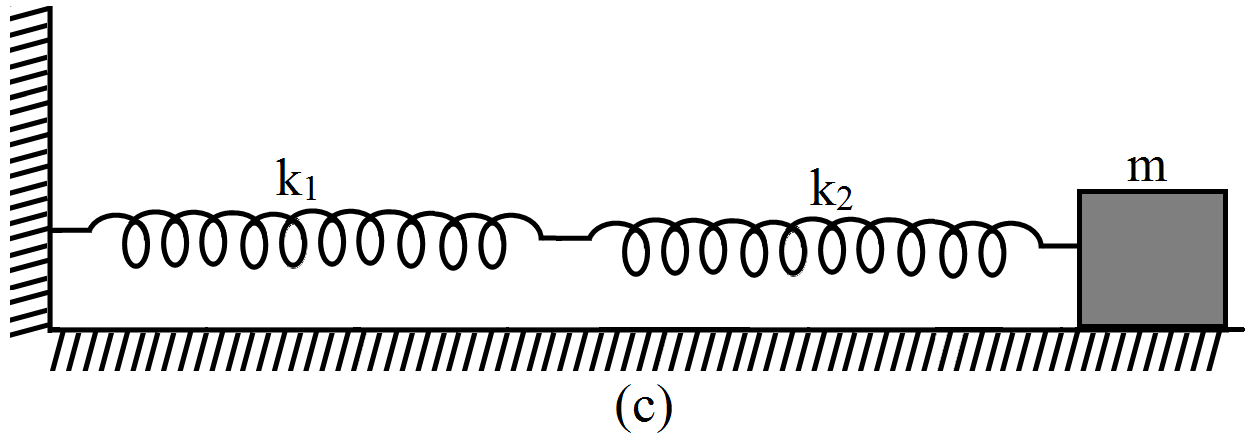
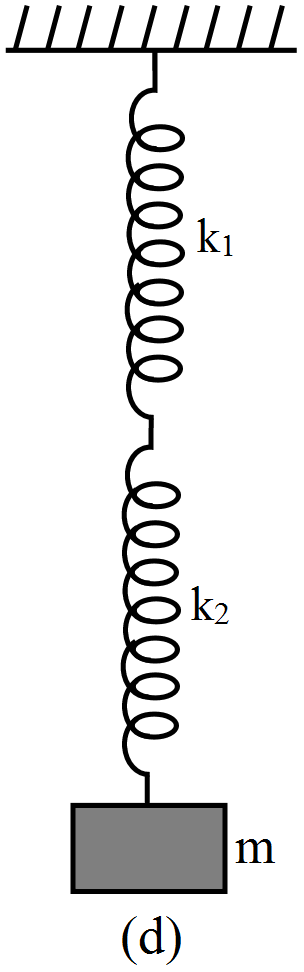
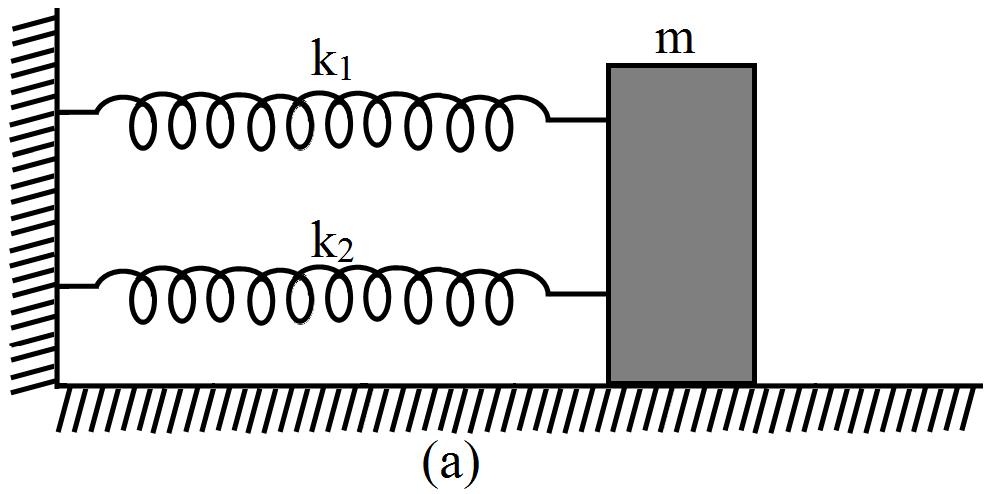
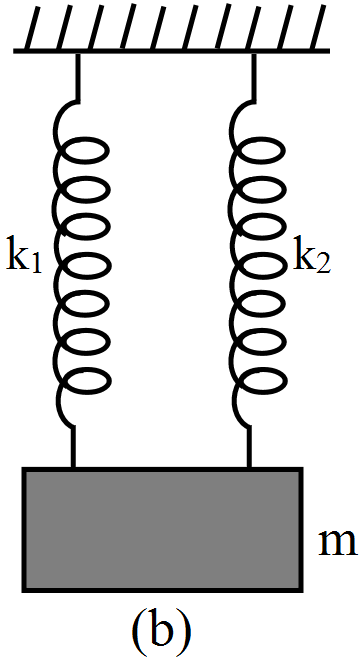
Figure below shows four different spring arrangements. If the mass in each arrangement is displaced from its equilibrium position and released, what is the resulting frequency of vibration in each case? Neglect the mass of the spring. (Fig. (a) and (b) represent an arrangement of springs in parallel, and (c) and (d) represent springs in series)


Answer
(a), (b) In parallel equivalent value of $k = k_1 + k_2$
$\therefore\text{f}=\frac{1}2\pi{}\sqrt{\frac{\text{k}_1+\text{k}_2}{\text{m}}}$
(c), (d) In series equivalent $\text{k}=\frac{\text{k}_1\text{k}_2}{\text{k}_1+\text{k}_2}$
$\therefore\text{f}=\frac{1}{2\pi}\sqrt{\frac{\text{k}_1\text{k}_2}{(\text{k}_1+\text{k}_2)\text{m}}}$
View full question & answer
Question 723 Marks
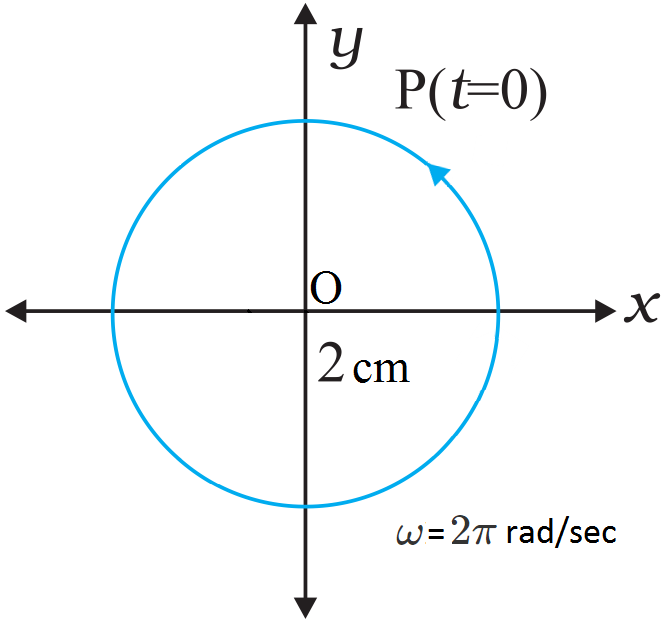
Plot the corresponding reference circle for each of the following simple harmonic motions. Indicate the initial (t = 0) position of the particle, the radius of the circle, and the angular speed of the rotating particle. For simplicity, the sense of rotation may be fixed to be anticlockwise in every case: (x is in cm and t is in s).$\text{x}=2\cos\pi\text{t}$
Answer
$\text{x}=2\cos\pi\text{t}$If this equation is compared with the standard SHM equation $\text{x}=\text{A}\cos\bigg(\Big(\frac{2\pi}{\text{T}}\Big)\text{t}+\phi\bigg),$ then we get:
Amplitude, A = 2cm
Phase angle, $\phi=0$
Angular velocity, $\omega=\pi\text{ rad/s}$
The motion of the particle can be plotted as shown in the following figure.
View full question & answer
Question 733 Marks
A 0.2kg. of mass hangs at the end of a spring. When 0.02kg more mass is added to the end of the spring, it stretches 7cm more. If the 0.02kg mass is removed, what will be the period of vibration of the system?
Answer
When 0.02kg is added, there is a stretch of 7cm. Using mg = Kx, we have$\text{K}=\frac{0.02\times10}{7\times10^{-2}}=\frac{20}{7}=2.86\text{N/m}$
Time period $=\text{T}=2\pi\sqrt{\frac{\text{m}}{\text{K}}}$$=2\pi\sqrt{\frac{0.2}{2.86}}=1.66\sec.$
View full question & answer
Question 743 Marks
A spring compressed by $0.1m$ develops a restoring force of $10N$. A body of mass $4\ kg$ is placed on it. Deduce the $(i)$ force constant of the spring $(ii)$ depression of the spring under the weight of the body and $(iii)$ period of oscillation, if the body is disturbed.
Answer
Restoring force,
$F = 10N;$
Mass of body $m = 4 kg$
Displacement $\xi=0.1\text{m}$
  1. The force constant of spring
$\text{k}=\frac{\text{Force}}{\text{Displacement}}=\frac{10}{0.1}$

$=100\text{Nm}^{-1}$
  1. Depression due lo weight
$=\frac{\text{Force}}{\text{k}}=\frac{4\times10}{100}=0.4\text{m}$
  1. Period of oscillation,
$\text{T}=2\pi\sqrt{\frac{\text{m}}{\text{k}}}=2\pi\sqrt{\frac{4}{100}}=\frac{2\pi}{5}\text{s}$
View full question & answer
Question 753 Marks
A simple pendulum of length l and having a bob of mass M is suspended in a car. The car is moving on a circular track of radius R with a uniform speed v. If the pendulum makes small oscillations in a radial direction about its equilibrium position, what will be its time period?
Answer
The bob of the simple pendulum will experience the acceleration due to gravity and the centripetal acceleration provided by the circular motion of the car. Acceleration due to gravity = g Centripetal acceleration = $v^2/R$ where, v is the uniform speed of the car R is the radius of the track Effective acceleration (g') is given as:$\text{g}'=\sqrt{\text{g}^2+\frac{\upsilon^4}{\text{R}^2}}$
$\therefore$ Time period, $\text{T}=2\pi\sqrt{\frac{\text{l}}{\text{g}'}}$
$=2\pi\frac{\text{l}}{\text{g}^2+\frac{\upsilon^4}{\text{R}^2}}$
View full question & answer
Question 763 Marks
A particle is subjected to two simple harmonic motions$\text{x}_1=\text{A}_1\sin\omega\text{t}$ $\text{x}_2=\text{A}_2\Big(\omega+\frac{\pi}{3}\Big)$ Find
  1. The disphcement at $t = 0.$
  2. The maximum speeil of thc particle and.
  3. The madmum accelerution of the particle.
Answer
  1. At $t = 0$
$\text{x}_1=\text{A}_1\sin\omega\text{t}=0$
$\text{x}_2=\text{A}_2\Big(\omega+\frac{\pi}{3}\Big)$
$=\frac{\text{A}_2\sqrt{3}}{2}$
Thus the resultant displacement at $t = 0$ is
$\text{x}=\text{x}_1+\text{x}_2=\frac{\text{A}_2\sqrt{3}}{2}$
  1. $\text{A}=\sqrt{\text{A}_1^2+{\text{A}_2^2}+2\text{A}_1\text{A}_2^2\cos\frac{\pi}{3}}$
$\text{A}=\sqrt{\text{A}_1^2+{\text{A}_2^2}+\text{A}_1\text{A}_2}$
The maximum speed is
$\text{V}_\text{max}=\omega\text{A}$
$=\omega=\sqrt{\text{A}_1^2+{\text{A}_2^2}+\text{A}_1\text{A}_2}$
  1. The maximum acceleration is
$\text{a}_\text{max}=\omega^2\text{A}$
$=\omega^2=\sqrt{\text{A}_1^2+{\text{A}_2^2}+\text{A}_1\text{A}_2}$
View full question & answer
Question 773 Marks
A body oscillates with SHM according to the equation $($ in $SI$ units $)$, $x=5 \cos [2 \pi t+\pi / 4] \text {. }$
At $t=1.5 s$, calculate the $(a)$ displacement, $(b)$ speed and $(c)$ acceleration of the body.
Answer
The angular frequency $\omega$ of the body $=2 \pi s ^{-1}$ and its time period $T=1 s$.
At $t=1.5 s$
(a) displacement $=(5.0 m ) \cos \left[\left(2 \pi s ^{-1}\right) \times\right.1.5 s +\pi / 4] $
$ =(5.0 m ) \cos [(3 \pi+\pi / 4)]$
$ =-5.0 \times 0.707 m$
$ =-3.535 m$
$(b)$ Using Eq. $(13.9),$ the speed of the body
$=-(5.0 m )\left(2 \pi s ^{-1}\right) \sin \left[\left(2 \pi s ^{-1}\right) \times 1.5 s \right.$
$+\pi / 4]$
$=-(5.0 m )\left(2 \pi s ^{-1}\right) \sin [(3 \pi+\pi / 4)]$
$=10 \pi \times 0.707 m s ^{-1}$
$=22 m s ^{-1}$
$(c)$ Using Eq.$(13.10),$ the acceleration of the body
$=-\left(2 \pi s ^{-1}\right)^2 \times \text { displacement }$
$=-\left(2 \pi s ^{-1}\right)^2 \times(-3.535 m )$
$=140 m s ^{-2}$
View full question & answer
3 Marks Question - Page 2 - Physics STD 11 Science Questions - Vidyadip