Questions · Page 2 of 2

2 Marks Questions

Question 512 Marks
Two springs $A$ and $B$ with constants $\mathrm{k}_{\mathrm{A}}$ and $\mathrm{k}_{\mathrm{B}}\left(\mathrm{k}_{\mathrm{A}}>\mathrm{k}_{\mathrm{B}}\right)$ are given. In which of the springs more work is to be done if,
  1. They are stretched by the same amount.
  2. They are stretched by same force.
Answer
We know, $\text{F}=\text{-kx}$ and $W =$ Energy $=\frac{1}{2}\text{kx}^2$.
  1. For same stretch, $\frac{\text{w}_\text{A}}{\text{w}_\text{B}}=\frac{\text{k}_\text{A}}{\text{k}_\text{B}}$
$\therefore\text{k}_\text{A}>\text{k}_\text{B},\text{w}_\text{A}>\text{w}_\text{B}$
  1. For same force,
$\frac{\text{w}_\text{A}}{\text{w}_\text{B}}=\frac{\text{F}^2}{2\text{k}_\text{A}}\cdot\frac{2\text{k}_\text{B}}{\text{F}^2},\frac{\text{w}_\text{A}}{\text{w}_\text{B}}$
$\therefore\text{w}_\text{A}<\text{w}_\text{B}$
View full question & answer
Question 522 Marks
A force F = a + bx acts on a particle in the x-direction, where a and b are constants. Find the work done by this force during a displacement from x = 0 to x = d.
Answer
Given that F= a + bx Where a and b are constants. So, work done by this force during this force during the displacement x = 0 and x = d is given by, $\text{W}=\int\limits_0^\text{d}\text{Fdx}$ $\text{W}=\int\limits_0^\text{d}\text{(a+bx)dx}$ $=\Big[\text{ax}+\Big(\frac{\text{bx}^2}{2}\Big)\Big]_0^\text{d}$ $=\Big[\text{a}+\frac{1}{2}\text{bd}\Big]\text{d}$
View full question & answer
Question 532 Marks
Show that in elastic one dimensional collision, velocity of approach before collision is equal to velocity of separation after collision.
Answer
In elastic collision, we know, both K.E. and momentum will be conserved. Therefore, $\frac{1}{2}\text{m}_1\text{u}_1^2=\frac{1}{2}\text{m}_2\text{u}_2^2=\frac{1}{2}\text{m}_1\text{v}_1^2+\frac{1}{2}\text{m}_2\text{v}_2^2$ $\text{and}\text{ m}_1\text{u}_1+\text{m}_2\text{u}_2=\text{m}_1\text{v}_1+\text{m}_2\text{v}_2$ They can be Writtem as, $\text{m}_1(\text{u}_1^2-\text{v}_1^2)=\text{m}_2(\text{v}_2^2-\text{u}_2^2)\cdots\text{ (i)}$ $\text{m}_1(\text{u}_1-\text{v}_1)=\text{m}_2(\text{v}_2^2-\text{u}_2)\cdots\text{(ii)}$ Dividing (i) and (ii), we have $\text{u}_1+\text{v}_1=\text{v}_2+\text{u}_2$ $\text{v}_2-\text{v}_1=-\text{u}_2-\text{u}_1).$ Hence Proved.
View full question & answer
Question 542 Marks
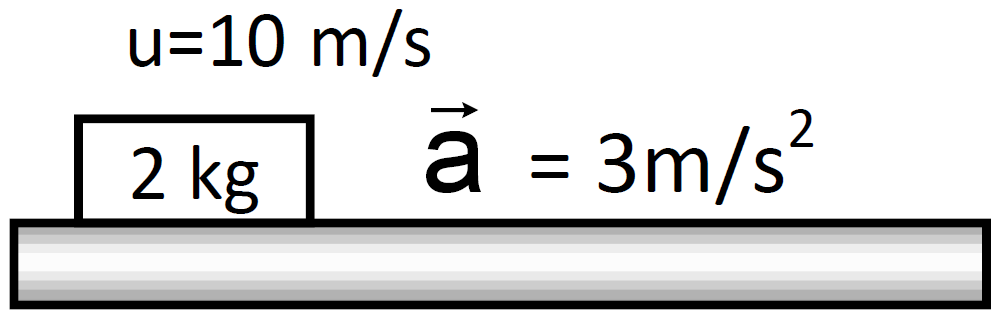
A block of mass 2.00 kg moving at a speed of $10.0 \mathrm{~m} / \mathrm{s}$ accelerates at $3.00 \mathrm{~m} / \mathrm{s}^2$ for 5.00 s . Compute its final kinetic energy.
Answer


$M_b$ = 2kg
u = 10m/s
$a = 3m/s^2$
t = 5s
ν = u + at
= 10 + 3 × 5 = 25m/s
$\therefore$ Final $\text{K.E.}=\frac{1}{2}\text{mv}^2$
$=\frac{1}{2}\times2\times625=625\text{J}$
View full question & answer
Question 552 Marks
Discuss the variation of mass with velocity.
Answer
By Einstein's theory of relativity $\text{m}=\frac{\text{m}_0}{\sqrt{1\frac{\text{v}_2}{\text{c}^2}}}$ = mass of moving body increases with velocity, because if v is increased $\Rightarrow\frac{\text{v}^2}{\text{c}^2}$ is increased. $\Rightarrow1-\frac{\text{v}^2}{\text{c}^2}\text{ is decreased }$ $\Rightarrow\frac{\text{m}_0}{\sqrt{1\frac{\text{v}^2}{\text{c}^2}}}\text{is increased}.$ If v is zero then $m = m_0$
View full question & answer
Question 562 Marks
A spring balance reads forces in Newtons. The scale is 20cm long and read from 0 to 60N. Find potential energy of spring when the scale reads 20N.
Answer
We can calculate the spring constant of spring, as it is extended by 20 cm under 60 N force. $\mathrm{F}=\mathrm{kx} \Rightarrow 60=\mathrm{k} \times 20 \times$ $10^{-2} \mathrm{~K}=300 \mathrm{~N} / \mathrm{m}$ At a force of 20 N , the extension in spring is $\mathrm{F}=\mathrm{kx} \Rightarrow 20=300 \mathrm{x} \mathbf{x}=\frac{1}{2}=\frac{1}{15} \mathrm{~m}$
View full question & answer
Question 572 Marks
The average work done by a human heart while it beats once is 0.5J. Calculate the power used by heart if it beats 72 times in a minute.
Answer
According to the problem, average work done by a human heart per beat = 0.5J Total work done during 72 beats in 1 minute = 72 × 0.5J = 36J Power = Work done = 36J/60s = 0.6w
View full question & answer
Question 582 Marks
The magnetic force on a charged particle is always perpendicular to its velocity. Can the magnetic force change the velocity of the particle? Speed of the particle?
Answer
The magnetic force on a charged particle is always perpendicular to its velocity. Therefore, the work done by the magnetic force on the charged particle is zero. Here, the kinetic energy and speed of the particle remain unaffected, while the velocity changes due to the change in direction of its motion.
View full question & answer
Question 592 Marks
A particle moves from a point $\vec{\text{r}}_1=(2\text{m})\vec{\text{i}}+(3\text{m})\vec{\text{j}}$ to another point $\vec{\text{r}}_2=(3\text{m})\vec{\text{i}}+(2\text{m})\vec{\text{j}}$ during which a certain force $\vec{\text{F}}=(5\text{N})\vec{\text{i}}+(5\text{N})\vec{\text{j}}$ acts on it. Find the work done by the force on the particle during the displacement.
Answer
Given, $\vec{\text{r}}_1=2\hat{\text{i}}+3\hat{\text{j}}$ $\vec{\text{r}}_2=3\hat{\text{i}}+2\hat{\text{j}}$ So, displacement vector is given by, $\vec{\text{r}}=\vec{\text{r}}_1-\vec{\text{r}}_2$ $\Rightarrow\vec{\text{r}}=\Big(3\hat{\text{i}}+2\hat{\text{j}}\Big)-\Big(2\hat{\text{i}}+3\hat{\text{j}}\Big)$ $=\hat{\text{i}}-\hat{\text{j}}$ So, work done $=\vec{\text{F}}\times\vec{\text{S}}$ $=5\times1+5(-1)=0$
View full question & answer
Question 602 Marks
A book is lifted from the floor and is kept in an almirah. One person says that the potential energy of the book is increased by 20J and the other says it is increased by 30J. Is one of them necessarily wrong?
Answer
Yes, one of them is necessarily wrong. We measure potential energy from a reference level chosen by the observer. However, the change in potential energy of a body does not depend on the level of reference.
View full question & answer
Question 612 Marks
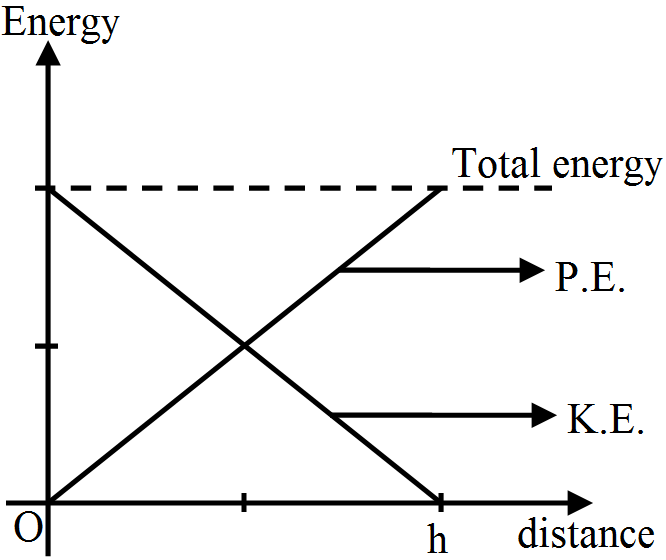
Draw a graph showing the variation of potential energy and kinetic energy with respect to height of a free fall under gravitational force.
Answer
The total energy associated with a mass 'm' at any height 'h' is mgh. The variation of potential and kinetic energy from ground to height 'h' is given as.
View full question & answer
Question 622 Marks
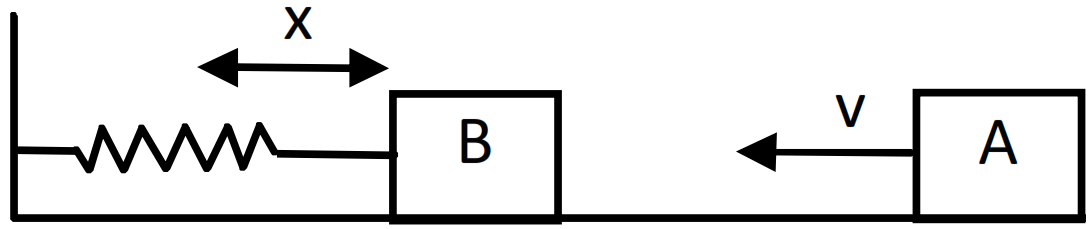
A block of mass m moving at a speed v compresses a spring through a distance x before its speed is halved. Find the spring constant of the spring.
Answer

Let the velocity of the body at A be v
So, the velocity of the body at B is $\frac{\text{v}}{2}$
Energy at point A = Energy at point B
So, $\frac{1}{2}\text{mv}_\text{A}^2=\frac{1}{2}\text{mv}_\text{B}^2-\frac{1}{2}\text{kx}^{2+}$
$\Rightarrow\frac{1}{2}\text{kx}^2=\frac{1}{2}\text{mv}_\text{A}^2-\frac{1}{2}\text{mv}_\text{B}^2$
$\Rightarrow\text{kx}^2=\text{m}\Big(\text{v}_\text{A}^{2+-}\text{v}_\text{B}^2\Big)$
$\Rightarrow\text{kx}^2=\text{m}\Big(\text{v}^2-\frac{\text{v}^2}{4}\Big)$
$\Rightarrow\text{k}=\frac{3\text{m}\text{v}^2}{4\text{x}^2}$
View full question & answer
Question 632 Marks
Prove that the work done in a frictional surface is non zero in a closed path.
Answer
Let $\mathrm{F}_f$ be the force of friction in a surface. The work done to carry a mass $m$ from a point $A$ to another point $B$ is, $-F_f$ $A B$. In the return path $B$ to $A$ also, the work done is $-F_f A B$, since the $F_f$ acts against the motion. The net work done is therefore, $-2 \mathrm{~F}_f(\mathrm{AB})$. Since friction is dependent on the nature of the surface it is dependent on path.
View full question & answer
Question 642 Marks
The displacement $($in metre$)$ of a particle moving along $X-$axis is given by $x(m) = 18t + 5t^2$. Calculate:
  1. The instantaneous velocity.
  2. Instantaneous acceleration.
A $t = 2$ second.
Answer
$x(m)= 18t + 5t^2$
  1. Instantaneous velocity $(v) =\frac{\text{dx}}{\text{dt}}$
$=(18+10\text{t})\text{ms}^{-1}$
at $\text{ t}=2\text{ sec,}\text{v}=18+20=38\text{m/ s}$
  1. Instanraneous acceleration $\text{a}=\frac{\text{dx}}{\text{dt}}=10\text{m/ s}^2$
View full question & answer
Question 652 Marks
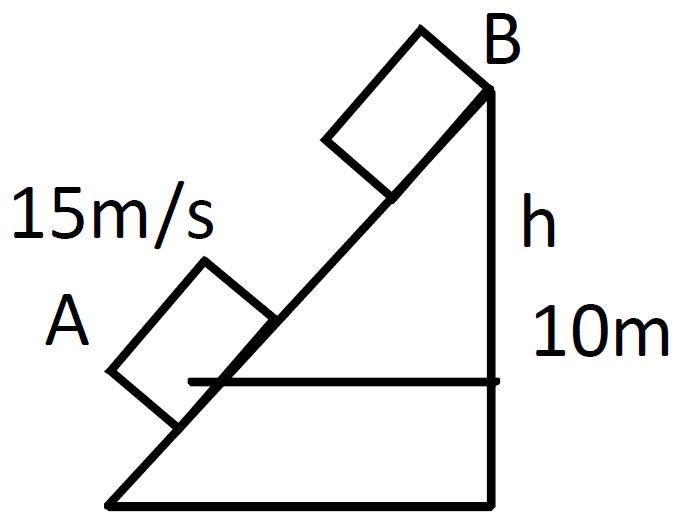
A car weighing 1400kg is moving at a speed of 54km/h up a hill when the motor stops. If it is just able to reach the destination which is at a height of 10m above the point, calculate the work done against friction (negative of the work done by the friction).
Answer


m = 1400kg, v = 54km/h = 15m/sec, h = 10m
Work done = Total K.E. - Total P.E.
$=0+\frac{1}{2}\text{mv}^2-\text{mgh}$
$=\frac{1}{2}\times1400\times(15)^2-1400\times9.8\times10$
$=157500-137200$
$=20300$
So, work done against friction, $W_t$ = 20300J
View full question & answer
Question 662 Marks
A block of mass $m=1 kg$, moving on a horizontal surface with speed $V_l=2 m s ^{-1}$ enters a rough patch ranging from $x=0.10 m$ to $x=2.01 m$. The retarding force $F_r$ on the block in this range is inversely proportional to $x$ over this range,
$ F_r=\frac{-k}{x} \text { for } 0.12.01 m$
where $k=0.5 J$. What is the final kinetic energy and speed $v_f$ of the block as it crosses this patch?
Answer
From Eq. $(5.8a)$
$K_f=K_i+\int_{0.1}^{2.01} \frac{(-k)}{x} d x$
$=\frac{1}{2} m v_i^2-\left.k \ln (x)\right|_{0.1} ^{2.01}$
$=\frac{1}{2} m v_i^2-k \ln (2.01 / 0.1)$
$=2-0.5 \ln (20.1)$
$=2-1.5=0.5 J$
$v_f=\sqrt{2 K_f / m}=1 m s ^{-1}$
Here, note that $\ln$ is a symbol for the natural logarithm to the base $e$ and not the logarithm to the base $10\left[\ln X =\log _e X =2.303 \log _{10} X \right]$.
View full question & answer
Question 672 Marks
Example 5.4 In a ballistics demonstration a police officer fires a bullet of mass $50.0 g$ with speed $200 m s ^{-1}$ (see Table 5.2) on soft plywood of thickness $2.00 cm$. The bullet emerges with only $10 \%$ of its initial kinetic energy. What is the emergent speed of the bullet?
Answer
The initial kinetic energy of the bullet is $m v^2 / 2=1000 J$. It has a final kinetic energy of $0.1 \times 1000=100 J$. If $v_f$ is the emergent speed of the bullet,
$
\begin{aligned}
\frac{1}{2} m v_f^2 & =100 J \\
v_f & =\sqrt{\frac{2 \times 100 J }{0.05 kg }} \\
& =63.2 m s ^{-1}
\end{aligned}
$
The speed is reduced by approximately $68 \%$ (not 90\%).
View full question & answer
Question 682 Marks
A cyclist comes to a skidding stop in 10 m. During this process, the force on the cycle due to the road is 200 N and is directly opposed to the motion. (a) How much work does the road do on the cycle ? (b) How much work does the cycle do on the road ?
Answer
Work done on the cycle by the road is the work done by the stopping (frictional) force on the cycle due to the road.
(a) The stopping force and the displacement make an angle of $180^{\circ} (\pi\ rad )$ with each other. Thus, work done by the road,
$
\begin{aligned}
W_r & =F d \cos \theta \\
& =200 \times 10 \times \cos \pi \\
& =-2000 J
\end{aligned}
$
It is this negative work that brings the cycle to a halt in accordance with WE theorem.
(b) From Newton's Third Law an equal and opposite force acts on the road due to the cycle. Its magnitude is 200 N. However, the road undergoes no displacement. Thus, work done by cycle on the road is zero.
View full question & answer
Question 692 Marks
Find the angle between force $F =(3 \hat{ i }+4 \hat{ j }-5 \hat{ k })$ unit and displacement $d =(5 \hat{ i }+4 \hat{ j }+3 \hat{ k })$ unit. Also find the projection of $F$ on $d$.
Answer
$\begin{aligned} \text { Answer } F \cdot d & =F_x d_x+F_y d_y+F_z d_z \\ & =3(5)+4(4)+(-5)(3) \\ & =16 \text { unit } \\ \text { Hence } F \cdot d & =F d \cos \theta=16 \text { unit } \\ \text { Now } F \cdot F \quad & F^2=F_x^2+F_y^2+F_z^2 \\ & =9+16+25 \\ & =50 \text { unit } \\ \text{and} \ d \cdot d & =d^2=d_x^2+d_y^2+d_z^2 \\ & =25+16+9 \\ & =50 \text { unit } \\ \therefore \cos \theta & =\frac{16}{\sqrt{50} \sqrt{50}}=\frac{16}{50}=0.32, \\ & \theta=\cos ^{-1} 0.32\end{aligned}$
View full question & answer
2 Marks Questions - Page 2 - Physics STD 11 Science Questions - Vidyadip